

Guest

Cisco Catalyst 3750-E Series Switches

Cisco Catalyst 3750-E Series Switches Data Sheet

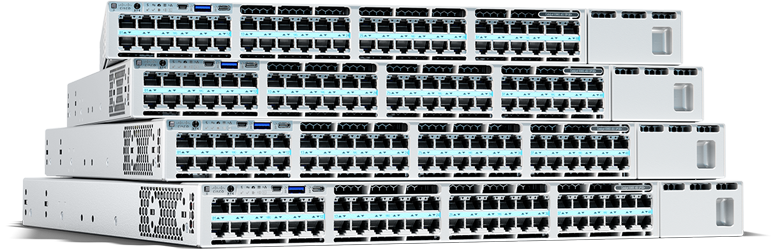
The Cisco® Catalyst® 3750-E Series Switches with StackWise Plus (Figure 1) is an enterprise-class line of stackable wiring closet switches that facilitates the deployment of secure converged applications while maximizing investment protection for evolving network and application requirements. Combining 10/100/1000 and Power over Ethernet (PoE) configurations with 10 Gigabit Ethernet uplinks, the Cisco Catalyst 3750-E enhances worker productivity by enabling applications such as IP telephony, wireless, and video.

Cisco Catalyst 3750-E Series Primary Features

• Cisco TwinGig converter module for migrating uplinks from Gigabit Ethernet to
10 Gigabit Ethernet

• PoE configurations with up to 15.4 W of PoE on all 48 ports

• StackWise Plus for ease of use and resiliency with 64 Gbps of throughput

• Modular power supply with externally available backup

• Multicast routing, IPv6 routing, and access control list in hardware

• Out-of-band Ethernet management port along with RS-232 console port

Figure 1. Cisco Catalyst 3750-E Series Switches (front and back)

Switch Configurations

Table 1 shows the Cisco Catalyst 3750-E Series configurations:

Table 1. Switch Configurations

Feature

Description

Cisco Catalyst 3750E-24TD

24 Ethernet 10/100/1000 ports and 2 X2 10 Gigabit Ethernet uplinks

Cisco Catalyst 3750E-24PD

24 Ethernet 10/100/1000 ports with PoE and 2 X2 10 Gigabit Ethernet uplinks

Cisco Catalyst 3750E-48TD

48 Ethernet 10/100/1000 ports and 2 X2 10 Gigabit Ethernet uplinks

Cisco Catalyst 3750E-48PD

48 Ethernet 10/100/1000 ports with PoE and 2 X2 10 Gigabit Ethernet uplinks

Cisco Catalyst 3750E-48PD-F

48 Ethernet 10/100/1000 ports with 15.4 watts PoE on all 48 ports and 2 X2 10 Gigabit Ethernet uplinks

Cisco Catalyst 3750-E Software

Cisco Catalyst 3750-E Series is available with either the IP Base or the IP Services feature set. The IP Base feature set includes advanced quality of service (QoS), a suite of security features, rate-limiting, access control lists, and basic static and Routing Information Protocol (RIP) routing capability. The IP Services feature set provides a richer set of enterprise-class features, including advanced hardware-based IP unicast and multicast routing-Enhanced Interior Gateway Routing Protocol (EIGRP), Open Shortest Path First (OSPF), Border Gateway Protocol (BGP), Protocol Independent Multicast (PIM), and so on. An Advanced IP Services feature set is also available for IPv6 routing.
Customers can transparently upgrade the software feature set in the Cisco Catalyst 3750-E Series Switches through Cisco IOS® Software Activation. Software activation authorizes and enables the Cisco IOS Software feature sets. A special file contained in the switch, called a license file, is examined by Cisco IOS Software when the switch is powered on. Based on the license's type, Cisco IOS Software activates the appropriate feature set. License types can be changed, or upgraded, to activate a different feature set. For detailed information about Software Activation, visit http://www.cisco.com/go/sa.

Investment Protection

The Cisco Catalyst 3750-E Series Switches are compatible with the Cisco Catalyst 3750 Series Switches, enabling customers to stack them together and thereby protect existing investment in the Cisco Catalyst 3750 Series Switches. The Cisco TwinGig Small Form-Factor Pluggable (SFP) converter module further protects customers' investment in Cisco Catalyst 3750-E Series Switches by enabling migration from Gigabit Ethernet to 10 Gigabit Ethernet uplinks, as business needs require, without having to upgrade the switches.

Cisco StackWise Plus Technology

Cisco StackWise Plus technology is built on the highly successful StackWise™ technology, which is a premium stacking architecture optimized for Gigabit Ethernet. StackWise technology was designed to respond to additions, deletions, and redeployment while maintaining constant performance. The stack behaves as a single switching unit that is managed by a master switch elected from one of the member switches. The master switch automatically creates and updates all the switching and optional routing tables. A working stack can accept new members or delete old ones without service interruption. StackWise creates a highly resilient single unified system of up to nine switches, providing simplified management using a single IP address, single telnet session, single command-line interface (CLI), auto-version checking, autoconfiguration, and more. StackWise Plus supports all the features of StackWise and provides backward compatibility with the existing Cisco Catalyst 3750 Series Switches while enhancing the throughput of the system up to 64 Gbps. StackWise Plus also enables local switching in Cisco Catalyst 3750-E Series Switches. Local switching packets coming into a port in the Cisco Catalyst 3750-E Series Switch destined for another port in the same switch do not have to traverse through the stack ring, thus increasing the forwarding capacity of the switch.

10 Gigabit Ethernet Uplinks and the Cisco TwinGig SFP Converter

The Cisco Catalyst 3750-E features wire-speed 10 Gigabit Ethernet uplink ports for high-bandwidth applications, relieving congestion and ensuring smooth delivery of data. The TwinGig SFP converter (see Figure 2) converts a 10 Gigabit Ethernet X2 interface into two Gigabit Ethernet SFP ports. This way, customers can initially use the switch with Gigabit Ethernet uplinks and later implement 10 Gigabit Ethernet uplinks as business demands change, without having to upgrade the access layer.

Figure 2. Cisco TwinGig Adapter Converting 10 Gigabit Ethernet X2 Interface into Two Gigabit Ethernet SFP Interfaces

Modular Power Supplies

The Cisco Catalyst 3750-E Series Switches have one power supply slot and support the following power supplies. PoE switches require a PoE power supply. Data-only switches can operate with any of the power supplies.

• C3K-PWR-1150WAC: 12WAC power supply with 740W PoE

• C3K-PWR-750WAC: 750WAC power supply for 24-port switch with 370W PoE

• C3K-PWR-265WAC: 265WAC power supply for 48-port or 24-port switch without PoE

• C3K-PWR-265WDC: 265WDC power supply for 48-port or 24-port switch without PoE


Maximum power availability for converged voice and data networks is attainable when a Cisco Catalyst 3750-E Series Switch is combined with the Cisco RPS 2300 Redundant Power System for transparent protection against internal power supply failures and an uninterruptible power supply (UPS) system to safeguard against power outages. Using the RPS 2300 to provide backup power, the Cisco Catalyst 3750-E Series Switch power supplies become hot swappable. Table 3 shows the power supply compatibility matrix.

Power over Ethernet

The Cisco Catalyst 3750-E Series can provide a lower total cost of ownership for deployments that incorporate Cisco IP phones, Cisco Aironet® wireless LAN (WLAN) access points, or any IEEE 802.3af-compliant end device. PoE removes the need for wall power to each PoE-enabled device and eliminates the cost for additional electrical cabling and circuits that would otherwise be necessary in IP phone and WLAN deployments. The Cisco Catalyst 3750-E 24-port PoE configurations can support 24 simultaneous full-powered PoE ports at 15.4W for maximum powered-device support. The Cisco Catalyst 3750-E 48-port PoE configurations can support 48 simultaneous full-powered PoE ports at 15.4W when using the optional 1150W power supply. Alternatively, for deployments that do not need maximum power, a smaller power supply makes use of Cisco Catalyst Intelligent Power Management to support 24 ports at 15.4W, 48 ports at 7.7W, or any combination in between.

Redundant Power System

The Cisco Catalyst 3750-E Series Switches support the new generation of Redundant Power Supply (RPS) 2300. The RPS 2300 increases availability in a converged data, voice, and video network by providing transparent power backup to two of six attached Cisco Catalyst 3750-E Series Switches at the same time. The failed power supply can be swapped out while the switch is being powered up by the RPS 2300.

Primary Features and Benefits

Ease of Use: Deployment

A working stack is self-managing and self-configuring. When switches are added or removed, the master switch automatically loads the Cisco IOS Software version running on the stack to the new switch, loads the global configuration parameters, and updates all the routing tables to reflect changes. Upgrades are applied universally and simultaneously to all members of the stack.
The Cisco Catalyst 3750-E Series stacks up to nine switches as a single logical unit for a total of 468 Ethernet 10/100/1000 ports, 432 PoE 10/100/1000 ports, or 18 10 Gigabit Ethernet ports. Individual 10/100/1000 units can be joined in any combination to evolve with network needs.
Other ease of use features include but are not limited to:

• Smartports enable fast and easy configuration of Cisco recommended best practice security and QoS features, encapsulating years of Cisco networking expertise.

• Dynamic Host Configuration Protocol (DHCP) autoconfiguration of multiple switches through a boot server eases switch deployment.

• Automatic QoS (AutoQoS) simplifies QoS configuration in voice over IP (VoIP) networks by issuing interface and global switch commands to detect Cisco IP phones, classify traffic, and help enable egress queue configuration.

• Master configuration management helps ensure that all switches are automatically upgraded when the master switch receives a new software version. Automatic software version checking and updating help ensure that all stack members have the same software version.

• Autonegotiation on all ports automatically selects half- or full-duplex transmission mode to optimize bandwidth.

• Dynamic Trunking Protocol (DTP) facilitates dynamic trunk configuration across all switch ports.

• Port Aggregation Protocol (PAgP) automates the creation of Cisco Fast EtherChannel® groups or Gigabit EtherChannel groups to link to another switch, router, or server.

• Link Aggregation Control Protocol (LACP) allows the creation of Ethernet channeling with devices that conform to IEEE 802.3ad. This feature is similar to Cisco EtherChannel technology and PAgP.

• Automatic media-dependent interface crossover (MDIX) automatically adjusts transmit and receive pairs if an incorrect cable type (crossover or straight-through) is installed.

• Unidirectional Link Detection Protocol (UDLD) and Aggressive UDLD allow unidirectional links caused by incorrect fiber-optic wiring or port faults to be detected and disabled on fiber-optic interfaces.

High Availability

The Cisco Catalyst 3750-E Series increases availability for stackable switches. Each switch can operate both as master controller and as forwarding processor. Each switch in the stack can serve as a master, creating a 1:N availability scheme for network control. In the unlikely event of a single unit failure, all other units continue to forward traffic and maintain operation.
Other high-availability features include but are not limited to:

• Cross-Stack EtherChannel provides the ability to configure Cisco EtherChannel technology across different members of the stack for high resiliency.

• Flexlink provides link redundancy with convergence time less than 100 ms.

• IEEE 802.1s/w Rapid Spanning Tree Protocol (RSTP) and Multiple Spanning Tree Protocol (MSTP) provide rapid spanning-tree convergence independent of spanning-tree timers and also offers the benefit of Layer 2 load balancing and distributed processing. Stacked units behave as a single spanning-tree node.

• Per-VLAN Rapid Spanning Tree (PVRST+) allows rapid spanning-tree reconvergence on a per-VLAN spanning-tree basis, without requiring the implementation of spanning-tree instances.

• Cisco Hot Standby Router Protocol (HSRP) is supported to create redundant, failsafe routing topologies.

• Switch-port autorecovery (Errdisable) automatically attempts to reactivate a link that is disabled because of a network error.

High-Performance IP Routing

Cisco Express Forwarding hardware routing architecture delivers extremely high-performance IP routing in the Cisco Catalyst 3750-E Series Switches.

• Basic IP unicast routing protocols (Static, Routing Information Protocol Version 1 [RIPv1], and RIPv2) are supported for small-network routing applications.

• Advanced IP unicast routing protocols (OSPF, EIGRP, and BGPv4) are supported for load balancing and constructing scalable LANs. The IP Services feature set is required.

• IPv6 routing (RIPng, OSPFv3) is supported in hardware for maximum performance. Advanced IP Services feature set is required for IPv6 routing.

• Equal-cost routing facilitates Layer 3 load balancing and redundancy across the stack.

• Policy-based routing (PBR) allows superior control by facilitating flow redirection regardless of the routing protocol configured. The IP Services feature set is required.

• HSRP provides dynamic load balancing and failover for routed links, up to 32 HSRP links supported per unit or stack.

• Protocol Independent Multicast (PIM) for IP multicast routing is supported, including PIM sparse mode (PIM-SM), PIM dense mode (PIM-DM), and PIM sparse-dense mode. The IP Services feature set is required.

• Distance Vector Multicast Routing Protocol (DVMRP) tunneling interconnects 2 multicast-enabled networks across nonmulticast networks. The IP Services feature set is required.

• Fallback bridging forwards non-IP traffic between two or more VLANs. The IP Services feature set is required.

Superior Quality of Service

The Cisco Catalyst 3750-E Series offers Gigabit Ethernet speed with intelligent services that keep everything flowing smoothly, even at 10 times the normal network speed. Industry-leading mechanisms for marking, classification, and scheduling deliver superior performance for data, voice, and video traffic, all at wire speed.
Following are some of the QoS features supported in the Cisco Catalyst 3750-E Series Switches:

• Cross-stack QoS allows QoS to be configured across the entire stack.

• 802.1p class of service (CoS) and differentiated services code point (DSCP) field classification is provided, using marking and reclassification on a per-packet basis by source and destination IP address, MAC address, or Layer 4 TCP/UDP port number.

• Cisco control-plane and data-plane QoS ACLs on all ports help ensure proper marking on a per-packet basis.

• Four egress queues per port help enable differentiated management of up to four traffic types across the stack.

• Shaped Round Robin (SRR) scheduling helps ensure differential prioritization of packet flows by intelligently servicing the ingress queues and egress queues.

• Weighted Tail Drop (WTD) provides congestion avoidance at the ingress and egress queues before a disruption occurs.

• Strict priority queuing helps ensure that the highest-priority packets are serviced ahead of all other traffic.

• The Cisco committed information rate (CIR) function provides bandwidth in increments as low as 8 Kbps.

• Rate limiting is provided based on source and destination IP address, source and destination MAC address, Layer 4 TCP/UDP information, or any combination of these fields, using QoS ACLs (IP ACLs or MAC ACLs), class maps, and policy maps.

• Up to 64 aggregate or individual policers are available per Fast Ethernet or Gigabit Ethernet port.

Advanced Security

The Cisco Catalyst 3750-E Series supports a comprehensive set of security features for connectivity and access control, including ACLs, authentication, port-level security, and identity-based network services with 802.1x and extensions. This set of comprehensive features not only helps prevent external attacks, but defends the network against "man-in-the-middle" attacks, a primary concern in today's business environment. The switch also supports the Network Admission Control (NAC) security framework.

• Dynamic ARP Inspection (DAI) helps ensure user integrity by preventing malicious users from exploiting the insecure nature of the ARP protocol.

• DHCP Snooping prevents malicious users from spoofing a DHCP server and sending out bogus addresses. This feature is used by other primary security features to prevent a number of other attacks such as ARP poisoning.

• IP source guard prevents a malicious user from spoofing or taking over another user's IP address by creating a binding table between the client's IP and MAC address, port, and VLAN.

• Private VLANs restrict traffic between hosts in a common segment by segregating traffic at Layer 2, turning a broadcast segment into a nonbroadcast multi-access-like segment.

• Private VLAN Edge provides security and isolation between switch ports, which helps ensure that users cannot snoop on other users' traffic.

• Unicast RPF feature helps mitigate problems caused by the introduction of malformed or forged (spoofed) IP source addresses into a network by discarding IP packets that lack a verifiable IP source address.

• IEEE 802.1x allows dynamic, port-based security, providing user authentication.

• IEEE 802.1x with VLAN assignment allows a dynamic VLAN assignment for a specific user regardless of where the user is connected.

• IEEE 802.1x with voice VLAN permits an IP phone to access the voice VLAN irrespective of the authorized or unauthorized state of the port.

• IEEE 802.1x and port security are provided to authenticate the port and manage network access for all MAC addresses, including that of the client.

• IEEE 802.1x with an ACL assignment allows for specific identity-based security policies regardless of where the user is connected.

• IEEE 802.1x with guest VLAN allows guests without 802.1x clients to have limited network access on the guest VLAN.

• Web authentication for non-802.1x clients allows non-802.1x clients to use an SSL-based browser for authentication.

• Multi-Domain Authentication allows an IP phone and a PC to authenticate on the same switch port while placing them on appropriate Voice and Data VLAN.

• MAC Auth Bypass (MAB) for voice allows third-party IP phones without an 802.1x supplicant to get authenticated using the MAC address.

• Cisco security VLAN ACLs on all VLANs prevents unauthorized data flows from being bridged within VLANs.

• Cisco standard and extended IP security router ACLs define security policies on routed interfaces for control-plane and data-plane traffic. IPv6 ACLs can be applied to filter IPv6 traffic.

• Port-based ACLs for Layer 2 interfaces allow security policies to be applied on individual switch ports.

• Secure Shell (SSH) Protocol, Kerberos, and Simple Network Management Protocol Version 3 (SNMPv3) provide network security by encrypting administrator traffic during Telnet and SNMP sessions. SSH Protocol, Kerberos, and the cryptographic version of SNMPv3 require a special cryptographic software image because of U.S. export restrictions.

• Bidirectional data support on the Switched Port Analyzer (SPAN) port allows Cisco Intrusion Detection System (IDS) to take action when an intruder is detected.

• TACACS+ and RADIUS authentication facilitates centralized control of the switch and restricts unauthorized users from altering the configuration.

• MAC Address Notification allows administrators to be notified of users added to or removed from the network.

• Port Security secures the access to an access or trunk port based on MAC address.

• Multilevel security on console access prevents unauthorized users from altering the switch configuration.

• Bridge protocol data unit (BPDU) Guard shuts down Spanning Tree PortFast-enabled interfaces when BPDUs are received to avoid accidental topology loops.

• Spanning Tree Root Guard (STRG) prevents edge devices not in the network administrator's control from becoming Spanning Tree Protocol root nodes.

• IGMP filtering provides multicast authentication by filtering out nonsubscribers and limits the number of concurrent multicast streams available per port.

• Dynamic VLAN assignment is supported through implementation of VLAN Membership Policy Server client capability to provide flexibility in assigning ports to VLANs. Dynamic VLAN facilitates the fast assignment of IP addresses.

Intelligent Power over Ethernet (PoE) Management

The Cisco Catalyst 3750-E PoE models support Cisco IP phones and Cisco Aironet WLAN access points, as well as any IEEE 802.3af-compliant end device. The Cisco Catalyst 3750-E-48PD can support 48 simultaneous full-powered PoE ports at 15.4W with the 1150W power supply.

• Cisco Discovery Protocol version 2 (CDPv2) allows the Cisco Catalyst 3750-E Series Switch to negotiate a more granular power setting when connecting to a Cisco powered device such as IP phones or access points than what is provided by IEEE classification.

• Per Port power consumption command allows customers to specify maximum power setting on an individual port.

• Per Port PoE Power Sensing measures actual power being drawn, enabling more intelligent control of powered devices.

• The PoE MIB provides proactive visibility into power usage and allows customers to set different power level thresholds

Management and Control Features

Each Cisco Catalyst 3750-E Series stack is managed as a single object and has a single IP address. The primary management and control features in the Cisco Catalyst 3750-E Switches include:

• Cisco IOS Software CLI support provides common user interface and command set with all Cisco routers and Cisco Catalyst desktop switches.

• Switching Database Manager Templates for access, routing, and VLAN deployment allow the administrator to easily maximize memory allocation to the desired features based on deployment-specific requirements.

• Generic On-Line Diagnostic (GOLD) checks the health of hardware components and verifies proper operation of the system data and control plane at run time and boot time.

• Virtual routing and forwarding (VRF)-Lite enables a service provider to support two or more VPNs, with overlapping IP addresses.

• Local Proxy Address Resolution Protocol (ARP) works in conjunction with Private VLAN Edge to minimize broadcasts and maximize available bandwidth.

• VLAN1 minimization allows VLAN1 to be disabled on any individual VLAN trunk.

• Smart Multicast, with Cisco StackWise Plus technology, allows the Cisco Catalyst 3750-E Series to offer greater efficiency and support for more multicast data streams such as video by putting each data packet onto the backplane only once.

• Internet Group Management Protocol (IGMP) Snooping for IPv4 and IPv6 MLD v1 and v2 Snooping provide fast client joins and leaves of multicast streams and limit bandwidth-intensive video traffic to only the requestors.

• Multicast VLAN Registration (MVR) continuously sends multicast streams in a multicast VLAN while isolating the streams from subscriber VLANs for bandwidth and security reasons.

• Per-port broadcast, multicast, and unicast storm control prevents faulty end stations from degrading overall systems performance.

• Voice VLAN simplifies telephony installations by keeping voice traffic on a separate VLAN for easier administration and troubleshooting.

• Cisco VLAN Trunking Protocol (VTP) supports dynamic VLANs and dynamic trunk configuration across all switches.

• Remote Switch Port Analyzer (RSPAN) allows administrators to remotely monitor ports in a Layer 2 switch network from any other switch in the same network.

• For enhanced traffic management, monitoring, and analysis, the Embedded Remote Monitoring (RMON) software agent supports four RMON groups (history, statistics, alarms, and events).

• Layer 2 traceroute eases troubleshooting by identifying the physical path that a packet takes from source to destination.

• Trivial File Transfer Protocol (TFTP) reduces the cost of administering software upgrades by downloading from a centralized location.

• Network Timing Protocol (NTP) provides an accurate and consistent timestamp to all intranet switches.

• Multifunction LEDs per port for port status; half-duplex and full-duplex mode; and 10BASE-T, 100BASE-TX, and 1000BASE-T indication as well as switch-level status LEDs for system, redundant-power supply, and bandwidth utilization provide a comprehensive and convenient visual management system.

• Jumbo frames (9216 bytes) are available on the 10/100/1000 configurations for advanced data and video applications requiring very large frames.

Network Management Tools

The Cisco Catalyst 3750-E Series offers both a superior CLI for detailed configuration and Cisco Network Assistant Software, a PC-based tool for quick configuration based on preset templates. In addition, CiscoWorks LAN Management Solution (LMS) supports the Cisco Catalyst 3750-E Series for networkwide management.

Cisco Network Assistant

A PC-based network management application designed for small and medium-sized business (SMB) networks with up to 250 users, Cisco Network Assistant offers centralized network management and configuration capabilities. Cisco Network Assistant uses Cisco Smartports technology to simplify both initial deployment and ongoing maintenance. This application also features an intuitive GUI where users can easily apply common services across Cisco switches, routers, and access points, such as:

• Configuration management

• Troubleshooting advice

• Inventory reports

• Event notification

• Network security settings

• Password synchronization

• Drag-and-drop Cisco IOS Software upgrades

• Secure wireless


For detailed information about Cisco Network Assistant, visit http://www.cisco.com/go/cna.

CiscoWorks LAN Management Solution (LMS)

CiscoWorks LMS is a suite of powerful management tools that simplify the configuration, administration, monitoring and troubleshooting of Cisco networks. It integrates these capabilities into a world-class solution for improving the accuracy and efficiency of your operations staff, while increasing the overall availability of your network. LMS supports over 400 different device types including the 3750-E and 3560-E series switches and it provides:

• Network discovery, topology views, end-station tracking and VLAN management

• Real-time network fault analysis with easy-to-deploy device specific best-practice templates

• Hardware and software inventory management, centralized configuration tools, and Syslog monitoring

• Network response time and availability monitoring and tracking

• Real-time device, link, and port traffic management, analysis, and reporting


For detailed information about CiscoWorks LMS, go to http://www.cisco.com/en/US/products/sw/cscowork/ps2425/index.html

Product Specifications

Table 2 lists product specifications for the Cisco Catalyst 3750-E Series.

Table 2. Descriptions and Specifications

Description

Specification

Performance

• 128-Gbps switching fabric
• Stack-forwarding rate of 95 Mpps for 64-byte packets
• Forwarding rate:
• 3750E-24TD-65.5 Mpps
• 3750E-24PD-65.5 Mpps
• 3750E-48TD-101.2 Mpps
• 3750E-48PD-101.2 Mpps
• 3750E-48PD-F-101.2 Mpps
• Memory:
• 256 MB DRAM and 64 MB FLASH
• Feature resources:
• 1005 VLANs
• 4K VLAN IDs
• 1000 switched virtual interfaces (SVIs)
• 468 routed ports per stack
• 9216 byte jumbo frames

MAC, routing, security, and QoS scalability numbers depend on the type template used
in the switch:

• MAC address
• Default Template: 6K
• Access Template: 4K
• VLAN Template: 12K
• Routing Template: 3K
• IGMP groups and multicast routes
• Default Template: 1K
• Access Template: 1K
• VLAN Template: 1K
• Routing Template: 1K
• Total unicast routes
• Default Template: 8K
• Access Template: 6K
• VLAN Template: 0
• Routing Template: 11K
• Directly connected hosts
• Default Template: 6K
• Access Template: 4K
• VLAN Template: 0
• Routing Template: 3K
• Indirect routes
• Default Template: 2K
• Access Template: 2K
• VLAN Template: 0
• Routing Template: 8K
• Security ACEs
• Default Template: 1K
• Access Template: 2K
• VLAN Template: 1K
• Routing Template: 1K
• QoS ACEs
• Default Template: 0.5K
• Access Template: 0.5K
• VLAN Template: 0.5K
• Routing Template: 0.5K
• PBR ACEs
• Default Template: 0
• Access Template: 0.5K
• VLAN Template: 0
• Routing Template: 0.5K

Connectors and Cabling

• 1000BASE-T ports: RJ-45 connectors, 2-pair Cat-5 UTP cabling
• 1000BASE-T SFP-based ports: RJ-45 connectors, 2-pair Cat-5 UTP cabling
• 100BASE-FX, 1000BASE-SX, -LX/LH, -ZX, -BX10, and CWDM SFP-based ports: LC fiber connectors (single-mode or multimode fiber)
• 10GBASE-SR, LR, ER, LX4, CX4 X2-based ports: SC fiber connectors (single-mode or
multimode fiber)
• Cisco StackWise stacking ports: copper-based Cisco StackWise cabling
• Ethernet Management port: RJ-45 connectors, 2-pair Cat-5 UTP cabling
• Management console port: RJ-45-to-DB9 cable for PC connections

Power Connectors

• Customers can provide power to a switch by using either the internal power supply or the Cisco RPS 2300. The connectors are located at the back of the switch.
• Internal power supply connector: The internal power supply is an autoranging unit. The internal power supply supports input voltages between 100 and 240VAC. Use the supplied AC power cord to connect the AC power connector to an AC power outlet.
• Cisco RPS connector: The connector offers connection for an optional Cisco RPS 2300 that uses AC input and supplies DC output to the switch.
• Only the Cisco RPS 2300 (model PWR2300-AC-RPS-N1=) should be attached to the redundant-power-supply receptacle.

Indicators

• Per-port status LEDs: link integrity, disabled, activity, speed, and full-duplex indications
• System-status LEDs: system, RPS, and bandwidth-utilization indications

Dimensions (H x W x D)

• 3750E-24TD
• Inches: 1.75 x 17.5 x 18.1
• Centimeters: 4.45 x 44.5 x 46.0
• 3750E-24PD
• Inches: 1.75 x 17.5 x 18.1
• Centimeters: 4.45 x 44.5 x 46.0
• 3750E-48TD
• Inches: 1.75 x 17.5 x 18.1
• Centimeters: 4.45 x 44.5 x 46.0
• 3750E-48PD
• Inches: 1.75 x 17.5 x 18.1
• Centimeters: 4.45 x 44.5 x 46.0
• 3750E-48PD-F
• Inches: 1.75 x 17.5 x 21.7
• Centimeters: 4.45 x 44.5 x 55.2

Weight

• 3750E-24TD
• Pounds: 17.9
• Kilograms: 8.1
• 3750E-24PD
• Pounds: 18.3
• Kilograms: 8.3
• 3750E-48TD
• Pounds: 18.8
• Kilograms: 8.6
• 3750E-48PD
• Pounds: 19.2
• Kilograms: 8.75
• 3750E-48PD-F
• Pounds: 20.9
• Kilograms: 9.5

Environmental Ranges

• Operating temperature: 32 to 113ºF (0 to 45ºC)
• Storage temperature: -13 to 158ºF (-25 to 70ºC)
Relative humidity operating: 10 to 85% (noncondensing)
Relative humidity nonoperating: 0 to 95% (noncondensing)
• Operating altitude: up to 10,000 ft (3049 m)
• Storage altitude: up to 15,000 ft (4573 m)

Acoustic Noise

• International Organization for Standardization (ISO) 7779: bystander position operating to an ambient temperature of 30ºC
• 3750E-24TD-45 dB
• 3750E-48TD-45 dB
• 3750E-24PD-45 dB
• 3750E-48PD-45 dB
• 3750E-48PD-F-48 dB

Mean Time Between Failure (MTBF)

3750E-24TD-177,975 hours

3750E-24PD-167,107 hours

3750E-48TD-166,369 hours

3750E-48PD-153,265 hours

3750E-48PD-F-149,667 hours

Table 3 lists the management and standards support for the Cisco Catalyst 3750-E Series.

Table 3. Management and Standards Support for Cisco Catalyst 3750-E Series Switch

Description

Specification

Management

• BRIDGE-MIB
• CISCO-CDP-MIB
• CISCO-CLUSTER-MIB
• CISCO-CONFIG-MAN-MIB
• CISCO-ENTITY-FRU-CONTROL-MIB
• CISCO-ENVMON-MIB
• CISCO-FLASH-MIB
• CISCO-FTP-CLIENT-MIB
• CISCO-HSRP-MIB
• CISCO-HSRP-EXT-MIB
• CISCO-IGMP-FILTER-MIB
• CISCO-IMAGE-MIB
• CISCO-IP-STAT-MIB
• CISCO-L2L3-INTERFACE-CONFIG-MIB
• CISCO-POE-EXTENSIONS-MIB
• CISCO-MAC-NOTIFICATION-MIB
• CISCO-MEMORY-POOL-MIB
• CISCO-PAGP-MIB
• CISCO-PING-MIB
• CISCO-PROCESS-MIB
• CISCO-RTTMON-MIB
• CISCO-STP-EXTENSIONS-MIB
• CISCO-SYSLOG-MIB
• CISCO-TCP-MIB
• CISCO-VLAN-IFTABLE-RELATIONSHIP-MIB
• CISCO-VLAN-MEMBERSHIP-MIB
• CISCO-VTP-MIB
• ENTITY-MIB
• ETHERLIKE-MIB
• IF-MIB
• IGMP-MIB
• IPMROUTE-MIB
• OLD-CISCO-CHASSIS-MIB
• OLD-CISCO-FLASH-MIB
• OLD-CISCO-INTERFACES-MIB
• OLD-CISCO-IP-MIB
• OLD-CISCO-SYS-MIB
• OLD-CISCO-TCP-MIB