

Guest

Cisco EnergyWise

Evaluating and Enhancing Green Practices with Cisco Catalyst Switching

Introduction

National security, environmental, and resource supply issues will drive governments to implement green initiatives and incentives. There will be business ramifications as a result of policies implemented by local, state, and federal governments around the world. As traditional energy supplies decrease and newer, but more costly, renewable supplies are brought online, organizations will be forced to look for more efficient ways to deploy their data networks to meet stricter government regulations and prevent a bottom-line impact.

Cisco has recognized this impending impact on the IT community for some time and has been building products and developing new technologies to assist organizations in this transition. This document describes the Green Operations and Characteristics of the Cisco® Catalyst® Series Switches. These switches include the 6500 Series, 4500 Series, 3750 Series, 3560 Series, and 2960 Series Switches. These Cisco Catalyst switch families offer the latest technologies to enable organizations to meet the green requirements of today while providing flexible architectures to address the necessities of tomorrow. This paper covers the following topics:

• Energy Savings

• Operational Efficiency

• Innovative Business Practices

Energy Savings

One of the most direct ways that organizations can achieve their goals to become greener is to deploy solutions that offer improved energy efficiency. Even though power related to network equipment is just a fraction of an Enterprise's overall power usage, the Cisco Catalyst Series Switches have made advancements in power management and infrastructure consolidation that allow IT groups to deploy more energy efficient architectures. Some of these enhancements include higher efficiency power supplies, Cisco EnergyWise, intelligent power management, virtualization and others.

Power Management: Power Supply Efficiency

There have been several hardware enhancements in the area of energy efficiency for the Cisco Catalyst Series Switches. The most pronounced change has been in the efficiency of the power supplies. When both of these switches were first introduced, the efficiency of the power supplies was in the range of 80%. With the ratification of IEEE 802.3af Power-over-Ethernet in 2003, the demand for power delivery in the data network increased dramatically as customers began to converge their data and voice networks. Recognizing this, Cisco developed higher capacity power supplies for the Cisco Catalyst Series Switches to meet this new demand, and at the same time took advantage of new technology to provide power supplies with efficiency in the 91% range. Figure 1 shows an actual AC power supply efficiency curve.

Figure 1. AC Power Supply Efficiency

Going from 80% to 90% may not sound like a lot, but consider the environmental and financial impact that such a change entails:

Example 1: Power Supply Efficiency Savings

Switch with 384 IEEE Class 3 devices (15.4W each) = ~5913.6W from the system power supplies A power supply with 80% efficiency draws ~7392W from the power source (19.25W per device)
A power supply with 90% efficiency draws ~6571W from the power source (17.11W per device)
As you can see, that is a difference of ~821W for this one access switch. If these devices are powered on 12 hours a day for 365 days, that is a savings of ~3596 kilowatt-hours per year per switch. Some organizations might run these devices 24 hours a day, which would double the savings. The financial savings from a power perspective are pretty obvious, but the environmental savings may not be so apparent. When considering all power sources, a kilowatt-hour of electricity generation creates ~1.25lb of CO2. By moving to more efficient power supplies, this would represent a savings of ~4500lb of CO2 per access switch. Since governments around the world are looking at carbon taxes, usually based on tons of CO2 generated, the improvement of power supply efficiency will further add to the bottom line by resulting in lower tax burdens.

Power Management: Performance-to-Power Gain

While increases in power supply efficiency might seem to have the largest impact on an organization's drive to reduce their carbon footprint, other hardware enhancements on the Cisco Catalyst Series Switches will also further the goal to become greener. The ability to move more data with fewer components allows organizations to deploy more efficient architectures. Figure 2 shows how improvements in technology have resulted in the ability to transmit more information while increasing power efficiency.

Figure 2. GE and 10GE Power Efficiency Improvements on Cisco Catalyst 6500 Linecards

Figure 3 shows how advancements in Supervisor technology allow for more bandwidth to be available at a lower power profile.

Figure 3. Cisco Catalyst 4500 Supervisor Power Efficiency Improvements

Figure 4 shows the Gigabit Cisco Catalyst StackWise® Fixed Switches and their watts per gigabit. These measurements were taken from a "typical" use scenario. The fixed switching efficiency for watts per gigabit interface has improved significantly.

Figure 4. Gigabit Fixed Switching Power Efficiency Improvements

Further enhancements, such as the ability to dynamically apply power to only certain portions of the hardware based on traffic utilization, are being investigated. The Cisco Catalyst 4500 has already begun to adopt these types of enhancements. With the Sup6-E, the Supervisor and E-Series Line Card ASICs are intelligent enough to shut down certain portions of the hardware when the chassis isn't fully loaded. These existing, and future, hardware enhancements allow organizations to deploy architectures to solve their information requirements while moving toward a greener infrastructure to meet the needs of an environmentally changing world.

Power Management: CDP, LLDP, and Power Policing

Ever since Cisco began deploying pre-standard PoE, the Cisco Catalyst Series Switches have been able to interact with CDP-enabled devices to dynamically assign power. This interaction allows the system to more efficiently distribute power to Powered Devices (PDs) by using CDP to determine exactly how much power a PD requires. For example, if an IEEE Class 3 Cisco Phone comes online, the system will first allocate 15.4W from the power budget to meet the IEEE Class 3 requirement. Once the phone is online, the system and phone will communicate using CDP, and part of that communication will include the phone's actual power requirement. The system will compare the actual power requirement with what was originally allocated. If the actual requirement is lower, then the system will change the allocation to match actual requirement. Now that IEEE 802.1ab Link-Layer Discovery Protocol (LLDP) is available, this capability should be able to be extended to non-CDP capable devices in the future.
In addition to CDP and LLDP, the Cisco Catalyst Series Switches support the ability to manually configure the amount of power allocated to a port supporting a PD. For the Cisco Catalyst 6500 this support began with Cisco IOS® Software Release 12.2(33)SXH and requires the WS-F6K-48-AF PoE daughtercard. The Cisco Catalyst 4500 began supporting this capability with 12.2(50)SG. The Cisco Catalyst fixed switches began supporting this feature in 12.2(44)SE. For example, consider a PD that is IEEE 802.3af Class 3, does not support CDP or LLDP and only requires 10W to operate. By default the system will allocate 15.4W for this PD to comply with the IEEE 802.3af standard, thereby wasting 5W from the power budget. By manually setting the power allocation to the 10W the device actually requires, power resources will be more efficiently utilized. This would prevent the organization from buying more equipment and running more electrical circuits than were necessary.

Power Management: Embedded Event Manager (EEM)

Beginning with Cisco IOS Software Release 12.2(18)SXF5 for the Cisco Catalyst 6500, Cisco IOS Software Release 12.2(44)SG for the Cisco Catalyst 4500 and Cisco IOS Software Release 12.2(37)SE for Cisco Catalyst Fixed Switches, the Embedded Event Manager (EEM) feature has allowed for the creation of custom scripts to execute commands based on system events. One of the more useful events is the Timer Event, which is essentially similar to a CRON operation in other environments. This timer event allows the engineer to instruct the system to execute a script at a specific time based on the switch's internal clock. This can be very advantageous when it comes to power management, especially in an environment that is not 24x7. Figure 5 shows an example of how EEM has been used to provide a customer with a more energy efficient infrastructure, resulting in financial savings and a lower environmental impact.

Figure 5. Time-based PoE Using Embedded Event Manager (EEM)

This example shows just the financial benefit, but we can also calculate the environmental benefit of deploying this intelligent power management capability with EEM. As we saw previously, every 1 kilowatt-hour of electricity averages ~1.25lb of CO2 release. That means that this organization is saving:

Example 2: CO2 Savings from Intelligent Power Management

19.23W1 / phone * 10,000 phones = 192,300W
192,300W / 1000 = 192.3 kilowatts
192.3 kilowatts * 5000 hours = 961,500 kilowatt-hours
961,500 kilowatt-hours * 1.25 lb CO2 / kilowatt-hour = 1,201,875 lb CO2 SAVED !!
By simply utilizing a script to shut of their phones when not needed, this organization is saving over $100,000 and reducing their carbon footprint by over 600 tons. Additional savings could be realized by a minor modification of this script to turn off not only the phones but also the linecards to which the phones are attached. EEM gives an engineer the ability to execute any system command once the required event has been detected by the system.

Power Management: Cisco EnergyWise

Another intelligent power management capability coming to the Cisco Catalyst Series Switches is a feature called Cisco EnergyWise. Cisco EnergyWise will be able to deliver the same intelligent power management as we saw in the EEM example, except it will be extended across the entire infrastructure of a facility to include such devices as HVAC Controllers, Laptops, Desktops,
Printers, PoE Devices and more. Cisco EnergyWise is an industry-wide initiative being undertaken by Cisco and several other vendors to address the following areas:
Cisco EnergyWise provides an organization with an in-depth overview of its power consumption and will allow for the consumption to be altered based on policies that can react real-time to changing environmental conditions. Cisco EnergyWise policies can be centrally maintained and distributed to all Cisco EnergyWise entities (i.e. any device that communicate with an Cisco EnergyWise Network). Each Cisco EnergyWise entity can have a priority assigned so that a policy can be written to affect a subset of Cisco EnergyWise Entities instead of all of them.
Consider the EEM example in Figure 4. What if the customer wanted one phone to be on at all times for emergency purposes? That could certainly be accomplished with the EEM script by having a corporate policy to have all emergency phones in a certain port in a chassis (e.g. port 48 or slot 1). That way the script could be written to shut down all ports but that one.
What happens, though, if somebody moves that phone to a different port and leaves the emergency port with no phone connected because they are not aware of the corporate policy? The phone will go offline and there will be no emergency services in that location until the problem is remedied. Cisco EnergyWise can solve this problem by utilizing separate priorities for Cisco EnergyWise entities, no matter where they are in the network. Figure 6 shows how Cisco EnergyWise can enable the same Time-Base PoE policy that is possible with EEM.

Figure 6. Time-based PoE Using Cisco EnergyWise

In this example, the Cisco EnergyWise Management Application would send out a policy to all of the registered Cisco EnergyWise neighbors telling them to shut down all devices with Priority < 50. This means that the phone on the top, which might be the emergency phone, would not be affected since its priority is greater than 50. All other devices whose priorities are less than 50, whether they be phones, access points, or anything else that is Cisco EnergyWise-aware, will get shut down. If someone were to move the phone with priority 70 to another spot within the network, it would not matter since the priority will not change.
The future plans for Cisco EnergyWise to interact with multiple different systems attached to the network make it a much more powerful tool than a standalone script. Once the proper applications and APIs are available, Cisco EnergyWise will be able to manage not only PoE devices but also laptops, HVAC systems and other building control systems. Consider the example in Figure 7.

Figure 7. Peak Power Monitoring with Cisco EnergyWise

In this example, the Cisco EnergyWise Management Application is monitoring the entire building's total power draw and comparing that to the available power from the utility. If the power level begins to get to within a pre-determined range of the maximum power available, or if the area starts to suffer a temporary drop in power due to a rolling brown-out, then the Cisco EnergyWise Management Application can detect this and take action. Based upon pre-defined response policies, Cisco EnergyWise might be able to:

1. Notify the HVAC control system to change temperature by a certain amount.

2. Notify laptops to begin running on battery until they are drawn down to a certain remaining percentage.

3. Send eligible phones into sleep mode, or change operating mode from color to black-and-white.

4. Turn off eligible light fixtures.

These capabilities will not be available in the first phase of Cisco EnergyWise implementation, but they are the types of initiatives that Cisco is driving with other vendors across the networking, PC and building control systems industries. The Cisco Catalyst Series Switches are usually integral parts of these types of networks, and Cisco EnergyWise support is a key initiative that will allow these platforms to maintain their leadership roles in the area of green IT.

Infrastructure Consolidation: Virtualization

The Cisco Catalyst Series Switches offer a variety of virtualization technologies that enable organizations to achieve a greener infrastructure. Virtualization may offer the biggest benefit in this area, but most customers still view virtualization as primarily an enabler of separation for security purposes. Part of this reasoning is due to the relative newness of green initiatives, but the flipside of it is also because virtualization has been pretty much taken for granted to date.
When discussions about virtualization are held, most people will talk about MPLS, VRFs, server virtualization or perhaps some new technology on the virtualization horizon. What most people never seem to talk about is a technology that has been around for more than a decade: Virtual Local Area Networks (VLANs). If your organization is using VLANs, then you are using virtualization. While perhaps not as exciting or cutting edge as some of these newer virtualization technologies, from a green perspective the VLAN is just as effective as any of these others.
The green benefit of virtualization is realized by allowing an organization to deploy one common infrastructure to meet the diverse needs of its customer base. Whether it is a service provider using virtualization (maybe MPLS) to segment customers, a hospital system using virtualization (maybe VLANs) to meet regulatory requirements for patient data or an enterprise customer using virtualization (maybe VRF-lite) to segment areas of the business, all are deploying one single architecture instead of multiple independent architectures to meet their requirements.
The Cisco Catalyst 6500 supports MPLS, VRF-lite and VLANs while the Cisco Catalyst 4500 and Cisco Catalyst Fixed Switches support VRF-lite and VLANs for implementing virtualization. Recently, a new virtualization technology called the Virtual Switching System (VSS) was introduced on the Cisco Catalyst 6500. This new virtualization technology allows two Cisco Catalyst 6500 switches to be bundled together to appear as one device. As a result, devices connecting to a VSS see a single device to which they can form a Multi-chassis EtherChannel® (MEC) by connecting one uplink to each switch in the VSS. This has some definite advantages from a network management and support perspective (e.g. no need to support HSRP/VRRP and no need to rely on STP for loop management), but it also has a positive impact on an organization's drive to become greener. This deployment is shown in Figure 8.

Figure 8. Virtual Switching System in the Data Center

As organizations continue to virtualize their server infrastructure with technologies such as those offered by VMware, link utilization will be driven higher and higher as a single server begins to act as multiple servers. If each uplink from the server in Figure 7 is 10/100/1000, then as overall bandwidth driven by the server approaches 1-Gbps, the network administrator will have two choices. One choice is to add another server to the infrastructure, but this would require an entire new server's worth of power, cooling and rack space to be provisioned. The second choice is to simply add an additional pair of uplinks to the server and add those to the existing MEC that is formed with the VSS. While this will also incur additional power and cooling, it will not be nearly as much for a pair of NICs (or a single dual-interface NIC) as it would be for an entire server.
Whether an organization is deploying MPLS, VLANs, VRF-lite or VSS, virtualization technologies provide a green benefit by allowing for a common architecture to support the organization's needs. The virtualization capabilities of the Cisco Catalyst Series Switches have continued to evolve with the needs of our customers, and now the additional green benefit of these technologies is being realized.

Infrastructure Consolidation: Virtualized Services

In addition to L2 / L3 virtualization, the Cisco Catalyst 6500 supports services modules offering virtual contexts that allow organizations to deploy L4-7 services in a way that will assist them in meeting their green initiatives. The Firewall Services Module (FWSM), Application Control Engine (FWSM) and Virtual Private Networking Services SPA Interface Processor (VPN Services SIP) can each be divided into as many as 250 individual contexts allowing any port in the chassis to become services enabled. This becomes an especially compelling advantage from a green perspective since only a single blade needs to be deployed to take the place of potentially 250 individual devices that would all their own power, cooling and rack space. Figure 9 shows an example of how virtualized services can benefit an organization's effort to become more efficient.

Figure 9. Virtualized Services Modules vs Appliances

In Figure 9 we see that for every new logical server group that is added, a pair of load balancers, firewalls and SSL termination devices must be added if the appliance model is being followed. If each of these were to draw 200W, then that means that for every additional logical server group an additional 1200W of power is required. By using virtualized service modules to achieve this same result, a total of 4 modules would be required to achieve the same level of support with a total power requirement of 800W.
An organization might decide that it does not need 200 logical server groups but rather 5. The results are the following:

Appliance Model

5 Logical Server Groups
10 Firewalls @ 200W each = 2000W
10 Load Balancers @ 200W each = 2000W
10 SSL Terminators @ 200W each = 2000W
Total Power Consumption = 6000W (6kw)
6 kw * 24 hours/day * 365 days/year = 52,560 kilowatt hours/year
1.25 lb CO2 / kilowatt hour * 52,560 kilowatt hours/year = 65,700 lb CO2 / year
$.12 / kilowatt hour * 52,560 kilowatt hours / year = $6307.20 / year

Virtualized Service Model

5 Logical Server Groups
2 Firewalls @ 200W each = 400W
2 Application Control Engines (load balancing + SSL termination) @ 200W each = 400W
Total Power Consumption = 800W (.8kw)
.8kw * 24 hours/day * 365 days/year = 7008 kilowatt hours/year
1.25 lb CO2 / kilowatt hour * 7008 kilowatt hours/year = 8,760 lb CO2 / year
$.12 / kilowatt hour * 7008 kilowatt hours / year = $840.96 / year
By deploying a virtualized services model, even for a small deployment such as shown in the 5 logical server group example, an organization will realize immediate gains in their efforts to become greener and more profitable. One must also consider the amount of dollars saved by the reduced amount of cooling as well as the lower environmental impact by not requiring the production of 30 devices when just 4 will meet the service requirements. Service virtualization is another difference-making technology that makes the Cisco Catalyst 6500 a smart choice for organizations looking to increase the bottom line and decrease their carbon footprint.

Operational Efficiency

Unlike Energy Savings which can offer a directly measured green benefit, Operational Efficiency is a little more difficult to quantify. The Cisco Catalyst Series Switches have long had a philosophy of sustainable operations as demonstrated by the extensibility and longer lifecycles of the two platforms.

Platform Extensibility

Due to the flexible modular architectures of the Cisco Catalyst 6500 and Cisco Catalyst 4500, the capabilities of the platforms can be extended without the need to undergo a complete network overhaul. The addition of new Supervisors can deliver new services to legacy linecards, eliminating the need to upgrade an entire chassis to take advantage of new features. This means that as industry trends changed from 100-Mbps to 1-Gbps to 10-Gbps, these platforms have been able to adapt simply by developing new interface modules to adjust to the evolving needs of the network. The Cisco Catalyst 6500 and Cisco Catalyst 4500 allow for interface modules of different generations to co-exist in a single chassis, providing organizations with a smoother transition from one architecture to the next. From a financial perspective, this allows IT groups to implement new technologies at a lower cost by supporting a "pay-as-you grow" philosophy of technology migration. From a green perspective, this means that the amount of e-waste is significantly reduced. Consider the example below.

Example 3: E-Waste Reduction through Platform Extensibility

2001

Company XYZ purchases a Cisco Catalyst 6500 to act as a Data Center server aggregation device, providing 10/100 connectivity to the servers and multi-Gbps port channels (using the Supervisor 2 GBIC interfaces) for uplink. The list price (based on $US) of such a configuration would have been:
1 x 6509 Chassis @ $9,500 each = $9,500
2 x 2500W Power Supplies @ $3,000 each = $6,000
2 x Supervisor 2 @ $28,000 each = $56,000
6 x 48-port 10/100 @ $18000 each = $108,000
Total = $179,500

2004

Due to increased business and two acquisitions since 2001, Company XYZ needs to upgrade half of their Data Center servers to 10/100/1000 to meet expanded data demands. They also need to provide 10-Gbps uplinks to handle the traffic demands on the network.

2008

Company XYZ has been implementing server virtualization via VMware, causing their link utilization to climb but their physical server count to be cut in half. They currently have a standard L2 infrastructure with spanning tree and HSRP, but need something more robust and easy to manage due to increased video traffic in the network.
In 2004, Company XYZ purchases the following to meet their new demands (list prices in $US, not including potential trade-in credits):
1 x Fan Tray 2 @ $500 each = $500
2 x Supervisor 720-3B @ $28,000 each = $56,000
1 x 4-port 10GE @ $20,000 = $20,000
3 x 48-port 10/100/1000 @ $15,000 each = $45,000
Total = $121,500
Since the Cisco Catalyst 6500 allows different generations of modules to operate in the same chassis, Company XYZ can keep all of their 10/100 linecards in the chassis and still deliver the higher data requirements. In addition, new features of the Supervisor 720 such as IPv6, MPLS, GRE and Enhanced uRPF can be applied to the legacy 10/100 ports without upgrading those modules in any way. If the Cisco Catalyst 6500 did not have this capability, Company XYZ would have had to buy a new chassis, new power supplies and 3 new linecards to replace their legacy linecards. This would have added over $50,000 to the cost of the project (per switch) and would have increased the e-waste for Company XYZ as they would have had to rid themselves of this redundant equipment instead of carrying it forward. It would have also increased the overall environmental impact of the project as the new chassis, power supplies and linecards would have had to have been manufactured and shipped to Company XYZ.
In 2008, Company XYZ decides that they will upgrade their Cisco Catalyst 6500s to support VSS to make their architecture more robust to meet their evolving video needs. To achieve this they purchase (list prices in $US, not including potential trade-in credits):
1 x Supervisor 720-10G @ $38,000 each = $38,000
Total = $38,000
Since Company XYZ's server count has been cut in half due to virtualization, they can trade in their remaining 48-port 10/100 modules. VSS mode supports the following systems components as the system was configured before the purchase of the Supervisor 720-10G: the 4-port 10GE and 48-port 10/100/1000 linecards purchased in 2004, the Fan Tray 2 purchased in 2004 and the 6509 chassis purchased in 2001. One of the Supervisor 720-3Bs can be traded in or redeployed since VSS mode supports only a single Supervisor in a each chassis that makes up the VSS. The Cisco Catalyst 6500's architecture is saving Company XYZ in excess of $75,000 (per switch) since the existing chassis, linecards and power supplies do not have to be replaced, and the amount of e-waste is drastically reduced for the same reason.
The Cisco Catalyst switches offer a "TwinGig" X2 module that can be inserted into the switch in place of a 10Gig X2. The TwinGig module houses 2 1Gig SFPs and can be used for uplink interfaces until the traffic on the switch grows to a point that 10Gig uplinks are required. The TwinGig modules are hot swappable.
The StackWise Cisco Catalyst Switches provide a clear growth path for providing additional Ethernet interfaces to locations that require more access without increasing the operational cost of adding more switches. StackWise switches can grow with the addition of new members without taking the stack out of service. When StackWise switch members are added or removed from an operational stack, only a minor disruption in network traffic will occur. The stack does not need to be taken out of service. The Cisco Catalyst 3750 and 3750E switches can be mixed in the same stack, providing the flexibility of adding 10 Gigabit Ethernet interfaces to existing stacks without replacing all the stack members.

Extended Lifecycles

The Cisco Catalyst 6500 and Cisco Catalyst 4500 Series Switches are engineered to provide industry-leading investment protection to make sure that the architecture you deploy today can be incrementally changed as the needs of your organization evolve. This allows for a pay-as-you-grow implementation that allows IT groups to more quickly deploy new technology while reducing costs (see Example 3) and moving toward meeting green initiatives. Figure 10 shows the platform longevity for the Cisco Catalyst 6500 and Cisco Catalyst 4500.

Figure 10. Cisco Catalyst 6500 and Cisco Catalyst 4500 Investment Protection

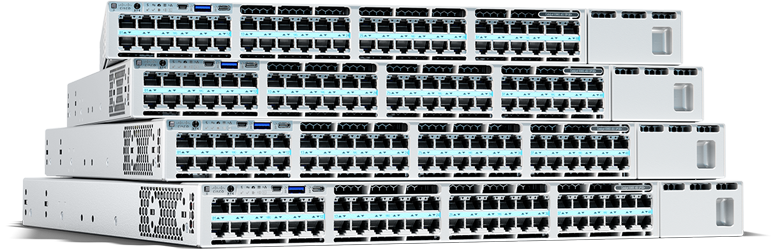
The StackWise enabled fixed Ethernet switches are the Cisco Catalyst 3750 and 3750E, The ability to add a StackWise enabled switch into an existing stack of fixed switches allows for network connectivity growth as demand grows without adding additional operational overhead. Adding more fixed switches to an existing stack does not increase operational costs since no additional managed devices are added to the network. Cisco Catalyst 3750 fixed switches and Cisco Catalyst 3750E fixed switches can be mixed in a stack. Offering a mixed stack of Cisco Catalyst 3750 and Cisco Catalyst 3750E switches provides an upgrade path to take advantage of the newest technologies and Ethernet features without having to replace the entire stack.

Figure 11. Cisco Catalyst 3750E Stack

Links to specific and detailed information on Cisco Catalyst StackWise technology:

Innovative Business Practices

The desire to meet green initiatives and improve the bottom line will drive organizations to begin changing their business behavior. Remote Collaboration technologies such as Cisco WebEx® collaboration, Cisco TelePresence™, and Unified Communications are enabling organizations to make more efficient use of workspaces as well as allowing them to implement work models that reduce travel and make telecommuting more feasible. The Cisco Catalyst Series Switches are an integral part of the architectures supporting these initiatives due to their robust architectures and QoS portfolios.

Remote Collaboration Technology Support

The Cisco Catalyst Series Switches are well positioned to support the collaboration technologies that can enable organizations to transition to a greener footprint. Most of these technologies revolve around high-bandwidth, high-priority traffic that must be guaranteed from end-to-end to maintain a high quality interaction. From a raw bandwidth perspective, the Cisco Catalyst Series Switches meet the needs of these evolving technologies. The Cisco Catalyst 6500 can support up to 720-Gbps per individual system or 1.44-Tbps when utilizing the Virtual Switching System (VSS). This is achieved by providing a dedicated 80-Gbps per slot (bi-directional) with distributed forwarding technology that can drive over 700 Mpps in a VSS. The Cisco Catalyst 4500 can deliver up to 320-Gbps per system, up to 48-Gbps (bi-directional) per slot and up to 250Mpps with a centralized forwarding architecture. The Cisco Catalyst 3750E stack has stack bandwidth of 64 Gbps with StackWisePlus, while the Cisco Catalyst 3750 stack has a stack bandwidth of 32 Gbps with StackWise.
Raw bandwidth is not the only factor to consider when determining if a platform can adequately support collaboration technologies which demand guaranteed transmission throughout a network. Quality of Service (QoS) capabilities of the infrastructure is just as important. The Cisco Series Switches have hardware-based QoS mechanisms that guarantee high-priority traffic will be transmitted through the network should congestion conditions arise. For the Cisco Catalyst 6500 this is achieved by implementing per-port strict priority queues into which this high-priority collaboration traffic can be placed. These queues will always transmit traffic in these strict priority queues before traffic in the lower priority queues, guaranteeing full link bandwidth for the high-priority traffic if needed. The Cisco Catalyst 4500 uses a centralized forwarding architecture that classifies, queues and schedules packets at the Supervisor Engine level. There is a strict priority queue available at this level to make sure that high-priority traffic can be transmitted before lower priority traffic in a congestion scenario. The Cisco Catalyst Fixed Switches use per port Shaped Round Robin egress queuing technology. Shaped Round Robin queuing supports both Strict Priority and Weighted Round Robin queuing. An egress queue can be configured for Strict priority, to support high-priority traffic.
The final major consideration for support of high-priority collaboration traffic is the availability of the network. Collaboration traffic is sensitive to delays, requiring a network architecture that can recover quickly from an outage and that can support upgrades with little to no traffic impact. The Cisco Catalyst 6500 and Cisco Catalyst 4500 both support hardware availability features such as redundant Supervisors, redundant power supplies and online insertion and removal of linecards. They also support link redundancy via EtherChannel, Equal Cost Multi-Path (ECMP) and Multi-chassis EtherChannel (for VSS only) that can redirect traffic sub-second in case of a link failure. The Cisco Catalyst Fixed Switches support an external redundant power supply. The StackWise Cisco Catalyst Fixed Switches provide high availability with online insertion and removal of stack members with only minor disruptions in operational traffic. Additionally the StackWise Cisco Catalyst Fixed Switches support an automatic switchover of the stack manager should the current stack manager fail. StackWise Cisco Catalyst Fixed switches support Cross-Stack EtherChannel for protection against uplink failure or a single stack member failure.
For software availability, the Cisco Catalyst 6500 and Cisco Catalyst 4500 support Non-Stop Forwarding with Stateful Switchover (NSF/SSO) for sub-second, stateful failover between redundant Supervisors. The Cisco Catalyst 6500 with 12.2(33)SXI and newer code has support for Enhanced Fast Software Upgrades (EFSU) to enable lower impacting software upgrades in dual-Supervisors systems. When using EFSU in a VSS, at least 50% of the VSS will be available at all times during the upgrade process. The Cisco Catalyst 4500 with 12.2(31)SGA and newer support full-image In-Service Software Upgrade (ISSU) in systems with dual Supervisors. When using ISSU to upgrade system code, the Cisco Catalyst 4500 will experience as little as 10ms of downtime during the switchover to the new code.

Green Impact of Remote Collaboration

The Cisco Catalyst Series Switches have the necessary features and architectural robustness to support collaboration technologies and help achieve an organization's green initiatives. Below is an example of how Cisco is using these technologies to transition to a greener organization.
Cisco has been utilizing new collaboration technologies very aggressively on an all Cisco Catalyst Series Switches infrastructure. Figures 12 through 14 show the green impact that Cisco has experienced as a result of deploying these technologies and enabling the Cisco Virtual Offices.

Figure 12. Cisco TelePresence Impact Within Cisco

Figure 13. Cisco Unified MeetingPlace and Cisco WebEx Impact Within Cisco

Figure 14. Cisco Virtual Offices at Cisco

The numbers in Figures 12 through 14 indicate that new collaboration technologies can have a dramatic impact on the bottom line and can contribute significantly to meet green initiatives. The Cisco Catalyst Series Switches currently have the necessary architecture and features to enable an organization to realize these gains, and new features and architectures are being developed that will allow the platforms to continue this support as new technologies emerge.

Conclusion

As we move forward into the 21st century, organizations will face added pressure to become more environmentally friendly as a result of changing public perception about our impact upon our environment. Responding to these changing perceptions, governments around the globe have already begun to enact tougher environmental policies to address national security, environmental and resource supply concerns. To comply with these policies and prevent a bottom-line impact, organizations are looking at ways to transition to more efficient data networks.
The Cisco Catalyst Switches Series Switches offer a number of solutions to enable organizations to make this transition, and Cisco will continue to invest in new green technologies as new challenges arise. Increased energy savings through enhanced power management and infrastructure consolidation, operational efficiency via platform extensibility and longer lifecycles and innovative business practices resulting from new collaboration technologies make the Cisco Catalyst Series Switches a sensible choice for organizations needing to meet the green initiatives of the 21st century.
1This number will vary based on power supply and PoE conversion efficiency.