Cisco 880 Series Integrated Services Routers - Data Sheet
Available Languages
The Cisco® 880 Series Integrated Services Routers (ISRs) combine Internet access, security, voice, and wireless services onto a single, secure device that is simple to use and manage for small businesses and enterprise small branch offices and teleworkers. The Cisco 880 Series delivers features including firewall, content filtering, VPNs, and Wireless LANs (WLANs) at broadband speeds to small offices. Easy deployment and centralized management features enable enterprises or service providers to deploy the Cisco 880 Series in small branch offices or small businesses.
Product Overview
Cisco 880 Series Integrated Services Routers are fixed-configuration routers that provide collaborative business solutions for secure voice and data communication to small businesses and enterprise teleworkers. They offer concurrent broadband services over third-generation (3G), Metro Ethernet, and multiple DSL technologies to provide business continuity. Wireless 802.11n and 3G offer LAN and WAN mobility. The routers provide the performance required for concurrent services, including firewall, intrusion prevention, content filtering, and encryption for VPNs; optional 802.11g/n for mobility; and Quality-of-Service (QoS) features for optimizing voice and video applications. In addition, the web-based Cisco Configuration Professional configuration tool simplifies setup and deployment. Centralized management capabilities give network managers visibility and control of the network configurations at the remote site.
Cisco 880 Series Integrated Services Routers offer:
● High performance for broadband access in small offices and small branch-office and teleworker sites
● Collaborative services with secure analog, digital voice, and data communication
● Business continuity and WAN diversity with redundant WAN links: Fast Ethernet, Multimode G.SHDSL (Ethernet in the First Mile [EFM] and ATM), Multimode DSL (very-high-data-rate DSL 2 [VDSL2] and Asymmetric DSL 2 and 2+ [ADSL2 and ADSL2+, respectively]), 3G, and ISDN
● Voice-enabling features:
◦ Cisco Unified Communications Manager Express (5 user), which offers innovative key system and small Private-Branch-Exchange (PBX) capabilities for small and medium-sized business customers
◦ Survivable Remote Site Telephony (SRST) voice continuity for enterprise small branch-office and teleworker sites
◦ Cisco Unified Border Element (Cisco UBE) IP-IP voice gateway functions for connecting to Session Initiation Protocol (SIP) trunking services as a replacement for Primary Rate Interface (PRI) or Foreign‑Exchange-Office (FXO) voice connectivity to the service provider. Note: Cisco Unified Border Element support for the Cisco 880 Series has feature limitations as compared to the Cisco Integrated Services Routers Generation 2 (ISR G2) Routers. Go to https://www.cisco.com/go/cube for the full set of Cisco Unified Border Element features. Cisco Unified Border Element limitations on Cisco 880 Routers are listed later in this document.
● Enhanced security, including:
◦ Firewall with advance application and control for email, Instant Messaging (IM), and HTTP traffic
◦ Site-to-site remote-access and dynamic VPN services: IP Security (IPsec) VPNs (Triple Data Encryption Standard [3DES] or Advanced Encryption Standard [AES]), Dynamic Multipoint VPN (DMVPN), Group Encrypted Transport VPN with onboard acceleration, and Secure Sockets Layer (SSL) VPN
◦ Intrusion Prevention System (IPS): An inline, deep-packet inspection feature that effectively mitigates a wide range of network attacks
◦ Content filtering: A subscription-based integrated security solution that offers category-based reputation rating; keyword blocking; and protection against adware, malware, spyware, and Uniform Resource Locator (URL) blocking
● Four-port 10/100 Fast Ethernet managed switch with VLAN support; two ports support Power over Ethernet (PoE) for powering IP phones or external access points
● Secure 802.11g/n access-point option based on draft 802.11n standard with support for autonomous or Cisco Unified WLAN architectures
● Newer Cisco 880 Series (part numbers C881-K9, C886VA-K9, C886VAJ-K9, C887VA-K9, C887VAM-K9 and C888-K9), which are fanless, providing a quiet, comfortable working environment in small offices
● CON/AUX port for console or external modem
● One USB 1.1 port for security eToken credentials, booting from USB, and loading configuration
● Easy setup, deployment, and remote-management capabilities through web-based tools and Cisco IOS® Software
Figure 1 shows a Cisco 881 Integrated Services Router.
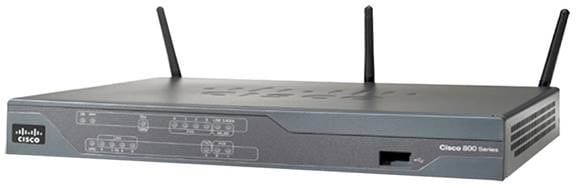
Tables 1 and 2 list the routers that currently make up the Cisco 880 data, voice, and SRST series, respectively.
Table 1. Cisco 880 Series Data Models
| Models |
WAN Interface |
LAN Interfaces |
802.11g/n Option |
Embedded 3G |
Integrated ISDN Dial Backup |
| C881 |
10/100-Mbps Fast Ethernet |
4-port 10/100-Mbps managed switch |
No |
No |
No |
| Cisco 881 |
|||||
| C886VA |
Multimode VDSL2/ADSL2/2+ over ISDN |
4-port 10-/100-Mbps managed switch |
No |
No |
Yes |
| C886VAJ |
Multimode VDSL/ADSL Annex J over ISDN |
4-port 10-/100-Mbps managed switch |
No |
No |
Yes |
| Cisco 886 VA |
Multimode VDSL2/ADSL2/2+ over ISDN |
4-port 10-/100-Mbps managed switch |
Yes (Cisco 886VAW) |
Yes (Cisco 886VAG) |
Yes |
| Cisco 887VA |
Multimode VDSL2/ADSL2/2+ over basic telephone service |
4-port 10-/100-Mbps managed switch |
Yes (Cisco 887VAW) |
Yes (Cisco 887VAG) |
No |
| Cisco 886 |
ADSL2/2+ over ISDN (Annex B) |
4-port 10-/100-Mbps managed switch |
Yes (Cisco 886W) |
Yes (Cisco 886G) |
Yes |
| C887 |
Multimode VDSL/ADSL over POTS |
4-port 10-/100-Mbps managed switch |
No |
No |
No |
| C887VAM |
Multimode VDSL/ADSL Annex-M over POTS |
4-port 10-/100-Mbps managed switch |
No |
No |
No |
| Cisco 887 |
ADSL2/2+ over basic telephone service (Annex A) |
4-port 10-/100-Mbps managed switch |
Yes (Cisco 887W) |
Yes (Cisco 887G) |
Yes |
| Cisco 887V |
VDSL2 over basic telephone service |
4-port 10-/100-Mbps managed switch |
Yes (Cisco 887V) |
Yes (Cisco 887VG) |
Yes |
| C888 |
G.SHDSL(EFM/ATM) (No ATM IMA support) |
4-port 10-/100-Mbps managed switch |
No |
No |
Yes |
| Cisco 888 |
|||||
| Cisco 888E |
G.SHDSL (EFM) |
4-port 10-/100-Mbps managed switch |
Yes (Cisco 888W) |
Yes (Cisco 888EG) |
Yes |
| Cisco 888EA |
Multimode G.SHDSL (EFM/ATM) |
4-port 10-/100-Mbps managed switch |
No |
No |
Yes |
Table 2. Cisco 880 Series Voice Models
The Cisco 880 Series is ideal for small branch offices and teleworkers who need to be connected to larger enterprise networks as well as small businesses for either voice or data applications. These routers help extend corporate networks to secure remote sites while giving users access to the same applications found in a corporate office. When users require WLAN access, visibility and control of network security are even more critical at the remote site. The Cisco 880 Series meets this need with a single device that combines integrated 802.11g/n capabilities with security features such as Wi-Fi Protected Access (WPA), including authentication with IEEE 802.1x with Cisco Extensible Authentication Protocol (LEAP) and Protected EAP (PEAP) and encryption with WPA Temporal Key Integrity Protocol (TKIP). (Refer to the wireless solution overview and security data sheet for more information.) The Cisco 880 Series models that include the integrated access point can use either autonomous or Cisco Unified WLAN modes. In Cisco Unified WLAN mode, as part of an enterprise WLAN architecture, all WLAN functions are centrally managed through Cisco Wireless LAN Controllers and the Cisco Wireless Control System (WCS).
Service providers and value-added resellers can take advantage of the Cisco 880 Series to provide a true business-class broadband service. Business customers are using broadband access to connect to the Internet or to connect offices together, and they require a platform that incorporates voice and security without sacrificing performance. The Cisco 881V and Cisco 887VA-V voice routers offer industry-leading voice gateway capability with the ability enable Cisco Unified Communications Manager Express or SRST as required. Many of these customers are connecting computers in offices through WLANs; having a single device for both WAN and WLAN access provides a new option for managed services. These customers also require a higher level of support to keep their networks operational. Services with these customers should be simple to set up, while allowing a level of remote management and troubleshooting to address support inquiries quickly. The Cisco 880 Series meets the requirements of small offices and managed services providers.
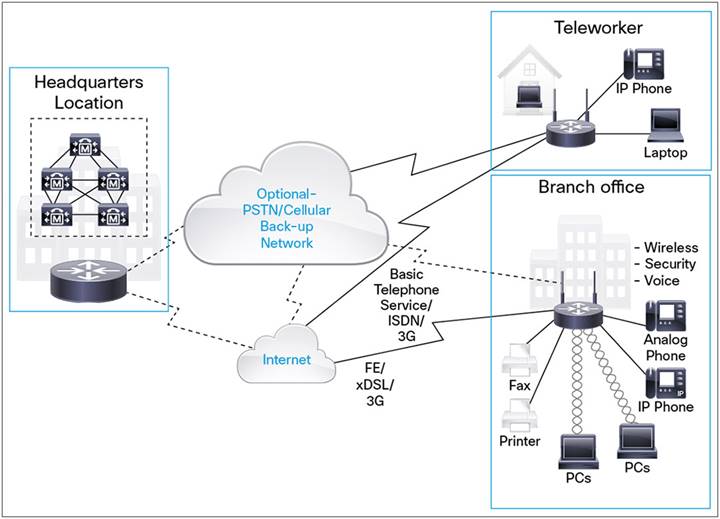
Figure 2 shows deployment scenarios.
Applications
The Cisco 880 Series is ideally suited for deployment in a small office or in a small office that is part of a large network, most often with a secure VPN connection. These types of offices can include the following:
● Small remote office: The Cisco 880 Series can connect users in a small remote office, such as an insurance, lawyer, or sales office. When connecting to the main office, VPN encryption and integrated security such as firewall and intrusion prevention protect the network at the perimeter. The Cisco 880 with the Cisco Unified Border Element Series can also support connection to SIP trunking Voice-over-IP (VoIP) services the service provider offers. Additionally, IT managers can centrally manage the remote site to quickly troubleshoot any network problems. For added reliability, customers can also use the integrated 3G or ISDN backup or connect through an external modem if the primary broadband link fails. Integrated secure unified WLAN connectivity simplifies the deployment and management devices at the remote site. Redundant WAN links offer business continuity, enabling nondisruptive business operation.
● Virtual office: The Cisco 880 Series is ideal for corporate teleworkers who have a mix of broadband connection types such as DSL, 3G, and Metro Ethernet. The Cisco 880 Voice Gateway and SRST Series provides a secure virtual office with all the collaborative services such as data, voice, and fax services. SRST helps ensure voice services are operational in case of WAN link failure, and redundant WAN links help ensure business continuity. QoS features in the Cisco 880 Series allow for connection of an IP or analog phone to the router, giving voice traffic precedence over data applications. Integrated WLAN support in the Cisco 880 Series helps ensure that if wireless connectivity is used it is secure. (Refer to the Cisco Virtual Office Solution, https://www.cisco.com/go/cvo, for more information.)
● Remote call-center agent: Similar to teleworking applications, this solution extends the Cisco IP Contact Center solution for telephone call-center agents to remote sites. With a high-quality, secure connection through the Cisco 880 Series, call-center agents can be dispersed away from costly call-center facilities while maintaining secure and productive voice and data access in their homes. SRST and business-continuity solutions in the Cisco 880 Series provide reliability and continuous business operation. Alternatively, the remote call-center agent can be provided with SIP trunking service with service demarcation provided by Cisco Unified Border Element features, and the central call center can forward calls to the remote call-center agent through the remote-office SIP trunk.
● Retail VPN: Retail stores migrating from dialup connections for point-of-sale transactions can use the Cisco 880 Series to take advantage of low-cost broadband access with the required security to comply with Payment-Card-Industry (PCI) and other data security requirements. They can then add multiple devices and applications to the store network to take advantage of the increased bandwidth and also incorporate optional WLAN support to enable secure mobility and enhance productivity.
● Managed services: Service providers and value-added resellers can use the Cisco 880 Series as a platform to offer differentiated business-class security, voice, and WLAN services for small business customers. With built-in analog and digital voice ports and the ability to upgrade to a five-user Cisco Unified Communications Manager Express IP PBX, service providers can now offer all the Cisco Unified Communications benefits to small and medium-sized businesses. The SIP trunking connectivity features of the Cisco 880 with the Cisco Unified Border Element Series Router can provide the high-quality VoIP service needed through the service provider cloud.
Features and Benefits
Table 3 lists the features and benefits of the Cisco 880 Series Integrated Services Routers.
Table 3. Features and Benefits of Cisco 880 Series Routers
Summary
Cisco 880 Series Integrated Services Routers combine increased network performance with advanced security to allow small-office customers to get the most from their broadband connections for both data and voice applications. With models supporting different broadband technologies such as DSL, 3G, and Metro Ethernet, the Cisco 880 Series can be deployed at any small-office location. Optional integrated 802.11g/n wireless capabilities provide true business-class WAN and WLAN access in a single solution. With the Cisco 880 Series, enterprise IT managers and service providers can take advantage of a solution that can be easily set up at the remote site and can be centrally managed to reduce ongoing operational costs.
Cisco ONE Software
Cisco ONE™ Software offers a valuable and flexible way to buy software for the WAN, access, and data center domains. At each stage in the product lifecycle, Cisco ONE Software helps make buying, managing, and upgrading your network and infrastructure software easier. Cisco ONE Software provides:
● Flexible licensing models to smoothly distribute customers’ software spending over time
● Investment protection for software purchases through software services–enabled license portability
● Access to updates, upgrades, and new technology from Cisco through Cisco® Software Support Services (SWSS)
Cisco ONE for WAN gives organizations broad capabilities for branch offices and the enterprise edge. Cisco ONE Foundation for WAN connects and secures your branch office while optimizing for cost. Cisco ONE WAN Collaboration integrates voice and video into your branch office and network edge.
Product Specifications
Cisco IOS Software Support
Table 4 lists the minimum Cisco IOS Software releases and the default Cisco IOS Software feature sets.
Table 4. Cisco IOS Software Releases and Default Cisco IOS Software Feature Sets
| Models |
Universal Image |
Default Feature Set |
First Cisco IOS Software Release |
| Cisco 881 |
Data |
Advanced Security |
12.4(20)T |
| Cisco 881 SEC, Embedded 3G |
Data |
Advanced IP |
12.4(20)T, 15.1(4)M |
| Cisco 881V |
Voice |
Advanced IP* |
15.1(4)M |
| Cisco 881 SRST |
Voice |
Advanced IP* |
12.4(20)T |
| Cisco 886VA and 887VA |
Data |
Advanced Security |
15.1(2)T |
| Cisco 886VA and 887VA WLAN |
Data |
Advanced Security |
15.1(3)T |
| Cisco 886VA and 887VA Embedded 3G |
Data |
Advanced Security |
15.1(4)M |
| Cisco 886 and 887 |
Data |
Advanced Security |
12.4(22)YB3 |
| Cisco 886 and 887 SEC, 3G |
Data |
Advanced IP |
12.4(22)YB3 |
| Cisco 887V |
Data |
Advanced Security |
12.4(22)YB, 12.4(24)T |
| Cisco 887V SEC, 3G |
Data |
Advanced IP |
12.4(22)YB, 12.4(24)T |
| Cisco 887V WLAN |
Data |
Advanced Security |
15.0(1)M |
| Cisco 887V 3G |
Data |
Advanced IP |
15.0(1)M |
| Cisco 887VA-V |
Voice |
Advanced IP |
15.1(4)M |
| Cisco 887VA-V-W |
Voice |
Advanced IP |
15.1(4)M |
| Cisco 888 |
Data |
Advanced Security |
12.4(20)T |
| Cisco 888 SEC, 3G |
Data |
Advanced IP |
12.4(20)T, 15.1(4)M |
| Cisco 888 SRST |
Voice |
Advanced IP* |
12.4(20)T |
| Cisco 888E |
Data |
Advanced Security |
15.1(1)T |
| Cisco 888E Embedded 3G |
Data |
Advanced IP |
15.1(4)M |
| Cisco 888EA |
Data |
Advanced Security |
15.2(2)T |
| Cisco 881, 886VA, 887VA, 888, 888E with Cisco Unified Border Element |
Voice |
Advanced IP |
15.1(4)M |
| C881-K9, C886-K9, C886VAJ-K9, C887VA-K9, and C887VAM-K9 |
Data |
Advanced Security |
15.3(3)M2, 15.4(1)T |
| C888-K9 |
Data |
Advanced Security |
15.4(2)T |
| Access-point software (ap801) |
- |
- |
12.4(10b)JA3 |
Tables 5 and 6 list Cisco IOS Software features of the Cisco 880 Series.
Table 5. Cisco IOS Software Features on Cisco 880 Series: Advanced Security Feature Set (Default)
Table 6. Cisco IOS Software Features on Cisco 880 Series: WLAN Features (Available with Wireless Option)

Cisco IOS Software Advanced IP Services Feature Set (Optional Software Upgrade)
The Advanced IP Services software image has all the features of the Advanced Security software image with the addition of the features listed in Tables 7 through 10.
Table 7. Cisco IOS Software Features on Cisco 880 Series: Advanced IP Services Feature Set (Optional Software Upgrade)
| Feature |
Description |
| IP and IP services features |
● Layer 2 Tunneling Protocol Version 3 (L2TPv3)
|
| Switch features |
|
| Security features |
|
| QoS features |
|
| Metro Ethernet features |
|
| IPv6 features |
|
| Unified WLAN management |
Table 8. Cisco IOS Software Features on Cisco 880V Series: Advanced IP Services Feature Set
| Feature |
Description |
| Cisco Voice Gateway |
4 FXS ports and 2 Basic Rate Interface (BRI) port for PBX connectivity; 1 FXO port is available on the Cisco 881V SKU |
| Cisco Unified Communications Manager Express (Cisco UCME)/SRST version |
Ability to upgrade to 5-user license of Cisco UCME/SRST; Version 8.6 and later are supported |
| Call-control signaling |
H.323 Versions 1, 2, 3, and 4; Media Gateway Control Protocol (MGCP) 0.1 and 1.0; Skinny Client Control Protocol (SCCP); and SIP call-control protocols are supported. |
| ITU standard voice codecs |
G.711, G.729, G.729a/b, G.723.1, G.726, and G.728, which are standards-based compression technologies allowing transmission of voice across IP, are supported. The G.711 standard employs 64-kbps pulse code modulation (PCM) using either mu-law or a-law. Other codecs employ lower bit rates. |
| Cisco Unified Communications Manager support |
For SRST features for IP phones, refer to the SRST data sheet at: https://www.cisco.com/en/US/products/sw/voicesw/ps2169/products_data_sheets_list.html. Cisco Unified Communications Manager support for analog and digital ports come with Releases 7.1(5), 8.5(1), and 8.6(2). |
| Telephony interface signaling support |
Cisco 880 V supports the following signaling protocols:
● FXS loop-start and ground-start signaling
● FXO
● Inbound signaling (such as dual-tone multifrequency [DTMF] and multifrequency support)
● BRI QSIG
|
| Voice features |
● Echo cancellation: This feature cancels echo on tail circuits up to 64 msec (configurable tail length).
● Silence suppression and Voice Activity Detection (VAD): Bandwidth is used only when someone is speaking. During silent periods of a phone call, bandwidth is available for data traffic.
● Comfort-noise generation: This feature reassures the phone user that the connection is being maintained, even when no voice packets are being transmitted.
● Caller ID support: Per-port caller ID (with per-call unblocking) is configurable over analog FXS.
● Dial-plan mapping: This feature simplifies configuration and management through automatic mapping of dialed phone numbers to IP addresses.
|
| Voice port-specific features |
● FXS: FXS provides battery polarity reversal detection and initiation for disconnect supervision and far-end answer supervision.
● ISDN BRI network side and phantom power: The BRI port provides the ability to connect a private branch exchange (PBX) or private automatic branch exchange (PABX) configured as user side directly to the router. It also provides phantom power to accommodate equipment that requires it.
● LED indicators show voice-processing resources and port status.
|
| Fax and modem |
● Fax and modem pass-through allows fax and modem traffic to pass through a voice port.
● Fax Relay provides a more robust protocol for fax transmission over packet networks. It also supports the T.37 and T.38 fax protocols.
|
| High-performance flexible digital-signal-processor (DSP) architecture |
● Channel capacity: Cisco 880V supports up to four voice channels.
● Flexible DSP architecture: There is no need to specify codec complexity at configuration. An appropriate codec is dynamically selected when a call is established, while DSP resources are allocated optimally.
● Feature upgrades: The DSP architecture allows for addition of new features through simple code updates.
|
Table 9. Cisco IOS Software Features on Cisco 880 SRST Series: Advanced IP Services Feature Set
| Feature |
Description |
| Cisco SRST version |
|
| Call-control signaling |
H.323 Versions 1, 2, 3, and 4, Media Gateway Control Protocol MGCP 0.1 and 1.0, Skinny Client Control Protocol (SCCP), and SIP call-control protocols are supported. |
| ITU standard voice codecs |
G.711, G.729, G.729a/b, G.723.1, G.726, and G.728, which are standards-based compression technologies allowing transmission of voice across IP, are supported. The G.711 standard employs 64-kbps pulse code modulation (PCM) using either mu-law or a-law. Other codecs employ lower bit rates. |
| Cisco Unified Communications Manager support |
For SRST features for IP phones, refer to the SRST data sheet at: https://www.cisco.com/en/US/products/sw/voicesw/ps2169/products_data_sheets_list.html. Cisco Unified Communications Manager support for analog and digital ports comes with Releases 6.1(3), 7.0(2), and 7.1(3). |
| Telephony interface signaling support |
|
| Voice features |
● Echo cancellation: This feature cancels echo on tail circuits up to 64 msec (configurable tail length).
● Silence suppression and Voice Activity Detection (VAD): Bandwidth is used only when someone is speaking. During silent periods of a phone call, bandwidth is available for data traffic.
|
| Voice port-specific features |
● FXS: FXS provides battery polarity reversal detection and initiation for disconnect supervision and far-end answer supervision.
|
| Fax and modem |
|
| High-performance flexible digital-signal-processor (DSP) architecture |
Table 10. Cisco IOS Software Features on Cisco 880 Series with Cisco Unified Border Element: Advanced IP Services Feature Set
| Feature |
Description |
| Cisco Unified Border Element version |
Cisco Unified Border Element 7.0 and later are supported. |
| Call-control signaling |
H.323 Versions 1, 2, 3, and 4; MGCP 0.1 and 1.0; SCCP; and SIP call-control protocols are supported. |
| ITU standard voice codecs |
G.711, G.729, G.729a/b, G.723.1, G.726, and G.728, which are standards-based compression technologies that allow transmission of voice across IP, are supported. The G.711 standard employs 64-kbps Pulse Code Modulation (PCM) using either mu-law or a-law. Other codecs employ lower bit rates. |
| Cisco Unified Communications Manager support |
For SRST features for IP phones, refer to the SRST data sheet at: https://www.cisco.com/en/US/products/sw/voicesw/ps2169/products_data_sheets_list.html. Cisco Unified Communications Manager support for analog and digital ports comes with Releases 6.1(3), 7.0(2), and 7.1(3). |
| Telephony interface signaling support |
Cisco 880 SRST supports the following PSTN trunk signaling protocols:
● FXS loop-start and ground-start signaling
● FXO
● Inbound signaling (such as Dual-Tone Multifrequency [DTMF] and multifrequency support)
● BRI QSIG
Cisco 880 Cisco Unified Border Element supports the following VoIP trunk signaling protocols:
● Up to 15 SIP-to-SIP sessions. (no H.323 support)
Note: The Cisco 880 with Cisco Unified Border Element does not include DSP feature support such as transcoding or transrating. Note: The Cisco 880 with Cisco Unified Border Element does not support concurrent operation of SRST or Cisco Unified Communications Manager Express. |
| Voice features |
● Echo cancellation: This feature cancels echo on tail circuits up to 64 msec (configurable tail length).
● Silence suppression and VAD: Bandwidth is used only when someone is speaking. During silent periods of a phone call, bandwidth is available for data traffic.
● Comfort-noise generation: This feature reassures the phone user that the connection is being maintained, even when no voice packets are being transmitted.
● Caller ID support: Per-port caller ID (with per-call unblocking) is configurable over analog FXS.
● Dial-plan mapping: This feature simplifies configuration and management through automatic mapping of dialed phone numbers to IP addresses.
|
| Voice port-specific features |
● FXS: FXS provides battery polarity reversal detection and initiation for disconnect supervision and far-end answer supervision.
● ISDN BRI network side and phantom power: The BRI port provides the ability to connect a PBX or PABX configured as user side directly to the router. It also provides phantom power to accommodate equipment that requires it.
● LED indicators show voice-processing resources and port status.
|
System Specifications
Tables 11 and 12 list the system specifications for the Cisco 880 Series Routers.
Table 11. System Specifications
| Feature |
Description |
| Default and maximum flash memory |
● 128 MB on Cisco 880 Series data, embedded 3G Wireless WAN (WWAN), and Cisco Unified Border Element models
● 256 MB on Cisco 880 Series Voice and SRST models
● 256 MB on newer C881-K9, C886VA-K9, C886VAJ-K9, C887VA-K9, C887VAM-K9 and C888-K9 models
|
| WAN |
● Fast Ethernet
● Multimode VDSL2 and ADSl2/2+ over ISDN with ISDN backup
● Multimode VDSL2 and ADSl2/2+ over basic telephone service
● ADSL2/2+ over ISDN with ISDN backup
● ADSL2/2+ over basic telephone service with ISDN backup
● VDSL2 over basic telephone service with ISDN backup
● Multimode G.SHDSL (2- and 4-wire support) with ISDN backup
● Fast Ethernet and 3G WAN for Code Division Multiple Access (CDMA) and High-Speed Downlink Packet Access (HSDPA)
|
| LAN switch |
Managed 4-port 10/100BASE-T with autosensing Media Device In/Media Device Cross-Over (MDI/MDX) for auto crossover |
| Standard 802.11g/n access point based on IEEE 802.11n draft 2.0 standard |
Optional on all models |
| Console or auxiliary port |
RJ-45 |
| One USB 1.1 port for advanced security features such as security tokens or USB flash memory |
● One USB 1.1 port on Cisco 880 Series Routers
● USB devices supported:
◦ USB eTokens
◦ USB flash memory
Note: The USB 1.1 port cannot be used for connecting external devices other than those specified at: https://www.cisco.com/en/US/prod/collateral/modules/ps6247/product_data_sheet0900aecd80232473.html. |
| ISDN BRI S/T |
Available on:
● Cisco 886, 886VA, 887, 887V, 888, and 888EA for out-of-band management and dial backup or primary
|
| 3G express card modem |
Available on:
● Cisco 881G, 886G, 887G, 887VG, and 888G for out-of-band management and backup or primary
● Cisco 888G for out-of-band management and backup or primary
Note: Cisco 887VG currently ships with HSPA modem only. |
| External power supply |
Universal 100 to 240 VAC input; 60W, 12 VDC output |
| Physical dimensions and weight |
Product dimensions, nonwireless models (H x W x D):
● 1.9 x 12.8 x 9.8 in. (48 x 325 x 249 mm) (includes rubber feet)
● 1.75 x 12.8 x 9.8 in. (44 x 325 x 249 mm) (without rubber feet)
Product dimensions, wireless models (H x W x D):
● 1.9 x 12.8 x 10.4 in. (48 x 325 x 264 mm) (includes rubber feet)
● 1.75 x 12.8 x 10.4 in. (44 x 325 x 264 mm) (without rubber feet; excludes antennas)
● Weight: 5.5 lb (2.5 kg) maximum
|
| Power |
Product power specifications:
● AC input voltage: 100 to 240 VAC
● Frequency: 50 to 60 Hz
● Maximum output power: 60W
● Output voltages: 12 VDC
Optional internal PoE with external adapter:
● Maximum output power: 80W
● External output voltage: 48 VDC
|
| Approvals and compliance |
Emissions:
●
47 CFR Part 15: 2006
●
CISPR22: 2005
●
EN300386: V1.3.3: 2005
●
EN55022: 2006
●
EN61000-3-2: 2000 [Inc amd 1 and 2]
●
EN61000-3-3: 1995 [+ amd 1: 2001]
●
ICES-003 Issue 4: 2004
●
KN 22: 2005
●
VCCI: V-3/2006.04
Immunity:
●
CISPR24: 1997 [+ amd 1 and 2]
●
EN300386: V1.3.3: 2005
●
EN50082-1: 1992
●
EN50082-1: 1997
●
EN55024: 1998 [+ amd 1 and 2]
●
EN61000-6-1: 2001
The following are supported on teleworker models:
● AS/NRZ 3548: 1992 Class B
● CFR 47 Part 15 Class B
● EN60555-2 Class B
● EN55022 Class B
● ICES-003, Issue 2, Class B, April 1997S
|
| Certifications |
|
|
● Nonoperating temperature: -4 to 149°F (-20 to 65°C)
● Nonoperating humidity: 5 to 95% relative humidity (noncondensing)
● Nonoperating altitude: 0 to 15,000 ft (0 to 4570m)
● Operating temperature
◦ At sea level: 32 to 104°F (0 to 40°C)
◦ Up 10,000 ft: 32 to 77°F (0 to 25°C)
◦
Derating 2.7°F/10,000 ft (1.5°C/1,000 ft)
● Operating humidity: 10 to 85% relative humidity (noncondensing)
● Operating altitude: 0 to 10,000 ft (0 to 3000m)
|

Table 12. Wireless LAN and 3G Specifications
| SRST Specifications |
|
| SRST specifications |
● Packet fax and voice DSP module PVDM2-16
FXS voice-port specifications:
● Tip and ring interfaces for each FXS port (subscriber line interface card [SLIC])
● Ring voltage
● Ring frequency
● Ring waveform
● Ring load
● Ringer Equivalence Number (REN)
● Loop resistance
● On- and off-hook characteristics
● On-hook voltage (tip and ring)
● Off-hook current
● RJ-11 FXS port terminating impedance option
BRI voice-port specifications:
● Interface type
● Compliance
● Safety conformance
● ITU compliance
● Interface
● ISDN digital access
● Physical connector
● Phantom power
|
| Radio frequency band |
● 2.4 GHz
|
| Data rates supported |
● 802.11b: 1, 2, 5.5, 6, 9, and 11 Mbps
● 802.11g: 1, 2, 5.5, 6, 9, 11, 12, 18, 24, 36, 48, and 54 Mbps
● 802.11n: 1, 2, 5.5, 6, 9, 11, 12, 18, 24, 36, 48, 54, and m0-m15
|
| Maximum transmit power (2-channel aggregate) |
Note: Maximum power setting is subject to changes by channel and by region, depending on regulations.
● 802.11b 20 dBm
● 802.11g 17 dBm
● 802.11n 16 dBm
|
| 3G specifications |
|
| Data rates |
● CDMA: 850 and 1900 MHz
● HSDPA: 850, 900, 1900, and 2100 MHz
|
DSL Specifications
Tables 13 through 21 list the DSL features specifications and DSL Access Multiplexer (DSLAM) interoperability support for the Cisco 880 Series Routers. For more information and details about DSLAM and line-card interoperability, please refer to the following document: What Is Cisco ISR and ISR G2 xDSL Interoperability?
Table 13. DSL Features Specifications
| DSL Specifications |
|
| Multimode DSL (VDSL2 and ADSL2/2+) (886VA and 887VA models) |
● Broadcom Chipset
● Dying gasp
● IEEE 802.1q VLAN tagging
● Independent DSL firmware loading
VDSL2
● ITU G.993.2 (VDSL2)
● 997 and 998 band plans
● VDSL2 profiles: 8a, 8b, 8c, 8d, 12a, 12b, and 17a
●
U0 band support (25
-
276 kHz)
● Ethernet PTM mode only based on IEEE 802.3ah 64/65 octet encapsulation
● DELT Diagnostics Mode
ADSL2/2+
● ADSL over basic telephone service with Annex A and Annex B ITU G. 992.1 (ADSL), G.992.3 (ADSL2), and G.992.5 (ADSL2+)
● ADSL over basic telephone service with Annex M (extended upstream bandwidth) G.992.3 (ADSL2) and G.992.5 (ADSL2+)
◦ Cisco 887VA-M is optimized for PSD Mask EU-64 M9.
◦ Cisco 887VA-M supports UK Annex M.
● G.994.1 ITU Ghs
● Reach-extended ADSL2 (G.922.3) Annex L for increased performance on loop lengths greater than 16,000 feet from central office
●
T1.413 ANSI ADSL DMT issue 2 compliance
● DSL Forum TR-067 conformity
● Inpulse Noise Protection (INP) and extended INP
● Downstream Power Back-Off (DPBO)
● ATM mode only
|
| ADSL specifications (886 and 887 models) |
● ST-Microelectronics 20190 Chipset
● ADSL over basic telephone service with Annex A and Annex B ITU G. 992.1 (ADSL), G.992.3 (ADSL2), and G.992.5 (ADSL2+)
● ADSL over basic telephone service with Annex M (extended upstream bandwidth) G.992.3 (ADSL2) and G.992.5 (ADSL2+)
◦ Cisco 887-M is optimized for PSD Mask EU-64 M9.
◦ Cisco 887M supports UK Annex M only with Huawei 5300 DSLAM and its EADB line card with Customer‑Premises-Equipment (CPE) firmware Version 4.0.17.
● G.994.1 ITU G.hs
● Reach-extended ADSL2 (G.922.3) Annex L for increased performance on loop lengths greater than 16,000 feet from central office
●
T1.413 ANSI ADSL DMT issue 2 compliance
● DSL Forum TR-067 conformity
● Does not provide interoperability with carrierless amplitude modulation/phase modulation (CAP)-based ADSL lines
● Dying gasp
● IEEE 802.1q VLAN tagging with Cisco IOS Software Release 15.1(1)T or later
|
| VDSL2 specifications |
● Broadcom Chipset
● ITU G.993.2 (VDSL2) over basic telephone service only
● 997 and 998 band plans, over basic telephone service only
● VDSL2 profiles supported: 8a, 8b, 8c, 8d, 12a, 12b, and 17a
●
U0 band support (25276 kHz)
● Ethernet PTM mode only based on IEEE 802.3ah 64/65 octet encapsulation
● DELT Diagnostics Mode
● IEEE 802.1q VLAN tagging
|
| G.SHDSL (ATM mode) specifications (Cisco 888) |
● Conexant/Ikanos Chipset
● 2- and 4-wire modes
● Symmetrical WAN speeds up to 2.304 Mbps over a single copper pair and up to 4.608 Mbps over two copper pairs using ITU-T G.991.2 Annex A and Annex B
● Dying gasp; uses power status bit (Section 7.1.2.5.3 of G.991.2) for signaling
|
| G.SHDSL (EFM mode) specifications (Cisco 888E) |
● Conexant/Ikanos Chipset
● 2-wire mode
● Symmetrical WAN speeds up to 2.304 Mbps over a single copper pair using ITU-T G.991.2 Annex A and Annex B
● Symmetrical WAN speeds from 768 kbps to 5.696 Mbps over a single copper pair using ITU-T G.991.2 Annex F and Annex G
● Symmetrical WAN speeds up to 22.784 Mbps over four copper pairs using IEEE 802.3ah EFM bonding
● Wetting current (Section A.5.3.3 of G.991.2)
● Dying gasp; uses power status bit (Section 7.1.2.5.3 of G.991.2) for signaling
● Rate adaption
|
| Multimode G.SHDSL (EFM/ATM) specifications (Cisco 888EA) |
● Lantiq Chipset
● 4-pair support
● Compliance with standard based on ITU Recommendation G.991.2
● Support for G.SHDSL Annexes A (U.S. signaling) and B (European signaling)
● Support for Annexes F and G
● Symmetrical WAN speeds up to 1 x 2304 kbps over single copper pair, up to 2 x 2304 kbps over two copper pairs, up to 3 x 2304 kbps over three copper pairs, and up to 4 x 2304 kbps over four copper pairs using ITU-T G.991.2 Annexes A and B
● Symmetrical WAN speeds up to 1 x 5696 kbps over single copper pair, up to 2 x 5696 kbps over two copper pairs, up to 3 x 5696 kbps over three copper pairs, and up to 4 x 56964 kbps over four copper pairs using ITU-T G.991.2 Annexes F and G
● Support for EFM bonding; supports up to four SHDSL pairs bonding
● In ATM mode, support for maximum of 8 Permanent Virtual Circuits (PVCs)
● Support for dying gasp and wetting current
● Support for point-to-point configuration
● Support for 802.1Q, QinQ, trunk, and VLAN tagging
● Support for ATM CoS and IP QoS features, 802.1P, and DSCP
● Support for EFM (IEEE 802.3ah) OA&M
● Ability to configure multiple G.SHDSL EFM EHWICs per Cisco 1921, 1941, 2900, and 3900 Series Routers
● Compliance with single RJ-45 connector system requirements
|
Table 14. Multimode DSL DSLAM Interoperability for Cisco 887VA
| DSLAM |
VDSL2 over Basic Telephone Service Line-Card Chipset |
| ZTE 9806 |
Broadcom |
| Huawei MA5600 |
Broadcom |
Table 15. Multimode DSL DSLAM Interoperability for Cisco 886VA
| Siemens HIX 5300 |
Infineon |
| ECI 480 |
Infineon |
| Alcatel ASAM 7300 |
Globespan |
Table 16. ADSL-over-ISDN DSLAM Interoperability for Cisco 886
| DSLAM |
ADSL2/2+ over ISDN Line-Card Chipset |
| Siemens HIX 5300 |
Infineon |
| ECI 480 |
Infineon |
| Alcatel ASAM 7300 |
Globespan |
Table 17. ADSL over Basic Telephone Service DSLAM Interoperability for Cisco 887 and 887M
| DSLAM |
ADSL2/2+ over Basic Telephone Service Line-Card Chipset |
| Alcatel ASAM 7300 |
Broadcom (Annex A and Annex M) |
| ECI 480 |
Infineon (Annex A and Annex M) |
| Ericsson |
Broadcom (Annex A and M) |
| Huawei 5600 |
Globespan (Annex A only) |
| Lucent Stinger |
Globespan (Annex A and Annex M) |
Table 18. VDSL2 DSLAM Interoperability for Cisco 887V
| DSLAM |
VDSL2 over Basic Telephone Service Line-Card Chipset |
| ZTE 9806 |
Broadcom |
| Huawei MA5600 |
Broadcom |
Table 19. G.SHDSL DSLAM Interoperability for Cisco 888
| DSLAM |
G.SHDSL (2- and 4-Wire) Line-Card Chipset |
| ECI Hi-Focus SAM 480 |
Infineon |
| Alcatel ASAM7300 |
Conexant/Ikanos |
| Lucent Stinger |
Conexant/Ikanos |
| Siemens Hix-5300 |
Infineon |
Table 20. G.SHDSL DSLAM Interoperability for Cisco 888E
| DSLAM |
G.SHDSL (2- and 4-Wire) Line-Card Chipset |
| Huawei 5603 |
Infineon |
| Alcatel ISAM 7302 |
Infineon |
| Hatteras HN4000e |
Infineon |
Table 21. Multimode G.SHDSL DSLAM Interoperability for Cisco 888EA-K9
| DSLAM |
G.SHDSL (4-Pair) Line-Card Chipset |
| Huawei 5603 |
Infineon |
| Alcatel ISAM 7302 |
Infineon |
| Hatteras HN4000e |
Infineon |
| Alcatel ASAM 7300 |
|
| Lucent Stringer |
|
| ECI 480 |
|
| Alcatel ISAM_7330_FTTN |
|
| Actelis ML698 |
|
Ordering Information
Table 22 lists ordering information for the Cisco 880 Series. To place an order, visit the Cisco ordering homepage.
Table 22. Ordering Information
Cisco ONE Software for WAN is available for the ISR 880.
Cisco ONE Software offers a complete solution that delivers an optimal experience over any connection while helping you get the most from your WAN investment with secure, fault-tolerant connectivity.
Benefits:
● Connect branch offices and your campus securely at an optimal cost by improving application performance through application protocol acceleration and optimization techniques that offload the WAN.
● Integrate voice and video across branch offices and your campus to increase productivity.
For ordering information for Cisco ONE Software for the ISR 880, go to https://www.cisco.com/c/en/us/products/software/one-wan/wan-part-numbers.html.
Cisco License Manager is a secure client- and server-based application used to manage Cisco IOS Software activation and licenses. For more information about Cisco License Manager, visit https://www.cisco.com/go/clm.
Cisco Services for the Branch Office
Services from Cisco and our certified partners can help you reduce the cost and complexity of branch-office deployments. We have the depth and breadth of experience across technologies to architect a blueprint for a branch-office solution to meet your company's needs. Planning and design services align technology with business goals and can increase the accuracy, speed, and efficiency of deployment. Technical services help maintain operational health, strengthen software application functions, solve performance problems, and lower expenses. Optimization services are designed to continually improve performance and help your team succeed with new technologies. For more information, please visit https://www.cisco.com/go/services.
Cisco Capital Financing Helps You Achieve Your Objectives
Cisco Capital® financing can help you acquire the technology you need to achieve your objectives and stay competitive. We can help you reduce capital expenditures (CapEx), accelerate your growth, and optimize your investment dollars and ROI. Cisco Capital financing gives you flexibility in acquiring hardware, software, services, and complementary third-party equipment. And there’s just one predictable payment. Cisco Capital financing is available in more than 100 countries. Learn more.
 Feedback