Cisco UCS 6200 Series Fabric Interconnects Data Sheet
Available Languages
Cisco Unified Computing System Overview
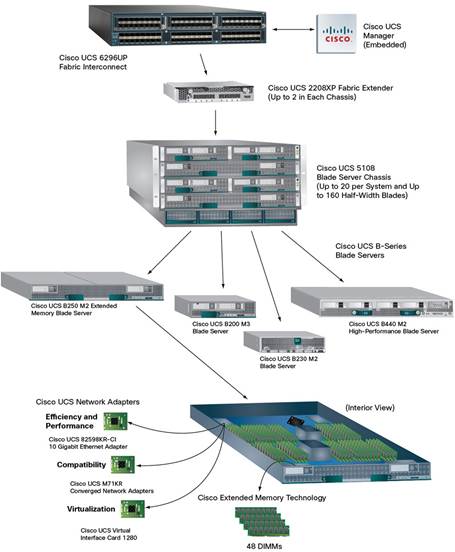
The Cisco Unified Computing System™ (Cisco UCS™) is a next-generation data center platform that unites computing, networking, storage access, and virtualization resources into a cohesive system designed to reduce total cost of ownership (TCO) and increase business agility. The system integrates a low-latency, lossless 10 Gigabit Ethernet unified network fabric with enterprise-class, x86-architecture servers. The system is an integrated, scalable, multichassis platform in which all resources participate in a unified management domain (Figure 1).
Product Overview
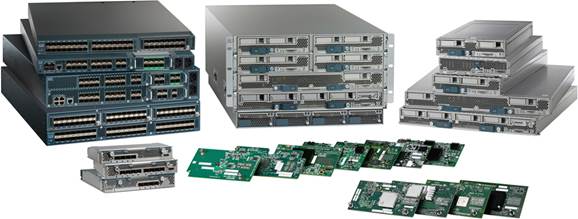
The Cisco UCS 6200 Series Fabric Interconnects are a core part of the Cisco Unified Computing System, providing both network connectivity and management capabilities for the system (Figure 2). The Cisco UCS 6200 Series offers line-rate, low-latency, lossless 10 Gigabit Ethernet, Fibre Channel over Ethernet (FCoE), and Fibre Channel functions.
The Cisco UCS 6200 Series provides the management and communication backbone for the Cisco UCS B-Series Blade Servers and 5100 Series Blade Server Chassis. All chassis, and therefore all blades, attached to the Cisco UCS 6200 Series Fabric Interconnects become part of a single, highly available management domain. In addition, by supporting unified fabric, the Cisco UCS 6200 Series provides both LAN and SAN connectivity for all blades within its domain.
The Cisco UCS 6200 Series uses a cut-through networking architecture, supporting deterministic, low-latency, line‑rate 10 Gigabit Ethernet on all ports, switching capacity of 2 terabits (Tb), and bandwidth of 320 Gbps per chassis, independent of packet size and enabled services. The product family supports Cisco® low-latency, lossless 10 Gigabit Ethernet[1] unified network fabric capabilities, which increase the reliability, efficiency, and scalability of Ethernet networks. The fabric interconnect supports multiple traffic classes over a lossless Ethernet fabric from the blade through the interconnect. Significant TCO savings come from an FCoE‑optimized server design in which network interface cards (NICs), host bus adapters (HBAs), cables, and switches can be consolidated.
Unified Fabric with FCoE: I/O Consolidation
The Cisco UCS 6200 Series is built to consolidate LAN and SAN traffic onto a single unified fabric, saving the capital expenditures (CapEx) and operating expenses (OpEx) associated with multiple parallel networks, different types of adapter cards, switching infrastructure, and cabling within racks. The unified ports allow either base or expansion module ports in the interconnect to support direct connections from Cisco UCS to existing native Fibre Channel SANs. The capability to connect FCoE to native Fibre Channel protects existing storage system investments while dramatically simplifying in-rack cabling.
Cisco UCS Manager
The Cisco UCS 6200 Series hosts and runs Cisco UCS Manager in a highly available configuration, enabling the fabric interconnects to fully manage all Cisco UCS elements. Connectivity to the Cisco UCS 5100 Series blade chassis is maintained through the Cisco UCS 2100 or 2200 Series Fabric Extenders in each blade chassis. The Cisco UCS 2304 Fabric Extender is not supported. The Cisco UCS 6200 Series interconnects support out-of-band management through a dedicated 10/100/1000-Mbps Ethernet management port as well as in-band management. Cisco UCS Manager typically is deployed in a clustered active-passive configuration on redundant fabric interconnects connected through dual 10/100/1000 Ethernet clustering ports.
Optimization for Virtualization
For virtualized environments, the Cisco UCS 6200 Series supports Cisco virtualization-aware networking and Cisco Data Center Virtual Machine Fabric Extender (VM-FEX) architecture. VM-FEX allows the interconnects to provide policy-based virtual machine connectivity, with network properties moving with the virtual machine, and a consistent operational model for both physical and virtual environments.
Cisco UCS 6248UP 48-Port Fabric Interconnect
The Cisco UCS 6248UP 48-Port Fabric Interconnect (Figure 3) is a one-rack-unit (1RU) 10 Gigabit Ethernet, FCoE, and Fibre Channel switch offering up to 960 Gbps of throughput and up to 48 ports. The switch has thirty-two 1/10-Gbps fixed Ethernet, FCoE, and Fibre Channel ports and one expansion slot.

Cisco UCS 6296UP 96-Port Fabric Interconnect
The Cisco UCS 6296UP 96-Port Fabric Interconnect (Figure 4) is a 2RU 10 Gigabit Ethernet, FCoE, and native Fibre Channel switch offering up to 1920 Gbps of throughput and up to 96 ports. The switch has forty-eight 1/10-Gbps fixed Ethernet, FCoE, and Fibre Channel ports and three expansion slots.
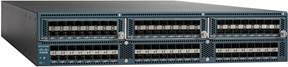
Table 1 summarizes the characteristics of the Cisco UCS 6200 Series Fabric interconnects.
Table 1. Characteristics of Cisco UCS 6200 Series Fabric Interconnects[2]
| Item |
Cisco UCS 6248UP |
Cisco UCS 6296UP |
|
| Description |
48-port fabric interconnect |
96-port fabric interconnect |
|
| Form factor |
1RU |
2RU |
|
| Number of fixed 10 Gigabit Ethernet and FCoE Enhanced Small Form-Factor Pluggable (SFP+) ports |
32 fixed ports with an additional 16 ports available through expansion module |
48 fixed ports with an additional 48 ports available through three expansion module |
|
| Throughput |
960 Gbps |
1920 Gbps |
|
| Expansion slots |
1 |
3 |
|
| Fan modules |
1+1 |
2+2 |
|
Expansion Module Option for Cisco UCS 6200 Series Fabric Interconnects
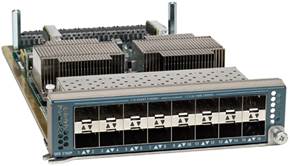
The Cisco UCS 6200 Series supports an expansion module that can be used to increase the number of 10 Gigabit Ethernet, FCoE, and Fibre Channel ports (Figure 5). This unified port module provides up to 16 ports that can be configured for 10 Gigabit Ethernet, FCoE, and 1/2/4/8-Gbps native Fibre Channel using the SFP or SFP+[3] interface for transparent connectivity with existing Fibre Channel networks.
Features and Benefits
Table 2 summarizes the features and benefits of the Cisco UCS 6200 Series.
Table 2. Features and Benefits
| Feature |
Benefit |
| Management by Cisco UCS Manager |
●
Allows all elements connected to the interconnects to participate in a single, highly available management domain
|
| Unified fabric |
●
Decreases TCO by reducing the number of NICs, HBAs, switches, and cables needed
●
Transparently encapsulates Fibre Channel packets into Ethernet
|
| Fabric extender architecture |
●
Scales to 20 chassis without adding complexity by eliminating the need for dedicated chassis management and blade switches and by reducing the number of cables needed
●
Provides deterministic latency for optimized application performance
|
| Performance |
●
Provides high-speed, low-latency connectivity to the chassis
●
Provides approximately 50% reduction in end-to-end system latency (latency is 3.2 microseconds)
|
| Lossless fabric |
● Provides a reliable, robust foundation for unifying LAN and SAN traffic on a single transport
|
| Priority flow control (PFC) |
● Simplifies management of multiple traffic flows over a single network link
● Supports different classes of service, helping enable both lossless and classic Ethernet on the same fabric
|
| Systemwide bandwidth management |
● Helps enable consistent and coherent quality of service (QoS) throughout the system
|
| Cisco Data Center VM‑FEX technology |
● Helps enable a consistent operational model between virtual and physical environments
● Provides the same level of network visibility for virtualized and nonvirtualized environments
● Improves diagnostic and troubleshooting capabilities in a virtual environment
● Simplifies network and security policy enforcement when migrating virtual machines from one host to another
|
| Rear ports |
● Helps keep cable lengths short and efficient
|
| Redundant hot-swappable fans and power supplies |
● Helps enable high availability in multiple configurations
● Increases serviceability
● Provides uninterrupted service during maintenance
|
| Front-to-back cooling |
● Supports efficient data center hot- and cold-aisle designs
|
| SFP+ ports |
● Increases flexibility with a range of interconnect solutions, including copper Twinax cable for short runs and fiber for long runs
● Consumes less power per port than traditional solutions
● Helps enable cost-effective connections on fabric extenders with Cisco Fabric Extender Transceiver (FET) optics
|
| SFP-compatible ports |
● Allows all fixed and modular expansion ports to be configured to operate in 1 Gigabit Ethernet mode with the transceiver options specified for use with SFP-compatible ports in Table 3
|
| Port-based licensing options |
● Helps enable a pay-as-you-go model, allowing customers to add capacity as the networking needs of an individual system increase
|
Product Specifications
Transceivers
The Cisco UCS 6200 Series supports a wide variety of 10 Gigabit Ethernet connectivity options using Cisco 10GBASE SFP+ modules. In addition, all fixed and modular expansion ports on the Cisco UCS 6200 Series support 1 Gigabit Ethernet connectivity options using 1GBASE SFP modules. Alternatively, 2/4/8-Gbps Fibre Channel SFP+ and 1/2/4-Gbps Fibre Channel SFP interfaces are supported on all ports.
Table 3 lists the supported transceiver options.
Table 3. Cisco UCS 6200 Series Transceiver Support Matrix
| Cisco SFP |
Description |
| Cisco SFP-10G-SR |
10GBASE-SR SFP+ module (multimode fiber [MMF]) |
| Cisco SFP-10G-SR-S |
10GBASE-SR SFP+ module (MMF), S-Class |
| Cisco SFP-10G-LR |
10GBASE-LR SFP+ module (single-mode fiber [SMF]) |
| Cisco SFP-10G-LR-S |
10GBASE-LR SFP+ module (SMF), S-Class |
| Cisco SFP-10G-ER |
10GBASE-ER SFP+ module (SMF) |
| Cisco SFP-10G-ER-S |
10GBASE-ER SFP+ module (SMF), S-Class |
| Cisco SFP-H10GB-CU1M |
10GBASE-CU SFP+ cable, 1m (Twinax cable) |
| Cisco SFP-H10GB-CU3M |
10GBASE-CU SFP+ cable, 3m (Twinax cable) |
| Cisco SFP-H10GB-CU5M |
10GBASE-CU SFP+ cable, 5m (Twinax cable) |
| SFP-H10GB-ACU7M |
10GBASE-CU SFP+ cable, 7m (Twinax cable) |
| SFP-H10GB-ACU10M |
10GBASE-CU SFP+ cable, 10m (Twinax cable) |
| Cisco SFP-10G-AOC1M |
10GBASE-AOC SFP+ cable, 1m |
| Cisco SFP-10G-AOC2M |
10GBASE-AOC SFP+ cable, 2m |
| Cisco SFP-10G-AOC3M |
10GBASE-AOC SFP+ cable. 3m |
| Cisco SFP-10G-AOC5M |
10GBASE-AOC SFP+ cable. 5m |
| Cisco SFP-10G-AOC7M |
10GBASE-AOC SFP+ cable. 7m |
| Cisco SFP-10G-AOC10M |
10GBASE-AOC SFP+ cable. 10m |
| Cisco FET-10G |
10GBASE-FET SFP+ module (MMF) |
| Cisco GLC-T |
1000BASE-T SFP (for SFP-compatible ports only, as defined in Table 2) |
| Cisco GLC-SX-MMD |
Gigabit Ethernet SFP, LC connector SX transceiver (MMF; for SFP-compatible ports only, as defined in Table 2) |
| Cisco GLC-LH-SMD |
Gigabit Ethernet SFP, LC connector LX/LH transceiver (SMF; for SFP-compatible ports only, as defined in Table 2) |
| Cisco SFP-GE-T |
1000BASE-T SFP, extended temperature range (for SFP-compatible ports only, as defined in Table 2) |
| Cisco SFP-GE-S |
Gigabit Ethernet SFP, LC connector SX transceiver (MMF), extended temperature range and digital optical monitoring (DOM) (for SFP-compatible ports only, as defined in Table 2) |
| Cisco SFP-GE-L |
Gigabit Ethernet SFP, LC connector LX/LH transceiver (SMF), extended temperature range and DOM (for SFP-compatible ports only, as defined in Table 2) |
| Cisco DS-SFP-FC4G-SW |
4-Gbps Fibre Channel shortwave (SW) SFP, LC |
| Cisco DS-SFP-FC4G-LW |
4-Gbps Fibre Channel longwave (LW) SFP, LC |
| Cisco DS-SFP-FC8G-SW |
8-Gbps Fibre Channel SW SFP+, LC |
| Cisco DS-SFP-FC8G-LW |
8-Gbps Fibre Channel LW SFP+, LC |
Cabling
Table 4 provides 10 Gigabit Ethernet cabling specifications for the Cisco UCS 6200 Series.
Table 4. Cabling Specifications
| Connector (Media) |
|||||
| SFP+ copper (CU) |
Twinax |
1, 3, and 5m |
Approximately 0.1 watt (W) |
Approximately 0.1 microsecond |
SFF 8431 |
| SFP+ ACU copper |
Active Twinax |
7m 10m |
Approximately 0.5W |
Approximately 0.1 microsecond |
SFF 8461 |
| SFP+ FET |
MM OM3 MM OM4 |
||||
| SFP+ short reach (SR) and MMF |
MM OM2 MM OM3 MM OM4 |
82 and 300m |
1W |
Approximately 0 microseconds |
IEEE 802.3ae |
| SFP+ long reach (LR) |
|||||
| SFP+ long reach (ER) |
SMF |
40 km |
1.5W |
Approximately 0 microseconds |
IEEE 802.3ae |
| SFP+ long reach (ZR) |
SMF |
80 km |
1.5W |
Approximately 0 microseconds |
IEEE 802.3ae |
Performance
● Cisco UCS 6248UP: Layer 2 hardware forwarding at 960 Gbps or 714.24 million packets per second (mpps)
● Cisco UCS 6296UP: Layer 2 hardware forwarding at 1.92 Tbps or 1428.48 mpps
● MAC address table entries: 32,000
● Low-latency cut-through design: Provides predictable, consistent traffic latency regardless of packet size, traffic pattern, or enabled features
Layer 2
● Layer 2 interconnect ports and virtual LAN (VLAN) trunks
● IEEE 802.1Q VLAN encapsulation
● Support for up to 1024 VLANs and virtual SANs (VSANs) per interconnect
● Rapid Per-VLAN Spanning Tree Plus (PVRST+)
● Internet Group Management Protocol (IGMP) Versions 1, 2, and 3 snooping
● Cisco EtherChannel technology
● Link Aggregation Control Protocol (LACP): IEEE 802.3ad
● Advanced EtherChannel hashing based on Layer 2, 3, and 4 information
● Jumbo frames on all ports (up to 9216 bytes)
● Pause frames (IEEE 802.3x)
QoS
● Layer 2 IEEE 802.1p (class of service [CoS])
● Eight hardware queues per port
● Per-port QoS configuration
● CoS trust
● Per-port virtual output queuing
● CoS-based egress queuing
● Egress strict-priority queuing
● Egress port-based scheduling: Weighted Round-Robin (WRR)
High Availability
● Hot-swappable field-replaceable power supplies, fan modules, and expansion modules
● 1+1 power redundancy
● N+1 fan module redundancy
Management
● Interconnect management using redundant 10/100/1000-Mbps management or console ports
● All management provided through Cisco UCS Manager; please refer to the Cisco UCS Manager data sheet for more information about management interfaces
Low-Latency, Lossless 10 Gigabit Ethernet Unified Network Fabric
● PFC (per-priority pause frame support)
● Data Center Bridging Exchange (DCBX) Protocol
● IEEE 802.1Qaz: Bandwidth management
● Layer 2 multipathing (future)
Unified Ports
● All ports configurable as 1/10 Gigabit Ethernet or 1/2/4/8-Gbps Fibre Channel
Industry Standards
● IEEE 802.1p: CoS prioritization
● IEEE 802.1Q: VLAN tagging
● IEEE 802.1s: Multiple VLAN instances of Spanning Tree Protocol
● IEEE 802.1w: Rapid reconfiguration of Spanning Tree Protocol
● IEEE 802.3: Ethernet
● IEEE 802.3ad: LACP
● IEEE 802.3ae: 10 Gigabit Ethernet
● SFP+ support
● Remote monitoring (RMON)
Physical Specifications
SFP+ Optics
Cisco UCS products support 10 Gigabit Ethernet SFP+ copper Twinax cables for short distances and SFP+ optics for longer distances. SFP+ has several advantages compared to other 10 Gigabit Ethernet connectivity options:
● Small 10 Gigabit Ethernet form factor
● Optical interoperability with XENPAK, X2, and 10 Gigabit Small Form-Factor Pluggable (XFP) interface types
● Low power consumption
● Hot-swappable device
Power Supply
Tables 5 and 6 summarize the power-supply properties for the Cisco UCS 6200 Series.
Table 5. AC Power Supply
| Property |
Cisco UCS 6248UP |
Cisco UCS 6296UP |
| Typical operating power |
350W |
750W |
| Maximum power |
600W |
950W |
| Input voltage |
100 to 240 VAC |
100 to 240 VAC |
| Frequency |
50 to 60 Hz |
50 to 60 Hz |
| Efficiency |
95 to 98% (50 to 100% load) |
95 to 98% (50 to 100% load) |
| RoHS compliance |
Yes |
Yes |
| Hot swappable |
Yes |
Yes |
| Heat dissipation |
1998 BTU/hr |
3163 BTU/hr |
Table 6. DC Power Supply
| Property |
Cisco UCS 6248UP |
| Typical operating power |
400W with 48 ports running at 100% |
| Maximum output power |
750W |
| Input voltage |
-40 to -72 VDC |
| Input current |
25A maximum |
| Maximum input power |
1000W |
| Efficiency |
88 to 92% (50 to 100% load) |
| RoHS compliance |
Yes |
| Hot swappable |
Yes |
| Heat dissipation |
75W (10% of 750W) |
Cisco UCS 6200 Series Physical and Environmental Specifications
Table 7 summarizes the physical and environmental specifications for the Cisco UCS 6200 Series.
Table 7. Physical and Environmental Specifications
| Property |
Cisco UCS 6296UP |
|
| Physical |
3.44 x 17.3 x 29.5 in. |
|
| Operating temperature |
32 to 104°F (0 to 40°C) |
|
| Nonoperating temperature |
-40 to 158°F (-40 to 70°C) |
|
| Humidity |
5 to 95% (noncondensing) |
|
| Altitude |
0 to 10,000 ft (0 to 300m) |
Weight
Table 8 summarizes the weights for the Cisco UCS 6200 Series.
Table 8. Weight
| Component |
|
| Cisco UCS 6248UP with 2 power supplies, 1 expansion module, and 2 fan modules |
|
| Cisco UCS 6296UP with 2 power supplies, 3 expansion module, and 4 fan modules |
50 lb (22.67 kg) |
Regulatory Standards Compliance: Safety and EMC
Table 9 summarizes Cisco UCS 6200 Series regulatory compliance.
Table 9. Regulatory Standards Compliance
Ordering Information
Table 10 presents ordering information for the Cisco UCS 6200 Fabric Interconnect.
Table 10. Ordering Information
| Part Number |
Description |
| Fabric Interconnect |
|
| UCS-FI-6248UP |
UCS 6248UP 1RU Fabric Interconnect/No PSU/32 UP/ 12p LIC |
| UCS-FI-6296UP |
UCS 6296UP 2RU Fabric Interconnect/No PSU/48 UP/ 18p LIC |
| Expansion Module |
|
| UCS-FI-E16UP |
UCS 6200 16-port Expansion module/16 UP/ 8p LIC |
| Daughter Card |
|
| UCS-FI-DL2 |
UCS 6248 Layer 2 Daughter Card |
| Power Supply and Fan |
|
| UCS-PSU-6248UP-AC |
UCS 6248UP Power Supply/100-240VAC |
| UCS-PSU-6248UP-DC |
UCS 6248UP Power Supply/-48VDC |
| UCS-PSU-6248-HVDC |
UCS 750W 200V-380V DC Hot Plug Power Supply for 6428UP FI |
| UCS-PSU-6296UP-AC |
UCS 6296UP Power Supply/100-240VAC |
| UCS-PSU-6296UP-DC |
UCS 6296UP Power Supply DC |
| UCS-FAN-6248UP |
UCS 6248UP Fan Module |
| UCS-FAN-6296UP |
UCS 6296UP Fan Module |
| Accessories and Blanks |
|
| UCS-BLKE-6200 |
UCS 6200 Series Expansion Module Blank |
| UCS-ACC-6248UP |
UCS 6248UP Chassis Accessory Kit |
| UCS-ACC-6296UP |
UCS 6296UP Chassis Accessory Kit |
Warranty Information
Warranty information is provided at Cisco.com on the Product Warranties page.
Cisco Unified Computing Services
Using a unified view of data center resources, Cisco and our industry-leading partners deliver services that accelerate your transition to a unified computing environment. Cisco Unified Computing Services helps you quickly deploy your data center resources and optimize ongoing operations to better meet your business needs. For more information about these and other Cisco Data Center Services, visit http://www.cisco.com/go/dcservices.
Why Cisco?
Cisco has significant experience in listening to customer requirements and providing solid technology innovation for the enterprise data center. Cisco delivers standards-based solutions backed by a broad partner ecosystem of industry leaders to provide end-to-end customer solutions. Unified computing elevates the traditional product classification of network, server, storage, operating systems, and applications to a vision that encompasses the whole data center. Cisco, as one of the largest technology providers in the world, has the resources, expertise, and customer focus to deliver on this vision.
Cisco Capital
Financing to Help You Achieve Your Objectives
Cisco Capital can help you acquire the technology you need to achieve your objectives and stay competitive. We can help you reduce CapEx. Accelerate your growth. Optimize your investment dollars and ROI. Cisco Capital financing gives you flexibility in acquiring hardware, software, services, and complementary third-party equipment. And there’s just one predictable payment. Cisco Capital is available in more than 100 countries. Learn more.
For More Information
For more information about the Cisco UCS 6200 Series Fabric Interconnects, visit http://www.cisco.com/en/US/products/ps10276/index.html or contact your local account representative.
 Feedback