Table Of Contents
Product Overview
Switch Features
Power Redundancy
Catalyst 4503-E Switch Features
Catalyst 4506-E Switch Features
Supervisor Engine Redundancy
Catalyst 4507R-E Switch Features
Catalyst 4510R-E Switch Features
Supervisor Engines
LEDs
Gigabit Ethernet Uplink Ports
10-Gigabit Ethernet Uplink Ports
SFP Ports
10/100BASE-T Management Port
CONSOLE Port
RESET Button
Compact Flash Slot
Fan Assembly
Power Supplies
Power Supply LEDs
Power Supply Fan
Load-Sharing Feature
Environmental Monitoring Feature
Remote Power Cycling Feature
Terminal Block
Ferrite Bead
Remote Power-Cycling Operation
1400 W DC Triple-input Power Supply Operational Modes
System Architecture
Power Flow
Power over Ethernet
Management Flow
Switching Traffic Flow
Product Overview
This chapter provides an overview of the features and components of the Catalyst 4500 E-series switches. The Catalyst 4500 E-series switches are the Catalyst 4503-E switch, the Catalyst 4506-E switch, the Catalyst 4507R-E switch, and the Catalyst 4510R-E switch. The information is presented in these major sections:
•
Switch Features
•
Supervisor Engines
•
Fan Assembly
•
Power Supplies
•
System Architecture
Switch Features
The following sections describe the features of the Catalyst 4500 E-series switches:
•
Power Redundancy
•
Catalyst 4503-E Switch Features
•
Catalyst 4506-E Switch Features
•
Supervisor Engine Redundancy
•
Catalyst 4507R-E Switch Features
•
Catalyst 4510R-E Switch Features
Power Redundancy
All Catalyst 4500-E switches offer 1+1 power redundancy, so that in the event of a power interruption the switch can still operate using power from another circuit. The power supplies can also run in a combined mode so that chassis can have power from both supplies at once. You will need to use the power redundancy-mode command to configure combined mode. Redundant mode is the default.
Catalyst 4500-E switches support power supply redundancy only between power supplies of equal wattage and type. A mix of power supplies is not supported. The second power supply recognized is placed into err-disable mode.
A more detailed discussion of power redundancy is in the Environmental Monitoring and Power Management chapter of the software configuration guide. Refer to the appropriate guide for your software release.
Catalyst 4503-E Switch Features
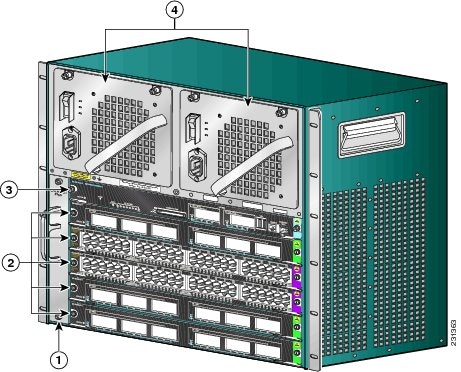
The Catalyst 4503-E switch (see Figure 1-1) is a three-slot switch designed for high-performance high-density wiring closet applications.
Figure 1-1 Catalyst 4503-E Switch (Front View)
1
|
Fan assembly
|
3
|
Supervisor engine (Slot 1)
|
2
|
Switching modules (Slots 2 and 3)
|
4
|
Power supplies
|
The Catalyst 4503-E switch supports the Supervisor Engine II+, Supervisor Engine II+TS, Supervisor Engine II+10GE, Supervisor Engine IV, Supervisor Engine V, Supervisor Engine V-10GE, Supervisor Engine 6L-E, and Supervisor Engine 6-E. The supervisor engine has a nonblocking, full-duplex, switching fabric that provides connections between the supervisor engine and the switching modules. Some supervisor engines use SFP modules for Gigabit Ethernet connections, or X2 modules for 10-Gigabit Ethernet connections. Refer to the installation note for your supervisor engine for more details on these modules.
Slot 1 is reserved for the supervisor engine only, which provides switching, local and remote management, and switch-status monitoring. Slots 2 and 3 are available for switching modules. The chassis will support up to 24 Gbps per slot for slots 2 and 3, for a maximum of 116 ports with a Supervisor Engine II+TS, or 96 ports and 2 uplinks for other supervisors.
Table 1-1 describes the features of the Catalyst 4503-E switch.
Table 1-1 Features of the Catalyst 4503 Switch
Feature
|
Description
|
Ethernet speeds
|
• Ethernet (10BASE-T) interface to workstations and repeaters
• Fast Ethernet (100BASE-T) interface to workstations, servers, switches, and routers
Note Autonegotiation of link speed on each 10/100 port allows migration to 100BASE-T from a 10BASE-T installed base.
• Gigabit Ethernet (1000BASE-T and 1000BASE-X) interfaces for backbone interconnection of high-performance workstations, servers, switches and routers
• 10-Gigabit Ethernet interfaces for backbone interconnection of high-performance switches and routers
|
Standard equipment
|
• Three-slot modular chassis with one slot reserved for a supervisor engine and two slots for switching modules
• One hot-swappable fan assembly
• Two power supply bays
|
Power supplies
|
• Supports a 1000 W, 1300 W, 1400 W, 2800 W, or 4200W AC-input power supply or a 1400 W DC-input single input or triple-input power supply1
• Optional redundant power supply
|
Supervisor engine support
|
• Supports the WS-X4013+, WS-X4013+TS, WS-X4013+10GE, WS-X4515, WS-X4516, WS-X4516-10GE, WS-X45-SUP6L-E, and WS-X45-Sup6-E supervisor engines
• Holds the ASIC-based forwarding engine (data path) and the management processor and software (control path)
• Features interface monitoring, environmental status, and SNMP and console/Telnet interface
Note Packets are not forwarded while the module is removed; a system reboot occurs when a supervisor engine is reinserted.
|
Switching module support
|
• 24-port 10/100BASE-TX Fast Ethernet switching module (WS-X4124-RJ45)
• 24-port 100BASE-FX Fast Ethernet switching module (WS-X4124-FX-MT)
• 48-port 100BASE-FX Fast Ethernet switching module (WS-X4148-FX-MT)
|
| |
• 48-port 100BASE-LX10 Fast Ethernet switching module (WS-X4148-FE-LX-MT)
• 48-port 10/100-Mbps Fast Ethernet switching module (WS-X4148-RJ)
• 48-port 100BASE-BX10-D Fast Ethernet switching module (WS-X4148-FE-BD-LC)
• 48-port 10/100-Mbps Fast Ethernet switching module (WS-X4148-RJ21)
|
Switching module support (continued)
|
• 48-port 100BASE-X Fast Ethernet switching module (WS-X4248-FE-SFP)
• 24-port IEEE 802.3af-compliant PoE 10/100BASE-TX switching module (WS-X4224-RJ45V)
• 48-port IEEE 802.3af compliant PoE 10/100BASE-TX RJ-45 switching module (WS-X4248-RJ45V)
|
| |
• 48 port IEEE 802.3af compliant PoE 10/100BASE-TX RJ-21 switching module (WS-X4248-RJ21V)
• 32-port 10/100-Mbps Fast Ethernet plus 2-port Gigabit Ethernet switching module (WS-X4232-GB-RJ)
• 32-port 10/100-Mbps Fast Ethernet plus 2-port 1000BASE-X Layer 3 Gigabit Ethernet routing module (WS-X4232-L3)
• 32-port 10/100-Mbps Fast Ethernet switching module with modular uplink support (WS-X4232-RJ-XX)
– 4-port MT-RJ uplink module (WS-U4504-FX-MT) (optional)
|
| |
• 2-port Gigabit Ethernet switching module (WS-X4302-GB)
• 6-port 1000BASE-X Gigabit Ethernet switching module (WS-X4306-GB)
• 6-port Gigabit Ethernet switching module (WS-X4506-GB-T)
• 18-port Gigabit Ethernet switching module (WS-X4418-GB)
|
| |
• 24-port 10/100/1000BASE-T Gigabit Ethernet switching module (WS-X4424-GB-RJ45)
• 48-port Gigabit Ethernet 1000 BASE LX (SPF) switching module (WS-X4448-GB-LX)
• 48-port 10/100/1000BASE-T Gigabit Ethernet switching module (WS-X4448-GB-RJ45)
• 24-port IEEE 802.3af-compliant PoE 10/100/1000BASE-T RJ-45 switching module (WS-X4524-GB-RJ45V)
|
| |
• 48-port 10/100/1000BASE-T Gigabit Ethernet switching module (WS-X4548-GB-RJ45)
• 48-port Gigabit Ethernet switching module (WS-X4448-GB-SFP)
• 48-port IEEE 802.3af compliant PoE 10/100/1000BASE-T Gigabit Ethernet switching module (WS-X4548-GB-RJ45V)
• Backplane channel module (WS-X4019)
• 6-port 10GbE X2 switching module (WS-X4606-X2-E)
• 48-port 802.3af PoE 10/100/1000 RJ45 switching module (WS-X4648-RJ45V-E)
• 48-port Premium PoE 10/100/1000 (RJ45) switching module (WS-X4648-RJ45V+E)
|
Catalyst 4506-E Switch Features
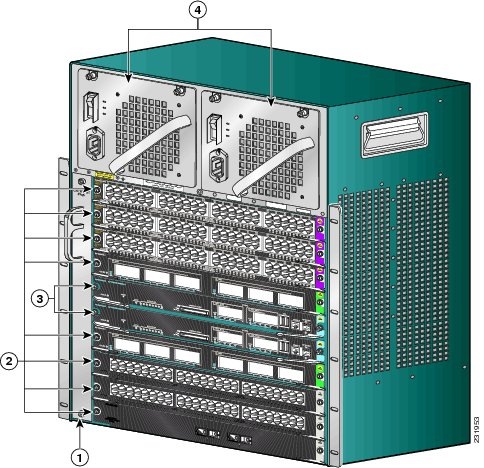
The Catalyst 4506-E switch (see Figure 1-2) is a six-slot switch designed for high-performance high-density wiring closet applications.
Figure 1-2 Catalyst 4506-E Switch (Front View)
1
|
Fan assembly
|
3
|
Supervisor engine (Slot 1)
|
2
|
Switching modules (Slots 2 to 6)
|
4
|
Power supplies
|
The Catalyst 4506-E switch supports the Supervisor Engine II+, Supervisor Engine II+10GE, Supervisor Engine IV, Supervisor Engine V, Supervisor Engine V-10GE, Supervisor Engine 6L-E, and Supervisor Engine 6-E. The supervisor engine has a nonblocking, full-duplex, switching fabric that provides connections between the supervisor engine and the switching modules. Some supervisor engines use SFP modules for Gigabit Ethernet connections, or X2 modules for 10-Gigabit Ethernet connections. Refer to the installation note for your supervisor engine for more details on these modules.
Slot 1 is reserved for the supervisor engine only, which provides switching, local and remote management, and switch-status monitoring. Slots 2 through 6 are available for switching modules. The chassis will support up to 24 Gbps per slot for slots 2 through 6, for a maximum of 240 ports and 2 uplinks.
Table 1-2 describes the features of the Catalyst 4506-E switch.
Table 1-2 Features of the Catalyst 4506-E Switch
Feature
|
Description
|
Ethernet speeds
|
• Ethernet (10BASE-T) interface to workstations and repeaters
• Fast Ethernet (100BASE-T) interface to workstations, servers, switches, and routers
Note Autonegotiation of link speed on each 10/100 port allows migration to 100BASE-T from a 10BASE-T installed base.
• Gigabit Ethernet (1000BASE-T and 1000BASE-X) interfaces for backbone interconnection of high-performance workstations, servers, switches and routers
• 10-Gigabit Ethernet interfaces for backbone interconnection of high-performance switches and routers
|
Standard equipment
|
• Six-slot modular chassis with one slot reserved for a supervisor engine and five slots for switching modules
• One hot-swappable fan assembly
• Two power supply bays
|
Power supplies
|
• Supports a 1000 W, 1300 W, 1400 W, 2800 W, 4200 W, or 6000 W AC-input power supply or a 1400 W DC-input single or triple-input power supply1
• Optional redundant power supply
|
Supervisor engine support
|
• Supports the WS-X4013+, WS-X4515, WS-X4516, WS-X4516-10GE, WS-X45-SUP6L-E, and WS-X45-Sup6-E
• Holds the ASIC-based forwarding engine (data path) and the management processor and software (control path)
• Features interface monitoring, environmental status, and SNMP and console/Telnet interface
Note Packets are not forwarded while the module is removed; a system reboot occurs when a supervisor engine is reinserted.
|
Switching module support
|
• 24-port 10/100BASE-TX Fast Ethernet switching module (WS-X4124-RJ45)
• 24-port 100BASE-FX Fast Ethernet switching module (WS-X4124-FX-MT)
• 48-port 100BASE-FX Fast Ethernet switching module (WS-X4148-FX-MT)
• 48-port 100BASE-LX10 Fast Ethernet switching module (WS-X4148-FE-LX-MT)
• 48-port 10/100-Mbps Fast Ethernet switching module (WS-X4148-RJ)
• 48-port 100BASE-BX10-D Fast Ethernet switching module (WS-X4148-FE-BD-LC)
|
Switching module support (continued)
|
• 48-port 10/100-Mbps Fast Ethernet switching module (WS-X4148-RJ21)
• 24-port IEEE 802.3af-compliant PoE 10/100BASE-TX switching module (WS-X4224-RJ45V)
• 48-port IEEE 802.3af compliant PoE 10/100BASE-TX RJ-45 switching module (WS-X4248-RJ45V)
• 48-port 100BASE-X Fast Ethernet switching module (WS-X4248-FE-SFP)
• 48 port IEEE 802.3af compliant PoE 10/100BASE-TX RJ-21 switching module (WS-X4248-RJ21V)
|
| |
• 32-port 10/100-Mbps Fast Ethernet plus 2-port Gigabit Ethernet switching module (WS-X4232-GB-RJ)
• 32-port 10/100-Mbps Fast Ethernet plus 2-port 1000BASE-X Layer 3 Gigabit Ethernet routing module (WS-X4232-L3)
• 32-port 10/100-Mbps Fast Ethernet switching module with modular uplink support (WS-X4232-RJ-XX)
• 2-port Gigabit Ethernet switching module (WS-X4302-GB)
• 6-port 1000BASE-X Gigabit Ethernet switching module (WS-X4306-GB)
|
| |
• 6-port Gigabit Ethernet switching module (WS-X4506-GB-T)
• 18-port Gigabit Ethernet switching module (WS-X4418-GB)
• 24-port 10/100/1000BASE-T Gigabit Ethernet switching module (WS-X4424-GB-RJ45)
• 48-port Gigabit Ethernet 1000 BASE LX (SPF) switching module (WS-X4448-GB-LX)
• 48-port 10/100/1000BASE-T Gigabit Ethernet switching module (WS-X4448-GB-RJ45)
|
| |
• 24-port IEEE 802.3af-compliant PoE 10/100/1000BASE-T RJ-45 switching module (WS-X4524-GB-RJ45V)
• 48-port 10/100/1000BASE-T Gigabit Ethernet switching module (WS-X4548-GB-RJ45)
• 48-port Gigabit Ethernet switching module (WS-X4448-GB-SFP)
• 48-port IEEE 802.3af compliant PoE 10/100/1000BASE-T Gigabit Ethernet switching module (WS-X4548-GB-RJ45V)
• Backplane channel module (WS-X4019)
• 6-port 10GbE X2 switching module (WS-X4606-X2-E)
• 48-port 802.3af PoE 10/100/1000 RJ45 switching module (WS-X4648-RJ45V-E)
• 48-port Premium PoE 10/100/1000 RJ45 switching module (WS-X4648-RJ45V+E)
|
Supervisor Engine Redundancy
The Catalyst 4507R-E and Catalyst 4510R-E switches support supervisor engine redundancy. Redundancy allows a second supervisor engine to take over if the active supervisor engine fails.
With supervisor engine redundancy enabled, if the active supervisor engine fails or if a manual switchover is performed, the redundant supervisor engine becomes the active supervisor engine. The redundant supervisor engine is automatically initialized with the startup configuration of the active supervisor engine. Depending on the configuration this shortens the switchover time from 30 seconds or longer in Route Processor Redundancy (RPR) mode, to less than a second in Stateful Switch Over (SSO) mode.
In addition to the reduced switchover time, supervisor engine redundancy supports these:
•
Online insertion and removal (OIR) of the redundant supervisor engine
Supervisor engine redundancy allows OIR of the redundant supervisor engine for maintenance. When the redundant supervisor engine is inserted, the active supervisor engine detects it. The redundant supervisor engine boots into a partially initialized state in RPR mode and a fully initialized state in SSO mode.
•
Software upgrade
Load the new image on the redundant supervisor engine and conduct a switchover. This minimizes downtime during software changes on the supervisor engine.
When power is first applied to a switch, the supervisor engine that boots first becomes the active supervisor engine and remains active until a switchover occurs.
Redundancy requires that both supervisor engines in the chassis are of the same supervisor engine model, and that they use the same Cisco IOS software image.
For more detail about redundancy, refer to the Configuring Supervisor Engine Redundancy Using RPR and SSO chapter of the software configuration guide for your software release.
Catalyst 4507R-E Switch Features
The Catalyst 4507R-E switch (see Figure 1-3) is a seven-slot switch designed for high-performance high-density wiring closet applications.
Figure 1-3 Catalyst 4507R-E Switch (Front View)
1
|
Fan Tray
|
3
|
Supervisor engines (primary in slot 3, secondary in slot 4)
|
2
|
Switching modules (slots 1, 2, 5, 6, 7)
|
4
|
Power supplies
|
The Catalyst 4507R-E switch supports the Supervisor Engine II+, Supervisor Engine IV, Supervisor Engine V, Supervisor Engine V-10GE, Supervisor Engine 6L-E, and Supervisor Engine 6-E. The supervisor engine has two Gigabit Ethernet ports and a nonblocking, full-duplex, switching fabric that provides connections between the supervisor engine and the switching modules. Some supervisor engines use SFP modules for Gigabit Ethernet connections or X2 modules for 10-Gigabit Ethernet connections. Refer to the installation note for your supervisor engine for more details on these modules.
Slot 3 is reserved for the supervisor engine only, which provides switching, local and remote management, and switch-status monitoring. Slot 4 is reserved for a redundant supervisor engine only. Slots 1, 2, 5, 6, and 7 are available for switching modules and provide 24 Gbps per slot for a maximum of 240 ports and 4 uplinks.
Table 1-3 describes the features of the Catalyst 4507R-E switch.
Table 1-3 Features of the Catalyst 4507R-E Switch
Feature
|
Description
|
Ethernet speeds
|
• Ethernet (10BASE-T) interface to workstations and repeaters
• Fast Ethernet (100BASE-T) interface to workstations, servers, switches, and routers
Note Autonegotiation of link speed on each 10/100 port allows migration to 100BASE-T from a 10BASE-T installed base.
• Gigabit Ethernet (1000BASE-T and 1000BASE-X) interfaces for backbone interconnection of high-performance switches and routers
• 10-Gigabit Ethernet interfaces for backbone interconnection of high-performance switches and routers
|
Standard equipment
|
• Seven-slot modular chassis with one slot reserved for a supervisor engine, one slot reserved for a redundant supervisor engine, and five slots for switching modules
• Two power supply bays
• One hot-swappable fan assembly
|
Power supplies
|
• Can support a 1000 W, 1300 W, 1400 W, 2800 W, or 4200W AC-input power supply or a 1400 W DC-input single or triple-input power supply1
• Optional redundant power supply
|
Supervisor engine support
|
• Supports the WS-X4013+, WS-X4515, WS-X4516, WS-X4516-10GE, WS-X45-SUP6L-E, and WS-X45-Sup6-E Supervisor Engines
• Holds the ASIC-based forwarding engine (data path) and the management processor and software (control path)
• Features interface monitoring, environmental status, and SNMP and console/Telnet interface
Note With a single supervisor, packets are not forwarded while the module is removed; a system reboot occurs when a supervisor engine is reinserted. In redundant systems, removing the active supervisor causes the standby supervisor to become active.
|
Switching module support
|
• 32-port 10/100-Mbps Fast Ethernet plus 2-port Gigabit Ethernet switching module (WS-X4232-GB-RJ)
• 32-port 10/100-Mbps Fast Ethernet plus 2-port 1000BASE-X Layer 3 Gigabit Ethernet routing module (WS-X4232-L3)
• 32-port 10/100-Mbps Fast Ethernet switching module with modular uplink support (WS-X4232-RJ-XX)
– 4-port MT-RJ uplink module (WS-U4504-FX-MT) (optional)
• 2-port Gigabit Ethernet switching module (WS-X4302-GB)
• 24-port 10/100BASE-TX Fast Ethernet switching module (WS-X4124-RJ45)
• 24-port 100BASE-FX Fast Ethernet switching module (WS-X4124-FX-MT)
• 48-port 100BASE-FX Fast Ethernet switching module (WS-X4148-FX-MT)
• 48-port 100BASE-LX10 Fast Ethernet switching module (WS-X4148-FE-LX-MT)
• 48-port 10/100-Mbps Fast Ethernet switching module (WS-X4148-RJ)
• 48-port 100BASE-BX10-D Fast Ethernet switching module (WS-X4148-FE-BD-LC)
• 48-port 10/100-Mbps Fast Ethernet switching module (WS-X4148-RJ21)
• 48-port 100BASE-X Fast Ethernet switching module (WS-X4248-FE-SFP)
|
Switching module support (continued)
|
• 24-port IEEE 802.3af-compliant PoE 10/100BASE-TX switching module (WS-X4224-RJ45V)
• 48-port IEEE 802.3af compliant PoE 10/100BASE-TX RJ-45 switching module (WS-X4248-RJ45V)
• 48 port IEEE 802.3af compliant PoE 10/100BASE-TX RJ-21 switching module (WS-X4248-RJ21V)
• 6-port 1000BASE-X Gigabit Ethernet switching module (WS-X4306-GB)
• 6-port Gigabit Ethernet switching module (WS-X4506-GB-T)
• 18-port Gigabit Ethernet switching module (WS-X4418-GB)
• 24-port 10/100/1000BASE-T Gigabit Ethernet switching module (WS-X4424-GB-RJ45)
• 48-port Gigabit Ethernet 1000 BASE LX (SPF) switching module (WS-X4448-GB-LX)
• 48-port 10/100/1000BASE-T Gigabit Ethernet switching module (WS-X4448-GB-RJ45)
• 24-port IEEE 802.3af-compliant PoE 10/100/1000BASE-T RJ-45 switching module (WS-X4524-GB-RJ45V)
• 48-port 10/100/1000BASE-T Gigabit Ethernet switching module (WS-X4548-GB-RJ45)
• 48-port Gigabit Ethernet switching module (WS-X4448-GB-SFP)
• 48-port IEEE 802.3af compliant PoE 10/100/1000BASE-T Gigabit Ethernet switching module (WS-X4548-GB-RJ45V)
• 6-port 10GbE X2 switching module (WS-X4606-X2-E)
• 48-port 802.3af PoE 10/100/1000 RJ45 switching module (WS-X4648-RJ45V-E)
• 48-port Premium PoE 10/100/1000 RJ45 switching module (WS-X4648-RJ45V+E)
|
Catalyst 4510R-E Switch Features
The Catalyst 4510R-E switch (see Figure 1-4) is a ten-slot switch designed for high-performance high-density wiring closet applications.
Figure 1-4 Catalyst 4510R-E Switch (Front View)
1
|
Fan Tray
|
3
|
Supervisor engines (primary in slot 5, secondary in slot 6)
|
2
|
Switching modules (slots 1, 2, 3, 4, 7, 8, 9, 10)
|
4
|
Power supplies
|
The Catalyst 4510R-E switch supports the Supervisor Engine V, Supervisor Engine V-10GE, and Supervisor Engine 6-E. The supervisor engine has a nonblocking, full-duplex, switching fabric that provides connections between the supervisor engine and the switching modules. Some supervisor engines use SFP modules for Gigabit Ethernet connections, or X2 modules for 10 Gigabit Ethernet connections. Refer to the installation note for your supervisor engine for more details on these modules.
Slot 5 is reserved for the supervisor engine only, which provides switching, local and remote management, and switch-status monitoring. Slot 6 is reserved for a redundant supervisor engine only. Slots 1, 2, 3, 4, 7, 8, 9, and 10 are available for switching modules and provide up to 24 Gbps per slot for a maximum of 384 ports and 4 uplinks. With a Supervisor Engine 6-E, slots 8 to 10 provide 6 Gbps per slot and all other slots provide 24 Gbps per slot. With a Supervisor Engine V or Supervisor Engine V-10GE, all slots are 6 Gbps and E-series switching modules can not be used.
Table 1-4 describes the features of the Catalyst 4510R-E switch.
Table 1-4 Features of the Catalyst 4510R-E Switch
Feature
|
Description
|
Ethernet speeds
|
• Ethernet (10BASE-T) interface to workstations and repeaters
• Fast Ethernet (100BASE-T) interface to workstations, servers, switches, and routers
Note Autonegotiation of link speed on each 10/100 port allows migration to 100BASE-T from a 10BASE-T installed base.
• Gigabit Ethernet (1000BASE-T and 1000BASE-X) interfaces for backbone interconnection of high-performance switches and routers
• 10-Gigabit Ethernet interfaces for backbone interconnection of high-performance switches and routers
|
Standard equipment
|
• Ten-slot modular chassis with one slot reserved for a supervisor engine, one slot reserved for a redundant supervisor engine, and eight slots for switching modules
• Two power supply bays
• One hot-swappable fan assembly
|
Power supplies
|
• Can support a 1400 W, 2800 W, 4200 W, or 6000 W AC-input power supply or a 1400 W DC-input single or triple-input power supply1 , 2
• Optional redundant power supply
|
Supervisor engine support
|
• Supports the WS-X4516, WS-X4516-10GE, and WS-X45-Sup6-E Supervisor Engines
• Holds the ASIC-based forwarding engine (data path) and the management processor and software (control path)
• Features interface monitoring, environmental status, and SNMP and console/Telnet interface
Note With a single supervisor, packets are not forwarded while the module is removed; a system reboot occurs when a supervisor engine is reinserted. In redundant systems, removing the active supervisor causes the standby supervisor to become active.
|
Switching module support
|
• 24-port 10/100BASE-TX Fast Ethernet switching module (WS-X4124-RJ45)
• 24-port 100BASE-FX Fast Ethernet switching module (WS-X4124-FX-MT)
• 48-port 100BASE-FX Fast Ethernet switching module (WS-X4148-FX-MT)
• 48-port 100BASE-LX10 Fast Ethernet switching module (WS-X4148-FE-LX-MT)
• 48-port 10/100-Mbps Fast Ethernet switching module (WS-X4148-RJ)
• 48-port 100BASE-BX10-D Fast Ethernet switching module (WS-X4148-FE-BD-LC)
• 48-port 10/100-Mbps Fast Ethernet switching module (WS-X4148-RJ21)
• 24-port IEEE 802.3af-compliant PoE 10/100BASE-TX switching module (WS-X4224-RJ45V)
• 48-port IEEE 802.3af compliant PoE 10/100BASE-TX RJ-45 switching module (WS-X4248-RJ45V)
• 48-port 100BASE-X Fast Ethernet switching module (WS-X4248-FE-SFP)
• 48 port IEEE 802.3af compliant PoE 10/100BASE-TX RJ-21 switching module (WS-X4248-RJ21V)
• 32-port 10/100-Mbps Fast Ethernet plus 2-port Gigabit Ethernet switching module (WS-X4232-GB-RJ)
|
Switching module support (continued)
|
• 32-port 10/100-Mbps Fast Ethernet plus 2-port 1000BASE-X Layer 3 Gigabit Ethernet routing module (WS-X4232-L3)
• 32-port 10/100-Mbps Fast Ethernet switching module with modular uplink support (WS-X4232-RJ-XX)
– 4-port MT-RJ uplink module (WS-U4504-FX-MT) (optional)
• 2-port Gigabit Ethernet switching module (WS-X4302-GB)
• 6-port 1000BASE-X Gigabit Ethernet switching module (WS-X4306-GB)
• 6-port Gigabit Ethernet switching module (WS-X4506-GB-T)
• 18-port Gigabit Ethernet switching module (WS-X4418-GB)
• 24-port 10/100/1000BASE-T Gigabit Ethernet switching module (WS-X4424-GB-RJ45)
• 48-port Gigabit Ethernet 1000 BASE LX (SPF) switching module (WS-X4448-GB-LX)
• 48-port 10/100/1000BASE-T Gigabit Ethernet switching module (WS-X4448-GB-RJ45)
• 24-port IEEE 802.3af-compliant PoE 10/100/1000BASE-T RJ-45 switching module (WS-X4524-GB-RJ45V)
• 48-port 10/100/1000BASE-T Gigabit Ethernet switching module (WS-X4548-GB-RJ45)
• 48-port Gigabit Ethernet switching module (WS-X4448-GB-SFP)
• 48-port IEEE 802.3af compliant PoE 10/100/1000BASE-T Gigabit Ethernet switching module (WS-X4548-GB-RJ45V)
• 6-port 10GbE X2 switching module (WS-X4606-X2-E)
• 48-port 802.3af PoE 10/100/1000 RJ45 switching module (WS-X4648-RJ45V-E)
• 48-port Premium PoE 10/100/1000 RJ45 switching module (WS-X4648-RJ45V+E)
|
Supervisor Engines
The following supervisor engines are available for the Catalyst 4500 series and Catalyst 4500 E-series switches:
•
Supervisor Engine II-Plus (WS-X4013+)
•
Supervisor Engine II-Plus TS (WS-X4013+TS)
•
Supervisor Engine II-Plus 10GE (WS-X4013+10GE)
•
Supervisor Engine IV (WS-X4515)
•
Supervisor Engine V (WS-X4516)
•
Supervisor Engine V-10GE (WS-X4516-10GE)
•
Supervisor Engine 6-E (WS-X45-Sup6-E)
•
Supervisor Engine 6L-E (WS-X45-Sup6L-E)
Note
If you move a supervisor engine from a Catalyst 4500 series chassis to a Catalyst 4500-E chassis it must use Cisco IOS Release 12.2(37)SG or later in order to work with the new chassis. Refer to the release note for software upgrade procedures if needed:
http://www.cisco.com/en/US/docs/switches/lan/catalyst4500/release/note/OL_5184.html#wp305142
The Catalyst 4500 series and Catalyst 4500 E-series supervisor engines have the following features:
Table 1-5 Supervisor Engine Features
Feature
|
Description
|
Data path and control
|
Available on all network interfaces
|
Management functions
|
Interface monitoring
Environmental status
SNMP and console/Telnet interface
|
MAC addresses supported
|
32,768 per system (Cisco IOS only)
|
VLANS
|
Up to 4,096 VLANs with IEEE 802.1Q VLAN tagging on all ports and VLAN Trunking Protocol (VTP)
|
Port aggregation
|
PAgP1 for 100-Mbps and 1000-Mbps EtherChannel
|
SNMP
|
Full implementation, including entity-MIB, all relevant standard MIBs, and all relevant Cisco MIBs
|
RMON
|
The first four groups (Ethernet statistics, Alarms, Events, and History) are on a per-port basis without an optional RMON processing module
|
SPAN2
|
Supported, which allows you to redirect traffic from any port or VLAN to a SPAN destination port
|
Performance management
|
Information provided
|
Hot-swappable
|
Supported. On non-redundant systems, packets are not forwarded while the supervisor engine is removed, and a system reboot occurs when a supervisor engine is reinserted.
|
Gigabit Ethernet (using a GBIC or SFP)
|
Includes two (four on WS-X4516-10GE and WS-X4013+10GE) Gigabit Ethernet (1000BASE-X) interfaces for backbone interconnection of high-performance switches and routers
|
10-Gigabit Ethernet (WS-X4516-10GE, WS-X4013+10GE WS-X45-Sup6L-E and WS-X45-Sup6-E)
|
Includes two 10 Gigabit Ethernet interfaces for backbone interconnection of high-performance switches and routers
|
Forwarding
|
Layer 2, 3, and 4 forwarding (Cisco IOS only)
|
Supervisor Engine II-Plus maximum full-duplex throughput
|
64 Gbps, 48 Mpps (with Catalyst 4506-E and 4507R-E) or 28-Gbps, 21 Mpps (with Catalyst 4503-E)
|
Supervisor Engine II-Plus TS maximum full-duplex throughput
|
64 Gbps, 48 Mpps (with Catalyst 4503-E only) full-duplex Gigabit Ethernet switching engine
|
Supervisor Engine II-Plus 10GE maximum full-duplex throughput
|
108 Gbps, 81 Mpps (with Catalyst 4506-E and 4507R-E) 72-Gbps, 54 Mpps (with Catalyst 4503-E) full-duplex Gigabit Ethernet switching engine
|
Supervisor Engine IV maximum full-duplex throughput
|
64 Gbps, 48 Mpps (with Catalyst 4506-E and 4507R-E, or 28-Gbps, 21 Mpps with Catalyst 4503-E)
|
Supervisor Engine V maximum full-duplex throughput
|
96-Gbps, 72 Mpps (with Catalyst 4510R-E) 68 Gbps, 51 Mpps (with Catalyst 4507R-E) 64 Gbps, 48 Mpps (with Catalyst 4506-E) 28 Gbps, 21 Mpps (with Catalyst 4503-E)
|
Supervisor Engine V-10GE maximum full-duplex throughput
|
136-Gbps, 102 Mpps (with Catalyst 4510R-E) 116 Gbps, 87 Mpps (with Catalyst 4507R-E) 108 Gbps, 80 Mpps (with Catalyst 4506-E) 72 Gbps, 54 Mpps (with Catalyst 4503-E)
|
Supervisor Engine 6-E maximum full-duplex throughput
|
320-Gbps, 250 Mpps (with Catalyst 4510R-E) 280 Gbps, 210 Mpps (with Catalyst 4507R-E) 280 Gbps, 210 Mpps (with Catalyst 4506-E) 136 Gbps, 102 Mpps (with Catalyst 4503-E)
|
Supervisor Engine 6L-E maximum full-duplex throughput
|
280-Gbps, 210 Mpps (with Catalyst 4507R-E) 280 Gbps, 210 Mpps (with Catalyst 4506-E) 136 Gbps, 102 Mpps (with Catalyst 4503-E)
|
To install a supervisor engine, refer to the procedure in the Catalyst 4500 Series Module Installation Guide or to the installation note specific to the supervisor. engine.
For information about the connectors, LEDs, and switches located on the front panel of the supervisor engine, see these sections:
•
LEDs
•
Gigabit Ethernet Uplink Ports
•
10-Gigabit Ethernet Uplink Ports
•
10/100BASE-T Management Port
•
CONSOLE Port
•
RESET Button
•
Compact Flash Slot
LEDs
Table 1-6 describes the supervisor engine LEDs.
Table 1-6 Supervisor Engine LEDs
LED
|
Color/State
|
Description
|
STATUS
|
|
Indicates the results of a series of self-tests:
|
| |
Green
|
All diagnostic tests passed.
|
| |
Red
|
A test failed.
|
| |
Orange
|
System boot or diagnostic test is in progress, or two power supplies are installed but only one is turned on.
|
| |
Off
|
Module is disabled.
|
UTILIZATION
|
Green 1-100%
|
If the switch is operational, this display indicates the current traffic load over the backplane (as an approximate percentage).
|
LINK
|
|
Indicates the status of the 10/100BASE-T port, 10/100/1000BASE-T or uplink ports:
|
| |
Green
|
The link is operational.
|
| |
Orange
|
The link is disabled by user.
|
| |
Flashing orange
|
The power-on self-test indicates a faulty port.
|
| |
Off
|
No signal is detected or there is a link configuration failure.
|
ACTIVE
|
|
Indicates whether the uplink port is active or not:
|
(uplink port)
|
Green
|
The port is active.
|
| |
Off
|
The port is not active.
|
ACTIVE
|
|
The LED to the right of the uplink ports is only used in switches with two supervisors. The LED lights on the active supervisor.
|
Gigabit Ethernet Uplink Ports
The Gigabit Ethernet uplink ports operate in full-duplex mode only. GBICs have SC connectors to interface with multimode fiber (MMF) and single-mode fiber (SMF) cable. For more information about GBICs, refer to the Catalyst 4500 Series Module Installation Guide. Frequently updated compatibility information for GBICs, X2s, and SFPs are in documents at:
http://www.cisco.com/en/US/products/hw/modules/ps5455/products_device_support_tables_list.html
When two Supervisor Engine Vs are present in a Catalyst 4507R-E and Catalyst 4510R-E, all four uplinks are active on both Primary (active) and Secondary (standby) supervisor engines by default, or two uplinks are active in a non-redundant configuration. This limits access to slot 10 on the Catalyst 4510R to ports 3 and 4 only. You can only use the 2-port Gigabit Ethernet switching module (WS-X4302-GB) in slot 10 (flex-slot) when a Supervisor Engine V is used.
10-Gigabit Ethernet Uplink Ports
The 10-Gigabit Ethernet uplink ports operate in full-duplex mode only, and are only on the WS-X4516-10GE, WS-X4013+10GE, WS-45-Sup6L-E, and WS-45-Sup6-E. These ports use the hot-swappable 10GBASE X2 optical transceivers. The X2s have SC connectors to interface with multimode fiber (MMF) and single-mode fiber (SMF) cable.
On a Catalyst 4510R-E with a Supervisor Engine V-10GE, the user can use either four Gigabit Ethernet uplinks using SFPs or two 10-Gigabit Ethernet uplinks using X2s. The user also has the option of using the Gigabit Ethernet and 10-Gigabit Ethernet uplinks simultaneously. With this option, the tenth slot can only support the WS-X4302-GB switching module. On a Catalyst 4507R-E, the user can use the Gigabit Ethernet uplinks and 10-Gigabit Ethernet uplinks simultaneously.
When two Supervisor Engine V-10GEs are present in a Catalyst 4510R-E or Catalyst 4507R-E switch, or two Supervisor Engine II-Plus 10GEs are present in a Catalyst 4507R-E, one X2 uplink is active on both the primary (active) and secondary (standby) supervisor engines by default, or two uplinks are active in a non-redundant configuration.
On a Catalyst 4510R-E with a Supervisor Engine 6-E, 10-Gigabit Ethernet uplinks using X2s are the only available uplinks. Slots 8-10 are intended for Catalyst 4500 classic switching modules only and all other slots may use classic or E-series switching modules.
When two Supervisor Engine 6-Es are present in a Catalyst 4510R-E or Catalyst 4507R-E switch, or two Supervisor Engine II-Plus 10GEs are present in a Catalyst 4507R-E, one X2 uplink is active on both the primary (active) and secondary (standby) supervisor engines by default, or two uplinks are active in a non-redundant configuration.
SFP Ports
Gigabit Ethernet SFP ports operate in full-duplex mode only and are present on the WS-X4013+TS, WS-X4516-10GE, and WS-X4013+10GE supervisors, as well as some switching modules. WS-X45-Sup6-E supervisors can use Cisco TwinGig converters to support two SFPs per X2 uplink port, for a maximum of 4 SFP ports per supervisor. SFP connectors vary with interface type and may use multimode fiber (MMF), single-mode fiber (SMF) cable, or copper Ethernet cables. SFPs use LC type fiber connectors and RJ-45 copper connectors.
10/100BASE-T Management Port
The Ethernet management port can be used (in ROMMON mode only) to recover a switch software image that has been corrupted or destroyed due to a network catastrophe. When using Cisco IOS Release 12.2(50)SG or later, this port can also perform the same functions as the console port. For earlier Cisco IOS software releases, this port is not active while the switch is operating normally.
CONSOLE Port
The CONSOLE port has an EIA/TIA-232 RJ-45 connector. The CONSOLE port allows you to perform the following functions:
•
Configure the switch from the CLI
•
Monitor network statistics and errors
•
Configure SNMP agent parameters
Note
EIA/TIA-232 was known as recommended standard RS-232 before its acceptance as a standard by the Electronic Industries Alliance (EIA) and Telecommunications Industry Association (TIA).
RESET Button
The RESET button is used to restart the switch.
Note
Use a paper clip or other small, pointed object to press the Reset button.
Compact Flash Slot
The Compact Flash slot accepts a Type 1 Compact Flash disk. You can use it for file transfer tasks such as loading a new software image. The Compact Flash card is optional. For more information, refer to Using the Compact Flash on the Catalyst 4500 Supervisor Engines at:
http://www.cisco.com/en/US/docs/switches/lan/catalyst4500/hardware/configuration/notes/OL_2788.html
Fan Assembly
Note
For complete environmental specifications, including airflow requirements, see Appendix A, "Specifications."
The system fan assembly provides cooling air for the internal chassis components. The fan assembly is a tray of fans that you can insert and remove from the chassis while the system is on line. The Catalyst 4503-E fan assembly (WS-X4593-E) has two fans and the Catalyst 4506-E fan assembly (WS-X4596-E) has four fans, the Catalyst 4507R-E fan assembly (WS-X4597-E) has eight fans, and the Catalyst 4510R-E fan assembly(WS-X4582-E) has ten fans. The fans draw in fresh air from one side and exhaust air on the other side. Catalyst 4506-E airflow is shown in Figure 1-5, the others in the series are the same direction.
Caution 
You must install module filler plates on unused switching module slots to ensure proper airflow.
Figure 1-5 Catalyst 4506-E Airflow
Power Supplies
Note
For detailed specifications on all Catalyst 4500 power supplies, refer to the "Catalyst 4507R-E Switch Specifications" section on page A-4.
A Catalyst 4500 E-series switch can use a 1000 W, 1300 W, 1400 W, 2800 W (see Figure 1-6), 4200 W, or 6000W (with two inputs, see Figure 1-7) AC-input power supply, a 1400 W DC-input power supply with integrated PEM (see Figure 1-9), or a 1400 W DC multiple-input power supply (see Figure 1-10). The power supplies are hot-swappable. If you have power supplies of different types installed in the two bays, only one will be active and some power features will not be available. The power supply in the left bay is PS1, the one in the right bay is PS2.
The AC-input power supply has one or two power cords that connects each power supply to the site power source. The DC-input power supply is equipped with a input terminal block that is directly connected to the site power wiring.
Each power supply has an ON/OFF switch that supplies power to the switch. For information on removing and replacing power supplies, see the "Removing and Replacing the Power Supply" section on page 4-2.
Figure 1-6 AC-Input Power Supply (All Except 4200 W and 6000 W)
1
|
AC receptacle
|
3
|
Captive screws
|
2
|
Power switch
|
|
|
Figure 1-7 4200 W Dual Input AC Power Supply
1
|
AC input 2 receptacle
|
4
|
AC input 1 receptacle
|
2
|
AC input 2 on switch
|
5
|
Captive screws
|
3
|
AC input 1 on switch
|
|
|
Figure 1-8 6000 W Dual Input AC Power Supply
1
|
AC input 2 receptacle
|
4
|
AC input 1 receptacle
|
2
|
AC input 2 on switch
|
5
|
Captive screws
|
3
|
AC input 1 on switch
|
6
|
Remote power cycling terminal
|
Note
The 4200 W and 6000 W AC power supplies should not be used in mixed-voltage configurations. All the inputs in a chassis must be the same voltage (110 or 220 V).
Figure 1-9 1400 W DC-Input Power Supply
Figure 1-10 1400 W DC Triple-Input Power Supply
Note
The 1400 W DC triple-input power supply is not compatible with other power supplies used on these products, and can only be used with similar supplies. In redundant mode, the two power supplies must have identical inputs.
The 1400 W DC input power supply (either single or triple-input) may be used with the Catalyst 4500 Series AC Power Shelf. Documentation for the Catalyst 4500 Series AC Power Shelf is at http://www.cisco.com/en/US/docs/switches/lan/catalyst4500/hardware/configuration/notes/
78_15068.html
Catalyst 4500 E-series switches support one power supply and an optional redundant power supply. Each AC power supply has an individual power cord and status LEDs. Systems with redundant power supplies will share the load, with each unit providing approximately one-half of the total load. For information about configuring your switch for redundant and combined modes, refer to the software configuration guide for your switch.
The Catalyst 4510R-E requires at least 1400 W of input power. (The 1000 W AC and 1300 W AC power supplies will fit and function in a Catalyst 4510R-E; however, power management may be required in high density configurations.) Cisco recommends the use of the 1400 W DC, 1400 W AC, and 2800 W AC power supplies for the Catalyst 4510R-E.
When power is removed from one power supply on a Catalyst 4500 E-series switch that has two power supplies, the redundant power feature causes the second power supply to produce full power.
To replace a power supply, see the "Removing and Replacing the Power Supply" section on page 4-2.
Power Supply LEDs
Table 1-7 describes the power supply LEDs.
Table 1-7 Power Supply LEDs
LED
|
Color/State
|
Description
|
INPUT OK
|
|
Indicates whether the input voltage is within the required range:
|
| |
Green
|
Input voltage is within the required range.
|
| |
Flashing
|
Input voltage is present, but is below required range.
|
| |
Off
|
Input voltage is below the required range or the power supply is off.
|
OUTPUT FAIL
|
|
|
| |
Red
|
Output voltage is not within the specified range.
|
| |
Off
|
Output voltage is within the specified range.
|
FAN OK
|
|
Indicates the status of the power supply fans:
|
| |
Green
|
The fans are operational.
|
| |
Off
|
The fans are not operational.
|
In-line PWR (for 1400 W DC single input power supplies)
|
Green
|
-48 V passthru output voltage is enabled and is greater than -39 V and less than -60 V.
|
| |
Off
|
Indicates any of the following:
• Passthru breakers are not enabled.
• DC input is less than -40.5 V.
• One or more -48 V outputs is less than -39 V.
|
Amber
|
Passthru breakers are enabled and input voltage exceeds -60 V.
|
Power Supply Fan
Each power supply has a built-in fan. Air enters the front of the power supply (power-input end) and exits through the back. An air dam keeps the airflow separate from the rest of the chassis, which is cooled by the system fan assembly.
Load-Sharing Feature
When you install and turn on a second power supply on a Catalyst 4500 E-series switch, it provides approximately one-half of the required power to the system. If one power supply fails, the other power supply immediately assumes full power to maintain uninterrupted system operation.
Note
Load sharing works only when both power supplies in the chassis are the same type.
When you install a redundant power supply, load sharing and fault tolerance are enabled automatically; no additional software configuration is required.
Environmental Monitoring Feature
With the environmental monitoring and reporting feature, you can keep your system running by resolving adverse environmental conditions before loss of operation.
The power supply monitors its own internal temperature and voltages. In the event of excessive internal temperature, the power supply shuts down to prevent damage. When the power supply returns to a safe operating temperature, it restarts. If the power supply output voltage is not within the specified range, the LED labeled OUTPUT FAIL will light. An instance of substantial output overvoltage can shut down the power supply.
An instance of substantial input over-voltage (greater than -75 V DC continuous) can damage the power supply input circuitry and can cause it to shut down permanently.
For a 1400 W DC power supply, the main power switch has an input range of -40.5 to -72 V DC, while the -48 V PoE operates over a range of -40.5 to -56 V DC. The PoE either fails to start or shuts down if exposed to greater than -56 V DC input. PoE recovers after you recycle input power within the proper voltage range. If the PoE shuts down due to input over-voltage (greater than -56 V DC), the main converter section does not shut down.
The supervisor engine monitors the status of each power supply and provides a status report through the switch software. For more details on how the supervisor engine monitors the power supplies, refer to the "Environmental Monitoring and Power Management" chapter of the Catalyst 4500 Series Switch Cisco IOS Software Configuration Guide.
Remote Power Cycling Feature
The 6000 W power supply is equipped with a remote power cycling feature that allows you to remotely turn on or turn off the power supply through an external relay controller box. Figure 1-11 shows a typical remote power on/off setup. A three-position terminal block, located on the lower right quadrant of the power supply faceplate, provides the interface to the external relay controller box. (See Figure 1-11.)
Figure 1-11 Remote Power On/Off Feature Components
Terminal Block
The terminal block has four contacts labeled +V, IN, GND, and FB. Two control wires from an external relay controller box attach to either +V and IN or IN and GND. +V and IN are used when the relay controller box contains a normally-open (NO) type of relay. IN and GND are used when using an RS232 interface.
Ferrite Bead
A plastic bag containing one ferrite bead and two 4-inch plastic ties is included with the 6000 W power supply AC power cords. The ferrite bead is a passive device that limits high-frequency interference on interface and control cables, and is only required when you install the remote power-cycling feature that is supported by the 6000 Watt power supply. The ferrite bead is installed on the two control wires that come from the relay controller box to the terminal block on the 6000 W power supply. The ferrite bead should be installed as close as possible to the power supply terminal block for the bead to be effective. You do not need the ferrite bead for 6000 Watt power supply installations that do not include the remote power-cycling feature. If you need to install the ferrite bead, refer to the"Installing the Ferrite Bead" procedure on page 4-10.
Remote Power-Cycling Operation
This feature allows you to remotely power cycle the Catalyst 4500 E- series switch using any appropriate third-party relay controller. This eliminates the need for you to have access to the supervisor engine console or CLI to control power cycling. Table 1-8 lists the relay controller box relay type, the corresponding power supply terminal block positions, and a description of the power-cycling operation.
Table 1-8 6000 W Power Supply Relay Controller Switch Settings and Operation
External Relay Controller Box Relay Type
|
Power Supply Terminal Block Positions Used
|
Remote Power-Cycling Operation
|
Normally open (NO) relay.
|
The +V pin is internally pulled up to 12V with a 10K ohms pull up resistor, and pin IN is connected to the input pin (either pin 1,4,10 or 13) of the Line Receiver.
|
• Power supply cycled from on to off—The power supply is powered off by energizing the relay (relay contacts go from open to closed) for more than 5 seconds.
• Power supply cycled from off to on—The power supply is powered on by reenergizing the relay (relay contacts go from closed to open) after a 10 second delay.
|
RS232 driver.
|
Pin IN is connected to the input pin (either pin 1,4,10 or 13) of the Line Receiver, and pin GND is connected to ground. A capacitor of 1 uF should be used between the Line Receiver input and the ground to bypass noise peaks.
|
• Power supply cycles from on to off—The power supply is powered off by RS232 logic HI for more than 5 seconds.
• Power supply cycles from off to on— The power supply is powered on by RS232 logic LO after a 10 second delay.
|
No relay attached. Remote power-cycling feature not installed.
|
—
|
—
|
1400 W DC Triple-input Power Supply Operational Modes
The 1400 W DC Triple Input SP Power Supply (data only) allows added redundancy by providing terminals for two DC inputs rated at 15 A and one rated at 12.5 A per power supply.
This power supply has five operational modes depending on the inputs receiving power. When all three inputs are active, at input voltages greater than -44.0 V DC, the power supply delivers 1400 W maximum total output. Table 1-9 provides output information for these modes, given a single supply.
Table 1-9 Input Modes
Input Mode
|
Input Number
|
Input Configuration
|
Maximum Total Output Power
|
1
|
1
|
1 x 12.5 A
|
386 W @ -40.5 V DC 412 W @ -44.0 V DC
|
2
|
2 OR 3
|
1 x 15 A
|
466 W @ -40.5 V DC 495 W @ -44.0 V DC
|
3
|
1, 2 OR 3
|
1 x 12.5 A and 1 x 15 A
|
845 W @ -40.5 V DC 908 W @ -44.0 V DC
|
4
|
2, 3
|
2 x 15A
|
914 W @ -40.5 V DC 990 W @ -44.0 V DC
|
5
|
1, 2, 3
|
1 x 12.5A and 2 x 15 A
|
1294 W @ -40.5 V DC 1400 W @ -44.0 V DC
|
The maximum total input current is 42.5A and the maximum ambient temperature is 55 C. To determine total maximum input power to a supply, add up the active individual module input power ratings. Table 1-10 provides output information for these modes, given two supplies working in combined mode. Table 1-11 provides output information for these modes, given two supplies working in redundant mode.
Table 1-10 Combined Mode Power Supply Configuration
(2450 W Max Output Power)
Input Number
|
Maximum Input Current
|
Maximum Input Power @ -44 V DC
|
1
|
12.5 A @ -44 V DC
|
550 W
|
2
|
15 A @ -44 V DC
|
660 W
|
3
|
15 A @ -44 V DC
|
660 W
|
Table 1-11 Dual Redundant Mode Power Supply Configuration
(1400 W Max Output Power)
Input Number
|
Approximate Input Current
|
Approximate Input Power @ -40.5 V DC
|
Approximate Input Power @ -44 V DC
|
1
|
6.25 A @ -40.5 / -44 V DC
|
253 W
|
275 W
|
2
|
7.5 A @ -40.5 / -44 V DC
|
304 W
|
330 W
|
3
|
7.5 A @ -40.5 / -44 V DC
|
304 W
|
330 W
|
Note
In a redundant configuration with all inputs supplied, there must be a 100 W minimum system load or the OUTPUT FAIL LED shows a false failure.
The 1400 W DC Triple Input SP Power Supply requires a minimum draw from the system that it is installed in. Table 1-12 shows the minimum draw for the possible modes.
Table 1-12 Minimum Load Table
| |
PSU1
|
PSU2
|
|
|
| |
Input 1
|
Input 2
|
Input 3
|
Input 1
|
Input 2
|
Input 3
|
12V Minimum Load
|
3.3V Minimum Load
|
Single Operation
|
Mode 1
|
ON
|
OFF
|
OFF
|
-
|
-
|
-
|
1.33A
|
0.6A
|
Mode 2
|
OFF
|
ON
|
OFF
|
-
|
-
|
-
|
1.33A
|
0.6A
|
| |
OFF
|
OFF
|
ON
|
-
|
-
|
-
|
1.33A
|
0.6A
|
Mode 3
|
ON
|
ON
|
OFF
|
-
|
-
|
-
|
2.66A
|
0.6A
|
| |
ON
|
OFF
|
ON
|
-
|
-
|
-
|
2.66A
|
0.6A
|
Mode 4
|
OFF
|
ON
|
ON
|
-
|
-
|
-
|
2.66A
|
0.6A
|
Mode 5
|
ON
|
ON
|
ON
|
-
|
-
|
-
|
4A
|
0.6A
|
Dual Redundant Operation
|
Mode 1
|
ON
|
OFF
|
OFF
|
ON
|
OFF
|
OFF
|
2.66A
|
1.2A
|
Mode 2
|
OFF
|
ON
|
OFF
|
OFF
|
ON
|
OFF
|
2.66A
|
1.2A
|
| |
OFF
|
OFF
|
ON
|
OFF
|
OFF
|
ON
|
2.66A
|
1.2A
|
Mode 3
|
ON
|
ON
|
OFF
|
ON
|
ON
|
OFF
|
5.32A
|
1.2A
|
| |
ON
|
OFF
|
ON
|
ON
|
OFF
|
ON
|
5.32A
|
1.2A
|
Mode 4
|
OFF
|
ON
|
ON
|
OFF
|
ON
|
ON
|
5.32A
|
1.2A
|
Mode 5
|
ON
|
ON
|
ON
|
ON
|
ON
|
ON
|
8A
|
1.2A
|
System Architecture
This section describes the interaction between the various system components of Catalyst 4500 E-series switches. Only the Catalyst 4503-E switch is shown in the examples.
Power Flow
Figure 1-12 shows power ingress and flow through the system.
Figure 1-12 Power Flow
Power enters the switch through the power supplies. Several types of power supplies are available, depending on the power needs for your system and the power type available on your site. All power supplies provide a 3.3 V circuit (shown as a dash-dot line) to the components on the backplane and a 12 V circuit (shown as a solid line) that is carried over the backplane to the fans, supervisor engine, and switching modules. Power supplies that support PoE (1300 W AC, 2800 W AC, 4200 W, and 6000 W AC or 1400 W DC) also provide a -48 V circuit (shown as a dashed line) to PoE-enabled switching modules, which is then available to the powered device connected to the switching module.
Note
The Supervisor Engine II-Plus TS has internal DC-to-DC converters that use the 12 V circuit to provide PoE to powered devices connected to the Supervisor engine only. If your system has a Supervisor Engine II-Plus TS in slot 1, you still need a PoE-enabled power supply to provide PoE to the other slots.
All Catalyst 4500 E-series switches support dual power supplies, configurable for combined mode or redundant mode. In combined mode, the switch has available the combined rated wattage of both power supplies, less some expected efficiency loss. In redundant mode, one power supply provides power to the system and the other supply is on standby should there be a failure in either the power supply or the input voltage source it is connected to.
Power over Ethernet
The Cisco Catalyst 4500 E-series switches support the 802.3af standard for PoE on 10/100 or 10/100/1000 ports, enabling customers to support telephones, wireless base stations, video cameras, and other appliances. PoE makes it possible to place devices in unique locations without having to provide new outlets and costly electrical circuits. PoE also enables businesses to isolate critical devices on a single power system so that the entire system can be supported by uninterruptable power supply (UPS) backup.
All new Cisco Catalyst PoE switching modules can support 15.4 W of power per port simultaneously. Not only do the modules support the IEEE standard, including the optional power classifications, but the Cisco pre-standard power implementation is also supported to help ensure backward compatibility with existing Cisco powered devices. The modules are compatible with any chassis and supervisor engine. Most importantly, the Catalyst 4500 E-series switch has the power supplies and accessories to support 15.4 W per port on every port simultaneously in any fully loaded chassis. (This requires an external power shelf or a 4200 W or 6000 W dual-input power supply.)
PoE Over-subscription
With the advent of powered devices requiring as much as 15.4 W and the different combinations of power supplies and chassis port densities, it becomes quite possible to over-subscribe the PoE capacity of the power supplies. This temporary over-subscription typically occurs when a power supply configured in combined mode fails or when the user has not kept track of the powered devices and plugs in one too many. The best practice is to design a PoE system in which all devices receive the power needed at all times. When a power supply is over-subscribed—more power is being drawn from it than it can supply—the power supply shuts down. There are several ways to predictably manage a temporary PoE over-subscription:
1.
Configure unused ports to never receive PoE. This prevents a user from inadvertently plugging a powered device into a port and causing problems for other powered devices.
2.
Configure ports to be in static mode. This is for ports that have highest priority, such as phones for executives or wireless access points. If ports need to be disabled because of a power shortage, auto ports are disabled before static ports.
3.
Configure the maximum wattage on ports to be less than the default, based on the maximum power consumption of the powered device. This disallows devices demanding unexpected amounts of power and also stretches the finite resources of the power supplies. For example, the default port wattage is 15.4 W. By configuring a maximum of 7 W, twice as many PoE powered devices can be supported with the same power supply.
PoE Switching Modules
The Cisco Catalyst 4500 E-series offers switching modules, power supplies, and accessories required to deploy and operate a standards-based PoE internetwork. PoE provides -48 V DC power over standard Category 5 unshielded twisted-pair (UTP) cable up to 100 meters when an IEEE 802.3af-compliant or Cisco pre-standard powered device is attached to the PoE switching module port. Instead of requiring wall power, attached devices such as IP phones, wireless base stations, video cameras, and other IEEE-compliant appliances can use power provided by the PoE switching modules. This capability gives network administrators centralized control over power and eliminates the need to install outlets in ceilings and other out-of-the-way places where a powered device may be installed.
Although references to "PoE," "inline-power," and "voice" power supplies and switching modules are synonymous, there are only two versions: Cisco prestandard and IEEE 802.3af compliant. Every Cisco Catalyst 4500 E-series chassis and PoE power supply supports the IEEE 802.3af standard and the Cisco prestandard power implementation ensuring backward compatibility with existing Cisco powered devices. All IEEE 802.3af-compliant switching modules can distinguish an IEEE or Cisco prestandard powered device from an unpowered network interface card (NIC), ensuring that power is applied only when an appropriate device is connected.
All PoE switching modules can distinguish an IEEE or Cisco prestandard powered device from an unpowered network interface card (NIC) to ensure power is applied only when an appropriate device is connected. With a Cisco PoE network, administrators can depend on a robust network that is safe to deploy and simple to maintain.
Deploying PoE on the Cisco Catalyst 4500 E-series
When the switch is properly configured, implementing PoE is easy when it is used with a Cisco powered device that supports Cisco Discovery Protocol. All PoE switching modules automatically detect an attached powered device the moment it is installed. Also, the switch returns unused port power to the system power budget for use by other devices because it supports the IEEE802.3af optional power classifications.
The Cisco Catalyst 4500 E-series offers internal power supplies and external power devices for multiple deployment scenarios. These scenarios include small and large deployments in AC or DC environments for data-only configurations, and scalability of up to 15.4 W per port for PoE configurations.
The switches share a common power supply form factor. Each Cisco Catalyst 4500 E-series chassis is designed for 1 + 1 power protection while meeting the needs of PoE demands. In addition to power resiliency, the Cisco Catalyst 4500 E-series includes 1 + 1 supervisor-engine redundancy (Cisco Catalyst 4507R-E and Catalyst 4510R-E only) and software-based fault tolerance. Integrated resiliency in both hardware and software minimizes network downtime, helping ensure workforce productivity, portability, and customer success.
All available Cisco Catalyst 4500 E-series compatible power supplies can be used for data-only deployments, which typically require just a few hundred watts. For deployments that dictate support for PoE power, Cisco offers several options.
The Cisco Catalyst 4500 E-series offers several internal supplies: 1000 W AC (data only), 1400 W AC (data only), 1300 W (data and PoE), 1400 W DC (data and PoE), 2800 W (data and PoE), 4200 W AC (data and PoE), and 6000 W AC (data and PoE). When more than 6000 W of redundant data and PoE are required for a Cisco Catalyst 4500 E-series chassis in an AC-powered environment, Cisco offers an external AC power shelf that houses two 2500 W AC power supplies. When two power shelves are combined, they can produce 7500 W—the remaining 2500 W supply can be used for N + 1 protection.
The Cisco Catalyst 4500 E-series has two DC power options; one is optimized for data-only deployments in service provider central offices (part number PWR-C45-1400DC), and the other is used for high-power PoE deployments (part number PWR-C45-1400DC-P).
Cisco Catalyst 4500 Series External AC Power Shelf and
1400 W DC Power Supply with Integrated Power Entry Module
The external AC power shelf must be used in conjunction with the 1400 W DC power supply. In addition to providing power for the chassis, fans, and non-PoE switching modules, the 1400 W DC power supply contains a power entry module (PEM). The PEM is used to pass additional power to the chassis backplane, power demanded by the PoE switching modules. The chassis power trace used for PoE is independent from the one used by the supervisor engine(s), fan tray, and backplane components. The 1400 W DC power supply can accept up to 7500 W DC for data and PoE applications. Up to 1400 W can be dedicated for data (supervisor engine, fan tray, etc.), while the remaining power is passed through via the PEM and is used for PoE.
When only one external AC power shelf is used (with two 2500 W AC power supplies), it provides the 1400 W DC power supply with 5000 W of DC power in total. When two AC power shelves are strapped together, the switch can provide up to 7500 W of DC power (3 + 1 redundant).
Cisco Catalyst 4500 Series Service Provider DC Power Supply
The triple-input 1400 W DC power supply is optimized for service provider or central-office deployments. By providing multiple inputs, the service provider DC power supply enables central-office technicians to customize the output power to meet their application needs. Many central-office deployments require only a fraction of the 1400 W available in the service provider power supply. Low current inputs mean technicians can connect the supply to smaller fuses and breakers. The service provider power supply makes it possible to deploy a Cisco Catalyst 4503-E with a single 15 A circuit. Likewise, it is possible to deploy a fully populated Cisco Catalyst 4510R-E with two 20 A and one 15 A circuits rather than a single 60 A connection, which often requires rack rewiring.
Management Flow
Figure 1-13 shows management and status information flow through the system.
Figure 1-13 Management Flow
Each system component has an EEPROM that identifies it to the supervisor engine over a serial connection on the backplane, which also passes along information like temperature, fan speed, power draw per slot and port, and port activity. LED status information is also sent to the supervisor engine, which makes it available to an administrator through a terminal connection or management software.
All Catalyst 4500 E-series switches support:
•
Cisco Group Management Protocol, for standards-based and Cisco technology-enhanced efficient multimedia networking.
•
Simple Network Management Protocol (SNMP).
•
CiscoWorks, which can manage critical network characteristics such as availability, responsiveness, resilience, and security.
•
Cisco NetFlow Services. The Cisco NetFlow Services Card for the Supervisor Engine IV and V support statistics capture in hardware for flow-based and VLAN-based statistics monitoring. This data can be exported, collected, and analyzed for virus detection and mitigation, network-traffic accounting, usage-based network billing, network planning, network monitoring, and data-mining capabilities. Cisco NetFlow Services is integral to the Supervisor Engine V-10GE.
Switching Traffic Flow
All Catalyst 4500 series switches use a shared memory switching fabric. All forwarding decisions, QoS, security policies and transmit queuing are implemented in the Supervisor Engine. Individual switching modules are transparent, and only contain simple stub ASICs and PHYs; they do not perform buffering or local switching. Classic switching modules and Classic IOS supervisor engines have a per slot switching capacity of 6 Gbps, while E-series switching modules and supervisor engines have a per slot switching capacity of 24 Gbps.
Frames flow into the switch through interfaces on the switching modules. Each switching module connects to a backplane that supports a connection of up to 24 Gbps up to the supervisor engine. When a frame reaches the supervisor engine, and a forwarding decision is made, the packet is sent out a port on the same switching module, a different switching module, or the supervisor engine uplinks. Figure 1-14 shows a conceptual diagram of switching traffic flow through the system.
Figure 1-14 Switching Traffic Flow
Over-subscription
Classic Catalyst 4500 Series 48 port 10/100/1000 E-Series Switching modules are 8:1 oversubscribed and Catalyst 4500 E-Series 48 port 10/100/1000 Switching modules are 2:1 oversubscribed. On both types of switching modules, there are multiplexing ASIC's which group the front panel ports and multiplex them to the internal switch fabric. On a 48 port 10/100/1000 Classic Catalyst 4500 Series switching module, eight front panel ports are multiplexed into a a single, nonblocking, full-duplex Gigabit Ethernet connection to the internal switch fabric of the Catalyst 4500 Classic Supervisors or the Supervisor 6-E. On the Catalyst 4500 E-series 48 port 10/100/1000 switching modules, six front panel ports are multiplexed into a 3 gigabit nonblocking, full-duplex Ethernet connection to the internal switch fabric on the Supervisor Engine 6-E.
If the data rate received for a port presents a potential overflow condition, flow control sends pause frames to the remote port to temporarily stop traffic and prevent frame loss. For both Classic and E-series switching modules each port operates independently so that flow control, or configuration of one port, does not block or degrade the performance of another port in that group.
The 6 port 2.5:1 oversubscribed 10GbE X2 based switching module operates in a similar way. The six front panel ports are multiplexed by groups of three into two ASICS, each having a 12 gigabit connection into the internal switch fabric.
In a Catalyst 4500 E-series chassis with the Supervisor 6-E, there is no performance degradation when both Classic and E-series line cards are mixed within the chassis. The Classic switching modules will continue to operate at 6 gigabits per slot and the E-series switching modules will operate at 24 gigabits per slot.
Supervisor Redundancy
The Cisco Catalyst 4507R-E and Catalyst 4510R-E switches support 1+1 supervisor-engine redundancy for integrated resiliency. Redundant supervisor engines help minimize network downtime. With the support of stateful switchover (SSO), the secondary supervisor engine serves as a backup to immediately take over after a primary supervisor failure. During the switchover, Layer 2 links are maintained transparently without the need to renegotiate sessions. As a result, business-critical applications such as Voice-over-IP (VoIP) calls are not dropped. The Nonstop Forwarding (NSF) Aware feature in Cisco IOS software is also supported, providing the ability to interface with NSF-capable devices and to continue forwarding packets as routing information is updated upon a supervisor-engine switchover.