IOS XEでのレイヤ2 VPN仮想プライベートLANサービスのトラブルシューティング

はじめに
このドキュメントでは、Cisco IOS® XEテクノロジーのレイヤ2 VPN仮想プライベートLANサービス(VPLS)のトラブルシューティング方法について説明します。
前提条件
要件
次の項目に関する知識があることが推奨されます。
- 基本的な IP ルーティング
- レイヤ2 VPN仮想プライベートLANサービス
使用するコンポーネント
このドキュメントの情報は、Cisco IOS XEソフトウェアに基づくものです。
このドキュメントの情報は、特定のラボ環境にあるデバイスに基づいて作成されたものです。このドキュメントで使用するすべてのデバイスは、クリアな(デフォルト)設定で作業を開始しています。本稼働中のネットワークでは、各コマンドによって起こる可能性がある影響を十分確認してください。
ネットワーク図
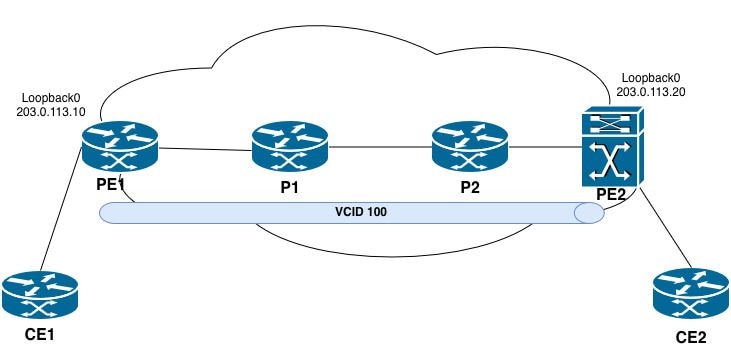 VPLSトポロジ
VPLS相互接続が動作していない
トラブルシューティングの手順
セッションが予期せず終了した後、VPLSクロスコネクトがダウン状態になった。
PE2#show xconnect all
Legend: XC ST=Xconnect State S1=Segment1 State S2=Segment2 State
UP=Up DN=Down AD=Admin Down IA=Inactive
SB=Standby HS=Hot Standby RV=Recovering NH=No Hardware

XC ST  Segment 1                         S1 Segment 2                         S2
------+---------------------------------+--+---------------------------------+--
DN pri vfi 100                           UP mpls 203.0.113.10:100             DN
UP pri ac Vl100:100(Eth VLAN)            UP vfi 100                           UP
UP pri bd 100                            UP vfi 100                           UP
ステップ 1: 正確なVC/VPLSの状態を確認します。
PE2#show mpls l2transport vc 100 detail
Local interface: VFI 100 vfi up
   Interworking type is Ethernet
   Destination address: 203.0.113.10, VC ID: 100, VC status: down
     Last error: Local access circuit is not ready for label advertise << The local device is unable to advertise labels because the access circuit (AC) is not in a ready state.
     Output interface: none, imposed label stack {} << no MPLS labels are being imposed because no path exists.
     Preferred path: not configured << No explicit traffic engineering path is configured for this pseudowire.
     Default path: no route << No route to the remote PE (203.0.113.10) exists in the routing table.
     No adjacency
Create time: 10:50:35, last status change time: 00:17:39
  Last label FSM state change time: 00:17:33
Signaling protocol: LDP, peer x.x.x.x:0 up
  Targeted Hello: 203.0.113.20(LDP Id) -> 203.0.113.10, LDP is DOWN, no binding
  Graceful restart: not configured and not enabled
  Non stop routing: not configured and not enabled
  Status TLV support (local/remote) : enabled/None (no remote binding
    LDP route watch : enabled
    Label/status state machine : local ready, LruRnd
    Last local dataplane status rcvd: No fault
    Last BFD dataplane status rcvd: Not sent
    Last BFD peer monitor status rcvd: No fault
    Last local AC circuit status rcvd: No fault
    Last local AC circuit status sent: DOWN(hard-down) << The local device is advertising the access circuit as hard-down to the remote PE.
    Last local PW i/f circ status rcvd: No fault
    Last local LDP TLV status sent: No fault
    Last remote LDP TLV status rcvd: None (no remote binding) << No status has been received from the remote PE.
    Last remote LDP ADJ status rcvd: None (no remote binding) << No adjacency status received from the remote peer.
  MPLS VC labels: local 16, remote unassigned
  Group ID: local n/a, remote unknown
  MTU: local 1500, remote unknown
  Remote interface description:
Sequencing: receive disabled, send disabled
Control Word: On (configured: autosense)
SSO Descriptor: 203.0.113.10/100, local label: 16
Dataplane:
  SSM segment/switch IDs: 0/8194 (used), PWID: 1
VC statistics:
  transit packet totals: receive 0, send 0
  transit byte totals: receive 0, send 0
  transit packet drops: receive 0, seq error 0, send 0
VPLS相互接続(VC ID 100)がダウン状態に移行しました。根本原因は、次に示す条件に起因します。
1. リモートPEへのルートがない – ルータのルーティングテーブルに203.0.113.10へのルートがない(デフォルトパス:ルートがない)。 有効なルートがないと、MPLSラベルスイッチドパス(LSP)を確立できません。
2. ターゲットLDPセッションがダウンしています – 203.0.113.20から203.0.113.10へのターゲットLDPセッションが確立されていません。これにより、PEルータ間で疑似回線ラベルが交換されなくなります。
3. リモートラベルバインディングなし:ターゲットのLDPセッションがダウンしているため、VC 100にリモートラベルが割り当てられていません。疑似配線は、ローカルラベルとリモートラベルの両方がない状態ではトラフィックを転送できません。
4. 隣接関係なし:有効なルートおよびLDPセッションがないと、リモートPEへのMPLS隣接関係は存在しません。
ステップ 2 ローカル接続回線をチェックします。
VCがダウンしているPE上:
PE2#show interfaces vlan 100 | include up|errors
Vlan100 is up, line protocol is up , Autostate Disabled
Keepalive not supported
0 input errors, 0 CRC, 0 frame, 0 overrun, 0 ignored
0 output errors, 1 interface resets

PE2#show running-config interface vlan 100
Building configuration...

Current configuration : 72 bytes
!
interface Vlan100
no ip address
no autostate
xconnect vfi 100
end
ステップ 3 VFI設定を確認します。
PE2#show running-config | section l2 vfi
l2 vfi 100 manual
vpn id 100
neighbor 203.0.113.10 pw-class VPLS_100

PE2#show l2vpn vfi
Legend: RT=Route-target, S=Split-horizon, Y=Yes, N=No

VFI name: 100, state: up, type: multipoint, signaling: LDP
  VPN ID: 100
  Bridge-Domain 100 attachment circuits:
    Vlan100
  Pseudo-port interface: pseudowire100001
  Interface Peer Address VC ID S
  pseudowire100002 203.0.113.10 100 Y
主な所見
1. VFIが運用上アップしている:ローカルVFIインスタンスがアクティブで、トラフィックを転送する準備ができている。
2. 接続回線がバインドされている:Vlan100がブリッジドメイン100およびVFIと正しく関連付けられている。
3. 擬似回線が設定されている:擬似回線(擬似回線100002)が、VC ID 100の203.0.113.10にあるリモートPEに対して定義されている。
4. スプリットホライズンが有効になっている:これは、レイヤ2ループを防止するためにVPLSマルチポイント環境で想定される動作です。
ステップ 4 PEループバックの到達可能性を確認します。
PE2#ping 203.0.113.10
Type escape sequence to abort.
Sending 5, 100-byte ICMP Echos to 203.0.113.10, timeout is 2 seconds:
!!!!!
Success rate is 100 percent (5/5), round-trip min/avg/max = 1/1/1 ms

PE2#show ip route 203.0.113.10
Routing entry for 203.0.113.10/32
Known via "ospf 1", distance 110, metric 2, type intra area
Last update from 192.0.2.9 on TwentyFiveGigE1/0/3, 00:01:30 ago
Routing Descriptor Blocks:
* 192.0.2.9, from 198.51.100.2, 00:01:30 ago, via TwentyFiveGigE1/0/3
Route metric is 2, traffic share count is 1

PE2#ping mpls ipv4 203.0.113.10/32 source 203.0.113.20
Sending 5, 72-byte MPLS Echos to 203.0.113.10/32,
timeout is 2 seconds, send interval is 0 msec:

Codes: '!' - success, 'Q' - request not sent, '.' - timeout,
'L' - labeled output interface, 'B' - unlabeled output interface,
'D' - DS Map mismatch, 'F' - no FEC mapping, 'f' - FEC mismatch,
'M' - malformed request, 'm' - unsupported tlvs, 'N' - no label entry,
'P' - no rx intf label prot, 'p' - premature termination of LSP,
'R' - transit router, 'I' - unknown upstream index,
'l' - Label switched with FEC change, 'd' - see DDMAP for return code,
'X' - unknown return code, 'x' - return code 0

Type escape sequence to abort.
!!!!!
Success rate is 100 percent (5/5), round-trip min/avg/max = 1/1/2 ms
Total Time Elapsed 8 ms
標準pingとMPLS LSP ping:主な違い
標準のpingは、MPLS LSPが壊れた場合でも成功することがあります。その理由は次のとおりです。
・ IP経由で宛先に直接到達できる場合、ICMPパケットをIPルーティングできます(ラベルスイッチングはできません)。
・ 中継ルータは、ラベルが付加されていない場合、IPルックアップを使用してICMPパケットを転送できます。
逆に、ping mpls ipv4は、パケットをラベルスイッチドパス経由で強制的に通過させることで、実際のMPLSデータプレーンを検証します。これにより、次のことが保証されます。
・ ラベルが正しく割り当てられ、配布されていること。
・ LFIBエントリは各ホップで一貫しています。
・ LSPエンドツーエンドパスは機能しています。
ステップ 5コアのMPLSおよびLDPを確認します。
PE2#show mpls ldp neighbor
    Peer LDP Ident: 203.0.113.10:0; Local LDP Ident 203.0.113.20:0
        TCP connection: 203.0.113.10.646 - 203.0.113.20.39001
        State: Oper; Msgs sent/rcvd: 16/15; Downstream
        Up time: 00:02:15
        LDP discovery sources:
          TwentyFiveGigE1/0/3, Src IP addr: 192.0.2.9
          Targeted Hello 203.0.113.20 -> 203.0.113.10, active, passive
        Addresses bound to peer LDP Ident:
          203.0.113.10 192.0.2.6 192.0.2.9
このコマンドは、ローカルルータ(PE2)とリモートピア間のLDPネイバーセッション情報を提供します。出力の各フィールドについて詳しく説明します。
- ピア ID:
Peer LDP Ident | 203.0.113.10:0 |リモートピアのLDPルータID。:0は、プラットフォーム全体のデフォルトのラベルスペースを示します。これは通常、リモートルータのループバックアドレスです。
Local LDP Ident | 203.0.113.20:0 |ローカルルータ(PE2)のLDPルータID。 これは通常、PE2のループバックアドレスです。
- TCPセッション情報:
TCP接続| 203.0.113.10.646 - 203.0.113.20.39001 | LDP通信に使用されるTCPセッション。リモートピア(203.0.113.10)は既知のLDPポート646を使用し、ローカルルータ(203.0.113.20)は一時ポート39001を使用します。LDPは、信頼性の高いラベル配布のためにTCPを使用します。
- Session state:
State | Oper | LDPセッションは動作状態にあり、セッションが完全に確立されて機能していることを意味します。
Msgs sent/rcvd | 16/15 |セッション確立後に送信(16)および受信(15)されたLDPメッセージの数。これには、キープアライブ、ラベルマッピング、およびその他のLDPメッセージが含まれます。
ダウンストリーム| - |ラベル配布モードを示します。Downstream Unsolicitedは、PE2から明示的に要求されることなく、ピアがラベルをPE2に配布することを意味します。これはLDPのデフォルトモードです。
アップタイム| 00:02:15 |セッションは2分15秒間動作しています。 - LDP検出ソース:
TwentyFiveGigE1/0/3 | Src IP addr: 192.0.2.9 | A basic discovery (link-level) helloが、送信元IPアドレス192.0.2.9でインターフェイスTwentyFiveGigE1/0/3上のピアから受信されます。これは、2台のルータがこのインターフェイスに直接接続されていることを示します。
Targeted Hello | 203.0.113.20 → 203.0.113.10, active, passive |ローカルルータ(203.0.113.20)とリモートピア(203.0.113.10)の間にターゲットディスカバリ(拡張)helloが存在します。 - ピアLDP IDにバインドされるアドレス:
ピアにバインドされたアドレス| 203.0.113.10、192.0.2.6、192.0.2.9 | LDPアドレスメッセージを介してリモートピアがアドバタイズしたIPアドレスのリスト。これらはリモートルータのインターフェイスを表します。
手順5.1リモートVPLSピアへのMPLSラベルスイッチドパスの確認
PE2#show mpls forwarding-table 203.0.113.10
Local        Outgoing         Prefix               Bytes Label     Outgoing          Next Hop
Label        Label            or Tunnel Id         Switched        interface
25           Pop Label        203.0.113.10/32      0                Twe1/0/3         192.0.2.9

PE2#show mpls ldp bindings 203.0.113.10 32
  lib entry: 203.0.113.10/32, rev 69
        local binding: label: 25
        remote binding: lsr: 203.0.113.10:0, label: imp-null
PE2は、P2およびP1を介した予想されるラベルパスをバイパスして、PE1からimp-nullを直接受信します。これは、PE2とP2の間にLDPセッションが欠落しているか、MPLS設定の問題があることを示します。
手順5.2次のコマンドを実行して、ネクストホップ情報を確認します。
- mpls ldpネイバーの表示
- MPLS転送テーブルの表示
P2#show mpls forwarding-table 203.0.113.10
Local        Outgoing          Prefix Bytes          Label           Outgoing       Next Hop
Label        Label             or Tunnel Id          Switched        interface
None         No Label          203.0.113.10/32       0
主な観察
- ローカルラベル:なし| P2はこのプレフィクスにローカルラベルを割り当てていません。
- 送信ラベル:ラベルなし|ラベル操作は実行されません。
- 発信インターフェイスまたはネクストホップなし|プレフィックスはローカル所有として扱われ、PE1への転送は行われません。
P2#show mpls ldp neighbor
    Peer LDP Ident: 203.0.113.20:0; Local LDP Ident 198.51.100.2:0
        TCP connection: 203.0.113.20.17326 - 198.51.100.2.646
        State: Oper; Msgs sent/rcvd: 30/29; Downstream
        Up time: 00:13:57
        LDP discovery sources:
           GigabitEthernet0/0/1, Src IP addr: 192.0.2.10
        Addresses bound to peer LDP Ident:
          203.0.113.20 192.0.2.10
Peer LDP Ident: 198.51.100.1:0; Local LDP Ident 198.51.100.2:0
    TCP connection: 198.51.100.1.646 - 198.51.100.2.12799
    State: Oper; Msgs sent/rcvd: 30/28; Downstream
    Up time: 00:13:56
    LDP discovery sources:
      GigabitEthernet0/0/0, Src IP addr: 192.0.2.5
    Addresses bound to peer LDP Ident:
      192.0.2.2 192.0.2.5 198.51.100.1

P2#show ip ospf neighbor

Neighbor ID       Pri   State           Dead Time    Address           Interface
198.51.100.3        0   FULL/ -         00:00:34     192.0.2.10        GigabitEthernet0/0/1
198.51.100.1        0   FULL/ -         00:00:34     192.0.2.5         GigabitEthernet0/0/0
主な観察
- P2には、PE1(203.0.113.10)との直接のLDPアジャセンシー関係がありません。 P1はトポロジのP2とPE1の間にあるため、これは予想どおりです。P2はP1へのラベルスイッチングトラフィックを担当し、P1はそのトラフィックをPE1に転送します。
- P2のLDP Identは198.51.100.2:0です。P2はLDPルータIDとして198.51.100.2を使用し、203.0.113.10は使用しません。ただし、203.0.113.10はまだLoopback10で設定されているため、ルーティングの競合が発生します。
ステップ 6リモートPEループバックアドレスへのルートを確認します。
P2#show ip route 203.0.113.10
Routing entry for 203.0.113.10/32
  Known via "connected", distance 0, metric 0 (connected, via interface)
  Routing Descriptor Blocks:
  * directly connected, via Loopback10
      Route metric is 0, traffic share count is 1
結論
- 重複IPアドレス:IPアドレス203.0.113.10がP2(Loopback10)とPE1(Loopback0)で設定されており、これによりMPLSドメイン内で競合が発生します。
- ルーティングの競合:P2は203.0.113.10/32を接続ルート(アドミニストレーティブディスタンス0)としてインストールします。これは、PE1によって発信されたIGP学習ルートよりも優先されます。
- LSP障害:P2はプレフィックスをローカルで所有されているものと見なすため、203.0.113.10/32のトランスポートラベルをPE2に割り当てたり、アドバタイズしたりしません。
- VPLSへの影響:P2からの有効なトランスポートラベルがないため、PE2はPE1へのLSPを確立できません。その結果、VPLS疑似配線転送パスを形成できません。
VPLS相互接続は確立されているが擬似回線を通過するデータトラフィックがない
Catalyst 9000シリーズのVPLSの動作検証
トラブルシューティングの手順
ステップ 1:疑似配線が動作状態であることを確認します。
パラメータが正しいことを確認します。
- VFI状態がアップです
- 擬似回線インターフェイスが表示されます
- 正しいピアアドレスとVC IDが表示されます
PE2#show mpls l2transport vc

Local intf    Local circuit              Dest address    VC ID      Status
------------- -------------------------- --------------- ---------- ----------
VFI 100        vfi                       203.0.113.10    100        UP
PE2#show mpls l2transport vc 100 detail
Local interface: VFI 100 vfi up
  Interworking type is Ethernet
  Destination address: 203.0.113.10, VC ID: 100, VC status: up
    Output interface: Twe1/0/3, imposed label stack {17 16}
    Preferred path: not configured
    Default path: active
    Next hop: 192.0.2.9
Create time: 1d11h, last status change time: 00:30:50
  Last label FSM state change time: 00:30:26
Signaling protocol: LDP, peer 203.0.113.10:0 up
  Targeted Hello: 203.0.113.20(LDP Id) -> 203.0.113.10, LDP is UP
  Graceful restart: not configured and not enabled
  Non stop routing: not configured and not enabled
  Status TLV support (local/remote) : enabled/supported
    LDP route watch : enabled
    Label/status state machine : established, LruRru
    Last local dataplane status rcvd: No fault
    Last BFD dataplane status rcvd: Not sent
    Last BFD peer monitor status rcvd: No fault
    Last local AC circuit status rcvd: No fault
    Last local AC circuit status sent: No fault
    Last local PW i/f circ status rcvd: No fault
    Last local LDP TLV status sent: No fault
    Last remote LDP TLV status rcvd: No fault
    Last remote LDP ADJ status rcvd: No fault
  MPLS VC labels: local 16, remote 16
  Group ID: local n/a, remote 0
  MTU: local 1500, remote 1500
  Remote interface description:
  MAC Withdraw: sent:1, received:0
Sequencing: receive disabled, send disabled
Control Word: On (configured: autosense)
SSO Descriptor: 203.0.113.10/100, local label: 16
Dataplane:
  SSM segment/switch IDs: 16395/8194 (used), PWID: 1
VC statistics:
transit packet totals: receive 0, send 0
transit byte totals: receive 0, send 0
transit packet drops: receive 0, seq error 0, send 0
- VFIステータス|アップ|ローカルデバイスでVFIが動作中です。
- 宛先アドレス| 203.0.113.10 |リモートPEルータID (PE1ループバックアドレス)。
- VC ID | 100 |この擬似回線の仮想回線ID。両方のPEルータで一致している必要があります。
- VCステータス|アップ|擬似回線は動作中です。ローカルとリモートのシグナリングは、どちらも障害を示しません。
- 強制ラベルスタック{17 16} |擬似回線に着信するパケットに適用される2ラベルのMPLSスタック。ラベル17は、MPLSコアを介してリモートPEに到達するために使用されるトランスポートラベル(外部)です。ラベル16は、リモートPEの疑似回線を識別するために使用されるVCラベル(内部)です。
- Targeted Hello | 203.0.113.20 → 203.0.113.10, LDP is up | PE2(ローカル)とPE1(リモート)の間のターゲットLDPセッションが確立され、動作しています。
- ローカルラベル| 16 |この擬似回線にPE2によって割り当てられたVCラベル。リモートPE(PE1)は、PE2にトラフィックを送信するときにこのラベルを使用します。リモートラベル| 16 |この擬似回線についてPE1によってアドバタイズされるVCラベル。PE2は、PE1にトラフィックを送信するときに、このラベル(内部ラベル)を付加します。
- MAC Withdrawが送信されました| 1 | PE2は1つのMAC withdrawメッセージをリモートPEに送信しました。これは、トポロジの変更後にMACアドレステーブルをフラッシュするために使用されます。
- MAC Withdraw received | 0 |リモートPEからMAC withdrawメッセージを受信しませんでした。
- VC統計情報|どちらの方向(送信: 0、受信: 0)にも転送されているトラフィックはありません。
ステップ 2接続回線(トランクインターフェイス)のステータスを確認します。
トランクインターフェイスが動作可能で、正しいVLANに関連付けられていることを確認します。
確認:
- インターフェイスがアップ/アップの状態である
- VPLSブリッジドメインに関連付けられたVLANがトランク上で許可され、アクティブになっている
- VLANがSTPによってプルーニングまたはブロックされていない
PE2#show interfaces twentyFiveGigE 1/0/2 status
Port       Name        Status        Vlan          Duplex       Speed  Type
Twe1/0/2               connected     trunk           full         10G  SFP-10GBase-SR
PE2#show interfaces trunk
Port         Mode        Encapsulation   Status       Native vlan
Twe1/0/2     on          802.1q          trunking     1

Port         Vlans allowed on trunk
Twe1/0/2     100

Port         Vlans allowed and active in management domain
Twe1/0/2     100

Port         Vlans in spanning tree forwarding state and not pruned
Twe1/0/2     100
ステップ 3VLANとブリッジドメインとの関連付けを確認します。
トランク設定(EVCなし)のCatalyst 9000では、VLANをブリッジドメインにマッピングする必要があります。
Confirm:
- VLANは、メンバVFIまたはメンバ設定によってブリッジドメインに関連付けられます。
- ブリッジドメイン設定は、正しいVFIを参照しています。
PE2#show running-config interface vlan100
Building configuration...

Current configuration : 72 bytes
!
interface Vlan100
no ip address
xconnect vfi 100
ステップ 4MACアドレスラーニングを確認します。
ローカル接続回線とリモート擬似回線の両方からMACアドレスが学習されていることを確認します。
確認:
- ローカルCE1 MACアドレスは、トランクインターフェイスで学習されます。
- リモートCE2のMACアドレスは、疑似回線インターフェイスで学習されます。
疑似配線でMACアドレスが学習されない場合:
- トラフィックがリモートPEから受信されません。
- リモートPEに設定の問題があり、トラフィックが疑似回線に入ることができません。
- ブリッジドメインが擬似回線インターフェイスに正しく関連付けられていない。
ローカルトランクでMACアドレスが学習されない場合:
- CEデバイスが予想されるVLANでトラフィックを送信していない。
- トランクインターフェイス上でVLANがブロック状態または非アクティブ状態になっている。
PE2#show mac address-table vlan 100
          Mac Address Table
-------------------------------------------

Vlan Mac Address Type     Ports
---- ----------- -------- -----
100 cc7f.76b7.525f STATIC Vl100
100 e462.c4bb.17f1 DYNAMIC Twe1/0/2  >> CE2 Mac address learned over Twe1/0/2 interface.
ステップ 5 スパニングツリープロトコル(STP)の状態を確認します。
STPはトランクインターフェイス上のVLANをブロックできるため、トラフィックがブリッジドメインに入るのを防ぐことができます。
確認:
・ トランクポートが、VPLSブリッジドメインに関連付けられたVLANに対してフォワーディングステートになっている
・ ポートがブロッキング、リスニング、またはラーニングステートでない
STPがポートをブロックしている場合:
・ STPプライオリティまたはポートコストの調整
・ トランクポートをSTPエッジポートとして設定することを検討(トポロジに適している場合)
PE2#show spanning-tree vlan 100

VLAN0100
  Spanning tree enabled protocol rstp
  Root ID    Priority 32868
           Address cc7f.76b7.51c0
           This bridge is the root
           Hello Time 2 sec Max Age 20 sec Forward Delay 15 sec

Bridge ID  Priority  32868 (priority 32768 sys-id-ext 100)
           Address   cc7f.76b7.51c0
           Hello Time 2 sec Max Age 20 sec Forward Delay 15 sec
           Aging Time 300 sec

Interface           Role Sts Cost      Prio.Nbr Type
------------------- ---- --- --------- -------- --------------------------------
Twe1/0/2            Desg FWD 2000      128.2    P2p
ステップ 6MPLSラベルスタックと転送パスを確認します。
正しいラベルが付加され、転送パスが有効であることを確認します。
確認:
- 有効な発信ラベルがある(No LabelまたはNoneではない)
- 発信インターフェイスとネクストホップが正しい
PE2からP2 LSPへのパス:
PE2#show mpls forwarding-table 203.0.113.10 32
Local     Outgoing     Prefix            Bytes Label     Outgoing      Next Hop
Label     Label        or Tunnel Id      Switched        interface
22        17           203.0.113.10/32   810             Twe1/0/3      192.0.2.9 << For the transport path to the remote PE1 loopback, the imposed outgoing label is 17. The router at 192.0.2.9 assigned this value as its local label binding for the destination prefix.
P2からP1 LSPへのパス:
P2#show mpls forwarding-table 203.0.113.10 32
Local     Outgoing    Prefix            Bytes Label     Outgoing       Next Hop
Label     Label       or Tunnel Id      Switched        interface
17        16          203.0.113.10/32   79290           Gi0/0/0        192.0.2.5 << Local label as 17 and the imposed outgoing label is 16. The router at 192.0.2.5 assigned this value as its local label binding for the destination prefix.
P1からPE1 LSPへのパス:
P1#show mpls forwarding-table 203.0.113.10 32
Local     Outgoing    Prefix            Bytes Label     Outgoing       Next Hop
Label     Label       or Tunnel Id      Switched        interface
16        Pop Label   203.0.113.10/32   76184           Gi0/0/0        192.0.2.1 << Pop Label is performed before forwarding the packet to the next hop. This confirms that the next hop (PE1) advertised implicit null to P1.
P1からPE1 LSPへのパス:
PE1#show mpls forwarding-table 203.0.113.10 32
Local      Outgoing   Prefix           Bytes Label         Outgoing       Next Hop
Label      Label      or Tunnel Id     Switched            interface
None       No Label   203.0.113.10/32  0
ラベルパスの確認:
この出力とPE2およびP2からの以前の出力に基づくと、PE2からPE1への完全なラベルスイッチドパスは次のようになります。
[PE2] Packet leaves with label stack: | 17 | (transport label)
        ↓
[P2]  Receives label 17, swaps to 16: | 16 | (transport label)
        ↓
[P1]  Receives label 16, pops label:  | IP | (pure IP packet)
        ↓
[PE1] Receives pure IP packet - local delivery
VPLSトラフィックがこのLSPを通過する場合、パケットは2ラベルスタック(transport : VCラベル)を伝送します
[PE2] Packet leaves with label stack: | 17 | 16 | (transport + VC label)
       ↓
[P2] Receives label 17, swaps to 16:  | 16 | 16 | (transport + VC label)
       ↓
[P1] Receives label 16, pops label:   | 16 | (VC label only)
       ↓
[PE1] Receives VC label 16 - pseudowire disposition into bridge domain
結論
PE2からPE1へのMPLSトランスポートLSPは完全に動作しており、パス内のすべてのルータで正しくプログラムされています。VPLS疑似回線シグナリングは完了しており、ローカルとリモートの両方のラベルが交換され、障害は報告されていません。
ただし、コントロールプレーンが完全に確立されているにもかかわらず、ユーザトラフィックは疑似配線を介して転送されません。これにより、問題がMPLSコアおよび疑似配線シグナリングの外部、特に1台または両方のPEルータの接続回線層に存在することが確認されます
ルータのVPLS動作検証
トラブルシューティングの手順
ステップ 1: 正確なVC/VPLSの状態を確認します。
パラメータが正しいことを確認します。
PE1#show mpls l2transport vc

Local intf    Local circuit              Dest address     VC ID     Status
------------- -------------------------- --------------- ---------- ----------
VFI 100        vfi                       203.0.113.20    100         UP
PE1#show mpls l2transport vc 100 detail
Local interface: VFI 100 vfi up
  Interworking type is Ethernet
  Destination address: 203.0.113.20, VC ID: 100, VC status: up
    Output interface: Te0/0/4, imposed label stack {19 16}
    Preferred path: not configured
    Default path: active
    Next hop: 192.0.2.2
  Create time: 1d09h, last status change time: 08:38:02
    Last label FSM state change time: 08:38:25
  Signaling protocol: LDP, peer 203.0.113.20:0 up
    Targeted Hello: 203.0.113.10(LDP Id) -> 203.0.113.20, LDP is UP
    Graceful restart: not configured and not enabled
    Non stop routing: not configured and not enabled
    Status TLV support (local/remote) : enabled/supported
      LDP route watch : enabled
      Label/status state machine : established, LruRru
      Last local dataplane status rcvd: No fault
      Last BFD dataplane status rcvd: Not sent
      Last BFD peer monitor status rcvd: No fault
      Last local AC circuit status rcvd: No fault
      Last local AC circuit status sent: No fault
      Last local PW i/f circ status rcvd: No fault
      Last local LDP TLV status sent: No fault
      Last remote LDP TLV status rcvd: No fault
      Last remote LDP ADJ status rcvd: No fault
    MPLS VC labels: local 16, remote 16
    Group ID: local n/a, remote 0
    MTU: local 1500, remote 1500
    Remote interface description:
    MAC Withdraw: sent:0, received:1
  Sequencing: receive disabled, send disabled
  Control Word: On (configured: autosense)
  SSO Descriptor: 203.0.113.20/100, local label: 20
  Dataplane:
    SSM segment/switch IDs: 8199/4097 (used), PWID: 1
  VC statistics:
    transit packet totals: receive 336, send 0
    transit byte totals:   receive 27552, send 0
    transit packet drops: receive 0, seq error 0, send 0
- VFIステータス|アップ| VFIはPE1で動作中です。
- 宛先アドレス| 203.0.113.20 |リモートPEルータID (PE2ループバックアドレス)。
- VC ID | 100 |この擬似回線の仮想回線ID。この値は両方のPEルータで一致します。
- VCステータス|アップ|擬似回線は動作中です。ローカルとリモートのシグナリングは、どちらも障害を示しません。
- ローカルインターフェイス| VFI 100 |この疑似回線に関連付けられているローカル仮想転送インスタンス。
- 強制ラベルスタック| {19 16} |擬似回線に着信するパケットに適用される2ラベルのMPLSスタックです。ラベル19は、MPLSコアを経由してPE2に到達するために使用されるトランスポートラベル(外側)です。ラベル16は、PE2での疑似回線を識別するために使用されるVCラベル(内部)です。
- Targeted Hello | 203.0.113.10 → 203.0.113.20, LDP is up | PE1(ローカル)からPE2(リモート)へのターゲットLDPセッションが確立され、動作しています。
- ローカルラベル| 16 |この擬似回線にPE1によって割り当てられたVCラベル。PE2は、PE1にトラフィックを送信するときにこのラベル(内部ラベル)を使用します。
- MAC Withdrawが送信されました| 0 | PE1はMAC withdrawメッセージをPE2に送信していません。
- MAC Withdraw received | 1 | PE1はPE2から1つのMAC withdrawメッセージを受信しました。これは、PE2でトポロジの変更が発生し、このVFIのMACアドレステーブルを消去するようにPE1に要求したことを示します。
- VC統計情報|受信した中継パケット| 336 | 336個のパケットがこの疑似回線でPE2から受信されました。
受信した中継バイト| 27,552 | 27,552バイトをPE2から受信しました。
送信された中継パケット| 0 | PE1からPE2への擬似回線にパケットが送信されていません。
送信されたトランジットバイト| 0 | PE2に向けて送信されたバイトはありません。
ステップ 2ブリッジドメインの設定とメンバーシップを確認します。
ブリッジドメインに正しいメンバ(サービスインスタンスインターフェイスおよび擬似回線)があることを確認します。
PE1#show running-config interface TenGigabitEthernet0/0/5
Building configuration...

Current configuration : 174 bytes
!
interface TenGigabitEthernet0/0/5
no ip address
service instance 100 ethernet
encapsulation dot1q 100
rewrite ingress tag pop 1 symmetric
bridge-domain 100
!
end

PE1#show interfaces tenGigabitEthernet 0/0/5 | include up|errors
TenGigabitEthernet0/0/5 is up, line protocol is up
  Keepalive not supported
  Full Duplex, 10000Mbps, link type is force-up, media type is H10GB-CU1M
     0 input errors, 0 CRC, 0 frame, 0 overrun, 0 ignored
     0 output errors, 0 collisions, 1 interface resets
ステップ 3 MACアドレスラーニングを確認します。
ローカル接続回線とリモート擬似回線の両方からMACアドレスが学習されていることを確認します。
PE1#show bridge-domain
Bridge-domain 100 (2 ports in all)
State: UP                 Mac learning: Enabled
Aging-Timer: 300 second(s)
Unknown Unicast Flooding Suppression: Disabled
Maximum address limit: 65536
    TenGigabitEthernet0/0/5 service instance 100
    vfi 100 neighbor 203.0.113.20 100
   AED MAC address Policy Tag Age Pseudoport
-----------------------------------------------------------------------------
ブリッジドメイン自体はアップ状態ですが、学習されたMACアドレスがないことが重要な詳細事項です。これは通常、ローカルインターフェイス、ブリッジドメイン、およびリモートVFIの間のどこかで、トラフィックがまだ学習されていないか、またはサービスマッピング/転送の問題があることを示しています。
ステップ 4 VFI設定を確認します。
PE1#show running-config | section vfi
l2 vfi 100 manual
 vpn id 100
 bridge-domain 100
neighbor 203.0.113.20 encapsulation mpls
ステップ 5 MPLSトランスポートパスを確認します。
リモートループバックアドレスにMPLS tracerouteを送信して、迅速な検証を実行します。
PE1#traceroute mpls ipv4 203.0.113.20 255.255.255.255 source 203.0.113.10
Tracing MPLS Label Switched Path to 203.0.113.20/32, timeout is 2 seconds

Codes: '!' - success, 'Q' - request not sent, '.' - timeout,
'L' - labeled output interface, 'B' - unlabeled output interface,
'D' - DS Map mismatch, 'F' - no FEC mapping, 'f' - FEC mismatch,
'M' - malformed request, 'm' - unsupported tlvs, 'N' - no label entry,
'P' - no rx intf label prot, 'p' - premature termination of LSP,
'R' - transit router, 'I' - unknown upstream index,
'l' - Label switched with FEC change, 'd' - see DDMAP for return code,
'X' - unknown return code, 'x' - return code 0

Type escape sequence to abort.
0 192.0.2.1 MRU 1500 [Labels: 17 Exp: 0]
L 1 192.0.2.2 MRU 1500 [Labels: 16 Exp: 0] 96 ms
L 2 192.0.2.6 MRU 1500 [Labels: implicit-null Exp: 0] 12 ms
! 3 192.0.2.10 2 ms
MPLS tracerouteの出力から、送信元PEルータ(203.0.113.10)と宛先PEルータ(203.0.113.20)の間でラベルスイッチドパス(LSP)が正常に確立されていることがわかります。
トレースは、出力PEに到達する前に、入力PEでのラベルインポジション(IP-IP)、トランジットラベルスイッチルータ(LSR)間でのラベルスワッピング動作、およびPenultimate Hop Popping(PHP)を示します。
具体的には、
- ホップ0は、ターゲットFECを宛先とするトラフィックにラベル17が適用されることを示します。
- ホップ1は、17 ~ 16のラベルスワップ動作を示しており、コア経由のMPLS転送を確認できます。
- ホップ2は、PHPがPenultimateルータによって実行されていることを示すimplicit-nullをアドバタイズします。
- ホップ3は、リターンコード「!」で示されるように、宛先に正常に到達します。
tracerouteでは、ラベルバインディングの欠落、FECのミスマッチ、LSPの早期終了、サポートされていないラベル操作など、MPLS転送の異常は報告されません。
PE1
Push 17
  ↓
P1
Swap 17 → 16
  ↓
P2
Pop label
  ↓
PE2 receives pure IP packet
ステップ 6擬似回線データプレーンを検証します。
PE1#ping mpls pseudowire 203.0.113.20 100 source 203.0.113.10
Sending 5, 72-byte MPLS Echos to 203.0.113.20,
timeout is 2 seconds, send interval is 0 msec:

Codes: '!' - success, 'Q' - request not sent, '.' - timeout,
'L' - labeled output interface, 'B' - unlabeled output interface,
'D' - DS Map mismatch, 'F' - no FEC mapping, 'f' - FEC mismatch,
'M' - malformed request, 'm' - unsupported tlvs, 'N' - no label entry,
'P' - no rx intf label prot, 'p' - premature termination of LSP,
'R' - transit router, 'I' - unknown upstream index,
'l' - Label switched with FEC change, 'd' - see DDMAP for return code,
'X' - unknown return code, 'x' - return code 0

Type escape sequence to abort.
!!!!!
Success rate is 100 percent (5/5), round-trip min/avg/max = 1/1/1 ms
Total Time Elapsed 6 ms
PE2#ping mpls pseudowire 203.0.113.10 100 source 203.0.113.20
Sending 5, 72-byte MPLS Echos to 203.0.113.10,
timeout is 2 seconds, send interval is 0 msec:

Codes: '!' - success, 'Q' - request not sent, '.' - timeout,
'L' - labeled output interface, 'B' - unlabeled output interface,
'D' - DS Map mismatch, 'F' - no FEC mapping, 'f' - FEC mismatch,
'M' - malformed request, 'm' - unsupported tlvs, 'N' - no label entry,
'P' - no rx intf label prot, 'p' - premature termination of LSP,
'R' - transit router, 'I' - unknown upstream index,
'l' - Label switched with FEC change, 'd' - see DDMAP for return code,
'X' - unknown return code, 'x' - return code 0

Type escape sequence to abort.
!!!!!
Success rate is 100 percent (5/5), round-trip min/avg/max = 1/1/2 ms
Total Time Elapsed 9 ms
MPLS擬似回線データプレーンは、ping mpls擬似回線テストによって正常に検証されます。疑似配線のpingは成功し、ブリッジドメインはVPLSを介してリモートMACを学習するので、予期されるローカルMACアドレスが学習されないローカル接続回線またはVLAN転送パスで問題が発生する可能性が高くなります。
結論
MPLS疑似回線pingが成功すると、MPLSトランスポートLSPと疑似回線ラベルバインディングがローカルおよびリモートPEルータ間で動作していることを確認できます。この結果は、MPLS転送、ラベル配布、および疑似回線シグナリングが正常に機能しており、リモートPEが指定されたVCの疑似回線OAMパケットを処理できることを示しています。
この結果に基づいて、MPLSコアおよび疑似配線インフラストラクチャが動作可能に見えます。トラフィックの問題が解決しない場合は、基盤となるMPLSトランスポートパスではなく、接続回線、VPLS転送動作、MACラーニング、MTUの一貫性、およびCE側の接続に焦点を当てて、さらに調査を進めることができます。
これらのトピックの詳細は、次の項を参照してください。
- マルチプロトコルラベルスイッチング(MPLS)設定
- MPLSレイヤ2 VPNの設定
- Catalyst 9500 と ISR 4000 の間の VPLS の設定
- BGP シグナリングと VPLS のテクニカル ノート
更新履歴
| 改定 | 発行日 | コメント |
|---|---|---|
1.0 |
07-Jul-2026
|
初版 |
 フィードバック