- Preface (Version 3.0)
- Product Overview (Version 3.0)
- Getting Started With Your Cisco SIP IP Phone (Version 3.0)
- Managing Cisco SIP IP Phones (Version 3.0)
- SIP Compliance with RFC-2543 Information (Version 3.0)
- SIP Call Flows (Version 3.0)
- Technical Specifications (Version 3.0)
- Translated Safety Warnings (Version 3.0)
- Glossary (Version 3.0)
Technical Specifications
The following sections describe the technical specifications for the Cisco SIP IP phone:
• Physical and Operating Environment Specifications
The following table lists the physical and operating specifications of the Cisco SIP IP phone.
Cable Specifications
The following cables are required to connect the Cisco SIP IP phone:
•RJ-11 for the handset connection
•RJ-45 jack for the LAN connection (labeled "10/100 SW").
•RJ-45 jack for a second 10Base-T compliant connection (labeled "10/100 PC").
•48-volt power connector. The diameter of the center pin in the phone power jack (Switchcraft 712A) is .1 inches (2.5 mm). The center pin is positive (+) voltage. The miniature power plug required to mate with the power jack on the phone is a Switchcraft 760 or equivalent.
Regulatory Safety Compliance
The Cisco IP Phone models 7960, 7940, and 7910 meet the following regulatory safety and compliance approvals:
•CE Marking
•Safety
–UL1950
–CSA C22.2 No. 950
–EN 60950
–IEC 60950
–AS/NZS 3260
–TS001
•EMC
–AS/NZS 3548 Class B
–VCCI Class B
–FCC (47CFR) Part 15 Class B
–EN 55022, Class B
•Telecom
–IC CS-03
–FCC (47CFR) Part 68
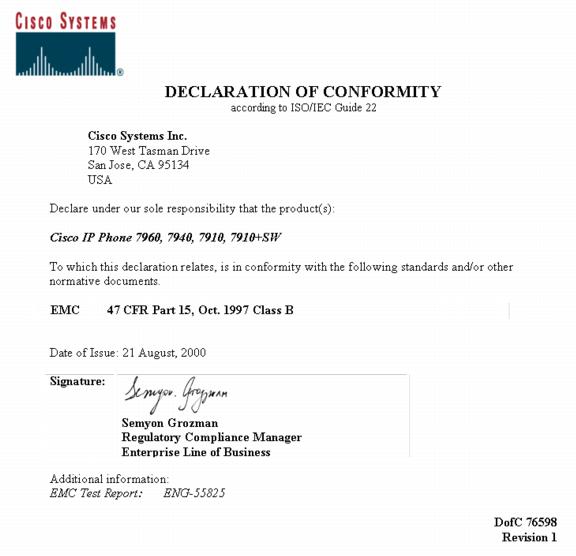
Figure C-1 contains the FCC Class B Declaration for the Cisco IP Phone 7960, 7940, 7910, and 7910+SW.
Figure C-1 FCC Class B Declaration
Connections Specifications
The Cisco SIP IP phone has two RJ-45 ports that each support 10/100 Mbps half- or full-duplex connections to external devices—the network port and access port. You can use either Category 3 or 5 cabling for 10 Mpbs connections, but use Category 5 for 100 Mbps connections. On both the LAN-to-phone port (left RJ-45 port facing the back of the phone) and PC-to-phone port (right port), use full-duplex to avoid collisions. Use the LAN-to-phone port to connect the phone to the network a LAN-to-phone jack. Use the PC-to-phone port to connect a network device, such as a computer, to the phone.
For a diagram identifying the different ports on the back of the Cisco SIP IP phone, see the "Connecting the Phone" section.
 Feedback
