Overview

Cisco Data Center Network Manager (DCNM) is a management system for Cisco NXOS-based storage fabrics. In addition to provisioning, monitoring, and troubleshooting the data center network infrastructure, the Cisco DCNM provides a comprehensive feature-set that meets the routing, switching, and storage administration needs of data centers. It streamlines the provisioning for the Programmable Fabric and monitors the SAN components.

Cisco DCNM provides a high level of visibility and control through a single web-based management console for Cisco Nexus Series Switches, Cisco MDS, and Cisco Unified Computing System (UCS) products. Cisco DCNM also includes Cisco DCNM-SAN client and Device Manager functionality.

This section contains the following sections:

Introduction

Cisco DCNM provides an alternative to the command-line interface (CLI) for switch configuration commands.

Cisco DCNM includes these management applications:

Cisco DCNM Web UI

Cisco DCNM Web UI allows operators to monitor and obtain reports for Cisco MDS and Nexus events, performance, and inventory from a remote location using a web browser. Licensing and discovery are part of the Cisco DCNM Web UI.

Performance Manager

Performance Manager presents detailed traffic analysis by capturing data with SNMP. This data is compiled into various graphs and charts that can be viewed on the Cisco DCNM Web UI.

Installation Options

Cisco DCNM software images are packaged with the Cisco DCNM installer, signature certificate, and signature verification script. Unzip the desired Cisco DCNM installer image ZIP file to a directory. Verify the image signature by following the steps in the README file. The installer from this package installs the Cisco DCNM software.

DCNM Open Virtual Appliance (OVA) Installer

This installer is available as an Open Virtual Appliance file (.ova). The installer contains a pre-installed OS, DCNM, and other applications needed for programmable fabric.

DCNM ISO Virtual Appliance (ISO) Installer

This installer is available as an ISO image file (.iso). The installer is a bundle of OS, DCNM, and other applications needed for dynamic fabric automation.


Note

If you are installing Cisco DCNM on SE, install the DCNM ISO Virtual Appliance (.iso) installer.


Deployment Options

You can deploy the Cisco DCNM installer in one of the following modes:

Standalone Server

All types of installers are packaged along with PostgreSQL database. The default installation steps for the respective installers result in this mode of deployment.

High Availability for Virtual Appliances

You can deploy the DCNM Virtual appliances, both OVA and ISO, in High Availability mode to have resilience in case of application or OS failures.

DCNM Computes

Compute nodes are scale out application hosting nodes that run resource-intensive services to provide services to the larger Fabric. When compute nodes are added, all services that are containers, run only on these nodes. This includes Config Compliance, Endpoint Locator, and Virtual Machine Manager.

DCNM in Clustered Mode

In a clustered mode, the Cisco DCNM Server with more compute nodes provides an architecture to expand resources, as you deploy more applications. The DCNM Servers do not run containerized applications. All applications that work in unclustered mode works in the clustered mode, also.

DCNM in Unclustered Mode

In unclustered mode, the Cisco DCNM runs some of its internal services as containers. Cisco DCNM leverages resources from the Standby node for running some containers applications. The Cisco DCNM Active and Standby nodes work together to extend resources to the overall functionality and deployment of DCNM and its applications. However, it has limited resources to run some of the advanced applications and to extend the system to deploy more applications delivered through the Cisco AppCenter.

Upgrading Cisco DCNM

Before Cisco DCNM Release 11.0(1), DCNM OVA, and ISO supported SAN functionality. From Cisco DCNM Release 11.3(1), you can install Cisco DCNM for SAN Deployment on both OVA and ISO virtual appliances. However, there is not upgrade path for SAN OVA\ISO.

From Release 11.3(1), Cisco DCNM OVA and ISO is supported for SAN functionality.

The following table summarizes the type of upgrade that you must follow to upgrade to Release 11.3(1).

Table 1. Type of Upgrade for Classic LAN, LAN Fabric, and IP for Media (IPFM) deployments

Current Release Number

Upgrade type to upgrade to Release 11.3(1)

11.2(1)

Inline Upgrade

11.1(1)

Inline Upgrade

11.0(1)

11.0(1) → 11.1(1) → 11.3(1)

  1. Upgrade to 11.1(1) using Inline Upgrade

  2. Upgrade from 11.1(1) to 11.3(1) using Inline Upgrade

10.4(2)

1

10.4(2) → 11.1(1) → 11.3(1)

  1. Upgrade to 11.1(1) using the DCNMUpgradeTool

  2. Upgrade from 11.1(1) to 11.3(1) using Inline Upgrade

1 (This upgrade path is not supported for Cisco DCNM Media Controller deployments)

System Requirements


Note

We recommend that you do not upgrade any underlying third-party software separately. All the necessary software components will be updated during the inline upgrade procedure. Upgrading the components outside of DCNM upgrade will cause performance issues.


This section describes the various system requirements for proper functioning of your Cisco DCNM, Release 11.3(1).

Java Requirements

The Cisco DCNM Server is distributed with JRE 11.0.2 into the following directory:

DCNM_root_directory/java/jdk11

Server Requirements

Cisco DCNM, Release 11.3(1), supports the Cisco DCNM Server on these 64-bit operating systems:

  • IP for Media, LAN Fabric, and Classic LAN Deployments:

    • Open Virtual Appliance (OVA) with an integrated CentOS Linux release 7.6

    • ISO Virtual Appliance (ISO) with an integrated CentOS Linux release 7.6

Cisco DCNM Release 11.3(1) supports the following databases:

  • PostgreSQL 9.4.5


Note

The ISO/OVA installation only supports the embedded PostgreSQL database.

From Release 11.2(1), Cisco DCNM supports the ISO installation on a bare-metal server (no hypervisor) on the following server platforms:

Server

Product ID (PID)

Recommended minimum memory, drive capacity, and CPU count 2

Cisco UCS C240M4

UCSC-C240-M4S

32G / 500G 16 vCPUs

Cisco UCS C240M4

UCSC-C240-M4L

32G / 500G 16 vCPUs

Cisco UCS C240 M5S

UCSC-C240-M5SX

32G / 500G 16 vCPUs

Cisco UCS C220 M5L

UCSC-C220-M5L

32G / 500G 16 vCPUs

2 Install the Cisco DCNM Compute node with 16vCPUs, 64G RAM, and 500GB hard disk. Ensure that you do not install the Compute node on 32G RAM server.

If you are deploying Network Insights applications on the Cisco DCNM Compute cluster, refer to the app-specific Release Notes for additional CPU/memory requirements for the Computes.


Note

Cisco DCNM can work on an alternative computing hardware as well, despite Cisco is only testing on Cisco UCS.


Supported Hypervisors

From Release 11.3(1), Cisco DCNM supports the running of the Cisco DCNM Server on the following hypervisors., for DCNM LAN Fabric and DCNM LAN Classic Deployments:

Hypervisor supported

Data Center Manager server application

Supported deployments

ESXi 6.7 P01

vCenter 6.7 P01

All

ESXi 6.5

vCenter 6.5

All

ESXi 6.0

vCenter 6.0

All

RedHat 7.6 KVM

Virtual Machine Manager (comes with RHEL 7.6)

  • LAN Fabric

  • Classic LAN

Hyper-V on Windows Server 2019

Hyper-V Manager (comes with Windows Server 2019)

  • LAN Fabric3

  • Classic LAN

3 This is supported with Native HA mode, and not in Cluster mode.

VMware Snapshot Support for Cisco DCNM

Snapshots capture the entire state of the virtual machine at the time you take the snapshot. You can take a snapshot when a virtual machine is powered on, powered off.


Note

vCenter server is mandatory to deploy the Cisco DCNM OVA Installer.


To take a snapshot on the VM, perform the following steps:

  1. Right-click the virtual machine the inventory and select Snapshots > Take Snapshot.

  2. In the Take Snapshot dialog box, enter a Name and description for the snapshot.

  3. Click OK to save the snapshot.

The following snapshots are available for VMs.

  • When VM is powered off.

  • When VM is powered on, and active.


Note

Cisco DCNM supports snapshots when VM is either powered on or powered off. DCNM doesn’t support snapshots when the Virtual Machine memory option is selected.


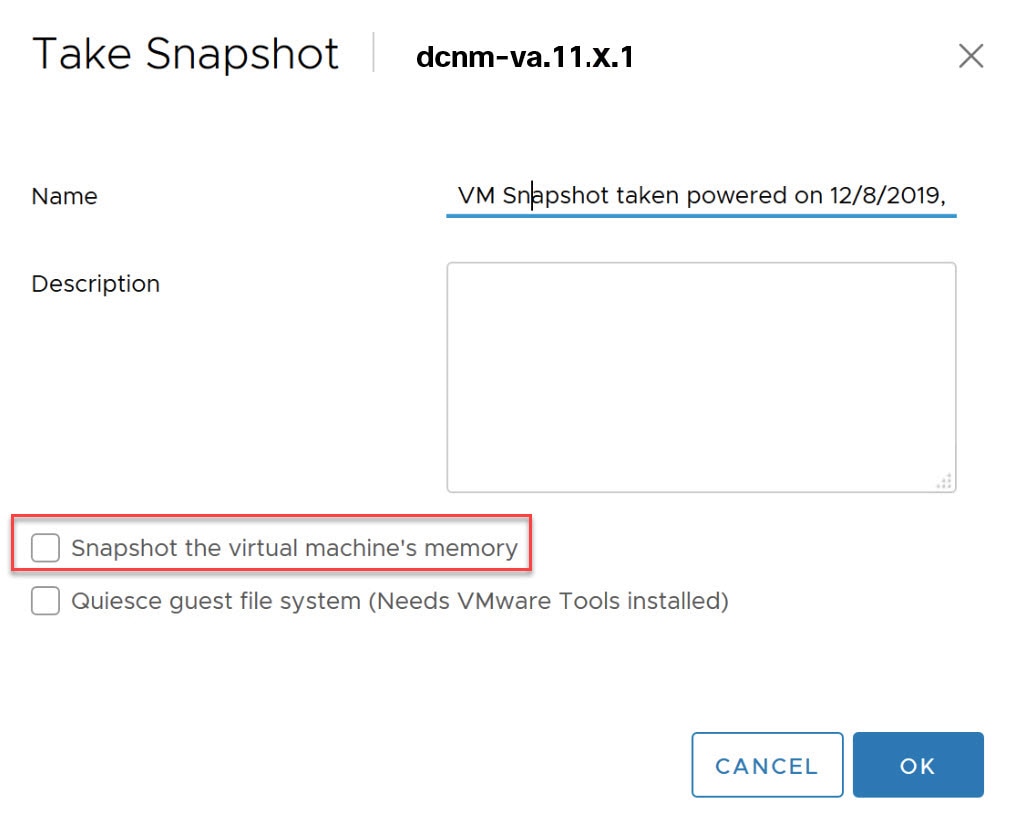
Note that the Snapshot the Virtual Machine's memory check box must not be selected, as shown in the following figure. However, it is grayed out when the VM is powered off.
You can restore VM to the state in a Snapshot.
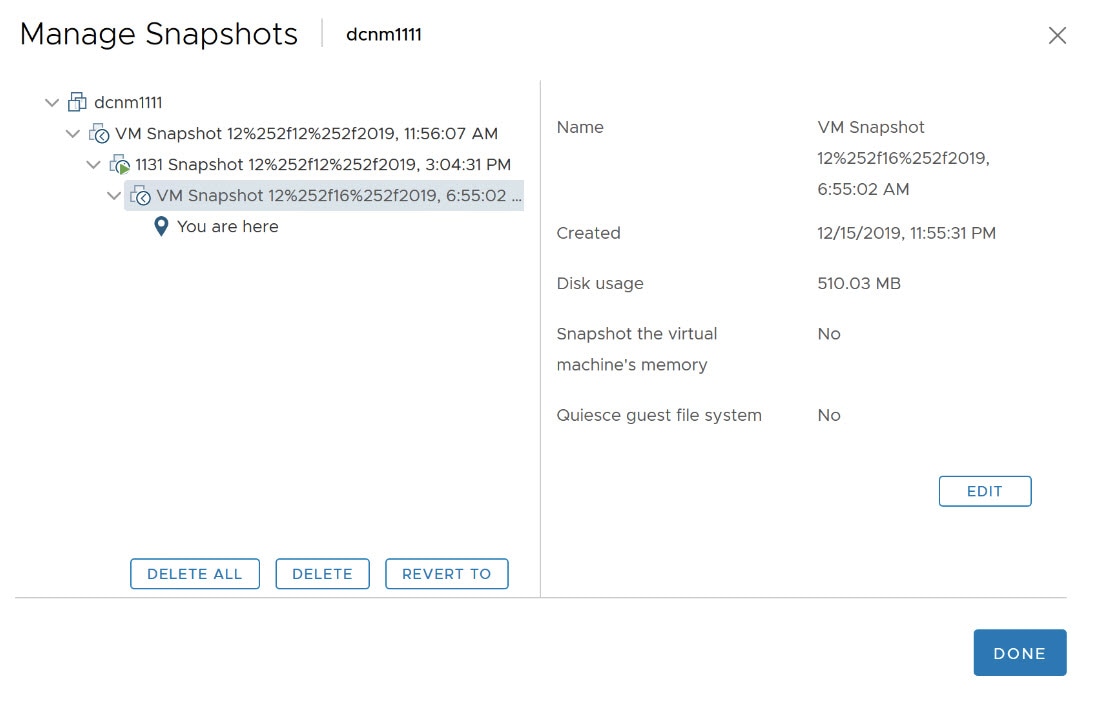
Right-click on the Virtual Machine and select Manage Snapshot. Select the snapshot to restore, and click Done.

Table 2. Snapshot Support for Classic LAN, LAN Fabric, Media Controller, and SAN OVA Deployments

VMware vSphere Hypervisor (ESXi)

6.0

6.5

6.7

6.7 P01

VMware vCenter Server

6.0

6.5

6.7

6.7 P01

Server Resource Requirements

Deployment Deployment Type Small (Lab or POC) Large (Production) Huge (Production) Compute

Classic LAN

  • OVA

  • ISO

CPU: 8 vCPUs

RAM: 24 GB

DISK: 500 GB

CPU: 16 vCPUs

RAM: 32 GB

DISK: 500 GB

CPU: 32vCPUs

RAM: 128 GB

DISK: 500 GB

CPU: 16 vCPUs

RAM: 64 GB

DISK: 500 GB


Note

For Huge and Compute deployments, you can add extra disk. The size of the disk can range from a minimum of 32GB to a maximum of 1.5TB.


You can add additional disk space to your DCNM set up. Logon to DCNM server using SSH. Extend the disk file system using appmgr system scan-disks-and-extend-fs command.

Supported Web Browsers

Cisco DCNM supports the following web browsers:

  • Google Chrome Version 79.0.3945.79

  • Mozilla Firefox Version 71.0 (32/64 bit)

  • Microsoft Internet Explorer Version 11.706 update version 11.0.120

Other Supported Software

The following table lists the other software that is supported by Cisco DCNM, Release 11.3(1).

Table 3. Other Supported Software

Component

Features

Security

  • ACS versions 4.0, 5.1, 5.5, and 5.8

  • ISE version 2.6

  • Telnet Disabled: SSH Version 1, SSH Version 2, Global Enforce SNMP Privacy Encryption.

  • Web Client Encryption: HTTPS with TLS 1, 1.1 and 1.2

  • TLS 1.3

OVA\ISO Installers

CentOS 7.6/Linux Kernel 3.10.x

Also, Cisco DCNM supports call-home events, fabric change events, and events that are forwarded by traps and email.

Qualified Security Certifications

Security Certifications Date run on DCNM 11.4(1)
Nessus 6/29/2020
Appscan 6/29/2020
Qualsys 6/29/2020