Cisco Fabric Manager Server Federation Overview
This chapter provides an overview of the Cisco Fabric Manager Server Federation features and includes the following sections:
• Cisco Fabric Manager Server Federation
•Federated Server Architecture
•Requirements and Prerequisites
•Software Licensing Requirements
Cisco Fabric Manager Server Federation
A Server Federation is a distributed system that includes a collection of intercommunicated servers or computers, which is utilized as a single, unified computing resource. With Fabric Manager Server federation, you can communicate with multiple servers together in order to provide scalability, and easy manageability of data and programs running within the federation. A federation of Fabric Manager Servers include several functional units such as Fabric Manager Server, embedded web servers, database and Fabric Manager Client that access the servers.
The Fabric Manager Server in the federation uses the same database to store and retrieve data. The database is shared among different servers to share common information. A Fabric Manager Client or Fabric Manager Web client can open fabrics from the Fabric Manager Server using the mapping table. A fabric can be moved from one logical server to another. A logical server also can be moved from one physical machine to another machine.
Federated Server Architecture
This section explains some key points about Federated Server architecture. There are four components in a federated environment: Fabric Manager Server, Fabric Manager Client, Fabric Manager Web Client and databases.
•Fabric Manager Server— Fabric Manager Server is a platform for advanced MDS monitoring, troubleshooting, and configuration capabilities. Fabric Manager Server provides centralized MDS management services and performance monitoring. SNMP operations are used to efficiently collect fabric information. Each computer configured as a Cisco Fabric Manager Server can monitor multiple Fibre Channel SAN fabrics. Up to 16 clients (by default) can connect to a single Cisco Fabric Manager Server concurrently.
•Fabric Manager Client— Cisco Fabric Manager Client is a Java and SNMP-based network fabric and device management tool with a GUI that displays real-time views of your network fabric, including Cisco Nexus 5000 Series switches, Cisco MDS 9000 Family switches and third-party switches, hosts, and storage devices.
•Fabric Manager Web client— Fabric Manager Web Client is a web-based application with which you can monitor Cisco MDS switch events, performance, and inventory from a remote location using a web browser.
•Database— Oracle 10g Enterprise Edition.
The Fabric Manager Servers and embedded web servers form a federation sharing a central database. Fabric Manager Client or Fabric Manager Web Client facilitates centralized management of the servers in a federation.
Figure 1-1
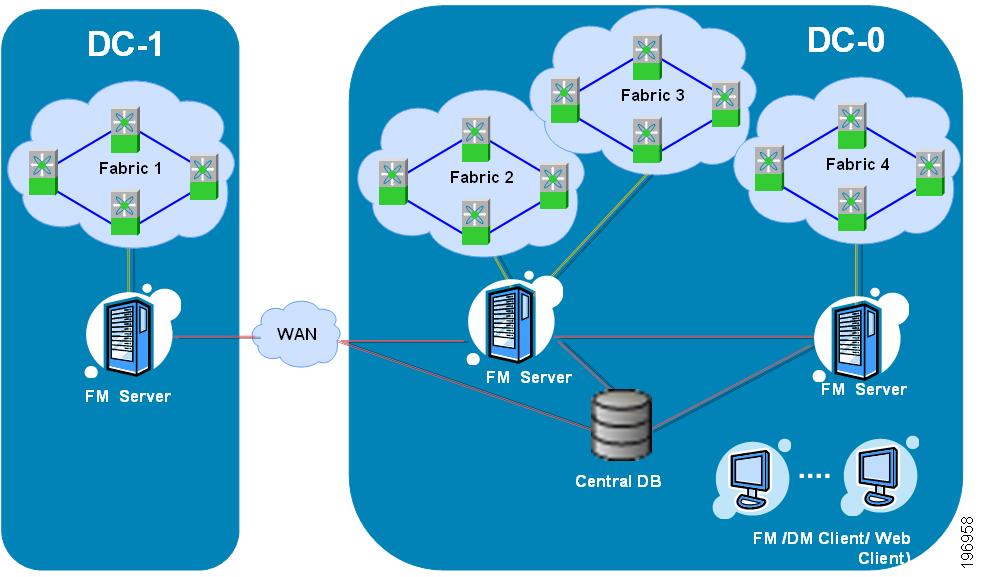
Federated Server Architecture
Fabric Manager Servers and the Fabric Manager Web Clients in the federation share a common database. The HTTP load balancer interfaces with the web servers to handle requests from web clients and the Fabric Manager desktop client will access Fabric Manager Servers in a federation through the federation proxy.
Figure 1-2
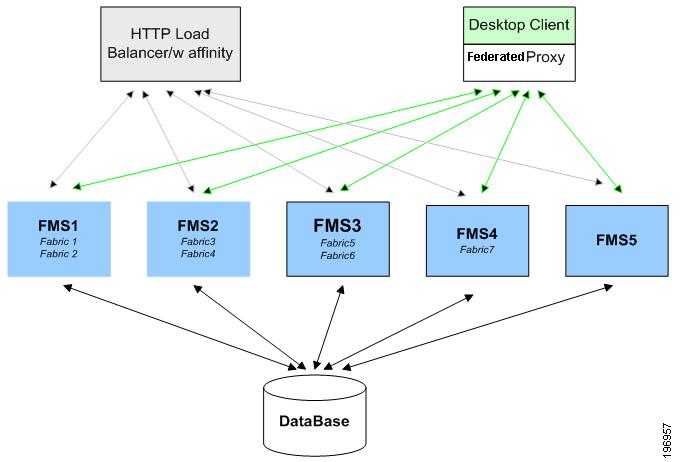
Federated Server Architecture
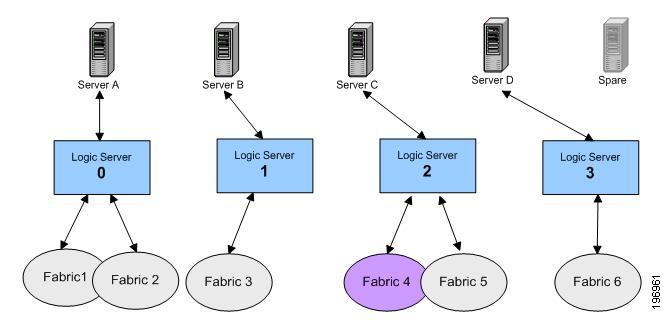
The relationships between physical server, logical server, and the fabrics are maintained by a centralized database. The mappings from logical to physical server as well as the mappings with the fabrics are managed by each Fabric Manager Server.
•Logical Server—Describes the functional layout - logically they appear to be different servers. In network topologies, a logical topology describes the paths that data can take across a network irrespective of how they are connected to each other.
•Physical Server— A physical server describes how the system is connected together in the physical world.
•Fabric— A fabric is similar to a network segment in a local area network. A typical Fibre Channel SAN fabric is made up of a number of Fibre Channel switches.
You can move fabrics from one logical server to another logical server. The logical servers also can be moved from one physical machine to another physical machine as well depending upon your resource constraints or requirements as shown in Figure 1-3. The mapping table entries should remain synchronized with the changes. This design helps to redistribute workloads, saves from manual failover, helps to optimize performance or scalability, and avoids collision of server IDs.
Figure 1-3
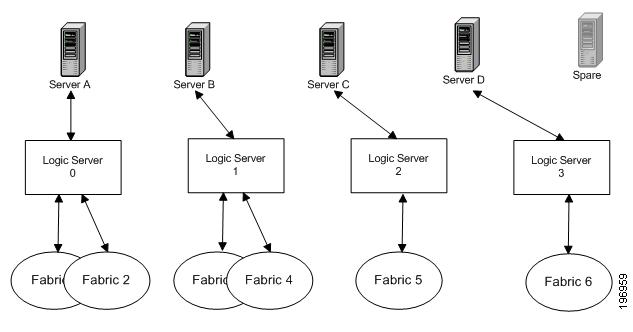
Federated Servers
Server IDs are assigned to the Fabric Manager Server when you install a Fabric Manager Server in the federation. The Installer checks for server ID conflicts with the mapping table in the shared database. The Fabric Manager Web Client or Fabric Manager Client can open fabrics from Fabric Manager Server using the mapping table. All Fabric Manager Servers communicates with the same database.
Figure 1-4
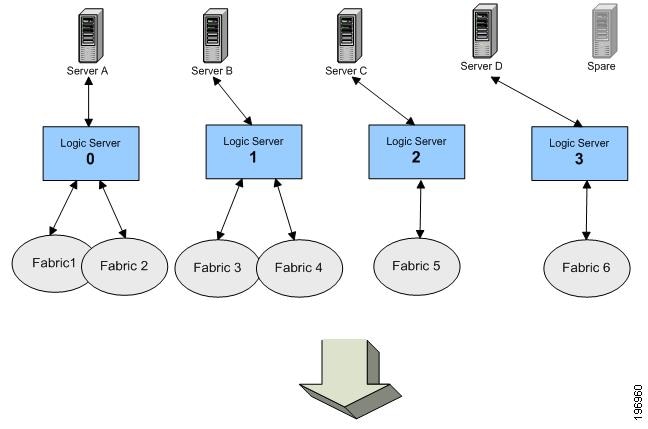
Moving Fabrics
Figure 1-5
Moving Fabrics
Terminology
The following table defines some of the common acronyms used in the federated server environment:
|
|
|
|---|---|
FM |
Fabric Manager. |
FMS |
Fabric Manager Server. |
PM |
Performance Manager. |
SAN |
Storage Area Network. |
Features and Capabilities
Fabric Manager Server federation has the following features and capabilities:
•Manage storage networking across all Cisco SAN and unified fabrics.
•Scalable performance through server federation for a multiple and large fabrics with many end-devices across different geographic data centers.
•Visibility of adjacent Ethernet networks and end-devices.
•Enables I/O convergence (FCoE).
•Real-time monitoring of SAN health status and network events.
•Visibility into performance, utilization, topology, and configuration details for more efficient planning and provisioning.
Fabric Manager Server License provides the following functionalities with out installing any additional software:
•Multiple Fabric Management
•Historical performance monitoring
•Performance prediction
•Summary reports
•Detailed drill-down reports
•Continuous health and event monitoring
•Roaming user profiles
•Fabric analyzer integration
Requirements and Prerequisites
The following prerequisites are required to set up Server Federation:
Software Licensing Requirements
Hardware Requirements
CPU Requirements
Dedicated dual processors@ 2.0 GHz for Oracle DB
Storage Requirements
Data file= 2GB (min) 20GB (max)
Backup & Restore: 6GB config file for 100 switches
Memory Requirements
2 GB (SGA) for a large setup.
Connectivity Requirements
Support up to 100 concurrent connections to sustain up to 10 server nodes in federated mode.
Software Requirements
Operating Systems
–Windows 2003 SP2
–Windows XP SP2
–Windows XP SP3
–Windows Vista SP1 (Enterprise edition)
–Red Hat Enterprise Linux AS Release 5
–Solaris (SPARC) 9 and 10
–VMWare ESX Server 3.5

Note Only Windows 2003 SP2 VM created on VMWare ESX Server 3.5 is supported.
Java
–Sun JRE and JDK 1.5(x) and 1.6(x) is supported
Browsers
–Internet Explorer 6.x and 7.0
–Firefox 3.0
–Mozilla 1.7 (packaged with Solaris 9)
Database
–Oracle Database 10g Express, Oracle 10g Enterprise Edition
–Oracle 11g Enterprise Edition
–PostgreSQL 8.2 (Windows and Red Hat Enterprise Linux AS Release 4)
–PostgreSQL 8.1 (Solaris 8, 9 and 10)
Java Database Connectivity (JDBC)
The Fabric Manager uses Oracle JDBC drivers ojdbc14.jar and ojdbc14.jar to access the Oracle database and store data. You can download the recommended version (10.2.0.1.0) of the ojdbc14.jar file, from the following link:
http://www.oracle.com/technology/software/tech/java/sqlj_jdbc/htdocs/jdbc_10201.html
Software Licensing Requirements
Fabric Manager Federated Server environment has the following license requirements:
Cisco Fabric Manager Server is licensed on a per switch basis. The following functions and features will be active only when you purchase the license.
•Federation and Multiple Fabric Management
•Historical performance monitoring
•Performance prediction
•Summary reports
•Detailed drill-down reports
•Continuous health and event monitoring
•Roaming user profiles
•Fabric analyzer integration
Note Server federation will not function on a trial license.
 Feedback