Supported Topologies

This appendix provides information about the topologies supported for the Cisco ACI Virtual Edge.


Important

Topologies not included in this appendix have not been tested and are not supported.

Note

For all topologies, we recommend using LACP wherever possible and supported by your hardware. We recommend using MAC pinning only when using LACP is not possible.

For a given ESXi host, that host can only be connected to a single pair of leaves in a vPC domain. This means in the case of a blade enclosure like a UCS B Series Chassis with Fabric Interconnects (FI), the fabric interconnects must be connected to the same vPC domain.


Direct Connection

This topology connects the ESXi hypervisor to the Cisco Application Centric Infrastructure Controller directly.
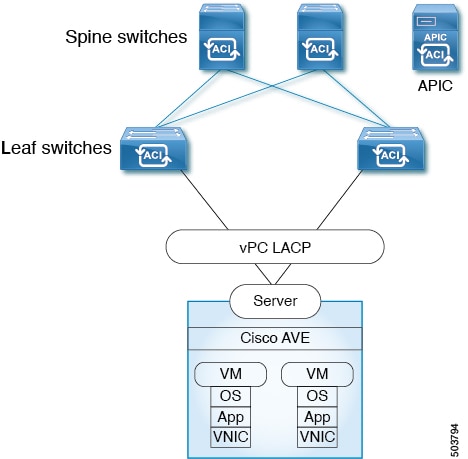
Figure 1. Direct Connection

To use this topology, you must configure port channel policy both under Fabric > Access Policies and when you create the Cisco Application Centric Infrastructure (ACI) Virtual Edge virtual machine manager (VMM) domain. See the following procedures:

Alternatively, you can configure the VMM domain profile using the configuration wizard under the Fabric wizard. If you do so, you do not need to configure the port channel using the procedure in the Cisco ACI Virtual Edge Configuration Guide.


Note

Do not use MAC pinning with a direct connection to a VPC leaf pair. Instead, use Link Aggregation Control Protocol (LACP) or enhanced LACP to provide redundancy and reliability. Using MAC pinning with a direct connection leads to traffic loss when peer leaf switches are rebooted. Use MAC Pinning only where virtual port channel (VPC) cannot be supported, such as for Cisco UCS Fabric Interconnects with southbound interfaces.

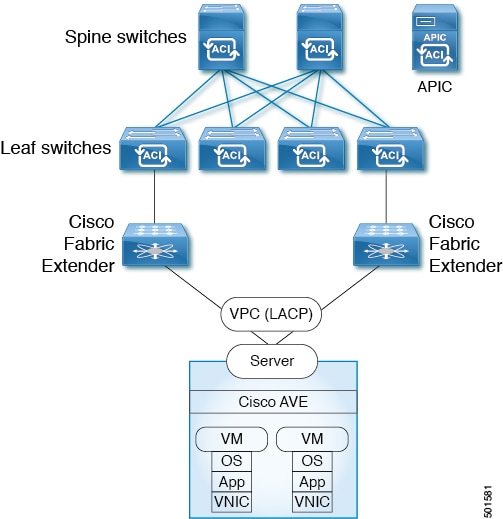
Cisco Fabric Extender

This topology connects the ESXi hypervisor to the Cisco APIC through a Fabric Extender (FEX). You can connect the ESXi to the following:

  • Multiple leaf switches using a virtual port channel (VPC)

  • A single leaf switch using a port channel (MAC pinning or LACP bundle)

In the following illustration, VPC is used as an example. You can use port channel instead.

Figure 2. Cisco Fabric Extender Topology


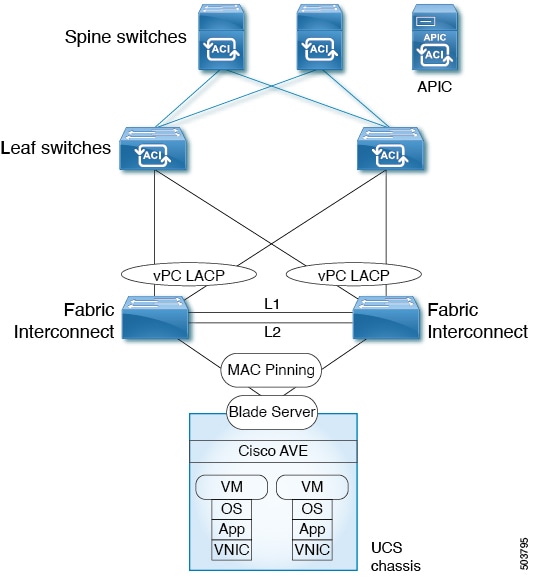
VPC with Cisco UCS Fabric Interconnects

This topology connects the ESXi hypervisor to the Cisco APIC using Cisco UCS Fabric Interconnects, VPCs, LACP, and MAC pinning.

Figure 3. VPC with Cisco UCS Fabric Interconnects Topology

In this topology, the Cisco ACI Virtual Edge can be configured only with MAC pinning. That is because Cisco UCS Fabric Interconnects don't support LACP or vLACP on the southbound ports towards the blade server. Therefore, the illustration shows MAC pinning only on the Cisco ACI Virtual Edge side. Each UCS Fabric Interconnect has a vPC Port-Channel to the same pair of leafs in a vPC Domain.

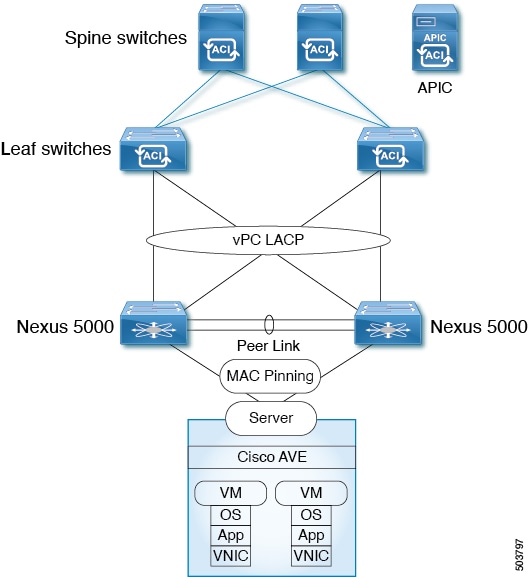
Dual-Side VPC with Cisco Nexus 5000 and MAC Pinning

This topology connects the ESXi hypervisor to a Cisco Application Policy Infrastructure Controller (APIC) through the Cisco Nexus 5000 switch, virtual port channels, and MAC pinning.

Figure 4. Dual-Side VPC with Cisco Nexus 5000 and MAC Pinning Topology

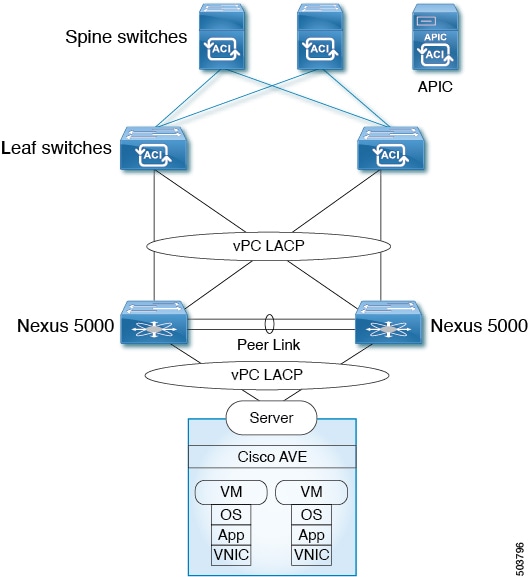
Dual-Side VPC with Cisco Nexus 5000 and VPC

This topology connects the ESXi hypervisor to a Cisco Application Policy Infrastructure Controller (APIC) through the Cisco Nexus 5000 switch and virtual port channels.

Figure 5. Dual-Side VPC with Cisco Nexus 5000 and VPC Topology

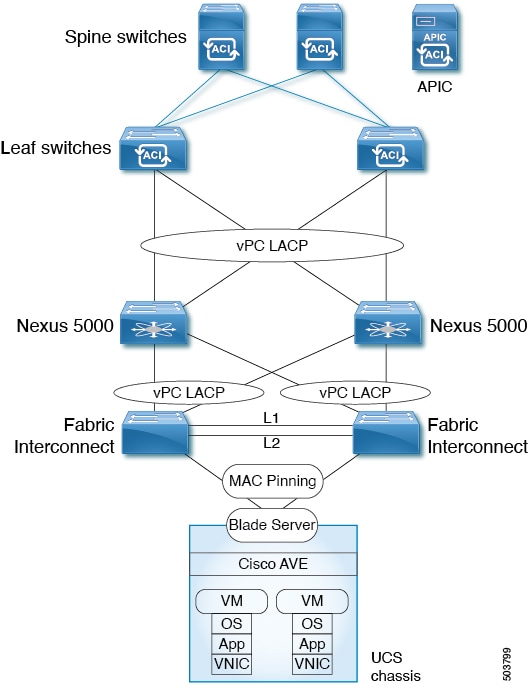
Single-Side VPC with Cisco Nexus 5000 and Cisco UCS Fabric Interconnects

This topology connects the ESXi hypervisor to the leaf switches using MAC pinning, directly or through Cisco Nexus 5000 switches and Cisco UCS Fabric Interconnects.

Figure 6. Single-Side VPC with Cisco Nexus 5000 and Cisco UCS Fabric Interconnects Topology

In this topology, the Cisco ACI Virtual Edge can be configured only with MAC pinning. That is because Cisco UCS Fabric Interconnects do not support LACP on the southbound ports toward the blade server. Therefore, the illustration shows MAC pinning only on the Cisco ACI Virtual Edge side.

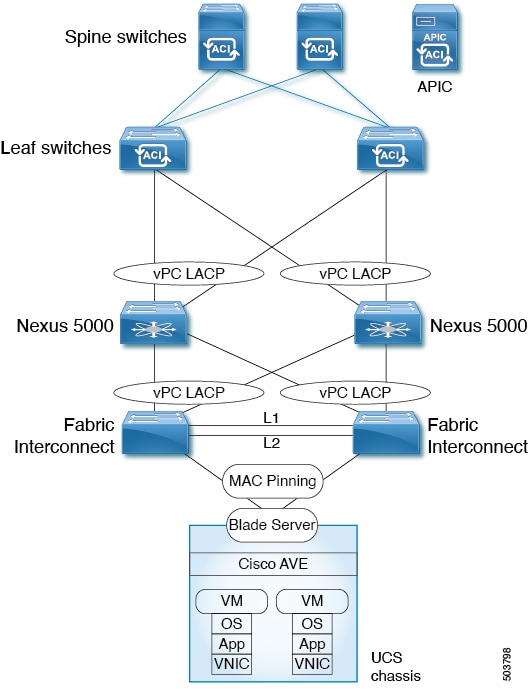
Dual-Side VPC with Cisco Nexus 5000 and Cisco UCS Fabric Interconnects

This topology connects the ESX hypervisor to the leaf switches using MAC pinning, directly or through Cisco Nexus 5000 switches and Cisco UCS Fabric Interconnects.

Figure 7. Dual-Side VPC with Cisco Nexus 5000 and Cisco UCS Fabric Interconnects Topology

In this topology, the Cisco ACI Virtual Edge can be configured only with MAC pinning. That is because Cisco UCS Fabric Interconnects do not support LACP on the southbound ports toward the blade server. Therefore, the illustration shows MAC pinning only on the Cisco ACI Virtual Edge side.