Preface
This document addresses the installation and configuration of Red Hat OpenShift. Installation of the Cisco PSC and Cisco UCS are addressed in other documents. The installation and configuration of Red Hat OpenShift in this document is defined specifically to create a solution for the ordering, provisioning and management of OpenShift services through the Cisco PSC. Users should be qualified in the installation and configuration of Red Hat OpenShift, Cisco PSC, and the Cisco Unified Computing System (UCS).
Document Objective and Scope
The two most critical problems facing IT departments today are the continuing costs of supporting legacy applications, and the need to be more responsive to service demands on a tight budget.
This document recognizes these two critical issues, and provides a solution that addresses the requirements for both with a single infrastructure for ordering, provisioning, and management of services. This design guide documents a solution providing OpenShift PaaS services through the Cisco PSC.
This design guide provides a comprehensive explanation of procedures required to provide Red Hat OpenShift services through the Cisco Prime Services Catalog. Details of system design and architecture to support the services are explained, including the deployment models for services, and guidelines for implementation and configuration. It is recommended that best practices be followed when deploying Red Hat OpenShift services through the Cisco Prime Services Catalog.
This design and implementation guide provides a comprehensive first step to delivering IaaS and PaaS services through the Cisco PSC.
Business Dilemma
IT departments are facing two critical problems today:
- Legacy Applications/Server Sprawl—This is the cost of inefficiency when legacy applications continue to run in a dedicated environment. Servers are running with low utilization, and expanding access to the application requires increasing the number of servers.
- Increasing Velocity for IT Services and Changes—The demand for changes to IT services is accelerating at a pace never before experienced in the history of computing while the IT budget is stagnant at best, and, in some cases, shrinking.
IT managers need to solve these two critical issues, while also reaching the objectives for high availability for existing day-to-day operations.
- Solving the IT dilemma requires a strategy that addresses the migration of legacy applications and the tools required to meet the increasing IT demands. A single, comprehensive solution for IaaS, PaaS, and IT services is required.
- The IaaS strategy provides the environment for rapid resource deployment. Virtualizing legacy applications lowers server costs, and controls server sprawl. However, IaaS alone cannot solve the problem. IaaS provides a container, which are useful for applications, tools for managing applications, or an environment for building services. PaaS provides the environment and development tools for building new services and expanding existing services.
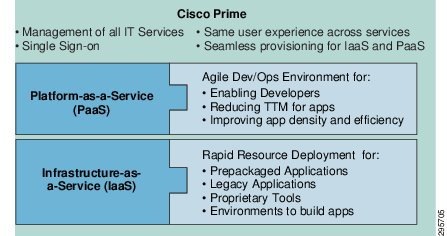
- PaaS is a tool kit, not a complete solution. To be effective, PaaS needs to be deployed and managed because without effective management, this tool kit can experience the same issues as other applications running in dedicated environments. Solving the IT dilemma (Figure 3-1) requires an environment that provisions, configures, and manages both IaaS and PaaS services through a single pane-of-glass; provides the same user experience for managing both IaaS and PaaS; and seamlessly and dynamically provides IaaS services for instantiation and expansion of PaaS services.
Figure 3-1 Solving the IT Dilemma
The solution presented in this document offers IT departments a dual technology approach to solving the IT dilemma.
- PaaS services are provided for the migration of legacy applications to the cloud environment, reducing costs, controlling server sprawl, and improving efficiency for legacy applications.
- PaaS services are provided as the tool kit to turbo-charge the DevOps world. The value of PaaS is derived not from replacing existing tools, but by offering enhanced capabilities in tools already familiar to the developer.
- Businesses that solve today's IT dilemma will meet the challenges, and excel at satisfying their customers' needs.
- Businesses continuing on the legacy IT path will find it more difficult and expensive to compete.
 Feedback