About the Remediation Module
With the APIC/Secure Firewall Remediation Module, when an attack on your network is detected by the Management Center, the offending endpoint can be completely quarantined in the Application Policy Infrastructure Controller (APIC) so that no further traffic is allowed to go in or out of that endpoint. The following figure shows the relationship between the Management Center and the APIC when the remediation module is installed.
Compatibility
The following table shows the compatibility between the APIC/Secure Firewall Remediation Module, Management Center, and APIC.
|
Remediation module version compatible with.... |
Management Center version |
APIC version |
|---|---|---|
|
2.0.2 |
7.0 and later |
5.1(1h) |
Infected endpoint
The following figure shows how the APIC/Secure Firewall Remediation Module reacts when an infected endpoint is detected.
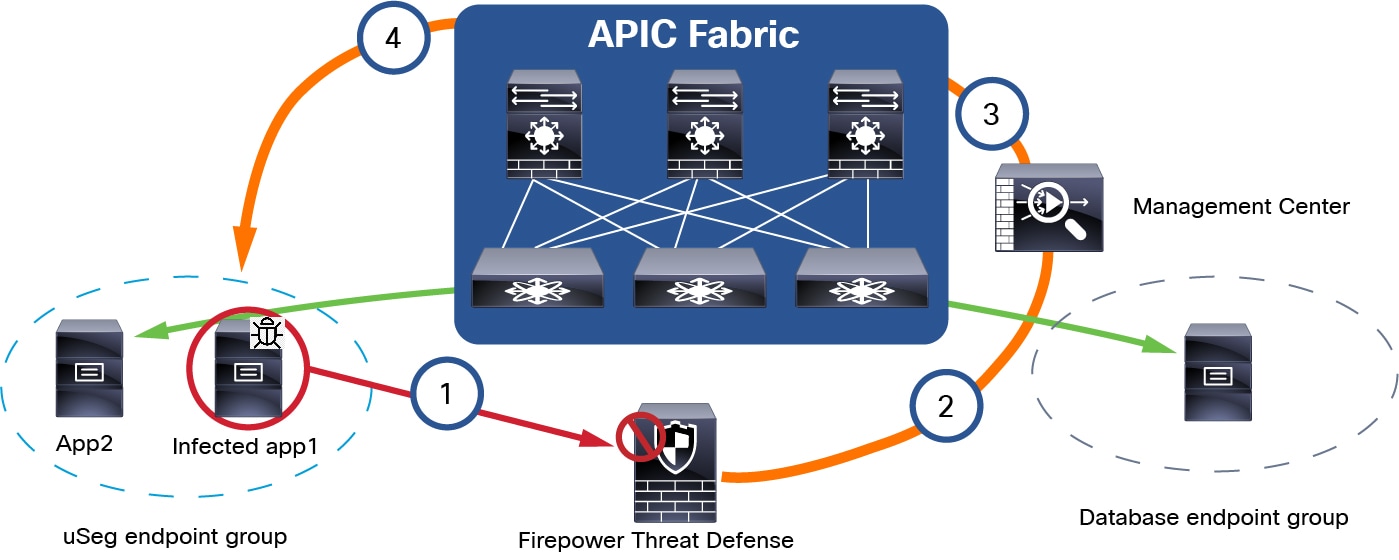
The process is as follows:
-
An endpoint with an infected application in an endpoint group (endpoint group on the left) launches an attack on another endpoint in Database EPG. The attack is blocked inline by a managed device (such as a physical or virtual device running Firepower Threat Defense).
-
An attack event is generated and sent to the Management Center. The attack event includes information about the infected endpoint.
-
The attack event triggers the remediation module for APIC, which used the APIC northbound (NB) API to contain the infected endpoint in the ACI fabric.
-
The APIC quickly contains or quarantines the infected application workload into an isolated microsegment (uSeg) EPG.
Because App2 is not infected, it can still communicate on the network.
You can quarantine a source endpoint, a destination endpoint, or both, as the next section shows.
Quarantine source and/or destination endpoints
On detection of an infected endpoint, you can optionally quarantine either the source endpoint, the destination endpoint, or both, as the following figure shows.
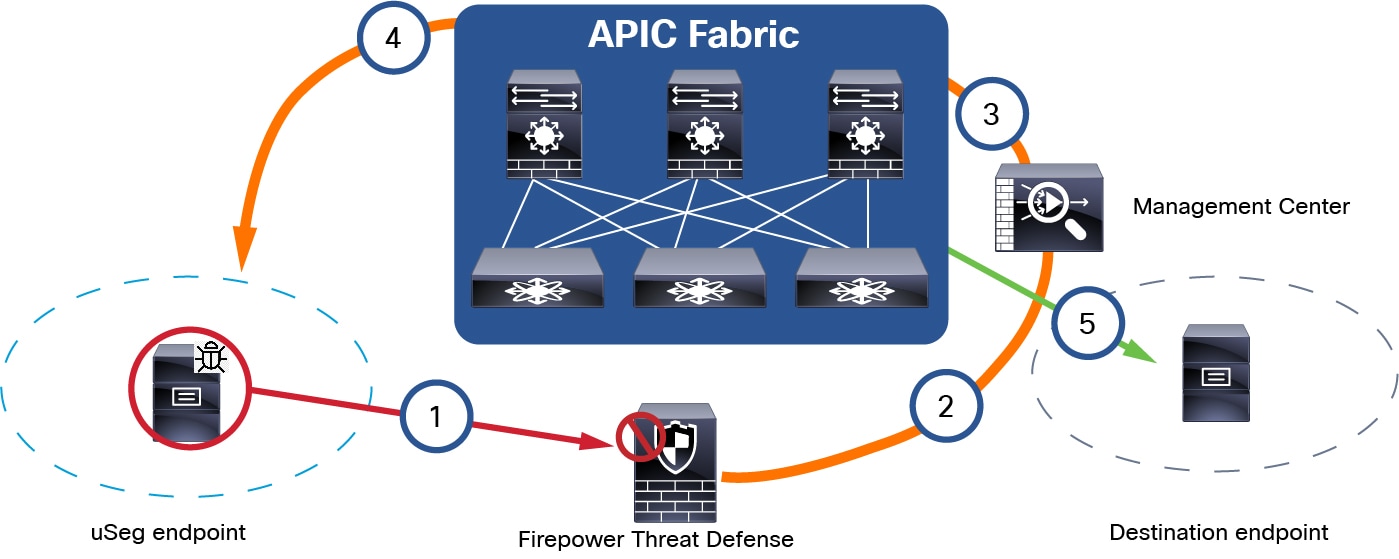
The figure shows the following process:
-
An endpoint with an infected application in an endpoint group (EPG) launches an attack on another endpoint in another EPG. The attack is blocked inline by a managed device (such as a physical or virtual device running Firepower Threat Defense).
-
An attack event is generated and sent to the Management Center. The attack event includes information about the infected endpoint.
-
The attack event triggers the remediation module for APIC, which used the APIC northbound (NB) API to contain the infected endpoint in the ACI fabric.
-
The APIC quickly contains or quarantines the infected application workload into an isolated microsegment (uSeg) EPG.
-
Depending on the configuration, the source endpoint can be quarantined, the destination endpoint can be quarantined, or both endpoints can be quarantined.
The example shown in the figure quarantines the uSeg (source) endpoint but not the destination endpoint.
Always allow traffic to critical servers
You can allow traffic to and from critical servers, even if those servers are passing traffic that could be considered suspicious. Use this option with caution but it can be useful in situations where you always want to allow this traffic.
The following figure shows an example.
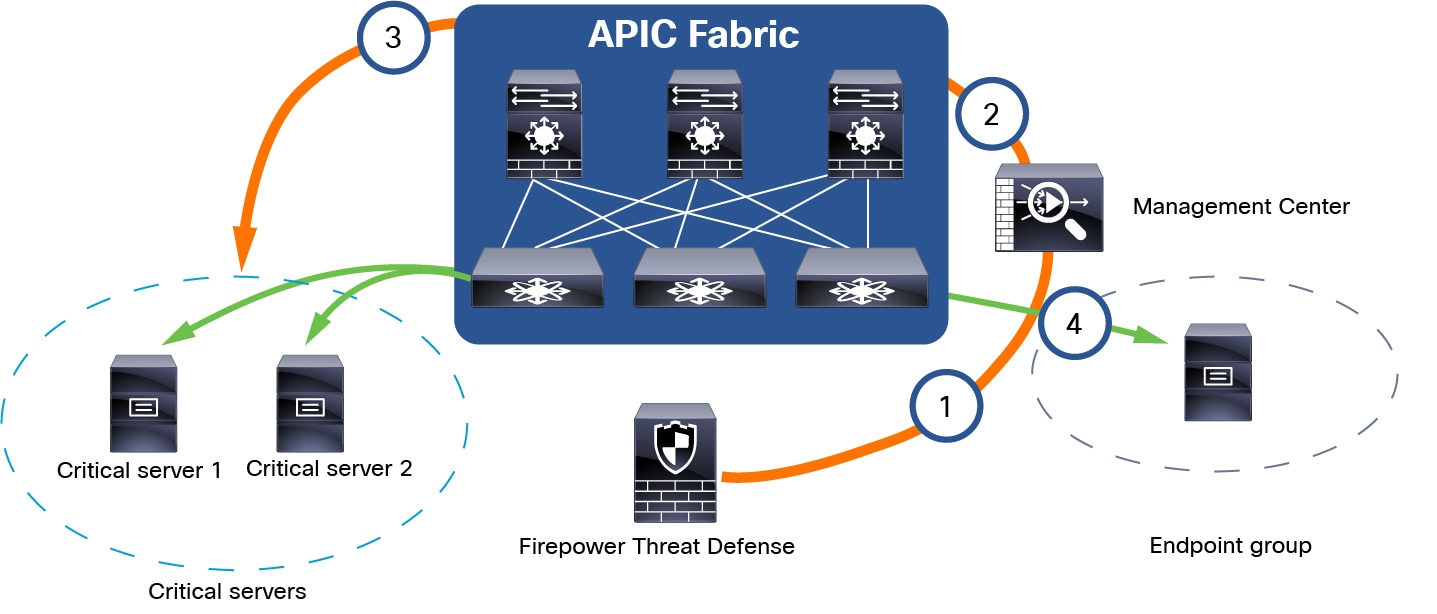
The figure shows the following process:
-
An endpoint in
Endpoint groupsends traffic to servers designated asCritical Servers. (You specify these servers by IP address.) -
The Management Center ignores this traffic, even if it matches correlation rules.
-
Traffic is always allowed to and from the critical servers in
Endpoint groupandCritical Servers, regardless of what the traffic contains.
 Feedback