- Preface
- Cisco NCS Documentation Roadmap
- New and Changed Information
- Setting Up Optical Service Channel Cards
- Provisioning Optical Amplifier Cards
- Provisioning Multiplexer and Demultiplexer Cards
- Setting Up Tunable Dispersion Compensating Units
- Provisioning Protection Switching Module
- Provisioning Reconfigurable Optical Add/Drop Cards
- Provisioning Transponder and Muxponder Cards
- Configuring GE_XP, 10GE_XP, GE_XPE, and 10GE_XPE Cards Using PCLI
- Pseudo Command Line Interface Reference
- Card Features
- Card Specifications
- Administrative and Service States
- SNMP
- CTC Enhancements, Operations, and Shortcuts
- Network Element Defaults
- Index
Provisioning Optical Amplifier Cards
This chapter describes the optical amplifier cards used in Cisco NCS networks and related procedures.
For card safety and compliance information, refer to the Regulatory Compliance and Safety Information for Cisco NCS Platforms document.
Optical amplifier card architecture includes an optical plug-in module with a controller that manages optical power, laser current, and temperature control loops. An amplifier also manages communication with the control card and operation, administration, maintenance, and provisioning (OAM&P) functions such as provisioning, controls, and alarms.
- Applications of Amplifiers
- Card Compatibility
- OPT-PRE Amplifier Card
- OPT-BST and OPT-BST-E Amplifier Card
- OPT-AMP-17-C Card
- OPT-AMP-C Card
- OPT-RAMP-C and OPT-RAMP-CE Cards
- RAMAN-CTP and RAMAN-COP Cards
- OPT-EDFA-17 and OPT-EDFA-24 Cards
- EDRA-1-xx and EDRA-2-xx Cards
Applications of Amplifiers
The following amplifiers can be configured as booster or preamplifiers:
The amplifier functions as a booster amplifier by default. The amplifier role is automatically configured when the CTP NE update configuration file is loaded in CTC. The amplifier role can also be manually modified.
For more information about the supported configurations and network topologies, see and
Card Compatibility
The following table lists the Cisco Transport Controller (CTC) software compatibility for each optical amplifier card.
|
Card Name |
R10.0 |
R10.1 |
R10.3 |
R10.5 |
R10.5.2/R10.6.1 |
|---|---|---|---|---|---|
|
OPT-PRE |
NCS 2002, NCS 2006 |
NCS 2002, NCS 2006 |
NCS 2002, NCS 2006 |
NCS 2002, NCS 2006 |
NCS 2002, NCS 2006, NCS 2015 |
|
OPT-BST |
NCS 2002, NCS 2006 |
NCS 2002, NCS 2006 |
NCS 2002, NCS 2006 |
NCS 2002, NCS 2006 |
NCS 2002, NCS 2006, NCS 2015 |
|
OPT-BST-E |
NCS 2002, NCS 2006 |
NCS 2002, NCS 2006 |
NCS 2002, NCS 2006 |
NCS 2002, NCS 2006 |
NCS 2002, NCS 2006, NCS 2015 |
|
OPT-AMP-17-C |
NCS 2002, NCS 2006 |
NCS 2002, NCS 2006 |
NCS 2002, NCS 2006 |
NCS 2002, NCS 2006 |
NCS 2002, NCS 2006, NCS 2015 |
|
OPT-AMP-C |
NCS 2002, NCS 2006 |
NCS 2002, NCS 2006 |
NCS 2002, NCS 2006 |
NCS 2002, NCS 2006 |
NCS 2002, NCS 2006, NCS 2015 |
|
OPT-RAMP-C |
NCS 2002, NCS 2006 |
NCS 2002, NCS 2006 |
NCS 2002, NCS 2006 |
NCS 2002, NCS 2006 |
NCS 2002, NCS 2006 |
|
OPT-RAMP-CE |
NCS 2006 |
NCS 2006 |
NCS 2006 |
NCS 2006 |
NCS 2006 |
|
RAMAN-CTP |
NCS 2002, NCS 2006 |
NCS 2002, NCS 2006 |
NCS 2002, NCS 2006 |
NCS 2002, NCS 2006, NCS 2015 |
NCS 2002, NCS 2006, NCS 2015 |
|
RAMAN-COP |
NCS 2002, NCS 2006 |
NCS 2002, NCS 2006 |
NCS 2002, NCS 2006 |
NCS 2002, NCS 2006, NCS 2015 |
NCS 2002, NCS 2006, NCS 2015 |
|
OPT-EDFA-17 |
NCS 2002, NCS 2006 |
NCS 2002, NCS 2006 |
NCS 2002, NCS 2006 |
NCS 2002, NCS 2006, NCS 2015 |
NCS 2002, NCS 2006, NCS 2015 |
|
OPT-EDFA-24 |
NCS 2002, NCS 2006 |
NCS 2002, NCS 2006 |
NCS 2002, NCS 2006 |
NCS 2002, NCS 2006, NCS 2015 |
NCS 2002, NCS 2006, NCS 2015 |
|
EDRA-1-26 |
NCS 2006 |
NCS 2006 |
NCS 2006 |
NCS 2006, NCS 2015 |
NCS 2006, NCS 2015 |
|
EDRA-1-35 |
NCS 2006 |
NCS 2006 |
NCS 2006 |
NCS 2006, NCS 2015 |
NCS 2006, NCS 2015 |
|
EDRA-2-26 |
NCS 2006 |
NCS 2006 |
NCS 2006 |
NCS 2006, NCS 2015 |
NCS 2006, NCS 2015 |
|
EDRA-2-35 |
NCS 2006 |
NCS 2006 |
NCS 2006 |
NCS 2006, NCS 2015 |
NCS 2006, NCS 2015 |
OPT-PRE Amplifier Card
 Note | For OPT-PRE card safety labels, see Class 1M Laser Product Cards. |
The OPT-PRE is a C-band, DWDM, two-stage erbium-doped fiber amplifier (EDFA) with midamplifier loss (MAL) that can be connected to a dispersion compensating unit (DCU). The OPT-PRE is equipped with a built-in variable optical attenuator (VOA) that controls the gain tilt and can also be used to pad the DCU to a reference value. You can install the OPT-PRE in Slots 1 to 6 and 12 to 17. The card is designed to support up to 80 channels at 50-GHz channel spacing. The OPT-PRE features include:
-
Amplified spontaneous emissions (ASE) compensation in fixed gain mode
-
Four signal photodiodes to monitor the input and output optical power of the two amplifier stages through CTC
-
An optical output port for external monitoring
Note
The optical splitter has a ratio of 1:99, resulting in about 20 dB-lower power at the MON port than at the COM TX port.
For more information about the OPT-PRE Amplifier card, see http://www.cisco.com/en/US/prod/collateral/optical/ps5724/ps2006/product_data_sheet0900aecd800e4d24.html and Card Features.
Related Procedures for OPT-PRE Card
The following is the list of procedures and tasks related to the configuration of the OPT-PRE card:
OPT-BST and OPT-BST-E Amplifier Card
Note | For OPT-BST and OPT-BST-E cards safety labels, see "Class 1M Laser Product Cards". . |
The OPT-BST is designed to ultimately support up to 80 channels at 50-GHz channel spacing. The OPT-BST-E amplifier card is a gain-enhanced version of the OPT-BST card. It is designed to support up to 80 channels at 50-GHz channel spacing. Both the cards are C-band, DWDM EDFA with optical service channel (OSC) add-and-drop capability. When an OPT-BST or an OPT-BST-E is installed, an OSCM card is also needed to process the OSC. You can install the OPT-BST and OPT-BST-E cards in Slots 1 to 6 and 12 to 17. The card’s features include:
-
Gain range of 5 to 20 dB in constant gain mode and output power mode for an OPT-BST card
-
Gain range of 8 to 23 dBm with the tilt managed at 0 dBm in constant gain mode and output power mode for an OPT-BST-E card
-
Enhanced gain range of 23 to 26 dBm with unmanaged tilt with OPT-BST-E card
-
Optical Safety Remote Interlock (OSRI), a CTC software feature capable of shutting down optical output power or reducing the power to a safe level (automatic power reduction)
-
Automatic laser shutdown (ALS), a safety mechanism used in the event of a fiber cut. For information about using the card to implement ALS in a network, see "Network Optical Safety". .
Note
The optical splitters each have a ratio of 1:99. The result is that MON TX and MON RX port power is about 20 dB lower than COM TX and COM RX port power.
For more information about the OPT-BST and OPT-BST-E Amplifier cards, see http://www.cisco.com/en/US/prod/collateral/optical/ps5724/ps2006/product_data_sheet0900aecd802be30a.html and Card Features.
Related Procedures for OPT-BST and OPT-BST-E Cards
The following is the list of procedures and tasks related to the configuration of the OPT-BST and OPT-BST-E cards:
OPT-AMP-17-C Card
Note | For OPT-AMP-17-C safety labels, see "Class 1M Laser Product Cards".. |
The OPT-AMP-17-C is a 17-dB gain, C-band, DWDM EDFA amplifier/preamplifier with OSC add-and-drop capability. It supports 80 channels at 50-GHz channel spacing in the C-band (that is, the 1529 nm to 1562.5 nm wavelength range). When the system has an OPT-AMP-17-C installed, an OSCM card is needed to process the OSC. You can install the OPT-AMP-17-C in Slots 1 to 6 and 12 to 17.
-
Standard gain range of 14 to 20 dB at startup when configured as a preamplifier
-
Standard gain range of 20 to 23 dB in the transient mode when configured as a preamplifier
-
Gain range of 14 to 23 dB (with no transient gain range) when configured as a booster amplifier
For more information about the OPT-AMP-17-C card, see http://www.cisco.com/en/US/prod/collateral/optical/ps5724/ps2006/product_data_sheet0900aecd800e4d24.html and Card Features.
Related Procedures for OPT-AMP-17-C Card
The following is the list of procedures and tasks related to the configuration of the OPT-AMP-17-C card:
-
NTP-G143 Import the Cisco Transport Planner NE Update Configuration File
-
DLP-G140 View Power Statistics for Optical Amplifier, 40-SMR1-C, and 40-SMR2-C Cards
-
NTP-G160 Modify OPT-AMP-L, OPT-AMP-17-C, OPT-AMP-C, OPT-RAMP-C, OPT-RAMP-CE, 15454-M-RAMAN-CTP, 15454-M-RAMAN-COP, OPT-EDFA-17, and OPT-EDFA-24 Card Line Settings and PM Thresholds
OPT-AMP-C Card
Note | For OPT-AMP-C card safety labels, see "Class 1M Laser Product Cards". |
The OPT-AMP-C card is a 20-dB output power, C-band, DWDM EDFA amplifier/preamplifier. It contains mid-stage access loss for a Dispersion Compensation Unit (DCU). To control gain tilt, a VOA is used. The VOA can also be used to attenuate the signal to the DCU to a reference value. The amplifier module also includes the OSC add (TX direction) and drop (RX direction) optical filters.
The OPT-AMP-C card supports 80 channels at 50-GHz channel spacing in the C-band (that is, the 1529 nm to 1562.5 nm wavelength range). When the system has an OPT-AMP-C card installed, an OSCM card is needed to process the OSC. You can install the OPT-AMP-C card in Slots 1 to 6 and 12 to 17. Slots 2 to 6 and Slots 12 to 16 are the default slots for provisioning the OPT-AMP-C card as a preamplifier, and slots 1 and 17 are the default slots for provisioning the OPT-AMP-C card as a booster amplifier.
For more information about the OPT-AMP-C card, see http://www.cisco.com/en/US/prod/collateral/optical/ps5724/ps2006/prod_data_sheet0900aecd8072b322.html. and Card Features.
Related Procedures for OPT-AMP-C Card
The following is the list of procedures and tasks related to the configuration of the OPT-AMP-C card:
-
NTP-G143 Import the Cisco Transport Planner NE Update Configuration File
-
DLP-G140 View Power Statistics for Optical Amplifier, 40-SMR1-C, and 40-SMR2-C Cards
-
NTP-G160 Modify OPT-AMP-L, OPT-AMP-17-C, OPT-AMP-C, OPT-RAMP-C, OPT-RAMP-CE, 15454-M-RAMAN-CTP, 15454-M-RAMAN-COP, OPT-EDFA-17, and OPT-EDFA-24 Card Line Settings and PM Thresholds
OPT-RAMP-C and OPT-RAMP-CE Cards
Note | For OPT-RAMP-C or OPT-RAMP-CE card safety labels, see "Class 1M Laser Product Cards". |
The OPT-RAMP-C card is a double-slot card that improves unregenerated sections in long spans using the span fiber to amplify the optical signal. Different wavelengths in C-band receive different gain values. To achieve Raman amplification, two Raman signals (that do not carry any payload or overhead) are required to be transmitted on the optical fiber because the gain generated by one signal is not flat. The energy of these Raman signals transfer to the higher region of the spectrum thereby amplifying the signals transmitted at higher wavelengths. The Raman effect reduces span loss but does not compensate it completely.
When the Raman optical powers are set correctly, a gain profile with limited ripple is achieved. The wavelengths of the Raman signals are not in the C-band of the spectrum (used by MSTP for payload signals). The two Raman wavelengths are fixed and always the same. Due to a limited Raman gain, an EDFA amplifier is embedded into the card to generate a higher total gain. An embedded EDFA gain block provides a first amplification stage, while the mid stage access (MSA) is used for DCU loss compensation.
The OPT-RAMP-CE card is a 20 dBm output power, gain-enhanced version of the OPT-RAMP-C card and is optimized for short spans. The OPT-RAMP-C and OPT-RAMP-CE cards can support up to 80 optical transmission channels at 50-GHz channel spacing over the C-band of the optical spectrum (wavelengths from 1529 nm to 1562.5 nm). To provide a counter-propagating Raman pump into the transmission fiber, the Raman amplifier provides up to 500 mW at the LINE-RX connector. The OPT-RAMP-C or OPT-RAMP-CE card can be installed in Slots 1 to 5 and 12 to 16, and supports all network configurations. However, the OPT-RAMP-C or OPT-RAMP-CE card must be equipped on both endpoints of a span.
The Raman total power and Raman ratio can be configured using CTC. The Raman configuration can be viewed on the Maintenance > Installation tab.
The features of the OPT-RAMP-C and OPT-RAMP-CE card include:
-
Raman section: 500 mW total pump power for two pump wavelengths
-
Gain Flattening Filter (GFF) for Raman plus EDFA ripple compensation
-
Hardware output signals for LOS monitoring at input photodiodes
For more information about the OPT-RAMP-C and OPT-RAMP-CE cards, see http://www.cisco.com/en/US/prod/collateral/optical/ps5724/ps2006/data_sheet_c78-500925.html. and Card Features.
Related Procedures for OPT-RAMP-C and OPT-RAMP-CE Cards
The following is the list of procedures and tasks related to the configuration of the OPT-RAMP-C and OPT-RAMP-CE cards:
-
NTP-G201 Configure the Raman Pump on an MSTP Link
-
DLP-G140 View Power Statistics for Optical Amplifier, 40-SMR1-C, and 40-SMR2-C Cards
-
NTP-G160 Modify OPT-AMP-L, OPT-AMP-17-C, OPT-AMP-C, OPT-RAMP-C, OPT-RAMP-CE, 15454-M-RAMAN-CTP, 15454-M-RAMAN-COP, OPT-EDFA-17, and OPT-EDFA-24 Card Line Settings and PM Thresholds
RAMAN-CTP and RAMAN-COP Cards
Note | The RAMAN-CTP and RAMAN-COP cards are supported in R9.3.02 and later. |
Note | For RAMAN-CTP and RAMAN-COP cards safety labels, see "Class 1M Laser Product Cards". |
The single-slot RAMAN-CTP and RAMAN-COP cards support counter and co-propagating Raman amplification on very long unregenerated spans.
The cards manage up to 96 ITU-T 50-GHz spaced channels over the C-band of the optical spectrum (wavelengths from 1528.77 nm to 1566.72 nm). The counter-propagating RAMAN-CTP card is the master unit. The co-propagating RAMAN-COP card is the slave unit and can be used only when the counter-propagating unit is present. The RAMAN-CTP card and the RAMAN-COP card must be installed in adjacent slots for Cisco NCS 2000 Series chassis. However, these adjacent slots must not be used to install two RAMAN-CTP or two RAMAN-COP cards.
The RAMAN-CTP card can be calibrated either manually or using the Automatic Raman Pump Amplification (ARPC) procedure from the Card tab in the Provisioning panel in CTC. When the RAMAN-COP card is used, the RAMAN-CTP card can be calibrated only using the manual option. ARPC is supported only in the NCS Flex package.
The features of the RAMAN-CTP and RAMAN-COP cards include:
-
Raman section: 1000 mW total pump power for four pumps and two wavelengths
-
Embedded distributed feedback (DFB) laser at 1568.77 nm to be used for optical safety and link continuity (in RAMAN-CTP card only)
-
Photodiodes to enable monitoring of the DFB laser and signal power (in RAMAN-CTP card only)
-
Hardware managed automatic laser shutdown (ALS) for optical laser safety
-
Hardware output signals for loss of signal (LOS) monitoring at input photodiodes
-
Raman pump back reflection detector to check for excessive back reflection
- Important Notes Regarding Patchcord Installation
- RAMAN-CTP and RAMAN-COP Cards Power Monitoring
- Related Procedures for RAMAN-CTP and RAMAN-COP Cards
Important Notes Regarding Patchcord Installation
Warning Avoid eye or skin exposure to direct or scattered radiation.
Two E-2000 PS PC to F-3000s SM PC patchcords are shipped with the RAMAN-CTP card.
One E-2000 PS PC to E-2000 PS PC patchcord is shipped with the RAMAN-COP card.
Connect the F-3000s SM PC connector to the RAMAN-CTP card before connecting the E2000 PS PC high optical power connector to the card.
The F-3000s SM PC connector is mechanically and optically compatible with the LC PC connectors and the LC PC mating adapters. If the connectors are clean, the standard connectors and the F-3000s SM PC connectors can be used for optical power of 250 mW and higher.
RAMAN-CTP and RAMAN-COP Cards Power Monitoring
Physical photodiodes P1 through P10 monitor the power for the RAMAN-CTP card.
Physical photodiodes P3 through P6 monitor the power for the RAMAN-COP card.
The PM parameters for the power values are listed at Optics and 8b10b PM Parameter Definitions.
For information on the associated TL1 AIDs for the optical power monitoring points, see the “CTC Port Numbers and TL1 Aids” section in Cisco ONS SONET TL1 Command Guide, Release 9.8.
For more information about the RAMAN-CTP and RAMAN-COP cards, see http://www.cisco.com/en/US/prod/collateral/optical/ps5724/ps2006/data_sheet_c78-658538.html and Card Features.
Related Procedures for RAMAN-CTP and RAMAN-COP Cards
 Caution | During a software upgrade, do not unplug the RAMAN-CTP or RAMAN-COP card fibers or connectors. The ends of unterminated fibers or connectors emit invisible laser radiation. |
The following is the list of procedures and tasks related to the configuration of the RAMAN-CTP and RAMAN-COP cards:
-
NTP-G201 Configure the Raman Pump on an MSTP Link
-
DLP-G140 View Power Statistics for Optical Amplifier, 40-SMR1-C, and 40-SMR2-C Cards
-
NTP-G160 Modify OPT-AMP-L, OPT-AMP-17-C, OPT-AMP-C, OPT-RAMP-C, OPT-RAMP-CE, 15454-M-RAMAN-CTP, 15454-M-RAMAN-COP, OPT-EDFA-17, and OPT-EDFA-24 Card Line Settings and PM Thresholds
-
NTP-G184 Create a Provisionable Patchcord
-
DLP-G690 Configure the Raman Pump Using Manual Day-0 Installation
OPT-EDFA-17 and OPT-EDFA-24 Cards
Note | For OPT-EDFA-17 and OPT-EDFA-24 card safety labels, see "Class 1M Laser Product Cards". |
The OPT-EDFA-17 and OPT-EDFA-24 cards are C-band, DWDM EDFA amplifiers/preamplifiers with 20-dBm output powers. These cards do not contain mid-stage access loss for a Dispersion Compensation Unit (DCU). The OPT-EDFA-17 and OPT-EDFA-24 cards provide a noise-figure optimized version of the EDFA amplifiers to cope with new modulation formats like PM-DQPSK, which do not need dispersion compensation. To control gain tilt, a VOA is used. The amplifier module also includes the OSC add (TX direction) and drop (RX direction) optical filters.
The OPT-EDFA-17 and OPT-EDFA-24 cards share the same hardware platform and firmware architecture but differ in their operative optical gain range, which is 17 dB and 24 dB respectively.
The OPT-EDFA-17 and OPT-EDFA-24 cards are true variable gain amplifiers, offering an optimal equalization of the transmitted optical channels over a wide gain range. They support 96 channels at 50-GHz channel spacing in the C-band (that is, 1528.77 nm to 1566.72 nm wavelength range). When an ONS 15454 has an OPT-EDFA-17 or OPT-EDFA-24 card installed, an OSCM card is needed to process the OSC. You can install the OPT-EDFA-17 or OPT-EDFA-24 card in Slots 1 to 6 and 12 to 17. Slots 2 to 6 and Slots 12 to 16 are the default slots for provisioning the OPT-EDFA-17 and OPT-EDFA-24 cards as a preamplifier. Slots 1 and 17 are the default slots for provisioning the OPT-EDFA-17 and OPT-EDFA-24 cards as a booster amplifier.
The main functionalities of the OPT-EDFA-17 and OPT-EDFA-24 cards are:
-
Amplification of the input signal at COM-RX port towards LINE-TX port through a true-variable gain EDFA block
-
Monitoring of the LINE input or output signal with 1% TAP splitters
The features of the OPT-EDFA-17 and OPT-EDFA-24 cards are:
-
ASE compensation in Constant Gain and Constant Output Power modes
-
Gain range with gain tilt control of 5 to 17 dB (for OPT-EDFA-17 card) and 12 to 24 dB (for OPT-EDFA-24 card)
-
Extended gain range (with uncontrolled tilt) of 17 to 20 dB (for OPT-EDFA-17 card) and 24 to 27 dB (for OPT-EDFA-24 card)
For more information about the OPT-EDFA-17 and OPT-EDFA-24 cards, see http://www.cisco.com/en/US/prod/collateral/optical/ps5724/ps2006/data_sheet_c78-658542.html and Card Features.
- OPT-EDFA-17 and OPT-EDFA-24 Cards Power Monitoring
- Related Procedures for OPT-EDFA-17 and OPT-EDFA-24 Cards
OPT-EDFA-17 and OPT-EDFA-24 Cards Power Monitoring
Physical photodiodes PD1 through PD6 monitor the power for the OPT-EDFA-17 and OPT-EDFA-24 cards.
Related Procedures for OPT-EDFA-17 and OPT-EDFA-24 Cards
The list of procedures and tasks related to the configuration of the OPT-EDFA-17 and OPT-EDFA-24 cards are:
-
NTP-G143 Import the Cisco Transport Planner NE Update Configuration File
-
NTP-G31 Install the DWDM Dispersion Compensating Units
-
DLP-G140 View Power Statistics for Optical Amplifier, 40-SMR1-C, and 40-SMR2-C Cards
-
NTP-G160 Modify OPT-AMP-L, OPT-AMP-17-C, OPT-AMP-C, OPT-RAMP-C, OPT-RAMP-CE, 15454-M-RAMAN-CTP, 15454-M-RAMAN-COP, OPT-EDFA-17, and OPT-EDFA-24 Card Line Settings and PM Thresholds
-
NTP-G107 Remove Permanently or Remove and Replace DWDM Cards
EDRA-1-xx and EDRA-2-xx Cards
(Cisco NCS 2006 and Cisco NCS 2015)
Note | For EDRA-1-xx and EDRA-2-xx card safety labels, see the section, Class 1M Laser Product Cards. |
The double-slot EDRA-1-xx and EDRA-2-xx cards are erbium-doped Raman amplifiers that support Raman amplification on long unregenerated spans.
The cards manage up to 96 ITU-T 50 GHz spaced channels over the C-band of the optical spectrum (wavelengths from 1528.77 nm to 1566.72 nm). The cards can be installed in Slots 2 to 16 in the Cisco NCS 2015 chassis and Slots 2 to 6 in the Cisco NCS 2006 chassis. The OSC pluggable used with the cards is ONS-SC-OSC-18.0=.
For more information about the EDRA-1-xx and EDRA-2-xx cards, see http://www.cisco.com/en/US/solutions/collateral/ns340/ns394/ns398/ns406/data_sheet_c78-729313.html.
- EDRA Workflow Diagram
- EDRA-1-xx and EDRA-2-xx Cards Power Monitoring
- Related Procedures for EDRA-1-xx and EDRA-2-xx Cards
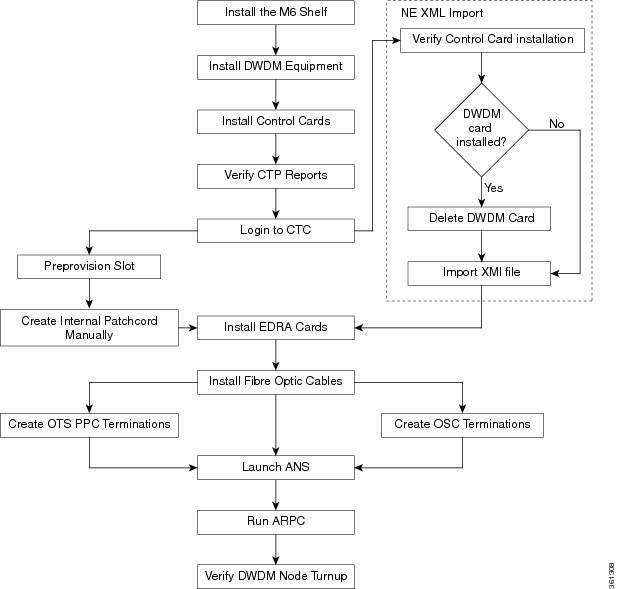
EDRA Workflow Diagram
This figure shows the workflow diagram of the EDRA card. The diagram depicts the tasks required to configure the EDRA card.
EDRA-1-xx and EDRA-2-xx Cards Power Monitoring
The following table lists the physical photodiodes that monitor the power for the EDRA-1-xx and EDRA-2-xx cards.
|
Photodiode |
CTC Type Name |
Calibrated to Port |
|---|---|---|
|
PD1 |
Remnant Pump Input power |
LINE-TX |
|
PD2 |
OSC Add Input Power |
OSC-RX |
|
PD3 |
EDFA1 Input Power |
LINE-RX |
|
PD4 |
EDFA1 Output Power |
COM-TX |
|
PD5 |
EDFA2 Input Power |
COM-RX |
|
PD6 |
EDFA2/LINE-TX Output Power |
LINE-TX |
|
PD7 |
OSC Drop Output Power |
LINE-TX |
|
PD11 |
Pump λ1 in-fibre Output Power |
LINE-RX |
|
PD12 |
Pump λ2 in-fibre Output Power |
LINE-RX |
|
PD13 |
Pump λ3 in-fibre Output Power |
LINE-RX |
|
PD14 |
Pump λ4 in-fibre Output Power |
LINE-RX |
|
PD15 |
Total Pump in-fibre Output Power |
LINE-RX |
|
PD16 |
Back-Reflected Pump Power |
LINE-RX |
|
PD17 |
OTDR2-L Input Power |
OTDR2-L-RX |
The PM parameters for the power values are listed at Optics and 8b10b PM Parameter Definitions.
For information on the associated TL1 AIDs for the optical power monitoring points, see the “CTC Port Numbers and TL1 Aids” section in Cisco NCS 2000 Series TL1 Command Guide.
Related Procedures for EDRA-1-xx and EDRA-2-xx Cards
The list of procedures and tasks related to the configuration of the EDRA-1-xx and EDRA-2-xx cards are:
-
NTP-G30 Install the DWDM Cards
-
NTP-G34 Install Fiber-Optic Cables on DWDM Cards and DCUs
-
NTP-G38 Provision OSC Terminations
-
NTP-G37 Run Automatic Node Setup
-
NTP-G51 Verify DWDM Node Turn Up
-
DLP-G140 View Power Statistics for Optical Amplifier, 40-SMR1-C, and 40-SMR2-C Cards
-
NTP-G160 Modify OPT-AMP-L, OPT-AMP-17-C, OPT-AMP-C, OPT-RAMP-C, OPT-RAMP-CE, 15454-M-RAMAN-CTP, 15454-M-RAMAN-COP, OPT-EDFA-17, and OPT-EDFA-24 Card Line Settings and PM Thresholds
-
NTP-G184 Create a Provisionable Patchcord
 Feedback