- Overview
- Getting Started
- Configuring RBAC
- Configuring Primary Authentication
- Configuring Trusted Points
- Configuring VM Managers
- Configuring System Profiles
- Configuring Tenants
- Configuring Service Policies and Profiles
- Configuring Device Policies and Profiles
- Configuring Managed Resources
- Integrating with DCNM
- Configuring Administrative Operations
Overview
This section contains the following topics:
Prime Network Services Controller Overview
The dynamic nature of cloud environments requires organizations to apply and enforce frequent changes to networks. These networks can consist of thousands of virtual services elements, such as firewalls, load balancers, routers, and switches. Cisco Prime Network Services Controller simplifies operations with centralized, automated multi-device and policy management for Cisco network virtual services. For the latest Prime Network Services Controller release updates and overview, see the corresponding Prime Network Services Controller data sheet.
Cisco Prime Network Services Controller (Prime Network Services Controller) is the primary management element for Cisco Nexus 1000V (Nexus 1000V) Switches and Services that can enable a transparent, scalable, and automation-centric network management solution for virtualized data center and hybrid cloud environments. Nexus 1000V switches and services deliver a highly secure multitenant environment by adding virtualization intelligence to the data center network. These virtual switches are built to scale for cloud networks. Support for Virtual Extensible LAN (VXLAN) helps enable a highly scalable LAN segmentation and broader virtual machine (VM) mobility.
Prime Network Services Controller enables the centralized management of Cisco virtual services to be performed by an administrator, through its GUI, or programmatically through its XML API. Prime Network Services Controller is built on an information-model architecture in which each managed device is represented by its subcomponents (or objects), which are parametrically defined. This model-centric approach enables a flexible and simple mechanism for provisioning and securing virtualized infrastructure using Cisco VSG security services.
With Cisco Nexus 1000V InterCloud, the enterprise network can be securely extended to the cloud, with its enterprise network and security configurations such as VLANs and policies extended to the cloud. Using Prime Network Services Controller, workloads can be migrated from the enterprise data center to the public cloud while retaining the same IP addresses and other networking parameters, thus avoiding the need to redesign the application.
Using Prime Network Services Controller, workloads in the public cloud can use the same security policies as their counterparts in the enterprise data center. System administrators get the policy consistency and network visibility that they require while retaining control of the cloud environment as a transparent extension of the enterprise data center.
With Prime Network Services Controller, customers have a unified view of the workloads across the enterprise data center (private cloud) and public cloud. They can select and migrate workloads from the enterprise data center to the public cloud.
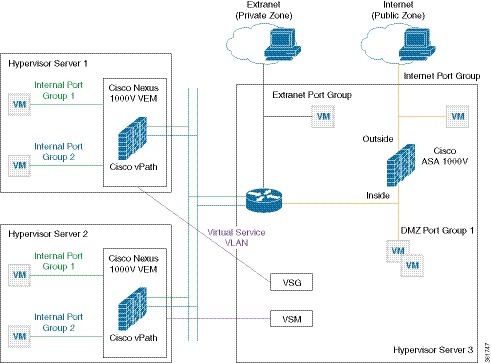
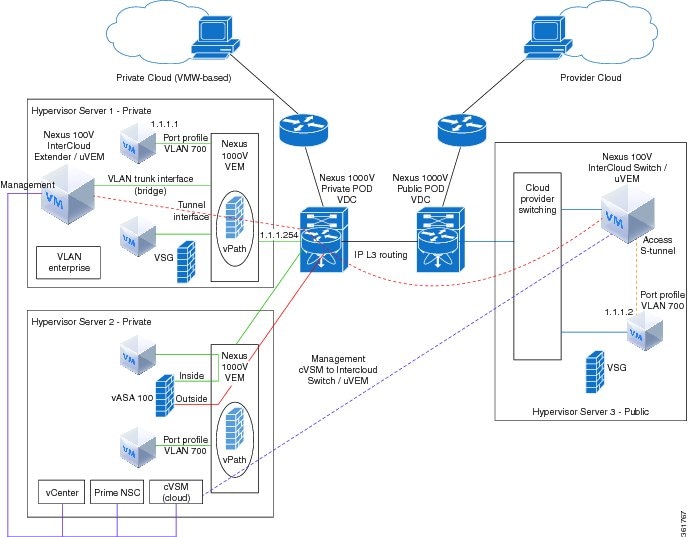
Topology Examples
The following figures show virtual data center and InterCloud topology examples.
Features and Benefits
The following table lists the features and benefits of using Prime Network Services Controller.
 Feedback