- Introducing CWCS
- FAQs and Programming Hints
- Understanding the CWCS Directory Structure
- Understanding the CWCS Execution Environment
- Getting Started with CWCS
- Using Shared Services
- Using the CiscoWorks Home Page
- Using Web Servers and Servlet Engines
- Integrating Applications with CMIC
- Using the Security System
- Using the Database APIs
- Using Backup and Restore
- Using the Core Client Registry
- Using the Device Credentials Repository
- Using the Core Logging API
- Adding Online Help
- Using the Daemon Manager
- Using the Job and Resource Manager
- Using Event Services Software
- Using the Event Distribution System
- Using the Installation Framework
- Using the Java Plug-in
- Using the Diagnostic and Support Utilities
- Using SNMP Services
- Using NT Services
- Using Device Center
- Using Product Instance Device Mapping
- Integrating Applications with Device Selector
- Using Per-Product Services
- Using Object Grouping Services
- Using the Common Services Transport Mechanism
- Using Package Support Updater
- Using Common Incremental Device Support
- Using the Licensing APIs
- Glossary
Using SNMP Services
CWCS provides support for SNMPv1, SNMPv2c, and SNMPv3.
SNMPv3 support is new in this version of CWCS. SNMP v3 support enhances the security of SNMP operation over the existing support for the SNMPv1/v2c model. It provides the degree of authentication and privacy required to perform network management operations securely.
CWCS SNMPv3 support allows you to:
• Address threats like information modification, masquerade, and disclosure and message stream modification.
•Do SNMP requests using SNMPv3.
•Automatically discover SNMP engine parameters.
•Get and Set SNMPv3 engine parameters.
•Handle SNMPv3-related error conditions.
•Set the number of outstanding requests.
•Automatically re-localize keys.
•Use existing support for SNMPv1/SNMPv2c.
The following topics describe how to use CWCS SNMP Services with your application:
For basic information on CWCS SNMP Services, see the "About SNMP Service Components" section on page 6-15.
For more information about CWCS SNMP Services, see:
•SNMPOnJava: Changes for SNMPv3 (authNoPriv)DS: EDCS-309325
Why SNMPv3?
SNMPv3 is included in this release of CWCS to address threats not addressed in the existing SNMPv1/v2c model:
•Information Modification: An entity can alter an in-transit message generated by an authorized entity in such a way as to effect unauthorized management operations, including the setting of object values.
•Masquerade: Management operations not authorized for some user may be attempted by assuming the identity of an authorized user.
•Disclosure: An entity can eavesdrop on the exchanges between managed agents and a management station and thereby learn the values of managed objects or learn of trap events.
•Message Stream Modification: The SNMP is designed to operate over a connection- less transport service, which may operate over any sub-network service.There is a threat that SNMP messages could be reordered,delayed,or duplicated to effect unauthorized management operations.
The SNMPv3 security model addresses the above threats in the following ways:
• Verify that each received SNMP message has not been modified during its transmission through the network.
•Verify the identity of the user who generates the SNMP requests.
•Detect received SNMP messages requesting or containing management information, whose time of generation was not recent.

Note For more information on the User-based Security Model (USM) for SNMPv3, refer to RFC 3414.
How SNMP Support Works
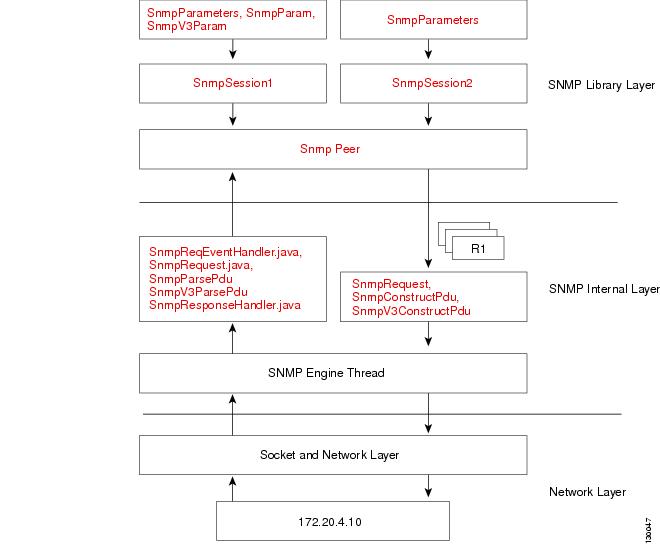
Figure 24-1 shows a high-level system flow for CWCS support of SNMP. The names of classes that were changed to handle SNMPv3 features are shown in red.
Figure 24-1 CWCS Support for SNMP
Using CWCS SNMP Services
CWCS SNMPv3 allows the user to work in the authNoPriv mode of the SNMPv3 security model.This mode provides packet-level security, integrity protection, and replay protection. SNMPv3 support is enabled automatically by passing an SNMPv3 credential to the SNMPOnJava library. The flow of SNMPv3 is intermingled with that of SNMP v1/v2c.
CWCS SNMPv1/v2c/v3 support is provided in the SNMPOnJava library.This library provides a series of APIs for applications to use.The SNMPOnJava library is divided into two main sections:
•The main library: Contains the bulk of the main classes dealing with SNMP. For a summary of the classes in this library, see the "About the SNMP Classes in the Main Library" section.
•The futureapi: Contains credentials-oriented classes and future extensions. For a summary of the classes in this library, see the "About the SNMP Classes in the Futureapi" section.
For details on each of the classes available in the SNMPOnJava library, see: http://mspring-u10.cisco.com/cvw/MOJO/packages.html.
The main features of CWCS support for SNMPv3 include:
•SNMPv3 is available for all applications.
•New APIs are available to get user credentials from applications.
•Applications can directly calculate the localized key from the user password.
•Applications can compute the local notion of an Agent's engine time.
•Automatic re-localization of keys.
•New APIs to expose the SNMPv3-engine-related parameters and localized keys to applications.
•Applications can pass SNMP-engine parameter information and localized keys to the library.
•Backward compatibility with the existing SNMP v1/v2c library.
Note SNMP engine parameters are SnmpEngineID, SnmpEngineTime, SnmpEngineBoots, and local notion of Agent's time.
About the SNMP Classes in the Main Library
The main library contains the classes shown in Table 24-1.
.
About the SNMP Classes in the Futureapi
The futureapi library contains the classes shown in Table 24-1.
 Feedback