- MPLS LDP Graceful Restart
- NSF/SSO - MPLS LDP and LDP Graceful Restart
- ISSU MPLS Clients
- MPLS Traffic Engineering�RSVP Graceful Restart
- NSF/SSO�MPLS TE and RSVP Graceful Restart
- Configuring NSF/SSO�MPLS VPN
- SSO and ISSU - MPLS VPN 6VPE and 6PE
- AToM Graceful Restart
- NSF/SSO�Any Transport over MPLS and AToM Graceful Restart
- L2VPN Pseudowire Redundancy
- Finding Feature Information
- Contents
- Prerequisites for NSF/SSO—MPLS LDP and LDP Graceful Restart
- Restrictions for NSF/SSO—MPLS LDP and LDP Graceful Restart
- Information About NSF/SSO—MPLS LDP and LDP Graceful Restart
- How NSF/SSO—MPLS LDP and LDP Graceful Restart Works
- What Happens During an LDP Restart and an LDP Session Reset
- How a Route Processor Advertises That It Supports NSF/SSO—MPLS LDP and LDP Graceful Restart
- What Happens if a Route Processor Does Not Have LDP Graceful Restart
- Checkpointing for NSF/SSO—MPLS LDP and LDP Graceful Restart
NSF/SSO—MPLS LDP and LDP Graceful Restart
Cisco Nonstop Forwarding (NSF) with Stateful Switchover (SSO) provides continuous packet forwarding, even during a network processor hardware or software failure. In a redundant system, the secondary processor recovers control plane service during a critical failure in the primary processor. SSO synchronizes the network state information between the primary and the secondary processor.
Multiprotocol Label Switching (MPLS) Label Distribution Protocol (LDP) uses SSO, NSF, and graceful restart to allow a Route Processor (RP) to recover from disruption in control plane service (specifically, the LDP component) without losing its MPLS forwarding state. LDP NSF works with LDP sessions between directly connected peers and with peers that are not directly connected (targeted sessions).

Note  In this document, the NSF/SSO—MPLS LDP and LDP Graceful Restart feature is called LDP NSF for brevity.
Finding Feature Information
For the latest feature information and caveats, see the release notes for your platform and software release. To find information about the features documented in this module, and to see a list of the releases in which each feature is supported, see the "Feature Information for NSF/SSO—MPLS LDP and LDP Graceful Restart" section.
Use Cisco Feature Navigator to find information about platform support and Cisco IOS XE software image support. To access Cisco Feature Navigator, go to http://www.cisco.com/go/cfn. An account on Cisco.com is not required.
Contents
•Prerequisites for NSF/SSO—MPLS LDP and LDP Graceful Restart
•Restrictions for NSF/SSO—MPLS LDP and LDP Graceful Restart
•Information About NSF/SSO—MPLS LDP and LDP Graceful Restart
•How to Configure and Use NSF/SSO—MPLS LDP and LDP Graceful Restart
•Configuration Examples for NSF/SSO—MPLS LDP and LDP Graceful Restart
•Feature Information for NSF/SSO—MPLS LDP and LDP Graceful Restart
Prerequisites for NSF/SSO—MPLS LDP and LDP Graceful Restart
MPLS high availability (HA) requires that neighbor networking devices be NSF-aware.
To perform LDP NSF, RPs must be configured for SSO. See the Stateful Switchover feature module for more information:
You must enable nonstop forwarding on the routing protocols running between the provider (P) routers, provider edge (PE) routers, and customer edge (CE) routers. The routing protocols are:
•Border Gateway Protocol (BGP)
•Open Shortest Path First (OSPF)
•Intermediate System-to-Intermediate System (IS-IS)
See the Cisco Nonstop Forwarding feature module for more information.
Restrictions for NSF/SSO—MPLS LDP and LDP Graceful Restart
LDP NSF has the following restriction:
•LDP NSF cannot be configured on label-controlled ATM (LC-ATM) interfaces.
Information About NSF/SSO—MPLS LDP and LDP Graceful Restart
To configure LDP NSF, you need to understand the following concepts:
•How NSF/SSO—MPLS LDP and LDP Graceful Restart Works
•What Happens During an LDP Restart and an LDP Session Reset
•How a Route Processor Advertises That It Supports NSF/SSO—MPLS LDP and LDP Graceful Restart
•What Happens if a Route Processor Does Not Have LDP Graceful Restart
•Checkpointing for NSF/SSO—MPLS LDP and LDP Graceful Restart
How NSF/SSO—MPLS LDP and LDP Graceful Restart Works
LDP NSF allows an RP to recover from disruption in service without losing its MPLS forwarding state. LDP NSF works under the following circumstances:
•LDP restart—An LDP Restart occurs after an SSO event interrupts LDP communication with all LDP neighbors. If the RPs are configured with LDP NSF, the backup RP retains the MPLS forwarding state and reestablishes communication with the LDP neighbors. Then the RP ensures that the MPLS forwarding state is recovered.
•LDP session reset—An LDP session reset occurs after an individual LDP session has been interrupted, but the interruption is not due to an SSO event. The LDP session might have been interrupted due to a TCP or UDP communication problem. If the RP is configured with MPLS LDP NSF support and graceful restart, the RP associates a new session with the previously interrupted session. The LDP bindings and MPLS forwarding states are recovered when the new session is established.
If an SSO event occurs on an LSR, that LSR performs an LDP restart. The adjacent LSRs perform an LDP session reset.
See the following section for more information about LDP restart and reset.
What Happens During an LDP Restart and an LDP Session Reset
In the topology shown in Figure 1, the following elements have been configured:
•LDP sessions are established between Router 1 and Router 2, as well as between Router 2 and Router 3.
•A label switched path (LSP) has been established between Router 1 and Router 3.
•The routers have been configured with LDP NSF.
Figure 1 Example of a Network Using LDP Graceful Restart

The following process shows how LDP recovers when one of the routers fails:
1. When an RP fails on Router 2, communications between the routers is interrupted.
2. Router 1 and Router 3 mark all the label bindings from Router 2 as stale, but they continue to use the bindings for MPLS forwarding.
3. Router 1 and Router 3 attempt to reestablish an LDP session with Router 2.
4. Router 2 restarts and marks all of its forwarding entries as stale. If you enter a show mpls ldp graceful-restart command, the command output includes the following line:
LDP is restarting gracefully.
5. Router 1 and Router 3 reestablish LDP sessions with Router 2, but they keep their stale label bindings. If you enter a show mpls ldp neighbor command with the graceful-restart keyword, the command output displays the recovering LDP sessions.
6. All three routers readvertise their label binding information. If a label has been relearned after the session has been established, the stale flags are removed. The show mpls forwarding-table command displays the information in the MPLS forwarding table, including the local label, outgoing label or VC, prefix, label-switched bytes, outgoing interface, and next hop.
You can set various timers to limit how long the routers wait for an LDP session to be reestablished before restarting the router. See the following commands for more information:
•mpls ldp graceful-restart timers forwarding-holding
•mpls ldp graceful-restart timers max-recovery
•mpls ldp graceful-restart timers neighbor-liveness
How a Route Processor Advertises That It Supports NSF/SSO—MPLS LDP and LDP Graceful Restart
An RP that is configured to perform LDP NSF includes the Fault Tolerant (FT) Type Length Value (TLV) in the LDP initialization message. The RP sends the LDP initialization message to a neighbor to establish an LDP session.
The FT session TLV includes the following information:
•The Learn from Network (L) flag is set to 1, which indicates that the RP is configured to perform LDP Graceful Restart.
•The Reconnect Timeout field shows the time (in milliseconds) that the neighbor should wait for a reconnection if the LDP session is lost. This field is set to 120 seconds and cannot be configured.
•The Recovery Time field shows the time (in milliseconds) that the neighbor should retain the MPLS forwarding state during a recovery. If a neighbor did not preserve the MPLS forwarding state before the restart of the control plane, the neighbor sets the recovery time to 0.
What Happens if a Route Processor Does Not Have LDP Graceful Restart
If an RP is not configured for MPLS LDP Graceful Restart and it attempts to establish an LDP session with an RP that is configured with LDP Graceful Restart, the following events occur:
1. The RP that is configured with MPLS LDP Graceful Restart sends an initialization message that includes the FT session TLV value to the RP that is not configured with MPLS LDP Graceful Restart.
2. The RP that is not configured for MPLS LDP Graceful Restart receives the LDP initialization message and discards the FT session TLV.
3. The two RPs create a normal LDP session but do not have the ability to perform MPLS LDP Graceful Restart.
You must enable all RPs with MPLS LDP Graceful Restart for an LDP session to be preserved during an interruption in service.
Checkpointing for NSF/SSO—MPLS LDP and LDP Graceful Restart
Checkpointing is a function that copies state information from the active RP to the backup RP, thereby ensuring that the backup RP has the latest information. If the active RP fails, the backup RP can take over.
For the LDP NSF feature, the checkpointing function copies the active RP's LDP local label bindings to the backup RP. The active RP sends updates to the backup RP when local label bindings are modified as a result of routing changes.
Note Local label bindings that are allocated by BGP and null local label bindings are not included in the checkpointing operation.
The checkpointing function is enabled by default.
To display checkpointing data, issue the show mpls ldp graceful-restart command on the active RP.
To check that the active and backup RPs have identical copies of the local label bindings, you can issue the show mpls ldp bindings command with the detail keyword on the active and backup RPs. This command displays the local label bindings that have been saved. The active RP and the backup RP should have the same local label bindings.
Troubleshooting Tips
You can use the debug mpls ldp graceful-restart command to enable the display of MPLS LDP checkpoint events and errors.
How to Configure and Use NSF/SSO—MPLS LDP and LDP Graceful Restart
•Configuring MPLS LDP Graceful Restart (required)
•Verifying the MPLS LDP Graceful Restart Configuration (optional)
Configuring MPLS LDP Graceful Restart
To configure MPLS LDP Graceful Restart, perform the following task. MPLS LDP Graceful Restart (GR) is enabled globally. When you enable LDP GR, it has no effect on existing LDP sessions. LDP GR is enabled for new sessions that are established after the feature has been globally enabled.
Prerequisites
•RPs must be configured for SSO. See the Stateful Switchover feature module for more information:
•You must enable Nonstop Forwarding on the routing protocols running between the P, PE, routers, and CE routers. See the Cisco Nonstop Forwarding feature module for more information.
SUMMARY STEPS
1. enable
2. configure terminal
3. ip cef [distributed]
4. mpls ldp graceful-restart
5. interface type slot/subslot/port[.subinterface-number]
6. mpls ip
7. mpls label protocol ldp
8. exit
9. exit
DETAILED STEPS
Verifying the MPLS LDP Graceful Restart Configuration
Use the following procedure to verify that MPLS LDP Graceful Restart has been configured correctly.
SUMMARY STEPS
1. enable
2. show mpls ldp graceful-restart
3. show mpls ldp neighbor graceful restart
4. show mpls ldp checkpoint
5. exit
DETAILED STEPS
Step 1 enable
Use this command to enable privileged EXEC mode. Enter your password if prompted. For example:
Router> enable
Router#
Step 2 show mpls ldp graceful-restart
The command output displays Graceful Restart sessions and session parameters:
Router# show mpls ldp graceful-restart
LDP Graceful Restart is enabled
Neighbor Liveness Timer: 5 seconds
Max Recovery Time: 200 seconds
Down Neighbor Database (0 records):
Graceful Restart-enabled Sessions:
VRF default:
Peer LDP Ident: 10.18.18.18:0, State: estab
Peer LDP Ident: 10.17.17.17:0, State: estab
Step 3 show mpls ldp neighbor graceful restart
The command output displays the Graceful Restart information for LDP sessions:
Router# show mpls ldp neighbor graceful-restart
Peer LDP Ident: 10.20.20.20:0; Local LDP Ident 10.17.17.17:0
TCP connection: 10.20.20.20.16510 - 10.17.17.17.646
State: Oper; Msgs sent/rcvd: 8/18; Downstream
Up time: 00:04:39
Graceful Restart enabled; Peer reconnect time (msecs): 120000
Peer LDP Ident: 10.19.19.19:0; Local LDP Ident 10.17.17.17:0
TCP connection: 10.19.19.19.11007 - 10.17.17.17.646
State: Oper; Msgs sent/rcvd: 8/38; Downstream
Up time: 00:04:30
Graceful Restart enabled; Peer reconnect time (msecs): 120000
Step 4 show mpls ldp checkpoint
The command output displays the summary of the checkpoint information:
Router# show mpls ldp checkpoint
Checkpoint status: dynamic-sync
Checkpoint resend timer: not running
5 local bindings in add-skipped
9 local bindings in added
1 of 15+ local bindings in none
Step 5 exit
Use this command to return to user EXEC mode. For example:
Router# exit
Router>
Configuration Examples for NSF/SSO—MPLS LDP and LDP Graceful Restart
This section contains the following configuration examples for LDP NSF:
•Configuring NSF/SSO—MPLS LDP and LDP Graceful Restart: Example
Configuring NSF/SSO—MPLS LDP and LDP Graceful Restart: Example
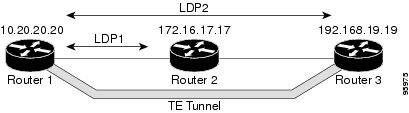
The following configuration example shows the LDP NSF feature configured on three routers. (See Figure 2.) In this configuration example, Router 1 creates an LDP session with Router 2. Router 1 also creates a targeted session with Router 3 through a TE tunnel using Router 2.
Figure 2 MPLS LDP: NSF/SSO Support and Graceful Restart Configuration Example
Router 1
redundancy
mode sso
ip subnet-zero
ip cef distributed
mpls label range 16 10000 static 10001 1048575
mpls label protocol ldp
mpls ldp logging neighbor-changes
mpls ldp graceful-restart
mpls traffic-eng tunnels
no mpls traffic-eng auto-bw timers frequency 0
mpls ldp router-id Loopback0 force
!
interface Loopback0
ip address 172.20.20.20 255.255.255.255
no ip directed-broadcast
no ip mroute-cache
!
interface Tunnel1
ip unnumbered Loopback0
no ip directed-broadcast
mpls label protocol ldp
mpls ip
tunnel destination 10.19.19.19
tunnel mode mpls traffic-eng
tunnel mpls traffic-eng autoroute announce
tunnel mpls traffic-eng priority 7 7
tunnel mpls traffic-eng bandwidth 500
tunnel mpls traffic-eng path-option 1 dynamic
!
interface ATM0/1/0
no ip address
no ip directed-broadcast
atm clock INTERNAL
no atm enable-ilmi-trap
no atm ilmi-keepalive
!
interface ATM0/1/0.5 point-to-point
ip address 172.17.0.2 255.255.0.0
no ip directed-broadcast
no atm enable-ilmi-trap
pvc 6/100
encapsulation aal5snap
mpls label protocol ldp
mpls traffic-eng tunnels
mpls ip
ip rsvp bandwidth 1000
!
router ospf 100
log-adjacency-changes
redistribute connected
nsf enforce global
network 172.17.0.0 0.255.255.255 area 100
network 172.20.20.20 0.0.0.0 area 100
mpls traffic-eng router-id Loopback0
mpls traffic-eng area 100
Router 2
redundancy
mode sso
!
ip cef distributed
no ip domain-lookup
mpls label range 17 10000 static 10001 1048575
mpls label protocol ldp
mpls ldp logging neighbor-changes
mpls ldp graceful-restart
mpls traffic-eng tunnels
no mpls traffic-eng auto-bw timers frequency 0
no mpls advertise-labels
mpls ldp router-id Loopback0 force
!
interface Loopback0
ip address 172.18.17.17 255.255.255.255
no ip directed-broadcast
!
interface ATM0/3/0
no ip address
no ip directed-broadcast
no ip mroute-cache
atm clock INTERNAL
atm sonet stm-1
no atm enable-ilmi-trap
no atm ilmi-keepalive
!
interface ATM0/3/0.5 point-to-point
ip address 172.17.0.1 255.255.0.0
no ip directed-broadcast
no atm enable-ilmi-trap
pvc 6/100
encapsulation aal5snap
mpls label protocol ldp
mpls traffic-eng tunnels
mpls ip
ip rsvp bandwidth 1000
!
interface POS0/1/0
ip address 10.0.0.1 255.0.0.0
no ip directed-broadcast
encapsulation ppp
mpls label protocol ldp
mpls traffic-eng tunnels
mpls ip
no peer neighbor-route
clock source internal
ip rsvp bandwidth 1000
!
router ospf 100
log-adjacency-changes
nsf enforce global
redistribute connected
network 10.0.0.0 0.255.255.255 area 100
network 172.17.0.0 0.255.255.255 area 100
network 172.18.17.17 0.0.0.0 area 100
mpls traffic-eng router-id Loopback0
mpls traffic-eng area 100
!
ip classless
Router 3
redundancy
mode sso
!
ip subnet-zero
ip cef distributed
!
no ip finger
no ip domain-lookup
mpls label protocol ldp
mpls ldp neighbor 10.11.11.11 targeted ldp
mpls ldp logging neighbor-changes
mpls ldp graceful-restart
mpls traffic-eng tunnels
no mpls traffic-eng auto-bw timers frequency 0
mpls ldp discovery directed-hello interval 12
mpls ldp discovery directed-hello holdtime 130
mpls ldp discovery directed-hello accept
mpls ldp router-id Loopback0 force
!
interface Loopback0
ip address 172.19.19.19 255.255.255.255
no ip directed-broadcast
!
interface POS1/1/0
ip address 10.0.0.2 255.0.0.0
no ip directed-broadcast
encapsulation ppp
mpls label protocol ldp
mpls traffic-eng tunnels
mpls ip
no peer neighbor-route
clock source internal
ip rsvp bandwidth 1000
!
router ospf 100
log-adjacency-changes
nsf enforce global
redistribute connected
network 10.0.0.0 0.255.255.255 area 100
network 172.19.19.19 0.0.0.0 area 100
mpls traffic-eng router-id Loopback0
mpls traffic-eng area 100
!
ip classless
Additional References
The following sections provide references related to the NSF/SSO—MPLS LDP and LDP Graceful Restart feature.
Related Documents
|
|
|
|---|---|
Stateful switchover |
|
MPLS Label Distribution Protocol |
|
MPLS LDP commands |
|
Cisco nonstop forwarding |
|
High availability commands |
Standards
|
|
|
|---|---|
No new or modified standards are supported by this feature, and support for existing standards has not been modified by this feature. |
— |
MIBs
RFCs
|
|
|
|---|---|
RFC 3036 |
LDP Specification |
RFC 3478 |
Graceful Restart Mechanism for Label Distribution |
Technical Assistance
Feature Information for NSF/SSO—MPLS LDP and LDP Graceful Restart
Table 1 lists the features in this module and provides links to specific configuration information.
Use Cisco Feature Navigator to find information about platform support and software image support. Cisco Feature Navigator enables you to determine which Cisco IOS XE software images support a specific software release, feature set, or platform. To access Cisco Feature Navigator, go to http://www.cisco.com/go/cfn. An account on Cisco.com is not required.
Note Table 1 lists only the Cisco IOS XE software release that introduced support for a given feature in a given Cisco IOS XE software release train. Unless noted otherwise, subsequent releases of that Cisco IOS XE software release train also support that feature.
|
|
|
|
|---|---|---|
NSF/SSO—MPLS LDP and MPLS LDP Graceful Restart |
Cisco IOS XE Release 2.1 |
Cisco Nonstop Forwarding (NSF) with Stateful Switchover (SSO) provides continuous packet forwarding, even during a network processor hardware or software failure. In a redundant system, the secondary processor recovers control plane service during a critical failure in the primary processor. SSO synchronizes the network state information between the primary and the secondary processor. Multiprotocol Label Switching (MPLS) Label Distribution Protocol (LDP) uses SSO, NSF, and graceful restart to allow a Route Processor (RP) to recover from disruption in control plane service (specifically, the LDP component) without losing its MPLS forwarding state. LDP NSF works with LDP sessions between directly connected peers and with peers that are not directly connected (targeted sessions). In Cisco IOS XE Release 2.1, this feature was introduced on Cisco ASR 1000 Series Aggregation Services Routers. The following sections provide information about this feature: • • • • • • • The following commands were introduced or modified: debug mpls ldp graceful-restart, mpls label protocol (global configuration), mpls ldp graceful-restart, mpls ldp graceful-restart timers forwarding-holding, mpls ldp graceful-restart timers max-recovery, mpls ldp graceful-restart timers neighbor-liveness, show mpls ip binding, show mpls ldp bindings, show mpls ldp checkpoint, show mpls ldp graceful-restart, show mpls ldp neighbor. |
 Feedback