Cisco Unified Attendant Console Enterprise Edition Version 9.1 Data Sheet
Available Languages
Cisco® Unified Attendant Consoles are client-server applications that enable operators and receptionists to answer and quickly dispatch incoming calls to their intended recipients or suitable alternatives. The applications offer a rich set of features, including a call-queuing engine, endpoint busy status, presence integration, and Cisco Unified Communications Manager end-user directory search.
Product Overview
The Cisco Unified Attendant Console Enterprise Edition (Figure 1) is an attendant console solution designed specifically for Cisco Unified Communications Manager customers. A single attendant console server can support up to 40 concurrent attendant console client logins and the complete Cisco Unified Communications Manager end-user directory. Associated with a Cisco Unified IP Phone, the Cisco Unified Attendant Console Enterprise Edition provides the human attendant console operator with the tools to quickly accept and effectively dispatch incoming calls to individuals across the organization.
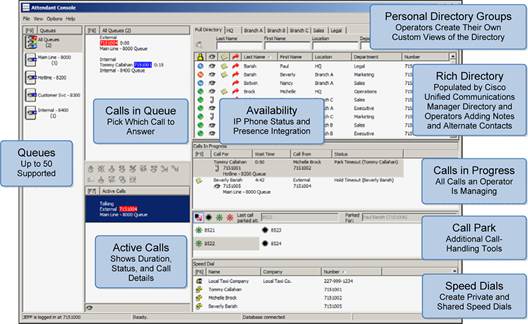
The Cisco Unified Attendant Console Enterprise Edition includes a web-based administration utility that guides you through configuring the application server with Cisco Unified Communications Manager. The Cisco Unified Attendant Console Enterprise Edition client software is loaded on each operator's desktop PC.
Features and Benefits
The Cisco Unified Attendant Console Enterprise Edition uses a powerful queuing engine to direct calls to the operator and provides the operator numerous monitoring features to help ensure that incoming calls are handled efficiently. The application provides up to 50 call queues with prioritization and overflow options. In addition, fields for alternative contact numbers and absentee notes are provided.
Table 1 lists features and benefits of Cisco Unified Attendant Console Enterprise Edition.
Table 1. Features and Benefits of Cisco Unified Attendant Console Enterprise Edition
| Feature |
Benefit |
|
| Queue Features |
||
| Support for 50 queues with prioritization |
||
| Operator queue assignment |
In Web Admin, you can assign one or more queues to each operator, allowing you to segment your call answering processes to fit your business needs. |
|
| Queue operator views |
||
| Overflow options |
No Operator overflow sends calls to the overflow destination when no operators are logged into the queue. Wait Time overflow sends calls to the overflow destination when a call has been waiting in queue for a defined period of time. Overflow settings are defined on a queue-by-queue basis. |
|
| Queue salutations |
You can configure a script to be read by the operator for each queue to help ensure the operator can provide the proper greeting. |
|
| Different music in different queues |
Callers hear music through the Cisco Unified Communications Manager Music on Hold (MoH) function. Cisco Unified Attendant Console Enterprise Edition queue device groups allow you to play different music to different queues. |
|
| Directory Features |
||
| Support for the entire Cisco Unified Communications Manager end-user directory |
The operator can answer calls and view busy status for the entire Cisco Unified Communications Manager end-user directory. |
|
| Directory integration |
||
| Each operator can create up to 100 custom directory groups, displayed as tabs across the top of the directory. These directory groups are subsets of the full directory, which is synchronized with Cisco Unified Communications Manager. Because personal directory groups are created using live directory filters as well as dragging and dropping individual contacts, operators can be confident their groups are always up-to-date. |
||
| Search options |
||
| Presence integration |
Operators can view each contact's Cisco Unified Presence status directly from the Attendant Console directory. This feature allows operators to manage calls efficiently because they can easily see whether a particular contact is available to take a call. |
|
| Telephony Features |
||
| Operator handset ringing |
When a call comes into a queue configured with operator handset ringing, the call is sent directly to the handset of the operator logged into that queue for the longest duration. This feature enables operators to answer the call from a wireless headset while away from their desks. (The wireless headset is not included.) |
|
| Transfer reversion (call recall) |
This feature allows a transferred call to revert back to the operator so that it can be answered and then transferred to a new destination. |
|
| Call park |
With call park, the operator can place a caller on hold while announcing that a call is on hold and waiting for a particular person or group. The call can be answered from any phone by dialing the park extension. |
|
| Call park recall |
||
| Call toggle |
Call toggle allows the operator to shift between callers. |
|
| Conference |
The conference feature allows the operator to provide a third-party conference call. |
|
| Emergency Mode switch |
||
| Night service |
||
| Additional Features |
||
| Adjustable font size |
Changing the font size is one of the many ways in which individual users can tailor the Cisco Unified Attendant Console Enterprise Edition application to best suit their needs. |
|
| Many of the attendant console client preferences can now follow users to different PCs running Cisco Unified Attendant Console Enterprise Edition. |
||
| Reports |
You can gain a better understanding of call volumes by operator and queue, the queues that have the most abandoned calls, and other important metrics through attendant console reports, accessible through the Web Admin tool. |
|
| Cisco Unified Attendant Console server is supported in a production environment on VMware ESXi 4.x or 5.0 running on a host machine that is compliant with the Cisco Specifications-Based Hardware Support program. For more information about this program, please visit: http://docwiki.cisco.com/wiki/Specification-Based_Hardware_Support. Note: This feature is supported only with Cisco Unified Communications Manager 8.0(1) and later. |
||
| Accessibility |
The visually impaired can use Cisco Unified Attendant Console Enterprise Edition because both ZoomText and JAWS scripts are supported. |
|
| Attendant console client localization |
English, French, German, Italian, Portuguese, Spanish, Dutch, Swedish, Danish, Russian, Arabic, Korean, Japanese, Traditional Chinese, and Simplified Chinese are supported. |
|
Product Specifications
Cisco Unified Attendant Console Enterprise Edition Version 9.1 is supported on Cisco Unified Communications Manager Versions 7.1(5) through 9.1(1). Cisco Unified Communications Manager Express is not supported.
Tables 2 and 3 list the server and client requirements for Cisco Unified Attendant Console Enterprise Edition.
Table 2. Server Requirements for Cisco Unified Attendant Console Enterprise Edition
| Product Component |
Hardware and Software Requirements |
| Cisco Unified Attendant Console Enterprise Edition server |
● 2.2 GHz Pentium 4 processor
● 4 GB RAM
● Network card, connected to the network using TCP/IP
● One of the following operating systems, with Windows regional settings set to English:
◦ Windows Server 2003 SP2 (32-bit)
◦ Windows Server 2008 R1 (32-bit)
◦ Windows Server 2008 R2 (64-bit)
● For non-English characters, the relevant language pack for the locale installed
● Internet Information Services (IIS) 6.0 or later
● ASP.NET, installed through Add/Remove Windows Component > Applications Server and Details
● .Net Framework 3.5 SP1
● One of the following databases:
◦ MS SQL Server 2005 Express, Standard, or Enterprise
◦ MS SQL Server 2008 Express, Standard, or Enterprise
Notes
● Cisco Unified Attendant Console server does not support the Cisco Media Convergence Server (MCS) version of Windows Server.
● If the Cisco Unified Attendant Console server installer does not detect a supported version of Microsoft SQL Server, it will automatically install Microsoft SQL Server 2008 Express.
● Please refer to the Cisco Unified Attendant Console Web Admin & Installation Guide for server configuration details.
|
Note: The operator client for the Cisco Unified Attendant Console Enterprise Edition requires the PC specifications listed in Table 3. You can install Cisco Unified Attendant Console Enterprise Edition client software on many PCs, but only up to 40 can be concurrently logged into a server. Refer to the “Ordering Information” section for additional licensing details.
Table 3. Client Requirements
| Product Component |
Hardware and Software Requirements |
| Cisco Unified Attendant Console Enterprise Edition |
● 1 GB RAM
● 1 GB available hard disk space
● Network card, connected to the network using TCP/IP
● SVGA (1024 x 768) display card
● Sound card and speakers (highly recommended)
● 17-inch or larger monitor (highly recommended)
● Keyboard with 10-key number pad
● Windows 7 (32-bit or WoW64), Vista Professional with SP2 (32-bit or WoW64), or Windows XP Professional with SP2
|
Download Information and 60-Day Evaluation
A free trial of the Cisco Unified Attendant Console Enterprise Edition is available; please visit http://www.cisco.com/go/ac for more information. After downloading and installing the Cisco Unified Attendant Console Enterprise Edition server, you may register for a free 60-day evaluation of the product.
Ordering Information
You must order a Cisco Unified Attendant Console Enterprise Edition license for each concurrent operator login. Amaximum of 40 concurrent operator client logins are supported per Cisco Unified Attendant Console Enterprise Edition server. Example: If you need 10 attendant consoles logged into the server at the same time, you should order 10 licenses.
Table 4 gives ordering information for Cisco Unified Attendant Console Business Edition.
Table 4. Ordering Information
| Product Name |
Version |
Delivery Method |
Top-Level Configuration Product Number |
Product Number |
| 9.1 |
Electronic |
L-CUAC9X-ATT-CON |
L-CUACE9X-ATT-CON |
|
| Cisco Unified Attendant Console Enterprise Edition |
9.1 |
Paper |
CUAC9X-ATT-CON |
CUACE9X-ATT-CON |
Service and Support
Using the Cisco Lifecycle Services approach, Cisco and our partners provide a broad portfolio of end-to-end services and support that can help increase the business value of your network and your return on investment. This approach defines the minimum set of activities needed, by technology and by network complexity, to help you successfully deploy and operate Cisco technologies and optimize their performance throughout the lifecycle of your network.
For More Information
For more information about the Cisco Unified Attendant Console Enterprise Edition, please contact your local Cisco account representative.
 Feedback