Cisco Nexus B22 Blade Fabric Extender Data Sheet
Available Languages
Bias-Free Language
The documentation set for this product strives to use bias-free language. For the purposes of this documentation set, bias-free is defined as language that does not imply discrimination based on age, disability, gender, racial identity, ethnic identity, sexual orientation, socioeconomic status, and intersectionality. Exceptions may be present in the documentation due to language that is hardcoded in the user interfaces of the product software, language used based on RFP documentation, or language that is used by a referenced third-party product. Learn more about how Cisco is using Inclusive Language.
The Cisco Nexus® B22 Blade Fabric Extender is designed to simplify data center server access architecture and operations in environments in which third-party blade servers are used. The Cisco Nexus B22, together with the Cisco Nexus 2000 Series Fabric Extenders, Cisco® Adapter Fabric Extender (Adapter FEX), and Cisco Data Center Virtual Machine Fabric Extender (VM-FEX), is part of the Cisco Fabric Extender (FEX) portfolio, which provides a highly scalable unified server access platform supporting 100 Megabit to 10 Gigabit Ethernet over fiber and copper, rack and blade form factors, and IEEE Data Center Bridging (DCB) protocol. The platform offers excellent support for the integration of third-party blade chassis into a Cisco Unified Fabric.
The Cisco Nexus B22 Blade Fabric Extender behaves like a remote line card for a parent Cisco Nexus switch, together forming a distributed modular system. This architecture simplifies data center access operations and architecture by combining the management simplicity of a single high-density access switch with the cabling simplicity of integrated blade switches and Top-of-Rack (ToR) access switches (Figure 1).
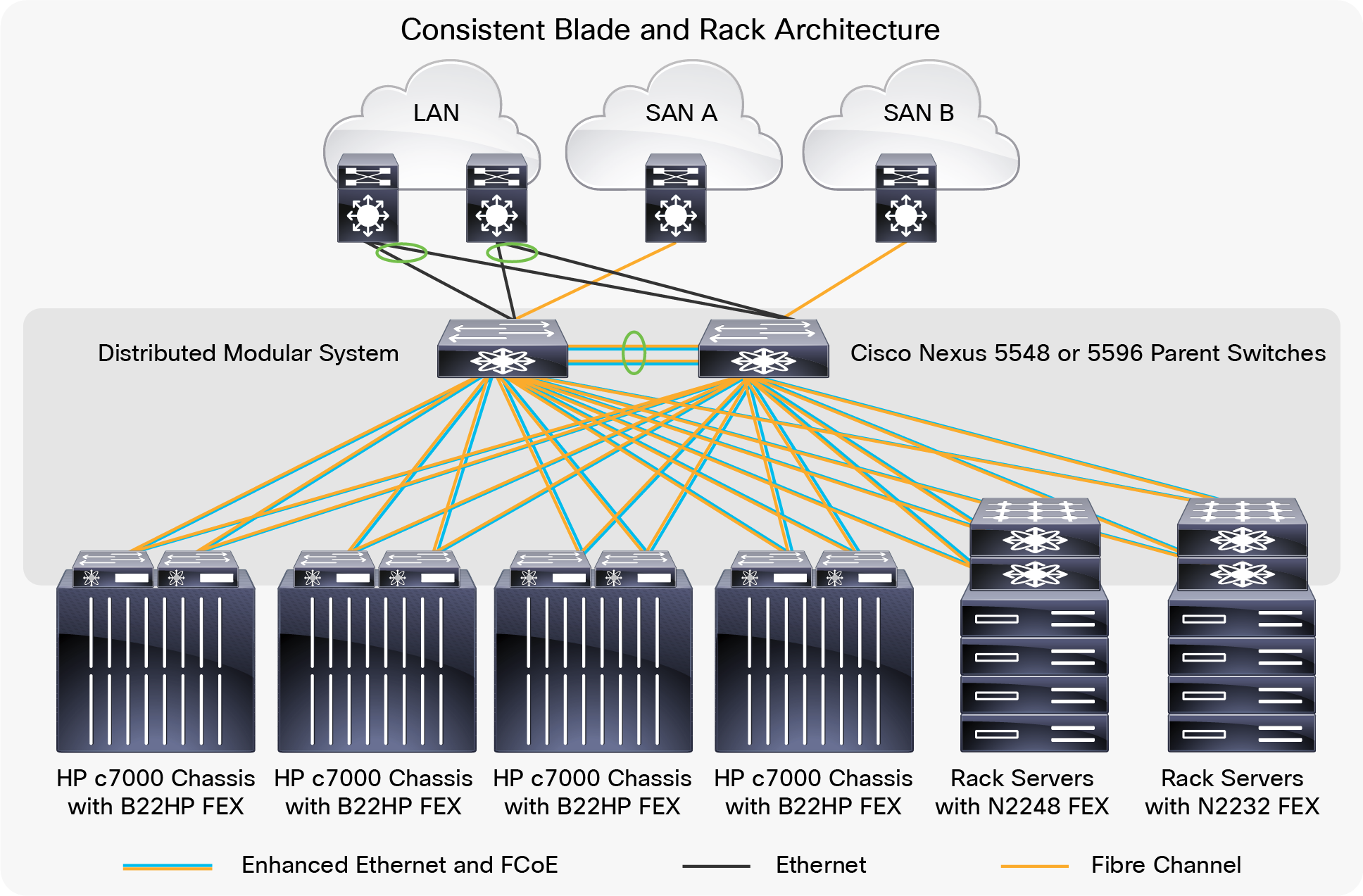
Cisco Nexus Fabric extenders provide highly scalable unified server access connectivity
The Cisco Nexus B22 provides the following main benefits:
● Highly scalable, consistent server access: The distributed modular system creates a scalable server access environment with no reliance on Spanning Tree Protocol, providing consistency between blade and rack servers.
● Simplified operations: One single point of management and policy enforcement using upstream Cisco Nexus switches eases the commissioning and decommissioning of blades through zero-touch installation and automatic configuration of fabric extenders.
● Increased business benefits: Consolidation, cabling reduction, investment protection through feature inheritance from the parent switch, and the capability to add functions without the need for a major equipment upgrade of server-attached infrastructure all contribute to reduced Operating Expenses (OpEx) and Capital Expenditures (CapEx).
Each member of the Cisco Nexus B22 platform transparently integrates into the I/O module slot of a third-party blade chassis, drawing both power and cooling from the blade chassis itself.
The Cisco Nexus B22 provides two types of ports:
● Ports for blade server attachment (host interfaces)
● Uplink ports (fabric interfaces)
Fabric interfaces, located on the front of the Cisco Nexus B22 module, are for connectivity to the upstream parent Cisco Nexus switch.
The Cisco Nexus B22 comes in four models. Figure 2 shows the Cisco Nexus B22 Blade Fabric Extender for HP. Figure 3 shows the Cisco Nexus B22 Blade Fabric Extender for Fujitsu. Figure 4 show the Cisco Nexus B22 Blade Fabric Extender for Dell. Figure 5 shows the Cisco Nexus B22 Blade Fabric Extender for IBM.
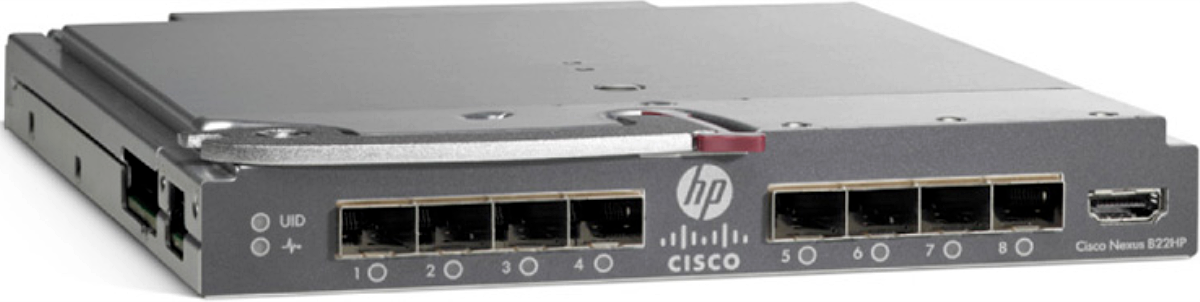
Cisco Nexus B22 Blade Fabric Extender for HP
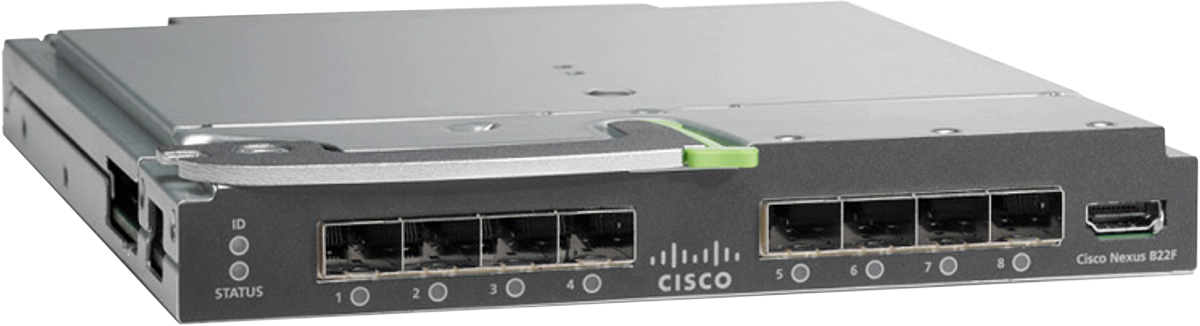
Cisco Nexus B22 Blade Fabric Extender for Fujitsu
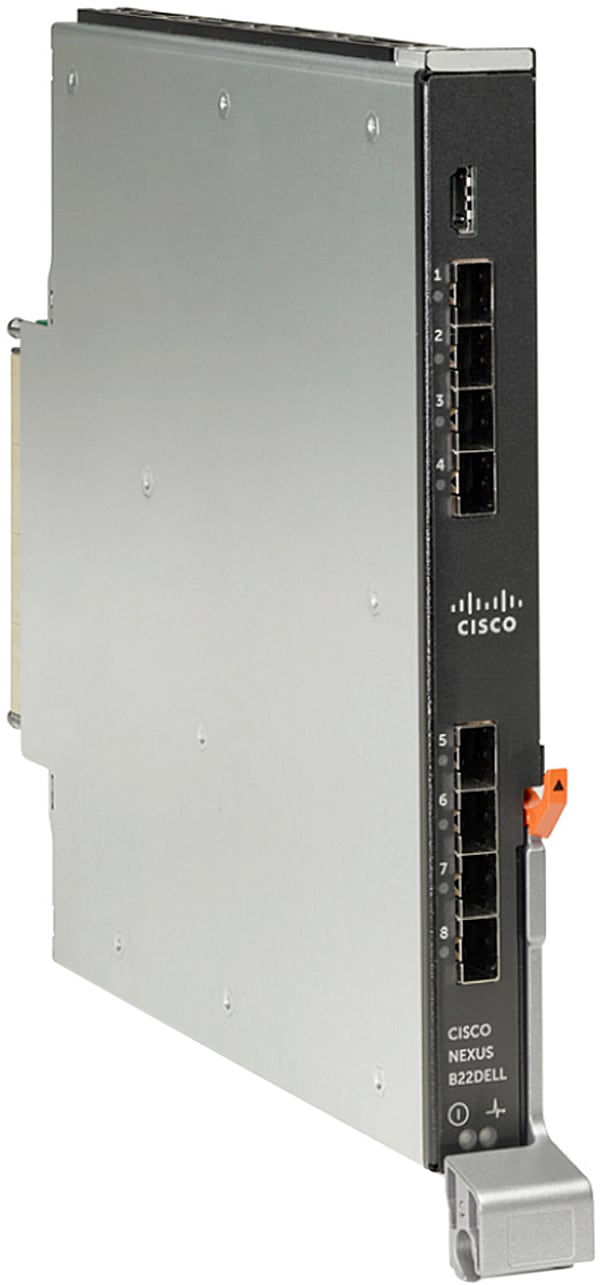
Cisco Nexus B22 Blade Fabric Extender for Dell
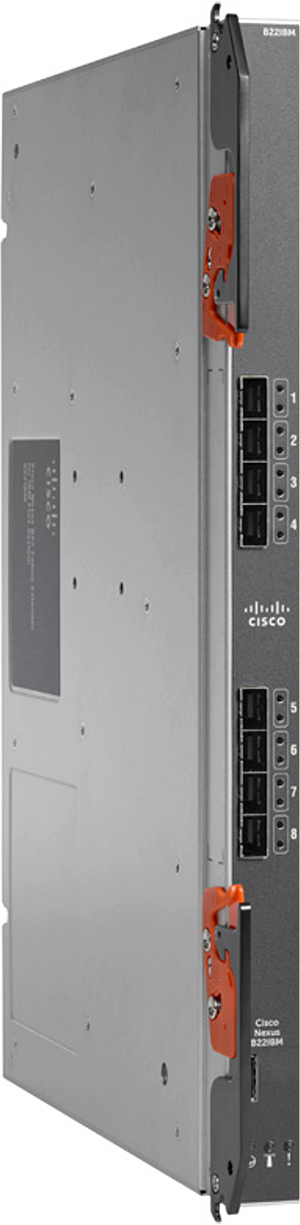
Cisco Nexus B22 Blade Fabric Extender IBM
Table 1 lists the Cisco Nexus B22 Blade Fabric Extenders. Cisco Nexus B22 Blade Fabric Extenders and Cisco Nexus 2000 Series Fabric Extenders can be mixed and matched to a parent switch to provide a variety of connectivity options, as shown in Table 2.
Table 1. Cisco Nexus B22 Fabric Extender models
Table 2. Cisco Nexus B22 Blade Fabric Extender parent switch support matrix
| Cisco Nexus Parent Switch |
Cisco Nexus 5000 Series Switches |
Cisco Nexus 6000 Series Switches |
Cisco Nexus 7000 Series Switches |
| Cisco Nexus blade fabric extender models |
Cisco Nexus B22HP Cisco Nexus B22F Cisco Nexus B22DELL Cisco Nexus B22IBM |
Cisco Nexus B22HP Cisco Nexus B22F Cisco Nexus B22DELL Cisco Nexus B22IBM |
Cisco Nexus B22HP |
| Cisco Nexus parent switch model or line card |
● Cisco Nexus 5010 or 5020 Switch for Cisco Nexus B22HP and B22F
● Cisco Nexus 5548P Switch
● Cisco Nexus 5548UP Switch
● Cisco Nexus 5596UP Switch
|
● Cisco Nexus 6001 Series Switch
● Cisco Nexus 6004 Series Switch
|
Line Cards Supported:
● N7K-M132XP-12,
N7K-M132XP-12L, N7K-M224XP-23L, N7K-F248XP-25, N7K-F248XP-25E |
| Scalability |
● Up to 24 fabric extenders per Cisco Nexus 5548P, 5548UP, and 5596UP Switch (16 fabric extenders for Layer 3 configurations)
● Up to 12 fabric extenders per Cisco Nexus 5010 and 5020 Switch
|
● Up to 48 fabric extenders for Layer 2 configurations
● Up to 24 fabric extenders for Layer 3 configurations
|
● Up to 32 fabric extenders for SUP1/SUP2 configurations
● Up to 64 fabric extenders for SUP2E configurations
|
● Highly scalable, consistent access layer: Today's data centers must have massive scalability to manage the combination of an increasing number of blade servers and a higher demand for bandwidth from each server. The Cisco Nexus B22 increases the scalability of the blade access layer to accommodate both sets of demands without increasing management points within the network.
◦ Massive scalability: A deployment of Cisco Nexus B22 Blade Fabric Extenders and Cisco Nexus 2000 Series Fabric Extenders connected to a Cisco Nexus parent switch supports highly scalable 1 and 10 Gigabit Ethernet environments under a single managed entity. Scalability limits are shown in Table 2, in the Scalability row.
◦ Layer 2 dependability: Reliance on Spanning Tree Protocol is eliminated between the fabric extender and the parent switch, thus enabling a large, multipath, loop-free topology. Use of a single management entity to support a large server domain allows policy to be enforced more efficiently and enhances Layer 2 data center access scalability. Use of the virtual PortChannel (vPC) feature allows fast convergence and effective utilization of bandwidth in Layer 2 environments.
◦ Consistent server access architecture: When mixed with the Cisco Nexus 2000 Series, the Cisco Nexus B22 provides a highly consistent server access architecture supporting 1 to 10 Gigabit Ethernet blade server connections and 100 Megabit to 10 Gigabit Ethernet rack server connections over both fiber and copper, supporting unified fabric and the IEEE DCB protocol.
● Simplified operations: The Cisco Nexus B22 simplifies operations and management.
◦ Single point of management: Cisco Nexus B22 Blade Fabric Extenders are remote line cards for a Cisco Nexus parent switch. All device configurations are managed on the Cisco Nexus parent switch, and configuration information is downloaded to the Cisco Nexus B22 using in-band communication.
◦ Software maintenance simplification: The Cisco Nexus B22 software is embedded in the Cisco Nexus parent switch software. The fabric extender is a “plug-and-play” device that automatically downloads the software image from the Cisco Nexus parent switch in the same way that a line card downloads software from the supervisor engine in a modular chassis. In-Service Software Upgrade (ISSU) on the fabric extenders provides the capability to perform transparent software upgrades, reducing downtime and allowing customers to integrate the newest features and functions with little or no impact on network operation for Ethernet, storage, and converged network environments.
◦ Switch feature consistency across a large number of servers: The Cisco Nexus B22 forwards all traffic to the parent Cisco Nexus switch over 10 Gigabit Ethernet fabric uplinks. Passing all traffic to the parent switch allows traffic to be switched according to policies established on the parent Cisco Nexus switch with a single point of management. Standardizing on the Cisco Nexus switches for both blade and rack servers allows data centers to support the same switch features across the entire access layer with a single point of management.
◦ Tenfold reduction in management points: The number of management points is significantly less than when discrete switches are used in the blade chassis. A traditional 12-blade chassis design using a discrete, redundant pair of Gigabit Ethernet blade switches has 24 management points. The equivalent architecture using the Cisco Nexus B22 has only 2 management points: a tenfold reduction in management complexity.
● Business benefits: The Cisco Nexus B22 offers a number of benefits to enhance the overall business.
◦ Cost-effective 10 Gigabit Ethernet solution: The Cisco Nexus B22 is an excellent platform for migration from 1 Gigabit Ethernet to 10 Gigabit Ethernet. Scalable 10 Gigabit Ethernet provides 10 times the bandwidth for approximately twice the price of 1 Gigabit Ethernet.
◦ Consolidation: The Cisco Nexus B22 protects investment into the future, supporting evolving data center needs by providing an easy migration path to low-latency 10 Gigabit Ethernet, High-Performance Computing (HPC), virtual machine-aware networks. In addition, the combination of the Cisco Nexus 5000 Series and the Cisco Nexus B22 provides a unified network fabric that supports LAN and SAN consolidation. Another benefit of the Cisco fabric extender architecture is the capability to collapse data center access and aggregation layers into one single layer.
◦ Investment protection: The Cisco Nexus B22 Blade Fabric Extenders can be mixed and matched with Cisco Nexus 2000 Series Fabric Extenders under a common parent Cisco Nexus switch. New functions can be derived from upstream Cisco Nexus switches, resulting in the capability to add new functions without the need for a major equipment upgrade.
◦ Cabling reduction with unified fabric: The Cisco Nexus B22 can pass Ethernet and Fibre Channel over Ethernet (FCoE) traffic over the same set of uplinks onto the Cisco Nexus fabric, reducing the total number of uplinks required.
◦ The Cisco Nexus B22 supports an optimal cabling strategy that simplifies network operations and prepares for future technologies. Low-cost connections of up to 10 meters to the Cisco Nexus parent switch can be made with copper Twinax cable, and longer connections of up to 100 meters can use the Cisco Fabric Extender Transceiver (FET). Standard 10-Gbps optics such as Short Reach (SR) and Long Reach (LR) are also supported for distances greater than 100 meters.
◦ Effective bandwidth utilization: Today’ blade servers are typically dual-homed to the network. Through vPC feature support, each server can bond its network adapters together into a 20-Gbps or higher PortChannel, achieving both high bandwidth and link redundancy.
◦ Reduced power and cooling: Cost-effective 10 Gigabit Ethernet solutions, optimal cabling, device consolidation, and efficient bandwidth utilization all contribute to a significant reduction in power and cooling needs in the data center.
Cisco Nexus B22 deployment scenarios
The Cisco Nexus B22 can be used in conjunction with a Cisco Nexus parent switch in four main design scenarios (shown in Figure 6):
● Server vPC: In this deployment scenario, access-layer redundancy is achieved through redundant server connections to two fabric extenders, using vPC and active-active server Network Interface Card (NIC) teaming.
● Fabric extender vPC (FEX vPC): In this deployment scenario, access-layer redundancy is achieved through redundant connections between the Cisco Nexus B22 Blade Fabric Extenders and the Cisco Nexus parent switches using vPC.
● Enhanced vPC (EvPC): In this deployment scenario, access-layer redundancy is achieved in two ways: through redundant connections between the Cisco Nexus B22 Blade Fabric Extenders and the Cisco Nexus parent switches using vPC, and through redundant server connections to two fabric extenders using vPC and active-active server NIC teaming.
● vPC+: In this deployment scenario, access-layer redundancy is achieved through server vPC, FEX vPC, and EvPC. In addition, a vPC+ domain allows the Cisco Nexus parent switch and the fabric extenders to be viewed as a single virtual switch in a Cisco FabricPath network.
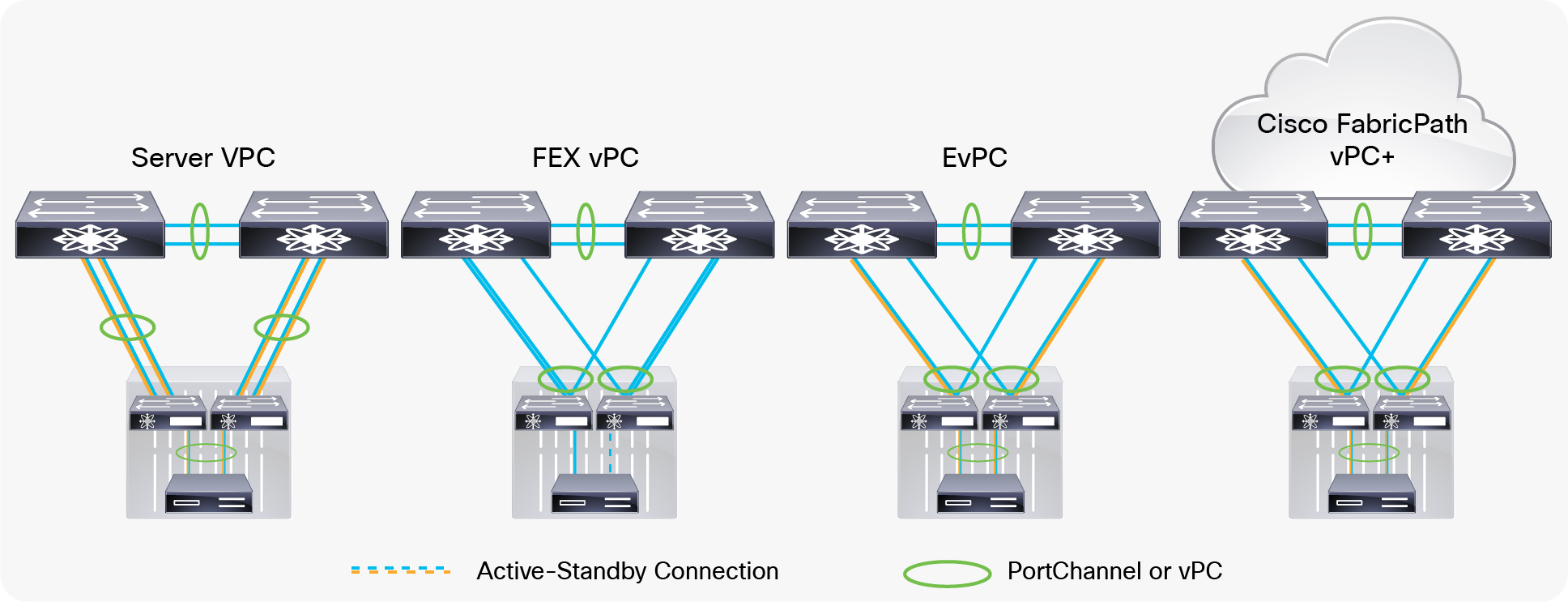
Cisco Nexus B22 Design Scenarios, from Left to Right: Server vPC, Fabric Extender vPC, Enhanced vPC, and vPC+
Tables 3 and 4 provide product specifications for the Cisco Nexus B22. Table 5 lists standards support, and Table 6 lists feature support.
Table 3. Cisco Nexus B22 Fabric Extender product specifications
Table 4. Cisco Nexus Fabric Extender transceiver specifications
Table 5. Cisco Nexus B22 compliance information
| Specification |
|
| Products should comply with CE Markings according to directives 2004/108/EC and 2006/95/EC. |
|
|
● CAN/CSA-C22.2 No 60950
● EN 60950
● IEC 60950
● TUV/VDE EN 60950 for B22DELL
|
|
Feature support for the Cisco Nexus B22 is derived mainly from the parent switch feature set. Therefore, consult the Cisco Nexus 5000 Series data sheet for a comprehensive list of features supported.
Table 6. Feature Support for Cisco Nexus B22
| Description |
|
| Local classification (256 access control list [ACL] entries) |
|
|
● IEEE 802.3ap: 10GBASE-KR
|
Cisco Nexus B22 ordering information
Table 7 provides ordering information for transceivers and cables. Please refer to the HP, Fujitsu, Dell, and IBM websites for chassis orderability.
Table 7. Ordering information
| Part Number |
|
| SFP-10G-ER(=) |
10GBASE-ER SFP+ Module |
| 40 Gigabit Ethernet Transceivers and Cables |
|
| QSFP-4SFP10G-CU1M |
Cisco 40GBASE-CR4 QSFP+ to 4 10GBASE-CU SFP+ direct-attach breakout cable, 1-meter, passive |
| QSFP-4SFP10G-CU3M |
Cisco 40GBASE-CR4 QSFP+ to 4 10GBASE-CU SFP+ direct-attach breakout cable, 3-meter, passive |
| QSFP-4SFP10G-CU5M |
Cisco 40GBASE-CR4 QSFP+ to 4 10GBASE-CU SFP+ direct-attach breakout cable, 5-meter, passive |
| QSFP-4x10G-AC7M |
Cisco 40GBASE-CR4 QSFP+ to 4 10GBASE-CU SFP+ direct-attach breakout cable, 7-meter, active |
| QSFP-4x10G-AC10M |
Cisco 40GBASE-CR4 QSFP+ to 4 10GBASE-CU SFP+ direct-attach breakout cable, 10-meter, active |
Cisco environmental sustainability
Information about Cisco’s environmental sustainability policies and initiatives for our products, solutions, operations, and extended operations or supply chain is provided in the “Environment Sustainability” section of Cisco’s Corporate Social Responsibility (CSR) Report.
Reference links to information about key environmental sustainability topics (mentioned in the “Environment Sustainability” section of the CSR Report) are provided in the following table:
| Sustainability topic |
Reference |
| Information on product material content laws and regulations |
|
| Information on electronic waste laws and regulations, including products, batteries, and packaging |
Cisco makes the packaging data available for informational purposes only. It may not reflect the most current legal developments, and Cisco does not represent, warrant, or guarantee that it is complete, accurate, or up to date. This information is subject to change without notice.
Technical support for the Cisco Nexus B22 Blade Fabric Extender can be obtained from either Cisco or the blade vendor who sold the fabric extender.
● All Cisco Nexus B22 Blade Fabric Extenders: For software configuration or troubleshooting assistance, support is obtained through the vendor providing support for the upstream Cisco Nexus switch. If support is provided by Cisco, for information about obtaining documentation and submitting a service request and other information, see the monthly “What’s New in Cisco Product Documentation,” which also lists all new and revised Cisco technical documentation, at https://www.cisco.com/en/US/docs/general/whatsnew/whatsnew.html. Subscribe to “What’s New in Cisco Product Documentation” as an RSS feed and set content to be delivered directly to your desktop using a reader application. The RSS feeds are a free service. Cisco currently supports RSS Version 2.0.
● Cisco Nexus B22HP: For hardware replacement of the Cisco Nexus B22HP under warranty, contact Hewlett-Packard. In the United States, for contact options see the Contact HP United States webpage. To contact HP by phone:
◦ Call 1-800-HP-INVENT (1-800-474-6836). This service is available 24 hours a day, 7 days a week. For continuous quality improvement, calls may be recorded or monitored.
◦ If you have purchased an HP Care Pack (service upgrade), call 1-800-633-3600. For more information about HP Care Packs, refer to the HP website. In other locations or for the name of the nearest HP authorized reseller, see the Contact HP Worldwide (in English) webpage.
● Cisco Nexus B22F: For hardware troubleshooting or replacement of the Cisco Nexus B22F, contact Fujitsu. Fujitsu support contact information is available at http://support.ts.fujitsu.com/, or http://jp.fujitsu.com/support/ in Japan.
● Cisco Nexus B22DELL: For hardware troubleshooting or replacement of the Cisco Nexus B22DELL, contact Dell. Dell support contact information is available at http://support.dell.com/.
● Cisco Nexus B22IBM: For hardware troubleshooting or replacement of the Cisco Nexus B22IBM, contact IBM. IBM support contact information is available at http://support.ibm.com/.
Flexible payment solutions to help you achieve your objectives
Cisco Capital makes it easier to get the right technology to achieve your objectives, enable business transformation and help you stay competitive. We can help you reduce the total cost of ownership, conserve capital, and accelerate growth. In more than 100 countries, our flexible payment solutions can help you acquire hardware, software, services and complementary third-party equipment in easy, predictable payments. Learn more.
● Cisco Nexus B22 Blade Fabric Extenders: https://www.cisco.com/go/nexusb22
● Cisco Nexus 2000 Series Fabric Extenders: https://www.cisco.com/go/nexus2000
● Cisco Nexus 5000 Series Switches: https://www.cisco.com/go/nexus5000
● Cisco Nexus 6000 Series Switches: https://www.cisco.com/go/nexus6000
● Cisco Nexus 6000 Series Switches: https://www.cisco.com/go/nexus7000
● Cisco NX-OS Software: https://www.cisco.com/go/nxos