Cisco RV110W Wireless-N VPN Firewall
Available Languages
Simple, Secure Connectivity for the Small Office/Home Office
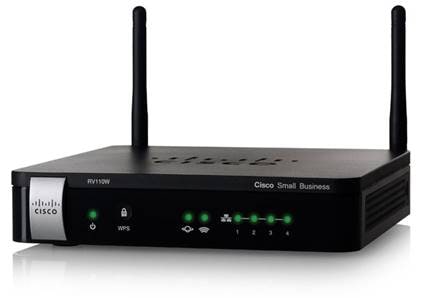
The Cisco® RV110W Wireless-N VPN Firewall provides simple, affordable, highly secure, business-class connectivity to the Internet for small offices/home offices and remote workers.
The Cisco RV110W combines wired and wireless connectivity for small offices and remote workers with a high-speed, 802.11n wireless access point; a 4-port 10/100 Mbps Fast Ethernet switch; an intuitive, browser-based device manager; and support for the Cisco FindIT Network Discovery Utility, all at a very affordable price. Its combination of business-class features, support for virtual networks to enable highly secure guest access, simple installation, and top-quality user experience takes basic connectivity for small businesses with five or fewer employees to a new level. See Figure 1.
Product Overview
The Cisco RV110W Wireless-N VPN Firewall features:
● High-speed, standards-based 802.11n wireless connectivity improves throughput and coverage, allowing employees to stay productive while away from their desks
● Integrated 4-port 10/100 switch, enabling you to connect to computers, printers, IP phones, cameras, and other devices
● Proven firewall with access rules support and advanced wireless security helps keep business assets safe
● Quality of service (QoS) support for enhanced voice, video, and data traffic
● Support for separate “virtual” networks, enabling you to control access to sensitive information and to set up highly secure wireless guest access
● IP Security (IPsec) Site-to-Site Tunneling and Point-to-Point Tunneling Protocol (PPTP) VPN support, providing highly secure remote access connectivity for Windows and Mac OS computers
● Support for IPv6, the latest Internet Protocol technology, to help your network accommodate new technologies
● Simplified configuration through an intuitive, browser-based device manager
● Support for the Cisco FindIT Network Discovery Utility
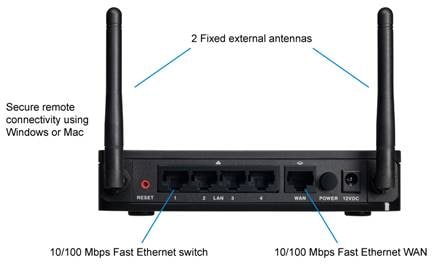
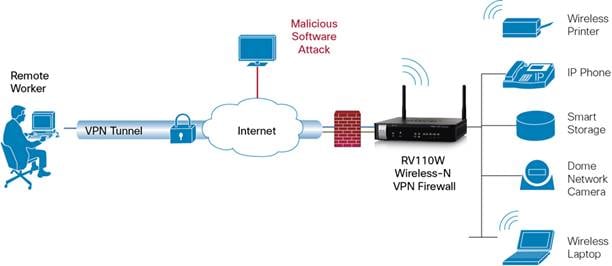
Figure 2 shows the back panel of the Cisco RV110W. Figure 3 shows a typical configuration using the firewall.
Product Specifications
Table 1 gives the product specifications for the Cisco RV110W.
Table 1. Product Specifications
| Feature |
Description |
| Routing |
● Static routing
● Dynamic routing
● Routing Information Protocol (RIP) v1 and v2
● Inter-VLAN routing
|
| Layer 2 |
● 802.1Q-based VLANs
● 4 active VLANs (3 to 4094 range)
|
| Network |
● Dynamic Host Configuration Protocol (DHCP) server
● Point-to-Point Protocol over Ethernet (PPPoE)
● Point-to-Point Tunneling Protocol (PPTP)
● Layer 2 Tunneling Protocol (L2TP)
● DNS proxy
● DHCP relay agent
● IGMP Proxy and multicast forwarding
● Internet Group Management Protocol (IGMP) proxy and multicast forwarding
● Rapid Spanning Tree Protocol (RSTP)
● Dynamic DNS (DynDNS), TZO, 3322.org)
● Network Address Translation (NAT), Port Address Translation (PAT)
● Port management
● Port Mirroring
● Software-configurable network edge (DMZ) to any LAN IP address
|
| IPv6 |
● Dual-stack IPv4 and IPv6
● 6to4 tunneling
● Multicast Listener Discovery (MLD) for IPv6 (RFC 2710)
● Stateless address auto-configuration
● DHCP v6 Server for IPv6 Clients on LAN
● DHCP v6 client for WAN connectivity
● Internet Control Message Protocol (ICMP) v6
● Static IPv6 Routing
● Dynamic IPv6 Routing with RIPng
● IPv6 Rapid Deployment
|
| Security |
● Stateful packet inspection (SPI) firewall
● Port forwarding and triggering
● Firewall Access Control Lists and Content Filtering
● Denial-of-service (DoS) prevention
● MAC-based wireless access control
● Static URL blocking or keyword blocking
● Schedule-based Internet access policy
● HTTPS web access to the device manager
● Username/password complexity enforcement
● Self-signed SSL certificate
● Import and export certificate using Privacy-Enhanced Mail (PEM) format
|
| VPN |
● 5 IPsec client sessions using Cisco QuickVPN client
● 5 PPTP client sessions for remote client access
● Triple Data Encryption Standard (3DES) VPN pass-through of PPTP, L2TP, and IPsec
● 1 IPSec Site-to-Site tunnel
|
Quality of service (QoS) |
● 802.1p port-based priority on LAN port, application-based priority on WAN port
● 4 queues
● Differentiated Services Code Pointsupport (DSCP)
● Class of Service (CoS)
● Bandwidth Management for service prioritization
|
| Management |
● Simple Network Management Protocol (SNMP) v3
● Event logging: local, syslog, email alerts
● Firmware upgradable through web browser
● Imported/exported configuration in text format
● Simple browser-based configuration (HTTP/HTTPS)
● Bonjour and Universal Plug and Play (UPnP)
● Network diagnostics: Ping, Traceroute, and DNS Lookup
|
| Performance |
● NAT throughput: 90 Mbps
● Concurrent sessions: 5,000
● VPN throughput: 5Mbps
|
Wireless LAN Specifications
Table 2 gives the wireless specifications for the Cisco RV110W.
Table 2. Wireless LAN Specifications
| Feature |
Description |
| WLAN hardware |
IEEE 802.11n standard-based access point with 802.11b/g compatibility Radio and modulation type:
● 802.11b: direct sequence spread spectrum (DSSS)
● 802.11g/n: orthogonal frequency division multiplexing (OFDM)
● 2 omnidirectional 1.8 dBi gain fixed external antennas
Operating channels:
● 11 in North America
● 13 in most of Europe
● Automatic channel selection
Transmit power:
● 802.11b: 17 dBm +/- 1.5 dBm
● 802.11g: 15 dBm +/- 1.5 dBm
● 802.11n: 12.5 dBm +/- 1.5 dBm
Receiver sensitivity:
● -87 dBm at 11 Mbps
● -71 dBm at 54 Mbps
● -68 dBm at msc15, HT20 / -66dBm at mcs15, HT40
|
| Wireless Domain Services (WDS) |
● Allows wireless signals to be repeated by up to 3 compatible devices
|
| Wi-Fi Multimedia (WMM) |
● WMM with QoS (802.11e), WMM power save (WMM-PS)
|
| Active WLAN clients |
● Up to 32 clients
|
| Service Set Identifiers (SSIDs) |
● Up to 4 separate wireless networks
|
| Wireless isolation |
● Wireless isolation between clients
|
| WLAN security |
● WPS ( Wi-Fi Protected Setup), Wired Equivalent Privacy (WEP), Wi-Fi Protected Access (WPA) personal and enterprise, WPA2 personal and enterprise
|
System Specifications
Table 3 gives the system specifications for the Cisco RV110W.
Table 3. System Specifications
| Feature |
Description |
| WAN |
One 10/100 Mbps Fast Ethernet WAN port |
| LAN |
Four 10/100 Mbps Fast Ethernet LAN ports |
| WLAN |
Built-in 802.11n wireless access point |
| LEDs |
Power, WPS, WAN, Wireless, LAN (ports 1-4) |
| Switch |
Power button (on/off) |
| Physical dimensions and weight |
● W x D x H = 5.91 in. x 5.91 in. x 1.18 in. (150 mm x 150 mm x 30 mm)
● Weight: 0.61 lb (0.3 kg)
|
| Power |
12V 1A |
| Certifications |
● FCC Class B
● CE
● IC
● cUL
● Wi-Fi
|
| Environmental operating range |
● Operating temperature: 0° to 40°C (32° to 104°F)
● Storage temperature: –20° to 70°C (–4° to 158°F)
● Operating humidity: 10% to 85% noncondensing
● Storage humidity: 5% to 90% noncondensing
|
Configuration Requirements
Table 4 lists the configuration requirements for the Cisco RV110W.
Table 4. Configuration Requirements
| Feature |
Description |
| Network adapter |
PC with network adapter and Ethernet cable |
| Web-based configuration |
Web browser |
Ordering Information
Table 5 gives ordering information for the Cisco RV110W.
Table 5. Ordering Information
| Part Number |
Product Name |
| RV110W-A-NA-K9 |
Cisco RV110W Wireless-N VPN Firewall (USA) |
| RV110W-E-G5-K9 |
Cisco RV110W Wireless-N VPN Firewall (Europe) |
| RV110W-A-CA-K9 |
Cisco RV110W Wireless-N VPN Firewall (Canada) |
| RV110W-A-AU-K9 |
Cisco RV110W Wireless-N VPN Firewall (Australia) |
| RV110W-E-CN-K9 |
Cisco RV110W Wireless-N VPN Firewall (China) |
| RV110W-A-AR-K9 |
Cisco RV110W Wireless-N VPN Firewall (Argentina) |
Warranty Information
Find warranty information on Cisco.com at the Product Warranties page.
For More Information
For more information, visit https://www.cisco.com/c/en/us/solutions/small-business/networking/routers.html.
 Feedback