

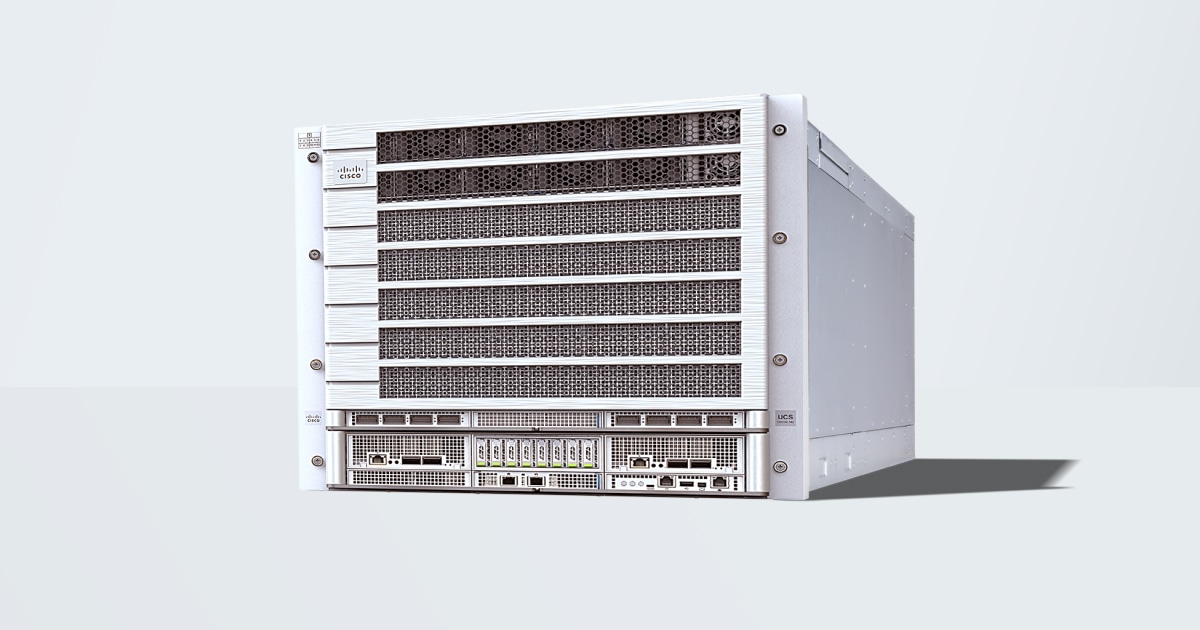
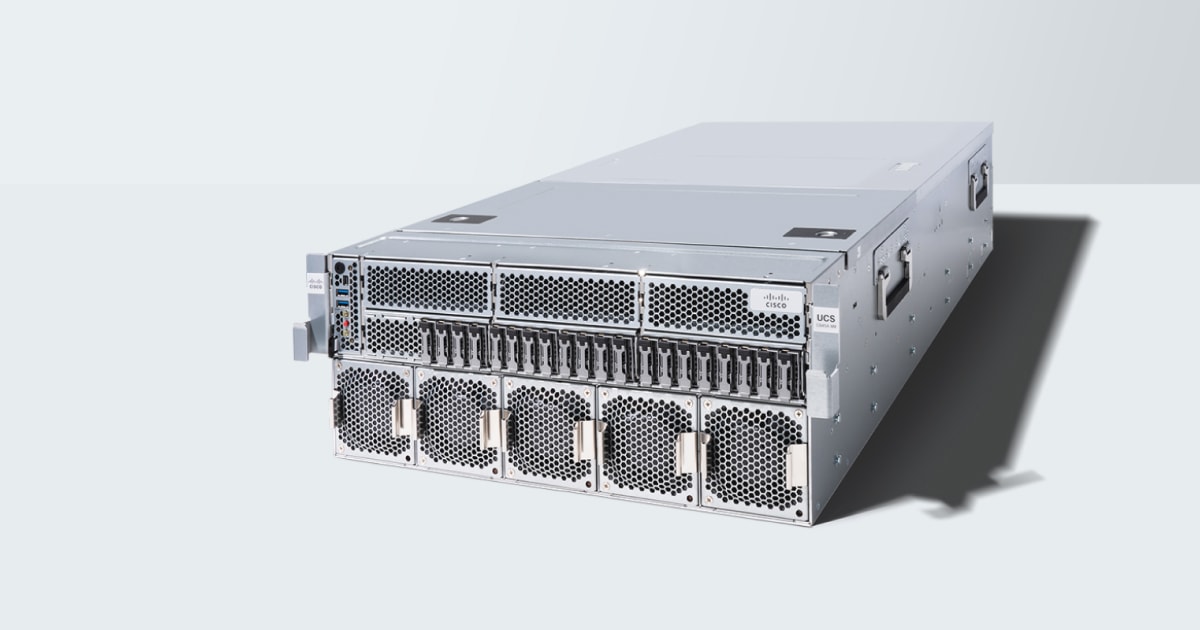
Cisco Unified Computing System (Cisco UCS) is a set of pre-integrated data center components that includes blade servers, rack servers, storage servers, adapters, fabric interconnects, and fabric extenders (FEX) that are integrated under a common embedded management system. This approach results in far fewer system components and much better manageability, operational efficiencies, and flexibility than comparable data center platforms.
Cisco AI servers portfolio
Dense AI GPU servers—NVIDIA HGX and AMD OAM
The Cisco UCS server platforms for AI supercomputing are designed to tackle the most demanding tasks in AI and HPC.
PCIe and NVLink GPU servers for AI at scale
Boost AI performance with C845A and C240 rack servers with PCIe GPU density or NVLink-enabled configurations.

Services and support
Cisco+ Hybrid Cloud
Choose (and only pay for) the features you need
Optimize workloads across your hybrid cloud with the flexibility you need to keep everything running smoothly on-premises.
Cisco Customer Experience (CX) services
Get help from our experts
Keeping track of new tech, evolving trends, and best practices is a full-time job. Let our CX team guide you through it all.
Frequently asked questions
Cisco UCS is the first data center platform that combines industry-standard, x86-architecture blade, rack, and storage servers with networking and storage access into a single converged system. The system is a set of pre-integrated data center components that creates a virtual server comprised of blade, rack, and storage servers, network adapters, fabric extenders, and fabric interconnects, all of which are integrated under a common embedded management system. The system is self-aware and self-integrating. It automatically discovers and inventories components. It enables cross-IT collaboration inside a single intuitive graphical interface using role-based access for multiple IT administrators (server, network, and storage).
Cisco UCS C-Series Rack Servers can integrate into Cisco UCS through Cisco UCS fabric interconnects or be used as standalone servers with Cisco or third-party switches. With world-record-setting performance for 2- and 4-socket servers, Cisco rack and storage servers can integrate into Cisco UCS through a single set of cables. These servers provide a wide range of I/O, memory, internal disk, Solid-State Disk (SSD) drive and NVMe storage device capacity, enabling you to easily match servers to workloads.
You can deploy the Cisco UCS C-Series Rack Servers as standalone servers or with Cisco Intersight to simplify administration and management of your server infrastructure freeing your IT staff to focus on mission-critical and value-added projects.
Cisco UCS C-Series rack servers empower you to tackle any workload challenge with a flexible combination of processor, memory, I/O, and internal storage resources. We offer a choice of AMD EPYC and Intel Xeon Scalable processors in our 1RU and 2RU rack servers.
For more detailed support information, please visit this Cisco UCS C Series Rack Server support page.
Discover articles, discussions and more at this Cisco Unified Computing System community page.