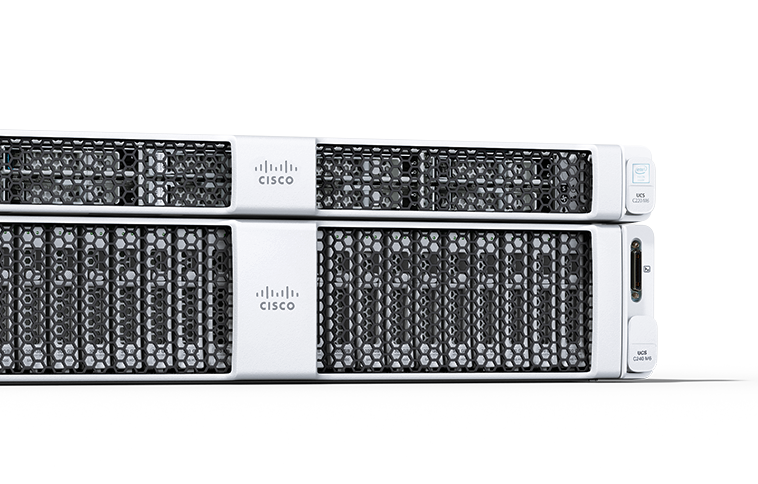
The Cisco® UCS B230 M1 Blade Server is one of the industry's highest-density two-socket blade server platforms. It is a critical new building block in the Cisco Unified Computing System™ portfolio, offering compact performance for enterprise-critical applications within the Cisco Unified Computing System architecture. It is an excellent choice for IT departments that are looking for ways to increase computing performance and memory capacity while getting the most value from the available space in their data centers.
With this broadened portfolio, Cisco continues its commitment to being a trusted x86 systems provider with a full range of system options. With the addition of the Cisco UCS B230 M1, the Cisco Unified Computing System gives customers new choices to help avoid deployment of mission-critical applications into silos of "accidental" architectures.
The Cisco UCS B230 M1 is based on industry-standard server technologies and provides:
• One or two Intel Xeon 6500 or 7500 series multicore processors, for up to 16 processing cores
• 32 DIMM slots for industry-standard Samsung 40-nanometer (nm) class technology using double-data-rate 3 (DDR3) memory
• Two optional solid-state drives (SSDs)
• One dual-port mezzanine slot for up to 20 Gbps of redundant I/O throughput
• Remote management through a Cisco Integrated Management Controller (CIMC) that implements policy established in Cisco UCS Manager software
• Local keyboard, video, and mouse (KVM) access through a front console port on each server
• Out-of-band access by remote KVM, Secure Shell (SSH) Protocol, and virtual media (vMedia) and Intelligent Platform Management Interface (IPMI)
The Cisco UCS B230 M1 is a half-width blade (Figure 1). Up to eight of these high-density two-socket servers can reside in the six-rack-unit (6RU) Cisco UCS 5100 Series Blade Server Chassis, offering one of the highest densities of servers per rack unit in the industry.
Figure 1. Cisco UCS B230 M1 Blade Server
Table 1 provides an overview of the Cisco UCS B230 M1.
Table 1. Cisco UCS B230 M1 Overview
Model
Number of Processor Sockets
Maximum Memory Capacity
Memory Size and Speed
Size and Form Factor
Maximum Number of Servers per Chassis
Maximum Number of Servers per Cisco Unified Computing System
Mezzanine Adapters
Throughput
Cisco UCS B230 M1 Blade Server
2
32 registered DIMMs (RDIMMs); up to 256 GB using 8 GB Dimms
4-, 8- and DDR3, error-correcting code (ECC) RDIMMs
Half-width
8
160
1
Up to 20 Gbps of redundant I/O
Features and Benefits
IT departments are constantly looking for ways to increase computing performance and memory capacity while getting the most value from the available space in their data centers. For these environments, Cisco increases the architectural advantages of its Intel Xeon 6500 and 7500 series processor-based server platforms by bringing to market one of the industry's highest-density two-socket blade server platforms. With the introduction of the Cisco UCS B230 M1, Cisco delivers performance and density in a compact, high-performance, half-width blade server form factor.
Combining the performance of the Intel Xeon 6500 and 7500 series processors with up to 32 DIMM slots, the Cisco UCS B230 M1 delivers compact performance and exceptional memory-per-core count to improve virtualization performance, reduce software license costs, and help enable more virtual machines.
The Cisco UCS B230 M1 is managed by Cisco UCS Manager, an award-winning embedded management system that provides unified management of all system components. The Cisco innovative service profile technology embedded in Cisco UCS Manager provisions Cisco UCS B-Series Blade Servers and their I/O properties (for more information, please see Cisco UCS Manager At-a-Glance). Infrastructure policies needed to provision servers and deploy applications, such as policies for power and cooling, security, identity, hardware health, and Ethernet and storage networking, are encapsulated in the service profiles. Use of service profiles helps reduce the number of manual steps needed for provisioning, the opportunities for human error, and server and network deployment times. In addition, service profiles improve policy consistency and coherency across the entire Cisco Unified Computing System.
Every Cisco UCS B-Series Blade Server uses converged network adapters (CNAs) for access to the unified fabric. This design reduces the number of adapters, cables, and access-layer switches needed while still allowing traditional LAN and SAN connectivity. This Cisco innovation reduces capital expenditures (CapEx) and operating expenses (OpEx), including administrative overhead and power and cooling costs. Among the I/O adapter options, and unique to the Cisco Unified Computing System, the Cisco UCS M81KR Virtual Interface Card (VIC) delivers up to 128 dynamic virtual adapters and interfaces, all tightly integrated with Cisco UCS Manager and VMware vCenter Server. Incorporating Cisco VN-Link technology, this advanced fabric interface provides network visibility to virtual machines and helps enable configurations and policies to follow the virtual machine during migration (for more information please see Cisco UCS M81KR Virtual Interface Card). Two of these high-performance adapters can be employed to make use of the significant processing capacity of the Intel Xeon 6500 or 7500 series processors in the Cisco UCS B230 M1.
Excellent for financial services companies and service providers, the Cisco UCS B230 M1 is designed to efficiently handle demanding database workloads, such as Oracle Real Application Cluster (RAC), Microsoft SQL, and single-instance Oracle database workloads, as well as virtualized workloads using VMware ESX and Microsoft HyperV.
The powerful Cisco UCS B230 M1 offers an innovative combination of performance, density, and cost-effective value.
Table 2 summarizes the features and benefits of the Cisco UCS B230 M1.
Table 2. Features and Benefits
Feature
Benefit
Unified fabric
Decreases total cost of ownership (TCO) by reducing the number of network interface cards (NICs), host bus adapters (HBAs), switches, and cables needed
Integration with Cisco UCS
Manager service profiles
• Helps reduce the number of manual steps required to deploy servers in the data center, improving server policy consistency and coherency.
• Allows servers and support infrastructure to be provisioned in minutes instead of days, shifting IT's focus from maintenance to strategic initiatives
Autodiscovery
Requires no configuration; like all components in the Cisco Unified Computing System, blades are automatically recognized and configured by Cisco UCS Manager
Extensive monitoring
• For each blade, extensive environmental monitoring provided by Cisco UCS Manager
• Allows use of user thresholds to optimize environmental management of the blade
Mezzanine adapters
Choice of CNAs and virtual interface adapters, providing flexibility, increased performance, compatibility with industry standards, and network policy coherence for virtualized environments
Optional local storage
• Support on each blade for up to two optional front-access SSDs
• Support for RAID 0 and 1
Intel Xeon 6500 or 7500 series
multicore processors
• Provide intelligent performance that automatically adapts to the diverse needs of a virtualized environment as well as the most computation-intensive standalone applications
• Use Intel Turbo Boost Technology and Intel Intelligent Power Technology to adapt processor performance to application demands and intelligently scale energy use based on utilization, reducing costs while still delivering the performance required
• Offer advanced reliability features, including Machine Check Architecture recovery, to automatically monitor, report, and recover from hardware errors to maintain data integrity and keep mission-critical services online
Specifications
Cisco UCS B-Series Blade Servers are designed for use in the Cisco Unified Computing System environment and require Cisco UCS Manager, UCS 6100 Series Fabric Interconnects, UCS 5100 Series Blade Server Chassis, and UCS 2100 Series Fabric Extenders to function in this integrated environment.
Table 3 summarizes the specifications for the Cisco UCS B230 M1.
Table 3. Product Specifications
Item
Specification
Processors
1 or 2 Intel Xeon 6500 or 7500 series processors
Processor cores
4, 6, or 8 cores, varying by processor model
Memory
• 32 DIMM slots
• Maximum of 256 GB with 8-GB Samsung 40-nm class DDR3 RDIMMs
Mezzanine adapters slots
• 1 per Cisco UCS B230 M1
Disk drives
Up to 2 front-accessible, hot-swappable SSDs per blade
Disk drive options
• 32 and 64-GB SSDs
Drive controller
• LSI SAS2108 RAID controller
• RAID 0 and 1 support
Management
Managed from the Cisco UCS 6100 Series Fabric Interconnects by Cisco UCS Manager
Temperature: Operating
50 to 95°F (10 to 35°C)
Temperature: Nonoperating
-40 to 149°F (-40 to 65°C)
Humidity: Operating
5 to 93% noncondensing
Humidity: Nonoperating
5 to 93% noncondensing
Altitude: Operating
0 to 10,000 ft (0 to 3000m); maximum ambient temperature decreases by 1°C per 300m
Using a unified view of data center resources, Cisco and our industry-leading partners deliver services that accelerate your transition to a unified computing environment. Cisco Unified Computing Services helps you quickly deploy your data center resources and optimize ongoing operations to better meet your business needs. For more information about these and other Cisco Data Center Services offerings, visit http://www.cisco.com/go/dcservices.
Why Cisco?
Cisco has significant experience in listening to customer requirements and providing solid technology innovation for the enterprise data center. Cisco delivers standards-based solutions backed by a broad partner ecosystem of industry leaders to provide end-to-end customer solutions. Unified computing elevates the traditional product classification of network, server, storage, operating systems, and applications to a data center-wide vision. Cisco, as one of the largest technology providers in the world, has the resources, expertise, and customer focus to deliver on the unified computing vision.