PDF(357.7 KB) View with Adobe Reader on a variety of devices
Updated:August 18, 2014
Document ID:1457308714429642
Bias-Free Language
The documentation set for this product strives to use bias-free language. For the purposes of this documentation set, bias-free is defined as language that does not imply discrimination based on age, disability, gender, racial identity, ethnic identity, sexual orientation, socioeconomic status, and intersectionality. Exceptions may be present in the documentation due to language that is hardcoded in the user interfaces of the product software, language used based on RFP documentation, or language that is used by a referenced third-party product. Learn more about how Cisco is using Inclusive Language.
Product Overview
Serial and asynchronous modules provide highly flexible connections for Cisco
® 1800, 1900, 2800, 2900, 3800, and 3900 Series Integrated Services Routers (ISRs). These modules help customers enable applications such as WAN aggregation, transport for traditional protocols, console servers, and dial access servers. Customers can mix and match modules to tailor cost-effective solutions for common networking problems such as remote network management, external dial-modem access, low-density WAN aggregation, transport for traditional protocols, and high-port-density support.
Cisco offers the following serial and asynchronous modules:
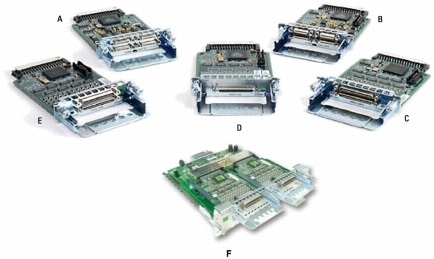
• Cisco 4-Port Serial High-Speed WAN Interface Card (HWIC-4T): Four high-speed serial ports (Figure 1A)
• Cisco 4-Port Asynchronous/Synchronous High-Speed WAN Interface Card (HWIC-4A/S): Four low-speed synchronous/asynchronous ports (Figure 1B)
• Cisco 8-Port Asynchronous/Synchronous High-Speed WAN Interface Card (HWIC-8A/S-232): Eight low-speed synchronous/asynchronous ports, EIA-232 only (Figure 1C)
• Cisco 32-Port Asynchronous Serial Service Module (SM-32A): Thirty-two asynchronous EIA-232 ports Figure 1F)
Figure 1. Cisco Serial and Asynchronous Modules
Common Applications
These highly flexible interface cards enable several important applications.
WAN Aggregation
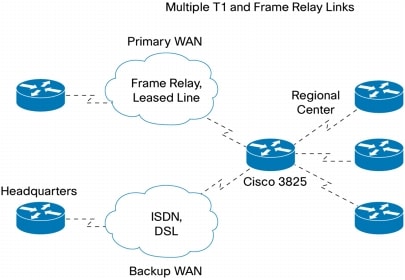
Serial interfaces can be used to aggregate WAN connections from remote sites. With support for serial speeds of up to 8 Mbps per port, the Cisco 4-Port Serial HWIC is well suited for low- and medium-density WAN aggregation (Figure 2).
Figure 2. WAN Aggregation
Transport for Traditional Protocols
Serial and synchronous/asynchronous ports are well suited for transporting traditional traffic across a TCP/IP network. This capability enables network convergence (Figure 3), eliminating the need for costly separate leased lines for this traffic. Traditional protocols supported by Cisco IOS
® Software include:
• Systems Network Architecture (SNA) and Synchronous Data Link Control (SDLC) Protocol
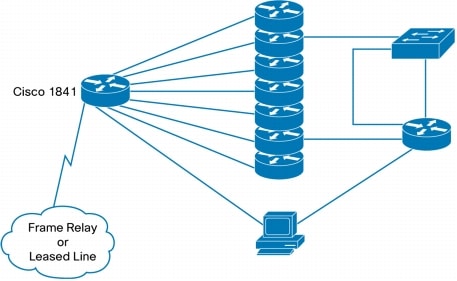
Asynchronous ports provide highly flexible connections that allow access to EIA-232 devices across a TCP/IP network. This capability allows out-of-band management of console and craft ports, allowing the network operator to manage a network of remote devices from a central location (Figure 4).
Figure 4. Managing Multiple Remote Devices from a Single Location
Dial Access Server
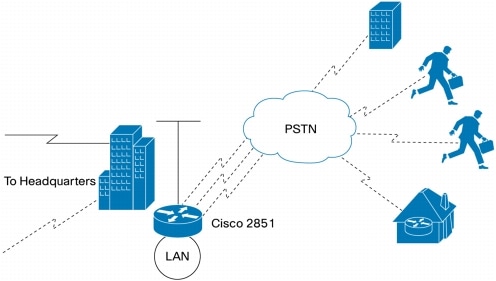
Asynchronous HWICs can connect to external dial modems to provide low-density dial access servers (Figure 5).
Figure 5. Dial Access Server
Connectors and Cabling
Serial and asynchronous HWICs have connectors and cabling that allow high port densities in the compact HWIC form factor. Tables 1 through 4 show connector and cabling specifications.
The Cisco 4-Port Serial HWIC and 4-Port Asynchronous/Synchronous HWIC each have four Smart Serial ports. These ports use the same connectors and cabling as the 2-port Serial WIC (WIC-2T) and 2-port Async/Sync WIC(WIC-2A/S).
Table 2. Smart Serial Cabling for Cisco 4-Port Serial HWIC and 4-Port Asynchronous/Synchronous HWIC
Product Number
Cable Type
Length
Connector Type
CAB-SS-V35MT
V.35 DTE
10 ft (3m)
Plug
CAB-SS-V35FC
V.35 DCE
10 ft (3m)
Socket
CAB-SS-232MT
EIA/TIA-232 DTE
10 ft (3m)
Plug
CAB-SS-232FC
EIA/TIA-232 DCE
10 ft (3m)
Socket
CAB-SS-449MT
EIA/TIA-449 DTE
10 ft (3m)
Plug
CAB-SS-449FC
EIA/TIA-449 DCE
10 ft (3m)
Socket
CAB-SS-X21MT
X.21 DTE
10 ft (3m)
Plug
CAB-SS-X21FC
X.21 DCE
10 ft (3m)
Socket
CAB-SS-530MT
EIA/TIA-530 DTE
10 ft (3m)
Plug
CAB-SS-530AMT
EIA/TIA-530A DTE
10 ft (3m)
Plug
High-Density Synchronous/Asynchronous Cabling
The Cisco 8-Port Asynchronous/Synchronous HWIC uses two high-density 4-port connectors. Each connector supports four ports of EIA-232 with data communications equipment (DCE) or data terminal equipment (DTE) interfaces. All four ports on one cable use the same DTE and DCE mode.
The Cisco 8-Port Asynchronous HWIC and 16-Port Asynchronous HWIC use one (HWIC-8A) or two (HWIC-16A) high-density 8-port connectors. The 8-port asynchronous cable provides the high-density connector on one end and eight RJ-45 plugs on the other. RJ-45- to DB-25 modular adapters are used to convert the RJ-45 to a DB-25 DTE or DB-25 DCE connection.
Table 4. High-Density Asynchronous Cabling
Product Number
Cable Type
Length
Connector Type
CAB-HD8-ASYNC
8-port EIA-232
10 ft (3m)
RJ-45
CAB-HD8-KIT
8-port EIA-232 plus 8 CAB-25AS-MMOD
10 ft (3m)
Plug DB-25
CAB-25AS-MMOD
RJ-45 to DB-25 adapter
‒
Plug DB-25
CAB-25AS-FDTE
RJ-45 to DB-25 adapter
‒
Socket DB-25
Platform Support
Serial and asynchronous modules are supported in the HWIC and enhanced HWIC (EHWIC) or service module (SM) slots of Cisco 1800, 1900, 2800, 2900, 3800, and 3900 Series ISRs. Table 5 indicates which platforms are supported. These modules are supported in all Cisco IOS Software feature sets. The minimum Cisco IOS Software release is shown in Table 6.
Cisco 1900 and 2900 Series and Cisco 3925 and 3945 ISRs
Cisco 3925E and 3945E ISRs
Minimum Cisco IOS Software Release (for all HWIC modules)
Cisco IOS Software Release 12.3(14)T
Cisco IOS Software Release 15.0(1)M
Cisco IOS Software Release 15.1(1)T
Minimum Cisco IOS Software Release (for SM-32A)
Not supported
Cisco IOS Software Releases 15.1(4)M2, 15.2(1)T1 and 15.2(2)T for Cisco 3900 Series.
Cisco IOS Software Release 15.1(4)M3 for Cisco 2900 Series
Cisco IOS Software Releases 15.1(4)M2, 15.2(1)T1, and 15.2(2)T
Minimum Cisco IOS Software technology package
IP Base
IP Base
IP Base
Specifications
The specifications for these modules are listed in Table 7.
Table 7. HWIC Specifications
Specification
HWIC-4T
HWIC-4A/S
HWIC-8A/S-232
HWIC-8A
HWIC-16A
SM-32A
Synchronous support
Yes
Yes
Yes
No
No
No
Synchronous maximum speed (per port)
8 Mbps
256 kbps
256 kbps
-
-
-
Asynchronous support
Yes
Yes
Yes
Yes
Yes
Yes
Asynchronous maximum speed (per port)
230.4 kbps
230.4 kbps
230.4 kbps
230.4 kbps
230.4 kbps
230.4 kbps
Bisync support
Yes
Yes
Yes
No
No
No
Serial protocols
EIA-232, EIA-449, EIA-530, EIA-530A, and V.35, X.21
EIA-232, EIA-449, EIA-530, EIA-530A, and V.35, X.21
EIA-232
EIA-232
EIA-232
EIA-232
Lead manipulation
Yes
Yes
Yes
Yes
Yes
Yes
Network clock synchronization
Yes
Yes
Yes
No
No
No
Common Specifications
The specifications listed here are common to all serial and asynchronous modules.
Agency approvals:
• AS/NZS 60950.1.2003 with Amendments A1 thru A3 (Australia/New Zealand)
• CAN/CSA 22.2 No. 60950-1-07, Second Edition (Canada)
• EN 60950-1: 2006, Second Edition (European Union)
• GB4943 (China)
• UL 60950-1, Second Edition (United States)
• IEC 60950-1: 2005, Second Edition (International)
Immunity:
• EN300386
• EN55024/CISPR24
• EN50082-1
Emissions:
• FCC Part 15 Class A
• ICES-003 Class A
• EN55022 Class A
• CISPR22 Class A
• AS/NZS 3548 Class A
• VCCI Class A
• EN 300386
• EN61000-3-3
• EN61000-3-2
Physical specifications:
• Single-wide HWIC (all HWIC modules) or single-wide SM (SM-32A), no slot restrictions
• Dimensions (HWIC modules) (H x W x D): 0.8 x 3.1 x 5.6 in. (2.1 x 7.9 x 14.2 cm)
• Dimensions (SM-32A) (H x W x D): 1.58 x 7.44 x 7.5 in. (4 x 18.9 x 19.1 cm)
Environmental specifications:
• Operating temperature: 32 to 104°F (0 to 40°C)
• Storage temperature: -4 to 149°F (-20 to 65°C)
• Relative humidity: 10 to 90 percent, noncondensing
Cisco and Partner Services for the Branch Office
Services from Cisco and our certified partners can help you transform the branch-office experience and accelerate business innovation and growth in Cisco Borderless Networks. We have the depth and breadth of expertise to create a clear, replicable, optimized branch-office footprint across technologies. Planning and design services align technology with business goals and can increase the accuracy, speed, and efficiency of deployment. Technical services help improve operation efficiency, save money, and mitigate risk. Optimization services are designed to continuously improve performance and help your team succeed with new technologies.

 Feedback