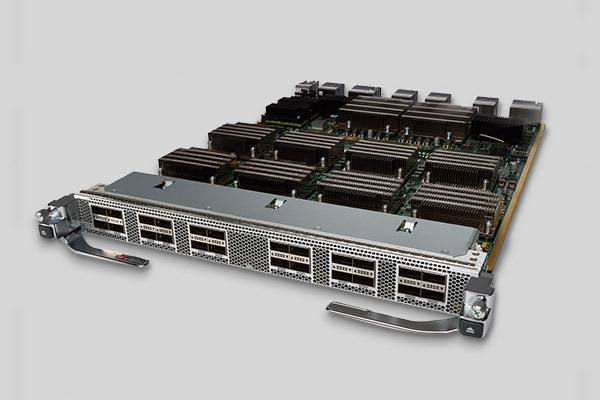
Q. What are Cisco® uBR7200 Series MC28U, MC28X, MC16U, and MC16X Broadband Processing Engines?
A. Cisco uBR7200 Series MC28U, MC28X, MC16U, and MC16X Broadband Processing Engines (BPEs) are a new series of cable line cards for the Cisco uBR7246VXR Universal Broadband Router. With the most advanced RF front end and superior Cisco Media Access Control (MAC) hardware, Cisco BPEs offer unmatched capacity, performance, and reliability. The cards vary in density and integrated upconverter option. Table 1 differentiates cards.
Table 1. Cisco BPE Identification
Part Number
Density
Integrated Upconverter Included
UBR-MC28U
2 x 8
(Two Downstreams, Eight Upstreams)
Yes
UBR-MC28X
2 x 8
(Two Downstreams, Eight Upstreams)
No
UBR-MC16U
1 x 6
(One Downstream, Six Upstreams)
Yes
UBR-MC16X
1 x 6
(One Downstream, Six Upstreams)
No
Q. Why are these cable line cards called "Broadband Processing Engines"? What makes them different from previous cable line cards?
A. Cisco uBR7200 Series MC28U, MC28X, MC16U, and MC16X Broadband Processing Engines (BPEs) feature a highly integrated and robust RF front end and superior processing engine for DOCSIS or Euro-DOCSIS-based networks. The BPE architecture and intelligence go beyond traditional line card capabilities to address expanding service and operational needs of multiple system operators (MSOs). BPEs offer onboard packet processing to help guarantee top performance in large-scale, multi-service deployments. An advanced set of features make the Cisco BPE an ideal choice for cable operators facing the challenge of delivering next-generation data, voice, and video services over cable networks.
General
Advanced PHY with Interference Removal Technology
Line-rate DOCSIS 1.1 and 2.0 processing using the advanced Cisco DOCSIS MAC technology
Universal capability; works with all DOCSIS annex modes, including North America, Europe, and Japan
Advanced RF Front End
Superior Media Access Control
Flexible density options
Hardware acceleration of DOCSIS 1.1 features
Enhanced RF robustness
Hardware acceleration for all BPI and BPI+ functions
Embedded ingress noise cancellation
Direct Sampling
Onboard Upconverters for the MC28U and MC16U
DOCSIS 2.0 A-TDMA feature support
Hardware-based Layer 2 Quality of Service (QoS)
Q. What CMTS platforms are these BPEs supported on?
A. Cisco uBR7200 Series MC28U, MC28X, MC16U, and MC16X BPEs are designed for the Cisco uBR7246VXR Universal Broadband Router. The BPEs provide unparalleled flexibility and robustness to the Cisco uBR7246VXR, further enhancing this communications-grade CMTS. The BPEs enable cable operators to offer higher speed and higher quality broadband cable services to subscribers. The new technology supported on these line cards enables cable operators to deploy advanced IP services.
Q. What does the Cisco MAC do?
A. Cisco uBR7200 Series MC28U, MC28X, MC16U, and MC16X BPEs feature dedicated Cisco MAC layer hardware for maximum performance in large-scale deployments. The MAC layer hardware enables scalability to thousands of cable modems, simultaneously providing hardware acceleration for sophisticated security features or processor-intensive functions such as concatenation, fragmentation, and payload header suppression (PHS) necessary to deploy advanced data, voice, and video services.
Q. What is "advanced PHY" and its relationship to DOCSIS 2.0?
A. Advanced PHY is essentially the use of improved, digital upstream receiver technology to enable faster upstream data rates and more immunity to common sources of noise. DOCSIS 2.0 solves the problem of limited upstream capacity, increasing the maximum raw data throughput rate to 30.72 Mbps using higher order modulation formats such as 64 quadrature amplitude modulation (QAM) and optionally 128 QAM trellis coded modulation (TCM). DOCSIS 2.0 supports QPSK, 8 QAM, and 32 QAM. DOCSIS 2.0 goes beyond advanced PHY to lay out two different MAC layer implementations: A-TDMA and synchronous code division multiple access (S-CDMA). CableLabs DOCSIS 2.0-qualified CMTS and CPE products must support both these MAC layer technologies.
Faced with concerns to minimize expenses, yet maintain customer satisfaction, is now the right time to deploy DOCSIS 2.0? What many operators want is a way to take advantage of the benefits of DOCSIS 2.0 today, without the operational difficulties of a full software upgrade to DOCSIS 2.0. Advanced PHY may be the answer. For the Cisco uBR7246VXR platform, Cisco uBR7200 Series MC28U, MC28X, MC16U, and MC16X BPEs are the line cards of choice, offering advanced PHY and A-TDMA support today.
Q. How do customers benefit from deploying these BPEs?
A. Cisco uBR7200 Series MC28U, MC28X, MC16U, and MC16X BPEs combine the highest level of integration with enhanced RF robustness and performance for the Cisco uBR7246VXR. The innovative design uses leading PHY chips from multiple vendors. The MC28U and MC16U feature integrated upconverters. All BPEs offer advanced RF features that include direct sampling of upstream channels and ingress noise cancellation. The cards deliver advanced CMTS functions, such as:
• MAC processing (modem registration, transmission opportunity scheduling, and Layer 2 QoS)
• On-board hardware-accelerated packet processing
With the Cisco uBR7200 Series MC28U, MC28X, MC16U, and MC16X, cable operators can take advantage of the real benefits inherent in DOCSIS 2.0, without having to make difficult operational changes to migrate to DOCSIS 2.0 today. Customer benefits include:
• Increased performance and capacity
• Reliable transmission even in noisy plant environments
• Reduced operational expenses
• Extended investment protection
Q. Do these BPEs support DOCSIS and Euro-DOCSIS 1.0, 1.1, and 2.0?
A. DOCSIS/Euro-DOCSIS 1.0 and 1.1 are supported. Line cards shipping today, June 2004, also support A-TDMA modulation-part of the DOCSIS and Euro-DOCSIS 2.0 specification.
Q. Do these new BPEs coexist with earlier cable line cards within a single Cisco uBR7246VXR chassis?
A. Yes, these cards can run within the same Cisco uBR7246VXR chassis with earlier MC14C, 16C, 16E, 16S, and 28C Universal Broadband Router (uBR) line cards. For best performance, however, a chassis should run all BPEs, instead of mixing BPEs and cable line cards that do not offer onboard processors.
Q. Can both DOCSIS and Euro-DOCSIS be run within a single Cisco uBR7246VXR populated with BPEs?
A. Yes, as long as each BPE is running only DOCSIS, Euro-DOCSIS or J-DOCSIS. Running both DOCSIS and Euro-DOCSIS
(or J-DOCSIS) on the same card is not supported.
Q. Which uBR hardware is compatible with Cisco uBR7200 Series MC28U, MC28X, MC16U, and MC16X BPEs?
A. Below are compatibility requirements:
• Chassis/system: Cisco uBR7246VXR only; no support on Cisco uBR10012 or uBR7100 Series.
• Cisco Network Processing Engine (NPE): Cisco NPE-400 and uBR7200-NPE-G1 only; no NPE-300, 225, or earlier NPE.
• Line cards: interoperate with MC14C, 16C, 16E, 16S, and 28C cards only.
• I/O Controller: uBR7200-I/O and UBR7200-I/O-2FE/E; no UBR7200-I/O-FE.
• Clock Card is supported
Q. Which Cisco IOS Releases support these BPEs?
A. Cisco IOS Release 12.2(15)CX or 12.2(15)BC2 or higher is required.
Q. What types of connectors are available on these BPEs?
A. Only "F" connectors are offered.
Q. How do these BPEs enable a distributed architecture on the Cisco uBR7246VXR?
A. The cards' onboard processors offload DOCSIS control and data path features from the NPEs such as the Cisco uBR7200-NPE-G1. As a result, the CMTS total processing cycles are distributed among the NPE and BPEs for higher overall system performance.
Q. What distributed features are offloaded from the NPE to the BPEs to process?