Software Lifecycle Support Statement - IOS XR
Available Languages
Bias-Free Language
The documentation set for this product strives to use bias-free language. For the purposes of this documentation set, bias-free is defined as language that does not imply discrimination based on age, disability, gender, racial identity, ethnic identity, sexual orientation, socioeconomic status, and intersectionality. Exceptions may be present in the documentation due to language that is hardcoded in the user interfaces of the product software, language used based on RFP documentation, or language that is used by a referenced third-party product. Learn more about how Cisco is using Inclusive Language.
This software lifecycle support statement explains the Cisco IOS XR Software release model and answers some common questions, such as the linkage between release age and the Software Maintenance Unit (SMU) policy. This document was formerly called “Guidelines for Cisco IOS XR Software.” This IOS XR Software policy will applicable starting with IOS XR 7.8.1.
The Cisco IOS XR Software model has three types of software releases. Each release type has its own content scope and release frequency. The first type is the feature release. The second type includes the maintenance release and the extended maintenance release. The third type is a mechanism to deploy asynchronous software patches called SMUs (Software Maintenance Units). Occasionally, we will pack multiple SMUs together into what’s called a Service Pack.
As of 2024, please refer to IOS XR Release Taxonomy Changes for updates on release numbering changes and release cadence.
The examples in these guidelines use the X.X.X format for release version numbers, for example 7.3.2 (Figure 1).
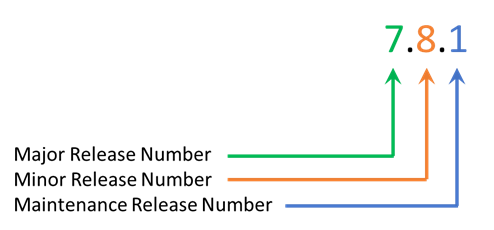
Cisco IOS XR Software release numbering: X.X.X format
Cisco IOS XR Software releases (X1.X2.X3) are designated by a change to either the first digit (X1) or the second digit (X2) in the release version number (for example, the 7 and the 3 in Cisco IOS XR Software Release 7.3.2). In general, a change to X1 would indicate a larger change compared to a change in X2.
Feature releases are delivered for one or more of the following reasons:
● Introduce significant changes throughout the software, including infrastructure or architectural changes:
◦ Likely to cause a change to X1.
● New functions, features, and enhancements:
◦ Likely to cause a change to X2.
● Bug fixes:
◦ Likely to cause a change to X3.
As the name implies, feature releases contain new features and support for new hardware. Feature releases will have the X.X.1 (dot one) designation. For example, IOS XR 7.5.1, and 7.8.1 would all be considered feature releases. From the software support perspective, Feature Release (FR) follows the Standard Maintenance Release (SMR) support time scale (see below for SMR time scale).
Feature releases are delivered approximately every 3 months. Cisco may alter the frequency of this release interval upon customers’ feedback and market conditions in the future, but every attempt is made to maintain a time-based release. Feature releases are usually numbered as a X.X.1 release but reserve the right to deviate from the numbering due to conditions in the future.
A Cisco IOS XR Software feature release is governed by the software lifecycle policy in the section “Lifecycle of Cisco IOS XR Software releases.”
The list of critical bug fixes and features added to a feature release is provided in the release notes along with installation instructions and dependencies. The software images are available for download at the Cisco.com Software Center. Please note that certain features may require the purchase of an additional license.
A Cisco IOS XR Software maintenance release is signified by incrementing the third digit in the release version number from the feature release. For example, XR 7.5.2, and 7.8.2 would all be considered maintenance or extended maintenance releases. Maintenance releases are the primary mechanism to deliver groups of critical bug fixes to Cisco IOS XR Software feature releases. As a matter of course, maintenance releases should contain only bug fixes but may occasionally contain feature enhancements.
Maintenance releases are delivered approximately every 3 months. Cisco may alter the frequency of this release interval based upon customers’ feedback and market conditions in the future, but every attempt is made to maintain a time-based release. Maintenance releases are usually numbered sequentially from X.X.2 on up, but Cisco reserves the right to deviate from the numbering due to conditions in the future.
A Cisco IOS XR Software maintenance release is governed by the software lifecycle policy in the section “Lifecycle of Cisco IOS XR Software releases.” A Standard Maintenance Release (SMR) is supported for 12 months from the End of Sale (EoS)date, and an Extended Maintenance Release (EMR) is supported for 24 months from the End of Sale (EoS) date.
Normally there are two releases per release number (first two numbers of the release): one Feature Release (FR) and one Extended Maintenance Release (EMR). Sometimes more than one maintenance release is required. When that happens, the last maintenance release is the EMR and all the maintenance releases before it are SMRs. For example, if a release number only has two releases, like IOS XR 7.8.1 and 7.8.2, IOS XR 7.8.1 is the feature release and 7.8.2 is the extended maintenance release, and there is no standard maintenance release. However, if a release number has more than two releases, like IOS XR 7.8.1, 7.8.2, and 7.8.3, then IOS XR 7.8.1 remains the feature release, but 7.8.2 becomes the Standard Maintenance Release (SMR) and 7.8.3 is now the extended maintenance release.
Cisco provides primary software maintenance support on an X.Y.1 (for example) release for 24 months after the X.Y release is introduced. These releases are referred to as Standard Maintenance Releases (SMRs). The last maintenance release, X.Y.2 (for example), is an Extended Maintenance Release (EMR) and has software maintenance support for 36 months from when the X.Y.1 release is posted. Cisco reserves the right to deviate from this policy of numeration and SMR or EMR designation in rare occasions.
Table 1. Current feature release SMR and EMR
| Software feature release |
7.5 |
7.6 |
7.7 |
7.8 |
7.9 |
7.10 |
7.11 |
| SMR (24 months) |
7.5.1 - ASR9K 64 Bit, 8000, NCS540, NCS560, NCS5500, NCS1000, XRv9K |
7.6.1 - ASR9K 64 Bit, 8000, NCS540, NCS560, NCS5500, NCS6000, XRv9K, Software Only |
7.7.1 - ASR9K 64 Bit, 8000, NCS540, NCS560, NCS5500, NCS5700, NCS1000, XRv9K, Software Only |
7.8.1 - ASR9K 64 Bit, 8000, NCS540, NCS560, NCS5500, NCS5700, NCS1000, XRv9K, Software Only |
7.9.1 - ASR9K 64 Bit, 8000, NCS540, NCS560, NCS5500, NCS5700, NCS1000 (not 1002), XRv9K, XRd, Software Only |
7.10.1 - ASR9K 64 Bit, 8000, NCS540, NCS560, NCS5500, NCS5700, NCS1000 (not 1002), XRv9K, XRd, Software Only |
7.11.1 - ASR9K 64 Bit, 8000, NCS540, NCS560, NCS5500, NCS5700, NCS1000 (not 1002), XRv9K, XRd, Software Only |
| EMR (36 months) |
7.5.2 - ASR9K 64 Bit, NCS540, NCS560, NCS5500, NCS1000, XRv9K 7.5.3 - 8000 |
7.6.2 - ASR9K 64 Bit, 8000, NCS540, NCS560, NCS5500, NCS6000, XRv9K, Software Only |
7.7.2 - ASR9K 64 Bit, 8000, NCS540, NCS560, NCS5500, NCS5700, NCS1000, XRv9K, Software Only |
7.8.2 - ASR9K 64 Bit, 8000, NCS540, NCS560, NCS5500, NCS5700, NCS1000, XRv9K, Software Only |
7.9.2 - ASR9K 64 Bit, 8000, NCS540, NCS560, NCS5500, NCS5700, NCS1000 (not 1002), XRv9K, XRd, Software Only |
7.10.2 - ASR9K 64 Bit, 8000, NCS540, NCS560, NCS5500, NCS5700, NCS1000 (not 1002), XRv9K, XRd, Software Only |
7.11.2 – ASR9K 64 Bit, 8000, NCS540, NCS560, NCS5500, NCS5700, NCS1000 (not 1002), XRv9K, XRd, Software Only |
| Software feature release |
6.7 |
6.8 |
6.9 |
7.0 |
7.1 |
7.2 |
7.3 |
7.4 |
| SMR (24 months) |
6.7.1 - CRS, ASR9K 32 Bit 6.7.2 - CRS, ASR9K 32 Bit |
6.8.1 – ASR9K 32 Bit |
6.9.1 – ASR9K 32 Bit |
7.0.1 - NCS540, NCS560, NCS1000, NCS5000, NCS5500, NCS6000, XRv9K 7.0.11 - 8000 7.0.12 - 8000 |
7.1.1 - NCS540, NCS560, NCS1000, NCS5000, NCS5500, NCS6000, XRv9K, ASR9K 64 Bit, Software Only 7.1.15 - ASR9K 64 Bit |
7.2.1 - NCS540, NCS560, NCS1000, NCS5000, NCS5500, NCS6000, XRv9K, Software Only, 8000 |
7.3.1 - NCS540, NCS560, NCS1000, NCS5000, NCS5500, XRv9K, Software Only, ASR9K 64 Bit |
7.4.1 - ASR9K 64 Bit, NCS540, NCS560, NCS5500, XRv9K |
| EMR (36 months) |
6.7.3 - ASR9K 32 Bit 6.7.4 – CRS |
6.8.2 - ASR9K 32 Bit |
6.9.2 - ASR9K 32 Bit |
7.0.2 - NCS540, NCS560, NCS1000, NCS5000, NCS5500, NCS6000, XRv9K, ASR9K 64 Bit 7.0.14 - 8000 |
7.1.2 - NCS540, NCS560, NCS1000, NCS5000, NCS5500, NCS6000, XRv9K, Software Only 7.1.3 - ASR9K 64 Bit |
7.2.2 - NCS540, NCS560, NCS1000, NCS5000, NCS5500, NCS6000, XRv9K, Software Only, 8000 |
7.3.2 - NCS540, NCS560, NCS1000, NCS5000, NCS5500, XRv9K, Software Only, ASR9K 64 Bit, 8000 |
7.4.2 - ASR9K 64 Bit, NCS540, NCS560, NCS5500, XRv9000 |
| Software feature release |
6.0 |
6.1 |
6.2 |
6.3 |
6.4 |
6.5 |
6.6 |
| SMR (24 months) |
6.0.1 - ASR9K 32 Bit, NCS1000, NCS5000, NCS5500, XRv9K 6.0.2 - ASR9K 32 Bit, NCS5500, NCS4000, XRv9K |
6.1.2 - CRS, ASRK 32 Bit, ASR9K 64 Bit, NCS1000 6.1.3 - CRS, ASRK 32 Bit, ASR9K 64 Bit, NCS5000, NCS5500, NCS6000 |
6.2.1 - CRS, ASR9K 32 Bit, ASR9K 64 Bit, NCS1000, NCS5000, NCS6000, XRv9K 6.2.2 - CRS, ASR9K 32 Bit, ASR9K 64 Bit, NCS1000, NCS5000, NCS5500, NCS6000, XRv9K 6.2.25 - CRS, ASR9K 32 Bit, ASR9K 64 Bit, NCS1000, NCS5000, NCS5500, NCS6000, XRv9K |
6.3.1 - ASR9K 32 Bit, ASR9K 64 Bit, NCS 1000, NCS 5000, NCS 5500, NCS 6000, XRv9K 6.3.2 - ASR9K 32 Bit, ASR9K 64 Bit, NCS1000, NCS540, NCS5000, NCS5500, NCS6000, XRv9K |
6.4.1 - CRS, ASR9K 32 Bit, ASR9K 64 Bit, NCS5000, NCS6000, XRv9K |
6.5.1 - XRv9K, NCS1000, NCS5000 6.5.2 - XRv9K, ASR9K 32 Bit, ASR9K 64 Bit, NCS1000, NCS5000, CRS |
6.6.2 - XRv9K, ASR9K 32 Bit, ASR9K 64 Bit, NCS1000, CRS |
| EMR (36 months) |
|
6.1.4 - ASR9K 32 Bit, ASR9K 64 Bit, CRS, NCS5000, NCS5500, NCS6000 |
6.2.3 - CRS, ASR9K 32 Bit, ASR9K 64 Bit, NCS5000, NCS5500, NCS6000, XRv9K |
6.3.3 - ASR9K 32 Bit, ASR9K 64 Bit, NCS540, NCS5000, NCS5500, NCS6000, XRv9K |
6.4.2 - CRS, ASR9K 32 Bit, ASR9K 64 Bit, NCS5000, NCS6000, XRv9K 6.4.3 - CRS |
6.5.3 - XRv9K, ASR9K 32 Bit, ASR9K 64 Bit, NCS540, NCS560, NCS5000, NCS5500 |
6.6.3 – CRS, ASR9K 32 Bit, ASR9K 64 Bit, NCS540, NCS560, NCS5000, NCS5500, XRv9000 |
Software maintenance support will provide customers with routine maintenance releases as well as point bug fixes as explained in the section “SMU.” Cisco continues to provide technical assistance support for Cisco IOS XR feature releases through the Cisco® Technical Assistance Center (TAC), until they reach the end of life, governed by the software lifecycle policy explained in the section “Lifecycle of Cisco IOS XR Software releases.”
At present, one to two maintenance releases are planned for each feature release. A planned maintenance release is provided approximately once every 3 months after the initial feature release. Representatives from Cisco TAC and Cisco Engineering evaluate the priority of bug fixes and determine the ones that should be included in each maintenance release. Cisco encourages Cisco IOS XR Software customers to include maintenance releases in their software maintenance plan to avoid possible operational effects from known software bugs.
The list of critical bug fixes in a maintenance release is provided in the release notes along with installation instructions and dependencies. Maintenance releases are cumulative for the feature release they support. At the time it is published, the latest maintenance release includes all critical fixes published since the feature release was introduced. Cisco encourages all Cisco IOS XR Software customers to actively migrate to the latest maintenance release at their earliest convenience. If a bug is encountered that has been fixed in a maintenance release, the Cisco support policy is to recommend an upgrade to the latest available maintenance release.
A Software Maintenance Unit (SMU) is a point fix may be provided until the End of Maintenance (EoM) of the release or until the fix in included in a maintenance release. For FR and SMR, the support period is 24 months after the initial feature release and does not change with any subsequent maintenance release. For EMR, this is for a period of 36 months after the initial feature release. Except for the Cisco Product Security Incident Response Team (PSIRT) SMU, it will be provided for 48 months after the initial feature release. SMUs are typically confined to a limited number of software components and are intended to be simple fixes. SMUs are not intended to deliver new features, and they are not a replacement for maintenance releases. The effect of an SMU and its installation procedure is documented in the release note that accompanies the SMU.
Production SMUs are provided on customer request on supported maintenance releases for service impacting issues observed in production or during maintenance release validation, for which there is no feasible workaround. Software bugs identified through software recommendations or bug search tools are not a basis for a production SMU request. Cisco continuously reviews software bugs affecting supported maintenance releases and provides Proactive Production SMU requests when Cisco deems necessary. Cisco reserves the right to maintain strict control over Production SMU delivery, to maintain the stability of the code base and prevent collateral damage.
URL for SMU policy: https://www.cisco.com/c/en/us/support/docs/ios-nx-os-software/ios-xr-software/116332-maintain-ios-xr-smu-00.html
Production SMU
A Production Software Maintenance Updates (SMU) is a SMU that is formally requested, developed, tested, and released. Production SMUs are intended for use in a live network environment and are formally supported by the Cisco TAC and the relevant development teams. Production SMUs are provided for critical live operation issues on a supported maintenance release. Production SMUs are characterized by package types, impact and criticality, and restart or installation impact type.
Production SMUs are provided on supported maintenance releases for service that impacts issues observed in production or during maintenance release validation, for which there is no feasible workaround. Software bugs identified through software recommendations or Bug Search Tools are not a basis for Production SMU requests. Cisco continuously reviews software bugs that affect supported maintenance releases and provides Proactive Production SMU requests when Cisco deems them necessary. Cisco reserves the right to maintain strict control over Production SMU delivery, to maintain the stability of the code base and prevent collateral damage.
Cisco PSIRT SMU
Cisco Product Security Incident Response Team (PSIRT) SMUs are supported for 48 months after the initial feature release. PSIRT SMUs are provided in response to security-related problems and are released under guidance from the Cisco PSIRT in accordance with the Cisco Security Vulnerability Policy. Cisco PSIRT SMUs are typically built, tested, and delivered to all active software releases affected by the PSIRT problem. Cisco PSIRT SMUs are supported by the Cisco TAC Service Pack.
A Service Pack combines multiple Platform-Dependent (PD) and Platform-Independent (PI) Software Maintenance Updates (SMUs) into one package. The goal of SPs is to reduce the independent SMU management overhead. An SP provides the same number of fixes through a single or small number of SP Package Installation Envelopes (PIEs).
SMU delivery and posting
SMUs are posted on Cisco.com for download on the “Cisco IOS XR Software Maintenance Upgrade” download page on the Cisco website. A list of recommended SMUs is available on the page. Each SMU is customized for a specific Cisco IOS XR Software release based on the affected customer’s software. However, SMUs are not normally generated for all available software releases.
With the introduction of each release type and SMU operation policy, the following section describes the entire release lifecycle.
Lifecycle of Cisco IOS XR Software Releases
Figure 2 illustrates primary milestones of a feature release lifecycle (X.Y), including the end-of-sale announcement, the end of sale, the end of maintenance support, and the end of maintenance through migration timeframes.
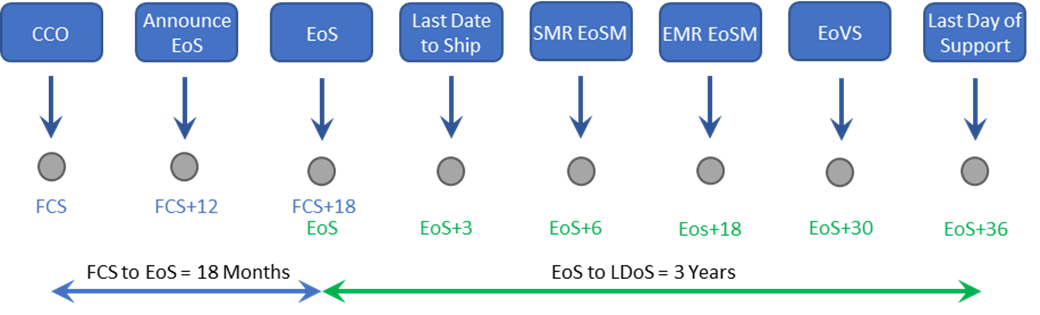
Cisco IOS XR Software feature release lifecycle (not to scale)
The entire lifecycle of any feature release is 4.5 years, which includes the 18 months after the FCS date until the end-of-sale date of the feature release, plus 3 years starting from the end-of-sale date until the release end-of-life date. All maintenance releases of a particular feature release will share the same end-of-sale, end-of-maintenance, end-of-maintenance-through-migration, and end-of-life milestones.
As described in the “Maintenance release” section, Cisco provides software maintenance support on a feature release for 24 (SMR) and 36 (EMR) months after an X.X release is introduced. Software maintenance support will provide customers with routine maintenance releases as well as point bug fixes through SMUs.
Bug dispositions for each phase follow:
● First Customer Shipment (FCS): The time at which the Cisco IOS XR Software feature release is posted on Cisco.com.
● Announce End of Sale: End-of-sale announcements generally occur 12 months after FCS of X.X.1 release. The announcement sets and shows all the significant milestone dates to the software lifecycle and helps customers plan for the eventual phasing out of support.
● End of Sale (EoS): End of sale occurs 18 months after FCS of X.X.1 release. Sales of this particular software release and its subsequent maintenance release should cease.
● Last Date to Ship: Last date to ship typically is 24 months after FCS of X.X.1 release but may be longer. It is the last date that manufacturing is allowed to ship a system with this release of software.
● End of Software Maintenance (EoSM): End of maintenance occurs 6 (for SMR) or 18 (for EMR) months after End of Sale (EoS) of the release. Bugs found are evaluated and fixed as soon as possible. If it meets the acceptable criteria for an SMU before the EoSM date, an SMU fix will be provided, or else the fix will go into the next available Maintenance and/or Feature release. For a Feature Release (FR) or Standard Maintenance Release (SMR), the EoM date occurs at 24 months. If the release is an Extended Maintenance Release (EMR), then EoM occurs at 36 months.
● End of Vulnerability Support (EoVS): End of Vulnerability Support (formerly End of PSIRT Support) occurs 30 months after End of Sale (EoS) of the release.
● Last Day of Support (LDoS) LDoS is 36 months after the End-of-Sale (EoS) date. Calls to Cisco TAC will not be addressed for this release. TAC recommendation will be to upgrade to a currently supported release to validate whether the bug still exists.
Cisco continues to provide TAC support for Cisco IOS XR feature releases until they reach the end-of-life milestone in accordance with the published Cisco end-of-life policy. Please refer to https://www.cisco.com/en/US/products/products_end-of-life_policy.html for more information.
Maintenance releases are cumulative for the feature release they support. At the time it is published, the latest maintenance release includes all critical fixes published since the feature release was introduced. Cisco encourages all Cisco IOS XR Software customers to actively migrate to the latest maintenance release at their earliest convenience. If a bug is encountered that has been fixed in a maintenance release, the company’s support policy is to recommend an upgrade to the latest available maintenance release.
For the upgrade path of a feature release, customers may have unique requirements, and they are encouraged to work with local Cisco customer representatives to find the most optimal release for their network.
Cisco notifies customers of the lifecycle and major milestones of a particular release by the following methods:
● Release note: When a feature release is introduced, Cisco publishes a release note on Cisco.com for that particular feature release. In this document, the end-of-sale, end-of-maintenance, and end-of-life dates of that release are indicated.
● End-of-Sale Preannouncement: Six months before the end-of-sale date of the feature release, Cisco issues an official end-of-sale bulletin for the software release, which includes all end-of-sale milestones affected, including end of maintenance and end of life.
All of the documents are intended to provide advanced notification to Cisco IOS XR Software customers of the pending end-of-sale and end-of-life milestones.
Cisco offers a wide range of services programs to accelerate customer success. These innovative services programs are delivered through a unique combination of people, processes, tools, and partners, resulting in high levels of customer satisfaction. Cisco services help customers protect their network investments, optimize network operations, and prepare their networks for new applications to extend network intelligence and the power of their business.
Cisco understands that our customers operate on disciplined, time-sensitive service-deployment operations with predictable qualification lead times. With the trend of convergence at application, service, and network toward a common packet-based infrastructure, the guidelines described in this document provide three types of software delivery methods designed to meet two fundamental requirements:
● Deliver features (including feature enhancements) in a timely manner: A given Cisco IOS XR Software feature must have consistent behavior on all supported Cisco IOS XR Software platforms.
● Fix problems found in deployed services.
Cisco IOS XR Software has defined multiple software release types to address the two fundamental requirements:
● Feature releases every 3 months (to introduce new software and hardware features and sometimes hardware platforms or software architecture changes).
● Maintenance releases every 3 months to cumulatively fix problems found.
● SMUs to address on-demand point bug fixes.
Cisco continuously improves the release and support practices based on customer needs and input. For any questions related to release practices or suggestions for improvements, please contact your local Cisco sales team.