
Table Of Contents
Provisioning Services
7.1 Overview
7.2 Managing Circuits
7.2.1 Circuit Table Launch Points
7.2.2 Circuit Table Management Tasks
7.2.3 Viewing the Circuit Table
7.2.4 Creating Circuits Using the Circuit Wizard
7.2.5 Modifying a Circuit on CTC-Based NEs
7.2.6 Modifying a Circuit on ONS 15530 or ONS 15540 NEs
7.2.7 Summary of Edit Circuit Options
7.2.8 Updating Circuits on CTC-Based NEs
7.2.9 Merging Circuits on CTC-Based NEs
7.2.10 Repairing a Circuit
7.2.11 Deleting a Circuit on CTC-Based NEs
7.2.12 Viewing Circuit Spans
7.2.13 Viewing the ONS 15530 and ONS 15540 Circuit Table
7.2.14 Viewing Circuits in the Circuit Path Table—ONS 15530 and ONS 15540
7.2.15 Viewing Circuits in the Circuit Path Span Table
7.2.16 Viewing VCAT Member Circuits
7.2.17 Creating VCAT Member Circuits
7.2.18 Filtering the Circuit Table
7.2.19 Tracing a Circuit on CTC-Based NEs
7.2.20 Modifying a Trace
7.2.21 Managing Circuit Notes
7.2.22 Managing Circuit Rolls
7.3 Managing BLSRs
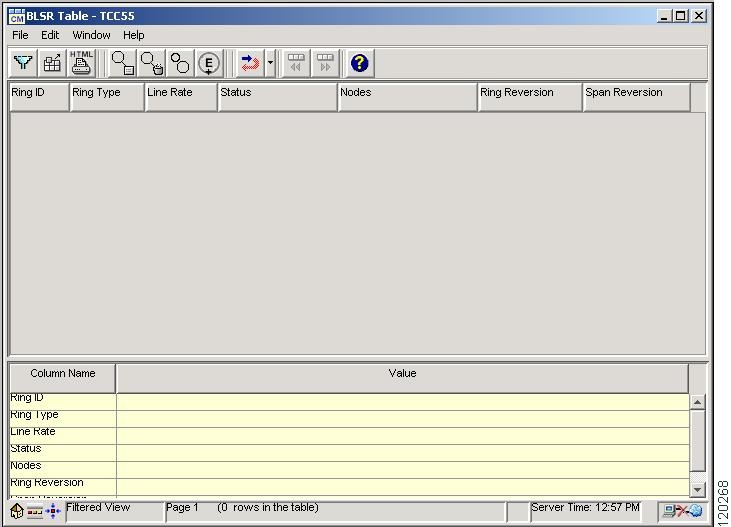
7.3.1 Viewing the BLSR Table
7.3.2 Creating a BLSR for an Individual Node
7.3.3 Creating BLSRs for Multiple Nodes Simultaneously
7.3.4 Viewing the BLSR Ring Map Table
7.3.5 Viewing a BLSR Squelch Table
7.3.6 Editing a BLSR
7.3.7 Exercising a BLSR
7.3.8 Changing the BLSR Exercise Interval
7.3.9 Using the BLSR Upgrade Table
7.3.10 Upgrading a BLSR
7.3.11 Filtering the BLSR Table
7.3.12 Deleting a BLSR
7.4 Managing MS-SPRings
7.4.1 Viewing the MS-SPRing Table
7.4.2 Creating an MS-SPRing for an Individual Node
7.4.3 Creating MS-SPRings for Multiple Nodes Simultaneously
7.4.4 Editing an MS-SPRing
7.4.5 Using the MS-SPRing Upgrade Table
7.4.6 Upgrading an MS-SPRing
7.4.7 Viewing the MS-SPRing Ring Map Table
7.4.8 Viewing the MS-SPRing Squelch Table
7.4.9 Exercising an MS-SPRing
7.4.10 Changing the MS-SPRing Exercise Interval
7.4.11 Filtering the MS-SPRing Table
7.4.12 Deleting an MS-SPRing
7.5 Managing VLANS for E-Series Cards
7.5.1 Creating a VLAN
7.5.2 Tracing a VLAN
7.5.3 Deleting a VLAN
7.6 Managing VLANs (non E-Series Cards)
7.7 Provisioning Data Services
7.7.1 Layer 2 Topology Table Management Tasks
7.7.2 Initializing Layer 2 Cards
7.7.3 Backing Up and Restoring ML Configuration Files on Layer 2 Cards
7.7.4 Provisioning the Layer 2 Topology
7.7.5 Viewing the L2 Topology Table
7.7.6 Creating a Layer 2 Topology
7.7.7 Deleting a Layer 2 Topology
7.7.8 Enabling a Layer 2 Service
7.7.9 Modifying a Layer 2 Topology
7.7.10 Filtering the Layer 2 Topology Table
7.7.11 Modifying the Port in a Layer 2 Topology
7.7.12 Inserting or Deleting a Card into an RPR Topology
7.7.13 Layer 2 Service Management Tasks
7.7.14 Changing the Framing Mode for ML-Series Cards
7.7.15 Provisioning ML-Series Cards to Receive SNMP Traps
7.8 Managing QoS Profiles
7.8.1 QoS Profile Management Tasks
7.8.2 Viewing the QoS Profile Table
7.8.3 Creating a QoS Profile
7.8.4 Modifying a QoS Profile
7.8.5 Duplicating a QoS Profile
7.8.6 Deleting a QoS Profile
7.8.7 Viewing the QoS Classes Table
7.9 Managing DWDM Rings
7.9.1 Viewing the DWDM Ring Table
7.9.2 Creating a DWDM Ring
7.9.3 Creating a DWDM Ring ID
7.9.4 Modifying a DWDM Ring
7.9.5 Filtering the DWDM Ring Table
7.9.6 Deleting a DWDM Ring
7.10 Managing DWDM Nodes
7.10.1 Calculating a DWDM Connection
7.10.2 Creating a DWDM Connection
7.10.3 Deleting a DWDM Connection
7.10.4 Importing a Cisco MetroPlanner Configuration File
7.10.5 Provisioning a DWDM Node Manually
7.10.6 Provisioning the Power Level of DWDM Nodes
7.10.7 Checking the Span Loss Between DWDM Nodes
7.10.8 Enabling and Disabling APC
7.10.9 Monitoring the Channel Power for ROADM Nodes
Provisioning Services
This chapter describes how to use CTM to provision network services. This chapter includes the following sections:
•
Overview
•
Managing Circuits
•
Managing BLSRs
•
Managing MS-SPRings
•
Managing VLANS for E-Series Cards
•
Provisioning Data Services
•
Managing QoS Profiles
•
Managing VLANs (non E-Series Cards)
•
Managing DWDM Rings
•
Managing DWDM Nodes
7.1 Overview
A metro network is a network that aggregates customer traffic and connects customers to services. The metro network is responsible for receiving network traffic from long-haul transport networks and routing this traffic to and from enterprises and end users.
The service point-of-presence (POP) performs service adaptation and packet switching. This layer performs the following functions:
•
Grooming of traffic from the metro network
•
Edge packet switching, where IP services are enabled
•
Core packet switching, where POPs are interconnected over the IP backbone
The service POP is the hub of high-value Internet services. The core network, where optical technologies predominate, is the domain of the long-haul carrier. This high-speed transport fabric interconnects service POPs and has traditionally been built as SONET ring architectures.
CTM simplifies OSS integration for service providers for the end-to-end management of transport networks.
7.2 Managing Circuits
A circuit represents an end-to-end connection between two or more connection termination points (CTPs). A circuit consists of an alternating series of cross-connections and link connections. In its simplest form, a circuit consists of a single cross-connection (if the circuit is defined between two CTPs on the same NE). A circuit can be bidirectional or unidirectional, point-to-point or point-to-multipoint, and protected or unprotected.
CTM allows you to create unidirectional and bidirectional circuits for CTC-based NEs. For unidirectional path switched ring (UPSR) circuits, you can create revertive or nonrevertive circuits. CTM can route the circuits automatically, or you can route them manually. For CTC-based NEs, circuits can be viewed, created, modified, traced, and deleted. For the ONS 15530 or ONS 15540, a circuit is an end-to-end connection between two ports on ONS 15530 or ONS 15540 NEs in terms of lambda (wavelength). For the ONS 155xx, circuit services provide the following major capabilities:
•
Finding all end-to-end connections between NEs in terms of client ports, provided the entire path was traversed within ONS 15530 and ONS 15540 NEs.
•
Displaying the protection information associated with each circuit.
•
Displaying all directional-based paths that have been configured and are in use for a protected circuit.
•
Displaying the active and standby paths that have been configured and are in use for a protected circuit.
Note
Circuit information is not available for the ONS 15200, ONS 15216, ONS 15302, ONS 15305, ONS 15501, ONS 15800, ONS 15801, ONS 15808, Cisco CRS-1, or Cisco Catalyst 6509.
Table 7-1 defines the circuit terms and options that are used throughout this chapter.
Table 7-1 Circuit Terms and Options
Circuit Option
|
Description
|
Link
|
Represents a topological relationship between two physical termination points (PTPs) for a particular layer rate. The possible set of layer rates is determined by the layer rates terminated by the PTP. For example, an OC-N port will terminate a physical layer rate and a SONET layer rate.
|
Circuit
|
Represents an end-to-end connection between two or more CTPs.
|
Cross-connection
|
A (normally flexible) connection between two CTPs within the same NE.
|
Link connection
|
An inflexible (or fixed) connection between two CTPs that are contained by two PTPs connected by a link. It represents a portion of the transport capacity of a link, such as an STS-1 channel within an OC-N link.
|
PTP
|
A termination point that is the actual or potential endpoint of a link that might be abstracted as a PTP. It is the representation of a physical port.
|
CTP
|
Represents the actual or potential endpoint of a cross-connection, link connection, or circuit. A CTP is contained within a PTP. In some cases, there is a single CTP associated with a PTP, such as with a DS1 PTP. There could also be multiple CTPs, such as with STS-1 or STS-Nc CTPs contained within an OC-N PTP.
|
Source
|
The circuit source is where the circuit enters the network.
|
Destination
|
The circuit destination is where the circuit exits the network.
|
Automatic circuit routing
|
CTM routes the circuit automatically on the shortest available path based on routing parameters and bandwidth availability.
|
Manual circuit routing
|
Manual routing allows you to choose a specific path, not just the shortest path chosen by automatic routing. You can choose a specific STS or VT for each circuit segment for SONET nodes, or a specific VC4, VC3, or VC12 for each circuit segment for SDH nodes. You can also create circuits from work orders prepared by an OSS such as the Telcordia TIRKS system.
|
Low-order tunnel
|
Low-order tunnels allow VC3 and VC12 circuits to pass through an SDH node without using cross-connect card (XC10G and XCVXL) resources. Low-order circuits using tunnels will use cross-connect capacity only at the source and destination nodes. One low-order tunnel can carry three VC3s, and each VC3 can carry 21 VC12s. One tunnel can carry one VC3 circuit span and 42 VC12 circuit spans, and each VC3 is a separate container that can contain a VC3 circuit span or 21 VC12 circuit spans.
|
Low-order aggregation point
|
Low-order aggregation points (LAPs) allow low-order VC12 and VC3 circuits to be aggregated into a VC4 for handoff to non-ONS networks or equipment, such as interoffice facilities (IOFs), switches, or digital access cross-connect systems. The VC4 grooming end of the LAP requires an STM-N card. LAPs can be created on MS-SPRings, 1-1, or unprotected nodes, but cannot be created on subnetwork connection protection (SNCP) nodes.
|
VT tunnel
|
VT tunnels allow VT1.5 circuits to pass through a SONET node without utilizing cross-connect resources. VT circuits using VT tunnels will use cross-connect capacity only at the source and destination nodes. One VT tunnel can carry 28 VT1.5 circuits.
|
VT aggregation point
|
VT aggregation points (VAPs) allow VT circuits to be aggregated into an STS for handoff to non-ONS networks or equipment, such as IOFs, switches, or digital access cross-connect systems. VAPs reduce VT matrix resource utilization at the node where the VT1.5s are aggregated onto the STS. This node is called the STS grooming end. The STS grooming end requires an OC-N, EC-1, or DS3XM-6 card. VT aggregation points can be created on BLSR, 1+1, or unprotected nodes, but cannot be created on UPSR nodes.
|
7.2.1 Circuit Table Launch Points
Table 7-2 describes the various launch points and the expected behavior for the Circuit table.
Table 7-2 Circuit Table Launch Points and Expected Behavior
Selection
|
Circuit Table
|
The top-level root node or group nodes in the Domain Explorer
|
All circuits that have NEs in the domain as source/destination or pass-through NEs.
|
The top-level root node or subnetwork nodes in the Subnetwork Explorer
|
All circuits that have NEs in the subnetwork as source/destination or pass-through NEs.
|
A group or subnetwork in the Network Map
|
All circuits that have NEs in the Network Map as source/destination or pass-through NEs.
|
A link in the Network Map
|
All circuits that pass through the specified link as well as circuits that have termination points on the specified link's endpoints.
|
A group of links in the Network Map
|
All circuits that pass through the specified link as well as circuits that have termination points on the specified link's endpoints.
|
A link in the Link table
|
All circuits that pass through the specified link as well as circuits that have termination points on the specified link's endpoints.
Note You cannot launch the Circuit table from the Link table for Layer 2 links.
|
An NE node in the Domain Explorer, Subnetwork Explorer, or Network Map
|
All circuits that have the selected NE node as the source/destination or pass-through NE.
|
An NE node in the NE Explorer
|
All circuits that have the selected NE node as the source/destination or pass-through NE.
|
NE Explorer > Configuration > Circuit Table
|
Can be launched by the selecting the node, a slot, or a port.
|
7.2.2 Circuit Table Management Tasks
Table 7-3 describes the various tasks that can be carried out from the Circuit table and the recommended order in which to complete these tasks. This table also describes how to open the appropriate windows to accomplish these tasks (from the menu bar) or, alternatively, what icons to select from the menu bar at the top of the window to accomplish the same tasks.
Table 7-3 Circuit Table Management Tasks
Task
|
Description
|
Selection
|
Icon
|
See
|
View the circuit table
|
The Circuit table displays the circuit information for all circuits that make up the topology.
|
From the Domain Explorer select Configuration > CTC-based SONET NEs or CTC-based SDH NEs > Circuit Table
|
—
|
Viewing the Circuit Table
|
Create a circuit
|
The Circuit wizard allows you to create a circuit between NEs in the same group or subnetwork.
|
Configuration > Create Circuit
|
|
Creating Circuits Using the Circuit Wizard
|
Modify a circuit
|
The Modify Circuit dialog box allows you to change circuit information for selected circuits.
|
Configuration > Modify Circuit
|
|
Modifying a Circuit on CTC-Based NEs
Modifying a Circuit on ONS 15530 or ONS 15540 NEs
|
Update a circuit
|
You need to update circuits after adding nodes to the network.
|
—
|
—
|
Updating Circuits on CTC-Based NEs
|
Merge circuits on CTC-based NEs
|
Use the circuit merge feature to merge different circuits into one or more new circuits.
|
Configuration > Merge
|
—
|
Merging Circuits on CTC-Based NEs
|
Repair a circuit
|
Use the Repair Circuit window to repair circuits.
|
—
|
—
|
Repairing a Circuit
|
Delete a circuit
|
Allows you to delete an existing circuit. You can also select and delete multiple circuits.
|
Configuration > Delete Circuit
|
—
|
Deleting a Circuit on CTC-Based NEs
|
View the Circuit Span table
|
The Circuit Span table displays information about all spans associated with the selected circuit.
|
Configuration > Open Circuit Span
|
|
Viewing Circuit Spans
|
View circuits in the Circuit Path table
|
The Circuit Path table displays information about all of the paths associated with the selected circuit or link.
|
—
|
—
|
Viewing Circuits in the Circuit Path Table—ONS 15530 and ONS 15540
|
View circuits in the Circuit Path Span table
|
The Circuit Path Span table displays detailed lightpath information about all spans associated with the selected circuit.
|
—
|
—
|
Viewing Circuits in the Circuit Path Span Table
|
View VCAT member circuits
|
Use the VCAT Member table to view members of a virtual concatenation (VCAT) circuit.
|
Configuration > Member Circuits
|
|
Viewing VCAT Member Circuits
|
Create VCAT member circuits
|
Use the Add Member wizard to add new members to an existing VCAT circuit.
|
In the VCAT Member table, choose Configuration > Add Member
|
|
Creating VCAT Member Circuits
|
Filter the Circuit table
|
Use the Circuit table filter to filter circuit data according to criteria that you select and to display the results in the Circuit table.
|
File > Filter
|
|
Filtering the Circuit Table
|
Trace a circuit on CTC-based NEs
|
Use the Circuit table to trace the connectivity of a circuit by showing the source node, the destination node, and any intermediate nodes in graphical format.
|
In the Circuit table, select the circuit to be traced and choose Configuration > Trace Circuit
|
—
|
Tracing a Circuit on CTC-Based NEs
|
Modify a trace
|
Use the Modify Trace window to change the section trace information for transponder and muxponder cards. Trace information can be used to find faults.
|
Select a trace and click Modify to open the Modify Trace window
|
—
|
Modifying a Trace
|
Manage circuit notes
|
Allows you to view and add notes to circuits displayed in the Circuit table.
|
Configuration > Show Circuit Note
|
|
Managing Circuit Notes
|
Manage circuit rolls
|
Use the Rolls table to manage ONS 15600 circuit rolls.
|
To view the Rolls table, select an ONS 15600 in the Domain Explorer tree and choose Configuration > CTC-based SONET NEs or CTC-based SDH NEs > Rolls Table
|
—
|
Managing Circuit Rolls
|
7.2.3 Viewing the Circuit Table
The Circuit table (Figure 7-1) shows circuit information for all circuits that make up a topology. A circuit describes a fixed-size bandwidth pipe that is fully cross-connected from one user-defined source point (node, slot, or port) to a second user-defined destination point across some number of node-to-node optical spans (zero if the circuit is local to a single NE).
An endpoint can be an actual physical drop port (DS-1, DS-3, and so on) or an STS-n or VT1.5 channel in an optical line. A multicast circuit consists of circuit spans that have one source endpoint and a sequence of destination endpoints.
To view the Circuit table, select a node in the Domain Explorer tree and choose Configuration > CTC-based SONET NEs or CTC-based SDH NEs > Circuit Table. Table 7-4 describes the fields in the Circuit table.
Tip
You can also open the Circuit table from the L2 Topology table by choosing Configuration > Circuits.
Figure 7-1 Circuit Table
Note
See Appendix A, "Icons and Menus Displayed in CTM" for details of all the icons displayed in this window.
Table 7-4 Field Descriptions for the Circuit Table
Column Name
|
Description
|
Circuit Name
|
Displays the name of the selected circuit.
Note If there are multiple circuits with the same name displayed in the Circuit table, the label Duplicate appears in this column.
|
Note
|
Displays comments that have been entered for the selected circuit. Allows you to add additional comments.
|
Source NE—Module Type/Physical Loc/Interface
|
Displays the NE ID and module type at the span source, the slot and port name and numbers (physical location), and the STS number (interface).
|
Destination NE—Module Type/Physical Loc/Interface
|
Displays the NE ID, module type at the destination, the slot and port name and numbers (physical location), and the STS number (interface).
|
Circuit Type
|
Displays the type of circuit selected. SONET circuit types are STS, VT, VT Aggregation, VT Tunnel, VT VCAT (shown as VT-v), STS VCAT (shown as STS-v), and DWDM optical channel network connection (OCHNC).
SDH circuit types are HOP, LOP, LOPA, LOPT, HOV (HO VCAT), LOV (LO VCAT), and OCHNC.
|
Circuit Size
|
Displays the size of the circuit:
• SONET circuit sizes are VT1.5, STS 1, STS 3c, STS 6c, STS 9c, STS 12c, STS 24c, STS 48c, STS 192c, STS-1-nv, STS-3c-nv, STS-12c-nv, and VT1.5-nv.
• SDH circuit sizes are VC12, VC3, VC4, VC4-2c, VC4-3c, VC4-4c, VC4-8c, VC4-16c, VC4-64c, VC4-nv, VC4-4c-nv, and VC3-nv.
Note n can be any value from 0 through 256 (0 is valid when all members of a VCAT circuit are deleted).
• OCHNC circuit sizes are multirate, 2.5 Gb/s forward error correction (FEC), 2.5 Gb/s No FEC, 10 Gb/s FEC, and 10 Gb/s No FEC.
Note Not all circuit sizes are supported on all NE releases.
|
Circuit Direction
|
Indicates whether the circuit carries unidirectional or bidirectional traffic.
|
Customer ID
|
Optional text field that displays the customer ID of the circuit.
|
Service ID
|
Optional text field that displays the service ID of the selected circuit.
|
Circuit Status
|
Displays the status of the selected circuit:
• Discovered—The circuit is completely configured in the network; all components are in place and a complete path exists from the circuit source to the circuit destination.
• Partial—The circuit is not complete; one or more cross-connections are not in place.
• Creating—CTM is creating the circuit.
• Deleting—CTM is deleting the circuit.
• Discovered_TL1—A TL1-created circuit or a TL1-like CTM-created circuit is complete and has upgradable cross-connects. A complete path from source to destination(s) exists.
• Partial_TL1—A TL1-created circuit or a TL1-like CTM-created circuit with upgradable cross-connects is missing a cross-connect, and a complete path from source to destination(s) does not exist. The circuit cannot be upgraded until the missing cross-connects are in place.
|
Circuit Service State
|
Displays the state of the circuit. SONET and SDH circuits have different values. For SONET circuits, values are:
• IS—Circuit is in service
• OOS—Circuit is out of service
• OOS Partial—Some segments of the circuit are out of service
For SDH circuits, corresponding values are:
• Unlocked
• Locked
• Locked [Partial]
|
Is Monitor
|
Indicates whether the circuit is a monitor circuit.
|
Circuit Protection Type
|
Indicates the circuit protection scheme. Options are:
• 2F BLSR—The circuit is protected by a 2-fiber bidirectional line switch ring (BLSR).
• 4F BLSR—The circuit is protected by a 4-fiber BLSR.
• BLSR—The circuit is protected by both 2-fiber and 4-fiber BLSR.
• UPSR—The circuit is protected by UPSR.
• DRI—The circuit is protected by a UPSR dual ring interconnection (DRI).
• 1+1—The circuit is protected by a 1+1 protection group.
• Y-Cable—The circuit is protected by a transponder or muxponder card Y-cable protection group.
• Protected—The circuit is protected by diverse SONET topologies; for example, a BLSR and a UPSR, or a UPSR and 1+1.
• 2F-PCA—The circuit is routed on a protection channel access (PCA) path on a 2-fiber BLSR. PCA circuits are unprotected.
• 4F-PCA—The circuit is routed on a PCA path on a 4-fiber BLSR. PCA circuits are unprotected.
• PCA—The circuit is routed on a PCA path on both 2-fiber and 4-fiber BLSRs. PCA circuits are unprotected.
• Unknown—Circuit protection types appear in the Circuit Protection Type column of the Circuit table when the circuit status is Discovered. If the circuit is not discovered, the protection type is Unknown.
• Lost—The circuit was protected, but the protection has been lost due to changes in the network.
|
Description
|
Displays a description of the selected circuit.
|
No. of VLANs
|
Displays the number of VLANs associated with the circuit.
|
Is VCAT or Member Circuit
|
A value of True means that the circuit is a VCAT circuit. A value of False means that the circuit is a normal contiguous concatenation (CCAT) circuit.
|
OCHNC Wavelength
|
Indicates the wavelength provisioned for the OCHNC, in nanometers (nm).
|
OCHNC Direction
|
Indicates the direction of the OCHNC. Values are east-to-west or west-to-east.
|
7.2.4 Creating Circuits Using the Circuit Wizard
The Create Circuit wizard (Configuration > Create Circuit) allows you to create circuits on CTC-based NEs. Use the Create Circuit wizard to create an end-to-end circuit through a subnetwork. A subnetwork is defined as a set of NEs that are interconnected directly or indirectly through links known by CTM. CTM supports circuit provisioning across a heterogeneous network. Establish a circuit by specifying the A and Z termination points (TPs). You can create multiple circuits using the Create Circuit wizard; however, for VT Tunnel circuits, the number you can create is limited by the bandwidth available on the VT Tunnel being used. The maximum number of VT circuits that can be routed through a VT Tunnel is 28.
Caution 
When adding CTC-based circuits, examine the links in the network to ensure correct operation. If any links are down, verify that the ports are not data communications channel (DCC) enabled. For information about viewing links, see
3.6.3 Viewing the Link Table, page 3-29.
Note
A new circuit can only be created within a subnetwork. You cannot create circuits across subnetworks.
Table 7-5 describes the launch points and the expected behavior for the Circuit wizard.
Table 7-5 Create Circuit Wizard Launch Points and Expected Behavior
Launch Point
|
Expected Behavior
|
Source and destination NE nodes in the Domain Explorer or Subnetwork Explorer
|
Select the source NE in the Domain Explorer or Subnetwork Explorer and choose Configuration > Create Circuit. The pointer changes to a plus (+) symbol; select the destination NE. The destination NE must be in the same network partition as the source. The Circuit wizard opens. Source and destination NEs are preset to the selected source and destination.
Note If the Esc key is pressed while the plus symbol is enabled, the operation is canceled and the plus symbol returns to a pointer.
|
Source and destination NE nodes in the Network Map
|
Select the source NE in the Network Map and choose Configuration > Create Circuit. The pointer displays a line extending from the source NE; select the destination NE. The Circuit wizard opens. Source and destination NEs in the Circuit wizard are preset to the selected source and destination NE nodes in the Network Map.
|
Configuration > Create Circuit in the Circuit table
|
Choose Configuration > Create Circuit in the Circuit table. The Circuit wizard opens. Select source and destination nodes. Destination nodes are filtered based on the source node. Source and destination nodes must be in the same network partition.
|
Table 7-6 describes the various types of circuits that can be created.
Table 7-6 Circuits Types that Can Be Created Using the Circuit Wizard
Task
|
Description
|
See
|
Create an STS (including Ethernet), VT, VT Tunnel, VT Aggregation, or OCHNC circuit
|
—
|
Creating an STS (Including Ethernet), VT, VT Tunnel, VT Aggregation, or OCHNC Circuit
|
Create a VCAT circuit
|
You can create VCAT circuits (STS-v, VT-v, VC_HO_PATH_VCAT_CIRCUIT, or VC_LO_PATH_VCAT_CIRCUIT).
|
Creating a VCAT Circuit
|
Create a VC_HO_path circuit
|
You can create unidirectional or bidirectional, revertive or nonrevertive, high-order path circuits.
|
Creating a VC_HO_Path_Circuit
|
Create a VC_LO_path circuit
|
You can create unidirectional or bidirectional, revertive or nonrevertive, low-order path circuits.
|
Creating a VC_LO_Path_Circuit
|
Create a VC low path tunnel connection
|
Select the node for which to create a circuit and open the Circuit wizard.
|
Creating a VC_LO_Path_Tunnel
|
Create a VC low path aggregation connection
|
Create Circuit wizard > Attributes pane.
|
Creating a VC_LO_Path_Aggregation Circuit
|
Create a DWDM optical channel network connection
|
Create Circuit wizard > Attributes pane.
|
Creating a DWDM Optical Channel Network Connection
|
Create a monitor circuit
|
Use the Circuit table to create new circuits from the CTM database and the associated cross-connections between NEs.
|
Creating a Monitor Circuit—CTC-Based NEs
|
Create a unidirectional drop circuit
|
Use the Create Drop wizard to create a new protected or unprotected unidirectional circuit drop.
|
Creating a Unidirectional Drop Circuit—CTC-Based NEs
|
Create a G1000-4 circuit
|
Provision G1000-4 point-to-point circuits and Ethernet manual cross-connects.
|
Creating G1000-4 Circuits
|
Create an E-series circuit
|
Create these configurations and Ethernet manual cross-connects.
|
Creating E-Series Circuits
|
Table 7-7 describes the fields in the Create Circuit wizard.
Table 7-7 Field Descriptions for the Create Circuit Wizard
Field
|
Description
|
Navigation Pane
|
The navigation pane on the left side of the Create Circuit wizard tells you where you are in the process of creating the circuit. The list of tasks shown initially is the default list of all possible tasks. As you move through the circuit creation, you are taken to the appropriate task. You can use the navigation pane to jump quickly from one task to the next, or to an already visited task.
Using the navigation pane is faster than using the Back and Next buttons, because you can jump over multiple panes in one step versus clicking Back or Next and moving through the panes sequentially.
Tip  As you proceed through the wizard, the panes you have visited are highlighted in white and identified by a number. Panes that are not applicable to the current circuit creation sequence are shown in italics.
|
Type
|
Type
|
Select the type of circuit to create from the Type drop-down list.
Note The circuit type selected is displayed (grayed out) in other navigation panes in the Circuit wizard. To change the circuit type you must return to the Type pane to make a new selection.
SONET and SDH circuits have different types. For SONET circuits, values are:
• STS (including Ethernet circuits)
• STS-v
• VT
• VT-v
• VT Tunnel
• VT Aggregation
• OCHNC
For SDH circuits, values are:
• VC_HO_PATH_CIRCUIT
• VC_HO_PATH_VCAT_CIRCUIT
• VC_LO_PATH_AGGREGATION
• VC_LO_PATH_CIRCUIT
• VC_LO_PATH_TUNNEL
• VC_LO_PATH_VCAT_CIRCUIT
• OCHNC
Note The available circuit types are based on the types selected for the user during user creation.
|
Number of Circuits
|
Enter the number of circuits that you want to create.
|
AutoRanged
|
If you are creating multiple circuits with the same slot and sequential port numbers, you can use AutoRanged to create the circuits automatically. The AutoRanged check box is checked automatically for multiple circuits.
|
For VC3 Port Grouping Only
|
(For SDH tunnel circuits only) Check this check box to create VC low-order path tunnels for port grouping. Using these circuits, VC4 tunnels can transport VC3 signal rates. Three ports form a port group. For example, in one E3 or one DS3i card, there are four port groups: Ports 1-3 = PG1, ports 4-6 = PG2, ports 7-9 = PG3, and ports 10-12 = PG4.
|
Attributes
(fields depend on the circuit type)
|
Name
|
Enter a unique name for the new circuit. The circuit name is a free-format string, up to 48 ASCII characters.
|
Description
|
Enter a description for the new circuit, up to 256 ASCII characters.
|
Type
|
(Read-only) Indicates the type of circuit that you selected in the Type pane.
Note To change the circuit type you must return to the Type pane to make a new selection.
|
Size
|
Specify the size of the circuit. SONET circuit sizes are VT 1.5, STS-1, STS-3C, STS-6C, STS-9C, STS-12C, STS-18C, STS-24C, STS-36C, STS-48C, or STS-192C.
SDH circuit sizes are VC12, VC3, VC4, VC4-2C, VC4-3C, VC4-4C, VC4-6C, VC4-8C, VC4-12C, VC4-16C, and VC4-64C.
If OCHNC is selected in Type, the OCHNC circuit size is Equipment Not Specific.
For supported circuit sizes on Ethernet cards, see Cisco ONS 15454 Reference Manual, available at http://www.cisco.com/univercd/cc/td/doc/product/ong/15400/index.htm.
For single-card EtherSwitch, only STS-1, STS-3C, STS-6C, and STS-12C apply. For multicard EtherSwitch, only STS-1, STS-3C, and STS-6C apply.
Note The available circuit sizes are based on the size limitation imposed on the user during user creation.
|
OCHNC Wavelength
|
If OCHNC is selected in Type, the wavelength of the OCHNC is selected here. If OCHNC is not selected in Type, this option is not available.
|
OCHNC Direction
|
If OCHNC is selected in Type, the east-to-west or west-to-east direction of the OCHNC is selected here. If OCHNC is not selected in Type, this option is not available.
|
Bidirectional
|
Check this check box to create a two-way circuit; uncheck it to create a one-way circuit.
|
State
|
Select an administrative state for the new circuit. SONET and SDH circuits have different values. For SONET circuits, values are:
• IS (In Service)—The circuit is in service and able to carry traffic.
• IS AINS (In Service-Auto In Service)—Alarm reporting is suppressed, but the circuit is able to carry traffic.
• OOS DSBLD (Out of Service-Disabled)—The circuit is out of service and unable to carry traffic.
• OOS_MT (Out of Service-Maintenance)—The circuit is in maintenance state. The maintenance state does not interrupt traffic flow; it suppresses alarms and conditions and allows loopbacks to be performed on the circuit.
For SDH circuits, corresponding values are:
• Unlocked
• Unlocked,autoInService
• Locked,disabled
• Locked,maintenance
|
Apply to Source/Destination Ports, If Allowed
|
Check this check box to apply the selected state to the source and destination ports.
|
Symmetric (for VCAT circuits)
|
Check this check box to create a symmetric VCAT circuit.
|
Member Size (for VCAT circuits)
|
Select a size for each VCAT member.
|
Number of Members (for VCAT circuits)
|
Specify the number of members to be configured for the VCAT circuit.
|
Mode (for VCAT circuits)
|
Choose the protection mode for the VCAT circuit:
• None—Provides no protection. A failure on one member causes the entire VCAT circuit to fail.
• SW-LCAS—Allows the VCAT circuit to adapt to member failures and keep traffic flowing after failures at a reduced bandwidth.
• LCAS—Uses a signaling protocol where the members in a virtual concatenation group (VCG) can be dynamically changed without interrupting the operation of uninvolved members. If implemented correctly, there are no errors. LCAS allows the source and destination nodes of a VCG to signal to each other so that the addition or deletion of a member from the VCG can be synchronized without errors.
|
Protected Drops (Non-Ethernet)
|
Specify whether protected drops are indicated. If selected, this option restricts the set of displayed source or destination termination points to those in 1:1, 1:n, or 1+1 protection groups.
|
Provision Working Go and Return on Primary Path
|
Check this check box to provision SNCP/UPSR protection routes in a Go and Return fashion as detailed in ITU-T G.841, to avoid too long a delay on another direction of traffic. This feature applies only to bidirectional UPSR/SNCP circuits. Unidirectional UPSR/SNCP circuits are not affected and the shortest path to the destination is always used as the working path.
|
Revertive
|
Specify whether traffic is reverted back to its original path when the conditions that diverted the circuit to the protect path are repaired. If you do not choose Revertive, traffic remains on the protect path.
|
Reversion Time
|
Specify the amount of time (in minutes) after which traffic reverts back to the original working path when conditions that caused the switch are cleared. The range is 0.5 to 12.0 minutes. The default is 5 minutes.
|
SF Threshold (for SONET circuits only)
|
Set the UPSR path-level signal failure (SF) threshold.
Note This field is visible only for point-to-point topologies.
|
SD Threshold (for SONET circuits only)
|
Set the UPSR path-level signal degrade (SD) threshold.
Note This field is visible only for point-to-point topologies.
|
Switch on PDI-P (for SONET circuits only)
|
Specify whether traffic should switch based on a received STS payload defect indication.
Note This field is visible only for point-to-point topologies.
|
Customer ID
|
Optional text field that displays the customer ID of the circuit. The customer ID can contain 0 to 256 alphanumeric and special characters.
|
Service ID
|
Optional text field that displays the service ID of the selected circuit. The service ID can contain 0 to 256 alphanumeric and special characters.
|
Source
(fields depend on the NE selected and the circuit type)
|
Use Secondary Source
|
(For DRI, open UPSR, and open-ended SNCP circuits) Check this check box to define a secondary source. Then, specify the slot, port, STS, DS-1, or VT for the secondary source.
|
NE ID
|
Select from the list of available NE IDs to specify the source NE ID.
|
Subnetwork ID
|
(Read-only) Displays the ID of the subnetwork associated with the circuit source.
|
Slot
|
Specify the source slot (only for SONET/SDH circuits).
|
Port
|
Specify the source port (only for SONET/SDH circuits).
|
STS
|
(For SONET circuits) Specify the source STS.
|
VT
|
(For SONET circuits) Specify the source VT.
|
DS1
|
(For SONET circuits) Specify the source DS-1.
|
VC4
|
(For SDH circuits) Specify the source VC4.
|
VC3
|
(For SDH circuits) Specify the source VC3.
|
VC12
|
(For SDH circuits) Specify the source VC12.
|
TUG3
|
(For SDH circuits) Specify the source TUG3.
|
TUG2
|
(For SDH circuits) Specify the source TUG2.
|
Destination
(fields depend on the NE selected and the circuit type)
|
Use Secondary Destination
|
(For DRI, open UPSR, and open-ended SNCP circuits) Check this check box to define a secondary destination. Then, specify the slot, port, STS, DS-1, or VT for the secondary destination.
|
NE ID
|
Select from the list of available TPs to specify the destination TP.
|
Subnetwork ID
|
(Read-only) Displays the ID of the subnetwork associated with the circuit destination.
|
Slot
|
Specify the destination slot (only for SONET/SDH circuits).
|
Port
|
Specify the destination port (only for SONET/SDH circuits).
|
STS
|
(For SONET circuits) Specify the destination STS.
|
VT
|
(For SONET circuits) Specify the destination VT.
|
DS1
|
(For SONET circuits) Specify the destination DS-1.
|
VC4
|
(For SDH circuits) Specify the destination VC4.
|
VC3
|
(For SDH circuits) Specify the destination VC3.
|
VC12
|
(For SDH circuits) Specify the destination VC12.
|
TUG3
|
(For SDH circuits) Specify the destination TUG3.
|
TUG2
|
(For SDH circuits) Specify the destination TUG2.
|
Routing Preferences
|
Route Automatically
|
Enable or disable automatic route selection. If enabled, CTM automatically determines the route for the circuit. Or, you can choose manual routing and specify all the intermediate hops on a hop-by-hop basis (up to 64 hops per circuit).
Note If you select the same source and destination nodes, automatic routing is enabled automatically.
|
Using Required Nodes/Links
|
(Available only if Route Automatically is checked) If checked, CTM automatically routes the circuit through the required nodes and/or links.
|
Review Route Before Creation
|
(Available only if Route Automatically is checked) Check this check box to review the route before it is created.
|
VT-DS3 Mapped Conversion
|
(Available only if Route Automatically is checked) If checked, you can route the circuit using the DS3XM12 card. Not applicable for data cards (ML-series and CE-100T-8 cards).
|
Common Fiber Routing
|
(For VCAT circuits) Click this radio button to route each member circuit on the same fiber.
|
Split Routing
|
(For VCAT circuits) Click this radio button to route member circuits on separate paths.
|
Member Preferences
|
(For VCAT circuits) Specify the following information for member circuits:
• Number—Enter a number between 1 and 256 to identify the member.
• Name—Enter a unique name to identify the member. The name can contain up to 48 alphanumeric characters, including spaces.
• Protection—Specify the member circuit protection type (Fully Protected, PCA, or Unprotected).
• Node Diverse—Specify the node diversity for each member circuit:
– Required—Ensures that the primary and alternate paths are node-diverse.
– Desired—CTM attempts node diversity. If node diversity is impossible, CTM uses primary and alternate paths that are link-diverse.
– Don't Care: Link Diverse Only—CTM creates primary and alternate paths that are link-diverse. The paths might be node-diverse, but CTM does not check for node diversity.
• Set Protection for All—Allows you to choose the same protection type for all members.
• Set Node Diversity for All—Allows you to specify the same node diversity for all members.
|
Fully Protected Path
|
If selected, CTM ensures that the circuit is fully protected. You can provision the circuit in a UPSR DRI topology by checking Dual Ring Interconnect. Or, if the circuit must pass across unprotected links, CTM creates a primary and alternate circuit route (virtual UPSR) based on the following node diversity specifications:
• Required—Ensures that the primary and alternate paths of the UPSR portions of the complete circuit path are node-diverse.
• Desired—CTM attempts node diversity. If node diversity is impossible, CTM uses primary and alternate paths that are link-diverse for the UPSR portions of the complete circuit path.
• Don't Care: Link Diverse Only—CTM creates primary and alternate paths that are link-diverse for the UPSR portions of the complete circuit path. The paths might be node-diverse, but CTM does not check for node diversity.
|
Protection Channel Access
|
To route the circuit on a BLSR protection channel, if available, uncheck the Fully Protected Path check box, and check the Protection Channel Access check box.
|
Dual Ring Interconnect
|
If you selected Fully Protected Path and the circuit will be routed on a UPSR DRI, check the Dual Ring Interconnect check box.
Note For DRI and iDRI manually created circuits, you must double-click the DRI span for it to become DRI. A single-click does not enable the DRI span.
|
Diverse Shared Risk Link Group
|
If checked, fully protected circuits will be routed through working and protected links that do not share risk groups.
|
Conversion Route Constraints
(available only if VT-DS3 Mapped Conversion is checked)
|
NE ID
|
Select from the list of available NE IDs to specify the source NE ID.
|
Subnetwork ID
|
(Read-only) Displays the ID of the subnetwork associated with the circuit source.
|
Slot
|
Specify the source slot that contains the DS3XM card.
|
DS3 Mapped STS
|
Choose Circuit Source or Circuit Dest.
|
VT/VC LO Circuit Options
(available only for VT and VC LO path circuits)
|
VT/VC LO Tunnel on Transit Nodes
|
This option is available if the VT or VC circuit passes through a node that does not have a low-order tunnel, or if an existing low-order tunnel is full. Low-order tunnels allow VT/VC circuits to pass through NEs without consuming low-order cross-connect card resources. In general, creating tunnels is a good idea if you are creating many low-order circuits from the same source and destination.
|
VT Aggregation Point (VAP)/VC LO Aggregation Point (LAP)
|
(For SONET) This option is available if you are creating a VT1.5 circuit to a DS1, EC-1, DS3XM-6; or an OC-N port on a BLSR, 1+1, or Unprotected node. A VAP allows VT1.5 circuits to be routed through a node using one STS connection on the cross-connect card matrix rather than multiple connections on the VT1.5 matrix.
(For SDH) This option is available if you are creating a VC12 circuit to an STM-N port for handoff to non-SDH networks or equipment, such as an IOF, switch, or DACS. A LAP allows low-order circuits to be routed through a node using one VC4 connection on the cross-connect card high-order matrix rather than multiple connections on the low-order matrix.
|
Circuit Source is STS/VC4 Grooming Node
|
Creates the VAP or LAP on the VT or VC circuit source node. This option is available only if the VT circuit originates on a DS1, EC-1, DS3XM-6, or OC-N card, or if the VC circuit originates on an STM-N card.
|
Circuit Destination is STS/VC4 Grooming Node
|
Creates the VAP or LAP on the VT or VC circuit destination node. This option is available only if the VT circuit terminates on a DS1, EC-1, DS3XM-6, or OC-N card, or if the VC circuit terminates on an STM-N card.
|
None
|
Choose this option if you do not want to create a low-order tunnel or a VAP/LAP. This is the only available option if CTM cannot create a low-order tunnel or VAP/LAP.
|
VLAN Selection
(available only for Ethernet cards or EtherGroups)
|
VLANs
|
Select from the list of available VLANs to associate an existing VLAN to the circuit. If the Circuit VLANs list is empty, CTM assigns the default VLAN.
To create a new VLAN, click the New VLAN button. Enter a unique VLAN name and ID. The VLAN ID must be an integer greater than 1 but less than 4093. Click OK; then, click OK in the Successfully created VLAN confirmation dialog box. The new VLAN appears in the list of VLANs. The list is ordered alphanumerically by VLAN name, where numbers precede letters and uppercase letters precede lowercase ones.
Note Gigabit Ethernet G-series, ML-series, and E-series cards that are configured in port ML-series mode do not support VLAN assignment.
|
Enable Spanning Tree
|
Check this check box to enable spanning tree protection for the circuit. This is disabled for intranode and multicard Ethernet circuits.
|
VT/VC LO Grooming Node Selection
|
Map view
|
Allows you to tag a node in the map view as a VT or VC LO grooming node. By clicking a node icon, the node is automatically tagged as a VT or VC LO grooming node.
|
Manual Provisioning
|
VCAT Member Number
|
(For VCAT circuits) Use the drop-down list to select route constraints for each member circuit.
|
Map view
|
Displays the NEs that are available in the subnetwork for circuit creation. This pane also indicates the source (and secondary source, if applicable) and destination (and secondary destination, if applicable) NEs selected for circuit creation. The map view is used to manually route the circuit from the source to the destination specified by the addition of the links selected.
Use the right-click menu options to navigate within the map view:
• Find Node—Opens the Find Node dialog box, which lists all of the nodes displayed on the map view. Select a node from the drop-down list and click OK. The selection context in the map view changes to show the selected node highlighted in the visible map area.
• Zoom In—Allows you to zoom in on an object in the map view.
• Zoom Out—Allows you to zoom out on the map view.
• Reset Zoom—Resets the current zoom level to its default zoom.
|
Available Spans
|
Select a link on the map view (related to the selected node) and its corresponding details are displayed in the Available Spans pane. Click Add to move the spans to the Selected Spans field. The newly added link appears in blue on the map view.
|
Selected Spans
|
Select one or more spans and click Remove to remove them from the Selected Spans field. The removed link appears in green to indicate its unselected state.
Note To specify a DRI link, double-click the link on the map. The map view displays the link as bidirectional.
|
Route Constraints
(applicable only if the Using Required Nodes/Links check box is checked)
|
VCAT Member Number
|
(For VCAT circuits) Use the drop-down list to select route constraints for each member circuit.
|
Map view
|
Displays the NEs that are available in the subnetwork for circuit creation. This pane also indicates the source (and secondary source, if applicable) and destination (and secondary destination, if applicable) NEs selected for circuit creation. The map view is used for the inclusion and exclusion of links or nodes during the specification of route constraints. The included nodes are shown in blue and the excluded links are shown in magenta.
Use the right-click menu options to navigate within the map view:
• Find Node—Opens the Find Node dialog box, which lists all of the nodes displayed on the map view. Select a node from the drop-down list and click OK. The selection context in the map view changes to show the selected node highlighted in the visible map area.
• Zoom In—Allows you to zoom in on an object in the map view.
• Zoom Out—Allows you to zoom out on the map view.
• Reset Zoom—Resets the current zoom level to its default zoom.
|
Selected Node/Link
|
Displays the current selected NE or link.
|
Included Links/Nodes
|
Displays the list of links or nodes that are included in the route.
|
Excluded Links/Nodes
|
Displays the list of links or nodes that are excluded from the route.
|
Review Route
(applicable only if the Review Route before creation check box is checked)
|
VCAT Member Number
|
(For VCAT circuits) Use the drop-down list to view the route chosen for each member circuit.
|
Map view
|
Displays the NEs that are available in the subnetwork for circuit creation. This pane also indicates the source (and secondary source, if applicable) and destination (and secondary destination, if applicable) NEs selected for circuit creation. The map view is used for the inclusion and exclusion of links or nodes during the specification of route constraints. The included nodes are shown in blue and the excluded links are shown in magenta.
Use the right-click menu options to navigate within the map view:
• Find Node—Opens the Find Node dialog box, which lists all of the nodes displayed on the map view. Select a node from the drop-down list and click OK. The selection context in the map view changes to show the selected node highlighted in the visible map area.
• Zoom In—Allows you to zoom in on an object in the map view.
• Zoom Out—Allows you to zoom out on the map view.
• Reset Zoom—Resets the current zoom level to its default zoom.
|
Review Route
|
Displays the NEs that are available in the subnetwork for circuit creation. This pane also indicates the source (and secondary source, if applicable) and destination (and secondary destination, if applicable) NEs selected for circuit creation. The map view displays information about the spans selected during autorouting in the subnetwork. The selected spans are shown in blue. When you select a span, its corresponding details are displayed in the Selected Span pane. The circuit summary displays the total hops and the cost for working and protect paths for the routed circuit.
|
Source NE ID
|
Displays the ID of the NE selected as the source node.
|
Destination NE ID
|
Displays the ID of the NE selected as the destination node.
|
Included Spans
|
If you enabled automatic route selection in the Routing Preferences pane, CTM automatically selects spans to route the circuit. This field lists all the spans that the CTM server selected automatically.
|
Selected Span
|
Displays detailed information about the span selected in the Included Spans list.
|
Circuit Summary
|
Circuit Summary
|
Summarizes the selections you made in the wizard panes. To change the circuit summary, click Back and change your selection(s).
|
7.2.4.1 Creating an STS (Including Ethernet), VT, VT Tunnel, VT Aggregation, or OCHNC Circuit
Step 1
Select the node for which to create a circuit and open the Circuit wizard. For an explanation of Circuit wizard launch points, see Table 7-5. Table 7-7 describes the fields in the Create Circuit wizard.
Step 2
In the Attributes pane, enter the following information; then, click Next:
a.
Name—Enter a unique name for the new circuit. The circuit name is a free-format string of up to 48 ASCII characters.
b.
Description—Enter a circuit description of up to 256 characters.
c.
Type—Specify STS (including Ethernet circuits), VT, VT Tunnel, VT Aggregation, or OCHNC. Choose STS for ML-series circuits. For ONS 15454, choose STS for circuits starting and ending at a fiber channel (FCMR) card.
Note
The circuit type selected is displayed (grayed out) in other navigation panes in the Circuit wizard. To change the circuit type you must return to the Type pane to make a new selection.
d.
Size (STS circuits only)—Specify STS-1, STS-9C, STS-12C, STS-24C, STS-48C, or STS-192C. The valid size for circuits involving the DS3i card is STS-3c. Valid sizes for circuits involving the FC_MR-4 card are STS-24C and STS-48C.
For a single-card EtherSwitch, only STS-1, STS-3C, STS-6C, and STS-12C apply. For a multicard EtherSwitch, only STS-1, STS-3C, and STS-6C apply.
Valid circuit sizes for an ML-series circuit are STS-1, STS-3c, STS6c, STS-9c, STS-12c, and STS-24c.
For OCHNC, the size is a read-only attribute with the value Equipment Not Specific.
e.
OCHNC Wavelength—Choose the OCHNC wavelength.
f.
OCHNC Direction—Choose whether the OCHNC direction is east-to-west to west -to-east.
g.
Bidirectional—Check this check box to create a two-way circuit; uncheck it to create a one-way circuit. (For STS and VT circuits only; E-series circuits, G-series circuits, ML-series circuits, VAP circuits, and VT tunnels are bidirectional.)
h.
Number of Circuits—Enter the number of circuits to be created. For ML-series circuits, only one circuit can be created.
i.
State—Choose an administrative state to apply to the circuit:
•
IS—The circuit is in service.
•
OOS—The circuit is out of service. Traffic is not passed on the circuit.
•
OOS-AINS—The circuit is out of service until it receives a valid signal, at which time the circuit state automatically changes to in service.
•
OOS-MT—The circuit is in maintenance state. The maintenance state does not interrupt traffic flow; it suppresses alarms and conditions and allows loopbacks to be performed on the circuit.
j.
Apply to source/destination ports—Check this check box to apply the selected state in the State field to the circuit source and destination ports. Uncheck this check box for ML-series circuits.
k.
Protected Drops (Non-Ethernet)—Check this check box if you want the circuit routed on protected drops only. If selected, this option restricts the set of displayed source or destination termination points to those in 1:1, 1:N, or 1+1 protection groups. Uncheck this check box for ML-series circuits.
l.
Provision working go and return on primary path (bidirectional UPSR/SNCP protection only)—Check this check box to provision the working path to go or return to the primary path.
Note
CTM currently provisions unidirectional SNCP/UPSR circuits following the GR-1400 standard. For bidirectional SNCP/UPSR circuits, you can check the Provision working go and return on primary path check box to route the working and protect paths in one direction following the ITU-T G.841 standard. Unidirectional UPSR/SNCP circuits are not affected by this new routing, and the shortest path is always used as the working path.
m.
Path Selectors (UPSR protection only)—If the circuit will be routed on a UPSR, set the UPSR path selectors as follows:
•
Revertive—Check this check box if you want traffic to revert to the working path when the conditions that diverted it to the protect path are repaired. If you do not choose Revertive, traffic remains on the protect path.
•
Reversion Time—If Revertive is checked, specify the amount of time (in minutes) after which traffic reverts back to the original working path when the conditions that caused the switch are cleared. The range is 0.5 to 12.0 minutes. The default is 5 minutes.
•
SF Threshold (for STS circuits only)—Set the UPSR path-level SF bit error rate (BER) threshold. This field is visible only for point-to-point topologies.
•
SD Threshold (for STS circuits only)—Set the UPSR path-level SD BER threshold. This field is visible only for point-to-point topologies.
•
Switch on PDI-P (for STS circuits only)—Specify whether or not traffic should switch based on a received STS payload defect indication. This field is visible only for point-to-point topologies.
n.
(Optional) Specify the customer information:
•
Customer ID—Identify the end user of the circuit.
•
Service ID—Enter the service ID of the circuit.
Step 3
In the Source pane, enter the following information; then, click Next:
•
NE ID—Select from the list of available TPs to specify the source TP.
•
Source—Specify the source slot, port, STS, DS1-14, and VT.
•
Use Secondary Source—Check this check box to create a secondary source. Then, specify the NE ID, slot, port, STS, DS1-14, and VT for the secondary source.
Note
The secondary source is applied to open-ended UPSR and DRI.
Step 4
In the Destination pane, enter the following information; then, click Next:
•
NE ID—Select from the list of available TPs to specify the destination TP.
•
Destination—Specify the destination slot, port, STS, DS1-14, and VT.
•
Use Secondary Destination—Check this check box to create a secondary destination. Then, specify the slot, port, STS, DS1-14, and VT for the secondary destination.
Note
The secondary destination is applied to open-ended UPSR and DRI.
Step 5
In the VLAN Selection pane (available only if an E-series Ethernet card or EtherGroup is chosen as the source or destination slot), complete the following steps; then, click Next:
a.
Select from the list of available VLANs to associate an existing VLAN to the circuit. If the Circuit VLANs list is empty, CTM assigns the default VLAN.
Note
Gigabit Ethernet G-series, ML-series, and E-series cards that are configured in Port Mapped mode do not support VLAN assignment.
b.
To create a new VLAN, click the New VLAN button. Enter a unique VLAN name and ID. The VLAN ID must be an integer greater than 1 but less than 4093. Click OK; then, click OK in the Successfully created VLAN confirmation dialog box. The new VLAN appears in the list of VLANs. The list is arranged alphanumerically by VLAN name, where numbers precede letters and uppercase letters precede lowercase ones.
c.
Check the Enable Spanning Tree check box to enable spanning tree protection for the circuit. This is disabled for intranode and multicard Ethernet circuits.
Step 6
In the Routing Preferences pane, complete the following steps; then, click Next.
a.
Route Automatically—Enable or disable automatic route selection. If enabled, CTM automatically determines the route for the circuit. If the same source and destination nodes were selected, automatic routing is enabled automatically. If disabled, you can specify the spans associated with the circuit. Under the Manual Route area, the Graphical radio button is selected by default.
b.
Using Required Nodes/Links—(Available only if Route Automatically is checked) Check this check box to let CTM automatically route the circuit through the required nodes and/or links.
c.
Review Route Before Creation—(Available only if Route Automatically is checked) Check this check box to review the route before it is created.
d.
Fully Protected Path—If not selected, choose Protection Channel Access to route the circuit on a BLSR protection channel.
e.
Fully Protected Path—If selected, CTM ensures that the circuit is fully protected. You can provision the circuit in a UPSR DRI topology by checking Dual Ring Interconnect. Or, if the circuit must pass across unprotected links, CTM creates a primary and alternate circuit route (virtual UPSR) based on the following node diversity specifications:
•
Required—CTM ensures that the primary and alternate paths within the UPSR portions of the complete circuit path are node-diverse.
•
Desired—CTM attempts node diversity. If node diversity is impossible, CTM uses primary and alternate paths that are link-diverse for the UPSR portions of the complete circuit path.
•
Don't Care: Link Diverse Only—CTM creates primary and alternate paths that are link-diverse for the UPSR portions of the complete circuit path. The paths might be node-diverse, but CTM does not check for node diversity.
•
Dual Ring Interconnect—If selected, the other node specifications (Required, Desired, and Don't Care: Link Diverse Only) are disabled.
Step 7
In the VT Options pane (available only if you are creating a VT circuit and automatic routing is selected), choose one of the following radio buttons; then, click Next:
•
VT Tunnel on Transit Nodes
•
VAP
•
None
Step 8
If you created a VAP, in the VT Grooming pane, select the following:
•
STS Grooming Node
•
VT Grooming Node
Step 9
In the Route Constraints pane (available when Route Automatically is disabled), a graphical representation of the circuit is displayed, including source and destination nodes. Specify the spans that will route the circuit. CTM starts at the source node. The next NE associated with each span is also displayed. The source node ID is initially displayed in the Selected Nodes field in the Links/Nodes area. Complete the following; then, click Finish:
a.
In the circuit display, select the span that will be used for the next hop.
b.
Complete the following in the Available Spans area:
•
From—Displays the source of the span
•
To—Displays the destination of the span
•
Source STS—Select the STS source from the drop-down list
•
VT—Select the VT time slot
•
DRI Span
c.
Click Add. The span is added to the Selected Spans list.
d.
Select the next NE from the circuit display. The node ID is displayed in the Selected Nodes field.
e.
Repeat substeps a to d for each intermediate NE until the destination NE is reached.
f.
To delete a span from the Selected Spans area, select a span from the Selected Spans list and click Delete.
Step 10
In the Route Constraints pane (available when Route Automatically and Using Required Nodes/Links are enabled), a graphical representation of the circuit is displayed, including source and destination nodes. Specify the nodes or links that will be included in the circuit route. Complete the following information:
a.
In the circuit display, select the node or link. The NE ID or link ID is displayed in the Selected Node/Link field.
b.
Click Include to include the selected node or link in the route. The node or link appears in the Included Links/Nodes list.
c.
Click Exclude to exclude the selected node or link from the route. The node or link appears in the Excluded Links/Nodes list.
d.
Click Remove to remove the selected node or link from the Included Links/Nodes or Excluded Links/Nodes lists.
e.
Click Up or Down to set the sequence of the nodes and spans included in the circuit.
f.
Repeat substeps a to e for each node or link that you want to include in the circuit route.
g.
Click Finish, or, if Review Route Before Creation is checked in the Routing Preferences pane, click Next.
Step 11
In the Review Route pane (available only if Review Route Before Creation is checked), review the following information; then, click Finish:
a.
In the circuit display, review the ID of the source and destination NEs.
b.
Included Spans—Because automatic route selection is enabled in the Routing Preferences pane, CTM automatically selects spans to route the circuit. This field lists all the spans that the CTM server selected automatically.
c.
Selected Span—Displays the following information about the span selected in the Included Spans list:
•
From—Span source
•
To—Span destination
•
Source STS—STS value
•
VT—VT time slot
Note
If you selected VT as the circuit type in the Attributes pane, chose Review Route Before Creation in the Routing Preferences pane, and selected VT Tunnel on Transit Nodes in the VT Options pane, the VT tunnel is created regardless of whether or not you are finished provisioning the circuit. Even if you click the Back button in the Review Route pane and change the VT circuit options, the newly created VT tunnel will not be deleted.
Step 12
In the message box, click OK.
Caution 
It takes several seconds to create a circuit. During that interval, if a new circuit is added with the same name, both circuits might be identified as duplicates. Therefore, be careful not to add a duplicate circuit during the creation of the first circuit.
7.2.4.2 Creating a VCAT Circuit
This section describes how to create VCAT circuits (STS-v, VT-v, VC_HO_PATH_VCAT_CIRCUIT, or VC_LO_PATH_VCAT_CIRCUIT). VCAT circuits are supported on the following cards:
•
ML1000, ML100T—Supported on ONS 15454 SONET and ONS 15454 SDH NEs
•
FCMR—Supported on ONS 15454 SONET and ONS 15454 SDH NEs
•
CE-100T-8S—Supported only on ONS 15454 SONET NEs
•
ML-100T-8—supported on ONS 15310 NEs
Note
Each card supports a different number of members. You can create only bidirectional, revertive or nonrevertive, and high-order/low-order path circuits. CTM can route the circuits automatically, or you can route them manually. Also, all members can be routed through a single fiber or you can specify a split fiber routing preference.
Step 1
Select the node for which to create a VCAT circuit and open the Circuit wizard. For an explanation of Circuit wizard launch points, see Table 7-5.
Step 2
In the Type pane, select STS-v, VT-v, VC_HO_PATH_VCAT_CIRCUIT, or VC_LO_PATH_VCAT_CIRCUIT.
Note
The circuit type selected is displayed (grayed out) in other navigation panes in the Circuit wizard. To change the circuit type you must return to the Type pane to make a new selection.
Note
You can create only one VCAT circuit at a time.
Step 3
In the Attributes pane, enter the following information:
•
Name—Enter a unique name for the new circuit. The circuit name is a free-format string of up to 48 ASCII characters.
•
Description—Enter a circuit description of up to 256 characters.
•
Bidirectional—In this release, only bidirectional VCAT circuits are supported. You cannot edit this field.
•
Number of circuits—Type the number of circuits you want to create. The default is 1. If you enter more than one, you can use autoranging to create the additional circuits automatically.
•
State—Specify IS, OOS_DSBLD, OOS-MT, IS-AINS, or OOS_OOG (Out of Service-Out of Group).
•
Apply to source/destination ports—Check this check box to apply the selected state to the source and destination ports.
•
Member Size—Select the size of the member for the VCAT circuit. This is the unit for VCAT circuit size.
•
Number of Members—Select the number of members (of the size selected above). Different cards support different numbers of members with different sizes.
•
Mode—Select the LCAS mode (None, Sw-LCAS, or LCAS) for the VCAT circuit. If other than None is selected as the Mode, only the cards supporting the LCAS mode selected will be listed for the source and destination selection.
•
Protected Drops—Check this check box if you want the circuit routed to protected drops only; that is, to ONS 15454 SDH cards that are in 1:1, 1:N, or 1+1 protection.
•
Provision working go and return on primary path (bidirectional UPSR/SNCP protection only)—Check this check box to provision the working path to go and return to the primary path.
•
SNCP path selector defaults—If the circuit will be routed on an SNCP, set the defaults as follows:
–
Revertive—Check this check box if you want traffic to revert to the working path when the conditions that diverted it to the protect path are repaired. If Revertive is not chosen, traffic remains on the protect path.
–
Reversion time—If Revertive is checked, set the reversion time. This is the amount of time that will elapse before the traffic reverts to the working path. Traffic can revert when conditions causing the switch are cleared. (The default reversion time is 5 minutes.)
–
SF threshold—Choose from 1 E-3, 1 E-4, or 1 E-5.
–
SD threshold—Choose from 1 E-5, 1 E-6, 1 E-7, 1 E-8, or 1 E-9.
–
Switch on PDI-P—Not available for ONS 15454 SDH circuits.
•
Customer ID (optional)—Identify the end user of the circuit.
•
Service ID (optional)—Enter the service ID of the circuit.
Note
The customer ID and service ID for the VCAT circuit will be applied to all member circuits.
Step 4
Click Next.
Step 5
In the Source pane, set the circuit source. Options include NE ID, slot, port, and STS. The options displayed depend on the circuit type, the circuit properties selected in Step 2 and Step 3, and the cards installed on the node.
Step 6
Click Next.
Step 7
In the Destination pane, enter the appropriate information for the circuit destination. Options include NE ID, slot, port, and STS. The options displayed depend on the circuit type, the circuit properties selected in Step 2 and Step 3, and the cards installed on the node.
Step 8
Click Next.
Step 9
In the Routing Preferences pane, enter the following information; then, click Next:
a.
Route Automatically—Enable or disable automatic route selection. If enabled, CTM automatically determines the route for the circuit. If the same source and destination nodes were selected, automatic routing is enabled automatically. If disabled, you can specify the spans associated with the circuit. Under the Manual Route area, the Graphical radio button is selected by default.
b.
Using Required Nodes/Links—(Available only if Route Automatically is checked) Check this check box to let CTM automatically route the circuit through the required nodes and/or links.
c.
Review Route Before Creation—(Available only if Route Automatically is checked) Check this check box to review the route before it is created.
d.
Select the routing preference for VCAT members. If all members are to be routed on a single fiber, choose Common Fiber Routing. If members are to be routed through different fibers in case one fiber does not have sufficient bandwidth, choose Split Routing.
e.
Specify the following member preferences:
•
Number—Select the member number, a unique number from 1 to 256.
•
Name—Edit the name for the member circuit. By default, <VCAT_NAME>_<Default MemberNumber> is the member name, where <VCAT_NAME> is the parent VCAT circuit name being created.
•
Protection—Select the protection mechanism for member circuits. To route the circuit on a protected path, choose Fully Protected (default). A fully protected circuit route is created based on the diversity option you choose. Fully protected paths might or might not have UPSR/SNCP path segments with primary and alternate paths. The path diversity options apply only to UPSR/SNCP path segments, if any exist. To create an unprotected circuit, choose Unprotected.
•
Node Diversity—Select node diversity for each member circuit.
f.
If you selected Fully Protected Path, choose one of the following options:
•
Required—Ensures that the primary and alternate paths within the extended UPSR/SNCP mesh network portions of the complete circuit path are nodally diverse.
•
Desired—Specifies that node diversity is preferred, but if node diversity is not possible, link-diverse paths are created for the extended UPSR/SNCP mesh network portion of the complete circuit path.
•
Link Diverse Only—Specifies that only link-diverse primary and alternate paths for extended UPSR/SNCP mesh network portions of the complete circuit path are needed.
•
N/A (Not Applicable)—Dual Ring Interconnect is not supported from CTM.
Note
Node diversity can be set for each member when Fully Protected is selected and Split Fiber Routing is selected.
Step 10
In the Manual Provisioning pane (available when Route Automatically is unchecked), a graphical representation of the circuit is displayed, including source and destination nodes. Select the member from the Member list box at the top of the pane. You must select each member and route the member from source to destination manually, by selecting spans and adding them to the route until the destination is reached. When the member selection is changed, the display is refreshed for the new member. Enter the following information; then, click Finish:
a.
In the VCAT Member Number list box, select the member for which the route is to be selected.
b.
In the circuit display, select the span that will be used for the next hop.
c.
In the Available Spans area, complete the following information:
•
From—Displays the source of the span
•
To—Displays the destination of the span
d.
Click Add. The span is added to the Selected Spans list.
e.
Select the next NE from the circuit display. The node ID is displayed in the Selected Nodes field.
f.
Repeat substeps b to e for each intermediate NE until the destination NE is reached.
g.
Repeat substeps a to f for each member until all members are routed.
h.
To delete a span from the Selected Spans area, select a span from the Selected Spans list and click Delete.
Step 11
In the Route Constraints pane (available when Route Automatically and Using Required Nodes/Links are enabled), a graphical representation of the circuit is displayed, including source and destination nodes. Select the member from the Member list box at the top of the pane. For common fiber routing, there is no Member list box, because constraints are applied to all the members. In split fiber routing, you can select different constraints for different members by selecting a member and then selecting spans or NEs to be included or excluded for routing the circuit. Specify the nodes or links that will be included in the circuit route. When the member selection is changed, the display is refreshed for the new member. Complete the following information:
a.
In the VCAT Member Number list box, select the member for which constraints are to be selected.
b.
In the circuit display, select the node or link. The NE ID or link ID is displayed in the Selected Node/Link field.
c.
Click Include to include the selected node or link in the route. The node or link appears in the Included Links/Nodes list.
d.
Click Exclude to exclude the selected node or link from the route. The node or link appears in the Excluded Links/Nodes list.
e.
Click Remove to remove the selected node or link from the Included Links/Nodes or Excluded Links/Nodes lists.
f.
Click Up or Down to set the sequence of the nodes and spans included in the circuit.
g.
Repeat substeps b to f for each node or link that you want to include in the circuit route.
h.
(Optional) Repeat substeps a to g for each member.
i.
Click Finish, or, if Review Route Before Creation is checked in the Routing Preferences pane, click Next.
Step 12
In the Review Route pane (available only if Review Route Before Creation is checked), review the following information; then, click Finish:
Note
Member routing information is displayed when a particular member is selected from the list box.
a.
In the VCAT Member Number list box, select the member.
b.
In the circuit display, review the ID of the source and destination NEs.
c.
Included Spans—Because automatic route selection is enabled in the Routing Preferences pane, CTM automatically selects spans to route the circuit. This field lists all the spans that the CTM server selected automatically.
d.
Selected Span—Review the span information.
Step 13
In the message box, click OK.
7.2.4.3 Creating a VC_HO_Path_Circuit
The E1-N-14 card, STM-N cards, and Ethernet cards all use high-order path circuits. You can create unidirectional or bidirectional, revertive or nonrevertive, high-order path circuits. CTM can route the circuits automatically, or you can route them manually. The E3-12 and DS3i-N-12 cards use VC low-order path tunnels.
Step 1
Select the node for which to create a circuit and open the Circuit wizard. For an explanation of Circuit wizard launch points, see Table 7-5.
Step 2
In the Attributes pane, enter the following information; then, click Next:
•
Name—Enter a unique name for the new circuit. The circuit name is a free-format string of up to 48 ASCII characters.
•
Description—Enter a circuit description of up to 256 characters.
•
Type—Choose VC_HO_Path_Circuit. The circuit type determines the provisioning options that are displayed.
Note
The circuit type selected is displayed (grayed out) in other navigation panes in the Circuit wizard. To change the circuit type you must return to the Type pane to make a new selection.
•
Size—Select the circuit size. VC high-order path circuits can be VC4, VC4-2c, VC4-3c, VC4-4c, VC4-8c, VC4-16c, or VC4-64c for optical cards and for some Ethernet cards (depending on the card type). Of the Ethernet cards, only the G-1000 can use VC4-3c, VC4-8c, and VC4-16c. The "c" indicates concatenated VC4s.
•
Bidirectional—Check this check box to create a two-way circuit; uncheck it to create a one-way circuit.
•
Number of circuits—Type the number of circuits you want to create. The default is 1. If you enter more than one, you can use autoranging to create the additional circuits automatically.
•
State—Specify IS, OOS, OOS-MT, or OOS-AINS.
•
Apply to source/destination ports—Check this check box to apply the selected state to the source and destination ports.
•
Protected Drops—Check this check box if you want the circuit routed to protected drops only; that is, to ONS 15454 SDH cards that are in 1:1, 1:N, or 1+1 protection.
•
Provision working go and return on primary path (bidirectional UPSR/SNCP protection only)—Check this check box to provision the working path to go and return to the primary path.
Note
CTM currently provisions unidirectional SNCP/UPSR circuits following the GR-1400 standard. For bidirectional SNCP/UPSR circuits, you can check the Provision working go and return on primary path check box to route the working and protect paths in one direction following the ITU-T G.841 standard. Unidirectional UPSR/SNCP circuits are not affected by this new routing, and the shortest path is always used as the working path.
•
SNCP path selector defaults—If the circuit will be routed on an SNCP, set the defaults as follows:
–
Revertive—Check this check box if you want traffic to revert to the working path when the conditions that diverted it to the protect path are repaired. If Revertive is not chosen, traffic remains on the protect path.
–
Reversion time—If Revertive is checked, set the reversion time. This is the amount of time that will elapse before the traffic reverts to the working path. Traffic can revert when conditions causing the switch are cleared. (The default reversion time is 5 minutes.)
–
SF threshold—Choose from 1 E-3, 1 E-4, or 1 E-5.
–
SD threshold—Choose from 1 E-5, 1 E-6, 1 E-7, 1 E-8, or 1 E-9.
–
Switch on PDI-P—Not available for ONS 15454 SDH circuits.
•
Customer ID (optional)—Identify the end user of the circuit.
•
Service ID (optional)—Enter the service ID of the circuit.
Step 3
In the Source pane, set the circuit source. Options include NE ID, slot, port, and VC4. The options displayed depend on the circuit type, the circuit properties selected in Step 2, and the cards installed in the node. Click Use Secondary Source if you want to create an SNCP bridge/selector circuit entry point in a multivendor SNCP.
Step 4
Click Next.
Step 5
In the Destination pane, enter the appropriate information for the circuit destination. Options include NE ID, slot, port, and VC4. The options displayed depend on the circuit type, the circuit properties selected in Step 2, and the cards installed in the node. Click Use Secondary Destination if you want to create a circuit destination point for unidirectional/bidirectional circuits.
Step 6
Click Next.
Step 7
In the Routing Preferences pane, complete the following information; then, click Next:
a.
Route Automatically—Enable or disable automatic route selection. If enabled, CTM automatically determines the route for the circuit. If the same source and destination nodes were selected, automatic routing is enabled automatically. If disabled, you can specify the spans associated with the circuit. Under the Manual Route area, the Graphical radio button is selected by default.
b.
Using Required Nodes/Links—(Available only if Route Automatically is checked) Check this check box to let CTM automatically route the circuit through the required nodes and/or links.
c.
Review Route Before Creation—(Available only if Route Automatically is checked) Check this check box to review the route before it is created.
d.
Set the circuit path protection as follows:
•
To route the circuit on a protected path, leave the Fully Protected Path check box checked (default) and proceed to the next substep. A fully protected circuit route is created based on the path diversity option you choose. Fully protected paths might or might not have SNCP path segments with primary and alternate paths. The path diversity options apply only to SNCP path segments, if any exist.
•
To create an unprotected circuit, uncheck Fully Protected Path and go to Step 8.
•
To route the circuit on an MS-SPRing protection channel, uncheck Fully Protected Path, check Protection Channel Access, and go to Step 8.
e.
If you selected Fully Protected Path, choose one of the following options:
•
Required—Ensures that the primary and alternate paths within the extended SNCP mesh network portions of the complete circuit path are nodally diverse.
•
Desired—Specifies that node diversity is preferred, but if node diversity is not possible, link-diverse paths are created for the extended SNCP mesh network portion of the complete circuit path.
•
Don't Care: Link Diverse Only—Specifies that only link-diverse primary and alternate paths for extended SNCP mesh network portions of the complete circuit path are needed.
•
Dual Ring Interconnect—Provisions the circuit in a DRI topology. If selected, the other node specifications (Required, Desired, and Don't Care: Link Diverse Only) are disabled.
Step 8
In the Route Constraints pane (available when Route Automatically is disabled), a graphical representation of the circuit is displayed, including source and destination nodes. Specify the spans that will route to the circuit. CTM starts at the source node. The next NE associated with each span is also displayed. The source node ID is initially displayed in the Selected Nodes field in the Links/Nodes area. Complete the following information; then, click Finish:
a.
In the circuit display, select the span that will be used for the next hop.
b.
In the Available Spans area, complete the following information:
•
From—Displays the source of the span
•
To—Displays the destination of the span
•
DRI Span
c.
Click Add. The span is added to the Selected Spans list.
d.
Select the next NE from the circuit display. The node ID is displayed in the Selected Nodes field.
e.
Repeat substeps a to d for each intermediate NE until the destination NE is reached.
f.
To delete a span from the Selected Spans area, select a span from the Selected Spans list and click Delete.
Step 9
In the Route Constraints pane (available when Route Automatically and Using Required Nodes/Links are enabled), a graphical representation of the circuit is displayed, including source and destination nodes. Specify the nodes or links that will be included in the circuit route. Complete the following information:
a.
In the circuit display, select the node or link. The NE ID or link ID is displayed in the Selected Node/Link field.
b.
Click Include to include the selected node or link in the route. The node or link appears in the Included Links/Nodes list.
c.
Click Exclude to exclude the selected node or link from the route. The node or link appears in the Excluded Links/Nodes list.
d.
Click Remove to remove the selected node or link from the Included Links/Nodes or Excluded Links/Nodes lists.
e.
Click Up or Down to set the sequence of the nodes and spans included in the circuit.
f.
Repeat substeps a to e for each node or link that you want to include in the circuit route.
g.
Click Finish, or, if Review Route Before Creation is checked in the Routing Preferences pane, click Next.
Step 10
In the Review Route pane (available only if Review Route Before Creation is checked), review the following information; then, click Finish:
a.
In the circuit display, review the ID of the source and destination NEs.
b.
Included Spans—Because automatic route selection is enabled in the Routing Preferences pane, CTM automatically selects spans to route the circuit. This field lists all the spans that the CTM server selected automatically.
c.
Selected Span—Review the span information.
Step 11
In the message box, click OK.
7.2.4.4 Creating a VC_LO_Path_Circuit
Step 1
Select the node for which to create a circuit and open the Circuit wizard. For an explanation of Circuit wizard launch points, see Table 7-5.
Step 2
In the Attributes pane, enter the following information; then, click Next:
•
Name—Enter a unique name for the new circuit. The circuit name is a free-format string of up to 48 ASCII characters.
•
Description—Enter a circuit description of up to 256 characters.
•
Type—Choose VC_LO_Path_Circuit. The circuit type determines the provisioning options that are displayed.
Note
The circuit type selected is displayed (grayed out) in other navigation panes in the Circuit wizard. To change the circuit type you must return to the Type pane to make a new selection.
•
Size—Select VC3 or VC12.
•
Bidirectional—Check this check box to create a two-way circuit; uncheck it to create a one-way circuit.
•
Number of circuits—Type the number of circuits you want to create. The default is 1. If you enter more than one, you can use autoranging to create the additional circuits automatically.
•
State—Specify IS, OOS, OOS-MT, or OOS-AINS.
•
Apply to source/destination ports—Check this check box to apply the selected state to the source and destination ports.
•
Protected Drops—Check this check box if you want the circuit routed to protected drops only; that is, to ONS 15454 SDH cards that are in 1:1, 1:N, or 1+1 protection.
•
Provision working go and return on primary path (bidirectional UPSR/SNCP protection only)—Check this check box to provision the working path to go and return to the primary path.
Note
CTM currently provisions unidirectional SNCP/UPSR circuits following the GR-1400 standard. For bidirectional SNCP/UPSR circuits, you can check the Provision working go and return on primary path check box to route the working and protect paths in one direction following the ITU-T G.841 standard. Unidirectional UPSR/SNCP circuits are not affected by this new routing, and the shortest path is always used as the working path.
•
SNCP path selector defaults—If the circuit will be routed on an SNCP, set the defaults as follows:
–
Revertive—Check this check box if you want traffic to revert to the working path when the conditions that diverted it to the protect path are repaired. If Revertive is not chosen, traffic remains on the protect path.
–
Reversion time—If Revertive is checked, set the reversion time. This is the amount of time that will elapse before the traffic reverts to the working path. Traffic can revert when conditions causing the switch are cleared. (The default reversion time is 5 minutes.)
–
SF threshold.
–
SD threshold.
–
Switch on PDI-P—Not available for ONS 15454 SDH circuits.
•
Customer ID (optional)—Identify the end user of the circuit.
•
Service ID (optional)—Enter the service ID of the circuit.
Step 3
In the Source pane, set the circuit source. Options include NE ID, slot, port, tug 3, tug 2, and VC3 or VC12. The options displayed depend on the circuit type, the circuit properties selected in Step 2, and the cards installed in the node. Click Use Secondary Source if you want to create an SNCP bridge/selector circuit entry point in a multivendor SNCP.
Step 4
Click Next.
Step 5
In the Destination pane, enter the appropriate information for the circuit destination. Options include NE ID, slot, port, and VC4. The options displayed depend on the circuit type, the circuit properties selected in Step 2, and the cards installed in the node. Click Use Secondary Destination if you want to create a circuit destination point for unidirectional/bidirectional and VC_LO_Path_Circuits.
Step 6
Click Next.
Step 7
In the Routing Preferences pane, complete the following information; then, click Next:
a.
Route Automatically—Enable or disable automatic route selection. If enabled, CTM automatically determines the route for the circuit. If the same source and destination nodes were selected, automatic routing is enabled automatically. If disabled, you can specify the spans associated with the circuit. Under the Manual Route area, the Graphical radio button is selected by default.
b.
Using Required Nodes/Links—(Available only if Route Automatically is checked) Check this check box to let CTM automatically route the circuit through the required nodes and/or links.
c.
Review Route Before Creation—(Available only if Route Automatically is checked) Check this check box to review the route before it is created.
d.
Set the circuit path protection as follows:
•
To route the circuit on a protected path, leave the Fully Protected Path check box checked (default) and proceed to the next substep. A fully protected circuit route is created based on the path diversity option you choose. Fully protected paths might or might not have SNCP path segments with primary and alternate paths. The path diversity options apply only to SNCP path segments, if any exist.
•
To create an unprotected circuit, uncheck Fully Protected Path and go to Step 8.
•
To route the circuit on an MS-SPRing protection channel, uncheck Fully Protected Path, check Protection Channel Access, and go to Step 8.
e.
If you selected Fully Protected Path, choose one of the following options:
•
Required—Ensures that the primary and alternate paths within the extended SNCP mesh network portions of the complete circuit path are nodally diverse.
•
Desired—Specifies that node diversity is preferred, but if node diversity is not possible, link-diverse paths are created for the extended SNCP mesh network portion of the complete circuit path.
•
Don't Care: Link Diverse Only—Specifies that only link-diverse primary and alternate paths for extended SNCP mesh network portions of the complete circuit path are needed.
•
Dual Ring Interconnect—Provisions the circuit in a DRI topology. If selected, the other node specifications (Required, Desired, and Don't Care: Link Diverse Only) are disabled.
Step 8
If you did not select Using Required Nodes/Links in Step 7, specify VC-LO circuit options. In the VC LO Options pane, choose one of the following radio buttons; then, click Finish (if you did not check Review Route Before Creation in Step 7) or Next (to view the spans included in the route in the Review Route pane).
a.
VC LO Tunnel on transit nodes
b.
VC LAP
•
Circuit source is VC4 grooming node
•
Circuit destination is VC4 grooming node
c.
None
Step 9
If you created a VC LAP, in the VC LO Options pane, select the following; then, click Finish (if you did not check Review Route Before Creation in Step 7) or Next (to view the spans included in the route in the Review Route pane).
•
VC4 Grooming Node
•
VC LO Grooming Node
Step 10
In the Route Constraints pane (available when Route Automatically is disabled), a graphical representation of the circuit is displayed, including source destination nodes. Specify the spans that will route the circuit. CTM starts at the source node. The next NE associated with each span is also displayed. The source node ID is initially displayed in the Selected Nodes field in the Links/Nodes area. Complete the following information; then, click Finish:
a.
In the circuit display, select the span that will be used for the next hop.
b.
In the Available Spans area, complete the following information:
•
From—Displays the source of the span
•
To—Displays the destination of the span
•
DRI Span
c.
Click Add. The span is added to the Selected Spans list.
d.
Select the next NE from the circuit display. The node ID is displayed in the Selected Nodes field.
e.
Repeat substeps a to d for each intermediate NE until the destination NE is reached.
f.
To delete a span from the Selected Spans area, select a span from the Selected Spans list and click Delete.
Step 11
In the Route Constraints pane (available when Route Automatically and Using Required Nodes/Links are enabled), a graphical representation of the circuit is displayed, including source and destination nodes. Specify the nodes or links that will be included in the circuit route. Complete the following information:
a.
In the circuit display, select the node or link. The NE ID or link ID is displayed in the Selected Node/Link field.
b.
Click Include to include the selected node or link in the route. The node or link appears in the Included Links/Nodes list.
c.
Click Exclude to exclude the selected node or link from the route. The node or link appears in the Excluded Links/Nodes list.
d.
Click Remove to remove the selected node or link from the Included Links/Nodes or Excluded Links/Nodes lists.
e.
Click Up or Down to set the sequence of the nodes and spans included in the circuit.
f.
Repeat substeps a to e for each node or link that you want to include in the circuit route.
g.
Click Finish, or, if Review Route Before Creation is checked in the Routing Preferences pane, click Next.
Step 12
In the Review Route pane (available only if Review Route Before Creation is checked), review the following information; then, click Finish:
a.
In the circuit display, review the ID of the source and destination NEs.
b.
Included Spans—Because automatic route selection is enabled in the Routing Preferences pane, CTM automatically chooses spans to route the circuit. This field lists all the spans that the CTM server selected automatically.
c.
Selected Span—Review the span information.
Step 13
In the message box, click OK.
7.2.4.5 Creating a VC_LO_Path_Tunnel
Step 1
Select the node for which to create a circuit and open the Circuit wizard. For an explanation of Circuit wizard launch points, see Table 7-5.
Step 2
In the Attributes pane, enter the following information; then, click Next:
•
Name—Enter a unique name for the new circuit. The circuit name is a free-format string of up to 48 ASCII characters.
•
Description—Enter a circuit description of up to 256 characters.
•
Type—Choose VC_LO_Path_Tunnel. The circuit type determines the provisioning options that are displayed. The E3-12 and DS3i-N-12 cards must use VC low-order path tunnels.
Note
The circuit type selected is displayed (grayed out) in other navigation panes in the Circuit wizard. To change the circuit type you must return to the Type pane to make a new selection.
•
Size—For VC_LO_Path_Tunnel, this is automatically set to VC4.
•
For VC3 Port Grouping Only—Available only when you select VC_LO_Path_Tunnel.
•
Bidirectional—For VC_LO_Path_Tunnel, this is automatically set to bidirectional.
•
Number of circuits—Type the number of circuits you want to create. The default is 1. If you enter more than one, you can use autoranging to create the additional circuits automatically.
•
State—Specify IS, OOS, OOS-MT, or OOS-AINS.
•
Apply to source/destination ports—Check this check box to apply the selected state to the source and destination ports.
•
Protected Drops—Check this check box if you want the circuit routed to protected drops only; that is, to ONS 15454 SDH cards that are in 1:1, 1:N, or 1+1 protection.
•
SNCP path selector defaults—If the circuit will be routed on an SNCP, set the defaults as follows:
–
Revertive—Check this check box if you want traffic to revert to the working path when the conditions that diverted it to the protect path are repaired. If Revertive is not chosen, traffic remains on the protect path.
–
Reversion time—If Revertive is checked, set the reversion time. This is the amount of time that will elapse before the traffic reverts to the working path. Traffic can revert when conditions causing the switch are cleared. (The default reversion time is 5 minutes.)
–
SF threshold—Choose from 1 E-3, 1 E-4, or 1 E-5.
–
SD threshold—Choose from 1 E-5, 1 E-6, 1 E-7, 1 E-8, or 1 E-9.
–
Switch on PDI-P—Not available for ONS 15454 SDH circuits.
•
Customer ID (optional)—Identify the end user of the circuit.
•
Service ID (optional)—Enter the service ID of the circuit.
Step 3
In the Source pane, set the circuit source. Options include NE ID, slot, port, and VC4. The options displayed depend on the circuit type, the circuit properties selected in Step 2, and the cards installed in the node. Click Use Secondary Source if you want to create an SNCP bridge/selector circuit entry point in a multivendor SNCP.
Step 4
Click Next.
Step 5
In the Destination pane, enter the appropriate information for the circuit destination. Options include NE ID, slot, and port group. The options displayed depend on the circuit type, the circuit properties selected in Step 2, and the cards installed in the node. Click Use Secondary Destination if you want to create a circuit destination point for unidirectional/bidirectional.
Step 6
Click Next.
Step 7
In the Routing Preferences pane, for VC_LO_Path_Tunnel (with port grouping), Route Automatically is disabled.
Step 8
Set the circuit path protection as follows:
•
To route the circuit on a protected path, leave the Fully Protected Path check box checked (default) and go to Step 9. A fully protected circuit route is created based on the path diversity option you choose. Fully protected paths might or might not have SNCP path segments with primary and alternate paths. The path diversity options apply only to SNCP path segments, if any exist.
•
To create an unprotected circuit, uncheck Fully Protected Path and go to Step 10.
•
To route the circuit on an MS-SPRing protection channel, uncheck Fully Protected Path, check Protection Channel Access, and go to Step 10.
Step 9
If you selected Fully Protected Path, choose one of the following options:
•
Required—Ensures that the primary and alternate paths within the extended SNCP mesh network portions of the complete circuit path are nodally diverse.
•
Desired—Specifies that node diversity is preferred, but if node diversity is not possible, link-diverse paths are created for the extended SNCP mesh network portion of the complete circuit path.
•
Don't Care: Link Diverse Only—Specifies that only link-diverse primary and alternate paths for extended SNCP mesh network portions of the complete circuit path are needed.
Step 10
Click Finish.
7.2.4.6 Creating a VC_LO_Path_Aggregation Circuit
Step 1
Select the node for which to create a circuit and open the Circuit wizard. For an explanation of Circuit wizard launch points, see Table 7-5.
Step 2
In the Attributes pane, enter the following information; then, click Next:
•
Name—Enter a unique name for the new circuit. The circuit name is a free-format string of up to 48 ASCII characters.
•
Description—Enter a circuit description of up to 256 characters.
•
Type—Choose VC_LO_Path_Aggregation. The circuit type determines the provisioning options that are displayed.
Note
The circuit type selected is displayed (grayed out) in other navigation panes in the Circuit wizard. To change the circuit type you must return to the Type pane to make a new selection.
•
Size—For VC_LO_Path_Aggregation, this is automatically set to VC4.
•
Bidirectional—For VC_LO_Path_Aggregation, this is automatically set to bidirectional.
•
Number of circuits—Type the number of circuits you want to create. The default is 1. If you enter more than one, you can use autoranging to create the additional circuits automatically.
•
State—Specify IS, OOS, OOS-MT, or OOS-AINS.
•
Apply to source/destination ports—Check this check box to apply the selected state to the source and destination ports.
•
Protected Drops—Check this check box if you want the circuit routed to protected drops only; that is, to ONS 15454 SDH cards that are in 1:1, 1:N, or 1+1 protection.
•
SNCP path selector defaults—If the circuit will be routed on an SNCP, set the defaults as follows:
–
Revertive—Check this check box if you want traffic to revert to the working path when the conditions that diverted it to the protect path are repaired. If Revertive is not chosen, traffic remains on the protect path.
–
Reversion time—If Revertive is checked, set the reversion time. This is the amount of time that will elapse before the traffic reverts to the working path. Traffic can revert when conditions causing the switch are cleared. (The default reversion time is 5 minutes.)
–
SF threshold—Choose from 1 E-3, 1 E-4, or 1 E-5.
–
SD threshold—Choose from 1 E-5, 1 E-6, 1 E-7, 1 E-8, or 1 E-9.
–
Switch on PDI-P—Not available for ONS 15454 SDH circuits.
•
Customer ID (optional)—Identify the end user of the circuit.
•
Service ID (optional)—Enter the service ID of the circuit.
Step 3
In the Source pane, set the circuit source. Options include NE ID, slot, port, and VC4. The options displayed depend on the circuit type, the circuit properties selected in Step 2, and the cards installed in the node.
Step 4
Click Next.
Step 5
In the Destination pane, enter the appropriate information for the circuit destination.
Step 6
Click Next.
Step 7
In the Routing Preferences pane, complete the following information; then, click Next:
a.
Route Automatically—Enable or disable automatic route selection. If enabled, CTM automatically determines the route for the circuit. If the same source and destination nodes were selected, automatic routing is enabled automatically. If disabled, you can specify the spans associated with the circuit. Under the Manual Route area, the Graphical radio button is selected by default.
b.
Using Required Nodes/Links—(Available only if Route Automatically is checked) Check this check box to let CTM automatically route the circuit through the required nodes and/or links.
c.
Review Route Before Creation—(Available only if Route Automatically is checked) Check this check box to review the route before it is created.
d.
Set the circuit path protection as follows:
•
To route the circuit on a protected path, leave the Fully Protected Path check box checked (default) and proceed to the next substep. A fully protected circuit route is created based on the path diversity option you choose. Fully protected paths might or might not have SNCP path segments with primary and alternate paths. The path diversity options apply only to SNCP path segments, if any exist.
•
To create an unprotected circuit, uncheck Fully Protected Path and go to Step 8.
•
To route the circuit on an MS-SPRing protection channel, uncheck Fully Protected Path, check Protection Channel Access, and go to Step 8.
e.
If you selected Fully Protected Path, choose one of the following options:
•
Required—Ensures that the primary and alternate paths within the extended SNCP mesh network portions of the complete circuit path are nodally diverse.
•
Desired—Specifies that node diversity is preferred, but if node diversity is not possible, link-diverse paths are created for the extended SNCP mesh network portion of the complete circuit path.
•
Don't Care: Link Diverse Only—Specifies that only link-diverse primary and alternate paths for extended SNCP mesh network portions of the complete circuit path are needed.
•
Dual Ring Interconnect—Provisions the circuit in a DRI topology. If selected, the other node specifications (Required, Desired, and Don't Care: Link Diverse Only) are disabled.
Step 8
In the Route Constraints pane (available when Route Automatically is disabled), a graphical representation of the circuit is displayed, including source and destination nodes. Specify the spans that will route the circuit. CTM starts at the source node. The next NE associated with each span is also displayed. The source node ID is initially displayed in the Selected Nodes field in the Links/Nodes area. Complete the following information; then, click Finish:
a.
In the circuit display, select the span that will be used for the next hop.
b.
In the Available Spans area, complete the following information:
•
From—Displays the source of the span
•
To—Displays the destination of the span
•
DRI Span
c.
Click Add. The span is added to the Selected Spans list.
d.
Select the next NE from the circuit display. The node ID is displayed in the Selected Nodes field.
e.
Repeat substeps a to d for each intermediate NE until the destination NE is reached.
f.
To delete a span from the Selected Spans area, select a span from the Selected Spans list and click Delete.
Step 9
In the Route Constraints pane (available when Route Automatically and Using Required Nodes/Links are enabled), a graphical representation of the circuit is displayed, including source and destination nodes. Specify the nodes or links that will be included in the circuit route. Complete the following information:
a.
In the circuit display, select the node or link. The NE ID or link ID is displayed in the Selected Node/Link field.
b.
Click Include to include the selected node or link in the route. The node or link appears in the Included Links/Nodes list.
c.
Click Exclude to exclude the selected node or link from the route. The node or link appears in the Excluded Links/Nodes list.
d.
Click Remove to remove the selected node or link from the Included Links/Nodes or Excluded Links/Nodes lists.
e.
Click Up or Down to set the sequence of the nodes and spans included in the circuit.
f.
Repeat substeps a to e for each node or link that you want to include in the circuit route.
g.
Click Finish, or, if Review Route Before Creation is checked in the Routing Preferences pane, click Next.
Step 10
In the Review Route pane (available only if Review Route Before Creation is checked), review the following information; then, click Finish:
a.
In the circuit display, review the ID of the source and destination NEs.
b.
Included Spans—Because automatic route selection is enabled in the Routing Preferences pane, CTM automatically selects spans to route the circuit. This field lists all the spans that the CTM server selected automatically.
c.
Selected Span—Review the span information.
Step 11
In the message box, click OK.
7.2.4.7 Creating a DWDM Optical Channel Network Connection
Step 1
Select the node for which to create a circuit and open the Circuit wizard. For an explanation of Circuit wizard launch points, see Table 7-5.
Step 2
In the Attributes pane, enter the following information; then, click Next:
•
Name—Enter a unique name for the new circuit. The circuit name is a free-format string of up to 48 ASCII characters.
•
Description—Enter a circuit description of up to 256 characters.
•
Type—Choose OCHNC. The circuit type determines the provisioning options that are displayed.
Note
The circuit type selected is displayed (grayed out) in other navigation panes in the Circuit wizard. To change the circuit type you must return to the Type pane to make a new selection.
•
Size—Choose Equipment Not Specific.
•
OCHNC Wavelength—Choose the OCHNC wavelength you want to provision.
•
OCHNC Direction—Choose whether OCHNC direction is east-to-west to west-to-east.
•
Bidirectional—Check this check box to create a bidirectional OCHNC, or uncheck it to create a unidirectional OCHNC.
•
Customer ID (optional)—Identify the end user of the circuit.
•
Service ID (optional)—Enter the service ID of the circuit.
Note
The remaining fields in the Attributes pane are not available.
Step 3
In the Source pane, set the circuit source; then, click Next.
Step 4
In the Destination pane, enter the appropriate information for the circuit destination.
Step 5
Click Finish.
Caution 
It takes several seconds to create a circuit. During that interval, if a new circuit is added with the same name, both circuits might be identified as duplicates. Therefore, be careful not to add a duplicate circuit during the creation of the first circuit.
7.2.4.8 Creating a Monitor Circuit—CTC-Based NEs
Use the Create Monitor Circuit wizard to create a new monitor circuit on CTC-based NEs.
Step 1
Select the CTC-based NE where you want to create a monitor circuit and open the Circuit table. For an explanation of Circuit table launch points, see Table 7-2.
Step 2
In the Circuit table, select the bidirectional circuit to be monitored.
Step 3
Choose Configuration > Modify Circuit (or click the Modify tool). The Modify Circuit dialog box opens.
Step 4
In the Modify Circuit dialog box, click the Monitor tab. The Monitor tab displays the ports that can be used to monitor the circuit selected in Step 2.
Step 5
In the Monitor tab, select the monitor source and click Create Monitors. The Create Monitor Circuit wizard opens.
Step 6
In the Create Monitor Circuit wizard, enter the following monitor circuit information; then, click Next:
•
Name—Enter the monitor circuit name.
•
State—Specify IS, OOS, OOS-MT, or OOS-AINS.
Step 7
In the Source pane, choose the source node, slot, port, STS, VT, or DS1 for the monitored circuit; then, click Next.
Step 8
In the Destination pane, choose the destination node, slot, port, STS, VT, or DS1 for the monitored circuit; then, click Next.
Step 9
Click Finish.
Step 10
In the confirmation dialog box, click OK.
Step 11
In the Modify Circuit dialog box, click Close. The new monitor circuit is displayed in the Circuit table.
7.2.4.9 Creating a Unidirectional Drop Circuit—CTC-Based NEs
Use the Create Drop wizard to create a new protected or unprotected unidirectional circuit drop. A circuit drop can also be created on bidirectional Ethernet circuits. For all other types of circuits, drop creation is possible only on unidirectional circuits.
Step 1
Select the CTC-based NE where you want to create a new unidirectional circuit drop and open the Circuit table. For an explanation of Circuit table launch points, see Table 7-2.
Step 2
In the Circuit table, select the unidirectional circuit where you want to create the drop.
Step 3
Choose Configuration > Modify Circuit (or click the Modify tool). The Modify Circuit dialog box opens.
Step 4
In the Modify Circuit dialog box, click the Drops tab, which displays the existing drops on the selected circuit.
Step 5
In the Drops tab, click Create. The Create Drop wizard opens.
Step 6
In the Create Drop wizard, fill in the following fields; then, click Next.
Note
Fields shown depend on the type and size of the selected circuit.
•
NE ID—Select the NE ID.
•
Slot—Specify the drop slot.
•
Port—Specify the drop port.
•
STS—(For SONET circuits) Specify the drop STS.
•
VT—(For SONET circuits) Specify the drop VT.
•
DS1—(For SONET circuits) Specify the drop DS-1.
•
VC4—(For SDH circuits) Specify the drop VC4.
•
VC3—(For SDH circuits) Specify the drop VC3.
•
VC12—(For SDH circuits) Specify the drop VC12.
•
TUG3—(For SDH circuits) Specify the drop TUG3.
•
TUG2—(For SDH circuits) Specify the drop TUG2.
•
Target Circuit State—Select an administrative state for the new circuit drop. SONET and SDH circuits have different values. For SONET circuits, values are:
–
IS
–
OOS DSBLD
–
IS AINS
–
OOS MT
For SDH circuits, values are:
–
Unlocked
–
Locked, disabled
–
Unlocked, automaticInService
–
Locked, maintenance
•
Apply to drop ports—Check this check box to apply the selected state to the drop port.
Step 7
(For protected unidirectional circuits) In the Routing Preferences pane, specify the routing and protection preferences for the new drop.
The Routing Preferences pane in the Create Drop wizard is similar to the Routing Preferences pane in the Create Circuit wizard, except that for a drop, the Fully Protected Path check box is unchecked (disabled) for Ethernet circuits and unchecked (enabled) for all other circuits. You can check or uncheck the Fully Protected Path check box. If the existing circuit is protected and during drop creation you check or uncheck the Fully Protected Path check box, an error message is returned after you click Next. You must change the protection option if the error message indicates that all drops must have the same protection.
Subsequent panes in the Create Drop wizard are identical to the panes in the Create Circuit wizard (see Table 7-7).
Step 8
Click Finish.
Step 9
In the confirmation dialog box, click OK.
Step 10
In the Modify Circuit dialog box, click Close.
7.2.4.10 Creating G1000-4 Circuits
This section explains how to provision G1000-4 point-to-point circuits and Ethernet manual cross-connects. Ethernet manual cross-connects allow you to cross-connect individual Ethernet circuits to an STS channel on the ONS 15454 SONET or ONS 15454 SDH optical interface and to bridge non-ONS SONET network segments.
7.2.4.10.1 G1000-4 Point-to-Point Ethernet Circuits
G1000-4 cards support point-to-point circuit configuration. Provisionable circuit sizes are STS-1, STS-3c, STS-6c, STS-9c, STS-12c, STS-24c, and STS-48c. Each Ethernet port maps to a unique STS circuit on the SONET side of the G1000-4.
The G1000-4 card supports any combination of up to four circuits from the list of valid circuit sizes; however, the circuit sizes can add up to no more than 48 STSs. Due to hardware constraints, the initial release of the G1000-4 card (software release 3.2) imposes additional restrictions on the combinations of circuits that can be dropped onto a G1000-4 card. These restrictions are transparently enforced by the ONS 15454 SONET and ONS 15454 SDH, so there is no need to keep track of restricted circuit combinations.
•
The restriction occurs when a single STS-24c is dropped on a card. In this instance, the remaining circuits on that card can be another single STS-24c or any combination of circuits of STS-12c size or smaller that add up to no more than 12 STSs (that is, a total of 36 STSs on the card).
•
No circuit restrictions are present if STS-24c circuits are not being dropped on the card. The full 48 STSs of bandwidth can be used (for example, a single STS-48c circuit or 4 STS-12c circuits).
•
Since the restrictions apply only when STS-24c circuits are involved but do not apply when two STS-24c circuits are on the same card, the impact of these restrictions can be easily minimized. Group the STS-24c circuits together on a card separate from circuits of other sizes. The grouped circuits can be dropped onto other G1000-4 cards on the ONS 15454 SONET or ONS 15454 SDH. The G1000-4 uses STS cross-connects only. No VT-level cross-connects are used. All SONET-side STS circuits must be contiguous.
Caution 
G1000-4 circuits connect with OC-N cards or other G1000-4 cards. G1000-4 cards do not connect with E-series Ethernet cards.
Caution 
The G1000-4 card requires the XC10G card to operate. The G1000-4 card is not compatible with XC or XCVT cards.
Step 1
In the Domain Explorer, select the ONS 15454 SONET or ONS 15454 SDH NE that will be used as one of the Ethernet circuit endpoints.
Step 2
Complete the following in the Domain Explorer:
a.
Select the source circuit.
b.
Choose Configuration > Create Circuit.
c.
Select the destination circuit. The Create Circuit wizard opens.
Step 3
In the Name field, type a name for the circuit.
Step 4
From the Type field, choose STS.
Note
The circuit type selected is displayed (grayed out) in other navigation panes in the Circuit wizard. To change the circuit type you must return to the Type pane to make a new selection.
Note
The VT and VT Tunnel types do not apply to Ethernet circuits.
Step 5
From the Size field, choose the size of the circuit. The valid circuit sizes for a G1000-4 circuit are STS-1, STS-3c, STS-6c, STS-9c, STS-12c, STS-24c, and STS-48c.
Step 6
Verify that the Bidirectional check box is checked.
Note
The states of the Number of Circuits check box and the Protected Drops check box are provided.
Caution 
If provisioning a G1000-4 circuit on a UPSR, do not check the Switch on PDI-P check box. Checking the Switch on PDI-P check box might cause unnecessary UPSR protection switches.
Step 7
(Optional) Specify the customer information:
•
Customer ID
•
Service ID
Step 8
Click Next. The Source pane opens.
Step 9
Choose the circuit source node. Either end node can be the circuit source.
Step 10
From the Slot field, choose the slot containing the G1000-4 card that will be used for one end of the point-to-point circuit.
Step 11
In the Port field, choose a port.
Step 12
Click Next. The Destination pane opens.
Step 13
Choose the circuit destination node.
Step 14
In the Slot field, choose the slot that holds the G1000-4 card that will be used for the other end of the point-to-point circuit.
Step 15
From the Port field, choose a port.
Step 16
Click Next. The Routing Preferences pane opens.
Step 17
In the Circuit Summary section, confirm that the following information about the point-to-point circuit is correct:
•
Circuit name
•
Circuit type
•
Circuit size
•
ONS 15454 SONET or ONS 15454 SDH nodes are included in the circuit
Step 18
Click Finish.
Step 19
To change the slot property information for the Ethernet card, see C.4.12 Slot Properties—G1000-4, page C-465.
Note
To change the capacity of a G1000-4 point-to-point circuit, delete the original circuit and reprovision a new, larger circuit.
7.2.4.10.2 G1000-4 Manual Cross-Connects
ONS 15454 SONET and ONS 15454 SDH NEs require end-to-end CTC visibility between nodes for normal provisioning of Ethernet circuits. When equipment from other vendors is placed between the ONS 15454 SONET and ONS 15454 SDH, equipment based on Open System Interconnection/Target Identifier Address Resolution Protocol (OSI/TARP) does not allow tunneling of the ONS 15454 SONET or ONS 15454 SDH TCP/IP-based data communications channel (DCC). To circumvent a lack of continuous DCC, the Ethernet circuit must be manually cross-connected to an STS channel riding through the non-ONS network. This allows an Ethernet circuit to run from ONS node to ONS node while utilizing the non-ONS network.

Note
In this chapter, cross-connect and circuit have the following meanings: Cross-connect refers to the connections that occur within a single ONS 15454 SONET or ONS 15454 SDH to allow a circuit to enter and exit an ONS 15454 SONET or ONS 15454 SDH. Circuit refers to the series of connections from a traffic source (where traffic enters the ONS 15454 SONET or ONS 15454 SDH network) to the drop or destination (where traffic exits an ONS 15454 SONET or ONS 15454 SDH network).
Step 1
In the Domain Explorer, select the ONS 15454 SONET and ONS 15454 SDH Ethernet circuit endpoint nodes.
Step 2
Complete the following in the Domain Explorer:
a.
Select the source circuit.
b.
Choose Configuration > Create Circuit.
c.
Select the destination circuit. The Create Circuit wizard opens.
Step 3
In the Name field, type a name for the circuit.
Step 4
From the Type field, choose STS.
Note
The circuit type selected is displayed (grayed out) in other navigation panes in the Circuit wizard. To change the circuit type you must return to the Type pane to make a new selection.
Note
The VT and VT Tunnel types do not apply to Ethernet circuits.
Step 5
From the Size field, choose the size of the circuit. The valid circuit sizes for a G1000-4 circuit are STS-1, STS-3c, STS-6c, STS-9c, STS-12c, STS-24c, and STS-48c.
Step 6
Verify that the Bidirectional check box is checked.
Step 7
(Optional) Specify the customer information:
•
Customer ID
•
Service ID
Step 8
Click Next. The Source pane opens.
Step 9
Choose the circuit source node.
Step 10
From the Slot field, choose the slot containing the Ethernet card.
Step 11
From the Port field, choose a port.
Step 12
Click Next. The Destination pane opens.
Step 13
Choose the current node as the circuit destination.
Step 14
From the Slot field, choose the optical card that will carry the circuit.
Step 15
Choose the STS that will carry the circuit from the STS field; then, click Next. The Routing Preferences pane opens.
Note
For Ethernet manual cross-connects, the same ONS 15454 SONET or ONS 15454 SDH serves as both source and destination.
Step 16
In the Circuit Summary pane, confirm that the following information is correct:
•
Circuit name
•
Circuit type
•
Circuit size
•
ONS 15454 SONET or ONS 15454 SDH nodes are included in this circuit
Note
If the circuit information is not correct, click the Back button; then, redo the procedure with the correct information. Alternately, click Finish; then, delete the completed circuit and start the procedure from the beginning.
Step 17
Click Finish.
Step 18
Provision the Ethernet ports. For port provisioning instructions, see 6.5.1 Provisioning E-Series Ethernet Ports for VLAN Membership, page 6-12.
Step 19
To complete the procedure, repeat Steps 1 to 17 for the second ONS 15454 SONET or ONS 15454 SDH.
Note
The appropriate STS circuit must exist in the non-ONS 15454 SONET or non-ONS 15454 SDH equipment to connect the two STSs from the ONS 15454 SONET or ONS 15454 SDH Ethernet manual cross-connect endpoints.
Caution 
If a CARLOSS alarm repeatedly appears and clears on an Ethernet manual cross-connect,
the two Ethernet circuits might have a circuit-size mismatch. For example, a circuit size of STS-3c might have been configured on the first ONS 15454 SONET or ONS 15454 SDH,
and a circuit size of STS-12c might have been configured on the second ONS 15454 SONET or ONS 15454 SDH
. To troubleshoot the cause of the CARLOSS alarm, refer to the "Alarm Troubleshooting" chapter of Cisco ONS 15454 Troubleshooting Guide or Cisco ONS 15454 SDH Troubleshooting Guide.
7.2.4.11 Creating E-Series Circuits
Ethernet circuits can link ONS nodes through point-to-point, shared packet ring, or hub-and-spoke configurations. Two nodes usually connect with a point-to-point configuration. More than two nodes usually connect with a shared packet ring configuration or a hub-and-spoke configuration. This section includes procedures for creating these configurations and also explains how to create Ethernet manual cross-connects. Ethernet manual cross-connects allow you to cross-connect individual Ethernet circuits to an STS channel on the ONS 15454 SONET or ONS 15454 SDH optical interface and also to bridge non-ONS SONET network segments.
Note
Before creating Ethernet connections, choose an STS-1, STS-3c, STS-6c, or STS-12c circuit size.
Note
When creating an STS-12c Ethernet circuit, Ethernet cards must be configured as single-card EtherSwitch. Multicard mode does not support STS-12c Ethernet circuits.
7.2.4.11.1 Provisioning E-Series EtherSwitch Point-to-Point Ethernet Circuits (Multicard, Single-Card, or Port-Mapped)
The ONS 15327, ONS 15454 SONET, and ONS 15454 SDH can set up a point-to-point (straight) Ethernet circuit as single-card or multicard. Multicard EtherSwitch is limited to STS-6c of bandwidth between two Ethernet circuit points, but allows you to add nodes and cards and create a shared packet ring. Single-card EtherSwitch allows a full STS-12c of bandwidth between two Ethernet circuit points.
Step 1
Select an ONS 15327, ONS 15454 SONET, or ONS 15454 SDH NE and choose Configuration > NE Explorer.
Step 2
In the tree view of the NE Explorer window, select the ONS 15327, ONS 15454 SONET, or ONS 15454 SDH Ethernet circuit endpoint nodes.
Step 3
Click the Identification tab.
Step 4
If you are building a multicard EtherSwitch point-to-point circuit:
a.
In the Card Mode field, choose Multicard EtherSwitch Group.
b.
In the confirmation dialog box, click OK.
c.
Repeat Steps 2 to 4 for each Ethernet card in the ONS 15327, ONS 15454 SONET, or ONS 15454 SDH that will carry the circuit.
Step 5
If you are building a single-card EtherSwitch circuit:
a.
In the Card Mode field, choose Single-card EtherSwitch.
b.
In the confirmation dialog box, click OK.
Step 6
If you are building a port mapped circuit:
a.
In the Card Mode field, choose Port Mapped.
b.
In the confirmation dialog box, click OK.
Step 7
Navigate to the other ONS 15327, ONS 15454 SONET, or ONS 15454 SDH Ethernet circuit endpoint.
Step 8
Repeat Steps 1 to 7 for the other ONS 15327, ONS 15454 SONET, or ONS 15454 SDH Ethernet circuit endpoint.
Step 9
Complete the following in the Domain Explorer:
a.
Select the source circuit.
b.
Choose Configuration > Create Circuit.
c.
Select the destination circuit. The Create Circuit wizard opens.
Step 10
In the Name field, type a name for the circuit.
Step 11
In the Type field, choose STS.
Note
The circuit type selected is displayed (grayed out) in other navigation panes in the Circuit wizard. To change the circuit type you must return to the Type pane to make a new selection.
Note
The VT and VT Tunnel types do not apply to Ethernet circuits.
Step 12
From the Size field, choose the size of the circuit.
•
The valid circuit sizes for an Ethernet multicard circuit are STS-1, STS-3c, and STS-6c.
•
The valid circuit sizes for an Ethernet single-card circuit are STS-1, STS-3c, STS-6c, and STS-12c.
Step 13
Verify that the Bidirectional check box is checked.
Step 14
(Optional) Specify the customer information:
•
Customer ID
•
Service ID
Step 15
Click Next. The Source pane opens.
a.
From the Slot field, choose the circuit source. Either end node can be the circuit source.
b.
When building a multicard EtherSwitch circuit, choose Ethergroup from the Slot field and click Next.
c.
When building a single-card EtherSwitch circuit, from the Slot field choose the Ethernet card where the single-card EtherSwitch was enabled and click Next.
d.
When building a circuit in port-mapped mode, from the Slot field choose the slot containing the E-series card that you will use for one end of the point-to-point circuit. Choose a port from the Port drop-down list and click Next.
Step 16
The Destination pane opens.
a.
From the Slot field, choose the circuit destination. Choose the node that is not the source.
b.
When building a multicard EtherSwitch circuit, choose Ethergroup from the Slot field and click Next.
c.
When building a single-card EtherSwitch circuit, from the Slot field choose the Ethernet card where the single-card EtherSwitch was enabled and click Next.
d.
When building a circuit in port-mapped mode, from the Slot field choose the slot containing the E-series card that you will use for the other end of the point-to-point circuit. Choose a port from the Port drop-down list and click Next. The VLAN Selection pane opens.
Step 17
Create the VLAN.
a.
Click the New VLAN button. The Define New VLAN dialog box opens.
b.
Assign an easily identifiable name to the VLAN.
c.
Assign a VLAN ID.
Note
The VLAN ID should be the next available number from 2 to 4093 that is not already assigned to an existing VLAN. Each ONS 15327, ONS 15454 SONET, or ONS 15454 SDH network supports a maximum of 509 user-provisionable VLANs.
d.
Click OK.
e.
Highlight the VLAN name and click the Add button to move the available VLAN to the Circuit VLANs list box.
Note
A maximum of 509 VLANs are supported on a DCC-connected network.
Step 18
Check the Enable Spanning Tree check box to enable spanning tree protection.
Step 19
Click Next. The Routing Preferences pane opens.
Step 20
In the Circuit Summary section, confirm that the following information is correct for the point-to-point circuit:
•
Circuit name
•
Circuit type
•
Circuit size
•
VLANs on the circuit
•
ONS 15327, ONS 15454 SONET, or ONS 15454 SDH nodes are included in the circuit
Step 21
Click Finish.
Step 22
Provision the Ethernet ports and assign ports to VLANs. For information about changing the slot properties, see C.4 Ethernet Cards, page C-428. For information about assigning ports to VLANs, see 6.5.5 E-Series Spanning Tree Protocol (IEEE 802.1D), page 6-16. For information about provisioning circuits manually, see E-Series Ethernet Manual Cross-Connects.
7.2.4.11.2 Provisioning E-Series Shared Packet Ring Ethernet Circuits
Step 1
Select an ONS 15327, ONS 15454 SONET, or ONS 15454 SDH NE in the Domain Explorer and choose Configuration > NE Explorer.
Step 2
In the tree view of the NE Explorer window, select the ONS 15327, ONS 15454 SONET, or ONS 15454 SDH Ethernet circuit endpoint nodes.
Step 3
Click the Identification tab.
Step 4
In the Card Mode field, choose Multicard EtherSwitch Group.
Step 5
Click Apply.
Step 6
Repeat Steps 2 to 5 for each Ethernet card in the ONS 15327, ONS 15454 SONET, or ONS 15454 SDH that will carry the shared packet ring.
Step 7
Navigate to the other ONS 15327, ONS 15454 SONET, or ONS 15454 SDH endpoint.
Step 8
Repeat Steps 2 to 7 for the other ONS 15327, ONS 15454 SONET, or ONS 15454 SDH endpoint.
Step 9
Complete the following in the Domain Explorer:
a.
Select the source circuit.
b.
Choose Configuration > Create Circuit.
c.
Select the destination circuit. The Create Circuit wizard opens.
Step 10
In the Name field, type a name for the circuit.
Step 11
In the Type field, choose STS.
Note
The circuit type selected is displayed (grayed out) in other navigation panes in the Circuit wizard. To change the circuit type you must return to the Type pane to make a new selection.
Note
The VT and VT Tunnel types do not apply to Ethernet circuits.
Step 12
From the Size field, choose the size of the circuit. For shared packet ring Ethernet, valid circuit sizes are STS-1, STS-3c, and STS-6c.
Step 13
Verify that the Bidirectional check box is checked.
Note
When building a shared packet ring configuration, the circuits must be provisioned manually.
Step 14
Click Next. The Source pane opens.
Step 15
From the Slot field, choose the circuit source. Any shared packet ring node can serve as the circuit source.
Step 16
Choose Ethergroup from the Slot field and click Next. The Destination pane opens.
Step 17
Choose the circuit destination from the Slot field. Except for the source node, any shared packet ring node can serve as the circuit destination.
Step 18
Choose Ethergroup from the Slot field and click Next. The VLAN Selection pane opens.
Step 19
Create the VLAN.
a.
Click the New VLAN button. The Define New VLAN dialog box opens.
b.
Assign an easily identifiable name to the VLAN.
c.
Assign a VLAN ID.
Note
The VLAN ID number must be unique. It should be the next available number from 2 to 4093 that is not already assigned to an existing VLAN. Each ONS 15327, ONS 15454 SONET, or ONS 15454 SDH network supports a maximum of 509 user-provisionable VLANs.
d.
Click OK.
e.
Highlight the VLAN name and click the Add button to move the VLAN from the Available VLANs column to the Circuit VLANs list box. When you move the VLAN from the Available VLANs column to the Circuit VLANs column, all of the VLAN traffic is forced to use the shared packet ring circuit that was created.
Step 20
Click Next.
Step 21
Uncheck the Route Automatically check box and click Next.
Note
If you selected VT as the circuit type in the Attributes pane and chose Manual Route in the Routing Preferences pane, the new VT tunnel is created when circuit provisioning is finished.
Step 22
Verify that the new circuit is configured correctly.
Note
If the circuit information is not correct, click the Back button and repeat the procedure with the correct information. Alternately, click Finish, delete the completed circuit, and begin the procedure again.
Step 23
Click Finish.
Step 24
Provision the Ethernet ports and assign ports to VLANs. For information about changing the slot properties, see C.4 Ethernet Cards, page C-428. For information about assigning ports to VLANs, see 6.5.5 E-Series Spanning Tree Protocol (IEEE 802.1D), page 6-16.
7.2.4.11.3 Provisioning E-Series Hub-and-Spoke Ethernet Circuits
This section provides steps for creating a hub-and-spoke Ethernet circuit configuration. The hub-and-spoke configuration connects point-to-point circuits (the spokes) to an aggregation point (the hub). In many cases, the hub links to a high-speed connection and the spokes are Ethernet cards.
Step 1
Select an ONS 15327, ONS 15454 SONET, or ONS 15454 SDH NE and choose Configuration > NE Explorer.
Step 2
In the tree view of the NE Explorer window, select the ONS 15327, ONS 15454 SONET, or ONS 15454 SDH Ethernet circuit endpoint nodes.
Step 3
Click the Identification tab.
Step 4
Under Card Mode, choose Single-card EtherSwitch and click Apply.
Step 5
Navigate to the other ONS 15327, ONS 15454 SONET, or ONS 15454 SDH endpoint and repeat Steps 2 to 4.
Step 6
Complete the following steps in the Domain Explorer:
a.
Select the source circuit.
b.
Choose Configuration > Create Circuit.
c.
Select the destination circuit. The Create Circuit wizard opens.
Step 7
In the Name field, type a name for the circuit.
Step 8
From the Type field, choose STS.
Note
The circuit type selected is displayed (grayed out) in other navigation panes in the Circuit wizard. To change the circuit type you must return to the Type pane to make a new selection.
Note
The types VT and VT Tunnel do not apply to Ethernet circuits.
Step 9
From the Size field, choose the size of the circuit.
Step 10
Verify that the Bidirectional check box is checked and click Next. The Source pane opens.
Step 11
Choose the circuit source. Either end node can be the circuit source.
Step 12
From the Slot field, choose the Ethernet card where the single-card EtherSwitch was enabled and click Next. The Destination pane opens.
Step 13
Choose the circuit destination. Choose the node that is not the source.
Step 14
From the Slot field, choose the Ethernet card where the single-card EtherSwitch was enabled and click Next. The VLAN Selection pane opens.
Step 15
Create the VLAN.
a.
Click the New VLAN button. The Define New VLAN dialog box opens.
b.
Assign an easily identifiable name to the VLAN.
c.
Assign a VLAN ID.
Note
The VLAN ID number must be unique. It should be the next available number from 2 to 4093 that is not already assigned to an existing VLAN. Each ONS 15327, ONS 15454 SONET, or ONS 15454 SDH network supports a maximum of 509 user-provisionable VLANs.
d.
Click OK.
e.
Highlight the VLAN name and click the Add button to move the VLAN from the Available VLANs column to the Circuit VLANs column.
Step 16
Click Next. The Routing Preferences pane opens.
Step 17
In the Circuit Summary section, confirm that the following information is correct for the hub-and-spoke circuit:
•
Circuit name
•
Circuit type
•
Circuit size
•
VLANs that will be transported across this circuit
•
ONS 15327, ONS 15454 SONET, or ONS 15454 SDH nodes are included in this circuit
Note
If the circuit information is not correct, click the Back button and repeat the procedure with the correct information. Alternately, click Finish, delete the completed circuit, and start the procedure from the beginning.
Step 18
Click Finish.
Step 19
Provision the second circuit and attach it to the already created VLAN.
Step 20
Provision the Ethernet ports and assign ports to VLANs. For information about changing the slot properties, see C.4 Ethernet Cards, page C-428. For information about assigning ports to VLANs, see 6.5.5 E-Series Spanning Tree Protocol (IEEE 802.1D), page 6-16.
7.2.4.11.4 E-Series Ethernet Manual Cross-Connects
ONS 15327, ONS 15454 SONET, and ONS 15454 SDH NEs require end-to-end CTC visibility between nodes for normal provisioning of Ethernet circuits. When equipment from other vendors is positioned between ONS 15327, ONS 15454 SONET, or ONS 15454 SDH NEs, equipment based on OSI/TARP does not allow tunneling of the ONS 15327, ONS 15454 SONET, or ONS 15454 SDH TCP/IP-based DCC. To circumvent this lack of continuous DCC, the Ethernet circuit must be manually cross-connected to an STS channel riding through the non-ONS network. This allows an Ethernet circuit to run from ONS node to ONS node by utilizing the non-ONS network.
Note
Provisioning manual cross-connects for multicard EtherSwitch circuits is a separate procedure from provisioning manual cross-connects for single-card EtherSwitch circuits. Both procedures are provided in the following sections.
7.2.4.11.5 Provisioning a Single-Card EtherSwitch Manual Cross-Connect
Step 1
Select an ONS 15327, ONS 15454 SONET, or ONS 15454 SDH NE in the Domain Explorer and choose Configuration > NE Explorer.
Step 2
In the tree view of the NE Explorer window, select the ONS 15327, ONS 15454 SONET, or ONS 15454 SDH Ethernet circuit endpoint nodes.
Step 3
Click the Identification tab.
Step 4
In Card Mode field, choose Single-card EtherSwitch and click Apply.
Step 5
Complete the following in the Domain Explorer:
a.
Select the source circuit.
b.
Choose Configuration > Create Circuit.
c.
Select the destination circuit. The Create Circuit wizard opens.
Step 6
In the Name field, type a name for the circuit.
Step 7
From the Type field, choose STS.
Note
The circuit type selected is displayed (grayed out) in other navigation panes in the Circuit wizard. To change the circuit type you must return to the Type pane to make a new selection.
Note
The types VT and VT Tunnel do not apply to Ethernet circuits.
Step 8
From the Size field, choose the size of the circuit. The valid circuit sizes for an Ethernet single-card circuit are STS-1, STS-3c and STS-6c.
Step 9
Verify that the Bidirectional check box is checked and click Next. The Source pane opens.
Step 10
Choose the current node as the circuit source.
Step 11
From the Slot field, choose the Ethernet card that will carry the circuit and click Next. The Destination pane opens.
Step 12
Choose the current node as the circuit destination.
Step 13
From the Slot field, choose the optical card that will carry the circuit.
Step 14
Choose the STS that will carry the circuit from the STS field and click Next. The VLAN Selection pane opens.
Note
For Ethernet manual cross-connects, the same node serves as both source and destination.
Step 15
Create the VLAN.
a.
Click the New VLAN button. The Define New VLAN dialog box opens.
b.
Assign an easily identifiable name to VLAN.
c.
Assign a VLAN ID.
Note
The VLAN ID should be the next available number from 2 to 4093 that is not already assigned to an existing VLAN. Each ONS 15327, ONS 15454 SONET, or ONS 15454 SDH network supports a maximum of 509 user-provisionable VLANs.
d.
Click OK.
e.
Highlight the VLAN name and click the Add button to move the VLAN from the Available VLANs column to the Circuit VLANs column.
Step 16
Click Next. The Routing Preferences pane opens.
Step 17
In the Circuit Summary section, confirm that the following information is correct:
•
Circuit name
•
Circuit type
•
Circuit size
•
VLANs on this circuit
•
ONS 15327, ONS 15454 SONET, or ONS 15454 SDH nodes are included in this circuit
Note
If the circuit information is not correct, click the Back button; then, redo the procedure with the correct information. Alternately, click the Finish button; then, delete the completed circuit and start the procedure from the beginning.
Step 18
Click Finish.
Step 19
Provision the Ethernet ports and assign ports to VLANs. For information about changing the slot properties, see C.4 Ethernet Cards, page C-428. For information about assigning ports to VLANs, see 6.5.5 E-Series Spanning Tree Protocol (IEEE 802.1D), page 6-16.
Step 20
After assigning the ports to the VLANs, repeat Steps 1 to 19 at the second ONS 15327, ONS 15454 SONET, or ONS 15454 SDH Ethernet manual cross-connect endpoint.
Note
The appropriate STS circuit must exist in the non-ONS 15454 SONET equipment to connect the two STSs from the ONS 15454 SONET Ethernet manual cross-connect endpoints.
Caution 
If a CARLOSS alarm repeatedly appears and clears on an Ethernet manual cross-connect,
the two Ethernet circuits might have a circuit-size mismatch. For example, a circuit size of STS-3c might have been configured on the first ONS 15454 SONET or ONS 15454 SDH, and a circuit
size of STS-12c might have been configured on the second ONS 15327, ONS 15454 SONET, or ONS 15454 SDH
. To troubleshoot the CARLOSS alarm, refer to the CARLOSS alarm troubleshooting procedure in the "Alarm Troubleshooting" chapter of Cisco ONS 15454 Troubleshooting Guide or
Cisco ONS 15454 SDH Troubleshooting Guide.
7.2.4.11.6 Provisioning an E-Series Multicard EtherSwitch Manual Cross-Connect
Step 1
Select an ONS 15327, ONS 15454 SONET, or ONS 15454 SDH NE in the Domain Explorer and choose Configuration > NE Explorer.
Step 2
In the tree view of the NE Explorer window, select the ONS 15327, ONS 15454 SONET, or ONS 15454 SDH Ethernet circuit endpoint nodes.
Step 3
Click the Identification tab.
Step 4
In the Card Mode field, choose Multicard EtherSwitch Group and click Apply.
Step 5
Repeat Steps 2 to 4 for each Ethernet card in the ONS 15327, ONS 15454 SONET, or ONS 15454 SDH that will carry the circuit.
Step 6
Complete the following in the Domain Explorer:
a.
Select the source circuit.
b.
Choose Configuration > Create Circuit.
c.
Select the destination circuit. The Create Circuit wizard opens.
Step 7
In the Name field, type a name for the circuit.
Step 8
From the Type field, choose STS.
Note
The circuit type selected is displayed (grayed out) in other navigation panes in the Circuit wizard. To change the circuit type you must return to the Type pane to make a new selection.
Note
The types VT and VT Tunnel do not apply to Ethernet circuits.
Step 9
From the Size field, choose the size of the circuit. The valid circuit sizes for an Ethernet multicard circuit are STS-1, STS-3c, and STS-6c.
Step 10
Verify that the Bidirectional check box is checked and click Next. The Source pane opens.
Step 11
Choose the current node as the circuit source.
Step 12
Choose Ethergroup from the Slot field and click Next. The Destination pane opens.
Step 13
Choose the current node as the circuit destination.
Step 14
Choose the Ethernet card that will carry the circuit from the Slot field and click Next. The VLAN Selection pane opens.
Note
For the Ethernet manual cross-connect, the destination and source should be the same node.
Step 15
Create the VLAN.
a.
Click the New VLAN button. The Define New VLAN dialog box opens.
b.
Assign an easily identifiable name to the VLAN.
c.
Assign a VLAN ID.
Note
The VLAN ID should be the next available number from 2 to 4093 that is not already assigned to an existing VLAN. Each ONS 15327, ONS 15454 SONET, or ONS 15454 SDH network supports a maximum of 509 user-provisionable VLANs.
d.
Click OK.
e.
Highlight the VLAN name and click the Add button to move the VLAN from the Available VLANs column to the Circuit VLANs column.
Step 16
Click Next. The Routing Preferences pane opens.
Step 17
In the Circuit Summary section, confirm that the following information is correct:
•
Circuit name
•
Circuit type
•
Circuit size
•
VLANs on this circuit
•
ONS 15327, ONS 15454 SONET, or ONS 15454 SDH nodes are included in this circuit
Note
If the circuit information is not correct, click the Back button; then, redo the procedure with the correct information. Alternately, click the Finish button; then, delete the completed circuit and start the procedure from the beginning.
Step 18
Click Finish.
Step 19
Provision the Ethernet ports and assign ports to VLANs. For information about changing the slot properties, see C.4 Ethernet Cards, page C-428. For information about assigning ports to VLANs, see 6.5.5 E-Series Spanning Tree Protocol (IEEE 802.1D), page 6-16. Return to Step 20 of this procedure after assigning the ports to VLANs.
Step 20
Highlight the circuit and click Edit. The Edit Circuit dialog box opens.
Step 21
Click Drops; then, click Create. The Define New Drop dialog box opens.
Step 22
From the Slot field, choose the optical card that links the ONS 15454 SONET or ONS 15454 SDH to the non-ONS 15454 equipment.
Step 23
From the Port field, choose the appropriate port.
Step 24
From the STS field, choose the STS that matches the STS of the connecting non-ONS 15454 equipment.
Step 25
Click OK. The Edit Circuit dialog box opens.
Step 26
Confirm the circuit information that is displayed in the Circuit Information dialog box and click Close.
Step 27
Repeat Steps 1 to 26 at the second ONS 15327, ONS 15454 SONET, or ONS 15454 SDH Ethernet manual cross-connect endpoint.
Note
The appropriate STS circuit must exist in the non-ONS 15454 equipment to connect the two ONS 15454 SONET or ONS 15454 SDH Ethernet manual cross-connect endpoints.
Caution 
If a CARLOSS alarm repeatedly appears and clears on an Ethernet manual cross-connect,
the two Ethernet circuits might have a circuit-size mismatch. For example, a circuit size of STS-3c might have been configured on the first ONS 15454 SONET or ONS 15454 SDH, and a circuit
size of STS-12c might have been configured on the second ONS 15454 SONET or ONS 15454 SDH
. To troubleshoot the CARLOSS alarm, refer to the CARLOSS alarm troubleshooting procedure in the "Alarm Troubleshooting" chapter of Cisco ONS 15454 Troubleshooting Guide or Cisco ONS 15454 SDH Troubleshooting Guide.
7.2.5 Modifying a Circuit on CTC-Based NEs
Use the Modify Circuit dialog box to modify properties of an existing circuit.
Step 1
Select the node that contains the circuit to be modified and open the Circuit table. For an explanation of Circuit table launch points, see Table 7-2.
Step 2
In the Circuit table, select the circuit to be modified and choose Configuration > Modify Circuit (or click the Modify tool). The Modify Circuit dialog box opens.
The tabs shown in the Modify Circuit dialog box depend on the type of circuit selected in Step 2. Table 7-8 provides descriptions.
Table 7-8 Field Descriptions for the Modify Circuit Dialog Box
Field
|
Description
|
General
|
Circuit ID
|
Enter a new circuit ID.
|
Description
|
Enter a new description of the selected circuit.
|
Customer ID
|
Optional text field that displays the customer ID of the circuit. The customer ID can contain 0 to 256 alphanumeric and special characters.
Note For VCAT member circuits, the Customer ID and Service ID fields are disabled. You cannot edit the customer ID or service ID for individual VCAT member circuits; rather, the individual circuits inherit this information from the parent VCAT circuit.
The customer ID of the VCAT circuit is applied to all member circuits. When the Customer ID field is changed for the parent VCAT circuit, the new value is applied to all members.
The Customer ID text field is disabled in the VCAT Member Circuit Edit area. You can still edit the member circuit ID (Name), Description, and Circuit Admin State.
When a new VCAT member circuit is added, the parent VCAT circuit's customer ID is also applied to the new member circuit.
|
Service ID
|
Optional text field that displays a service ID of the selected circuit. The service ID can contain 0 to 256 alphanumeric and special characters.
Note For VCAT member circuits, the Customer ID and Service ID fields are disabled. You cannot edit the customer ID or service ID for individual VCAT member circuits; rather, the individual circuits inherit this information from the parent VCAT circuit.
The service ID of the VCAT circuit is applied to all member circuits. When the Service ID field is changed for the parent VCAT circuit, the new value is applied to all members.
The Service ID text field is disabled in the VCAT Member Circuit Edit area. You can still edit the member circuit ID (Name), Description, and Circuit Admin State.
When a new VCAT member circuit is added, the parent VCAT circuit's service ID is also applied to the new member circuit.
|
Circuit Service State
|
Specify the service state for the selected circuit. SONET and SDH circuits have different values. For SONET circuits, values are:
• IS—Circuit is in service
• OOS—Circuit is out of service
• OOS Partial—Some segments of the circuit are out of service
For SDH circuits, corresponding values are:
• Unlocked
• Locked
• Locked [Partial]
|
Circuit Admin State
|
Specify the administrative state of the selected circuit. SONET and SDH circuits have different values. For SONET circuits, values are:
• IS (In Service)—The circuit is in service and able to carry traffic.
• IS AINS (In Service-Auto In Service)—Alarm reporting is suppressed, but the circuit is able to carry traffic.
• OOS DSBLD (Out of Service-Disabled)—The circuit is Out of Service and unable to carry traffic.
• OOS MT (Out of Service-Maintenance)—The circuit is in maintenance state. The maintenance state does not interrupt traffic flow; it suppresses alarms and conditions and allows loopbacks to be performed on the circuit.
• OOS OOG (Out of Service-Out of Group)—The VCAT member cross-connection is no longer used for carrying VCAT group traffic, but the cross-connection still exists.
For SDH circuits, corresponding values are:
• Unlocked
• Unlocked,autoInService
• Locked,disabled
• Locked,maintenance
|
Apply to source/ destination ports, if allowed
|
Check this check box to apply the selected state to the source and destination ports.
|
Routing Preferences (VCAT circuits only)
|
(Read-only) Indicates the type of routing for VCAT member circuits:
• Common Route—Each member circuit in the selected VCAT circuit is routed on the same fiber.
• Split Route—Member circuits are routed on separate paths.
|
VCAT Attributes (VCAT circuits only)
|
(Read-only) Displays the attributes that have been assigned to the selected VCAT circuit, including:
• Node—Node name.
• VCG Name—Virtual concatenation group name.
• Mode—Circuit mode (None, SW-LCAS, or LCAS).
• No. of Members—Number of members that have been configured for the VCAT circuit.
|
Monitor
|
Select Monitor Sources
|
Select a circuit monitor source from the list. Click Create Monitors to create a new monitor source for the circuit.
|
Drops
(Unidirectional and stitched Ethernet circuits only)
|
Drops
|
Displays the list of circuit drops. Select a drop and click Delete to delete a drop. Click Create to open the Create Drop wizard, where you can create a new drop.
|
Nodes
(Stitched Ethernet circuits only)
|
Nodes
|
Displays the source nodes of the selected circuit. Select a node and click Remove to remove the node from the circuit. Click Add to open the Add Circuit Node window, where you can add a new node as a source NE.
|
VLANs
(E-series cards in single-card and multicard mode only)
|
Available VLANs
|
Displays the list of available VLANs. Select one or more VLANs and click Add to add them to the Circuit VLANs field. Click New VLAN to open the Define New VLAN window, where you can enter a name and ID for a new VLAN for the selected circuit.
|
Circuit VLANs
|
Displays the list of selected VLANs. Select one or more VLANs and click Remove to remove them from the Circuit VLANs field. If the Circuit VLANs list is empty, CTM assigns the default VLAN.
|
Enable Spanning Tree
|
Check this check box to enable spanning tree protection for the circuit.
|
UPSR, SNCP
(UPSR is for CTC-based SONET protected circuits, SNCP is for CTC-based SDH protected circuits)
Note UPSR and SNCP attributes are editable only for VCAT member circuits, not for the VCAT parent circuit.
|
Node ID
|
Displays the name of the node.
|
Working Path
|
One of the two paths entering the selector function. In a revertive system, this is the preferred path. In a nonrevertive system, this is the path that is specified as the working path.
|
Protect Path
|
One of the two paths entering the selector function. In a revertive system, this is the nonpreferred path. In a nonrevertive system, this is the path that is not specified as the working path.
|
Reversion Time
|
Controls whether traffic reverts to the working path when conditions that diverted it to the protect path are repaired. If you choose Never, traffic does not revert. Choosing a time sets the amount of time that will elapse before traffic reverts to the working path.
|
SF BER Level
|
(STS and VC4 circuits only) Sets the UPSR SF BER threshold.
|
SD BER Level
|
(STS and VC4 circuits only) Sets the UPSR SD BER threshold.
|
PDI-P
|
(STS and VC4 circuits only) When checked, traffic switches if an STS payload defect indication is received.
|
Switch State
|
Switches circuit traffic between the working and protect paths. The color of the Working Path and Protect Path fields indicates the active path (the path selected at an exit node) versus the standby path (the path not selected at an exit node). Normally, the working path is green and the protect path is purple. If the protect path is green, working traffic has switched to the protect path.
• CLEAR—Removes a previously set switch command.
• LOCKOUT OF PROTECT—Prevents traffic from switching to the protect circuit path under any circumstances. Of all switch states, LOCKOUT has the highest priority.
• FORCE TO WORKING—Forces traffic to switch to the working circuit path, even if the path has SD or SF conditions. FORCE switch states have a higher priority than MANUAL switch.
• FORCE TO PROTECT—Forces traffic to switch to the protect circuit path, even if the path has SD or SF conditions. FORCE switch states have a higher priority than MANUAL switch.
• MANUAL TO WORKING—Switches traffic to the working circuit path if the path has an error rate less than the SD.
• MANUAL TO PROTECT—Switches traffic to the protect circuit path if the path has an error rate less than the SD.
Caution  The FORCE and LOCKOUT commands override normal protection switching mechanisms. Applying these commands incorrectly can cause traffic outages.
|
Hold Off Time
|
(DRI path selectors only) Sets the hold off time. Values are 0 to 10000 milliseconds, in increments of 100 milliseconds.
|
Use the tabs in the Modify Circuit dialog box as follows:
•
Use the General tab to edit the circuit ID and circuit description.
•
Use the Monitor tab to create monitors for the source drops. Select a drop in the Select Monitor Sources list and click Create Monitors. The Circuit wizard opens, with the source node and drops preset. See Creating an STS (Including Ethernet), VT, VT Tunnel, VT Aggregation, or OCHNC Circuit to create a new circuit.
•
Use the Drops tab to create multiple drops on existing unidirectional circuits. This feature is used to support different types of applications that could be routed from the same source to different destinations (video, voice, and so on). The multiple drops are provisioned on the destination side of the circuit. The source drop remains the same. In the Drops tab, select the required drops and click Create to provision a multidrop circuit. Make the selections and click OK.
•
Use the UPSR tab to edit UPSR selector attributes.
Note
UPSR selectors can be edited on a circuit basis, but not on a span basis.
•
Use the Nodes tab to add or delete nodes in multicard Ethernet circuits. Select a node from the list and click Add or Remove.
•
Use the VLANs tab to edit VLANs for a VLAN-capable circuit.
Note
If you make a mistake while editing VLANs, click the Reset button. This clears the selections entered, and you can restart the VLAN selection.
Step 3
Click Apply. (If the Apply button is not visible, proceed to Step 4.)
Step 4
Click Close.
7.2.6 Modifying a Circuit on ONS 15530 or ONS 15540 NEs
Step 1
In the Domain Explorer, Subnetwork Explorer, or Network Map, select an ONS 15530 or ONS 15540 (or a group or domain containing an ONS 15530 or ONS 15540) and choose Configuration > ONS 155XX > Circuit Table. The Circuit table opens.
Step 2
Select a circuit and choose Configuration > Modify Circuit. The Modify Circuit dialog box opens.
Step 3
Change the circuit name and/or description. A circuit name can have up to 64 characters, and a circuit description up to 256 characters.
Step 4
Click Apply.
Note
Changes are visible on the Circuit table after the screen has been refreshed.
7.2.7 Summary of Edit Circuit Options
Table 7-9 summarizes the options to edit circuits.
Table 7-9 Summary of Edit Circuit Options
Circuits
|
Edit Option
|
Type
|
Comments
|
All
|
Edit circuit ID, description, state, customer ID, and service ID
|
All
|
Change the circuit ID, but the ID must be unique. Description can contain up to 256 characters.
|
STS/VC_HO_PATH_CIRCUIT and VT/VC_LO_PATH_CIRCUIT in a UPSR ring
|
Change UPSR/SNCP selector attributes
|
Unidirectional and bidirectional
|
Change UPSR/SNCP selector attributes for STS/VC_HO_PATH_CIRCUIT and VT/VC_LO_PATH_CIRCUIT bidirectional circuits.
|
STS/VC_HO_PATH_CIRCUIT
|
Add drops
|
Unidirectional STS/VC_HO_PATH_CIRCUIT and unidirectional VT/VC_LO_PATH_CIRCUIT
|
Add a drop and verify it in the CTM database or in the Circuit table.
|
Add drops to Ethernet circuits
|
Bidirectional STS/VC_HO_PATH_CIRCUIT
|
Add a drop and verify it in the CTM database or in the Circuit table.
|
Add monitor circuits to STS circuits
|
Bidirectional STS/VC_HO_PATH_CIRCUIT
|
Monitor circuits must be unidirectional. Create a maximum of four monitor circuits for each STS circuit.
|
Add nodes to multicard Ethernet circuits
|
Multicard circuits
|
—
|
Add VLANs to Ethernet circuits
|
Bidirectional STS/VC_HO_PATH_CIRCUIT
|
Associate VLANs with the circuit and verify.
|
SDH circuits
|
Add monitor circuits
|
Bidirectional VC LO path tunnel
|
—
|
7.2.8 Updating Circuits on CTC-Based NEs
You must update circuits after adding nodes to the network.
Step 1
In the Domain Explorer tree, select the CTC-based NE and choose Configuration > CTC-based SONET NEs or CTC-based SDH NEs > Update Circuit. A message appears, stating that CTM has successfully updated the circuit.
Step 2
Click OK.
7.2.9 Merging Circuits on CTC-Based NEs
Use the circuit merge feature to merge different circuits into one or more new circuits. This feature enables you to merge many circuits (including TL1 circuits), thereby ensuring that the aligned sections are spliced into one circuit.
Step 1
In the Domain Explorer tree, select the CTC-based NE and choose Configuration > CTC-based SONET NEs or CTC-based SDH NEs > Circuit Table.
Step 2
In the Circuit table, select the circuit; this circuit will be the master circuit.
Step 3
Choose Configuration > Merge Table. The fields in the Circuit Merge table are identical to the fields in the Circuit table (Table 7-3). The Circuit Merge table displays the circuits that are path aligned with the master circuit. These circuits are called slave circuits. The Circuit Merge table shows circuits (slave circuits) that are the same size as the master circuit.
Note
You must merge n selected slave circuits with one selected master circuit. When circuits are merged from CTM, EMS attributes such as customer ID, service ID, description, and comments are retained only for master circuits. If the circuit merge is done through CTC, the EMS attributes are not retained in CTM.
Note
Circuits are allowed to merge only if the following conditions exist:
— Their connections are path aligned.
— They have compatible circuit type, size, and direction.
— They do not have different VLAN assignments.
— They do not have different nondefault SLA values.
— They have compatible circuit endpoints.
— They do not form an invalid circuit.
Step 4
To refresh any new aligned circuits with the selected circuit, choose Configuration > Refresh Lined Up Circuits (or click the Refresh Lined Up Circuits tool).
Step 5
Specify the circuit(s) that you want to merge with the selected circuit and choose Configuration > Merge (or click the Merge tool).
Step 6
If the selected circuit(s) cannot be merged completely into the current circuit, the following dialog box appears:
The selected circuit(s) cannot be merged completely into the current circuit. Disjointed
remnants of the selected circuit(s) might remain after the merge. Click OK to continue.
Step 7
Click OK to continue with the merge, or click Cancel to cancel the operation.
Note
The EMS attributes of the circuits are lost after the circuit reconfigure.
Step 8
To reconfigure circuits, return to the Circuit table, select the circuit(s) to reconfigure, and choose Configuration > Reconfigure Circuit(s). A progress bar displays the status of the reconfiguration. A failed or succeeded message displays the results of the reconfiguration.
7.2.10 Repairing a Circuit
The Alarm Interface Panel (AIP) provides surge protection for CTC-based NEs. This pane has a nonvolatile memory chip that stores the unique node address known as the MAC address. The MAC address identifies the nodes that support circuits. It allows CTM to determine circuit sources, destinations, and spans. If an AIP fails, an alarm will be generated and the LCD display on the fan tray assemblies of the NEs will go blank. To perform an in-service replacement of the AIP, you must contact the Cisco Technical Assistance Center (TAC). For contact information, go to the TAC website at http://www.cisco.com/tac.
You can replace the AIP on an in-service system without affecting traffic by using the circuit repair feature. If the AIP card needs to be replaced, you will need to repair circuits affected by the MAC address change on the NE. Circuit repair will work when all nodes are running the same software version. Each individual AIP replacement requires an individual circuit repair; if AIPs are replaced on two NEs, the circuit repair must be performed twice. Repairing circuits allows you to change the MAC address of all circuits originating at an NE to a user-provided NE ID. To repair a CTM circuit when an AIP card is changed, restart the CTM server or complete the following steps:
Note
While completing the following steps, do not create or delete any circuits using CTM.
Note
The following procedure applies to circuits on CTC-based NEs.
Step 1
Refer to Cisco ONS 15454 Reference Manual to replace the AIP card.
Note
Reset both Timing Communications and Control (TCC) cards after the AIP card is replaced.
Step 2
In the Domain Explorer, choose Administration > Control Panel.
Step 3
Expand NE Service.
Step 4
Select ONS 15310/ONS 15327/ONS 15454/ONS 15600 or ONS 15454 SDH/ONS 15600 SDH and deactivate the NE service.
Step 5
Activate the NE Service again and click Save.
Step 6
In the Domain Explorer, select the CTC-based NE and choose Configuration > CTC-based SONET NEs or CTC-based SDH NEs > Repair Circuit. The Repair Circuit dialog box opens.
The Repair Circuit dialog box allows you to change the MAC address of all circuits originating at the selected NE with a user-provided NE ID. MAC addresses are a subset of data link layer addresses. MAC addresses identify network entities in LANs implementing the IEEE MAC sublayer of the data link layer. Table 7-10 describes the fields in the Repair Circuit dialog box.
Step 7
After making your selections, click OK.
Table 7-10 Field Descriptions for the Repair Circuit Dialog Box
Field
|
Description
|
Old MAC Address
|
Enter the current MAC address of the NE. MAC addresses are 48 bits in length and are expressed as 12 hexadecimal digits (0-9, a-f):
• The first 6 hexadecimal digits are the manufacturer identification (or vendor code), called the Organizational Unique Identifier (OUI). These 6 digits are administered by the IEEE.
• The last 6 hexadecimal digits are the interface serial number or another value administered by the specific vendor.
|
New MAC Address
|
Enter the new MAC address of the NE.
|
7.2.11 Deleting a Circuit on CTC-Based NEs
Use the Circuit table to delete an existing circuit or multiple circuits from the CTM database and remove the associated cross-connections from the NEs.
Step 1
Select the node that contains the circuit to be deleted and open the Circuit table. For an explanation of Circuit table launch points, see Table 7-2.
Step 2
In the Circuit table, select the circuit(s) to be deleted and click the Delete tool (or choose Configuration > Delete Circuit).
Note
You cannot delete VT tunnel and VAP circuits that are in use.
Step 3
In the Delete Circuit(s) confirmation box, complete the following substeps:
a.
Check the Change drop port admin state check box.
b.
Select the state of the source or destination port from the drop-down list. For SONET circuits, the available states are:
•
IS (In Service)—The circuit is in service and able to carry traffic.
•
IS,AINS (In Service-Auto In Service)—Alarm reporting is suppressed, but the circuit is able to carry traffic.
•
OOS,DSBLD (Out of Service-Disabled)—The circuit is out of service and unable to carry traffic.
•
OOS,MT (Out of Service-Maintenance)—The circuit is in maintenance state. The maintenance state does not interrupt traffic flow; it suppresses alarms and conditions and allows loopbacks to be performed on the circuit.
For SDH circuits, the corresponding values are:
•
Unlocked
•
Unlocked,autoInService
•
Locked,disabled
•
Locked,maintenance
c.
Click Yes.
Step 4
In the confirmation dialog box, click OK.
Note
When deleting multiple circuits, if an error occurs during the deletion of a particular circuit, the operation continues with the deletion of the remaining selected circuits.
7.2.12 Viewing Circuit Spans
In the Circuit table, you can select a circuit and choose Configuration > Open Circuit Span. The Circuit Span table opens, showing information about all spans associated with the selected circuit. Table 7-11 provides descriptions.
Table 7-11 Field Descriptions for the Circuit Span Table
Column Name
|
Description
|
Circuit Name
|
Displays the name of the selected circuit.
|
Circuit Type
|
Displays the type of circuit that the span belongs to.
|
Circuit Size
|
Displays the size of the circuit that the span belongs to.
|
Source Network Element
|
Displays the NE ID of the span source.
|
Source Module Type/Physical Loc/Interface
|
Displays the module type at the span source, the slot and port name and numbers (physical location), and the STS number (interface).
|
Source State
|
Displays the state of the circuit span according to the source circuit node. Valid values are:
• Inactive—The circuit is inactive and the segment cannot be used.
• Stranded—Bandwidth is not available and the segment cannot be used.
• Routed—Circuit is being routed, but not provisioned, meaning that cross-connects have not been provisioned on the node/TCC.
• Tentative—Cross-connects have been created on the node, but circuit information is incomplete or has not been updated correctly. This is not a complete circuit.
• Active—Segment is in use.
|
Destination Network Element
|
Displays the NE ID of the span destination.
|
Destination Module Type/Physical Loc/Interface
|
Displays the module type at the span destination, the slot and port numbers (physical location), and the STS number (interface).
|
Destination State
|
Displays the state of the circuit span from the destination circuit node point of view. Valid values are Inactive, Stranded, Routed, Tentative, and Active.
|
Span Part of UPSR Ring
|
Indicates whether or not the circuit span is part of a UPSR.
|
Span Part of SNCP Ring (ONS 15454 SDH only)
|
Indicates whether or not the circuit span is part of an SNCP.
|
Span Active State
|
Indicates whether or not the circuit span carries active traffic.
|
Span Protection State
|
Displays the last successful span protection operation performed on the selected circuit span. Values are Clear, Manual, Force, and Lockout. This field only applies to circuit spans that are part of an SNCP ring.
|
In the Circuit table, you can select a circuit and choose Configuration > VLAN Table. The VLAN table opens, showing VLAN information associated with the selected circuit. Table 7-12 provides descriptions.
Table 7-12 Field Descriptions for the VLAN Table
Field
|
Description
|
VLAN ID
|
Displays the numerical ID of the VLAN. The VLAN ID range is from 2 through 4093.
|
VLAN Name
|
Displays the user-assigned name of the VLAN.
|
7.2.13 Viewing the ONS 15530 and ONS 15540 Circuit Table
The Circuit table displays circuit information for a network of ONS 15530 and ONS 15540 NEs. A circuit is an end-to-end connection between two ONS 15530 or ONS 15540 ports in terms of lambda (wavelength). The ONS 15530 and ONS 15540 provide transport for traffic over fiber, using dense wavelength division multiplexing (DWDM) technology to multiplex many lambdas over the same fiber.
By using circuit services, you can:
•
Find all end-to-end connections between ONS 155xx NEs in terms of client ports, provided the entire path is traversed within ONS 155xx NEs.
•
View each circuit's protection information.
•
For all circuits, view directional-based paths that have been configured and are in use.
•
For protected circuits, view active and standby paths that have been configured and are in use.
•
Filter the Circuit table display by choosing File > Filter.
•
Modify a circuit name or description by selecting the circuit and choosing Configuration > Modify Circuit.
•
Display ONS 15530 contained circuits (if any) by selecting a circuit and choosing Configuration > Show Contained Circuits.
•
Display the paths in a circuit by selecting the circuit and choosing Configuration > Open Circuit Path Table.
Step 1
In the Domain Explorer, Subnetwork Explorer, or Network Map, select the ONS 15530 or ONS 15540 group and choose Configuration > ONS 155XX > Circuit Table.
The Circuit table opens, showing circuit information for the selected NEs. Only those circuits for which the selected ONS 15530 or ONS 15540 is either the source or the destination are listed. Table 7-13 provides descriptions.
Table 7-13 Field Descriptions for the Circuit Table-ONS 15530 and ONS 15540
Field
|
Description
|
Circuit Name
|
The name of the circuit.
|
Circuit Description
|
The circuit description.
|
Note
|
Displays any comments that have been entered for the selected circuit. Allows you to add additional comments.
|
Circuit Type
|
The type of circuit selected. Values are:
• SONET
• Gigabit Ethernet
• 10-Gigabit Ethernet (GE)
• Fiber Channel
• FICON
• ESCON
• SDH
• ISC Compatible
• ISC Peer
• SYSPLEX
• DWDM Transparent—A circuit associated with the transparent port
• DWDM Wavelength—A circuit associated with the OSC channel
• Fast Ethernet
• FDDI
• 2.5-GE Trunk Wavelength
• 10-GE Trunk Wavelength
• 10-GE Trunk
|
Circuit Size
|
The size of the circuit. Values are:
• STS1
• STS3C
• STS12C
• STS48C
• DWDM_2.5G
• DWDM_10G
• FIBERCHANNEL1
• FIBERCHANNEL2
• FICON
• ESCON
• SYSPLEX
• FAST_ETHERNET
• GIGABIT_ETHERNET
• 10_GIGABIT_ETHERNET
• FDDI
• STM1C
• STM4C
• STM16C
• ISC_COMPATIBLE
• ISC_PEER
• SYSPLEX_TIMER_ETR
• SYSPLEX_TIMER_CLO
|
Circuit Direction
|
Whether the circuit carries unidirectional (one-way) or bidirectional (two-way) traffic.
|
Circuit State
|
The state of the circuit. Values are:
• Active—The circuit is active and completely discovered.
• Incomplete—The circuit was not completely discovered; that is, CTM was not able to trace the circuit all the way from source to destination.
• Errored—The circuit was discovered but it might be down. A circuit in this state might be operating and carrying traffic because circuits are shown as errored when one or more paths are down. Check the Circuit Path table (Configuration > Open Circuit Path Table) to find out whether any paths are still carrying traffic.
• Inactive—The source or destination port(s) have been shut down administratively.
|
Source Network Element
|
The source NE ID.
|
Source Interface
|
The module type at the circuit source node, the slot and port numbers (physical location), and the interface name.
|
Secondary Source Interface
|
The module type of the secondary source node, the slot and port numbers (physical location), and the interface name. The secondary source node is on the same device as the source module. Note that a secondary source is displayed only when the circuit has Y-cable protection at the source side.
|
Destination Network Element
|
The destination NE ID.
|
Destination Interface
|
The module type at the destination node, the slot and port numbers (physical location), and the interface name.
|
Source Protection Type
|
The type of protection at the source. Values are:
• Not Protected—There is no protection at the source
• Splitter Protection
• Y-cable/Line-Card Protection
• Trunk Protection
|
Destination Protection Type
|
The type of protection at the destination. Values are:
• No Protection—There is no protection at the destination
• Splitter Protection
• Y-cable/Line-Card Protection
• Trunk Protection
|
Additional Information
|
Wavelength, frequency, channel number, and band name of the source and secondary source. Secondary source information is applicable only when the circuit has Y-cable or line-card protection.
|
CDL Flow ID
|
(ONS 15530 only) The ID of the converged data link layer.
|
Step 2
To filter the Circuit table, choose File > Filter. The filter dialog box opens, containing circuits that you can filter in the following ways:
•
Filter by circuit names.
•
Filter by type and size of circuit.
•
Filter by NE ID.
•
Filter by active/inactive status—Filters out inactive circuits.
•
Filter by passthrough status—Filters out passthrough circuits (circuits that pass through a node without being dropped).
Step 3
To display contained circuits on an ONS 15530 or ONS 15540, select a circuit in the Circuit table and choose Configuration > Show Contained Circuits. Another Circuit table opens, showing any circuits contained within the selected circuit.
7.2.14 Viewing Circuits in the Circuit Path Table—ONS 15530 and ONS 15540
The Circuit Path table displays information about all of the paths associated with the selected circuit or link.
Step 1
In the Domain Explorer, choose Configuration > Link Table.
Step 2
In the Link table, choose Configuration > Circuit Path Table. The Circuit Path table opens. Table 7-14 provides descriptions.
Table 7-14 Field Descriptions for the Circuit Path Table
Field
|
Description
|
Circuit Name
|
The circuit name of the circuit associated with the path.
|
Circuit Path Number
|
The unique path number associated with the path.
|
Source NE ID
|
The source NE system ID for the path.
|
Source Interface
|
The source interface name for the path
|
Destination NE ID
|
The destination NE system ID for the path.
|
Destination Interface
|
The destination interface name for the path.
|
Path Status
|
The overall status of the path:
• Active—The path is active and completely discovered. The possible paths for a circuit are Active-Working, Active-Protected, Standby-Working, or Standby-Protected.
• Incomplete—The path is active but not completely discovered. CTM was not able to trace the path all the way from source to destination.
• Errored—The path was discovered but one or more interfaces are down.
|
Working Path
|
Whether the path is configured to be working or protected.
|
Active Path
|
Whether the path is active or on standby.
|
Down Interfaces
|
If the path is in the errored state, the list of interfaces that are causing this state.
|
Destination Optical Power (dBm)
|
The optical power level at the destination.
This value is not refreshed automatically. By default, the value shown is the value obtained at the last discovery. To refresh the value in this column, choose File > Refresh Circuit Power Levels.
|
7.2.15 Viewing Circuits in the Circuit Path Span Table
The Circuit Path Span table displays detailed lightpath information about all spans associated with the selected circuit. Each entry in the Circuit Path Span table displays a cross-connect (span within the NE) or segment (span between NEs) being used by the selected circuit.
Step 1
In the Domain Explorer, choose Configuration > Link Table.
Step 2
In the Link table, choose Configuration > Circuit Path Table.
Step 3
Select a circuit path and choose Configuration > Open Circuit Path Span Table. The Circuit Path Span table opens. Table 7-15 provides descriptions.
Table 7-15 Field Descriptions for the Circuit Path Span Table
Field
|
Description
|
Circuit Name
|
The circuit name.
|
Circuit Type
|
The type of the selected circuit.
|
Circuit Size
|
The size of the selected circuit.
|
Path Number
|
The number of the cross-connect or segment.
|
Path Hop Number
|
The hop number of the cross-connect or segment.
|
Source Network Element
|
The name of the NE where the circuit span originates.
|
Source Interface
|
The name of the interface that is the source for the cross-connect or segment.
|
Destination Network Element
|
The name of the NE where the circuit span terminates.
|
Destination Interface
|
The name of the interface that is the destination of the cross-connect or segment.
|
7.2.16 Viewing VCAT Member Circuits
Use the VCAT Member table to view members of a VCAT circuit.
Step 1
Select a CTC-based NE in the Domain Explorer tree and choose Configuration > CTC-based SONET NEs or CTC-based SDH NEs > Circuit Table.
Step 2
In the Circuit table, choose Configuration > Member Circuits. The VCAT Member table opens. Table 7-16 provides descriptions.
Table 7-16 Field Descriptions for the VCAT Member Table
Field
|
Description
|
Circuit Name
|
Displays the VCAT member name.
Note If there are multiple circuits with the same name displayed in the Circuit table, the label Duplicate appears in this column.
|
Note
|
Displays comments that have been entered for the selected VCAT member circuit. Allows you to add additional comments.
|
Source NE—Module Type/Physical Loc/Interface
|
Displays the NE ID and module type at the span source, the slot and port name and numbers (physical location), and the STS number (interface).
|
Destination NE—Module Type/Physical Loc/Interface
|
Displays the NE ID, module type at the destination, the slot and port name and numbers (physical location), and the STS number (interface).
|
Circuit Type
|
Displays the type of VCAT member circuit selected. SONET circuit types are STS, VT, VT Aggregation, VT Tunnel, VT VCAT (shown as VT-v), STS VCAT (shown as STS-v), and DWDM OCHNC.
SDH circuit types are HOP, LOP, LOPA, LOPT, HOV (HO VCAT), LOV (LO VCAT), and OCHNC.
|
Circuit Size
|
Displays the size of the VCAT member circuit.
• SONET circuit sizes are VT1.5, STS 1, STS 3c, STS 6c, STS 9c, STS 12c, STS 24c, STS 48c, and STS 192c.
• SDH circuit sizes are VC12, VC3, VC4, VC4-2c, VC4-3c, VC4-4c, VC4-8c, VC4-16c, and VC4-64c.
• OCHNC circuit sizes are multirate, 2.5 Gb/s FEC, 2.5 Gb/s No FEC, 10 Gb/s FEC, and 10 Gb/s No FEC.
Note Not all circuit sizes are supported on all NE releases.
|
Circuit Direction
|
Indicates whether the VCAT member circuit carries unidirectional or bidirectional traffic.
|
Customer ID
|
Optional text field that displays the customer ID of the VCAT member circuit.
|
Service ID
|
Optional text field that displays the service ID of the VCAT member circuit.
|
Circuit Status
|
Displays the status of the selected VCAT member circuit:
• Discovered—The circuit is completely configured in the network; all components are in place and a complete path exists from the circuit source to the circuit destination.
• Partial—The circuit is not complete; one or more cross-connections are not in place.
• Creating—CTM is creating the circuit.
• Deleting—CTM is deleting the circuit.
• Discovered_TL1—A TL1-created circuit or a TL1-like CTM-created circuit is complete and has upgradable cross-connects. A complete path from source to destination(s) exists.
• Partial_TL1—A TL1-created circuit or a TL1-like CTM-created circuit with upgradable cross-connects is missing a cross-connect, and a complete path from source to destination(s) does not exist. The circuit cannot be upgraded until the missing cross-connects are in place.
|
Circuit Service State
|
Displays the state of the VCAT member circuit. SONET and SDH circuits have different values. For SONET circuits, values are:
• IS—Circuit is in service
• OOS—Circuit is out of service
• OOS Partial—Some segments of the circuit are out of service
For SDH circuits, corresponding values are:
• Unlocked
• Locked
• Locked [Partial]
|
Is Monitor
|
Indicates whether the VCAT member circuit is a monitor circuit.
|
Circuit Protection Type
|
Indicates the VCAT member circuit protection scheme. Options are:
• 2F BLSR—The circuit is protected by a 2-fiber BLSR.
• 4F BLSR—The circuit is protected by a 4-fiber BLSR.
• BLSR—The circuit is protected by both 2-fiber and 4-fiber BLSR.
• UPSR—The circuit is protected by UPSR.
• DRI—The circuit is protected by a UPSR dual ring interconnection.
• 1+1—The circuit is protected by 1+1 protection group.
• Y-Cable—The circuit is protected by a transponder or muxponder card Y-cable protection group.
• Protected—The circuit is protected by diverse SONET topologies; for example, a BLSR and a UPSR, or a UPSR and 1+1.
• 2F-PCA—The circuit is routed on a PCA path on a 2-fiber BLSR. PCA circuits are unprotected.
• 4F-PCA—The circuit is routed on a PCA path on a 4-fiber BLSR. PCA circuits are unprotected.
• PCA—The circuit is routed on a PCA path on both 2-fiber and 4-fiber BLSRs. PCA circuits are unprotected.
• Unknown—Circuit protection types appear in the Circuit Protection Type column of the Circuit table when the circuit status is Discovered. If the circuit not discovered, the protection type is Unknown.
• Lost—The circuit was protected, but the protection has been lost due to changes in the network.
|
Description
|
Displays the description of the selected VCAT member circuit.
|
No. of VLANs
|
Displays the number of VLANs associated with the VCAT member circuit.
|
Is VCAT or Member Circuit
|
A value of True means that the circuit is a VCAT member circuit.
|
OCHNC Wavelength
|
Indicates the wavelength provisioned for the OCHNC, in nanometers (nm).
|
OCHNC Direction
|
Indicates the direction of the OCHNC. Values are east-to-west or west-to-east.
|
7.2.17 Creating VCAT Member Circuits
Use the Add Member wizard to add new members to an existing VCAT circuit.
Note
You can launch the Add Member wizard only for VCAT circuits that allow reconfiguration.
Step 1
Select a CTC-based NE in the Domain Explorer tree and choose Configuration > CTC-based SONET NEs or CTC-based SDH NEs > Circuit Table.
Step 2
In the Circuit table, choose Configuration > Member Circuits.
Step 3
In the VCAT Member table, choose Configuration > Add Member. The Add Member wizard opens. Table 7-17 provides descriptions.
Step 4
In the Add Members pane, specify the number of members to add to the existing VCAT circuit. Choose the administrative state for the new VCAT member circuit. All of the other panes (Routing Preferences, Manual Provisioning, Route Constraints, Review Route, and so on) are identical to the Create Circuit wizard. (See Table 7-7.)
Step 5
Click Next to proceed through the wizard panes. After finalizing your selections, click Finish.
Table 7-17 Field Descriptions for the Add Member Wizard
Field
|
Description
|
Add Members
|
Current Circuit Size
|
Displays the current size of the circuit.
|
Number of Members
|
Enter the number of members to add to the existing VCAT circuit.
|
New Circuit Size
|
Displays the new size of the circuit.
|
State
|
Select an administrative state for the new VCAT member circuit. SONET and SDH circuits have different values. For SONET circuits, values are:
• IS—The circuit is in service and able to carry traffic.
• IS AINS—Alarm reporting is suppressed, but the circuit is able to carry traffic.
• OOS DSBLD—The circuit is out of service and unable to carry traffic.
• OOS_MT—The circuit is in maintenance state. The maintenance state does not interrupt traffic flow; it suppresses alarms and conditions and allows loopbacks to be performed on the circuit.
For SDH circuits, corresponding values are:
• Unlocked
• Unlocked, autoInService
• Locked, disabled
• Locked, maintenance
|
Add to Drop Ports
|
Check this check box to apply the selected state to the drop ports.
|
Circuit Summary
|
Summarizes the selections you made in the wizard panes. To change the circuit summary, click Back and change your selection(s).
|
7.2.18 Filtering the Circuit Table
Use the Circuit table filter to filter circuit data according to criteria that you select.
Step 1
In the Domain Explorer tree, select the NE for which to view circuit information.
Step 2
From the Configuration menu, choose CTC-based SONET NEs, CTC-based SDH NEs, or ONS 155xx; then, choose Circuit Table from the submenu. The Circuit table opens, showing circuit information for the selected NE.
Step 3
Choose File > Filter (or click the Filter Data tool). The Circuit table filter opens. Table 7-18 provides descriptions.
Step 4
After making your selections, click OK. The filtered circuit data is displayed in the Circuit table.
Table 7-18 Field Descriptions for the Circuit Table Filter Dialog Box
Field
|
Description
|
Circuit Names
|
Displays the list of available circuit names. Click Add and Remove to move circuit names to and from the Selected Names list. If you check Ignore Circuit Names, CTM ignores all circuit names and the Available Names and Selected Names lists and Add and Remove buttons are disabled. This is equivalent to selecting all the names in the Available Names list of the Circuit Names tab.
|
Type and Size (CTC-based SONET NEs)
|
Allows you to specify the type and size of circuit to display. Select All to display circuit data for all Ethernet, STS, VT, VT Aggregation, VT Tunnel, VT VCAT (shown as VT-v), STS VCAT (shown as STS-v), and DWDM OCHNC circuits.
Select Size All to display circuit data for all VT1.5, STS-1, STS-3C, STS-6C, STS-9C, STS-12C, STS-18C, STS-24C, STS-36C, STS-48C, and STS-192C interfaces.
OCHNC sizes (shown only when the OCHNC circuit type is selected, not when the All option is selected) include multirate, 2.5 Gb/s FEC, 2.5 Gb/s No FEC, 10 Gb/s FEC, and 10 Gb/s No FEC.
Note When you select All, all circuit types and sizes for the specific NE model are displayed.
Note When circuit size is selected for filtering circuits, a VCAT circuit will be filtered if the size matches its member circuit size.
|
Type and Size (CTC-based SDH NEs)
|
Allows you to specify the type and size of circuit to display. Select Type All to display circuit data for all HOP, LOP, LOPA, LOPT, HOV (HO VCAT), LOV (LO VCAT), and OCHNC circuits. Select Size All to display circuit data for all VC12, VC3, VC4, VC4-2C, VC4-3C, VC4-4C, VC4-6C, VC4-8C, VC4-12C, VC4-16C, and VC4-64C interfaces.
OCHNC sizes (shown only when the OCHNC circuit type is selected, not when the All option is selected) include multirate, 2.5 Gb/s FEC, 2.5 Gb/s No FEC, 10 Gb/s FEC, and 10 Gb/s No FEC.
|
Type and Size (ONS 15530 and ONS 15540)
|
Allows you to specify the type and size of circuit to display. Select All to display circuit data for all 2.5 GB interfaces.
|
NE ID
|
Displays the list of available NE IDs. Click Add and Remove to move NEs to and from the Selected NE IDs list, and then run the filter.
|
Links (CTC-based NEs)
|
Displays all available links.
Note If you open the Circuit table from the Find window or the Domain Explorer, the Links tab is disabled. The tab is enabled only if you open the Circuit table from the Link table.
|
Description (CTC-based NEs)
|
Allows you to filter by circuit description.
|
Circuit State (ONS 15530 and ONS 15540)
|
Allows you to specify whether to display active or inactive circuits.
|
Passthru Circuits (ONS 15530 and ONS 15540)
|
Allows you to specify whether to display passthrough circuits. If checked, all circuits that pass through the selected node without being dropped are displayed. If unchecked, only the circuits being dropped at the node are displayed.
|
Customer ID
|
Displays a list of available customer IDs. Click Add and Remove to move customer IDs to and from the Selected Customer IDs list, and then run the filter. If you check Ignore All Customer IDs, CTM ignores the customer IDs in the filter criteria.
|
Service ID
|
Displays a list of available service IDs. Click Add and Remove to move service IDs to and from the Selected Service IDs list, and then run the filter. If you check Ignore All Service IDs, CTM ignores the service IDs in the filter criteria.
|
No. of VLANs
|
Displays filter criteria for the VLAN count. Enter the VLAN count in the text box and specify one of the options for comparison: Greater than or equal to, Less than or equal to, or Equal to.
|
7.2.19 Tracing a Circuit on CTC-Based NEs
Use the Circuit Trace window to trace the connectivity of a circuit by showing the source node, the destination node, and any intermediate nodes in graphical format. In addition, the Circuit Trace window displays the primary and secondary circuit paths. A circuit trace report is available only for CTC-based NEs.
Step 1
Select the node that contains the circuit to be traced and open the Circuit table. For an explanation of Circuit table launch points, see Table 7-2.
Step 2
In the Circuit table, select the circuit to be traced and choose Configuration > Trace Circuit. The Circuit Trace window opens.
Figure 7-2 shows the color scheme used to represent the port state and alarm status in the Circuit Trace window. The color of the NEs and ports represents the highest alarm severity on that entity.
Figure 7-2 Colors of Port State and Alarm Status
Row
|
Color
|
Port State
|
Port State Abbreviation
|
Alarm Status
|
1
|
Gray
|
Out of Service
|
OOS_DSBLD
|
—
|
2
|
Cyan
|
Out of Service-Maintenance
|
OOS_MT
|
—
|
3
|
Purple
|
In Service
|
IS_AINS
|
—
|
4
|
Green
|
In Service
|
IS
|
Clear
|
5
|
Light blue
|
In Service
|
IS
|
Warning
|
6
|
Yellow
|
In Service
|
IS
|
Minor
|
7
|
Orange
|
In Service
|
IS
|
Major
|
8
|
Red
|
In Service
|
IS
|
Critical
|
Note
•
The administrative state color (OOS_DSBLD, OOS_MT, IS_AINS) overrides the alarm state color.
•
For in-service (IS) ports, the alarm state color overrides the administrative state color.
Table 7-19 describes the icons in the Circuit Trace window.
Table 7-19 Object Icon Descriptions for the Circuit Trace Window
Object
|
Icon
|
Circuit source, where n indicates the source number
|
|
Circuit destination, where n indicates the destination number
|
|
NE
|
|
Active span
Note Arrows indicate the direction of traffic flow, with green indicating active traffic.
|
|
Standby span
Note Arrows indicate the direction of traffic flow, with purple indicating standby traffic.
|
|
PCA, VT Tunnel, or VAP span
Note Each span is tagged with a Tunnel, VAP, or PCA label.
|
|
Port
Note If there are multiple ports displayed, the ports on the top of the NE icon have a left-right to bottom-top association with the port name.
|
|
Unidirectional circuit
|
|
Bidirectional circuit
|
|
UPSR selector
Note The color of the UPSR selector represents the switch state. Green indicates that the selector is using the traffic from the working path; purple indicates that the selector is using traffic from the protected path.
|
|
(For UPSR selectors) Switched state is Locked
|
|
(For UPSR selectors) Switched state is Forced
|
|
(For UPSR selectors) Switched state is Manual
|
|
(For UPSR selectors) Switched state is APS clear
|
|
(For UPSR selectors) Switched state is Exercise
|
|
(For UPSR selectors) Provisioning type is Protected (PRT)
|
<PTP><Port name><CTP>(PRT)
|
(For UPSR selectors) Provisioning type is Working (WRK)
|
<PTP><Port name><CTP>(WRK)
|
Internal drop for VT Tunnel
|
|
Internal drop for VAP circuit
|
|
Internal drop for Ethernet circuit
|
|
Facility (line) loopback
|
|
Terminal loopback
|
|
Automatic J1 path trace mode
|
|
Manual J1 path trace mode
|
|
Dual Connection Node
|
|
Figure 7-3 shows a sample circuit diagram that uses many of the objects and icons described in Table 7-19.
Figure 7-3 Sample Circuit Diagram
The Circuit Trace window provides tooltips. For each span, the tooltip displays link protection and bandwidth information. If a circuit passes through a VT tunnel, the intermediate nodes through which the VT tunnel passes are displayed and the level of cross-connection is STS-1.
For DRI circuits, DRI nodes are tagged with a DRI label.
The Circuit Trace also displays ONS 15600 circuits that are in Roll Pending state. The Roll From circuit path is marked in green and the Roll To circuit path is marked in orange. CTPs that are part of the roll are labeled RollTo and RollFrom.
7.2.19.1 Viewing a J1 Path Trace from the NE Explorer
The SONET J1 path trace is a repeated, fixed-length string comprised of 64 consecutive J1 bytes. You can use the string to monitor interruptions or changes to circuit traffic. Cisco ONS 15454 Reference Manual available at http://www.cisco.com/univercd/cc/td/doc/product/ong/15400/index.htm shows the ONS 15454 cards that support path trace. DS-1 and DS-3 cards can transmit and receive the J1 field, while the EC-1, OC-3, OC-48AS, and OC-192 can only receive J1 bytes. Cards that are not listed in the reference manual do not support J1 bytes.
To view a J1 path trace from the NE Explorer:
Step 1
Select a CTC-based NE in the Domain Explorer tree and choose Configuration > NE Explorer (or click the Open NE Explorer tool).
Step 2
In the NE Explorer, click a card in the NE Explorer tree; then, click the J1 Path Trace tab in the card property sheet.
Step 3
Click the Retrieve button to retrieve J1 path trace information. Information is displayed in the property sheet.
Step 4
Select the row that corresponds to the port for which you want to display circuit trace information.
Step 5
Click Display. The Trace dialog box opens. Table 7-20 provides descriptions.
Table 7-20 Field Descriptions for the J1 Path Trace Dialog Box
Field
|
Description
|
STS Choices (J1 STS path trace only)
|
Choose the STS circuit that has path trace provisioned on the source and destination ports. This field does not appear on the J1 VC Path Trace dialog box.
|
VC3/VC4 Choices (J1 VC path trace only)
|
Choose the VC3 or VC4 circuit that has path trace provisioned on the source and destination ports. This field does not appear on the J1 STS Path Trace dialog box.
|
Path Trace Mode
|
Enable the path trace expected string by choosing one of the following values from the Path Trace Mode drop-down list:
• Off/None—Path trace mode is disabled.
• Auto—Uses the first string received from the port at the other end as the baseline string. An alarm is raised when a string that differs from the baseline is received. For OC-N ports, Auto is recommended, since Manual mode requires you to trace the circuit on the Edit Circuit window to determine whether the port is the source or destination path.
• Manual—Uses the Current Expected String field as the baseline string. An alarm is raised when a string that differs from the Current Expected String is received.
|
Disable AIS and RDI if TIM-P is Detected
|
Check the Disable AIS on TIM-P check box if you want to suppress the Alarm Indication Signal (AIS) and the Remote Defect Indication (RDI) when the STS or VC3/VC4 path trace identifier mismatch (TIM-P) alarm is detected.
|
Path Trace String Size
|
Select the path trace string size.
Note For information about the different path trace string sizes, refer to Cisco ONS 15454 Procedure Guide or Cisco ONS 15454 SDH Reference Manual, available on www.cisco.com.
|
Current Expected String
|
Displays the current expected string. Click Hex Mode to display the string in hexadecimal mode. Click ASCII Mode to display the string in ASCII text.
|
New Expected String
|
If you set Path Trace Mode to Manual, enter the string that the OC-N port should receive in the New Expected String field.
|
Current Received String
|
Displays the current received string.
|
7.2.19.2 Editing a J1 Path Trace
Step 1
Select the node that contains the circuit to be traced and open the Circuit table. For an explanation of Circuit table launch points, see Table 7-2.
Step 2
In the Circuit table, select the circuit to be traced and choose Configuration > Trace Circuit.
Step 3
Right-click a port and choose Edit J1 Path Trace. The J1 Path Trace dialog box opens. The Edit J1 Path Trace drop-down list is not displayed (when you right click) for ports that do not support the J1/J2 string. (See Table 7-20 for field descriptions.) Specify the following information:
•
Path Trace Mode—Enable the path trace expected string. Select one of the following options:
–
Off/None—Path trace mode is disabled.
–
Auto—Uses the first string received from the port at the other end as the baseline string. An alarm is raised when a string that differs from the baseline is received.
–
Manual—Uses the Current Expected String field as the baseline string. An alarm is raised when a string that differs from the Current Expected String is received.
•
Alarm Action—Select one of the following options:
–
Disable AIS and RDI on J1-TIM—Check this check box to suppress the alarm indication signal and the remote defect indication when the circuit TIM-P alarm is detected. This is disabled if you select Off/None as path trace mode.
–
Disable AIS on C2 Mismatch—Check this check box to suppress the alarm indication signal when the C2 byte mismatch alarm is detected.
•
Path Trace String Size—Select the path trace string size (16 byte or 64 byte).
•
In the Transmit area, do the following:
–
In the New Transmit String text box, enter the new string to be transmitted.
–
Click Hex Mode to display the string in hexadecimal mode. The string is displayed in the Current Transmit String area.
–
Click ASCII Mode to display the string in ASCII format. The string is displayed in the Current Transmit String area.
•
In the Expected area, do the following:
–
If you set the path trace mode to Manual, enter the string that the target card should receive in the New Expected String field.
–
Click Hex Mode to display the string in hexadecimal mode. The string is displayed in the Current Expected String area.
–
Click ASCII Mode to display the string in ASCII format. The string is displayed in the Current Expected String area.
•
In the Received area, the current received string is displayed in the Current Received String area. Do one of the following:
–
Click Hex Mode to display the string in hexadecimal mode.
–
Click ASCII Mode to display the string in ASCII format.
Step 4
Complete one of the following options:
•
Click Default if you want default values for the J1 path trace fields.
•
Click Refresh to refresh the J1 path trace information.
•
Click Apply to apply the information you specified.
7.2.19.3 Editing a J2 Path Trace
Step 1
Select the ONS 15454 SDH NE that contains the VC12 circuit to be traced and open the Circuit table. For an explanation of Circuit table launch points, see Table 7-2.
Step 2
In the Circuit table, select the VC12 circuit and choose Configuration > Trace Circuit.
Step 3
Right-click a port and choose Edit J2 Path Trace. The J2 Path Trace dialog box opens. Specify the following information:
•
Path Trace Mode—Enable the path trace expected string. Select one of the following options:
–
Off/None—Path trace mode is disabled.
–
Auto—Uses the first string received from the port at the other end as the baseline string. An alarm is raised when a string that differs from the baseline is received.
–
Manual—Uses the Current Expected String field as the baseline string. An alarm is raised when a string that differs from the Current Expected String is received.
•
Alarm Action—Select one of the following options:
–
Disable AIS and RDI on J2-TIM—Check this check box to suppress the alarm indication signal and the remote defect indication when the VC12 circuit TIM-P alarm is detected. This is disabled if you select Off/None as path trace mode.
–
Disable AIS on LO SLM—Check this check box to suppress the alarm indication signal when the VC12 circuit, low order signal label mismatch (LO SLM) alarm is detected.
•
Path Trace String Size—Select the path trace string size (16 byte or 64 byte).
•
In the Transmit area, do the following:
–
In the New Transmit String text box, enter the new string to be transmitted.
–
Click Hex Mode to display the string in hexadecimal mode. The string is displayed in the Current Transmit String area.
–
Click ASCII Mode to display the string in ASCII format. The string is displayed in the Current Transmit String area.
•
In the Expected area, do the following:
–
If you set the path trace mode to Manual, enter the string that the EC-42 card should receive in the New Expected String field.
–
Click Hex Mode to display the string in hexadecimal mode. The string is displayed in the Current Expected String area.
–
Click ASCII Mode to display the string in ASCII format. The string is displayed in the Current Expected String area.
•
In the Received area, the current received string is displayed in the Current Received String area. Do one of the following:
–
Click Hex Mode to display the string in hexadecimal mode.
–
Click ASCII Mode to display the string in ASCII format.
Step 4
Complete one of the following options:
•
Click Default if you want default values for the J2 path trace fields.
•
Click Refresh to refresh the J2 path trace information.
•
Click Apply to apply the information you specified.
7.2.20 Modifying a Trace
Trace information can be used to find faults. The Modify Trace window allows you to change the section trace information for transponder and muxponder cards. Select a trace and click Modify to open the Modify Trace window. Fields shown depend on the type of card selected. Table 7-21 provides descriptions.
Table 7-21 Field Descriptions for the Modify Trace Window
Field
|
Description
|
Port Number
|
Displays the port number.
|
Level
|
Allows you to set the trail trace identifier level (Section or Path).
|
Trace Mode
|
Allows you to set the trace mode (Off or Manual).
|
Disable FDI on TTIM
|
Allows you to disable forward defect indication (FDI) for trail trace identifier mismatch (TTIM) alarms.
Note The trace mode must be set to Manual before you can disable FDI on TTIM.
|
Disable AIS/RDI on TIM-S
|
Allows you to disable the AIS and the RDI when the path trace identifier mismatch section (TIM-S) alarm is detected.
Note The trace mode must be set to Manual before you can disable AIS/RDI on TIM-S.
|
Transmit Length
|
Select a transmit length for the trace.
|
Current Transmit String
|
Displays the current transmit string.
|
New Transmit String
|
Allows you to set a new transmit string.
|
Hex Mode
|
Click Hex Mode to display the string in hexadecimal mode.
|
Current Expected String
|
Displays the current expected string.
|
New Expected String
|
Allows you to set a new expected string.
|
Hex Mode
|
Click Hex Mode to display the string in hexadecimal mode.
|
Current Received String
|
(Read-only) Displays the current received string.
|
Hex Mode
|
Click Hex Mode to display the string in hexadecimal mode.
|
7.2.21 Managing Circuit Notes
The Circuit Note dialog box allows you to view and add notes to circuits displayed in the Circuit table. If a circuit has a note, the Circuit Note tool appears under the Note column. Comments are visible to all users.
Step 1
In the Domain Explorer, choose Configuration > CTC-based SONET NEs or CTC-based SDH NEs > Circuit Table.
Step 2
In the Circuit table, choose Configuration > Show Circuit Note (or click the Show Circuit Note tool). The Circuit Note dialog box opens. Table 7-22 provides descriptions.
Step 3
After reading, adding, or deleting notes, click OK.
Table 7-22 Field Descriptions for the Circuit Note Dialog Box
Field
|
Description
|
Note
|
Provides space to type comments about the selected circuit. To add your comments to the previous comments, click the Append radio button. To overwrite the previous comments, click Replace. To delete the comments, click Delete.
Note You can enable and disable the Replace and Delete functions in the Control Panel > User Interface Properties pane.
|
History
|
Displays comments that were entered by previous users.
|
7.2.22 Managing Circuit Rolls
Circuit rolls are managed from the Rolls table. Table 7-23 describes the various tasks that you can perform and the recommended order in which the tasks should be completed.
7.2.22.1 Viewing the Rolls Table
The Rolls table displays circuit roll information for the selected NE or NEs. The rolling maintenance function is available in the ONS 15600 SONET and ONS 15600 SDH to move live traffic from one entity to another. The connections can be single- or dual-ended. Only path-level (not line-level) bridging and rolling is supported.
To view the Rolls table, select an ONS 15600 in the Domain Explorer tree and choose Configuration > CTC-based SONET NEs or CTC-based SDH NEs > Rolls Table. Table 7-24 provides descriptions.
Table 7-24 Field Descriptions for the Rolls Table
Field
|
Description
|
Roll from Circuit
|
Displays the name of the circuit where the circuit roll originated.
|
Roll to Circuit
|
Displays the name of the circuit where the circuit roll terminates. It could be the same as Roll From Circuit when only a single circuit is involved in a roll.
|
Roll State
|
Displays the current state of the circuit roll. Values are:
• ROLL_PENDING—The roll is awaiting completion or cancellation.
• ROLL_COMPLETED—The roll has already been completed.
• ROLL_CANCELLED—The roll has been cancelled.
|
Roll Valid Signal
|
Displays the roll valid signal status (True or False).
|
Roll Mode
|
Displays the roll mode. Values are:
• Automatic—When a valid signal is received on the new path, CTM completes the roll on the node automatically. You can cancel an automatic roll only when the Roll Valid Signal value is False. One-way source rolls are always automatic.
• Manual—You must complete a manual roll after a valid signal is received. You can cancel a manual roll at any time. One-way destination rolls are always manual.
|
Roll Path
|
Displays the roll path for the entire circuit roll.
|
Roll from Path
|
Indicates the path that is being rolled away. The original cross-connection goes from Roll Path to Roll from Path.
|
Roll to Path
|
Indicates the new path being rolled to. After a successful completion of a roll, the new cross-connection goes from Roll Path to Roll to Path.
|
7.2.22.2 Rolling a Circuit
Use the Roll Circuit wizard to transfer ONS 15600 traffic from one facility to another without service interruption. The wizard is generally used to move a circuit off a card (for card or facility replacements) or to increase bandwidth utilization (for example, by moving lower-rate circuits across a shared high-rate circuit or rerouting circuits or parts of a circuit).
Step 1
In the Domain Explorer, choose Configuration > CTC-based SONET NEs or CTC-based SDH NEs > Circuit Table.
Step 2
In the Circuit table, select the circuit to roll and choose Configuration > Roll Circuit. The Roll Circuit wizard opens. Table 7-25 provides descriptions.
Table 7-25 Field Descriptions for the Roll Circuit Wizard
Field
|
Description
|
Roll Attributes
|
Circuit Roll Mode
|
Select the circuit roll mode (Auto or Manual).
|
Circuit Roll Type
|
Select the circuit roll type (Single or Dual).
|
Roll From Circuit
|
If you selected multiple circuits, select a circuit to roll from in the Roll From Circuit list.
|
Roll Summary
|
Displays the results of your choices on this screen.
|
Pivot/Fixed Point 1
|
Circuit Trace
|
The Roll From Circuit is traced so that you can select the circuit termination point. Select a circuit termination point from the graphic.
|
Selected CTP
|
Displays the user-selected circuit termination point.
|
Roll Summary
|
Displays the results of your choices on this screen.
|
Pivot/Fixed Point 2
(visible when Circuit Roll Type is Dual)
|
Circuit Trace
|
The Roll From Circuit is traced so that you can select the circuit termination point. Select a circuit termination point from the graphic.
|
Selected CTP
|
Displays the user-selected circuit termination point.
|
Roll Summary
|
Displays the results of your choices on this screen.
|
Select New End Point
(visible when Circuit Roll Type is Single)
|
NE ID
|
Select a new NE as the endpoint.
|
Subnetwork ID
|
Displays the subnetwork ID.
|
Slot
|
Select a slot from the list.
|
Port
|
Select a port from the list.
|
STS
|
Select an STS from the list.
|
VT
|
(Read-only) Displays the VT for the new endpoint.
|
Routing Preferences View
(visible when Circuit Roll Mode is Dual)
|
Route Automatically
|
Enable or disable automatic route selection. If enabled, CTM automatically determines the route for the circuit. Or, you can choose manual routing and specify all the intermediate hops on a hop-by-hop basis (up to 64 hops per circuit).
Note If you select the same source and destination nodes, automatic routing is enabled automatically.
|
Textual
|
Automatically selected when Route Automatically is disabled. Allows you to view the route textually.
|
Using Required Nodes/Links
|
If checked, CTM automatically routes the circuit through the required nodes and/or links.
|
Review Route Before Creation
|
(Available only if Route Automatically is checked) Check this check box to review the route before it is created.
|
Fully Protected Path
|
If selected, CTM ensures that the circuit is fully protected. If the circuit must pass across unprotected links, CTM creates a primary and alternate circuit route (virtual UPSR) based on the following node diversity specifications:
• Required—CTM ensures that the primary and alternate paths of the PPMN portions of the complete circuit path are node-diverse.
• Desired—CTM attempts node diversity. If node diversity is impossible, CTM uses primary and alternate paths that are link-diverse for the PPMN portions of the complete circuit path.
• Don't Care: Link Diverse Only—CTM creates primary and alternate paths that are link-diverse for the PPMN portions of the complete circuit path. The paths might be node-diverse, but CTM does not check for node diversity.
|
Protection Channel Access
|
To route the circuit on a BLSR protection channel, if available, uncheck Fully Protected Path, and check Protection Channel Access.
|
Dual Ring Interconnect
|
If you selected Fully Protected Path and the circuit will be routed on a UPSR DRI, check the Dual Ring Interconnect check box.
|
Manual Provisioning
|
Src NE ID
|
Displays the source NE ID.
|
Dest NE ID
|
Displays the destination NE ID.
|
Current NE ID
|
Displays the current NE ID.
|
Adl NE ID
|
Select any additional NEs.
|
Available Links
|
Select a link from the list.
|
Available Spans
|
Select one or more spans and click Add to move them to the Selected Spans field.
|
Selected Spans
|
Select one or more spans and click Remove to remove them from the Selected Spans field.
|
Route Constraints
(applicable only if the Using Required Node/Links check box is checked)
|
Source NE ID
|
Displays the ID of the NE selected as the source node.
|
Destination NE ID
|
Displays the ID of the NE selected as the destination node.
|
Current NE ID
|
Displays the ID of the current NE.
|
Adjacent NE ID
|
Displays the ID of the NE adjacent to the current ID.
|
Available Links
|
Displays a list of links available for the route.
|
Included Links/Nodes
|
Displays the list of links or nodes that are included in the route.
|
Excluded Links/Nodes
|
Displays the list of links or nodes that are excluded from the route.
|
Review Route
(applicable only if the Review Route Before Creation check box is checked)
|
Source NE ID
|
Displays the ID of the NE selected as the source node.
|
Destination NE ID
|
Displays the ID of the NE selected as the destination node.
|
Included Spans
|
If you enabled automatic route selection in the Routing Preferences pane, CTM automatically selects spans to route the circuit. This field lists all the spans that the CTM server selected automatically.
|
Selected Span
|
Displays detailed information about the span selected in the Included Spans list.
|
Roll Summary
|
—
|
Summarizes the selections you made in the wizard panes. To change the route summary, click Back and change your selection(s).
|
Step 3
In the Roll section of the Roll Attributes pane, specify the following information:
•
Circuit Roll Mode—Select either:
–
Auto—Create an automatic roll (required for a one-way source roll).
–
Manual—Create a manual roll (required for a one-way destination roll).
•
Circuit Roll Type—Select either Single or Dual. If you select Dual, click OK in the confirmation dialog box.
Step 4
In the Roll From Circuit section of the Roll Attributes pane, select the circuit from which to roll the circuit.
Step 5
Click Next.
Step 6
The Pivot/Fixed 1 pane displays the circuit trace. Click the square in the graphic image that represents the facility that you want to keep. This facility is the fixed location in the cross-connection involved in the roll process. The identifier appears in the text box below the graphic image. The facility not selected is the Roll From path. The Roll From path is deleted after the roll is completed.
Step 7
Depending on which circuit roll type you selected, do one of the following:
a.
If you selected Single as the circuit roll type, the Select New End Point pane opens. The selections in this pane indicate the Roll To facility. Specify the following (when available) for the new endpoint; then, click Next:
•
NE ID
•
Slot
•
Port
•
STS
•
VT
b.
If you selected Dual as the circuit roll type, specify the roll points and click Next.
Step 8
In the Routing Preferences pane, complete the following; then, click Next.
a.
Choose one of the following options:
•
Route Automatically—Enable or disable automatic route selection. If enabled, CTM automatically determines the route for the circuit. If the same source and destination nodes are selected, automatic routing is enabled automatically.
•
Route Manually—If manual routing is chosen, specify all the intermediate hops on a hop-by-hop basis (up to 64 hops per circuit). In manual route selection, designate the full sequence of intermediate NEs and CTPs for the primary and alternate routes.
CTM starts at the source NE and lists the spans available for the next hop. The next NE associated with each span is also listed. For the subsequent selected NE, CTM lists the available spans, excluding the span used to arrive at the current NE from the previous NE. This process continues until the destination NE is reached; then, the process repeats for the alternate route (if appropriate). For each span, CTM presents a default STS or VT time slot as appropriate, but also allows for selection of a different available time slot.
b.
Using Required Nodes/Links—Check this check box to let CTM automatically route the circuit through the required nodes and/or links.
c.
Review Route Before Creation—(Available only if Route Automatically is checked) Check this check box to review the route before it is created.
d.
Fully Protected Path—If not selected, choose Protection Channel Access to route the circuit on a BLSR protection channel.
e.
Fully Protected Path—If selected, CTM ensures that the circuit is fully protected. You can provision the circuit in a UPSR DRI topology by checking Dual Ring Interconnect. Or, if the circuit must pass across unprotected links, CTM creates a primary and alternate circuit route (virtual UPSR) based on the following node diversity specifications:
•
Required—CTM ensures that the primary and alternate paths within the UPSR portions of the complete circuit path are node-diverse.
•
Desired—CTM attempts node diversity. If node diversity is impossible, CTM uses primary and alternate paths that are link-diverse for the UPSR portions of the complete circuit path.
•
Don't Care: Link Diverse Only—CTM creates primary and alternate paths that are link-diverse for the UPSR portions of the complete circuit path. The paths might be node-diverse, but CTM does not check for node diversity.
•
Dual Ring Interconnect—If selected, the other node specifications (Required, Desired, and Don't Care: Link Diverse Only) are disabled.
Step 9
In the Route Constraints pane (available only if Route Automatically and Using Required Nodes/Links are checked), complete the following information; then, click Next to view the Review Route pane:
a.
Src NE ID—Displays the ID of the NE selected as the source node.
b.
Dest NE ID—Displays the ID of the NE selected as the destination node.
c.
Select Nodes/Links area:
•
Nodes—Select whether to use nodes in the circuit route
•
Links—Select whether to specify the links in the circuit route
d.
If you selected the Nodes radio button, select the nodes from the list.
e.
If you selected the Links radio button, select the following:
•
Current NE ID
•
Adjacent NE ID
•
Available Links
f.
Click Include to include the selected node or link in the route. The node or link appears in the Included Links/Nodes list.
g.
Click Exclude to exclude the selected node or link from the route. The node or link appears in the Excluded Links/Nodes list.
h.
Click Remove to remove the selected node or link from the Included Links/Nodes or Excluded Links/Nodes lists.
i.
Click Up or Down to set the sequence of the nodes and spans included in the circuit.
j.
If the Review Route Before Creation check box is checked, click Next to review the route summary.
Step 10
In the Manual Provisioning pane (available only for manual routing):
a.
Specify the following information:
•
Src NE ID—Displays the source node
•
Dest NE ID—Displays the destination node
•
Current NE ID—Displays the current node
•
Adj NE ID—Select the adjacent NE ID from the drop-down list
•
Available Links—Select a link from the drop-down list
b.
Select the span from the Available Spans area. Span information includes:
•
From—Start point of the span
•
To—Endpoint of the span
•
Source STS
•
VT
c.
Click Add to add the span to the Selected Spans list. Click Remove to remove spans from the Selected Spans list.
d.
Click Next Hop to specify links and nodes for the next hop. Complete substeps a through c for each hop.
e.
Click Reset to reset link and node information.
f.
Click Alternate Route to provision an alternate route.
Step 11
Click Finish.
7.2.22.3 Completing a Roll
Use the Complete Roll button to terminate a manual roll. You can do this when a manual roll is in a ROLL_PENDING state and you have not yet completed the roll or have not canceled its sibling roll.
Step 1
In the Domain Explorer tree, select the ONS 15600 NE and choose Configuration > CTC-based SONET NEs or CTC-based SDH NEs > Rolls Table.
Step 2
In the Rolls table, choose a roll to complete; then, choose Configuration > Complete Roll. The traffic is routed to the new port.
7.2.22.4 Finishing a Roll
Use the Finish Roll button to complete the circuit processing of both manual and automatic rolls. It changes the circuit state from ROLL_PENDING to ACTIVE.
Step 1
In the Domain Explorer tree, select the ONS 15600 NE and choose Configuration > CTC-based SONET NEs or CTC-based SDH NEs > Rolls Table.
Step 2
In the Rolls table, choose a roll to finish; then, choose Configuration > Finish Roll. The roll is cleared from the Rolls table and the new rolled circuit on the Circuit table returns to Active state.
7.2.22.5 Canceling a Roll
Use the Cancel Roll button to cancel the selected roll. You can cancel a manual roll at any time; you can cancel an automatic roll only if the Roll Valid Signal is False.
Step 1
In the Domain Explorer tree, select the ONS 15600 NE and choose Configuration > CTC-based SONET NEs or CTC-based SDH NEs > Rolls Table.
Step 2
In the Rolls table, choose a roll to cancel; then, choose Configuration > Cancel Roll.
7.2.22.6 Filtering the Rolls Table
Use the Rolls table filter to filter circuit roll data according to criteria that you select and to display the results in the Rolls table.
Step 1
In the Domain Explorer tree, select an ONS 15600 NE and choose Configuration > CTC-based SONET NEs or CTC-based SDH NEs > Rolls Table.
Step 2
Choose File > Filter. The Rolls table filter opens. Table 7-26 provides descriptions.
Table 7-26 Field Descriptions for the Rolls Table Filter Dialog Box
Field
|
Description
|
Roll Path
|
Displays the list of available roll paths. Click Add and Remove to move roll paths to and from the Selected Roll Path list.
|
Step 3
After making your selections, click OK.
7.2.22.7 Deleting a Roll
Step 1
In the Domain Explorer tree, select the ONS 15600 NE and choose Configuration > CTC-based SONET NEs or CTC-based SDH NEs > Rolls Table.
Step 2
In the Rolls table, choose a roll to delete, then, choose Configuration > Delete Roll.
Step 3
In the confirmation dialog box, click OK.
7.3 Managing BLSRs
Table 7-27 describes the various tasks that can be carried out from the BLSR table and the recommended order in which to complete these tasks. This table also describes how to open the appropriate windows to accomplish these tasks (from the menu bar) or, alternatively, what icons to select from the menu bar at the top of the window to accomplish the same tasks.
Use the following procedures to manage BLSRs. You can launch the BLSR table from either the Domain Explorer or the NE Explorer.
Table 7-27 BLSR Management Tasks
Task
|
Description
|
Selection
|
Icon
|
See
|
View the BLSR table
|
You can select a BLSR in the table and edit, delete, exercise, or upgrade the ring from 2-fiber to 4-fiber.
|
View the BLSR Table table from the Domain Explorer or NE Explorer.
|
—
|
Viewing the BLSR Table
|
Create a BLSR for an individual node
|
Use the Create BLSR wizard to create a BLSR.
|
Configuration > CTC-based SONET NEs > Create BLSR.
|
—
|
Creating a BLSR for an Individual Node
|
Create a BLSR for multiple nodes simultaneously
|
Use the Create BLSR wizard to create a BLSR.
|
Configuration > CTC-based SONET NEs > Create BLSR.
|
—
|
Creating BLSRs for Multiple Nodes Simultaneously
|
View the BLSR Ring Map table
|
The Ring Map table contains the BLSR information for the selected object in the table.
|
In the NE Explorer, click the BLSR tab; then, click Ring Map.
|
—
|
Viewing the BLSR Ring Map Table
|
View the BLSR Squelch table
|
The Squelch table displays the circuits that are isolated on the node by VC-4 number, east source/destination, and west source/destination.
|
—
|
—
|
Viewing a BLSR Squelch Table
|
Edit a BLSR
|
Use the Edit BLSR window to modify the ring ID, ring reversion, and span reversion on a ring.
|
In the BLSR table, choose Edit > Edit BLSR.
|
|
Editing a BLSR
|
Exercise a BLSR
|
Use the Exercise BLSR window to set up BLSR scheduling data to occur immediately, or at an exact time.
|
In the BLSR table, choose Edit > Exercise BLSR.
|
|
Exercising a BLSR
|
Change the BLSR exercise interval
|
The interval between the BLSR exercise is configured in the Control Panel.
|
—
|
—
|
Changing the BLSR Exercise Interval
|
Upgrade a BLSR
|
Use the BLSR Upgrade table to upgrade a 2-fiber BLSR to a 4-fiber ring.
|
In the BLSR table, choose Edit > Upgrade BLSR.
|
|
Using the BLSR Upgrade Table
|
Use the Upgrade BLSR wizard to upgrade a 2-fiber BLSR to a 4-fiber ring. Only OC-48 (or higher) rings can be upgraded.
|
—
|
Upgrading a BLSR
|
Filter the BLSR table
|
Allows you to select the way BLSRs are displayed in the BLSR table.
|
In the BLSR table, choose File > Filter.
|
|
Filtering the BLSR Table
|
Delete a BLSR
|
Deletes the selected BLSR.
|
In the BLSR table, choose Edit > Delete BLSR.
|
|
Deleting a BLSR
|
7.3.1 Viewing the BLSR Table
You can launch the BLSR table from either the Domain Explorer (see Viewing the BLSR Table from the Domain Explorer) or the NE Explorer (see Viewing the BLSR Table from the NE Explorer). Use the BLSR table to view BLSRs that are available in a subnetwork. The BLSR table displays the BLSR attributes and the nodes that participate in the ring. You can select a BLSR in the table and edit, delete, exercise, or upgrade the ring from 2-fiber to 4-fiber. Table 7-28 provides descriptions.
Table 7-28 Field Descriptions for the BLSR Table
Field
|
Description
|
Ring ID
|
Displays the ring ID as an alphanumeric value of up to six characters.
|
Ring Type
|
Displays the ring type.
|
Line Rate
|
Displays the line rate. For SONET, the rates are OC12, OC48, and OC192. For SDH, the rates are STM4, STM16, and STM64.
|
Status
|
Displays the ring status.
|
Nodes
|
Displays the nodes associated with the ring.
|
Ring Reversion
|
Displays the ring reversion time, in minutes.
|
Span Reversion
|
Displays the span reversion time, in minutes.
|
7.3.1.1 Viewing the BLSR Table from the Domain Explorer
In the Domain Explorer, select the NE; then, choose Configuration > CTC-based SONET NEs > BLSR Table. The BLSR table opens.
Figure 7-4 BLSR Table
7.3.1.2 Viewing the BLSR Table from the NE Explorer
Step 1
Select an ONS 15327, ONS 15454 SONET, or ONS 15600 SONET NE in the Domain Explorer and choose Configuration > NE Explorer (or click the Open NE Explorer tool).
Step 2
In the node properties pane, click the BLSR tab. The BLSR table opens. Specify the following information:
•
Fiber Type—Indicates whether the fiber type is 2-fiber or 4-fiber. 4-fiber BLSR is not available for the ONS 15600.
•
Rate—BLSR rate.
•
Ring Name—Not available for the ONS 15600.
•
Ring ID—Assign a ring ID number from 0 to 9999. Nodes in the same BLSR must have the same ring ID.
•
Node ID—Assign a node ID that identifies the node to the BLSR. Nodes in the same BLSR must have unique node IDs.
•
Ring Reversion—Set the amount of time before the traffic reverts to the original working path. The default is 5 minutes. All nodes in a BLSR ring should have the same ring reversion setting, particularly if Never (that is, nonrevertive) is selected.
•
Span Reversion—Not available for the ONS 15327. Set the amount of time to pass before the span reverts to the working path.
•
East Line—Assign the east BLSR port.
•
East Switch—Displays a list of switch commands for the east port.
•
West Line—Assign the west BLSR port.
•
West Switch—Displays a list of switch commands for the west port.
•
East Protect—Not available for the ONS 15327. For 4-fiber BLSR, assign the east BLSR protect port.
•
West Protect—Not available for the ONS 15327. For 4-fiber BLSR, assign the west BLSR protect port.
7.3.2 Creating a BLSR for an Individual Node
Use the BLSR Creation wizard to create BLSRs for the selected CTC-based SONET NE. The creation wizard can be launched by selecting an NE from the Domain Explorer, Subnetwork Explorer, or Network Map. You can create a BLSR from the Domain Explorer or the NE Explorer.
Note
Use the Create BLSR wizard to create the BLSR for all desired nodes simultaneously. See Creating BLSRs for Multiple Nodes Simultaneously.
7.3.2.1 Creating a BLSR from the Domain Explorer
Step 1
In the Domain Explorer, select the NE; then, choose Configuration > CTC-based SONET NEs > Create BLSR. The BLSR Creation wizard opens. Table 7-29 provides descriptions.
Table 7-29 Field Descriptions for the Create BLSR Wizard
Field
|
Description
|
Type
|
Specify the fiber type (2-fiber or 4-fiber).
Note 4-fiber BLSR is not available for the ONS 15327 and ONS 15600.
|
Line Rate
|
Choose the BLSR ring speed: OC-12 (2-fiber BLSR only), OC-48, or OC-192. The speed must match the OC-N speed of the BLSR trunk (span) cards.
|
Ring ID
|
Assign a ring ID, which can be any combination of up to six alphanumeric characters. Nodes in the same BLSR must have the same ring ID.
|
Ring Reversion
|
Set the amount of time that will pass before the traffic reverts to the original working path. The default is 5 minutes. All nodes in a BLSR ring should have the same ring reversion setting, particularly if Never (that is, nonrevertive) is selected.
|
Span Reversion
|
(For 4-fiber BLSRs only) Set the amount of time that will pass before the traffic reverts to the original working path following a span switch. The default is 5 minutes. Span reversions can be set to Never.
|
Step 2
After making your selections, click Next.
Step 3
A graphical view of the BLSR is displayed. You can complete any of the following:
•
Selected Link—Displays the link information for a selected link in the BLSR graphical view.
•
Add Span—Add a span. A span is represented by a green line.
•
Remove Span—Remove an existing span. A deleted span is represented by a black line.
•
Reverse Span—Allows you to reverse the direction of the span.
•
Excluded Nodes—Provides a list of nodes that were not included in the BLSR.
Step 4
Click Finish.
7.3.2.2 Creating a BLSR from the NE Explorer
Step 1
Select a CTC-based SONET NE in the Domain Explorer and choose Configuration > NE Explorer (or click the Open NE Explorer tool).
Step 2
Click the BLSR tab.
Step 3
Click Create.
Step 4
In the Create BLSR dialog box, set the BLSR properties:
•
Fiber Type—Select the BLSR fiber ring type (2-fiber or 4-fiber).
Note
4-fiber is not supported for the ONS 15327 and ONS 15600.
•
Ring ID—Assign a ring ID (a number from 0 to 9999). Nodes in the same BLSR must have the same ring ID.
•
Node ID—Assign a node ID. The node ID identifies the node to the BLSR. Nodes in the same BLSR must have unique node IDs.
•
Ring Reversion—Set the amount of time that will pass before the traffic reverts to the original working path. The default is 5.0. All nodes in a BLSR ring should have the same ring reversion setting, particularly if Never (that is, nonrevertive) is selected.
•
West Line—Assign the west BLSR port for the node from the drop-down list.
•
East Line—Assign the east BLSR port for the node from the drop-down list.
For 4-fiber BLSRs, complete the following information:
•
Span Reversion—Set the amount of time that will pass before the traffic reverts to the original working path following a span reversion. The default is 5 minutes. Span reversions can be set to Never. If a ring reversion time was set, the times must be the same for both ends of the span. That is, if the west fiber of Node A is connected to the east port of Node B, the Node A west span reversion time must be the same as the Node B east span reversion time. To avoid reversion time mismatches, it is recommended that you use the same span reversion time throughout the ring.
•
West Protect—Assign the west BLSR port that will connect to the west protect fiber.
•
East Protect—Assign the east BLSR port that will connect to the east protect fiber.
Step 5
Click OK.
Note
Some or all of the following alarms appear during BLSR setup: E-W MISMATCH, RING MISMATCH, APSCIMP, APSDFLTK, BLSROSYNC. The alarms will clear after all of the nodes in the BLSR are configured.
Step 6
Complete Steps 1 through 5 at each node where the BLSR will be added.
Step 7
After configuring the last BLSR node, wait for the BLSR Ring Map Change dialog box to appear. This can take from 10 to 30 seconds.
Note
The dialog box does not appear if SDCC Termination alarms (such as EOC) or BLSR alarms (such as E-W MISMATCH and RING MISMATCH) are present. If an SDCC alarm is present, review the DCC provisioning at each node. If BLSR alarms have not cleared, repeat Steps 1 through 5 at each node, making sure that each node is provisioned correctly. The dialog box does not apply to the ONS 15327 R3.4 or ONS 15454 R3.4.
Step 8
In the BLSR Ring Map Change dialog box, click Yes.
Step 9
In the BLSR Ring Map Change dialog box, verify that the ring map contains all of the provisioned nodes in the expected order. If so, click Accept. If the nodes do not appear, or are not in the expected order, repeat Steps 1 through 8, making sure that no errors are made.
Step 10
Test the BLSR using the following standard site testing procedure:
a.
Run test traffic through the ring.
b.
Click the BLSR tab and then click BLSR Span. Choose MANUAL RING from the East Switch list. Click Apply.
c.
In the Alarm Browser, verify that a Ring Switch West event is displayed, and that the far-end node that responded to this request reports a Ring Switch East event.
d.
Verify that traffic switches normally.
e.
Choose Clear from the East Switch list and click Apply.
f.
Repeat Steps a through d for the west switch.
g.
Disconnect the fibers at one node and verify that traffic switches normally.
7.3.3 Creating BLSRs for Multiple Nodes Simultaneously
Use the Create BLSR wizard from the Domain Explorer to create a BLSR for all desired SONET nodes simultaneously.
Table 7-30 Field Descriptions for the Create BLSR Wizard
Field
|
Description
|
BLSR Attributes
|
Type
|
The BLSR type (2-fiber or 4-fiber).
|
Line Rate
|
The line rate (OC12, OC48, or OC192).
|
Ring ID
|
Used-defined ring ID. The value can be any combination of up to six alphanumeric characters.
|
Ring Reversion
|
Ring reversion time, in minutes.
|
Span Reversion
|
Span reversion time, in minutes.
|
Working Span Selection
|
After the attributes are defined, a possible BLSR map is shown. You can select the spans from the map and perform Add, Remove, or Reverse operations. The Add operation adds all the spans to the ring. The Remove operation removes the selected span. The Reverse operation switches the east and west ports in the span. If all the spans are added to make a loop, the Finish button is enabled.
Note For 4-fiber BLSRs, instead of Finish, the Next button is provided.
Click Excluded Nodes to view the nodes that are being excluded from the BLSR and the reason for the exclusion.
|
Protect Ports Selection
|
(4-fiber BLSRs only) The table lists all the spans along with the potential protect ports. You can select the desired protect ports (east and west) for each span in the ring. The Finish button is enabled if all the required protect ports are selected.
|
7.3.4 Viewing the BLSR Ring Map Table
The Ring Map table contains BLSR information for the selected object in the table.
Step 1
Select an ONS 15327, ONS 15454 SONET, or ONS 15600 SONET NE in the Domain Explorer and choose Configuration > NE Explorer (or click the Open NE Explorer tool).
Step 2
Click the BLSR tab; then, click Ring Map. The Ring Map table opens. Table 7-31 provides descriptions.
Table 7-31 Field Descriptions for the Ring Map Table
Field
|
Description
|
Node ID
|
Displays the node ID, which identifies the node to the BLSR. Nodes in the same BLSR must have unique node IDs.
|
IP Address
|
Displays the NE IP address.
|
7.3.5 Viewing a BLSR Squelch Table
When multiple fiber cuts isolate a BLSR node, the Squelch table displays the circuits that are isolated on the node by VC-4 number, east source/destination, and west source/destination. The table is read-only.
Step 1
Select an ONS 15327, ONS 15454 SONET, or ONS 15600 SONET NE in the Domain Explorer and choose Configuration > NE Explorer (or click the Open NE Explorer tool).
Step 2
Click the BLSR tab; then, select a ring in the table.
Step 3
Click Squelch Table. The Squelch table opens. Table 7-32 provides descriptions.
Table 7-32 Field Descriptions for the Squelch Table
Field
|
Description
|
VC-4 Number
|
(Read-only) Displays the VC-4 number of the circuit.
|
East Source
|
(Read-only) Displays the east source NE.
|
East Destination
|
(Read-only) Displays the east destination NE.
|
West Source
|
(Read-only) Displays the west source NE.
|
West Destination
|
(Read-only) Displays the west destination NE.
|
7.3.6 Editing a BLSR
Step 1
In the Domain Explorer, select the NE; then, choose Configuration > CTC-based SONET NEs > BLSR Table.
Step 2
In the BLSR table, select the ring to edit; then, choose Edit > Edit BLSR.
Step 3
Edit the BLSR attributes:
•
Ring ID—Specify an ID of up to six alphanumeric characters.
•
Ring Reversion (min)—Set the ring reversion time to Never or from 0.5 to 12 minutes.
•
Span Reversion (min)—Set the span reversion time to Never or from 0.5 to 12 minutes.
Step 4
Click Apply.
7.3.7 Exercising a BLSR
The BLSR Exercise Schedule dialog box displays a graphical representation of a BLSR, including the following details:
•
The NEs that are part of the ring are shown along with the node name.
•
The colors of the NEs reflect the state.
•
The working ports that are selected during creation of the ring are shown in green. The working port names are also shown in green.
•
The protect ports that are selected during creation of the ring are shown in purple. The protect port names are also shown in purple.
•
The working spans are shown in green. This identifies spans that are selected during creation as the working spans.
•
The protect spans are shown in purple. For a 2-fiber BLSR, these spans are automatically assigned during creation. For a 4-fiber BLSR, these spans are based on the protect ports selected.
Step 1
In the Domain Explorer, select the NE; then, choose Configuration > CTC-based SONET NEs > BLSR Table.
Step 2
In the BLSR table, select the ring to edit; then, choose Edit > Exercise BLSR. The Exercise BLSR dialog box opens. Table 7-33 provides descriptions.
Table 7-33 Field Descriptions for the Exercise BLSR Dialog Box
Field
|
Description
|
Initial Node
|
Select the initial node from the graphic. The name of the selected node appears in the field.
|
Time
|
Schedule the exercise to occur immediately or at an exact time, including month, day, year, hour, and minute. Choose Now to schedule the BLSR exercise to begin immediately. Choose At Time to set the specific date and time of the exercise. To repeat the exercise, select a repeat interval from the Frequency drop-down list. It can be done once, daily, or weekly.
|
Step 3
After making your selections, click OK.
The job is queued in the Job Monitor table. For more information, see 4.6.1 Monitoring Scheduled Tasks, page 4-69.
7.3.8 Changing the BLSR Exercise Interval
The interval between BLSR exercises can be configured in the Control Panel. This interval represents the interval between east and west tasks of a ring exercise task.
Step 1
In the Domain Explorer, choose Administration > Control Panel.
Step 2
In the Control Panel, expand the NE Service and choose ONS 15310/ONS 15327/ONS 15454/ONS 15600.
Step 3
In the BLSR-Ring Exercise Interval field, enter the interval time. The default is 60 seconds.
Step 4
Click Save.
7.3.9 Using the BLSR Upgrade Table
Use the BLSR Upgrade table to upgrade a 2-fiber BLSR to a 4-fiber ring. The BLSR Upgrade wizard allows you to select the span reversion along with upgrade options. After selecting the spans, the protect ports selection wizard is displayed.
Table 7-34 describes the fields in the BLSR Upgrade table.
Table 7-34 Field Descriptions for the BLSR Upgrade Table
Field
|
Description
|
Ring ID
|
Allows you to modify the ring ID. It can be any combination of up to six alphanumeric characters.
|
Ring Reversion
|
Allows you to modify the ring reversion time.
|
Span Reversion
|
Allows you to modify the span reversion time.
|
7.3.10 Upgrading a BLSR
Use the Upgrade BLSR wizard to upgrade 2-fiber BLSRs to 4-fiber BLSRs. Only OC-48 (or higher) rings can be upgraded.
Step 1
In the Domain Explorer, select the NE; then, choose Configuration > CTC-based SONET NEs > BLSR Table.
Step 2
In the BLSR table, select the ring to edit; then, choose Edit > Upgrade BLSR. The Upgrade BLSR wizard opens. Table 7-35 provides descriptions.
Table 7-35 Field Descriptions for the Upgrade BLSR Wizard
Field
|
Description
|
BLSR Attributes
|
Span Reversion
|
Select the span reversion time, in minutes.
|
Upgrade Options
|
Select an upgrade option for the BLSR:
• Override Protection Operations—The upgrade procedure automatically clears all the protection operations and proceeds with the BLSR upgrade.
• Override Protection Switch—The upgrade continues despite the protection switch. If a protection switch occurs as a result of a fiber cut, there will be a loss of traffic.
• Ignore PCA—If there is extra PCA traffic on the ring, the traffic will be dropped during the upgrade.
|
BLSR Summary
|
Summarizes the selections you made on this screen.
|
Protect Ports Selection
|
Protect Ports table
|
Displays the protect ports for the upgraded BLSR.
|
BLSR Summary
|
Summarizes the selections you made on this screen.
|
Step 3
In the Upgrade BLSR wizard, specify the following information:
•
Span reversion
•
Upgrade options
Step 4
Click Next.
Step 5
The Protect Ports table opens and displays the following port information:
•
Name
•
West Working
•
West Protect
•
East Working
•
East Protect
Step 6
Click Finish.
7.3.11 Filtering the BLSR Table
Step 1
In the Domain Explorer, select the NE; then, choose Configuration > CTC-based SONET NEs > BLSR Table.
Step 2
In the BLSR table, choose File > Filter (or click the Filter Data tool). The filter dialog box opens.
Step 3
Use the filter to filter data according to criteria that you select and to display the results in the table. Table 7-36 describes the fields in the filter.
Table 7-36 Field Descriptions for the BLSR Filter Dialog Box
Field
|
Description
|
Network Elements
|
Displays the list of available NE IDs. Click Add and Remove to move NEs to and from the Selected list. The filter runs against the NEs in the Selected list.
|
BLSR Names
|
Allows you to filter the table using a range of BLSR names. The filter runs against the names in the Selected Names list. Check the Ignore All BLSR Names check box if you want to filter BLSR data and the name is not important.
|
Ring Type
|
Allows you to filter the table using a specific ring type (All, 2-fiber, or 4-fiber).
|
Line Rate
|
Allows you to filter the table using a specific line rate (All, OC12, OC48, or OC192). You can also select Inconsistent as a filter option, meaning that the BLSR will go into an inconsistent state if it has been provisioned correctly but is nonfunctional due to changes in the network.
|
7.3.12 Deleting a BLSR
You can delete a BLSR from the Domain Explorer or the NE Explorer.
7.3.12.1 Deleting a BLSR from the Domain Explorer
Step 1
In the Domain Explorer, select the NE; then, choose Configuration > CTC-based SONET NEs > BLSR Table.
Step 2
In the BLSR table, select the ring to delete; then, choose Edit > Delete BLSR.
Step 3
In the confirmation dialog box, click Yes.
7.3.12.2 Deleting a BLSR from the NE Explorer
Step 1
Select an ONS 15327, ONS 15454 SONET, or ONS 15600 NE in the Domain Explorer and choose Configuration > NE Explorer (or click the Open NE Explorer tool).
Step 2
Click the BLSR tab.
Step 3
Select the ring to delete and click Delete.
Step 4
In the confirmation dialog box, click OK.
7.4 Managing MS-SPRings
Table 7-37 describes the various tasks that can be carried out from the MS-SPRing table. This table also describes how to open the appropriate windows to accomplish these tasks (from the menu bar) or, alternatively, what icons to select from the menu bar at the top of the window to accomplish the same tasks.
Table 7-37 MS-SPRing Management Tasks
Task
|
Description
|
Selection
|
Icon
|
See
|
View the MS-SPRing table
|
Use the MS-SPRing table to view MS-SPRings that are available in a subnetwork. The MS-SPRing table displays the MS-SPRing attributes and the nodes that participate in the ring.
|
View the MS-SPRing table from Domain Explorer or NE Explorer.
|
—
|
Viewing the MS-SPRing Table
|
Create an MS-SPRing
|
Use the MS-SPRing Creation wizard to create MS-SPRings for the selected ONS 15454 SDH or ONS 15600 SDH NE.
|
In the MS-SPRing table, choose Edit > Create MS-SPRing.
|
—
|
Creating an MS-SPRing for an Individual Node
Creating MS-SPRings for Multiple Nodes Simultaneously
|
Edit an MS-SPRing
|
Use the Edit MS-SPRing window to modify the MS-SPRing.
|
In the MS-SPRing table, choose Edit > Edit MS-SPRing.
|
|
Editing an MS-SPRing
|
Upgrade a 2-fiber MS-SPRing to a 4-fiber ring
|
Use the MS-SPRing Upgrade table to upgrade a 2-fiber MS-SPRing to a 4-fiber ring.
|
In the MS-SPRing table, choose Edit > Edit MS-SPRing.
|
—
|
Using the MS-SPRing Upgrade Table
|
Upgrade an MS-SPRing
|
Allows you to upgrade the selected MS-SPRing.
|
In the MS-SPRing table, choose Edit > Upgrade MS-SPRing.
|
|
Upgrading an MS-SPRing
|
View the Ring Map table
|
The Ring Map table contains the MS-SPRing information for the selected object in the table.
|
—
|
—
|
Viewing the MS-SPRing Ring Map Table
|
View the MS-SPRing Squelch table
|
The MS-SPRing Squelch table displays the circuits that are isolated on the node by VC-4 number, east source/destination, and west source/destination.
|
—
|
—
|
Viewing the MS-SPRing Squelch Table
|
Exercise an MS-SPRing
|
The Exercise MS-SPRing window allows you to set up MS-SPRing scheduling data to occur immediately, or at an exact time.
|
In the MS-SPRing table, choose Edit > Exercise MS-SPRing.
|
|
Exercising an MS-SPRing
|
Change the MS-SPRing exercise interval
|
The interval between the MS-SPRing exercise can be configured in the Control Panel.
|
—
|
—
|
Changing the MS-SPRing Exercise Interval
|
Filter the MS-SPRing table
|
Allows you to select the way BLSRs are displayed in the BLSR table.
|
In the MS-SPRing table, choose File > Filter.
|
|
Filtering the MS-SPRing Table
|
Delete an MS-SPRing
|
Deletes the selected MS-SPRing.
|
In the MS-SPRing table, choose Edit > Delete MS-SPRing.
|
|
Deleting an MS-SPRing
|
7.4.1 Viewing the MS-SPRing Table
Use the MS-SPRing table to view MS-SPRings that are available in a subnetwork. The MS-SPRing table displays the MS-SPRing attributes and the nodes that participate in the ring. You can select an MS-SPRing in the table and edit, delete, exercise, or upgrade the ring from 2-fiber to 4-fiber.
Table 7-38 describes the fields in the MS-SPRing table.
Table 7-38 Field Descriptions for the MS-SPRing Table
Field
|
Description
|
Ring ID
|
Displays the ring ID as an alphanumeric value of up to six characters.
|
Ring Type
|
Displays the ring type.
|
Line Rate
|
Displays the line rate. For SONET, the rates are OC12, OC48, and OC192. For SDH, the rates are STM4, STM16, and STM64.
|
Status
|
Displays the ring status.
|
Nodes
|
Displays the nodes associated with the ring.
|
Ring Reversion
|
Displays the ring reversion time, in minutes.
|
Span Reversion
|
Displays the span reversion time, in minutes.
|
You can launch the MS-SPRing table from either the Domain Explorer or the NE Explorer.
7.4.1.1 Viewing an MS-SPRing from the Domain Explorer
In the Domain Explorer, click the ONS 15454 SDH or ONS 15600 SDH NE; then, choose Configuration > CTC-based SDH NEs > MS-SPRing Table. The MS-SPRing table displays the information shown in Table 7-38.
7.4.1.2 Viewing an MS-SPRing from the NE Explorer
Step 1
Select an ONS 15454 SDH or ONS 15600 SDH NE in the Domain Explorer and choose Configuration > NE Explorer (or click the Open NE Explorer tool).
Step 2
In the node properties pane, click the MS-SPRing tab. The MS-SPRing table displays the following information:
•
Type—Indicates whether the fiber type is 2-fiber or 4-fiber.
•
Rate—Select the MS-SPRing rate.
•
Ring ID—Assign a ring ID, using alphanumeric values. Nodes in the same MS-SPRing must have the same ring ID.
•
Node ID—Assign a node ID. This identifies the node to the MS-SPRing. Nodes in the same MS-SPRing must have a unique node ID.
•
Ring Reversion—Set the amount of time that will pass before the traffic reverts to the original working path. The default is 5 minutes. All nodes in an MS-SPRing should have the same ring reversion setting, particularly if Never is selected.
•
Span Reversion—Set the amount of time to pass before the span reverts to the working path.
•
East Line—Assign the east MS-SPRing port.
•
East Switch—Displays a list of switch commands for the east port.
•
West Line—Assign the west MS-SPRing port.
•
West Switch—Displays a list of switch commands for the west port.
•
East Protect—For a 4-fiber MS-SPRing, assign the east MS-SPRing protect port.
•
West Protect—For a 4-fiber MS-SPRing, assign the west MS-SPRing protect port.
7.4.2 Creating an MS-SPRing for an Individual Node
Use the MS-SPRing Creation wizard to create MS-SPRings for the selected ONS 15454 SDH or ONS 15600 SDH NE. MS-SPRings share the ring bandwidth equally between working and protection traffic. Half of the payload bandwidth is reserved for protection in each direction, making the communication pipe half-full under normal operation.
Note
Use the Create MS-SPRing wizard to create the MS-SPRing for all desired nodes simultaneously. See Creating MS-SPRings for Multiple Nodes Simultaneously.
You can create an MS-SPRing from the Domain Explorer or the NE Explorer.
7.4.2.1 Creating an MS-SPRing from the Domain Explorer
Step 1
Select an ONS 15454 SDH or ONS 15600 SDH NE in the Domain Explorer and choose Configuration > CTC-based SDH NEs > Create MS-SPRing. The MS-SPRing Creation Wizard opens. Table 7-39 provides descriptions.
Table 7-39 Field Descriptions for the MS-SPRing Creation Wizard
Field
|
Description
|
Type
|
MS-SPRing type (2-fiber or 4-fiber).
|
Line Rate
|
Line rate (STM4, STM16, or STM64).
|
Ring ID
|
Used-defined ring ID. The value can be any combination of up to six alphanumeric characters.
|
Ring Reversion
|
Ring reversion time, in minutes.
|
Span Reversion
|
Span reversion time, in minutes.
|
Working Spans Selection
|
After the attributes are defined, a possible MS-SPRing map is shown. You can select the spans from the map and perform Add, Remove, or Reverse operations. The Add operation adds all the spans to the ring. The Remove operation removes the selected span. The Reverse operation switches the east and west ports in the span. If all the spans are added to make a loop, the Finish button is enabled.
|
Step 2
After making your selections, click Next.
Step 3
A graphical view of the MS-SPRing is displayed. You can complete any of the following:
•
Selected Link—Displays the link information for a selected link in the MS-SPRing graphical view.
•
Add Span—Add a span. A span is represented by a green line.
•
Remove Span—Remove an existing span. A deleted span is represented by a black line.
•
Reverse Span—Allows you to reverse the direction of the span.
•
Excluded Nodes—Provides a list of nodes that were not included in the MS-SPRing.
Step 4
Click Finish.
7.4.2.2 Creating an MS-SPRing from the NE Explorer
Step 1
Select an ONS 15454 SDH or ONS 15600 SDH NE in the Domain Explorer and choose Configuration > NE Explorer (or click the Open NE Explorer tool).
Step 2
Click the MS-SPRing tab; then, click Create.
Step 3
In the Create MS-SPRing dialog box, set the MS-SPRing properties:
•
Type—Select the MS-SPRing ring type, either two fiber or four fiber.
•
Ring ID—Assign a ring ID (a number from 0 to 9999). Nodes in the same MS-SPRing must have the same ring ID.
•
Node ID—Select the node ID (0-31).
•
Ring Reversion—Set the amount of time that will pass before the traffic reverts to the original working path. The default is 5 minutes. All nodes in an MS-SPRing ring should have the same ring reversion setting, particularly if Never (that is, nonrevertive) is selected.
•
West Line—Select the west port.
•
East Line—Select the east port.
•
Span Reversion—Choose the amount of time that will elapse before the traffic reverts to the original working path following a traffic failure. The default is 5 minutes. Span reversions can be set to Never. If you set a ring reversion time, the times must be the same for both ends of the span. That is, if Node A's west fiber is connected to Node B's east port, the Node A west span reversion time must be the same as the Node B east span reversion time.
•
West Protect—Select the west MS-SPRing port that will connect to the west protect fiber.
•
East Protect—Select the east MS-SPRing port that will connect to the east protect fiber.
Step 4
Click OK.
7.4.3 Creating MS-SPRings for Multiple Nodes Simultaneously
Use the Create MS-SPRing wizard to create an MS-SPRing for all desired SDH nodes simultaneously.
Table 7-40 Field Descriptions for the Create MS-SPRing Wizard
Field
|
Description
|
MS-SPring Attributes
|
Type
|
MS-SPRing type (2-fiber or 4-fiber).
|
Line Rate
|
Line rate (STM4, STM16, or STM64).
|
Ring ID
|
Used-defined ring ID. The value can be any combination of up to six alphanumeric characters.
|
Ring Reversion
|
Ring reversion time, in minutes.
|
Span Reversion
|
Span reversion time, in minutes.
|
Working Span Selection
|
After the attributes are defined, a possible MS-SPRing map is shown. You can select the spans from the map and perform Add, Remove, or Reverse operations. The Add operation adds all the spans to the ring. The Remove operation removes the selected span. The Reverse operation switches the east and west ports in the span. If all the spans are added to make a loop, the Finish button is enabled.
Note For 4-fiber MS-SPRings, instead of Finish, the Next button is provided.
Click Excluded Nodes to view the nodes that are being excluded from the MS-SPRing and the reason for the exclusion.
|
Protect Ports Selection
|
(4-fiber MS-SPRings only) The table lists all the spans along with the potential protect ports. You can select the desired protect ports (east and west) for each span in the ring. The Finish button is enabled if all the required protect ports are selected.
|
7.4.4 Editing an MS-SPRing
Use the MS-SPRing Edit window to modify the ring ID, ring reversion, and span reversion on a ring.
Step 1
Select the ONS 15454 SDH or ONS 15600 SDH NE in the Domain Explorer and choose Configuration > CTC-based SDH NEs > MS-SPRing Table.
Step 2
In the MS-SPRing table, select the ring to edit; then, choose Edit > Edit MS-SPRing.
Step 3
Edit the MS-SPRing attributes:
•
Ring ID—Specify an ID from 0 to 9999.
•
Ring Reversion (min)—Set the ring reversion time to Never or from 0.5 to 12 minutes.
•
Span Reversion (min)—Set the span reversion time to Never or from 0.5 to 12 minutes.
Step 4
Click Apply.
7.4.5 Using the MS-SPRing Upgrade Table
Use the MS-SPRing Upgrade table to upgrade a 2-fiber MS-SPRing to a 4-fiber ring. The MS-SPRing Upgrade wizard allows you to select the span reversion along with upgrade options. After selecting the spans, the protect ports selection wizard is displayed.
Table 7-41 describes the fields in the MS-SPRing Upgrade table.
Table 7-41 Field Descriptions for the MS-SPRing Upgrade Table
Field
|
Description
|
Ring ID
|
Allows you to modify the ring ID. It can be any combination of up to six alphanumeric characters.
|
Ring Reversion
|
Allows you to modify the ring reversion time.
|
Span Reversion
|
Allows you to modify the span reversion time.
|
7.4.6 Upgrading an MS-SPRing
Only STM16 (or higher) rings can be upgraded.
Step 1
Select the ONS 15454 SDH or ONS 15600 SDH NE in the Domain Explorer and choose Configuration > CTC-based SDH NEs > MS-SPRing Table.
Step 2
In the MS-SPRing table, select the ring to edit; then, choose Edit > Upgrade MS-SPRing.
Step 3
In the Upgrade MS-SPRing dialog box, specify the following information:
•
Span reversion
•
Upgrade options—Choose one of the following options:
–
Override Protection Operations—The upgrade procedure automatically clears all the protection operations and proceeds with the upgrade.
–
Override Protection Switch—The upgrade continues despite the protection switch. If a protection switch occurs as a result of a fiber cut, there will be a loss of traffic.
–
Ignore PCA—If there is extra PCA traffic on the ring, the traffic will be dropped during the upgrade.
Step 4
Click Next. The Protect Ports table opens, displaying the following protect ports information for the upgraded MS-SPRing:
•
Name
•
West Working
•
West Protect
•
East Working
•
East Protect
Step 5
Click Finish.
7.4.7 Viewing the MS-SPRing Ring Map Table
The Ring Map table contains MS-SPRing information for the selected object in the table.
Step 1
Select an ONS 15454 SDH or ONS 15600 SDH NE in the Domain Explorer and choose Configuration > NE Explorer (or click the Open NE Explorer tool).
Step 2
Click the MS-SPRing tab; then, select a ring in the table.
Step 3
Click Ring Map. The Ring Map table opens. Table 7-42 provides descriptions.
Table 7-42 Field Descriptions for the Ring Map Table
Field
|
Description
|
Node ID
|
Displays the Node ID, which identifies the node to the MS-SPRing. Nodes in the same MS-SPRing must have unique node IDs.
|
IP Address
|
Displays the NE IP address.
|
7.4.8 Viewing the MS-SPRing Squelch Table
When multiple fiber cuts isolate an MS-SPRing node, the Squelch table displays the circuits that are isolated on the node by VC-4 number, east source/destination, and west source/destination. The table is read-only.
Step 1
Select an ONS 15454 SDH or ONS 15600 SDH NE in the Domain Explorer and choose Configuration > NE Explorer (or click the Open NE Explorer tool).
Step 2
Click the MS-SPRing tab; then, select a ring in the table.
Step 3
Click Squelch Table. The Squelch table opens. Table 7-43 provides descriptions.
Table 7-43 Field Descriptions for the Squelch Table
Field
|
Description
|
VC-4 Number
|
(Read-only) Displays the VC-4 number of the circuit.
|
East Source
|
(Read-only) Displays the east source NE.
|
East Destination
|
(Read-only) Displays the east destination NE.
|
West Source
|
(Read-only) Displays the west source NE.
|
West Destination
|
(Read-only) Displays the west destination NE.
|
7.4.9 Exercising an MS-SPRing
The MS-SPRing Exercise Schedule dialog box displays a graphical representation of an MS-SPRing, including the following details:
•
The NEs that are part of the ring are shown along with the node name.
•
The colors of the NEs reflect the state.
•
The working ports that are selected during creation of the ring are shown in green. The working port names are also shown in green.
•
The protect ports that are selected during creation of the ring are shown in purple. The protect port names are also shown in purple.
•
The working spans are shown in green. This identifies spans that are selected during creation as the working spans.
•
The protect spans are shown in purple. For a 2-fiber MS-SPRing, these spans are automatically assigned during creation. For a 4-fiber MS-SPRing, these spans are based on the protect ports selected.
Step 1
Select the ONS 15454 SDH or ONS 15600 SDH NE in the Domain Explorer and choose Configuration > CTC-based SDH NEs > MS-SPRing Table.
Step 2
In the MS-SPRing Table, choose Edit > Exercise MS-SPRing. The Exercise MS-SPRing dialog box opens. Table 7-44 provides descriptions.
Table 7-44 Field Descriptions for the Exercise MS-SPRing Dialog Box
Field
|
Description
|
Initial Node
|
Select the initial node from the graphic. The name of the selected node is displayed in the field.
|
Time
|
Set up the MS-SPRing exercise to occur immediately or at an exact time, including month, day, year, hour, and minute. Choose Now to schedule the MS-SPRing exercise to begin immediately. Choose At Time to set the specific date and time of the exercise. To repeat the exercise, select a repeat interval from the Frequency drop-down list. It can be once, daily, or weekly.
|
Step 3
After making your selections, click OK.
The job is queued in the Job Monitor table. For more information, see 4.6.1 Monitoring Scheduled Tasks, page 4-69.
7.4.10 Changing the MS-SPRing Exercise Interval
The interval between the MS-SPRing exercise can be configured in the Control Panel. This interval represents the interval between east and west tasks of a ring exercise task.
Step 1
In the Domain Explorer, choose Administration > Control Panel.
Step 2
In the Control Panel, expand the NE Service and choose ONS 15454 SDH/ONS 15600 SDH.
Step 3
In the MS-SPRing Exercise Interval field, enter the interval time. The default is 60 seconds.
Step 4
Click Save.
7.4.11 Filtering the MS-SPRing Table
Step 1
Select the ONS 15454 SDH or ONS 15600 SDH NE in the Domain Explorer and choose Configuration > CTC-based SDH NEs > MS-SPRing Table.
Step 2
In the MS-SPRing table, choose File > Filter (or click the Filter Data tool). The filter dialog box opens.
Step 3
Use the filter to filter data according to criteria that you select and to display the results in the table. Table 7-45 describes the fields in the filter.
Table 7-45 Field Descriptions for the MS-SPRing Filter Dialog Box
Field
|
Description
|
Network Elements
|
Displays the list of available NE IDs. Click Add and Remove to move NEs to and from the Selected list. The filter runs against the NEs in the Selected list.
|
MS-SPRing Names
|
Allows you to filter the table using a range of MS-SPRing names. The filter runs against the names in the Selected Names list. Check the Ignore All MS-SPRing Names check box if you want to filter data and the name is not important.
|
Ring Type
|
Allows you to filter the table using a specific ring type (All, 2-fiber, or 4-fiber).
|
Line Rate
|
Allows you to filter the table using a specific line rate (All, STM4, STM16, STM64). You can also select Inconsistent as a filter option, meaning that the MS-SPRing will go into an inconsistent state if it has been provisioned correctly but is nonfunctional due to changes in the network.
|
7.4.12 Deleting an MS-SPRing
You can delete an MS-SPRing from the Domain Explorer or the NE Explorer.
7.4.12.1 Deleting an MS-SPRing from the Domain Explorer
Step 1
Select an ONS 15454 SDH or ONS 15600 SDH NE in the Domain Explorer and choose Configuration > CTC-based SDH NEs > MS-SPRing Table.
Step 2
In the MS-SPRing table, select the ring to delete; then, choose Edit > Delete MS-SPRing.
Step 3
In the confirmation dialog box, click Yes.
7.4.12.2 Deleting an MS-SPRing from the NE Explorer
Step 1
Select an ONS 15454 SDH or ONS 15600 SDH in the Domain Explorer and choose Configuration > NE Explorer (or click the Open NE Explorer tool).
Step 2
Click the MS-SPRing tab.
Step 3
Select the ring to delete and click Delete.
Step 4
In the confirmation dialog box, click OK.
7.5 Managing VLANS for E-Series Cards
VLANs are managed at the network partition level. All VLANs that are discovered on one NE are propagated to all available NEs under the same network partition. Creating, editing, or deleting VLANs will affect all the NEs under the network partition.
Caution 
Make sure that the VLANs are unique across the entire network partition.
If you use CTC to manage VLANs, CTM will discover two VLANs with the same name but different IDs if the following conditions exist:
•
You created a VLAN with an ID and name in one ring
•
You created another VLAN with the same name but a different ID in another ring managed by another instance of CTC
•
Both rings are managed by the same network partition in CTM
A similar situation arises when two or more VLANs are created with the same ID but different names.
Note
The procedures in this section apply only to E-series cards. VLAN association for E-series cards is done during circuit creation.
Table 7-46 describes the various tasks that can be performed from the Manage VLANs dialog box.
Table 7-46 VLAN Management Tasks
Task
|
Description
|
See
|
Create a VLAN
|
Use the Manage VLANs dialog box to create new VLANs.
|
Creating a VLAN
|
Trace a VLAN
|
Use the VLAN Trace table to trace a VLAN.
|
Tracing a VLAN
|
Delete a VLAN
|
Use the Manage VLANs dialog box to delete existing VLANs.
|
Deleting a VLAN
|
7.5.1 Creating a VLAN
Use the Manage VLANs dialog box to create new VLANs or delete existing VLANs from the CTM domain. The Manage VLANs dialog box is enabled only if there is at least one in-service CTC-based NE in the domain. All CTM user types can access the Manage VLANs dialog box, but Operators cannot create or delete VLANs. The Manage VLANs dialog box can be launched from the NE or from the Subnetwork Explorer.
The Manage VLANs dialog box displays a list of all available VLANs in the CTM domain. The list is ordered alphanumerically by VLAN name, where numbers precede letters and uppercase letters precede lowercase ones.
Step 1
In the Domain Explorer, select a CTC-based NE and choose Configuration > Manage VLANs. Table 7-47 describes the fields in the Manage VLANs dialog box.
Alternatively, perform one of the following tasks to open the Manage VLANs dialog box:
•
Select a subnetwork from the Subnetwork Explorer and choose Configuration > Manage VLANs.
•
Select a node from the Network Map and choose Configuration > Manage VLANs.
Table 7-47 Field Descriptions for the Manage VLANs Dialog Box
Button
|
Description
|
All VLANs
|
Trace
|
Allows you to trace a VLAN.
|
Create
|
Allows you to add a new VLAN.
|
Delete
|
Allows you to delete a VLAN.
|
Close
|
Allows you to cancel the VLAN creation or deletion and close the dialog box.
|
Step 2
In the Manage VLANs dialog box, click Create.
Step 3
In the Define New VLAN dialog box, enter a unique VLAN name and ID. The VLAN ID must be an integer greater than 1.
Step 4
Click OK.
Step 5
In the confirmation dialog box, click OK.
Note
If the VLAN creation fails with an error message, it means that the CTM server is in a Config Resync operation state. In this state, all provisioning operations are blocked because the server is retrieving updated configuration information from the card. Close the Manage VLANs dialog box and wait 2 to 3 minutes; then, retry the VLAN creation.
7.5.2 Tracing a VLAN
The VLAN Trace table displays a tabular representation of the endpoints associated with the VLAN in the selected network partition.
Step 1
In the Domain Explorer, Subnetwork Explorer, or Network Map window, select a CTC-based NE and choose Configuration > Manage VLANs.
Step 2
In the Manage VLANs dialog box, select the VLAN to be traced and click Trace. The VLAN Trace table opens. Table 7-48 provides descriptions.
Table 7-48 Field Descriptions for the VLAN Trace Table
Field
|
Description
|
Bridge ID
|
Displays the bridge ID.
|
Designated Root
|
Displays the root bridge.
|
NE ID
|
Displays the name of the node.
|
Physical Location
|
Displays the slot and port that identify the PTP.
|
STP State
|
Displays the current spanning tree protocol (STP) state.
|
STP Enabled
|
Indicates whether or not STP is enabled for the card.
|
Network Partition ID
|
Displays the network partition ID.
|
7.5.3 Deleting a VLAN
Step 1
In the Domain Explorer, Subnetwork Explorer, or Network Map window, choose Configuration > Manage VLANs.
Step 2
In the Manage VLANs dialog box, select the VLAN to be deleted and click Delete.
Note
You cannot delete a VLAN that is in use. VLAN deletion will fail if any of the NEs in the network partition are not reachable.
Step 3
You are prompted to confirm the deletion request. Click OK.
Step 4
In the confirmation dialog box, click OK.
7.6 Managing VLANs (non E-Series Cards)
A VLAN is an end-to-end service within a Layer 2 topology. When provisioning a VLAN, CTM internally configures bridge groups, one on each card, wherever an Ethernet service drop is specified. A bridge group associates a service drop with the service VLAN ID, the optical virtual port subinterface. A VLAN service is a collection of bridge groups on a particular Layer 2 topology.
Bridge groups are invisible on the Layer 2 service provisioning application. You can review the associated service drops on each VLAN service.
Step 1
Select an existing Layer 2 topology from the Layer 2 Topology table.
Step 2
Select a service provider VLAN ID.
Step 3
Specify a customer ID and service ID. These are strings that you can assign to a VLAN service during provisioning. This information is local to CTM and is not configurable on the NE.
Step 4
Specify the QoS parameters (CIR/PIR).
Step 5
Specify the service drops. There must be at least one drop per ML card for point-to-point and Layer 2 topologies, and at least two drops, on a different card, for RPR.
Step 6
For each drop port, specify the port type and connection type.
7.7 Provisioning Data Services
Note
Layer 2 (L2) and Layer 3 (L3) services apply to ONS 15310, ONS 15454 SONET, and ONS 15454 SDH NEs only.
Metro Ethernet service capability is available through the ML-series cards on the ONS 15454 NE and the ML-100T-8 card on the ONS 15310.
These cards provide the Ethernet interface (access point) to the service provider customer equipment and enable the transport of the customer traffic over the optical network domain.
CTM supports Layer 2, Ethernet, service provisioning, and discovery. Before an Ethernet service can be provisioned, you must define an access domain, referred to in CTM as a Layer 2 topology. A Layer 2 topology consists of optical circuits with specific Layer 2 configurations. CTM supports Layer 2 topology provisioning and discovery. The types of Layer 2 topology supported are summarized in Table 7-49.
Table 7-49 Types of Layer 2 Topology Supported in CTM
Type
|
Description
|
See
|
Point-to-point
|
A single point-to-point optical circuit with specific Layer 2 configuration.
|
Creating a Layer 2 Topology
|
Hub and spoke
|
Managed as single point-to-point.
|
Resilient Packet Ring (RPR)
|
A chain of optical circuits connected through packet over SONET (POS) ports with a specific Layer 2 configuration.
|
The Ethernet service types supported by CTM are summarized in Table 7-50.
Table 7-50 Types of Ethernet Services Supported in CTM
Type
|
Description
|
See
|
UNI QinQ
|
Transparent LAN service. Service can be multiplexed with other UNI Dot1Q services.
|
Layer 2 Service Management Tasks
|
UNI Dot1Q
|
Services are multiplexed at the UNI.
|
NNI Dot1Q
|
Network-to-network interface. Services are multiplexed at the NNI.
|
UNI untagged
|
Service occupies the entire interface. For interface with a device that does not provide user VLAN ID capability.
|

Caution 
CTM provides optical circuit provisioning on the device through the CORBA interface and the data service through the Cisco IOS CLI interface. On the Cisco IOS side, CTM only recognizes the CLI configuration that is supported by CTM and ignores unsupported CLI configurations. CTM does not explicitly overwrite the existing configuration on the card. However, it can erase some of the configuration on the card without its knowledge. If you intend to use CTM to provision the supported services and plan to directly configure the nonsupported services on the card by passing CTM, consult Cisco first to prevent any configuration overwrite.
7.7.1 Layer 2 Topology Table Management Tasks
Table 7-51 describes the various tasks that can be carried out from the Layer 2 Topology table and the recommended order in which to complete these tasks. This table also describes how to open the appropriate windows to accomplish these tasks (from the menu bar) or, alternatively, what icons to select from the menu bar at the top of the window to accomplish the same tasks.
7.7.2 Initializing Layer 2 Cards
Before provisioning, you must first enable CTM communication with the Layer 2 cards. The cards to be managed should be initialized with a minimum configuration.
To allow CTM to communicate with Layer 2 cards, you must configure each card with a username, password, and hostname. You can customize this information in the Cisco IOS configuration file before loading it on the ML-series card.
When a Layer 2 topology is configured on NEs, CTM configures each ML-series card with a barebone configuration file. The barebone configuration file is the minimum configuration required for CTM to support the Layer 2 topology and Layer 2 services on it.
CTM provides the following barebone configuration files:
•
barebone15454CLI_Security.txt—Use this base barebone configuration file for ML100 or ML1000 cards on ONS 15454 SONET and ONS 15454 SDH NEs. This file loads the ML card in microcode base mode. This barebone configuration file is the recommended default.
•
barebone15454CLI_Enhanced_Security.txt—This configuration file provides microcode enhanced commands. Use this file to load a microcode enhanced image on ML100 or ML1000 cards on ONS 15454 SONET and ONS 15454 SDH NEs. The enhanced microcode image is required for CoS PM collection on ML cards.
•
barebone15310CLI_Security.txt—Use this barebone configuration file for ML-100T-8 cards on ONS 15310 NEs. This file loads the ML-100T-8 card in microcode enhanced mode. Microcode base mode is not supported on the ML-100T-8 card.
Note
The barebone configuration files are located on the server installation CD (ctms1/ctms/misc/). After installing the CTM server, the appropriate barebone configuration file is automatically copied by default to the opt/CiscoTransportManagerServer/IosConfig directory.
A sample Cisco IOS configuration file is shown below:
!
version 12.1
no service pad
service timestamps debug datetime msec localtime
service timestamps log datetime msec localtime
service password-encryption
service internal
!
hostname default46
!
logging buffered 4096 debugging
!
username CISCO15 privilege 15 password 7 112A2D2846405847
ip subnet-zero
!
!
ip classless
no ip http server
!
!
logging history size 100
snmp-server enable traps snmp authentication warmstart linkdown linkup coldstart
snmp-server enable traps bridge
snmp-server enable traps flash insertion removal
snmp-server enable traps hsrp
snmp-server enable traps config
snmp-server enable traps entity
snmp-server enable traps bgp
snmp-server enable traps syslog
!
!
line con 0
exec-timeout 0 0
line vty 0 4
exec-timeout 0 0
login local
!
end
You must perform the following steps before CTM can manage Layer 2 cards correctly:
Step 1
Initialize each card with the barebone configuration file through the CTM NE Explorer.
Step 2
Set the username and password, so that CTM will use the same username and password to communicate with the cards. This is done through the CTM Control Panel > Security Properties tab for ONS 15454 SONET and ONS 15454 SDH NEs.
Note
If you use a username/password combination other than CISCO15/CTM123+, it is recommended that you download the barebone configuration file to one of your ML-series cards, change the username and password to the ones you use, and manually copy the running configuration to all your ML-series cards.
7.7.3 Backing Up and Restoring ML Configuration Files on Layer 2 Cards
You can back up and restore ML configuration files using CTC or the Cisco IOS commands on the ML-series cards.
•
To store a backup version of the TCC2 (software) database on the workstation running CTC or on a network server, refer to Cisco ONS 15454 Procedure Guide.
•
To load a Cisco IOS startup configuration file through CTC, refer to Cisco ONS 15454 SONET/SDH ML-Series Multilayer Ethernet Card Software Feature and Configuration Guide.
7.7.4 Provisioning the Layer 2 Topology
CTM allows you to create VCAT circuits and their constituent member circuits during Layer 2 topology creation. To support a Layer 2 topology, for RPR, CTM allows you to create all VCAT circuits (and contained member circuits), all CCAT circuits, or a combination of VCAT and CCAT circuits. For a point-to-point L2 topology you can create either a VCAT or a CCAT circuit.
The Layer 2 topology can be a point-to-point optical circuit, or RPR consisting of a chain of optical circuits, or hub and spoke consisting of multiple optical circuits connected in a hub and spoke fashion:
•
Point-to-point topology—Select the source and destination of the point-to-point topology and provide the routing information for the SONET/SDH circuit. Both manual and automatic routing are supported. The following point-to-point topologies are supported:
–
ML-series card to ML-series card
–
ML-series card to OC-N/STM-N card
–
ML-series card to G-series card
–
ML-series card to E-series card (ONS 15327 only)
–
ML-series card to ML-100T-8 card
–
ML-series card to CE-100T-8 card
–
ML-100T-8 card to G-series card
–
ML-100T-8 card to E-series card (ONS 15327 only)
–
ML-100T-8 card to ML-100T-8 card
–
ML-100T-8 card to CE-100T-8 (ONS 15310 only)
Note
The E-series card requires a a field-programmable gate array (FPGA) upgrade to be compatible with ML-series and G-series cards. 16-bit cyclic redundancy check (CRC) is required.
Note
The G-series to E-series card combination does not involve the L2 Topology wizard.
•
RPR topology—Select the set of nodes that contains ML-series cards and then the set of ML-series cards. The ML-series order is important because it defines the order of the cards inside the rings. Once the ML-series cards have been selected, you are prompted with the set of SONET/SDH circuits that will be created underneath the Layer 2 topology. You can automatically route all the circuits or manually route the circuits that will be created underneath the Layer 2 topology. A minimum of two ML-series cards is required to configure an RPR.
•
Hub and spoke topologies—Supported as multiple point-to-point topologies. For point-to-point topologies, the following combinations of cards are supported:
–
ML-series to ML-series
–
ML-series to G-series
–
ML-series to OC-n/STM-n
When deployed as hub and spoke, the ML-series cards can be placed at the spoke locations, with the G-series cards providing an extension of the traffic to a Cisco 7600, which forms the hub of the architecture. This arrangement provides a cost-effective way to interface to the Cisco 7600. Alternatively, the ML-series cards can be deployed at both the hub and the spoke sites. See the ML-series Metro Ethernet Design and Implementation Guide for network configurations.
When deployed as RPR, all sites contain ML-series cards.
The Create Circuit wizard is used to repair a Layer 2 topology, when the bottom circuit has been deleted or removed erroneously.
The Layer 2 Topology table reports the operational state and the state for each Layer 2 topology. For point-to-point topologies, the operational state reflects the state of the underlying optical circuit. For RPR topologies, the operational state can have one of the following values:
•
In Service (IS)—RPR is in IS state when all the circuits underneath it are in IS state.
•
In Service Partial (IS-Partial)—RPR is in IS-Partial state when only one circuit underneath it is in OOS state and all remaining circuits underneath it are in IS state.
•
Out of Service (OOS)—RPR is in OOS state when more than two circuits underneath the RPR are in OOS state.
The Layer 2 Service Resync state provides the configuration synchronization state after discovery of the Layer 2 topology. The state can be In-Progress, Complete, Partially Complete, Layer 2 Service Not Ready, or Sync Failed. VLAN status is different and is available in the Layer 2 Services table.
CTM can discover a Layer 2 topology through the Create Layer 2 Topology wizard, Create Circuit wizard, through CTC, or through the TL1 interface.
A Layer 2 topology provisioned by this application is Layer 2 service enabled, meaning the optical circuit and the Cisco IOS configuration are set for subsequent Layer 2 services. However, a Layer 2 topology created through other means (such as through the Create Circuit wizard, CTC, or TL1 interface) is not Layer 2 service enabled. This is because the Cisco IOS configuration is missing. This type of Layer 2 topology must be Layer 2 service enabled if you want to provision Layer 2 services.
7.7.5 Viewing the L2 Topology Table
In the Domain Explorer window, choose Configuration > CTC-based SONET NEs or CTC-based SDH NEs > L2 Topology Table. The Layer 2 Topology table opens. (See Figure 7-5.)
Figure 7-5 Layer 2 Topology Table
Note
See Appendix A, "Icons and Menus Displayed in CTM" for details of all the icons displayed in this window.
The Layer 2 Topology table displays all the configured Layer 2 topologies. It also reports the bandwidth settings for each Layer 2 topology. These are set for each Layer 2 topology and added through the Layer 2 topology wizard. The following bandwidth settings are reported:
•
SP Management Bandwidth
•
Committed information rate (CIR) Bandwidth
•
Best Effort (BE) Bandwidth
•
AVVID_CONTROL
Note
You cannot delete a Layer 2 topology if there are Layer 2 services defined on it.
Table 7-52 describes the fields in the L2 Topology table.
Table 7-52 Field Descriptions for the Layer 2 Topology Table
Column
|
Description
|
Topology Name
|
Displays the name of the topology.
|
Description
|
Displays the user-defined description of the topology.
|
Topology Type
|
Displays the topology type (point-to-point or RPR).
|
Topology Size
|
Displays the topology size. When the size of the circuit underneath is not the same, the value is Mixed.
|
State
|
Displays the topology state (Complete or Incomplete). The state of a point-to-point topology is always Complete. A complete RPR is one in which all the circuits linking the ML-series cards in the RPR are known by CTM. An incomplete RPR is one in which one or more ML-series cards in the RPR are missing. A complete RPR can become incomplete when one or more circuits forming the RPR are deleted by the user in CTC or another external interface. An incomplete RPR can become complete when all the circuits forming the RPR become known.
|
L1 Protection
|
Displays the L1 protection state, either Fully Protected or Unprotected.
|
Operational State
|
Displays the operational states of the circuits underneath. Values include:
• In Service (IS)—All circuits are in service.
• In Service-Partial (IS-Partial)—One circuit is out of service and the rest are in service.
• Out of Service (OOS)—More than two circuits are out of service.
|
L2 Service Resync Status
|
Displays the CTM status after trying to synchronize the configuration of all the ML-series cards in the topology. Values include:
• Sync Failed—A card in the topology cannot resynchronize.
• In Progress—CTM is trying to synchronize configuration information for all ML-series cards in the topology.
• Complete—The Layer 2 service discovery is complete or the resynchronization is complete. In this state, the Layer 2 service information is synchronized with the NE.
• L2Service NotReady—One of the cards in the topology does not have a base card configuration.
• Partially Completed—If CTM cannot parse the configuration (for example, the configuration does not exist or is corrupt), the Layer 2 service discovery proceeds without acquiring the information from the ML card that has the problem. At the end of the discovery, the Layer 2 Service Resync Status is partially completed. You must reload the backed-up config file or the barebone config file (myconfig.txt) in the CTM server installation directory/IosConfig.
Note If the barebone configuration file is loaded in an ML slot, all previous configuration on the card is erased.
Note When the CTM server reboots and NEs are resynchronized, the CTM database resynchronizes the information related to the ML cards. After resynchronization, the L2 topology moves to Complete state. This entire process takes some time, which causes the L2 topology to remain in L2Service NotReady or Sync Failed state until the resynchronization is complete.
|
SP Management Bandwidth
|
Displays the bandwidth percentage used for the service provider (SP) management traffic class. The sum of the percentage allocation for all traffic classes cannot exceed 99%. The bandwidth range for each traffic type has a minimum range of 1% and a maximum range of 99%.
Note In an ML configuration, if the bandwidth is not used, the bandwidth utilization is rebalanced to use the assigned percentage.
|
SP Management CoS
|
Class of service value for SP management traffic.
|
CIR Bandwidth
|
Displays the bandwidth percentage used for the CIR traffic class. The sum of the percentage allocation for all traffic classes cannot exceed 99%. The bandwidth range for each traffic type has a minimum range of 1% and a maximum range of 99%.
|
CIR/PIR CoS
|
Class of service for CIR/PIR traffic.
|
Avvid Control Bandwidth
|
Allows you to set the bandwidth percentage used for the AVVID control. The sum of the percentage allocation for all traffic classes cannot exceed 99%. The bandwidth range for each traffic type has a minimum range of 1% and a maximum range of 99%.
|
Avvid Control CoS
|
Class of service for AVVID control traffic.
|
LLQ CoS
|
Class of service for AVVID voice video traffic.
|
Best Effort Bandwidth
|
Displays the bandwidth percentage used for the best-effort traffic class. The sum of the percentage allocation for all traffic classes cannot exceed 99%. The bandwidth range for each traffic type has a minimum range of 1% and a maximum range of 99%.
|
CoS Commit
|
Committed class of service (CoS). This value is set when applying the base card configuration and the value is the same on all the cards in the topology. CoS values below this value are discard eligible.
|
Topo BW Utilized
|
Displays the bandwidth of the topology that is used by the configured Layer 2 services on the topology.
|
Topo BW Available
|
Displays the bandwidth available for creating the L2 service on the topology.
|
7.7.6 Creating a Layer 2 Topology
Use the Create Layer 2 Topology wizard to set up a point-to-point or RPR topology.
7.7.6.1 Creating a Point-to-Point Layer 2 Topology
Note
You must have the appropriate user privileges to use the Create Layer 2 Topology wizard.
Step 1
In the Domain Explorer window, choose Configuration > CTC-based SONET NEs or CTC-based SDH NEs > L2 Topology Table.
Step 2
In the L2 Topology table, choose Configuration > Create L2 Topology (or click the Create L2 Topology icon). The Create Layer 2 Topology wizard opens (see Figure 7-6).
Tip
You can also access the Create Layer 2 Topology wizard by choosing Configuration > CTC-based SONET NEs or CTC-based SDH NEs > Create L2 Topology in the Domain Explorer.
Figure 7-6 Create Layer 2 Topology Wizard
Table 7-53 describes the fields in the wizard.
Note
Fields displayed in the wizard depend on the type of topology selected.
Table 7-53 Field Descriptions for the Create Layer 2 Topology Wizard
Field
|
Description
|
Navigation Pane
|
The navigation pane on the left side of the wizard tells you where you are in the process of creating the L2 topology. The list of tasks shown initially is the default list of all possible tasks. As you move through the topology creation, you are taken to the appropriate task. You can use the navigation pane to jump quickly from one task to the next, or to an already visited task.
Using the navigation pane is faster than using the Back and Next buttons, because you can jump over multiple panes in one step versus clicking Back or Next and moving through the panes sequentially.
Tip  As you proceed through the wizard, the panes you have visited are highlighted in white and identified by a number. Panes that are not applicable to the current creation sequence are shown in italics.
|
Topology Information, Topology Details
|
Name
|
Enter a unique name for the new topology. The topology name is a free-format string, up to 30 ASCII characters.
|
Description
|
Enter a description for the new topology, up to 60 ASCII characters.
|
Topology Type
|
Select the type of topology you want to create (point-to-point or RPR).
Note The contents of subsequent wizard panes are dependent on the Topology Type selected.
|
Topology Information, Circuit Information
(for point-to-point topologies)
|
Circuit Type
|
Specify the type of circuit: STS and STS-v for SONET NEs; VC_HO_PATH_VCAT_CIRCUIT, VC_HO-v, VC_LO_PATH_VCAT_CIRCUIT, and VC_LO-v for SDH NEs.
|
Circuit Size
|
Specify the size of the circuit. STS circuit sizes are STS-1, STS-3C, STS-6C, STS-9C, STS-12C, and STC-24C.
SDH circuit sizes are VC3, VC4, VC4-2c, VC4-3c, VC4-4c, and VC4-8c.
|
L1 Protected Drops
|
This field is visible only if you select point-to-point as the topology type.
|
Topology Information, L1 Protection Information
(for point-to-point topologies, for STS circuits only)
|
Revertive
|
Specify whether traffic is reverted back to its original path when the conditions that diverted the circuit to the protect path are repaired. This field is visible only if you select point-to-point as the topology type.
|
Reversion Time
|
Specify the amount of time (in minutes) after which traffic reverts back to the original working path when conditions that caused the switch are cleared. The default is 5 minutes. This field is visible only if you select point-to-point as the topology type.
|
SF Threshold
|
Set the UPSR path-level SF threshold. This field is visible only for point-to-point topologies.
|
SD Threshold
|
Set the UPSR path-level SD threshold. This field is visible only for point-to-point topologies.
|
Switch on PDI-P
|
Specify whether traffic should switch based on a received STS payload defect indication. This field is visible only for point-to-point topologies.
|
Topology Information, VCAT
(for point-to-point topologies, STS-v, VC_HO_PATH_VCAT_CIRCUIT, and VC_LO_PATH_VCAT_CIRCUIT)
|
Symmetric
|
Check this check box to create a symmetric VCAT circuit.
|
Member Size
|
Select a circuit size. The following sizes are supported for ML, ML-100T-8, and CE-100T-8 cards only:
• STS-1
• STS-3c
• STS-12c
• VC-3
• VC-4
• VC-4-4c
|
Number of Members
|
Select the number of members (1 or 2), as follows:
• ML-1000 and ML-1000T cards (supported on ONS 15454 SONET/SDH only), STS-1, STS-3c, STS-12c, VC4, VC4-4c, and VC3 can support two members. VT1.5 is not applicable.
• FCMR card (supported on ONS 15454 SONET/SDH only), STS-3c, and VC4 can support eight members. STS-1, STS-12c, VC4-4c, VC3, and VT1.5 are not applicable.
• ML-100T-8 card (supported on ONS 15310 only), STS-1 can support one, two, or three members, and VT1.5 can support 1 to 64 members. STS-3c, STS-12c, VC4, VC4-4c, and VC3 are not applicable.
• CE-110T-8 card (supported on ONS 15454 SONET only) and STS-1 can support one, two, or three members, and VT1.5 can support 1 to 64 members. STS-3c, STS-12c, VC4, VC4-4c, and VC3 are not applicable.
|
Mode
|
Select the circuit mode using the mode radio buttons (None, SW-LCAS, or LCAS).
|
Source
(for point-to-point topologies)
|
NE ID
|
Select from the list of available nodes to specify the source node.
|
Subnetwork ID
|
Displays the subnetwork ID for the selected node.
|
Slot
|
Select a source slot from the list.
|
Port
|
Select a source port from the list.
|
STS
|
Select a source STS from the list.
|
VT
|
Select a Virtual Tributary (VT) from the list.
|
Destination
(for point-to-point topologies)
|
NE ID
|
Select from the list of available nodes to specify the destination node.
|
Subnetwork ID
|
Displays the subnetwork ID for the selected node.
|
Slot
|
Select a destination slot from the list.
|
Port
|
Select a destination port from the list.
|
STS
|
Select a destination STS from the list.
|
VT
|
Select a VT from the list.
|
NE Selection
(for RPR Layer 2 topologies)
|
Subnetwork ID
|
Select from the list of available NE IDs to specify the source NE ID.
|
Available NEs
|
Select one or more NEs from the list and click Add to add them to the Selected NEs field.
|
Selected NEs
|
Displays the NEs selected for the Layer 2 topology. Select one or more NEs and click Remove to remove them from the Selected NEs list.
|
Card Selection
(for RPR Layer 2 topologies)
|
Available Cards
|
Select one or more cards from the list and click Add to add them to the Selected Cards field.
|
Selected Cards
|
Displays the cards selected for the Layer 2 topology. Select one or more cards and click Remove to remove them from the Selected Cards list.
|
Source
(fields depend on the NE selected and the circuit type)
|
Use Secondary Source
|
(For DRI, open UPSR, and open-ended SNCP circuits) Check to define a secondary source. Then, specify the slot, port, STS, DS-1, or VT for the secondary source.
|
NE ID
|
Select from the list of available NE IDs to specify the source NE ID.
|
Subnetwork ID
|
(Read-only) Displays the ID of the subnetwork associated with the circuit source.
|
Slot
|
Specify the source slot.
|
Port
|
Specify the source port.
|
STS
|
(For SONET circuits) Specify the source STS.
|
VC4
|
(For SDH circuits) Specify the source VC4.
|
VC3
|
(For SDH circuits) Specify the source VC3.
|
Destination
(fields depend on the NE selected and the circuit type)
|
Use Secondary Destination
|
(For DRI, open UPSR, and open-ended SNCP circuits) Check this check box to define a secondary destination. Then, specify the slot, port, STS, DS-1, or VT for the secondary destination.
|
NE ID
|
Select from the list of available TPs to specify the destination TP.
|
Subnetwork ID
|
(Read-only) Displays the ID of the subnetwork associated with the circuit destination.
|
Slot
|
Specify the destination slot.
|
Port
|
Specify the destination port.
|
STS
|
(For SONET circuits) Specify the destination STS.
|
VC4
|
(For SDH circuits) Specify the destination VC4.
|
VC3
|
(For SDH circuits) Specify the destination VC3.
|
Topology Bandwidth
|
LLQ (%) (read-only)
|
Low Latency Queueing (LLQ) is used for latency/delay sensitive traffic such as voice. On ML-series and CE-series cards, there is no limit on the bandwidth allocation of LLQ at the L2 topology level. It is limited only by input rate limiting of specific ports. Because some ports might be trusted (external CoS becomes internal CoS), CTM does not know how much bandwidth might be used by LLQ, so it cannot reduce the calculated available bandwidth by the correct amount for the L2 topology. The actual available bandwidth allocation is the displayed available bandwidth value minus the amount (if any) that will be used for LLQ traffic.
|
SP Management (%)
|
Allows you to modify the bandwidth percentage used for the SP management traffic class. The sum of the percentage allocation for all traffic classes cannot exceed 99%. The bandwidth range for each traffic type has a minimum range of 1% and a maximum range of 99%.
|
Committed Rate (%)
|
Allows you to modify the bandwidth percentage used for the CIR traffic class. The sum of the percentage allocation for all traffic classes cannot exceed 99%. The bandwidth range for each traffic type has a minimum range of 1% and a maximum range of 99%.
|
AVVID Control (%)
|
Allows you to set the bandwidth percentage used for the AVVID control. The sum of the percentage allocation for all traffic classes cannot exceed 99%. The bandwidth range for each traffic type has a minimum range of 1% and a maximum range of 99%.
|
Default Best Effort (%)
|
Allows you to modify the default bandwidth percentage used for the best-effort traffic class. The sum of the percentage allocation for all traffic classes cannot exceed 99%. The bandwidth range for each traffic type has a minimum range of 1% and a maximum range of 99%.
|
Available (%) (Excluding LLQ)
|
Available bandwidth percentage.
|
CoS Commit (CoS values below this value are discard eligible)
|
Committed CoS. This value is set when applying the base card configuration and the value is the same on all the cards in the topology.
|
Class of Service
|
Class of service for LLQ, SP management, CIR/PIR, and AVVID control types of traffic. The valid range is 0 through 7.
|
RPR Circuit Segment Details
(for RPR Layer 2 topologies)
|
Auto Route Entire RPR
|
Enable or disable automatic RPR routing. If enabled, CTM automatically determines the route for the RPR. Or, you can choose manual routing and specify all the intermediate hops on a hop-by-hop basis.
Note Selecting Auto Route Entire RPR disables all specific routing options on this window. Auto Route Entire RPR is enabled only if Apply to All Circuits is selected. When Apply to All Circuits is unchecked, the Auto Route Entire RPR check box is grayed out.
|
Routing Preferences
|
Route Automatically
|
Enable or disable automatic route selection. If enabled, CTM automatically determines the route for the circuit. Or, you can choose manual routing and specify all the intermediate hops on a hop-by-hop basis (up to 64 hops per circuit).
Note If you select the same source and destination nodes, automatic routing is enabled automatically.
|
Using Required Nodes/Links
|
If checked, CTM automatically routes the circuit through the required nodes and/or links.
|
Review Route Before Creation
|
(Available only if Route Automatically is checked) Check this check box to review the route before it is created.
|
VT-DS3 Mapped Conversion
|
(Available only if Route Automatically is checked) If checked, you can route the circuit using the DS3XM12 card. This field does not apply to data cards (ML-series and CE-100T-8 cards).
|
Fully Protected Layer 1
|
If selected, CTM ensures that the Layer 1 circuit is fully protected. If the circuit must pass across unprotected links, CTM creates a primary and alternate circuit route (virtual UPSR) based on the following node diversity specifications:
• Required—CTM ensures that the primary and alternate paths of the path-protected mesh networking (PPMN) portions of the complete circuit path are node-diverse.
• Desired—CTM attempts node diversity. If node diversity is impossible, CTM uses primary and alternate paths that are link-diverse for the PPMN portions of the complete circuit path.
• Don't Care: Link Diverse Only—CTM creates primary and alternate paths that are link-diverse for the PPMN portions of the complete circuit path. The paths might be node-diverse, but CTM does not check for node diversity.
|
Node-Diverse Path Required
|
CTM ensures that the primary and alternate paths of the PPMN portions of the complete circuit path are node-diverse.
|
Node-Diverse Path Desired
|
CTM attempts node diversity. If node diversity is impossible, CTM uses primary and alternate paths that are link-diverse for the PPMN portions of the complete circuit path.
|
Node-Diverse Path Don't Care
|
CTM creates primary and alternate paths that are link-diverse for the PPMN portions of the complete circuit path. The paths might be node-diverse, but CTM does not check for node diversity.
|
Protection Channel Access
|
To route the circuit on a BLSR protection channel, if available, uncheck Fully Protected Path, and check Protection Channel Access.
|
Dual Ring Interconnect
|
If selected, the other node specifications (Required, Desired, and Don't Care: Link Diverse Only) are disabled.
|
Diverse Shared Risk Link Group
|
If checked, fully protected circuits will be routed through working and protected links that do not share risk groups.
|
Manual Provisioning
|
VCAT Member Number
|
(For VCAT circuits) Use the drop-down list to select route constraints for each member circuit.
|
Map view
|
Displays the NEs that are available in the subnetwork for circuit creation. This pane also indicates the source (and secondary source, if applicable) and destination (and secondary destination, if applicable) NEs selected for circuit creation. The map view is used to manually route the circuit from the source to the destination specified by the addition of the links selected.
|
Available Spans
|
Select a link on the map view (related to the selected node) and its corresponding details are displayed in the Available Spans pane. Click Add to move the spans to the Selected Spans field. The newly added link appears in blue on the map view.
|
Selected Spans
|
Select one or more spans and click Remove to remove them from the Selected Spans field. The removed link appears in green to indicate its unselected state.
Note To specify a DRI link, double-click the link on the map. The map view displays the link as bidirectional.
|
Route Constraints
(applicable only if the Using Required Nodes/Links check box is checked)
|
VCAT Member Number
|
(For VCAT circuits) Use the drop-down list to select route constraints for each member circuit.
|
Map view
|
Displays the NEs that are available in the subnetwork for circuit creation. This pane also indicates the source (and secondary source, if applicable) and destination (and secondary destination, if applicable) NEs selected for circuit creation. The map view is used for the inclusion and exclusion of links or nodes during the specification of route constraints. The included nodes are shown in blue and the excluded links are shown in magenta.
|
Selected Node/Link
|
Displays the current selected NE or link.
|
Included Links/Nodes
|
Displays the list of links or nodes that are included in the route.
|
Excluded Links/Nodes
|
Displays the list of links or nodes that are excluded from the route.
|
Review Route
(applicable only if the Review Route before creation check box is checked)
|
VCAT Member Number
|
(For VCAT circuits) Use the drop-down list to view the route chosen for each member circuit.
|
Review Route
|
Displays the NEs that are available in the subnetwork for circuit creation. This pane also indicates the source (and secondary source, if applicable) and destination (and secondary destination, if applicable) NEs selected for circuit creation. The map view displays information about the spans selected during autorouting in the subnetwork. The selected spans are shown in blue. When you select a span, its corresponding details are displayed in the Selected Span pane. The circuit summary displays the total hops and the cost for working and protect paths for the routed circuit.
|
Source NE ID
|
Displays the ID of the NE selected as the source node.
|
Destination NE ID
|
Displays the ID of the NE selected as the destination node.
|
Included Spans
|
If you enabled automatic route selection in the Routing Preferences pane, CTM automatically selects spans to route the circuit. This field lists all the spans that the CTM server selected automatically.
|
Selected Span
|
Displays detailed information about the span selected in the Included Spans list.
|
Circuit Summary
|
Circuit Summary
|
Summarizes the selections you made in the wizard panes. To change the circuit summary, click Back and change your selection(s).
|
Step 3
In the Topology Information area, complete the following information:
•
Name—Enter a unique name for the new topology. The topology name is a free-format string, up to 30 ASCII characters.
•
Description—Enter a description for the new topology, up to 60 ASCII characters.
•
Topology Type—Select point-to-point type.
•
Circuit Type—Specify the type of circuit: STS and STS-v for SONET NEs; VC_HO_PATH_CIRCUIT, VC_HO-v, VC_LO_PATH_CIRCUIT, and VC_LO-v for SDH NEs.
Note
The Circuit Information area displays different fields depending upon the circuit type selected.
•
Circuit Size—Specify the size of the circuit. STS circuit sizes are STS-1, STS-3C, STS-6C, STS-9C, STS12C, and STS-24C. SDH circuit sizes are VC3, VC4, VC4-2c, VC4-3c, VC4-4c, and VC4-8c.
•
L1 Protected Drops—Check this check box if you are adding Layer 1 protected drops.
•
L1 Protection Information (for STS-type circuits only)—Complete the following information:
–
Revertive—Specify whether traffic is reverted back to its original path when the conditions that diverted the circuit to the protect path are repaired.
–
Reversion Time—Specify the amount of time (in minutes) after which traffic reverts back to the original working path when conditions that caused the switch are cleared. The default is 5 minutes.
–
SF Threshold—For STS circuits only. Set the UPSR path-level SF.
–
SD Threshold—For STS circuits only. Set the UPSR path-level SD threshold.
–
Switch on PDI-P—For STS circuits only. Specify whether traffic should switch based on a received STS payload defect indication.
•
VCAT (for STS-v circuits only)—Complete the following information:
–
Symmetric—Check this check box to create a symmetric VCAT circuit.
–
Member Size—Select a size for each VCAT member.
–
Mode—Select the protection mode for the VCAT circuit.
Step 4
Click Next.
Step 5
Specify the following information:
a.
In the Source pane, specify the following; then, click Next:
•
Use Secondary Source—Select to create a secondary source (if required)
•
NE ID
•
Subnetwork ID (read-only)
•
Slot
•
Port
•
STS
•
VT
b.
In the Destination pane, specify the following; then, click Next:
•
NE ID
•
Subnetwork ID (read-only)
•
Slot
•
Port
•
STS (applicable to OC-N cards only)
•
VT
Step 6
In the Topology Bandwidth pane, specify the bandwidth percentage used for each traffic class; then, click Next:
•
LLQ (%) (read-only)—LLQ is used for latency/delay sensitive traffic such as voice. On ML-series and CE-series cards, there is no limit on the bandwidth allocation of LLQ at the L2 topology level. It is limited only by input rate limiting of specific ports. Because some ports might be trusted (external CoS becomes internal CoS), CTM does not know how much bandwidth might be used by LLQ, so it cannot reduce the calculated available bandwidth by the correct amount for the L2 topology. The actual available bandwidth allocation is the displayed available bandwidth value minus the amount (if any) that will be used for LLQ traffic.
•
SP Management (%)—Allows you to modify the bandwidth percentage used for the SP management traffic class. The sum of the percentage allocation for all traffic classes cannot exceed 99%. The bandwidth range for each traffic type has a minimum range of 1% and a maximum range of 99%.
•
Committed Rate (%)—Allows you to modify the bandwidth percentage used for the CIR traffic class. The sum of the percentage allocation for all traffic classes cannot exceed 99%. The bandwidth range for each traffic type has a minimum range of 1% and a maximum range of 99%.
•
Best Effort (%)—Allows you to modify the bandwidth percentage used for the best-effort traffic class. The sum of the percentage allocation for all traffic classes cannot exceed 99%. The bandwidth range for each traffic type has a minimum range of 1% and a maximum range of 99%.
•
Available (%) (Excluding LLQ)—Available bandwidth percentage.
•
CoS Commit (CoS values below this value are discard eligible)—Select a value from the drop-down list. This value is set when applying the base card configuration and the value is the same on all the cards in the topology.
•
Class of Service—Class of service for LLQ, SP management, CIR/PIR, and AVVID control types of traffic. The valid range is 0 through 7.
Step 7
In the Routing Preferences pane, complete the following steps; then, click Next.
a.
Route Automatically—Enable or disable automatic route selection. If enabled, CTM automatically determines the route for the circuit. If the same source and destination nodes were selected, automatic routing is enabled automatically. If disabled, you can specify the spans associated with the circuit. Under the Manual Route area, the Graphical radio button is selected by default.
b.
Using Required Nodes/Links—(Available only if Route Automatically is checked) Check this check box to let CTM automatically route the circuit through the required nodes and/or links.
c.
Review Route Before Creation—(Available only if Route Automatically is checked) Check this check box to review the route before it is created.
d.
Fully Protected Path—If not selected, choose Protection Channel Access to route the circuit on a BLSR protection channel.
e.
Fully Protected Path—If selected, CTM ensures that the circuit is fully protected. You can provision the circuit in a UPSR DRI topology by checking Dual Ring Interconnect. Or, if the circuit must pass across unprotected links, CTM creates a primary and alternate circuit route (virtual UPSR) based on the following node diversity specifications:
•
Required—CTM ensures that the primary and alternate paths within the UPSR portions of the complete circuit path are node-diverse.
•
Desired—CTM attempts node diversity. If node diversity is impossible, CTM uses primary and alternate paths that are link-diverse for the UPSR portions of the complete circuit path.
•
Don't Care: Link Diverse Only—CTM creates primary and alternate paths that are link-diverse for the UPSR portions of the complete circuit path. The paths might be node-diverse, but CTM does not check for node diversity.
•
Dual Ring Interconnect—If selected, the other node specifications (Required, Desired, and Don't Care: Link Diverse Only) are disabled.
Step 8
In the VT Options pane (available only if you are creating a VT circuit and Route Automatically is selected), choose one of the following radio buttons; then, click Next:
•
VT Tunnel on Transit Nodes
•
VAP
•
None
Step 9
If you created a VT aggregation point, in the VT Grooming Node selection pane, select the following:
•
STS Grooming Node
•
VT Grooming Node
Step 10
In the Route Constraints pane (available when Route Automatically is disabled), a graphical representation of the circuit is displayed, including source and destination nodes. Specify the spans that will route the circuit. CTM starts at the source node. The next NE associated with each span is also displayed. The source node ID is initially displayed in the Selected Nodes field in the Links/Nodes area. Complete the following; then, click Finish:
a.
In the circuit display, select the span that will be used for the next hop.
b.
Complete the following in the Available Spans area:
•
From—Displays the source of the span
•
To—Displays the destination of the span
•
Source STS—Select the STS source from the drop-down list
•
VT—Select the VT time slot
•
DRI Span
c.
Click Add. The span is added to the Selected Spans list.
d.
Select the next NE from the circuit display. The node ID is displayed in the Selected Nodes field.
e.
Repeat substeps a to d for each intermediate NE until the destination NE is reached.
f.
To delete a span from the Selected Spans area, select a span from the Selected Spans list and click Delete.
Step 11
In the Route Constraints pane (available when Route Automatically and Using Required Nodes/Links are enabled), a graphical representation of the circuit is displayed, including source and destination nodes. Specify the nodes or links that will be included in the circuit route. Complete the following information:
a.
In the circuit display, select the node or link. The NE ID or link ID is displayed in the Selected Node/Link field.
b.
Click Include to include the selected node or link in the route. The node or link appears in the Included Links/Nodes list.
c.
Click Exclude to exclude the selected node or link from the route. The node or link appears in the Excluded Links/Nodes list.
d.
Click Remove to remove the selected node or link from the Included Links/Nodes or Excluded Links/Nodes lists.
e.
Click Up or Down to set the sequence of the nodes and spans included in the circuit.
f.
Repeat substeps a to e for each node or link that you want to include in the circuit route.
g.
Click Finish, or, if Review Route Before Creation is checked in the Routing Preferences pane, click Next.
Step 12
In the Review Route pane (available only if Review Route Before Creation is checked), review the following information; then, click Finish:
a.
In the circuit display, review the ID of the source and destination NEs.
b.
Included Spans—Because automatic route selection is enabled in the Routing Preferences pane, CTM automatically selects spans to route the circuit. This field lists all the spans that the CTM server selected automatically.
c.
Selected Span—Displays the following information about the span selected in the Included Spans list:
•
From—Span source
•
To—Span destination
•
Source STS—STS value
•
VT—VT time slot
Note
If you selected VT as the circuit type in the Attributes pane, chose Review Route Before Creation in the Routing Preferences pane, and selected VT Tunnel on Transit Nodes in the VT Options pane, the VT tunnel is created regardless of whether or not you are finished provisioning the circuit. Even if you click the Back button in the Review Route pane and change the VT circuit options, the newly created VT tunnel will not be deleted.
Step 13
In the confirmation dialog box, click OK.
Caution 
It takes several seconds to create a circuit. During that interval, if a new circuit is added with the same name, both circuits might be identified as duplicates. Therefore, be careful not to add a duplicate circuit during the creation of the first circuit.
7.7.6.2 Creating an RPR Layer 2 Topology
Step 1
In the Domain Explorer window, choose Configuration > CTC-based SONET NEs or CTC-based SDH NEs > L2 Topology Table.
Step 2
In the L2 Topology table, choose Configuration > Create L2 Topology. The Create Layer 2 Topology wizard opens. Table 7-53 provides field descriptions. The fields displayed depend on the type of topology selected.
Tip
You can also access the Create Layer 2 Topology wizard by choosing Configuration > CTC-based SONET NEs or CTC-based SDH NEs > Create L2 Topology in the Domain Explorer.
Note
You must have the appropriate user privileges to use the Create Layer 2 Topology wizard.
Step 3
In the Topology Information area, complete the following information:
•
Name—Enter a unique name for the new topology. The topology name is a free-format string, up to 30 ASCII characters.
•
Description—Enter a description for the new topology, up to 60 ASCII characters.
•
Topology Type—Choose Resilient Packet Ring.
Step 4
Click Next.
Step 5
In the NE Selection area, complete the following information:
a.
Select the subnetwork ID from the drop-down list.
b.
Add at least two NEs to the topology by selecting NEs from the Available NEs list and clicking Add. Delete an NE from the topology by selecting the NE from the Selected NEs list and clicking Remove.
c.
Rearrange the sequence of the NEs in the Selected NEs list by clicking the Up or Down arrows.
Step 6
Click Next.
Step 7
In the Card Selection area, add a card to the topology by selecting a card from the Available cards list and clicking Add. Delete a card from the topology by selecting the card from the Selected cards list and clicking Remove.
Step 8
Click Next.
Step 9
In the Topology Bandwidth area, specify the following information:
•
LLQ (%) (read-only)—LLQ is used for latency/delay sensitive traffic such as voice. On ML-series and CE-series cards, there is no limit on the bandwidth allocation of LLQ at the L2 topology level. It is limited only by input rate limiting of specific ports. Because some ports might be trusted (external CoS becomes internal CoS), CTM does not know how much bandwidth might be used by LLQ, so it cannot reduce the calculated available bandwidth by the correct amount for the L2 topology. The actual available bandwidth allocation is the displayed available bandwidth value minus the amount (if any) that will be used for LLQ traffic.
•
SP Management (%)—Allows you to modify the bandwidth percentage used for the SP management traffic class. The sum of the percentage allocation for all traffic classes cannot exceed 99%. The bandwidth range for each traffic type has a minimum range of 1% and a maximum range of 99%.
•
Committed Rate (%)—Allows you to modify the bandwidth percentage used for the CIR traffic class. The sum of the percentage allocation for all traffic classes cannot exceed 99%. The bandwidth range for each traffic type has a minimum range of 1% and a maximum range of 99%.
•
AVVID Control (%)—Allows you to set the bandwidth percentage used for the AVVID control. The sum of the percentage allocation for all traffic classes cannot exceed 99%. The bandwidth range for each traffic type has a minimum range of 1% and a maximum range of 99%.
•
Default Best Effort (%)—Allows you to modify the default bandwidth percentage used for the best-effort traffic class. The sum of the percentage allocation for all traffic classes cannot exceed 99%. The bandwidth range for each traffic type has a minimum range of 1% and a maximum range of 99%.
•
Available (%) (Excluding LLQ)—Available bandwidth percentage.
•
CoS Commit (CoS values below this value are discard eligible)—This value is set when applying the base card configuration and the value is the same on all the cards in the topology.
•
Class of Service—Class of service for LLQ, SP management, CIR/PIR, and AVVID control types of traffic. The valid range is 0 through 7.
Step 10
Click Next.
Step 11
In the RPR Circuit Segment Details area, do the following:
a.
Route the entire RPR automatically by checking Auto route entire RPR.
b.
If Auto route entire RPR is unchecked, select a circuit segment from the list; then, specify its route type. Select either Auto, for automatic route, or Manual, to manually set the route.
Note
The Auto route entire RPR option is available only if the Apply to all Circuits check box is checked.
c.
If Apply to all Circuits is checked, the circuit type and size are applied to all the circuits in the RPR. If it unchecked, you can select a different circuit type and size for each individual circuit in the RPR.
d.
In the Circuit Type field, specify the type of circuit. For the ONS 15454 SONET, select STS. For the ONS 15454 SDH, select VC_HO_PATH_CIRCUIT or VC_LO_PATH_CIRCUIT.
e.
In the Circuit Size field, specify the size of the circuit. STS circuit sizes are STS-1, STS-3C, STS-6C, STS-9C, STS12C, and STS-24C. SDH circuit sizes are VC3, VC4, VC4-2c, VC4-3c, VC4-4c, and VC4-8c.
Step 12
Click Next.
Step 13
If you specified the route type for a specific segment as Auto, continue to step 14. If you specified the route type for a specific segment as Manual, continue to step 15. If you selected to route the entire RPR automatically, complete the following information:
•
Fully Protected Layer 1—If selected, CTM ensures that the circuit is fully protected. You can provision the circuit if the circuit must pass across unprotected links. CTM creates a primary and alternate circuit route (virtual UPSR) based on the following node diversity specifications:
–
Required—CTM ensures that the primary and alternate paths within the UPSR portions of the complete circuit path are node-diverse.
–
Desired—CTM attempts node diversity. If node diversity is impossible, CTM uses primary and alternate paths that are link-diverse for the UPSR portions of the complete circuit path.
–
Don't Care: Link Diverse Only—CTM creates primary and alternate paths that are link-diverse for the UPSR portions of the complete circuit path. The paths might be node-diverse, but CTM does not check for node diversity.
•
Protection Channel Access—If Fully Protected Layer 1 is not selected, enable PCA to route the circuit on a BLSR protection channel.
Step 14
If you specified the route type for a specific segment as Manual, continue to step 15. If you selected to route the entire RPR automatically, continue to step 16. If you specified the route type for a specific segment as Auto, complete the following information:
a.
Using Required Nodes/Links—Check this check box to let CTM automatically route the circuit through the required nodes and/or links.
b.
Review Route Before Creation—Check this check box to review the route before it is created.
c.
Fully Protected Layer 1—If selected, CTM ensures that the circuit is fully protected. You can provision the circuit if the circuit must pass across unprotected links. CTM creates a primary and alternate circuit route (virtual UPSR) based on the following node diversity specifications:
•
Required—CTM ensures that the primary and alternate paths within the UPSR portions of the complete circuit path are node-diverse.
•
Desired—CTM attempts node diversity. If node diversity is impossible, CTM uses primary and alternate paths that are link-diverse for the UPSR portions of the complete circuit path.
•
Don't Care: Link Diverse Only—CTM creates primary and alternate paths that are link-diverse for the UPSR portions of the complete circuit path. The paths might be node-diverse, but CTM does not check for node diversity.
d.
Protection Channel Access—If Fully Protected Layer 1 is not selected, enable PCA to route the circuit on a BLSR protection channel.
e.
Click Next to specify the route constraints (available when Route Automatically and Using Required Nodes/Links are enabled):
•
Src NE ID—Read-only.
•
Dest NE ID—Read-only.
•
Nodes—Click this radio button if you want to add nodes to the route.
•
Links—Click this radio button if you select to add links to the route; then, choose Current NE ID, Adj NE ID, or Available Links.
f.
Click Include to add the selected node or link to the route constraint, or Exclude to remove the selected node or link from the route constraint.
g.
If the Review Route Before Creation check box (available when Route Automatically and Review Route before Creation are enabled) is checked and there are more segments for which you need to specify the routing information, click Next. RPR circuit segment details are displayed.
Step 15
If you specified the route type for a specific segment as Manual, complete the following information:
a.
Fully Protected Layer 1—If selected, CTM ensures that the circuit is fully protected. You can provision the circuit if the circuit must pass across unprotected links. CTM creates a primary and alternate circuit route (virtual UPSR) based on the following node diversity specifications:
•
Required—CTM ensures that the primary and alternate paths within the UPSR portions of the complete circuit path are node-diverse.
•
Desired—CTM attempts node diversity. If node diversity is impossible, CTM uses primary and alternate paths that are link-diverse for the UPSR portions of the complete circuit path.
•
Don't Care: Link Diverse Only—CTM creates primary and alternate paths that are link-diverse for the UPSR portions of the complete circuit path. The paths might be node-diverse, but CTM does not check for node diversity.
b.
Protection Channel Access—If Fully Protected Layer 1 is not selected, enable PCA to route the circuit on a BLSR protection channel.
c.
Click Next to specify the following information:
•
Source Node—Displays the source node
•
Destination—Displays the destination node
•
Current Node—Displays the current node
•
Adj NEID—Select the adjacent NE ID from the drop-down list
•
Available Links—Select a link from the drop-down list
d.
Select the span from the Available Spans area. Span information includes:
•
From—Start point of the span
•
To—Endpoint of the span
•
Source STS
e.
Click Add to add the span to the Selected Spans list. Click Remove to remove spans from the Selected Spans list.
f.
Click Next Hop to specify links and nodes for the next hop. Complete substeps a through c for each hop.
g.
Click Reset to reset the link and node information.
h.
Click Alternate Route to provision an alternate route.
i.
If there are more segments for which you need to specify routing information, click Next. RPR circuit segment details are displayed.
Step 16
Click Finish.
7.7.7 Deleting a Layer 2 Topology
Step 1
In the Domain Explorer window, choose Configuration > CTC-based SONET NEs or CTC-based SDH NEs > L2 Topology Table.
Step 2
In the L2 Topology table, select the topology that you want to delete and choose Configuration > Delete L2 Topology (or click the Delete L2 Topology tool).
Step 3
In the confirmation dialog box, click Yes.
Note
You cannot delete a Layer 2 topology if there are VLANs associated with it. Make sure to delete the VLANs one by one before deleting the Layer 2 topology. See Tracing a VLAN.
7.7.8 Enabling a Layer 2 Service
To ensure that provisioning is available for Layer 2 services, the Layer 2 topology attributes must be configured correctly on the underlying optical circuits. A Layer 2 topology can be configured using the TL1 interface, CTC, or CTM. Layer 2 topologies configured using CTM are Layer 2 service-ready. Layer 2 topologies configured using the TL1 interface, CTC, or CTM Create Circuit wizard are not Layer 2 service-ready. Some examples of the latter case are:
•
The optical circuit(s) of the Layer 2 topology are provisioned using the TL1 interface for Operations System Modifications for the Integration of Network Elements (OSMINE) compliance.
•
The user wants to resize the optical circuits and instead of deleting the entire Layer 2 topology, the user deletes each circuit from an existing Layer 2 topology and adds a new circuit with the new size until all circuits have been resized. This could result in a service outage.
•
The user wants to add or delete an optical circuit from an existing Layer 2 topology.
Caution 
The CTM operation
Configuration > Enable L2 Service is a traffic-affecting operation. There might be a loss of traffic for several seconds if there is any traffic passing through the service.
Step 1
Create a point-to-point or RPR topology with ML-series cards using the TL1 interface, CTC, or the Create Circuit wizard.
Step 2
In the Domain Explorer window, choose Configuration > CTC-based SONET NEs or CTC-based SDH NEs > L2 Topology Table. The L2 Topology table opens. The new topology will be listed and its Layer 2 Service Resync Status will be Layer 2 Service Not Ready.
Step 3
In the L2 Topology table, choose Configuration > Enable L2 Service. The Layer 2 Service Resync Status of the new topology becomes Complete.
Note
If circuits forming the RPR are created with names following the CTM naming convention (for example, cktname.1CTML or cktname.2CTML), the RPR will have the name cktname. If the CTM naming convention is not followed, the RPR will have the name of one of the circuits in the RPR topology.
7.7.9 Modifying a Layer 2 Topology
Use the Modify L2 Topology window to modify the parameters of the selected Layer 2 topology. The window has two tabs, General and Bandwidth.
Step 1
In the Domain Explorer window, choose Configuration > CTC-based SONET NEs or CTC-based SDH NEs > L2 Topology Table.
Step 2
In the L2 Topology table, select the appropriate topology and choose Configuration > Modify L2 Topology.
Step 3
Click the General tab to modify the settings in Table 7-54, as required.
Table 7-54 Field Descriptions for the Modify Layer 2 Topology—General Tab
Field
|
Description
|
Modify Topology
|
Topology Name
|
Allows you to modify the name of the topology.
|
Description
|
Allows you to modify the user-defined description of the topology.
|
Topology Type
|
(Read-only) Displays the topology type (point-to-point or RPR).
|
Circuit Size
|
(Read-only) Displays the circuit size.
|
Step 4
Click Apply to apply your settings or Reset to use the default settings.
Step 5
Click the Bandwidth tab to modify the settings in Table 7-55, as required.
Table 7-55 Field Descriptions for the Modify Layer 2 Topology—Bandwidth Tab
Field
|
Description
|
Topology Bandwidth
|
LLQ (%) (read-only)
|
Low Latency Queueing (LLQ) is used for latency/delay sensitive traffic such as voice. On ML-series and CE-series cards, there is no limit on the bandwidth allocation of LLQ at the L2 topology level. It is limited only by input rate limiting of specific ports. Because some ports might be trusted (external CoS becomes internal CoS), CTM does not know how much bandwidth might be used by LLQ, so it cannot reduce the calculated available bandwidth by the correct amount for the L2 topology. The actual available bandwidth allocation is the displayed available bandwidth value minus the amount (if any) that will be used for LLQ traffic.
|
SP Management (%)
|
Allows you to modify the bandwidth percentage used for the SP management traffic class. The sum of the percentage allocation for all traffic classes cannot exceed 99%. The bandwidth range for each traffic type has a minimum range of 1% and a maximum range of 99%.
|
Committed Rate (%)
|
Allows you to modify the bandwidth percentage used for the CIR traffic class. The sum of the percentage allocation for all traffic classes cannot exceed 99%. The bandwidth range for each traffic type has a minimum range of 1% and a maximum range of 99%.
|
AVVID Control (%)
|
Allows you to set the bandwidth percentage used for the AVVID control. The sum of the percentage allocation for all traffic classes cannot exceed 99%. The bandwidth range for each traffic type has a minimum range of 1% and a maximum range of 99%.
|
Default Best Effort (%)
|
Allows you to modify the default bandwidth percentage used for the best-effort traffic class. The sum of the percentage allocation for all traffic classes cannot exceed 99%. The bandwidth range for each traffic type has a minimum range of 1% and a maximum range of 99%.
|
Available (%) (Excluding LLQ)
|
Displays the available bandwidth.
|
CoS Commit
|
Committed CoS. This value is set when applying the base card configuration and the value is the same on all the cards in the topology. CoS values below this value are discard eligible.
|
Class of Service
|
Class of service for LLQ, SP management, CIR/PIR, and AVVID control types of traffic. The valid range is 0 through 7.
|
Step 6
Click Apply to apply your settings or Reset to use the default settings.
Step 7
Click Close.
7.7.10 Filtering the Layer 2 Topology Table
Step 1
In the Domain Explorer window, choose Configuration > CTC-based SONET NEs or CTC-based SDH NEs > L2 Topology Table. The Layer 2 Topology table opens.
Step 2
Choose File > Filter (or click the Filter Data tool). The L2 Topology Table Filter dialog opens.
Step 3
Use the L2 Topology Table Filter dialog box to filter data according to criteria that you select and to display the results in the L2 Topology table. Table 7-56 provides descriptions.
Step 4
After making your selections, click OK.
Table 7-56 Field Descriptions for the Layer 2 Topology Table Filter Dialog Box
Tab
|
Description
|
L2 Topology Names
|
Displays the available topologies. Click Add and Remove to move topologies to and from the selected list. If you want to filter topologies and the name is not important, check the Ignore Topology Names check box.
|
L2 Topology Size
|
Allows you to filter topologies based on circuit size. Click All to include all circuit sizes in the filter.
|
L2 Topology Type
|
Allows you to filter topologies based on topology type (Point-to-Point or RPR). Click All to include all topology types in the filter.
|
L2 Topology State
|
Allows you to filter topologies based on circuit state (Complete or Incomplete). Click All to include all circuit states in the filter.
|
7.7.11 Modifying the Port in a Layer 2 Topology
Use the Modify Ports dialog box to modify Layer 2 topology endpoints.
Step 1
In the Domain Explorer window, choose Configuration > CTC-based SONET NEs or CTC-based SDH NEs > L2 Topology Table.
Step 2
In the L2 Topology table, choose Configuration > Modify Ports. The Modify Ports dialog box opens.
Step 3
In the NE/Slot area, select the following from the drop-down lists:
•
NE ID—Select a user-defined NE name.
•
Slot—Select the ML card slot number.
Step 4
In the Enable/Disable Port area, specify the following information:
•
Port—Select the port number on the ML card.
•
State—Check this check box to enable the port. Uncheck this check box to disable the port.
Step 5
Click Apply.
7.7.12 Inserting or Deleting a Card into an RPR Topology
This section describes how to insert or remove cards from an existing RPR topology.
7.7.12.1 Inserting a Card into an Existing RPR Topology
Note
During the addition or removal of an ML card to or from an RPR topology, the POS interfaces of the circuits being deleted are automatically shut down before deletion. After the new circuits are created, the POS interfaces are automatically re-enabled. Shutting down the POS ports upon card insertion or removal ensures Layer 2 protection, so that traffic between all other cards is not lost.

Note
Station IDs uniquely identify ML cards in the RPR ring. While inserting an ML card into an RPR topology (whose resync state is Complete), the inserted ML card is assigned a station ID equal to the highest station ID in the existing RPR topology plus 1 (provided the highest station ID is less than or equal to 254). If the highest station ID is 254, unused station IDs in the topology less than 254 are used. The station ID of the ML card can be viewed in the Cisco IOS config file, within the interface SPR1 command block (applies only to an RPR topology). The following example shows a configuration snippet where the ML card is assigned a station ID of 1:
interface SPR1
no ip address
no keepalive
spr station-id 1
hold-queue 150 in
!
Step 1
Create a complete RPR topology. See Creating an RPR Layer 2 Topology.
Step 2
Take note of the card that will be inserted into the RPR topology.
Step 3
In the Domain Explorer window, choose Configuration > CTC-based SONET NEs or CTC-based SDH NEs > L2 Topology Table. The L2 Topology table opens.
Step 4
In the L2 Topology table, choose the appropriate L2 topology and choose Configuration > Add/Remove Card(s). The Add/Remove Cards wizard opens. Table 7-57 provides descriptions.
Table 7-57 Field Descriptions for the Add/Remove Cards Wizard
Field
|
Description
|
Navigation Pane
|
The navigation pane on the left side of the wizard tells you where you are in the process of adding or removing cards. You can use the navigation pane to jump quickly from one task to the next, or to an already visited task.
Using the navigation pane is faster than using the Back and Next buttons, because you can jump over multiple panes in one step versus clicking Back or Next and moving through the panes sequentially.
Tip  As you proceed through the wizard, the panes you have visited are highlighted in white and identified by a number.
|
Topology Information
|
L2 Topology Name
|
Displays the name of the selected L2 topology.
|
Description
|
Enter a description for the new topology.
|
Topology Type
|
Select the type of topology you want to create (point-to-point or RPR).
Note The contents of subsequent wizard panes are dependent on the Topology Type selected.
|
Topology Size
|
Select the topology size. When the size of the circuit underneath is not the same, the value is Mixed.
|
Operation Type Selection
|
Add Card(s)
|
Click this radio button to add card(s).
Note The insertion of one card will result in one circuit being deleted from the existing RPR and two new circuits being created.
|
Remove Card(s)
|
Click this radio button to remove card(s).
Note The deletion of a card results in two circuits being deleted from the existing RPR and one new circuit being created.
|
Add Card(s) Selection
|
Available Cards
|
Select one or more cards from the list and click Add to add them to the Selected Cards list.
|
Selected Cards
|
Displays the cards selected for the Layer 2 topology. Select one or more cards and click Remove to remove them from the Selected Cards list.
|
Remove Card(s) Selection
|
Configured Cards
|
Select one or more cards from the list and click Add to add them to the Deleted Cards list.
|
Deleted Cards
|
Displays the cards selected for the Layer 2 topology. Select one or more cards and click Remove to remove them from the Deleted Cards list.
|
Delete Circuit Segment Info
|
Src NE
|
Displays the ID of the NE selected as the source node.
|
Src Slot
|
Displays the ID of the source slot.
|
Src Port
|
Displays the ID of the source port.
|
Dest NE
|
Displays the ID of the NE selected as the destination node.
|
Dest Slot
|
Specify the destination slot.
|
Dest Port
|
Displays the ID of the destination port.
|
Circuit Type
|
Specify the type of circuit: STS and STS-v for SONET NEs; VC_HO_PATH_VCAT_CIRCUIT, VC_HO-v, VC_LO_PATH_VCAT_CIRCUIT, and VC_LO-v for SDH NEs.
|
Circuit Size
|
Specify the size of the circuit. STS circuit sizes are STS-1, STS-3C, STS-6C, STS-9C, STS-12C, and STC-24C.
SDH circuit sizes are VC3, VC4, VC4-2c, VC4-3c, VC4-4c, and VC4-8c.
|
Route Type
|
Select Auto to route automatically or Manual to route manually.
|
Status
|
Displays the circuit segment status information.
|
Inserted Circuit Segment Info
|
Src NE
|
Displays the ID of the NE selected as the source node.
|
Src Slot
|
Displays the ID of the source slot.
|
Src Port
|
Displays the ID of the source port.
|
Dest NE
|
Displays the ID of the NE selected as the destination node.
|
Dest Slot
|
Specify the destination slot.
|
Dest Port
|
Displays the ID of the destination port.
|
Circuit Type
|
Specify the type of circuit: STS and STS-v for SONET NEs; VC_HO_PATH_VCAT_CIRCUIT, VC_HO-v, VC_LO_PATH_VCAT_CIRCUIT, and VC_LO-v for SDH NEs.
|
Circuit Size
|
Specify the size of the circuit. STS circuit sizes are STS-1, STS-3C, STS-6C, STS-9C, STS-12C, and STC-24C.
SDH circuit sizes are VC3, VC4, VC4-2c, VC4-3c, VC4-4c, and VC4-8c.
|
Route Type
|
Select Auto to route automatically or Manual to route manually.
|
Status
|
Displays the circuit segment status information.
|
Routing Preferences
|
Route Automatically
|
Allows you to enable or disable automatic route selection. If enabled, CTM automatically determines the route for the circuit. If the same source and destination nodes were selected, automatic routing is enabled automatically. If disabled, you can specify the spans associated with the circuit. Under the Manual Route area, the Graphical radio button is selected by default.
|
Auto Route
|
• Using Required Nodes/Links—(Available only if Route Automatically is checked) If checked, CTM automatically routes the circuit through the required nodes and/or links.
• Review Route Before Creation—(Available only if Route Automatically is checked) Check this check box to review the route before it is created.
• VT-DS3 Mapper Conversion—(Available only if Route Automatically is checked) If checked, you can route the circuit using the DS3XM12 card.
|
Fully Protected Path
|
If selected, CTM ensures that the circuit is fully protected. You can provision the circuit in a UPSR DRI topology by checking Dual Ring Interconnect. Or, if the circuit must pass across unprotected links, CTM creates a primary and alternate circuit route (virtual UPSR) based on the following node diversity specifications:
• Required—Ensures that the primary and alternate paths of the UPSR portions of the complete circuit path are node-diverse.
• Desired—CTM attempts node diversity. If node diversity is impossible, CTM uses primary and alternate paths that are link-diverse for the UPSR portions of the complete circuit path.
• Don't Care: Link Diverse Only—CTM creates primary and alternate paths that are link-diverse for the UPSR portions of the complete circuit path. The paths might be node-diverse, but CTM does not check for node diversity.
|
Node-Diverse Path
|
• Required—Ensures that the primary and alternate paths of the UPSR portions of the complete circuit path are node-diverse.
• Desired—CTM attempts node diversity. If node diversity is impossible, CTM uses primary and alternate paths that are link-diverse for the UPSR portions of the complete circuit path.
• Don't Care: Link Diverse Only—CTM creates primary and alternate paths that are link-diverse for the UPSR portions of the complete circuit path. The paths might be node-diverse, but CTM does not check for node diversity.
|
Protection Channel Access
|
To route the circuit on a BLSR protection channel, if available, uncheck the Fully Protected Path check box, and check the Protection Channel Access check box.
|
Dual Ring Interconnect
|
If you selected Fully Protected Path and the circuit will be routed on a UPSR DRI, check the Dual Ring Interconnect check box.
For DRI and iDRI manually created circuits, you must double-click the DRI span for it to become DRI. A single-click does not enable the DRI span.
|
Diverse Shared Risk Link Group
|
If checked, fully protected circuits will be routed through working and protected links that do not share risk groups.
|
Circuit Summary
|
Summarizes the selections you made in the wizard panes. To change the circuit summary, click Back and change your selection(s).
|
Manual Provisioning
|
Links/Nodes
|
Selected Node—Select the links/nodes in the graphic to populate the selected node field.
Tip  Use the arrows to expand or reduce the graphical area, if required.
|
Spans
|
• Available Spans—Lists the available spans. Span information includes:
– From—Start point of the span
– To—Endpoint of the span
– Source STS
– VT
– DRI Span
• Selected Spans—Click Add to add the selected spans to the Selected Spans list or click Remove to remove spans from the Selected Spans list.
|
Step 5
Click the Add Card(s) radio button to add card(s) or click the Remove Card(s) radio button to remove card(s) from the selected L2 topology.
Tip
Fields highlighted in white in the Add/Remove Cards wizard can be configured; those highlighted in gray cannot be selected or configured.
Step 6
Click Next.
Step 7
In the Add Card(s) Selection pane, select one or more cards from the list and click Add to add them to the Selected Cards list.
Step 8
Use the Up or Down arrows to move cards up or down according to the spans.
Step 9
Click Next. In the Delete Circuit Segment Info pane, the circuit to be deleted is displayed.
Step 10
Click Yes to continue. The Deleting Circuits dialog box opens, confirming that the circuits are being deleted.
The Insert Circuit Segment Info pane opens, displaying the circuits on the L2 topology that will exist after inserting or deleting the card. Circuits with a white background must be created to complete the insert or delete operation.
Step 11
Click Next. A dialog box opens, confirming POS port shutdown on circuits being deleted and circuit deletion. Click Yes to continue.
Step 12
If you specified the route type for a specific segment as Auto, continue to step 14. If you specified the route type for a specific segment as Manual, continue to step 15. If you selected to route the entire RPR automatically, complete the following information:
•
Fully Protected Layer 1—If selected, CTM ensures that the circuit is fully protected. You can provision the circuit if the circuit must pass across unprotected links. CTM creates a primary and alternate circuit route (virtual UPSR) based on the following node diversity specifications:
–
Required—CTM ensures that the primary and alternate paths within the UPSR portions of the complete circuit path are node-diverse.
–
Desired—CTM attempts node diversity. If node diversity is impossible, CTM uses primary and alternate paths that are link-diverse for the UPSR portions of the complete circuit path.
–
Don't Care: Link Diverse Only—CTM creates primary and alternate paths that are link-diverse for the UPSR portions of the complete circuit path. The paths might be node-diverse, but CTM does not check for node diversity.
•
Protection Channel Access—If Fully Protected Layer 1 is not selected, enable PCA to route the circuit on a BLSR protection channel.
Step 13
If you specified the route type for a specific segment as Manual, continue to step 15. If you selected to route the entire RPR automatically, continue to step 16. If you specified the route type for a specific segment as Auto, complete the following information:
a.
Using Required Nodes/Links—Check this check box to let CTM automatically route the circuit through the required nodes and/or links.
b.
Review Route Before Creation—Check this check box to review the route before it is created.
c.
Fully Protected Layer 1—If selected, CTM ensures that the circuit is fully protected. You can provision the circuit if the circuit must pass across unprotected links. CTM creates a primary and alternate circuit route (virtual UPSR) based on the following node diversity specifications:
•
Required—CTM ensures that the primary and alternate paths within the UPSR portions of the complete circuit path are node-diverse.
•
Desired—CTM attempts node diversity. If node diversity is impossible, CTM uses primary and alternate paths that are link-diverse for the UPSR portions of the complete circuit path.
•
Don't Care: Link Diverse Only—CTM creates primary and alternate paths that are link-diverse for the UPSR portions of the complete circuit path. The paths might be node-diverse, but CTM does not check for node diversity.
d.
Protection Channel Access—If Fully Protected Layer 1 is not selected, enable PCA to route the circuit on a BLSR protection channel.
e.
Click Next to specify the route constraints (available when Route Automatically and Using Required Nodes/Links are enabled):
•
Src NE ID—Read-only.
•
Dest NE ID—Read-only.
•
Nodes—Click this radio button if you select to add nodes to the route.
•
Links—Click this radio button if you select to add links to the route; then, choose Current NE ID, Adj NE ID, or Available Links.
f.
Click Include to add the selected node or link to the route constraint, or Exclude to remove the selected node or link from the route constraint.
g.
If the Review Route Before Creation check box (available when Route Automatically and Review Route before Creation are enabled) is checked and there are more segments for which you need to specify the routing information, click Next. RPR circuit segment details are displayed.
Step 14
If you specified the route type for a specific segment as Manual, complete the following information:
a.
Fully Protected Layer 1—If selected, CTM ensures that the circuit is fully protected. You can provision the circuit if the circuit must pass across unprotected links. CTM creates a primary and alternate circuit route (virtual UPSR) based on the following node diversity specifications:
•
Required—CTM ensures that the primary and alternate paths within the UPSR portions of the complete circuit path are node-diverse.
•
Desired—CTM attempts node diversity. If node diversity is impossible, CTM uses primary and alternate paths that are link-diverse for the UPSR portions of the complete circuit path.
•
Don't Care: Link Diverse Only—CTM creates primary and alternate paths that are link-diverse for the UPSR portions of the complete circuit path. The paths might be node-diverse, but CTM does not check for node diversity.
b.
Protection Channel Access—If Fully Protected Layer 1 is not selected, enable PCA to route the circuit on a BLSR protection channel.
c.
Click Next to specify the following information:
•
Source Node—Displays the source node
•
Destination—Displays the destination node
•
Current Node—Displays the current node
•
Adj NEID—Select the adjacent NE ID from the drop-down list
•
Available Links—Select a link from the drop-down list
d.
Select the span from the Available Spans area. Span information includes:
•
From—Start point of the span
•
To—Endpoint of the span
•
Source STS
e.
Click Add to add the span to the Selected Spans list. Click Remove to remove spans from the Selected Spans list.
f.
Click Next Hop to specify links and nodes for the next hop. Complete substeps a through c for each hop.
g.
Click Reset to reset link and node information.
h.
Click Alternate Route to provision an alternate route.
i.
If there are more segments for which you need to specify the routing information, click Next. The Inserted Circuit Segments Info pane appears.
Step 15
Repeat Steps 12 through 14 until all the required circuits are created.
Step 16
Click Finish to add the new card. An Enabling POS Ports confirmation dialog box opens, and a "no shut" is performed on the POS ports, which are shut down and then re-enabled. The Add/Remove Cards wizard closes and you are returned to the L2 Topology table.
7.7.12.2 Removing a Card from an Existing RPR Topology
Note
During the addition or removal of an ML card to or from an RPR topology, the POS interfaces of the circuits being deleted are automatically shut down before deletion. After the new circuits are created, the POS interfaces are automatically re-enabled. Shutting down the POS ports upon card insertion or removal ensures Layer 2 protection, so that traffic between all other cards is not lost.
Step 1
Create a complete RPR topology. See Creating an RPR Layer 2 Topology.
Step 2
Take note of the card that will be deleted from the RPR topology.
Step 3
In the Domain Explorer window, choose Configuration > CTC-based SONET NEs or CTC-based SDH NEs > L2 Topology Table. The L2 Topology table opens.
Step 4
In the L2 Topology table, select the appropriate L2 topology and choose Configuration > Add/Remove Card(s). The Add/Remove Cards wizard opens. Table 7-57 describes the fields in the wizard.
Step 5
Click the Remove Card(s) radio button to remove card(s) from the selected L2 topology.
Tip
Fields highlighted in white in the Add/Remove Cards wizard can be configured; those highlighted in gray cannot be selected or configured.
Step 6
Click Next.
Step 7
In the Remove Card(s) Selection pane, select one or more cards from the list and click Add to add them to the Deleted Cards field.
Step 8
Click Next. In the Delete Circuit Segment Info pane, the circuit that will be deleted is displayed.
Step 9
Click Next.
Step 10
In the Insert Circuit Segments Info pane, make your selections, as required.
Step 11
Click Next. A dialog box opens; click Yes to confirm circuit deletion. The Deleting Circuits dialog box opens, confirming that the circuits are being deleted.
Step 12
The Insert Circuit Segment Info pane opens, displaying the circuits on the L2 topology that will exist after inserting or deleting the card. Circuits with a white background must be created to complete the insert or delete operation. When Next is clicked, the POS ports on the circuit are shut down and the circuit is deleted.
Step 13
If you specified the route type for a specific segment as Auto, continue to step 14. If you specified the route type for a specific segment as Manual, continue to step 15. If you selected to route the entire RPR automatically, complete the following information:
•
Fully Protected Layer 1—If selected, CTM ensures that the circuit is fully protected. You can provision the circuit if it must pass across unprotected links. CTM creates a primary and alternate circuit route (virtual UPSR) based on the following node diversity specifications:
–
Required—CTM ensures that the primary and alternate paths within the UPSR portions of the complete circuit path are node-diverse.
–
Desired—CTM attempts node diversity. If node diversity is impossible, CTM uses primary and alternate paths that are link-diverse for the UPSR portions of the complete circuit path.
–
Don't Care: Link Diverse Only—CTM creates primary and alternate paths that are link-diverse for the UPSR portions of the complete circuit path. The paths might be node-diverse, but CTM does not check for node diversity.
•
Protection Channel Access—If Fully Protected Layer 1 is not selected, enable PCA to route the circuit on a BLSR protection channel.
Step 14
If you specified the route type for a specific segment as Manual, continue to step 15. If you selected to route the entire RPR automatically, continue to step 16. If you specified the route type for a specific segment as Auto, complete the following information:
a.
Using Required Nodes/Links—Check this check box to let CTM automatically route the circuit through the required nodes and/or links.
b.
Review Route Before Creation—Check this check box to review the route before it is created.
c.
Fully Protected Layer 1—If selected, CTM ensures that the circuit is fully protected. You can provision the circuit if the circuit must pass across unprotected links. CTM creates a primary and alternate circuit route (virtual UPSR) based on the following node diversity specifications:
•
Required—CTM ensures that the primary and alternate paths within the UPSR portions of the complete circuit path are node-diverse.
•
Desired—CTM attempts node diversity. If node diversity is impossible, CTM uses primary and alternate paths that are link-diverse for the UPSR portions of the complete circuit path.
•
Don't Care: Link Diverse Only—CTM creates primary and alternate paths that are link-diverse for the UPSR portions of the complete circuit path. The paths might be node-diverse, but CTM does not check for node diversity.
d.
Protection Channel Access—If Fully Protected Layer 1 is not selected, enable PCA to route the circuit on a BLSR protection channel.
e.
Click Next to specify the route constraints (available when Route Automatically and Using Required Nodes/Links are enabled):
•
Src NE ID—Read-only.
•
Dest NE ID—Read-only.
•
Nodes—Click this radio button to add nodes to the route.
•
Links—Click this radio button to add links to the route; then, choose Current NE ID, Adj NE ID, or Available Links.
f.
Click Include to add the selected node or link to the route constraint, or Exclude to remove the selected node or link from the route constraint.
g.
If the Review Route Before Creation check box (available when Route Automatically and Review Route before Creation are enabled) is checked and there are more segments for which you need to specify the routing information, click Next. RPR circuit segment details are displayed.
Step 15
If you specified the route type for a specific segment as Manual, complete the following information:
a.
Fully Protected Layer 1—If selected, CTM ensures that the circuit is fully protected. You can provision the circuit if the circuit must pass across unprotected links. CTM creates a primary and alternate circuit route (virtual UPSR) based on the following node diversity specifications:
•
Required—CTM ensures that the primary and alternate paths within the UPSR portions of the complete circuit path are node-diverse.
•
Desired—CTM attempts node diversity. If node diversity is impossible, CTM uses primary and alternate paths that are link-diverse for the UPSR portions of the complete circuit path.
•
Don't Care: Link Diverse Only—CTM creates primary and alternate paths that are link-diverse for the UPSR portions of the complete circuit path. The paths might be node-diverse, but CTM does not check for node diversity.
b.
Protection Channel Access—If Fully Protected Layer 1 is not selected, enable PCA to route the circuit on a BLSR protection channel.
c.
Click Next to specify the following information:
•
Source Node—Displays the source node.
•
Destination—Displays the destination node.
•
Current Node—Displays the current node.
•
Adj NEID—Select the adjacent NE ID from the drop-down list.
•
Available Links—Select a link from the drop-down list.
d.
Select the span from the Available Spans area. Span information includes:
•
From—Start point of the span.
•
To—Endpoint of the span.
•
Source STS.
e.
Click Add to add the span to the Selected Spans list. Click Remove to remove spans from the Selected Spans list.
f.
Click Next Hop to specify links and nodes for the next hop. Complete substeps a through c for each hop.
g.
Click Reset to reset link and node information.
h.
Click Alternate Route to provision an alternate route.
i.
If there are more segments for which you need to specify the routing information, click Next. The Inserted Circuit Segments Info pane opens.
Step 16
Click Finish to remove the card. An Enabling POS Ports confirmation dialog opens, and a "no shut" is performed on the POS ports, which are shut down and then re-enabled. The Add/Remove Cards wizard closes and you are returned to the L2 Topology table.
7.7.13 Layer 2 Service Management Tasks
VLAN service is a collection of bridge groups within a Layer 2 topology. It can span multiple ML-series cards on a particular Layer 2 topology. In a point-to-point topology, no Layer 2 configuration is done on E-series, G-series, ML-100T-8, CE-100T-8, or OC-N cards. In an RPR topology, a VLAN can span the entire ring.
You can configure a VLAN service that consists of multiple service drops (Ethernet drops). Each service drop is classified according to:
•
Port type—NNI or UNI
•
Connection type—Dot1Q, QinQ, or Untagged
In a VLAN service, the recommended mix of port type and connection type is as follows:
•
UNI QinQ and NNI Dot1Q
•
UNI Dot1Q, UNI Untagged, and NNI Dot1Q
Table 7-58 summarizes the service drop configurations and associated parameters.
Table 7-58 Summary of Service Drop Configurations
Port Type
|
Connection Type
|
Port VLAN ID
|
Layer 2 Tunneling
(stp, cdp, vtp)
|
Mode
(Dot1Q tunnel)
|
Encap
(Dot1Q)
|
UNI
|
Dot1Q
|
1-4095
|
—
|
—
|
Yes
|
NNI
|
Dot1Q
|
Service Provider VLAN ID
|
—
|
—
|
Yes
|
UNI
|
Untagged
|
—
|
—
|
—
|
—
|
UNI
|
QinQ
|
—
|
Yes
|
Yes
|
—
|
Table 7-59 describes the Layer 2 service tasks supported in CTM and the recommended order in which to complete these tasks. This table also describes how to open the appropriate windows to accomplish these tasks (from the menu bar) or, alternatively, what icons to select from the menu bar at the top of the window to accomplish the same tasks.
7.7.13.1 Creating a Layer 2 Service
Use the Create L2 Service wizard to create a new Layer 2 service.
Note
Before creating a Layer 2 service, make sure that the topology state and the Layer 2 service resync state are both Complete in the L2 Topology table. See Viewing the L2 Topology Table.
Step 1
In the Domain Explorer window, choose Configuration > CTC-based SONET NEs or CTC-based SDH NEs > L2 Topology Table. The L2 Topology table opens.
Step 2
In the L2 Topology table, select the topology on which to create the Layer 2 service.
Step 3
Choose Configuration > Create L2 Service. The Create L2 Service wizard opens. Table 7-60 provides descriptions.
Table 7-60 Field Descriptions for the Create L2 Service Wizard
Field
|
Description
|
L2 Service Information
|
Layer 2 Topology Name
|
The name of the topology on which the Layer 2 service is created.
|
Service Provider VLAN ID
|
A unique number in a topology that is used to represent the VLAN. The valid range for service provider VLAN IDs is 1 to 4096. By default, the first VLAN number is displayed as 2, because VLAN number 1 is an administration VLAN. You can change the default value and create VLAN 1, if it is available.
|
Customer Information
|
Customer ID
|
The unique identification number of the customer for whom the Layer 2 service is being created.
|
Service ID
|
The service identification number of the customer for whom the Layer 2 service is being created.
|
L2 Service Summary
|
—
|
Summarizes the selections you made in the wizard panes. To change the L2 service summary, click Back and change your selection(s).
|
Selected Drops (Node/Slot/Port)
|
The drop ports selected in the L2 Service Drop Ports table.
|
L2 Service Drop Ports Selection
|
NE ID
|
Select the user-defined name of the selected NE.
|
Available L2 Service Drop Ports
|
Slot
|
The ML-series card slot number.
|
Type
|
The ML-series card type.
|
Port
|
The port number on the ML-series card.
|
Port Type
|
The available port type—UNI, NNI, or Any. If both UNI and NNI port types are available, Any is displayed.
|
Connection Type
|
The connection type—QinQ, dot1q, Untagged, or Any. For the UNI port type, connection types are QinQ, dot1q, and Untagged. For the NNI port type, only the dot1q connection type is allowed. If all types are available, this field is shown as Any.
|
Selected L2 Service Drop Ports
|
NE ID
|
The user-defined name of the selected NE.
|
Slot
|
The ML-series card slot number.
|
Type
|
The ML-series card type—ML100 or ML1000.
|
Add/Remove
|
Click Add to add the selected drop from the Available Layer 2 Service Drops list to the Selected L2 Service Drops list. Click Remove to remove drops from the Selected L2 Service Drops list.
|
Service Drops Configuration > Service Drops
|
Apply QoS parameters to all UNI ports
|
When selected, the quality of service (QoS) parameters specified in the QoS Parameters screen are applied to all the drops.
|
NE ID
|
The user-defined name of the selected NE.
|
Slot
|
Information about the slot.
|
Type
|
The ML-series card type—ML100 or ML1000.
|
Port
|
The port number on the ML-series card.
|
Enable
|
Used to enable or disable the drop port. When checked, the drop port is enabled.
|
Port Type
|
The port type—UNI or NNI.
|
Connection Type
|
The connection type. For the UNI port type, the connection type is QinQ, dot1q, or Untagged. For the NNI port type, only the NNI connection type is permitted.
|
Port VLAN ID
|
The port VLAN ID used for dot1q drops. By default, the NNI dot1q drop is populated with the SP VLAN ID.
|
PM State
|
Check this check box to collect PM data for each drop port in an ML-series card. Checking the PM State box sets the Cisco IOS cos accounting command in each appropriate front port.
|
QoS Parameters
|
Match Any
|
Matches all the traffic. When selected, all other fields (DSCP, IP Precedence, and CoS) are disabled.
|
Match DSCP
|
Matches the DSCP value. The valid range is 0 through 63.
|
DSCP Value
|
Displays the DSCP value.
|
Match IP
|
Matches the IP value. The valid range is 0 through 7.
|
IP Value
|
Displays the IP value.
|
Match CoS
|
Matches the CoS value. The valid range is 0 through 7.
|
CoS Value
|
Displays the CoS value.
|
AND
|
Selecting AND indicates Match All and Match Any of the traffic classifications, respectively.
The QoS profiles that are created with AND criteria are applied only to dot1Q (subinterface). For AND criteria only, a single value is allowed on CoS, DSCP, and IP Precedence.
|
Committed Rate
|
Displays the committed traffic rate value.
|
Committed Burst Size
|
Displays the committed burst size.
|
CIR CoS Type
|
Committed traffic CoS type (Trust or CoS Marked).
|
CIR CoS Value
|
Committed traffic CoS value. The valid range is 0 through 7.
|
Excess Action
|
Excess traffic action type (Discard or Allow).
|
Peak Rate
|
Displays the peak traffic rate value.
|
Peak Burst Size
|
Displays the peak traffic burst value.
|
PIR CoS Type
|
Displays the peak traffic CoS type (Trust or CoS Marked).
|
PIR CoS Value
|
Displays the peak traffic CoS value. The valid range is 0 through 7.
|
Violate Action
|
Displays the violate traffic action type (Discard or Allow).
|
Violate CoS
|
Displays the violate traffic CoS type (Trust or CoS Marked).
|
Violate CoS Value
|
Displays the violate traffic CoS value. The valid range is 0 through 7.
|
Best Effort Type
|
Displays the best effort traffic type (Line-Rate or Rate-Limited).
|
Max Rate
|
Displays the maximum rate value.
|
Max Burst Size
|
Displays the maximum burst value.
|
QoS Parameters > Profile
|
Load from QoS Profile
|
Select the QoS profile from the list displayed. See Creating a QoS Profile for details on how to create a QoS profile.
Note The remainder of the QoS parameters displayed on this tab are described earlier in this table.
|
QoS Parameters > Custom QoS
|
Load from QoS Profile
|
Select the QoS profile from the list displayed. See Creating a QoS Profile for details on how to create a QoS profile.
Note The remainder of the QoS parameters displayed on this tab are described earlier in this table.
|
Policing > Classification
|
Match Any
|
Matches all the traffic. When selected, all other fields (DSCP, IP Precedence, and CoS) are disabled.
|
Match DSCP
|
Matches the DSCP value. The valid range is 0 through 63.
|
Match IP Precedence
|
Matches the IP Precedence value. The valid range is 0 through 7.
|
Match CoS
|
Matches the CoS value. The valid range is 0 through 7.
|
AND
|
Selecting AND indicates Match All and Match Any of the traffic classifications, respectively.
The QoS profiles that are created with AND criteria are applied only to dot1Q (subinterface). For AND criteria only, a single value is allowed on CoS, DSCP, and IP Precedence.
|
Policing > Committed Traffic
|
Line Rate
|
Rate and burst of the Ethernet port are applicable.
|
Rate Limited
|
User-specified rate and burst limits are applicable.
|
Committed Rate
|
Displays the committed rate.
|
Committed Burst Size
|
Displays the committed burst size.
|
Policing > Committed Traffic > Committed CoS Marking
|
Trust
|
CoS transmit value set to 0.
|
Mark CoS
|
The Layer 2 Mark CoS value entered. The valid range is 0 through 7.
|
Policing > Excess Traffic
|
Discard
|
Excess traffic action should be set to "drop."
|
Allow
|
Excess traffic with CoS, as marked by the user, is transmitted.
|
Peak Rate
|
Peak rate value.
|
Peak Burst
|
Peak burst value.
|
Policing > Excess Traffic > Excess CoS Marking
|
Trust
|
CoS transmit value set to 0.
|
Mark CoS
|
The Layer 2 Mark CoS value entered. The valid range is 0 through 7.
|
Policing > Violations
|
Discard
|
Excess traffic action should be set to "drop."
|
Allow
|
Excess traffic with CoS, as marked by the user, is transmitted.
|
Policing > Violations > Violations CoS Marking
|
Trust
|
CoS transmit value set to 0.
|
Mark CoS
|
The Layer 2 Mark CoS value entered. The valid range is 0 through 7.
|
Policing > Best Effort
|
Line Rate
|
Rate and burst of the Ethernet port are applicable.
|
Rate Limited
|
User-specified rate and burst limits are applicable.
|
Max Rate
|
The maximum rate value.
|
Max Burst
|
The maximum burst value.
|
Policing > Best Effort > Best Effort CoS Marking
|
Trust
|
CoS transmit value set to 0.
|
Mark CoS
|
The Layer 2 Mark CoS value entered. The valid range is 0 through 7.
|
Service Drops Configuration (Service Drop)
|
Apply QoS parameters to all UNI ports
|
When selected, the QoS parameters specified in the QoS Parameters screen are applied to all the drops.
|
NE ID
|
The user-defined name of the selected NE.
|
Slot
|
Information about the slot.
|
Type
|
The ML-series card type—ML100 or ML1000.
|
Port
|
The port number on the ML card.
|
Enable
|
Used to enable or disable the drop port. When the check box is checked, the drop port is enabled.
|
Port Type
|
The port type—UNI or NNI.
|
Con Type
|
The connection type. For the UNI port type, the connection type is QinQ, dot1q, or Untagged. For the NNI port type, only the NNI connection type is permitted.
|
Port VLAN ID
|
The port VLAN ID used for dot1q drops. By default, the NNI dot1q drop is populated with the service provider VLAN ID.
|
PM State
|
Check this check box to collect PM data for each drop port in an ML-series card. Checking the PM State box sets the Cisco IOS cos accounting command in each appropriate front port.
|
QoS Parameters
|
The QoS parameters displayed on this screen are described earlier in this table.
|
Step 4
In the L2 Service Information pane, complete the following information:
•
L2 Topology Name
•
Service Provider VLAN ID
•
Customer ID
•
Service ID
Step 5
Click Next.
Step 6
In the L2 Service Drop Ports Selection pane, complete the following information:
a.
Select one of the NEs (from the NE ID drop-down list) on which to configure drops as part of the Layer 2 service being created. After the NE is selected, all the available drops and their capabilities are displayed in the Available Drops area.
b.
Select the L2 Service Drop Ports. Click Add to add Layer 2 service ports to the Selected L2 Service Drop Ports list. Click Remove to remove Layer 2 service ports from the list.
c.
Repeat Steps a. and b. to capture all the drops on different NEs that will be a part of the Layer 2 service.
Step 7
Click Next.
Step 8
Configure the drop ports in the Service Drops section by specifying the following information:
•
Apply QoS parameters to all UNI ports—Check this check box to apply the QoS parameters to all UNI ports.
•
NE ID—Displays the user-defined name of the selected NE.
•
Slot—Displays the slot where the card is located.
•
Type—Displays the type of ML-series card.
•
Port—Displays the port number.
•
Enable—Check this check box to enable drop port state. Uncheck it to disable the drop port state.
•
Port Type—Select the port type from the drop-down list for each of the drops selected in the previous screen.
•
Con Type—Select the connection type from the drop-down list for each of the drops selected in the previous screen.
•
Port VLAN ID—Specify the port VLAN ID for the dot1q drops.
•
PM State—Check this check box to collect PM data for each drop port in an ML-series card. Checking the PM State box sets the Cisco IOS cos accounting command in each appropriate front port.
Step 9
Click Next.
Note
You can select individual drop ports for QoS configuration or check the Apply QoS parameters to all UNI ports check box. If you select individual drop ports, you will need to repeat steps 8 through 12 for each drop port selected.
Step 10
The QoS Parameters pane opens, displaying the Profile and Custom QoS tabs. QoS parameters will be applied to UNI ports. Select the QoS profile to use from the Load from QoS Profile drop-down list.
Step 11
Select the Custom QoS tab. The Custom QoS tab allows you to customize the QoS profile you selected.
Step 12
Configure the fields in the Policing area. Table 7-60 describes the fields in the Custom QoS tab.
Note
The tabs displayed in the Policing area are grayed out or available depending on the selection you made from the Load from QoS Profile drop-down list. When Best Effort is selected, the Classification and Best Effort tabs in the Policing area are active and can be configured. When CIR/PIR is selected, the Classification, Committed Traffic, Excess Traffic, and Violations tabs in the Policing area are active and can be configured.
Step 13
Click Finish to create the Layer 2 service.
Step 14
In the confirmation dialog box, click OK.
Note
If the status of a Layer 2 topology is Incomplete but all the spans are present, it means that there is a configuration problem in the Layer 2 topology and you cannot add Layer 2 services that use this Layer 2 topology. You must delete the Layer 2 topology and add it again. See Creating a Layer 2 Topology or Deleting a Layer 2 Topology.
Note
If you try to provision a Layer 2 service while the server resynchronization is in progress, an error message is displayed. Wait a while before trying again. Also, there is a VLAN ID assigned for each Layer 2 service provisioning operation. If the same error is encountered, the VLAN ID will not be available until the CTM server recovers the VLAN ID.
7.7.13.2 Showing a Layer 2 Service
Step 1
In the Domain Explorer window, choose Configuration > CTC-based SONET NEs or CTC-based SDH NEs > L2 Topology Table.
Step 2
In the L2 Topology table, choose Configuration > Show L2 Services. The L2 Services table opens, displaying all the Layer 2 services that are configured on a Layer 2 topology. Table 7-61 provides descriptions.
Table 7-61 Field Descriptions for the L2 Services Table
Column
|
Description
|
Service Provider VLAN ID
|
A unique number in a topology that is used to represent the VLAN. The valid range for service provider VLAN IDs is 1 to 4096. By default, the first VLAN number is displayed as 2, because VLAN number 1 is an administration VLAN. You can change the default value and create VLAN 1, if it is available.
|
Customer ID
|
Displays the unique identification number of the customer for whom the L2 service is being created.
|
Service ID
|
Displays the service identification number of the customer for whom the L2 service is being created.
|
VLAN Status
|
Displays the drop sufficiency of the L2 service; valid values are Incomplete and Complete. The VLAN status is Incomplete if there are not sufficient drops for the L2 service.
For RPR topologies, if there is not at least one drop per two ML-series cards in the topology, the VLAN status is Incomplete. For point-to-point topologies, the VLAN status is Incomplete if there is not at least one drop per ML card in the topology.
|
7.7.13.3 Modifying a Layer 2 Service
Use the Modify L2 Service dialog box to modify some of the parameters of the selected L2 service.
Step 1
In the Domain Explorer window, choose Configuration > CTC-based SONET NEs or CTC-based SDH NEs > L2 Topology Table.
Step 2
In the L2 Topology table, choose Configuration > Show L2 Services.
Step 3
In the L2 Services table, select a service to modify; then, choose Configuration > Modify L2 Service. The Modify L2 Service dialog box opens.
Step 4
In the Modify L2 Service dialog box, modify the information described in Table 7-62, as required.
Table 7-62 Field Descriptions for the Modify L2 Service Dialog Box
Area
|
Description
|
Customer ID
|
Customer identification.
|
Service ID
|
Service identification.
|
Step 5
Click Apply.
Step 6
Click Close.
7.7.13.4 Filtering the L2 Services Table
Step 1
In the Domain Explorer window, choose Configuration > CTC-based SONET NEs or CTC-based SDH NEs > L2 Topology Table.
Step 2
In the L2 Topology table, choose Configuration > Show L2 Services.
Step 3
In the L2 Services table, choose File > Filter (or click the Filter Data tool). The L2 Service table filter opens. Table 7-63 provides descriptions.
Step 4
After making your selections, click OK.
Table 7-63 Field Descriptions for the L2 Service Table Filter Dialog Box
Field
|
Description
|
Customer ID
|
Displays a list of available customer IDs. Click Add or Remove to move customer IDs to and from the Selected Customer IDs list and then run the filter. If you check Ignore All Customer IDs, CTM ignores the customer IDs in the filter criteria.
|
Service ID
|
Displays a list of available service IDs. Click Add or Remove to move service IDs to and from the Selected Service IDs list and then run the filter. If you check Ignore All Service IDs, CTM ignores the service IDs in the filter criteria.
|
7.7.13.5 Deleting a Layer 2 Service
Step 1
In the Domain Explorer window, choose Configuration > CTC-based SONET NEs or CTC-based SDH NEs > L2 Topology Table.
Step 2
In the L2 Topology table, choose Configuration > Show L2 Services.
Step 3
In the L2 Services table, select a service to delete; then, choose Configuration > Delete L2 Service.
Step 4
In the confirmation dialog box, click Yes.
7.7.13.6 Enabling or Disabling PM Data Collection for Each Drop Port
CTM allows you to enable or disable PM data collection for each appropriate drop port in an ML-series card. You can enable or disable PM data collection while:
•
Creating a Layer 2 service (see Creating a Layer 2 Service)
•
Adding drop ports (see Creating L2 Service Drops)
•
Modifying drops (see Modifying L2 Service Drops)
Note
The enhanced statistics are only supported in the enhanced (nondefault) microcode image. The barebone configuration file that contains this command is bareboneCLI_Security_Enhanced_Microcode.txt.
7.7.13.7 Viewing the L2 Service Drop Ports Table
Step 1
In the Domain Explorer window, choose Configuration > CTC-based SONET NEs or CTC-based SDH NEs > L2 Topology Table.
Step 2
In the L2 Topology table, choose Configuration > Show L2 Services.
Step 3
In the L2 Services table, select a service; then, choose Configuration > Show Drops. The L2 Service Drop Ports table opens, listing all the drops in the selected service. Table 7-64 provides descriptions.
Table 7-64 Field Descriptions for the L2 Service Drop Ports Table
Column
|
Description
|
NE ID
|
User-defined name of the selected NE.
|
Slot Number
|
ML card slot number on which the drop is present.
|
Port
|
ML card port physical number on which the drop is present.
|
Port VLAN ID
|
Port VLAN ID used for dot1q drops.
|
Interface Type
|
Interface type of the ML card. Values are Fast Ethernet (FE) or Gigabit Ethernet (GIGE).
|
Port Type
|
Port type. Values are UNI or NNI.
|
Con Type
|
Connection type. Values are QinQ, dotq, or Untagged.
|
QoS Profile Name
|
Name of the QoS profile.
|
Drop Status
|
Displays whether a drop is shut down or enabled.
|
PM State
|
Check this check box to collect PM data for each drop port in an ML-series card. Checking the PM State box sets the Cisco IOS cos accounting command in each appropriate front port.
|
7.7.13.8 Filtering the L2 Service Drop Ports Table
Step 1
In the Domain Explorer window, choose Configuration > CTC-based SONET NEs or CTC-based SDH NEs > L2 Topology Table.
Step 2
In the L2 Topology table, choose Configuration > Show L2 Services.
Step 3
In the L2 Services table, select a service to which to add drops.
Step 4
Choose Configuration > Show Drops. The L2 Service Drop Ports table opens.
Step 5
Choose File > Filter (or click the Filter Data tool). The L2 Service Drop Ports Filter dialog box opens.
Step 6
Use the table filter to filter circuit data according to criteria that you select and to display the results in the table.
Step 7
Click OK.
7.7.13.9 Creating L2 Service Drops
Step 1
In the Domain Explorer window, choose Configuration > CTC-based SONET NEs or CTC-based SDH NEs > L2 Topology Table.
Step 2
In the L2 Topology table, choose Configuration > Show L2 Services.
Step 3
In the L2 Services table, select a service to which to add drops.
Step 4
Choose Configuration > Show Drops. The L2 Service Drop Ports table opens.
Step 5
Choose Configuration > Add Drops. The Add L2 Service Drops wizard opens. Table 7-65 provides descriptions.
Table 7-65 Field Descriptions for the Add L2 Service Drops Wizard
Field
|
Description
|
L2 Service Drop Ports Selection
|
NE ID
|
Displays the user-defined name of the NEs. Select an NE from the drop-down list. After the NE is selected, all the available drops and their capabilities are displayed in the Available L2 Service Drop Ports list.
|
Available L2 Service Drop Ports
|
Select the L2 service drop ports. Click Add to add L2 service ports to the Configured L2 Service Drop Ports list. Click Remove to remove L2 service ports from the list. Repeat to add or remove all the drops on different NEs that will be a part of the L2 service.
|
NE ID
|
Displays the user-defined name of the NEs. Select an NE from the drop-down list. After the NE is selected, all the available drops and their capabilities are displayed in the Available L2 Service Drop Ports list.
|
Slot
|
ML-series card slot number.
|
Type
|
ML-series card type—ML100 or ML1000.
|
Port
|
Port number on the ML card.
|
Port Type
|
Displays the available port type—UNI, NNI, or Any. If both UNI and NNI port types are available, Any is displayed.
|
Con Type
|
Connection type can be QinQ, dot1q, Untagged, or Any. For the UNI port type, connection types are QinQ, dot1q, and Untagged. For the NNI port type, only the dot1q connection type is allowed. If all types are available, this field is shown as Any.
|
L2 Service Summary
|
L2 Topology Name
|
Name of the topology on which the Layer 2 service drop is created.
|
Service Provider VLAN ID
|
A unique number in a topology that is used to represent the VLAN. The valid range for service provider VLAN IDs is 1 to 4096. By default, the first VLAN number is displayed as 2, because VLAN number 1 is an administration VLAN. You can change the default value and create VLAN 1, if it is available.
|
Customer ID
|
Displays the unique identification number of the customer for whom the Layer 2 service drop is being created.
|
Service ID
|
Displays the service identification number of the customer for whom the Layer 2 service drop is being created.
|
Selected Drops (Node/Slot/Port)
|
Displays the drop ports selected in the L2 Service Drop Ports table.
|
Drop Ports
|
Apply QoS parameters to all UNI ports
|
When selected, the QoS parameters specified in the QoS Parameters screen are applied to all the drops.
|
NE ID
|
Displays the user-defined name of the selected NE.
|
Slot
|
Displays information about the slot.
|
Type
|
ML-series card type—ML100 or ML1000.
|
Port
|
Port number on the ML card.
|
Enable
|
When checked, the drop port is enabled.
|
Port Type
|
Displays the port type—UNI or NNI.
|
Con Type
|
Connection type. For the UNI port type, the connection type can be QinQ, dot1q, or Untagged. For the NNI port type, only NNI is permitted.
|
Port VLAN ID
|
Port VLAN ID used for dot1q drops. For NNI dot1q drops, this field is populated by default with the service provider VLAN ID.
|
PM State
|
Check this check box to collect PM data for each drop port in an ML-series card. Checking the PM State box sets the Cisco IOS cos accounting command in each appropriate front port.
|
QoS Parameters
|
Match Any
|
Matches all the traffic. When selected, all other fields (DSCP, IP Precedence, and CoS) are disabled.
|
Match DSCP
|
Matches the DSCP value. The valid range is 0 through 63.
|
DSCP Value
|
Displays the DSCP value.
|
Match IP
|
Matches the IP value. The valid range is 0 through 7.
|
IP Value
|
Displays the IP value.
|
Match CoS
|
Matches the CoS value. The valid range is 0 through 7.
|
CoS Value
|
Displays the CoS value.
|
AND
|
Selecting AND indicates Match All and Match Any of the traffic classifications, respectively.
The QoS profiles that are created with AND criteria are applied only to dot1Q (subinterface). For AND criteria only, a single value is allowed on CoS, DSCP, and IP Precedence.
|
Committed Rate
|
Displays the committed traffic rate value.
|
Committed Burst Size
|
Displays the committed burst size.
|
CIR CoS
|
Committed traffic CoS type (Trust or CoS Marked).
|
CIR CoS Value
|
Committed traffic CoS value. The valid range is 0 through 7.
|
Excess Action
|
Excess traffic action type (Discard or Allow).
|
Peak Rate
|
Displays the peak traffic rate value.
|
Peak Burst Size
|
Displays the peak traffic burst value.
|
PIR CoS
|
Displays the peak traffic CoS type (Trust or CoS Marked).
|
PIR CoS Value
|
Displays the peak traffic CoS value. The valid range is 0 through 7.
|
Violate Action
|
Displays the violate traffic action type (Discard or Allow).
|
Violate CoS
|
Displays the violate traffic CoS type (Trust or CoS Marked).
|
Violate CoS Value
|
Displays the violate traffic CoS value. The valid range is 0 through 7.
|
Best Effort Type
|
Displays the best effort traffic type (Line-Rate or Rate-Limited).
|
Max Rate
|
Displays the maximum rate value.
|
Max Burst Size
|
Displays the maximum burst value.
|
QoS Parameters > Profile
|
Load from QoS Profile
|
Select the QoS profile from the list displayed. See Creating a QoS Profile for details on how to create a QoS profile.
Note The remainder of the QoS parameters displayed on this tab are described earlier in this table.
|
QoS Parameters > Custom QoS
|
Load from QoS Profile
|
Select the QoS profile from the list displayed. See Creating a QoS Profile for details on how to create a QoS profile.
Note The remainder of the QoS parameters displayed on this tab are described earlier in this table.
|
Policing > Classification
|
Match Any
|
Matches all the traffic. When selected, all other fields (DSCP, IP Precedence, and CoS) are disabled.
|
Match DSCP
|
Matches the DSCP value. The valid range is 0 through 63.
|
Match IP Precedence
|
Matches the IP Precedence value. The valid range is 0 through 7.
|
Match CoS
|
Matches the CoS value. The valid range is 0 through 7.
|
AND
|
Selecting AND indicates Match All and Match Any of the traffic classifications, respectively.
The QoS profiles that are created with AND criteria are applied only to dot1Q (subinterface). For AND criteria only, a single value is allowed on CoS, DSCP, and IP Precedence.
|
Policing > Committed Traffic
|
Line Rate
|
Rate and burst of the Ethernet port are applicable.
|
Rate Limited
|
User-specified rate and burst limits are applicable.
|
Committed Rate
|
Displays the committed rate.
|
Committed Burst Size
|
Displays the committed burst size.
|
Policing > Committed Traffic > Committed CoS Marking
|
Trust
|
CoS transmit value set to 0.
|
Mark CoS
|
The Layer 2 Mark CoS value entered. The valid range is 0 through 7.
|
Policing > Excess Traffic
|
Discard
|
Excess traffic action should be set to "drop."
|
Allow
|
Excess traffic with CoS, as marked by the user, is transmitted.
|
Peak Rate
|
Peak rate value.
|
Peak Burst
|
Peak burst value.
|
Policing > Excess Traffic > Excess CoS Marking
|
Trust
|
CoS transmit value set to 0.
|
Mark CoS
|
The Layer 2 CoS marked. The valid range is 0 through 7.
|
Policing > Violations
|
Discard
|
Excess traffic action should be set to "drop."
|
Allow
|
Excess traffic with CoS, as marked by the user, is transmitted.
|
Policing > Violations > Violations CoS Marking
|
Trust
|
CoS transmit value set to 0.
|
Mark CoS
|
The Layer 2 Mark CoS value entered. The valid range is 0 through 7.
|
Policing > Best Effort
|
Line Rate
|
Rate and burst of the Ethernet port are applicable.
|
Rate Limited
|
User-specified rate and burst limits are applicable.
|
Max Rate
|
The maximum rate value.
|
Max Burst
|
The maximum burst value.
|
Policing > Best Effort > Best Effort CoS Marking
|
Trust
|
CoS transmit value set to 0.
|
Mark CoS
|
The Layer 2 Mark CoS value entered. The valid range is 0 through 7.
|
Service Drops Configuration (Service Drop)
|
Apply QoS parameters to all UNI ports
|
When selected, the QoS parameters specified in the QoS Parameters screen are applied to all the drops.
|
NE ID
|
The user-defined name of the selected NE.
|
Slot
|
Information about the slot.
|
Type
|
The ML-series card type—ML100 or ML1000.
|
Port
|
The port number on the ML card.
|
Enable
|
Used to enable or disable the drop port. When checked, the drop port is enabled.
|
Port Type
|
The port type—UNI or NNI.
|
Con Type
|
The connection type. For the UNI port type, the connection type is QinQ, dot1q, or Untagged. For the NNI port type, only the NNI connection type is permitted.
|
Port VLAN ID
|
The port VLAN ID used for dot1q drops. By default, the NNI dot1q drop is populated with the service provider VLAN ID.
|
PM State
|
Check this check box to collect PM data for each drop port in an ML-series card. Checking the PM State box sets the Cisco IOS cos accounting command in each appropriate front port.
|
QoS Parameters
|
The QoS parameters displayed on this screen are described earlier in this table.
|
Step 6
In the L2 Service Drop Ports Selection section, complete the following information:
a.
Select one of the NEs in the NE ID drop-down list. After the NE is selected, all the available drops and their capabilities are displayed in the Available L2 Service Drop Ports list.
b.
Select the L2 service drop ports. Click Add to add Layer 2 service ports to the Configured L2 Service Drop Ports list. Click Remove to remove Layer 2 service ports from the list.
c.
Repeat Steps a. and b. to add or remove all the drops on different NEs that will be a part of the Layer 2 service.
Step 7
Click Next.
Step 8
In the Drop Ports section, complete the following information:
•
Apply QoS parameters to all UNI ports—Check this check box to apply the QoS parameters to all UNI ports.
•
Enable—Check this check box to enable the drop port state. Uncheck it to disable the drop port state.
•
Port Type—Select the port type.
•
Con Type—Select the connection type.
•
Port VLAN ID—Enter the VLAN ID for the dot1q drops.
•
PM State—Check this check box to collect PM data for each drop port in an ML-series card. Checking the PM State box sets the Cisco IOS cos accounting command in each appropriate front port.
Note
You can select individual drop ports for QoS configuration or check the Apply QoS parameters to all UNI ports check box. If you select individual drop ports, you will need to repeat steps 8 through 12 for each drop port selected.
Step 9
Review the QoS parameters and their corresponding values in the QoS Parameters area.
Step 10
Review the Layer 2 service summary in the L2 Service Summary area.
Step 11
Click Next.
Step 12
The QoS Parameters pane opens, displaying the Profile and Custom QoS tabs. QoS parameters will be applied to UNI ports. Select the QoS profile to use from the Load from QoS Profile drop-down list.
Step 13
Click the Custom QoS tab, which allows you to customize the QoS profile you selected.
Step 14
Configure the fields displayed in the Policing area. Table 7-60 describes the fields in the Custom QoS tab.
Note
The tabs displayed in the Policing area are grayed out or available depending on the selection you made from the Load from QoS Profile drop-down list. When Best Effort is selected, the Classification and Best Effort tabs in the Policing area are active and can be configured. When CIR/PIR is selected, the Classification, Committed Traffic, Excess Traffic, and Violations tabs in the Policing area are active and can be configured.
Step 15
Click Finish to add the Layer 2 service drop.
Step 16
In the confirmation dialog box, click OK.
7.7.13.10 Deleting L2 Service Drops
Step 1
In the Domain Explorer window, choose Configuration > CTC-based SONET NEs or CTC-based SDH NEs > L2 Topology Table.
Step 2
In the L2 Topology table, choose Configuration > Show L2 Services.
Step 3
In the L2 Services table, select a service on which to delete drops.
Step 4
Choose Configuration > Show Drops. The L2 Service Drop Ports table opens.
Step 5
Choose Configuration > Delete Drops. The Modify L2 Service dialog box opens.
Step 6
In the confirmation dialog box, click Yes.
7.7.13.11 Modifying L2 Service Drops
Use the Modify L2 Drops window to modify the selected Layer 2 drops.
Step 1
In the Domain Explorer window, choose Configuration > CTC-based SONET NEs or CTC-based SDH NEs > L2 Topology Table.
Step 2
In the L2 Topology table, choose Configuration > Show L2 Services.
Step 3
In the L2 Services table, select a service on which to modify drops.
Step 4
Choose Configuration > Show Drops. The L2 Service Drop Ports table opens.
Step 5
Choose Configuration > Modify Drops. The Modify L2 Service Drops dialog box opens.
Step 6
Click the Enable/Disable Drop tab if you want to enable or disable drops. Check the Enable check box to enable the drop port state. Uncheck it to disable the drop port state.
Step 7
Click the QoS tab if you want to enable QoS parameters per drop; then, specify the following QoS parameters:
•
CIR/PIR—If selected, specify the following information:
–
Committed information rate—Range is 1 to 800 Mbps for Gigabit Ethernet ML-series cards and 1 to 90 Mbps for FE ML-series cards.
–
Max CIR Burst—Default is 8000 bytes. Range is 8000 to 64000 bytes.
–
Peak Information Rate—Range is 96000 to 800000000 bits per second. PIR should be greater than or equal to CIR.
–
Max PIR Burst—Default is 64000 bytes. Range is 8000 to 64000 bytes. PIR burst should be greater than or equal to CIR burst.
•
Best Effort—If selected, the following are set to the default values:
–
Best Effort Max Value—Corresponds to the CIR value. Default is 96000 bits per second.
–
Burst—Corresponds to the Max CIR Burst value. Default is 8000 bytes.
Note
The PIR and Max PIR Burst do not need to be set. The card software sets these values to the same values as CIR and Max CIR Burst, respectively.
Step 8
Click the Performance Monitoring tab. Check the PM State box to collect PM data for each drop port in an ML-series card. Checking the PM State box sets the Cisco IOS cos accounting command in each appropriate front port.
Step 9
Click Apply to apply your settings or click Reset to use default settings.
Step 10
Click Close.
7.7.13.12 Viewing the QoS for Layer 2 Service Drop Port Table
Step 1
In the Domain Explorer window, choose Configuration > CTC-based SONET NEs or CTC-based SDH NEs > L2 Topology Table. The L2 Topology table opens.
Step 2
Choose Configuration > Show L2 Services. The Layer 2 Services table opens.
Step 3
Choose Configuration > Show Drops. The Layer 2 Services Drop Ports table opens.
Step 4
Choose Configuration > Show QoS. The QoS for Layer 2 Service Drop Port table opens. Table 7-66 provides descriptions.
Table 7-66 Field Descriptions for the QoS for Layer 2 Service Drop Port Table
Column
|
Description
|
QoS Class Name
|
Name of the class map and QoS class of the selected Layer 2 service drop.
|
Match Any
|
Matches all the traffic. When selected, all other fields (DSCP, IP Precedence, and CoS) are disabled.
|
Match IP Precedence
|
Matches the IP Precedence value. The valid range is 0 through 7.
|
IP Precedence Value
|
Displays the IP precedence value.
|
Match DSCP
|
Matches the DSCP value. The valid range is 0 through 63.
|
DSCP Value
|
Displays the DSCP value.
|
Match CoS
|
Matches the CoS value. The valid range is 0 through 7.
|
AND
|
Selecting AND indicates Match All and Match Any of the traffic classifications, respectively.
The QoS profiles that are created with AND criteria are applied only to dot1Q (subinterface). For AND criteria only, a single value is allowed on CoS, DSCP, and IP Precedence.
|
CoS Value
|
Displays the CoS value.
|
CIR Type
|
Displays the CIR type.
|
CIR Rate (Bps)
|
Committed rate.
|
CIR Burst (Bytes)
|
Committed burst.
|
CIR CoS Type
|
Committed traffic CoS type (Trust or CoS Marked).
|
CIR CoS Value
|
Committed traffic CoS value. The valid range is 0 through 7.
|
Excess Action
|
Excess traffic action type (Discard or Allow).
|
PIR Rate (Bps)
|
Peak rate.
|
PIR Burst (Bytes)
|
Peak burst.
|
PIR CoS Type
|
Displays the peak traffic CoS type (Trust or CoS Marked).
|
PIR CoS Value
|
Displays the peak traffic CoS value. The valid range is 0 through 7.
|
Violate Action
|
Displays the violate traffic action type (Discard or Allow).
|
Violate CoS Value
|
Displays the violate traffic CoS value. The valid range is 0 through 7.
|
Best Effort Type
|
Displays the best effort traffic type (Line-Rate or Rate-Limited).
|
Best Effort Rate (Bps)
|
Maximum rate.
|
Best Effort Burst (Bytes)
|
Maximum burst.
|
7.7.13.13 Configuring a Layer 2 Service Resynchronization
Step 1
In the Domain Explorer window, choose Administration > Control Panel.
Step 2
Expand NE Service.
Step 3
Select either ONS 15310/ONS 15327/ONS 15454/ONS 15600 or ONS 15454 SDH/ONS 15600 SDH.
Step 4
In the L2 Service Resync Delay field, enter the number of seconds before the Layer 2 service resynchronization resumes. The default is 600 seconds.
Step 5
Click Save.
Note
When configuring Layer 2 service resynchronization, data provisioning is disabled. It is recommended that resynchronization become less frequent on the provisioning server and more frequent on the monitoring server.
7.7.14 Changing the Framing Mode for ML-Series Cards
This section describes how to change the framing mode for ML-series cards from HDLC to GFP, and vice versa.
7.7.14.1 Changing the Framing Mode from HDLC to GFP
Depending on your configuration, complete one of the following steps for all cards that are involved in the L2 topology:
Step 1
For ONS 15454 ML cards, complete the following substeps:
a.
Select an ONS 15454 NE in the Domain Explorer and choose Configuration > NE Explorer.
b.
Click the ML card in the shelf view.
c.
Click the Identification tab.
d.
Change the Card Mode value to GFP-F.
e.
Click Apply.
f.
Click Yes at the following prompt:
This will commit your changes to the NE permanently. Do you want to continue?
g.
Click Yes at the following prompt:
Changing the card mode will cause the NE to reboot. Make the change anyway?
Step 2
For ONS 15310 ML cards, complete the following substeps:
a.
Launch the Cisco IOS CLI to the card.
b.
Enter the following CLI commands for all interfaces that are involved in the L2 topology:
Configuring from terminal, memory, or network [terminal]? t
Enter configuration commands, one per line. End with CNTL/Z.
default46(config)#interface <interface_ID_pos0_or_pos1>
default46(config-if)#pos mode gfp fcs-disabled
#show controllers <pos0_or_pos1>
The show controllers command returns output that is similar to the following example:
default46#show controllers pos 0
Hardware is Packet Over SONET
Alarms reportable to CLI: AIS-P LOP-P UNEQ-P TIM-P PLM-P ENCAP-MISMATCH RDI-P PD
I-P SF-P SD-P OOU_TPT-STS LOM-STS SQM-STS
Link state change defects: AIS LOP UNEQ PLM ENCAP RDI PDI LOA LOM SQM
Link state change time : 200 (msec)
7.7.14.2 Changing the Framing Mode from GFP to HDLC
Depending on your configuration, complete one of the following steps for all cards that are involved in the L2 topology:
Step 1
For ONS 15454 ML cards, complete the following substeps:
a.
Select an ONS 15454 NE in the Domain Explorer and choose Configuration > NE Explorer.
b.
Click the ML card in the shelf view.
c.
Click the Identification tab.
d.
Change the Card Mode value to HDLC.
e.
Click Apply.
f.
Click Yes at the following prompt:
This will commit your changes to the NE permanently. Do you want to continue?
g.
Click Yes at the following prompt:
Changing the card mode will cause the NE to reboot. Make the change anyway?
Step 2
For ONS 15310 ML cards, complete the following substeps:
a.
Launch the Cisco IOS CLI to the card.
b.
Enter the following CLI commands for all interfaces that are involved in the L2 topology:
Configuring from terminal, memory, or network [terminal]? t
Enter configuration commands, one per line. End with CNTL/Z.
default46(config)#interface <interface_pos0_or_pos1>
default46(config-if)# no pos mode gfp
#show controllers <pos0_or_pos1>
The show controllers command returns output that is similar to the following example:
default46#show controllers pos 0
Hardware is Packet Over SONET
Alarms reportable to CLI: AIS-P LOP-P UNEQ-P TIM-P PLM-P ENCAP-MISMATCH RDI-P PD
I-P SF-P SD-P OOU_TPT-STS LOM-STS SQM-STS
Link state change defects: AIS LOP UNEQ PLM ENCAP RDI PDI LOA LOM SQM
Link state change time : 200 (msec)
7.7.15 Provisioning ML-Series Cards to Receive SNMP Traps
Complete the following steps to receive SNMP traps that are generated on ML-series cards:
Step 1
In the Domain Explorer tree, select the NE that contains ML-series cards and choose Configuration > NE Explorer (or click the Open NE Explorer tool).
Step 2
In the node properties pane, click the Network tab.
Step 3
Click the SNMP subtab.
Step 4
If the NE is connected to the LAN (LNE or GNE), complete the following substeps:
a.
Check the Allow SNMP Set check box.
b.
If the LNE or GNE is acting as an SNMP proxy to forward traps from the ENE or DCC-connected NE, check the Allow SNMP Proxy check box.
c.
Click Apply.
d.
Click Create. The Create SNMP Trap Destination dialog box opens.
e.
Complete the following fields in the Create SNMP Trap Destination dialog box:
•
IP Address—Enter the IP address of the CTM server.
•
Community Name—Enter a community name that matches the community name in the node properties pane.
•
UDP Port—Enter 162 (default).
•
Trap Version—Choose SNMPv1 or SNMPv2c.
f.
Click OK.
g.
Click Apply.
Step 5
If the NE is not connected to the LAN but is DCC-connected to other NEs (ENE), complete the following substeps:
a.
Check the Allow SNMP Set and Allow SNMP Proxy check boxes on the ENE.
b.
Click Apply.
c.
Click Create. The Create SNMP Trap Destination dialog box opens.
d.
Complete the following fields in the Create SNMP Trap Destination dialog box:
•
IP Address—Create the relay IP address with the IP address of the GNE.
•
Community Name—Enter a community name that matches the community name in the node properties pane.
•
UDP Port—Enter 391.
•
Trap Version—Choose SNMPv1 or SNMPv2c.
•
Relay {A | B | C} IP Address, Relay {A | B | C} Community Name—Enter the relay IP addresses of all intermediate NEs that are part of the relay with the relay community name.
e.
Click OK.
f.
Click Apply.
7.8 Managing QoS Profiles
QoS profiles provide a flexible and powerful way of specifying a QoS configuration. They allow you to define a number of sets of QoS classes for different types of service requirements. The major advantages of provisioning using QoS profiles are the ability to create similar types of services quickly using the same profile and the flexibility to customize certain values of a selected profile.
Note
There is no association between the values of QoS profiles and values of QoS parameters used in an L2 service drop port instance.
Managing the QoS profiles is accomplished from the QoS Profile table.
7.8.1 QoS Profile Management Tasks
Table 7-67 describes the various tasks that can be carried out from the QoS Profile table and the recommended order in which to complete these tasks. This table also describes how to open the appropriate windows to accomplish these tasks (from the menu bar) or, alternatively, what icons to select from the menu bar at the top of the window to accomplish the same tasks.
Table 7-67 QoS Profile Table Management Tasks
Task
|
Selection
|
Icon
|
See
|
View the QoS Profile table
|
Configuration > CTC-based SONET NEs or CTC-based SDH NEs > QoS Profile Table
|
—
|
Viewing the QoS Profile Table
|
Create QoS profiles
|
In the QoS Profile table, choose Configuration > Create QoS Profile
|
|
Creating a QoS Profile
|
Modify a QoS profile
|
In the QoS Profile table, choose Configuration > Modify QoS Profile
|
|
Modifying a QoS Profile
|
Duplicate a QoS profile
|
In the QoS Profile table, choose Configuration > Duplicate QoS Profile
|
|
Duplicating a QoS Profile
|
Delete a QoS profile
|
In the QoS Profile table, choose Configuration > Delete QoS Profile
|
|
Deleting a QoS Profile
|
View the QoS Classes table
|
In the QoS Profile table, choose Configuration > Show QoS Profile
|
|
Viewing the QoS Classes Table
|
7.8.2 Viewing the QoS Profile Table
In the Domain Explorer window, choose Configuration > CTC-based SONET NEs or CTC-based SDH NEs > QoS Profile Table. The QoS Profile table opens (see Figure 7-7).
Figure 7-7 QoS Profile Table
Table 7-68 describes the fields in the QoS Profile table.
Table 7-68 Field Descriptions for the QoS Profile Table
Column Name
|
Description
|
Profile Name
|
Displays the name of the QoS profile.
|
Profile Type
|
Displays the QoS profile type.
|
Profile Description
|
Displays a description of the selected profile.
|
7.8.3 Creating a QoS Profile
Step 1
In the Domain Explorer window, choose Configuration > CTC-based SONET NEs or CTC-based SDH NEs > QoS Profile Table. The QoS Profile table opens.
Step 2
Choose Configuration > Create QoS Profile (or click the Create QoS Profile icon). The Create QoS Profile dialog box opens. Table 7-69 provides descriptions.
Table 7-69 Field Descriptions for the Create QoS Profile Dialog Box
Field
|
Description
|
Profile Name
|
Displays the name of the selected profile.
|
Profile Type
|
Allows you to select the type of profile to create. Choose Best Effort, CIR/PIR, or Advanced.
• When Best Effort is selected, the Classification and Best Effort tabs in the Policing area are active and can be configured.
• When CIR/PIR or Advanced is selected, the Classification, Committed Traffic, Excess Traffic, and Violations tabs in the Policing area are active and can be configured.
|
Description
|
Enter a description for the profile.
|
Policing > Classification
|
Match Any
|
Matches all the traffic. When selected, all other fields (DSCP, IP Precedence, and CoS) are disabled.
|
Match DSCP
|
Matches the DSCP value. The valid range is 0 through 63.
|
Match IP Precedence
|
Matches the IP Precedence value. The valid range is 0 through 7.
|
Match CoS
|
Matches the CoS value. The valid range is 0 through 7.
|
AND
|
Selecting AND indicates Match All and Match Any of the traffic classifications, respectively.
The QoS profiles that are created with AND criteria are applied only to dot1Q (subinterface). For AND criteria only, a single value is allowed on CoS, DSCP, and IP Precedence.
|
Policing > Committed Traffic
|
Line Rate
|
Rate and burst of the Ethernet port are applicable.
|
Rate Limited
|
User-specified rate and burst limits are applicable.
|
Committed Rate
|
Displays the committed rate.
|
Committed Burst Size
|
Displays the committed burst size.
|
Policing > Committed Traffic > CoS Marking
|
Trust
|
CoS transmit value set to 0.
|
Mark CoS
|
The Layer 2 Mark CoS value entered. The valid range is 0 through 7.
|
Policing > Excess Traffic
|
Discard
|
Excess traffic action should be set to "drop."
|
Allow
|
Excess traffic with CoS, as marked by the user, is transmitted.
|
Peak Rate
|
Peak rate value.
|
Peak Burst
|
Peak burst value.
|
Policing > Excess Traffic > Excess CoS Marking
|
Trust
|
CoS transmit value set to 0.
|
Mark CoS
|
The Layer 2 Mark CoS value entered. The valid range is 0 through 7.
|
Policing > Violations
|
Discard
|
Violate traffic action should be set to "drop."
|
Allow
|
Excess traffic with CoS, as marked by the user, is transmitted.
|
Policing > Violations > Violations CoS Marking
|
Trust
|
CoS transmit value set to 0.
|
Mark CoS
|
The Layer 2 Mark CoS value entered. The valid range is 0 through 7.
|
Policing > Best Effort
|
Line Rate
|
Rate and burst of the Ethernet port are applicable.
|
Rate Limited
|
User-specified rate and burst limits are applicable.
|
Max Rate
|
Displays the maximum rate value.
|
Max Burst
|
Displays the maximum burst value.
|
Policing > Best Effort > Best Effort CoS Marking
|
Trust
|
CoS transmit value is set to 0.
|
Mark CoS
|
The Layer 2 Mark CoS value entered. The valid range is 0 through 7.
|
Step 3
Enter a name for the QoS profile in the Profile Name field.
Step 4
Select the type of profile you want to create from the Profile Type drop-down list.
Step 5
Configure the fields in the Classification, Committed Traffic, Excess Traffic, Violations, and Best Effort tabs, as necessary.
Step 6
Click Add to add the configuration to the list displayed in the table. Repeat this step to add more than one policing configuration to the QoS profile.
Step 7
Click Save.
Step 8
In the confirmation dialog box, click OK. The new QoS profile appears in the QoS Profiles table.
7.8.4 Modifying a QoS Profile
The Modify QoS Profile wizard allows you to modify selected QoS profiles.
Note
The profile name and profile type cannot be changed in the Modify QoS Profile wizard. To change the name or type of QoS profile, you must create a new profile.
Step 1
In the Domain Explorer window, choose Configuration > CTC-based SONET NEs or CTC-based SDH NEs > QoS Profile Table. The QoS Profile table opens.
Step 2
Select a profile in the QoS Profile table and choose Configuration > Modify QoS Profile (or click the Modify QoS Profile icon). The Modify QoS Profile wizard opens. Table 7-70 provides descriptions.
Table 7-70 Field Descriptions for the Modify QoS Profile Wizard
Field
|
Description
|
Profile Name
|
(Read-only) Displays the name of the selected profile.
|
Profile Type
|
(Read-only) Displays the type of profile (Best Effort, CIR/PIR, or Advanced).
• When Best Effort is selected, the Classification and Best Effort tabs in the Policing area are active and can be configured.
• When CIR/PIR or Advanced is selected, the Classification, Committed Traffic, Excess Traffic, and Violations tabs in the Policing area are active and can be configured.
|
Description
|
Enter a description for the profile.
|
Policing > Classification
|
Match Any
|
Matches all the traffic. When selected, all other fields (DSCP, IP Precedence, and CoS) are disabled.
|
Match DSCP
|
Matches the DSCP value. The valid range is 0 through 63.
|
Match IP Precedence
|
Matches the IP Precedence value. The valid range is 0 through 7.
|
Match CoS
|
Matches the CoS value. The valid range is 0 through 7.
|
AND
|
Selecting AND indicates Match All and Match Any of the traffic classifications, respectively.
The QoS profiles that are created with AND criteria are applied only to dot1Q (subinterface). For AND criteria only, a single value is allowed on CoS, DSCP, and IP Precedence.
|
Policing > Committed Traffic
|
Line Rate
|
Rate and burst of the Ethernet port are applicable.
|
Rate Limited
|
User-specified rate and burst limits are applicable.
|
Committed Rate
|
Displays the committed rate.
|
Committed Burst Size
|
Displays the committed burst size.
|
Policing > Committed Traffic > Committed CoS Marking
|
Trust
|
CoS transmit value is set to 0.
|
Mark CoS
|
The Layer 2 Mark CoS value entered. The valid range is 0 through 7.
|
Policing > Excess Traffic
|
Discard
|
Excess traffic action should be set to "drop."
|
Allow
|
Excess traffic with CoS, as marked by the user, is transmitted.
|
Peak Rate
|
Peak rate value.
|
Peak Burst
|
Peak burst value.
|
Policing > Excess Traffic > Excess CoS Marking
|
Trust
|
CoS transmit value is set to 0.
|
Mark CoS
|
The Layer 2 Mark CoS value entered. The valid range is 0 through 7.
|
Policing > Violations
|
Discard
|
Excess traffic action should be set to "drop."
|
Allow
|
Excess traffic with CoS, as marked by the user, is transmitted.
|
Policing > Violations > Violations CoS Marking
|
Trust
|
CoS transmit value is set to 0.
|
Mark CoS
|
The Layer 2 Mark CoS value entered. The valid range is 0 through 7.
|
Policing > Best Effort
|
Line Rate
|
Rate and burst of the Ethernet port are applicable.
|
Rate Limited
|
User-specified rate and burst limits are applicable.
|
Max Rate
|
The maximum rate value.
|
Max Burst
|
The maximum burst value.
|
Policing > Best Effort > Best Effort CoS Marking
|
Trust
|
CoS transmit value is set to 0.
|
Mark CoS
|
The Layer 2 Mark CoS value entered. The valid range is 0 through 7.
|
Step 3
Configure the parameters displayed in the Classification, Committed Traffic, Excess Traffic, Violations, and Best Effort tabs, as necessary.
Step 4
Click Add to add the configuration to the list displayed in the table. Repeat this step to add more than one policing configuration to the QoS profile.
Step 5
Click Save.
Step 6
In the confirmation dialog box, click OK. The modified QoS profile appears in the QoS Profiles table.
7.8.5 Duplicating a QoS Profile
CTM allows you to create a new QoS profile by cloning an existing QoS profile.
Step 1
In the Domain Explorer window, choose Configuration > CTC-based SONET NEs or CTC-based SDH NEs > QoS Profile Table. The QoS Profile table opens.
Step 2
Select the QoS profile that you want to duplicate.
Step 3
Choose Configuration > Duplicate QoS Profile (or click the Duplicate QoS Profile icon). The Duplicate QoS Profile dialog box opens.
Step 4
Enter a name for the new QoS profile.
Step 5
Click OK to create the new duplicated QoS profile.
Step 6
In the confirmation dialog box, click OK. The new QoS profile appears in the QoS Profile table. You can now modify the new QoS profile if required.
7.8.6 Deleting a QoS Profile
Step 1
In the Domain Explorer window, choose Configuration > CTC-based SONET NEs or CTC-based SDH NEs > QoS Profile Table. The QoS Profile table opens.
Step 2
Select the QoS profile that you want to delete.
Step 3
Choose Configuration > Delete QoS Profile (or click the Delete QoS Profile icon).
Step 4
In the confirmation dialog box, click Yes.
Step 5
In the subsequent confirmation dialog box, click OK. The QoS Profile is deleted from the QoS Profile table.
7.8.7 Viewing the QoS Classes Table
Step 1
In the Domain Explorer window, choose Configuration > CTC-based SONET NEs or CTC-based SDH NEs > QoS Profile Table. The QoS Profile table opens.
Step 2
Choose Configuration > Show QoS Profile (or click the Show QoS Profile tool). The QoS Classes table opens. Table 7-71 provides descriptions.
Table 7-71 Field Descriptions for the QoS Classes Table
Column
|
Description
|
Match Any
|
Matches all the traffic. When selected, all other fields (DSCP, IP Precedence, and CoS) are disabled.
|
Match IP Precedence
|
Matches the IP Precedence value. The valid range is 0 through 7.
|
IP Precedence Value
|
Displays the IP precedence value.
|
Match DSCP
|
Matches the DSCP value. The valid range is 0 through 63.
|
DSCP Value
|
Displays the DSCP value.
|
Match CoS
|
Matches the CoS value. The valid range is 0 through 7.
|
CoS Value
|
Displays the CoS value.
|
AND
|
AND indicates Match All or Match Any of the traffic classifications, respectively.
|
Committed Traffic Type
|
Displays the committed traffic type.
|
Committed Rate
|
Displays the committed rate.
|
Committed Burst
|
Displays the committed burst size.
|
Committed CoS Type
|
Displays the committed CoS type.
|
Committed CoS Value
|
Displays the committed CoS value.
|
Excess Action
|
Excess traffic action type (Discard or Allow).
|
Peak Rate
|
Peak rate value.
|
Peak Burst
|
Peak burst value.
|
PIR CoS Type
|
Displays the peak traffic CoS type (Trust or CoS Marked).
|
PIR CoS Value
|
Displays the peak traffic CoS value. The valid range is 0 through 7.
|
Violate Action
|
Displays the violate traffic action type (Discard or Allow).
|
Violate CoS Value
|
Displays the violate traffic CoS value. The valid range is 0 through 7.
|
Best Effort Type
|
Displays the best effort traffic type (Line-Rate or Rate-Limited).
|
Best Effort Rate
|
Maximum rate.
|
Best Effort Burst
|
Maximum burst.
|
7.9 Managing DWDM Rings
Use the following procedures to manage DWDM rings from the DWDM Ring table. Table 7-72 describes the various tasks that can be carried out from the DWDM Ring table and the recommended order in which to complete these tasks.
Table 7-72 Managing DWDM Ring Table Tasks
Task
|
Selection
|
Icon
|
See
|
View the DWDM Ring table
|
Launch the DWDM Ring table from the Domain Explorer or from the NE Explorer
|
—
|
Viewing the DWDM Ring Table
|
Create a new DWDM ring
|
From the DWDM Ring table, choose Edit > Create Ring
|
|
Creating a DWDM Ring
|
Create a new DWDM ring ID
|
In the NE Explorer, click the DCC/GCC/OSC tab > DWDM Ring ID subtab
|
—
|
Creating a DWDM Ring ID
|
Modify an existing DWDM ring
|
From the DWDM Ring table, choose Edit > Modify Ring
|
|
Modifying a DWDM Ring
|
Filter the DWDM table
|
From the DWDM Ring table, choose File > Filter
|
|
Filtering the DWDM Ring Table
|
Delete a DWDM ring
|
From the DWDM Ring table, choose Edit > Delete Ring
|
|
Deleting a DWDM Ring
|
7.9.1 Viewing the DWDM Ring Table
Use the DWDM Ring table to manage DWDM ring settings across multiple NEs. The DWDM Ring table displays the DWDM ring attributes and the nodes that participate in the ring. Use the Edit menu options to modify, delete, or create a ring.
You can launch the DWDM Ring table from the Domain Explorer or the NE Explorer:
•
In the Domain Explorer, select an ONS 15454 SONET or ONS 15454 SDH DWDM NE and choose Configuration > CTC-based SONET NEs or CTC-based SDH NEs > DWDM Ring Table.
•
Launch the NE Explorer for the ONS 15454 SONET or ONS 15454 SDH DWDM NE; then, click the DCC/GCC/OSC tab > DWDM Ring ID subtab.
The DWDM Ring table opens. Table 7-73 provides descriptions.
Table 7-73 Field Descriptions for the DWDM Ring Table
Column Name
|
Description
|
NE ID
|
Lists the nodes selected in the Domain Explorer window that have a ring ID defined.
|
Ring ID
|
Lists the ring ID associated with the NE ID.
|
West Direction
|
Lists the OSCM or OSC-CSM port that supports the ring in the west direction. The value is N/A if there are no ports in the west direction.
|
East Direction
|
Lists the OSCM or OSC-CSM port that supports the ring in the east direction. The value is N/A if there are no ports in the east direction.
|
7.9.2 Creating a DWDM Ring
Use the Create DWDM Ring wizard to add new DWDM rings to the DWDM Ring table.
Note
Before creating a new DWDM ring, you must calculate connections for all nodes involved in the ring. See Calculating a DWDM Connection.
Step 1
In the Domain Explorer, select the ONS 15454 SONET or ONS 15454 SDH DWDM NE and choose Configuration > CTC-based SONET NEs or CTC-based SDH NEs > DWDM Ring Table.
Step 2
In the DWDM Ring table, choose Edit > Create Ring (or click the Create Ring tool). The Create DWDM Ring wizard opens. Table 7-74 provides descriptions.
Table 7-74 Field Descriptions for the Create DWDM Ring Wizard
Field
|
Description
|
NE Selection
|
Network Elements
|
Choose NEs on which to create the new DWDM ring. Click Add or Remove to move NEs to and from the Selected NEs list.
|
Line Selection
|
Ring ID
|
Specify the ring name. The ring name must contain between 1 and 6 alphanumeric characters. The name cannot contain special characters.
|
System ID
|
Specify the ID of the node on which to define the ring.
|
West Direction
|
Specify the OSCM or OSC-CSM port that supports the ring in the west direction. The value is N/A if there are no ports in the west direction.
|
East Direction
|
Specify the OSCM or OSC-CSM port that supports the ring in the east direction. The value is N/A if there are no ports in the east direction.
|
Step 3
Select the NE from the Available NEs list; then, click Add. Click Remove to delete an NE from the Selected NEs list.
Step 4
Click Next.
Step 5
In the Line Selection pane, enter the ring ID in the Ring ID field.
Step 6
Click Finish.
Step 7
In the confirmation dialog box, click OK. The new DWDM ring appears in the DWDM Ring table.
7.9.3 Creating a DWDM Ring ID
Use the Create DWDM Ring ID dialog box to add new DWDM ring IDs.
Note
Before creating a new DWDM ring ID, you must calculate connections for all nodes involved in the ring. See Calculating a DWDM Connection.
Step 1
In the Domain Explorer tree, select the ONS 15454 SONET or ONS 15454 SDH DWDM NE and choose Configuration > NE Explorer (or click the Open NE Explorer tool).
Step 2
In the node properties pane, click the DCC/GCC/OSC tab.
Step 3
Click the DWDM Ring ID subtab.
Step 4
Click Create. The Create DWDM Ring ID dialog box opens. Table 7-75 provides descriptions.
Step 5
After making your selections, click OK.
Table 7-75 Field Descriptions for the Create DWDM Ring ID Dialog Box
Field
|
Description
|
Ring ID
|
Specify the ring name. The ring name must contain between 1 and 6 alphanumeric characters. The name cannot contain special characters.
|
West Line
|
Specify the OSCM or OSC-CSM port that supports the ring in the west direction. The value is N/A if there are no ports in the west direction.
|
East Line
|
Specify the OSCM or OSC-CSM port that supports the ring in the east direction. The value is N/A if there are no ports in the east direction.
|
7.9.4 Modifying a DWDM Ring
Use the Modify DWDM Ring wizard to modify the name of the DWDM ring that is selected in the DWDM Ring table.
Step 1
In the Domain Explorer, select the ONS 15454 SONET or ONS 15454 SDH DWDM NE and choose Configuration > CTC-based SONET NEs or CTC-based SDH NEs > DWDM Ring Table.
Step 2
In the DWDM Ring table, select the ring to modify; then, choose Edit > Modify Ring (or click the Modify Selected Ring tool).
Step 3
In the confirmation dialog box, click Yes. The Modify DWDM Ring wizard opens. Table 7-76 provides descriptions.
Table 7-76 Field Descriptions for the Modify DWDM Ring Wizard
Field
|
Description
|
Ring Name
|
Modify the DWDM ring name. The ring name must contain between 1 and 6 alphanumeric characters. The name cannot contain special characters.
|
Step 4
Click Finish.
7.9.5 Filtering the DWDM Ring Table
Step 1
In the Domain Explorer, select the ONS 15454 SONET or ONS 15454 SDH DWDM NE and choose Configuration > CTC-based SONET NEs or CTC-based SDH NEs > DWDM Ring Table.
Step 2
In the DWDM Ring table, choose File > Filter (or click the Filter Data tool). The filter opens. Use the filter to filter data according to criteria that you select and to display the results in the table. Table 7-77 provides descriptions.
Step 3
After making your selections, click OK.
Table 7-77 Field Descriptions for the DWDM Ring Table Filter Dialog Box
Tab
|
Description
|
NE ID
|
Displays the available nodes selected in the Domain Explorer window that have a ring ID defined. Click Add or Remove to move NE IDs to and from the selected list. The filter runs on the NE IDs in the Selected NE ID list.
|
7.9.6 Deleting a DWDM Ring
Step 1
In the Domain Explorer, select the ONS 15454 SONET or ONS 15454 SDH DWDM NE and choose Configuration > CTC-based SONET NEs or CTC-based SDH NEs > DWDM Ring Table.
Step 2
In the DWDM Ring table, select the ring to delete; then, choose Edit > Delete Ring (or click the Delete Ring tool).
Step 3
In the confirmation dialog box, click Yes.
7.10 Managing DWDM Nodes
Use the tasks described in Table 7-78 to manage ONS 15454 SONET and ONS 15454 SDH DWDM nodes.
7.10.1 Calculating a DWDM Connection
To verify if the DWDM connection matches the connections on the DWDM design plan:
Step 1
In the Domain Explorer, select an ONS 15454 SONET or ONS 15454 SDH DWDM NE and choose Configuration > NE Explorer (or click the Open NE Explorer tool).
Step 2
In the node properties pane, click the DWDM tab.
Step 3
Click the Connections subtab.
Step 4
Click Calculate Connections. The DWDM connections are displayed with the following information:
•
Slot From
•
Unit-From
•
Port-From
•
Slot-To
•
Unit-To
•
Port-To
•
State
7.10.2 Creating a DWDM Connection
Step 1
In the Domain Explorer, select an ONS 15454 SONET or ONS 15454 SDH DWDM NE and choose Configuration > NE Explorer (or click the Open NE Explorer tool).
Step 2
In the node properties pane, click the DWDM tab.
Step 3
Click the Connections subtab.
Step 4
Click Create. The Create Optical Link dialog box opens.
Step 5
Specify the following information:
•
From Slot—Select the slot from which the DWDM connection will originate.
•
From Port—Select the port from which the DWDM connection will originate.
•
To Slot—Select the slot to which the DWDM connection will terminate.
•
To Port—Select the port to which the DWDM connection will terminate.
•
Bidirectional—Check if you want the DWDM connection to be bidirectional.
Step 6
Click OK.
7.10.3 Deleting a DWDM Connection
If a DWDM connection does not match the DWDM design plan, you can delete the DWDM connection.
Step 1
In the Domain Explorer, select an ONS 15454 SONET or ONS 15454 SDH DWDM NE and choose Configuration > NE Explorer (or click the Open NE Explorer tool).
Step 2
In the node properties pane, click the DWDM tab.
Step 3
Click the Connections subtab.
Step 4
Select the connection to delete.
Step 5
Click Delete.
7.10.4 Importing a Cisco MetroPlanner Configuration File
If you have a Cisco MetroPlanner configuration file, you can import this file into the DWDM node to configure the node automatically.
Step 1
In the Domain Explorer, select an ONS 15454 SONET or ONS 15454 SDH DWDM NE and choose Configuration > NE Explorer (or click the Open NE Explorer tool).
Step 2
In the node properties pane, click the DWDM tab.
Step 3
Click the Provisioning subtab.
Step 4
Click Import.
Step 5
Select the configuration file using the Open dialog box; then, click OK.
Step 6
Click Apply.
7.10.5 Provisioning a DWDM Node Manually
Step 1
In the Domain Explorer, select an ONS 15454 SONET or ONS 15454 SDH DWDM NE and choose Configuration > NE Explorer (or click the Open NE Explorer tool).
Step 2
In the node properties pane, click the DWDM tab.
Step 3
Click the Provisioning subtab.
Step 4
Depending on the optical type of the NE, modify the available parameters for each optical type as shown in Table 7-79. For drop-down lists, select an item from the list. For numerics, double-click the field and type the new number.
Step 5
After making your selections, click Apply.
Table 7-79 ONS 15454 SONET and ONS 15454 SDH ANS Parameters—Provisioning Subtab
Parameter
|
Description
|
Options
|
OADM
|
Network Type
|
Defines the DWDM network type.
|
The network type can be one of the following:
• Metro-Core—Channels are equalized. Default value.
• Metro-Access—Channels are not equalized to minimize the number of amplifiers in the ring.
|
System Type
|
Defines the DWDM system type.
|
The system type can be one of the following:
• SMF-28 32 Ch Control Gain (default value)
• SMF-28 32 Ch Control Power
• SMF-28 8 Ch Control Power
• SMF-28 16 Ch Control Power
|
Pin OADM Stage
|
Sets the per-channel input power at the OADM stage.
|
-50 dBm to 30 dBm
|
Pout OADM Stage
|
Sets the per-channel power out at the OADM stage.
|
-50 dBm to 30 dBm
|
Pout Band 30.3
|
Sets the per-band power out for the 30.3 drop band.
|
-50 dBm to 30 dBm
|
Pout Band 34.2
|
Sets the per-band power out for the 34.2 drop band.
|
-50 dBm to 30 dBm
|
Pout Band 38.1
|
Sets the per-band power out for the 38.1 drop band.
|
-50 dBm to 30 dBm
|
Pout Band 42.1
|
Sets the per-band power out for the 42.1 drop band.
|
-50 dBm to 30 dBm
|
Pout Band 46.1
|
Sets the per-band power out for the 46.1 drop band.
|
-50 dBm to 30 dBm
|
Pout Band 50.1
|
Sets the per-band power out for the 50.1 drop band.
|
-50 dBm to 30 dBm
|
Pout Band 54.1
|
Sets the per-band power out for the 54.1 drop band.
|
-50 dBm to 30 dBm
|
Pout Band 58.1
|
Sets the per-band power out for the 58.1 drop band.
|
-50 dBm to 30 dBm
|
Hub
|
Network Type
|
Defines the DWDM network type.
|
The network type can be one of the following:
• Metro-Core—Channels are equalized. Default value.
• Metro-Access—Channels are not equalized to minimize the number of amplifiers in the ring.
|
System Type
|
Defines the west-side DWDM fiber type, number of channels, and control mode.
|
The system type can be one of the following:
• SMF-28 32 Ch Control Gain (default value)
• SMF-28 32 Ch Control Power
• SMF-28 8 Ch Control Power
• SMF-28 16 Ch Control Power
|
Pdrop
|
Sets the expected power level on the client interface.
|
-50 dBm to 30 dBm
|
Pexpress
|
Sets the expected per-channel power on the pass-through interface.
|
-50 dBm to 30 dBm
|
Pout MUX Stage
|
Sets the per-channel power out at the multiplexing stage.
|
-50 dBm to 30 dBm
|
Terminal
|
Network Type
|
Defines the west-side DWDM fiber type, number of channels, and control mode.
|
The network type can be one of the following:
• SMF-28 32 Ch Control Gain (default value)
• SMF-28 32 Ch Control Power
• SMF-28 8 Ch Control Power
• SMF-28 16 Ch Control Power
|
System Type
|
Defines the west-side DWDM fiber type, number of channels, and control mode.
|
The system type can be one of the following:
• SMF-28 32 Ch Control Gain (default value)
• SMF-28 32 Ch Control Power
• SMF-28 8 Ch Control Power
• SMF-28 16 Ch Control Power
|
Pdrop
|
Sets the expected power level on the client interface.
|
-50 dBm to 30 dBm
|
Pout MUX Stage
|
Sets the west-side per-channel power out at the multiplexing stage.
|
-50 dBm to 30 dBm
|
Line
|
Network Type
|
Defines the DWDM network type.
|
The network type can be one of the following:
• Metro-Core—Channels are equalized. Default value.
• Metro-Access—Channels are not equalized to minimize the number of amplifiers in the ring.
|
System Type
|
Defines the west-side DWDM fiber type, number of channels, and control mode.
|
The system type can be one of the following:
• SMF-28 32 Ch Control Gain (default value).
• SMF-28 32 Ch Control Power
• SMF-28 8 Ch Control Power
• SMF-28 16 Ch Control Power
|
7.10.6 Provisioning the Power Level of DWDM Nodes
Step 1
In the Domain Explorer, select an ONS 15454 SONET or ONS 15454 SDH DWDM NE and choose Configuration > NE Explorer (or click the Open NE Explorer tool).
Step 2
In the node properties pane, click the DWDM tab.
Step 3
Click the Port Status subtab.
Step 4
Click the Launch ANS button.
Step 5
In the confirmation dialog box, click OK. The Automatic Node Setup (ANS) adjusts the values of the variable optical attenuators (VOAs) to equalize the per-channel power at the amplifier level.
7.10.7 Checking the Span Loss Between DWDM Nodes
The Span Check subtab allows you to check the span loss between the selected node and the previous node in the chain. The span check is always in reception.
Step 1
In the Domain Explorer, select an ONS 15454 SONET or ONS 15454 SDH DWDM NE and choose Configuration > NE Explorer (or click the Open NE Explorer tool).
Step 2
In the node properties pane, click the DWDM tab.
Step 3
Click the Span Check subtab.
Step 4
Click the Retrieve Span Loss Values button to run the span loss verification function and retrieve values for the measure span loss column.
Step 5
In the confirmation dialog box, click OK.
7.10.8 Enabling and Disabling APC
The APC subtab allows you to manually run the APC function, disable and enable APC, and view the date and time the power control setpoint was last checked and modified.
Step 1
In the Domain Explorer, select an ONS 15454 SONET or ONS 15454 SDH DWDM NE and choose Configuration > NE Explorer (or click the Open NE Explorer tool).
Step 2
In the node properties pane, click the DWDM tab.
Step 3
Click the APC subtab.
Step 4
Click the Run APC button to run the APC function manually. Click the Disable APC button to disable the APC function.
Caution 
Disabling APC should be performed only for specific maintenance actions. When APC is disabled, aging compensation calculations are not performed and circuits cannot be activated.
Step 5
In the confirmation dialog box, click OK.
7.10.9 Monitoring the Channel Power for ROADM Nodes
The ROADM Power Monitoring subtab provides a graphical representation of the power of each channel for each ROADM node. Specifically, it provides the power of the pass-through wavelength, the power of the added wavelength, and the equalized power out of the wavelength.
Step 1
In the Domain Explorer, select an ONS 15454 SONET or ONS 15454 SDH DWDM NE and choose Configuration > NE Explorer (or click the Open NE Explorer tool).
Step 2
In the node properties pane, click the DWDM tab.
Step 3
Click the ROADM Power Monitoring subtab.