![]() |
SIP Configuration Guide, Cisco IOS Release 15M&T
|
||||||||||||||||||||||||||||||||||||||||||||||||||||||||||||||||||||||||||||||||||||||||||||||||||||||||||||||||||||||||||||||||||||||||||||||||||||||||||||||||||||||||||||||||||||||||||||||||||||||||||||||||||||||||||||||||||||||||||||||||||||||||||||||||||||||||||||||||||||||||||||||||||||||||||||||||||||||||||||||||||||||||||||||||||||||||||||||||||||||||||||||||||||||||||||||||||||||||||||||||||||||||||||||||||||||||||||||||||||||||||
Achieving SIP RFC Compliance
![]() |
|||||||||||||||||||||||||||||||||||||||||||||||||||||||||||||||||||||||||||||||||||||||||||||||||||||||||||||||||||||||||||||||||||||||||||||||||||||||||||||||||||||||||||||||||||||||||||||||||||||||||||||||||||||||||||||||||||||||||||||||||||||||||||||||||||||||||||||||||||||||||||||||||||||||||||||||||||||||||||||||||||||||||||||||||||||||||||||||||||||||||||||||||||||||||||||||||||||||||||||||||||||||||||||||||||||||||||||||||||||||||||
|
Contents
Achieving SIP RFC ComplianceLast Updated: December 30, 2012
This chapter describes how to use or configure Cisco IOS Session Initiation Protocol (SIP) gateways to comply with published SIP standards. It discusses the following features:
Feature History for RFC4040-Based Clear Channel Codec Negotiation for SIP Calls
Finding Feature InformationYour software release may not support all the features documented in this module. For the latest caveats and feature information, see Bug Search Tool and the release notes for your platform and software release. To find information about the features documented in this module, and to see a list of the releases in which each feature is supported, see the feature information table at the end of this module. Use Cisco Feature Navigator to find information about platform support and Cisco software image support. To access Cisco Feature Navigator, go to www.cisco.com/go/cfn. An account on Cisco.com is not required. Prerequisites for SIP RFC Compliance
Restrictions for SIP RFC Compliance
Information About SIP RFC Compliance
SIP RFC 2543 ComplianceThe Cisco SIP gateway complies with RFC 2543. However, RFC 3261 has now replaced (obsoleted) RFC 2543. See "Restrictions for SIP RFC Compliance" and "SIP RFC 3261 Compliance" for more information about what is and is not supported in the new RFCs. SIP RFC 2782 ComplianceSIP on Cisco VoIP gateways uses Domain Name System Server (DNS SRV) query to determine the IP address of the user endpoint. The query string has a prefix in the form of "protocol.transport."as defined by RFC 2052. This prefix is attached to the fully qualified domain name (FQDN) of the next-hop SIP server. A second prefix style has been added to Cisco VoIP gateways and is now the default. This second style is defined by RFC 2782, which obsoleted RFC 2052 in February 2000. This new style is in compliance with RFC 2782 and appends the protocol label with an underscore "_" as in "_protocol._transport." The addition of the underscore reduces the risk of the same name being used for unrelated purposes. SIP RFC 3261 ComplianceRFC 3261, which obsoletes RFC 2543, defines the SIP signaling protocol for creating, modifying, and terminating sessions. Cisco's implementation of RFC 3261 supports the following:
Benefits of RFC 3261 include the following:
SIP Header Fields Network Components and MethodsThe tables below show RFC 3261 SIP functions--including headers, components, and methods. They also show if the specific functionality is supported by Cisco SIP gateways.
SIP ResponsesThe tables below show SIP responses that are supported by Cisco SIP gateways in compliance with RFC 3261. Cisco SIP gateways do not initiate the use of keepalive messages for calls that they originate or terminate. If the remote gateway uses a keepalive message, the SIP gateway complies.
SIP SDP Usage Transport Layer Protocols and DNS RecordsThe tables below show SIP SDP usage, transport protocols, and DNS records that are supported in RFC 3261. They also show if the specific functionality is supported by Cisco SIP gateways.
SIP ExtensionsThe table below shows supported SIP extensions.
SIP SecurityThe tables below show SIP security encryption and responses supported in RFC 3261. They also show if the specific functionality is supported by Cisco SIP gateways. SIP DTMF RelayCisco SIP gateways support DTMF relay in accordance with RFC 2833. The DTMF relay method is based on the transmission of Named Telephony Events (NTE) and DTMF digits over a Real-Time Transport Protocol (RTP) stream. Cisco SIP gateways also support forwarding DTMF tones by means of cisco-rtp, which is a Cisco proprietary payload type. The table below shows SIP DTMF relay methods. It also shows if the specific method is supported by Cisco SIP gateways. SIP Fax Relay and T.38The table below shows fax relay modes that are supported by Cisco SIP gateways in compliance with RFC 3261. It also shows if the specific method is supported by Cisco SIP gateways.
Cisco SIP gateways support T.38 and T.37 fax relay, store, and forward mechanisms. The table below is based on Annex-D of the T.38 ITU recommendation, Procedures for Real-Time Group 3 Facsimile Communication over IP Networks , June 1998. The table indicates recommendations from the standard and if Cisco SIP gateways support the requirements.
SIP URL ComparisonWhen Uniform Resource Locators (URLs) are received, they are compared for equality. URL comparison can be done between two From SIP URLs or between two To SIP URLs. The order of the parameters does not need to match precisely. However, for two URLs to be equal, the user, password, host, and port parameters must match. In Cisco IOS Release 12.3 and later releases, the maddr and transport parameters were removed and no longer used in Cisco SIP gateway implementations. However, in Cisco IOS Release 15.1(1)T and later releases, the maddr parameter is reintroduced so that the sender of a SIP request can specify a different destination for responses to those requests by specifying the maddr value for the URL in the Via header. If a compared parameter is omitted or not present, it is matched on the basis of its default value. The table below shows a list of SIP URL compared parameters and their default values.
Assuming that a comparison is taking place, the following is an example of equivalent URLs: 487 Sent for BYE RequestsRFC 3261 requires that a UAS that receives a BYE request first send a response to any pending requests for that call before disconnecting. After receiving a BYE request, the UAS should respond with a 487 (Request Cancelled) status message. 3xx Redirection ResponsesSee the "Configuring SIP Redirect Processing Enhancement" section in the "Basic SIP Configuration" module in this guide. DNS SRV Query ProcedureIn accordance with RFC 3261, when a Request URI or the session target in the dial peer contains a fully qualified domain name (FQDN), the UAC needs to determine the protocol, port, and IP address of the endpoint before it forwards the request. SIP on Cisco gateways uses Domain Name System Server (DNS SRV) query to determine the protocol, port, and IP address of the user endpoint. Before Cisco IOS Release 12.2(13)T, the DNS query procedure did not take into account the destination port. A Time to Live (TTL) value of 3600 seconds is recommended for DNS SRV records. If you have to change the TTL value, the following equation must be true: Where, A = Number of entries in the DNS SRV record B = Number of INVITE request retries configured using the retry invite command C = Waiting time for the SIP user agent configured using the timers trying command CANCEL Request Route HeaderA CANCEL message sent by a UAC on an initial INVITE request cannot have a Route header. Route headers cannot appear in a CANCEL message because they take the same path as INVITE requests, and INVITE requests cannot contain Route headers. Interpret User ParametersThere are instances when the telephone-subscriber or user parameters can contain escaped characters to incorporate space, control characters, quotation marks, hash marks, and other characters. After the receipt of an INVITE message, the telephone-subscriber or user parameter is interpreted before dial-peer matching is done. For example, the escaped telephone number in an incoming INVITE message may appear as: -%32%32%32 Although 222 is a valid telephone number, it requires interpretation. If the interpretation is not done, the call attempt fails when the user parameter is matched with the dial-peer destination pattern. user=phone ParameterA SIP URL identifies a user's address, which appears similar to an e-mail address. The form of the user's address is user@host where "user" is the user identification and " host" is either a domain name or a numeric network address. For example, the request line of an outgoing INVITE request might appear as: INVITE sip:5550100@example.com The user=phone parameter formerly required in a SIP URL is no longer necessary. However, if an incoming SIP message has a SIP URL with user=phone, user=phone is parsed and used in the subsequent messages of the transaction. 303 and 411 SIP Cause CodesRFC 3261 obsoletes the SIP cause codes 303 Redirection: See Other and 411 Client Error: Length required . Flexibility of Content-Type HeaderThe Content-Type header, which specifies the media type of the message body, is permitted to have an empty Session Description Protocol (SDP) body. Optional SDP s= LineThe s= line in SDP is accepted as optional. The s= line describes the reason or subject for SDP information. Cisco SIP gateways can create messages with an s= line in SDP bodies and can accept messages that have no s= line. Allow Header Addition to INVITEs and 2xx ResponsesThe use of the Allow header in an initial or re-INVITE request or in any 2xx class response to an INVITE is permitted. The Allow header lists the set of methods supported by the user agent that is generating the message. Because it advertises what methods should be invoked on the user agent sending the message, it avoids congesting the message traffic unnecessarily. The Allow header can contain any or all of the following: INVITE, OPTIONS, BYE, CANCEL, ACK, PRACK, COMET, REFER, NOTIFY, INFO, SUBSCRIBE. Simultaneous Cancel and 2xx Class ResponseAccording to RFC 3261, if the UAC desires to end the call before a response is received to an INVITE, the UAC sends a CANCEL. However, if the CANCEL and a 2xx class response to the INVITE "pass on the wire," the UAC also receives a 2xx to the INVITE. When the two messages pass, the UAC terminates the call by sending a BYE request. UPDATE-Request ProcessingRFC 3261, which obsoletes RFC 2543, defines the SIP signaling protocol for creating, modifying and terminating sessions. The SIP Extensions for Caller Identity and Privacy feature provides support for the following SIP gateway implementations that are compliant with the RFC 3261specification:
SIP UPDATE RequestsSIP accomplishes session management through a series of messages that are either requests from a server or client, or responses to a request. SIP uses an INVITE request to initiate and modify sessions between user agents (UAs), and uses the ACK method to acknowledge a final response to an INVITE request. In some cases a session needs to be modified before the INVITE request is answered. This scenario occurs, for example, in a call that sends early media, the information sent to convey call progress during an established session, and for which the INVITE request has not been accepted. In this scenario either the caller or callee should be able to modify the characteristics of a session, for instance, by putting the early media on hold before the call is answered. Prior to the SIP UPDATE method, which allows a client to update session parameters, there was no mechanism to allow a caller or callee to provide updated session information before a final response to the initial INVITE request was generated. The SIP Extensions for Caller Identity and Privacy feature provides support for the UPDATE method and enables the gateway capability to receive and process, but not send, UPDATE requests. The gateway also updates the session timer value after the call is active. A user agent client (UAC) initiates a session by sending an INVITE request to a user agent server (UAS). The UAS responds to the invitation by sending the following response codes:
A PRACK response is used to acknowledge receipt of a reliably transported provisional response, including a response with early media indication, while the ACK is used to acknowledge a final response to an INVITE request. A PRACK establishes an early dialog between UAC and UAS, a requirement to receive UPDATE requests with a new offer. When a 2xx response is sent it establishes a session and also creates a dialog, or call leg. A dialog established by a 1xx response is considered an early dialog, whereas a final response establishes a confirmed dialog. The SIP UPDATE method allows a UAC to update session parameters, such as the set of media streams and their codecs, without affecting the dialog state. Unlike a re-INVITE request, a SIP UPDATE request may be sent to modify a session before the initial INVITE request is answered without impacting the dialog state itself. The UPDATE method is useful for updating session parameters within early dialogs before the initial INVITE request has been answered, for example, when early media is sent. The SIP UPDATE method makes use of the offer and answer exchange using Session Description Protocol (SDP), as defined in the IETF specification, RFC 3264, An Offer/Answer Model with the Session Description Protocol (SDP) . One UA in the session generates an SDP message that constitutes the offer, that is, the set of media streams and codecs the UA wants to use, along with IP addresses and ports where the UA wants to receive the media. The other UA generates an answer, an SDP message responding to the offer. In the Cisco SIP implementation, a UAS can receive an UPDATE request in both early and confirmed dialogs. The point at which the offer is generated, the UPDATE is received, the presence or absence of reliable provisional response and SDP, are all factors that determine how the gateway handles the UPDATE request. An UPDATE request generates a response indicating one of several possible outcomes:
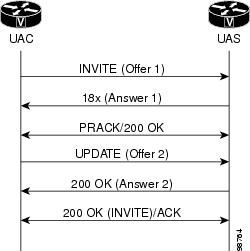
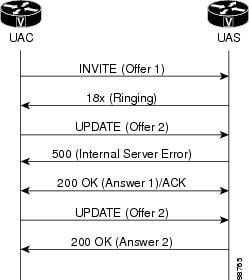
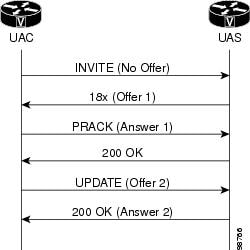
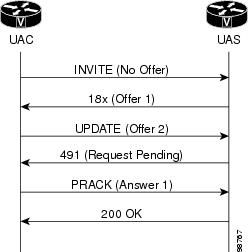
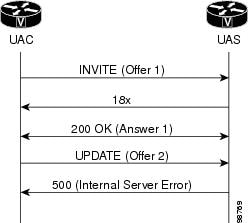
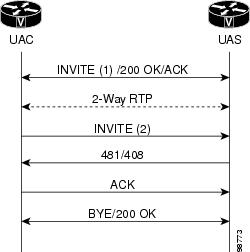
The following sections discuss how UPDATE requests are received and processed in various scenarios and call flows. UPDATE Request Processing Before the Call Is ActiveWhen the gateway sends a reliable provisional response with SDP, the response includes an Allow header that lists the UPDATE method and informs the caller of the gateway capability to support UPDATE processing. The figure below shows a call where the UAS sent a reliable provisional response (ANSWER 1) to an INVITE request (Offer 1). The18x early media response indicated the gateway capability to support UPDATEs. The UAC sent a provisional acknowledgement (PRACK) and received a 200 OK response to the PRACK request. The UAC requested the UAS modify the existing session media parameters of the early dialog by sending an UPDATE request (Offer 2). The UAS accepted Offer 2 by sending a 200 OK response. If media negotiation had failed, the UAS would have sent a 488 Unacceptable Media response instead. Later the UAS sent a 200 OK final response to the initial INVITE request. The UAS sent an ACK request acknowledging the final response to the INVITE request. In the figure below, the gateway received an UPDATE (Offer 2) before responding to the INVITE request (Offer 1), causing the gateway to reject the request by sending a 500 Internal Server Error with a Retry-After header field set to a randomly chosen value between zero and ten seconds. In the figure below, the initial INVITE request did not contain an offer, and the UAS gateway sent SDP with reliable provisional response (Offer 1) which was treated by the UAC as an offer. In the figure below, the UAS received an UPDATE request with an offer (Offer 2) before receiving a PRACK, that is, before the early dialog is established, causing the UAS (gateway) to generate a 491 Request Pending response. Error Responses to UPDATE Request Processing Before the Call Is ActiveIn other scenarios, additional rules apply to processing an UPDATE request with an offer when the gateway has sent a 200 OK response to an INVITE request but has not yet received an ACK. The following scenarios generate an error response and are shown in the figure below:
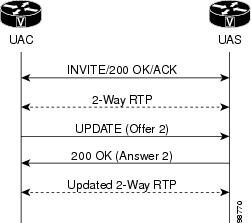
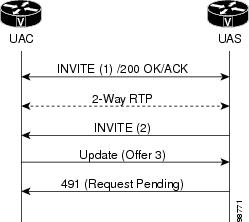
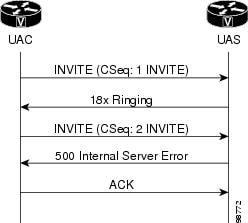
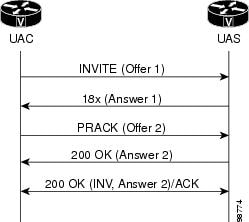
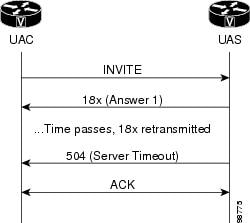
UPDATE Request Processing in the Active StateRFC 3261 recommends using a re-INVITE request, the SIP message that changes session parameters of an existing or pending call, to update session parameters after a call is active. UPDATEs received after a call is active are processed like a re-INVITE except that the 200 OK to update is not resent (see the figure below). The figure below shows a UAC that sent a mid-call INVITE request which has not yet been answered. In this state, when the gateway receives an UPDATE request with a new offer, it sends a 491 Request Pending error. Via Header Parameters and Merged Request DetectionTo meet specifications of RFC 3261, the SIP Extensions for Caller Identity and Privacy feature provides support for the branch parameter in the Via header of a request, the information used to identify the transaction created by that request. The branch parameter value begins with the value "z9hG4bK" indicating that the request was generated by a UAC that is RFC 3261 compliant. The SIP Extensions for Caller Identity and Privacy feature also adds support for generating the received parameter with the received address. The SIP Extensions for Caller Identity and Privacy feature uses the branch and sent-by parameters to detect a merged request, that is, a request that has arrived at the UAS more than once by following different paths. If the request has no tag in the To header field, the UAS checks the request against ongoing transactions. If the From tag, Call-ID, and CSeq headers exactly match those headers associated with an ongoing transaction, but the topmost Via header, including the branch parameter, does not match, the UAS treats the request as merged. The UAS responds to a merged request with a 482 Loop Detected error. Loose-Routing and the Record-Route HeaderThe SIP Extensions for Caller Identity and Privacy feature supports loose-routing, a mechanism that helps keep the request target and next route destination separate. The lr parameter, used in the uniform resource indicator (URI) that a proxy places in the Record-Route header, indicates proxy compatibility with RFC 3261. If the lr parameter is missing from a request, the UA assumes the next-hop proxy implements strict-routing in compliance with RFC 2543, and reformats the message to preserve information in the Request-URI. Multiple INVITE Requests Before a Final ResponseThis feature implements support for processing multiple INVITE requests received by the UAS before it sends a final response to the initial INVITE request (see the figure below). If the UAS gateway receives a second INVITE request before it sends the final response to the first INVITE request with a lower CSeq sequence number on the same dialog, the UAS returns a 500 Server Internal Error response to the second INVITE request. The error response also includes a Retry-After header field with a random value between 0 and 10 seconds. Mid-call Re-INVITE Request FailureThe SIP Extensions for Caller Identity and Privacy feature implements the mid-call re-INVITE request failure treatment shown in the figure below. The UAC terminates a dialog when a non-2xx final response to a mid-call INVITE request is one of the following: PRACK Request with a New OfferThe SIP Extensions for Caller Identity and Privacy feature supports a PRACK request with a new offer (see the figure below). If the UAC receives a reliable provisional response with an answer (Answer 1), it may generate an additional offer in the PRACK (Offer 2). If the UAS receives a PRACK with an updated offer, it generates a 200 OK with an answer (Answer 2) if negotiation is successful. Otherwise the UAS generates a 488 Unacceptable Media response. Reliable Provisional Response FailureThe SIP Extensions for Caller Identity and Privacy feature provides the treatment shown in the figure below when the UAS does not receive a corresponding PRACK after resending a 18x reliable provisional response for the maximum number of retries allowed or for 32 seconds. The UAS generates a 5xx response to clear the call. Sample MessagesThis section contains sample SIP messages collected at the terminating SIP gateway. SIP UPDATE Request Call Flow ExampleThe following example shows an exchange of SIP requests and responses, including an UPDATE request before the call is active: 1w0d:SIP Msg:ccsipDisplayMsg:Received: INVITE sip:222@192.0.2.12:5060 SIP/2.0 Record-Route:<sip:222@192.0.2.4:5060;maddr=192.0.2.4> Via:SIP/2.0/UDP 192.0.2.4:5060;branch=5,SIP/2.0/UDP 192.0.2.14:5060;branch=z9hG4bK1D38 From:<sip:111@192.0.2.14>;tag=3DD33DE4-10DF To:<sip:222@192.0.2.4> Date:Mon, 08 Apr 2002 16:58:08 GMT Call-ID:A2B205CC-4A4811D6-8010A410-F242231D@192.0.2.14 Supported:timer The next line shows the UAC requires the provisional response be reliably transported. Require:100rel Min-SE: 1800 Cisco-Guid:2729535908-1246237142-2148443152-4064420637 User-Agent:Cisco-SIPGateway/IOS-12.x The Allow header shows that the UPDATE method is supported. Allow:INVITE, OPTIONS, BYE, CANCEL, ACK, PRACK, COMET, REFER, SUBSCRIBE, NOTIFY, INFO, UPDATE, REGISTER CSeq:101 INVITE Max-Forwards:70 Remote-Party-ID:<sip:111@192.0.2.14>;party=calling;screen=no;privacy=off Timestamp:1018285088 Contact:<sip:111@192.0.2.14:5060> Expires:180 Allow-Events:telephone-event Content-Type:application/sdp Content-Length:262 The following SDP constitutes the initial offer, including media streams and codecs, along with IP addresses and ports to receive media. v=0 o=CiscoSystemsSIP-GW-UserAgent 6579 1987 IN IP4 192.0.2.14 s=SIP Call c=IN IP4 192.0.2.14 t=0 0 m=audio 17782 RTP/AVP 8 0 18 19 c=IN IP4 192.0.2.14 a=rtpmap:8 PCMA/8000 a=rtpmap:0 PCMU/8000 a=rtpmap:18 G729/8000 a=fmtp:18 annexb=no a=rtpmap:19 CN/8000 1w0d:SIP Msg:ccsipDisplayMsg:Sent: SIP/2.0 100 Trying Via:SIP/2.0/UDP 192.0.2.4:5060;branch=5,SIP/2.0/UDP 192.0.2.14:5060;branch=z9hG4bK1D38 From:<sip:111@192.0.2.14>;tag=3DD33DE4-10DF To:<sip:222@192.0.2.4>;tag=24D435A8-C29 Date:Sat, 07 Oct 2000 02:56:34 GMT Call-ID:A2B205CC-4A4811D6-8010A410-F242231D@192.0.2.14 Timestamp:1018285088 Server:Cisco-SIPGateway/IOS-12.x CSeq:101 INVITE Allow-Events:telephone-event Content-Length:0 In the following lines, the gateway responds by sending early media in answer to the initial offer. 1w0d:SIP Msg:ccsipDisplayMsg:Sent: SIP/2.0 183 Session Progress Via:SIP/2.0/UDP 192.0.2.4:5060;branch=5,SIP/2.0/UDP 192.0.2.14:5060;branch=z9hG4bK1D38 From:<sip:111@192.0.2.14>;tag=3DD33DE4-10DF To:<sip:222@192.0.2.4>;tag=24D435A8-C29 Date:Sat, 07 Oct 2000 02:56:34 GMT Call-ID:A2B205CC-4A4811D6-8010A410-F242231D@192.0.2.14 Timestamp:1018285088 Server:Cisco-SIPGateway/IOS-12.x CSeq:101 INVITE Require:100rel RSeq:5785 Allow:UPDATE Allow-Events:telephone-event Contact:<sip:222@192.0.2.12:5060> Record-Route:<sip:222@192.0.2.4:5060;maddr=192.0.2.4> Content-Disposition:session;handling=required Content-Type:application/sdp Content-Length:191 v=0 o=CiscoSystemsSIP-GW-UserAgent 5565 7580 IN IP4 192.0.2.12 s=SIP Call c=IN IP4 192.0.2.12 t=0 0 m=audio 18020 RTP/AVP 8 19 c=IN IP4 192.0.2.12 a=rtpmap:8 PCMA/8000 a=rtpmap:19 CN/8000 The following lines show the UAS receiving a PRACK for the 183 response. 1w0d:SIP Msg:ccsipDisplayMsg:Received: PRACK sip:222@192.0.2.12:5060 SIP/2.0 Via:SIP/2.0/UDP 192.0.2.4:5060;branch=6,SIP/2.0/UDP 192.0.2.14:5060;branch=z9hG4bK40A From:<sip:111@192.0.2.14>;tag=3DD33DE4-10DF To:<sip:222@192.0.2.4>;tag=24D435A8-C29 Date:Mon, 08 Apr 2002 16:58:08 GMT Call-ID:A2B205CC-4A4811D6-8010A410-F242231D@192.0.2.14 CSeq:102 PRACK RAck:5785 101 INVITE Content-Length:0 1w0d:SIP Msg:ccsipDisplayMsg:Sent: SIP/2.0 200 OK Via:SIP/2.0/UDP 192.0.2.4:5060;branch=6,SIP/2.0/UDP 192.0.2.14:5060;branch=z9hG4bK40A From:<sip:111@192.0.2.14>;tag=3DD33DE4-10DF To:<sip:222@192.0.2.4>;tag=24D435A8-C29 Date:Sat, 07 Oct 2000 02:56:34 GMT Call-ID:A2B205CC-4A4811D6-8010A410-F242231D@192.0.2.14 Server:Cisco-SIPGateway/IOS-12.x CSeq:102 PRACK Content-Length:0 The next lines show the UAS receiving an updated offer with different media streams and codecs. 1w0d:SIP Msg:ccsipDisplayMsg:Received: UPDATE sip:222@192.0.2.12:5060 SIP/2.0 Via:SIP/2.0/UDP 192.0.2.4:5060;branch=z9hG4bK10 Via:SIP/2.0/UDP 192.0.2.14:5060 To:<sip:222@192.0.2.4>;tag=24D435A8-C29 From:<sip:111@192.0.2.14>;tag=3DD33DE4-10DF Call-ID:A2B205CC-4A4811D6-8010A410-F242231D@192.0.2.14 CSeq:103 UPDATE Contact:sip:111@192.0.2.14:5060 Content-Length:262 v=0 o=CiscoSystemsSIP-GW-UserAgent 6579 1987 IN IP4 192.0.2.14 s=SIP Call c=IN IP4 192.0.2.14 t=0 0 m=audio 17782 RTP/AVP 8 0 18 19 c=IN IP4 192.0.2.14 a=rtpmap:8 PCMA/8000 a=rtpmap:0 PCMU/8000 a=rtpmap:18 G729/8000 a=fmtp:18 annexb=no a=rtpmap:19 CN/8000 The new offer in the UPDATE request is acceptable to the server, so it responds with the corresponding answer in the 200 OK message. 1w0d:SIP Msg:ccsipDisplayMsg:Sent: SIP/2.0 200 OK Via:SIP/2.0/UDP 192.0.2.4:5060;branch=z9hG4bK10,SIP/2.0/UDP 192.0.2.14:5060 From:<sip:111@192.0.2.14>;tag=3DD33DE4-10DF To:<sip:222@192.0.2.4>;tag=24D435A8-C29 Date:Sat, 07 Oct 2000 02:56:34 GMT Call-ID:A2B205CC-4A4811D6-8010A410-F242231D@192.0.2.14 Server:Cisco-SIPGateway/IOS-12.x CSeq:103 UPDATE Content-Type:application/sdp Content-Length:191 v=0 o=CiscoSystemsSIP-GW-UserAgent 5565 7580 IN IP4 192.0.2.12 s=SIP Call c=IN IP4 192.0.2.12 t=0 0 m=audio 18020 RTP/AVP 8 19 c=IN IP4 192.0.2.12 a=rtpmap:8 PCMA/8000 a=rtpmap:19 CN/8000 1w0d:SIP Msg:ccsipDisplayMsg:Sent: SIP/2.0 200 OK Via:SIP/2.0/UDP 192.0.2.4:5060;branch=5,SIP/2.0/UDP 192.0.2.14:5060;branch=z9hG4bK1D38 From:<sip:111@192.0.2.14>;tag=3DD33DE4-10DF To:<sip:222@192.0.2.4>;tag=24D435A8-C29 Date:Sat, 07 Oct 2000 02:56:34 GMT Call-ID:A2B205CC-4A4811D6-8010A410-F242231D@192.0.2.14 Timestamp:1018285088 Server:Cisco-SIPGateway/IOS-12.x CSeq:101 INVITE Allow:INVITE, OPTIONS, BYE, CANCEL, ACK, PRACK, COMET, REFER, SUBSCRIBE, NOTIFY, INFO, UPDATE, REGISTER Allow-Events:telephone-event Contact:<sip:222@192.0.2.12:5060> Record-Route:<sip:222@192.0.2.4:5060;maddr=192.0.2.4> Content-Type:application/sdp Content-Length:191 v=0 o=CiscoSystemsSIP-GW-UserAgent 5565 7580 IN IP4 192.0.2.12 s=SIP Call c=IN IP4 192.0.2.12 t=0 0 m=audio 18020 RTP/AVP 8 19 c=IN IP4 192.0.2.12 a=rtpmap:8 PCMA/8000 a=rtpmap:19 CN/8000 1w0d:SIP Msg:ccsipDisplayMsg:Received: ACK sip:222@192.0.2.12:5060 SIP/2.0 Via:SIP/2.0/UDP 192.0.2.4:5060;branch=7,SIP/2.0/UDP 192.0.2.14:5060;branch=z9hG4bK230 From:<sip:111@192.0.2.14>;tag=3DD33DE4-10DF To:<sip:222@192.0.2.4>;tag=24D435A8-C29 Date:Mon, 08 Apr 2002 16:58:08 GMT Call-ID:A2B205CC-4A4811D6-8010A410-F242231D@192.0.2.14 Max-Forwards:70 CSeq:101 ACK Content-Length:0 1w0d:SIP Msg:ccsipDisplayMsg:Sent: BYE sip:222@192.0.2.4:50605060;maddr=192.0.2.4 SIP/2.0 Via:SIP/2.0/UDP 192.0.2.12:5060;branch=z9hG4bKCA From:<sip:222@192.0.2.4>;tag=24D435A8-C29 To:<sip:111@192.0.2.14>;tag=3DD33DE4-10DF Date:Sat, 07 Oct 2000 02:56:35 GMT Call-ID:A2B205CC-4A4811D6-8010A410-F242231D@192.0.2.14 User-Agent:Cisco-SIPGateway/IOS-12.x Max-Forwards:70 Route:<sip:111@192.0.2.14:5060> Timestamp:970887414 CSeq:101 BYE Content-Length:0 1w0d:SIP Msg:ccsipDisplayMsg:Received: SIP/2.0 200 OK Via:SIP/2.0/UDP 192.0.2.12:5060;branch=z9hG4bKCA From:<sip:222@192.0.2.4>;tag=24D435A8-C29 To:<sip:111@192.0.2.14>;tag=3DD33DE4-10DF Date:Mon, 08 Apr 2002 16:58:29 GMT Call-ID:A2B205CC-4A4811D6-8010A410-F242231D@192.0.2.14 Server:Cisco-SIPGateway/IOS-12.x Timestamp:970887414 Content-Length:0 CSeq:101 BYE Loose-Routing Call Flow ExampleThe following sample message shows a loose-routing request: 1w0d:SIP Msg:ccsipDisplayMsg:Received: INVITE sip:222@192.0.2.12:5060 SIP/2.0 The SIP messages in the following call flow have the Request-URI set to the SIP URI of the destination UA instead of the SIP URI of the next-hop destination, that is, the SIP proxy server. Record-Route:<sip:222@192.0.2.4:5060;lr;maddr=192.0.2.4> Via:SIP/2.0/UDP 192.0.2.4:5060;branch=9,SIP/2.0/UDP 192.0.2.14:5060;branch=z9hG4bK2394 From:<sip:111@192.0.2.14>;tag=3DD3A404-12A3 To:<sip:222@192.0.2.4> Date:Mon, 08 Apr 2002 16:58:34 GMT Call-ID:B2474766-4A4811D6-8015A410-F242231D@192.0.2.14 Supported:timer Min-SE: 1800 Cisco-Guid:2991015782-1246237142-2148770832-4064420637 User-Agent:Cisco-SIPGateway/IOS-12.x Allow:INVITE, OPTIONS, BYE, CANCEL, ACK, PRACK, COMET, REFER, SUBSCRIBE, NOTIFY, INFO, UPDATE, REGISTER CSeq:101 INVITE Max-Forwards:70 Remote-Party-ID:<sip:111@192.0.2.14>;party=calling;screen=no;privacy=off Timestamp:1018285114 Contact:<sip:111@192.0.2.14:5060> Expires:180 Allow-Events:telephone-event Content-Type:application/sdp Content-Length:262 v=0 o=CiscoSystemsSIP-GW-UserAgent 1981 1761 IN IP4 192.0.2.14 s=SIP Call c=IN IP4 192.0.2.14 t=0 0 m=audio 18354 RTP/AVP 8 0 18 19 c=IN IP4 192.0.2.14 a=rtpmap:8 PCMA/8000 a=rtpmap:0 PCMU/8000 a=rtpmap:18 G729/8000 a=fmtp:18 annexb=no a=rtpmap:19 CN/8000 1w0d:SIP Msg:ccsipDisplayMsg:Sent: SIP/2.0 100 Trying Via:SIP/2.0/UDP 192.0.2.4:5060;branch=9,SIP/2.0/UDP 192.0.2.14:5060;branch=z9hG4bK2394 From:<sip:111@192.0.2.14>;tag=3DD3A404-12A3 To:<sip:222@192.0.2.4>;tag=24D49BE8-2346 Date:Sat, 07 Oct 2000 02:57:00 GMT Call-ID:B2474766-4A4811D6-8015A410-F242231D@192.0.2.14 Timestamp:1018285114 Server:Cisco-SIPGateway/IOS-12.x CSeq:101 INVITE Allow-Events:telephone-event Content-Length:0 1w0d:SIP Msg:ccsipDisplayMsg:Sent: SIP/2.0 180 Ringing Via:SIP/2.0/UDP 192.0.2.4:5060;branch=9,SIP/2.0/UDP 192.0.2.14:5060;branch=z9hG4bK2394 From:<sip:111@192.0.2.14>;tag=3DD3A404-12A3 To:<sip:222@192.0.2.4>;tag=24D49BE8-2346 Date:Sat, 07 Oct 2000 02:57:00 GMT Call-ID:B2474766-4A4811D6-8015A410-F242231D@192.0.2.14 Timestamp:1018285114 Server:Cisco-SIPGateway/IOS-12.x CSeq:101 INVITE Allow:UPDATE Allow-Events:telephone-event Contact:<sip:222@192.0.2.12:5060> Record-Route:<sip:222@192.0.2.4:5060;lr;maddr=192.0.2.4> Content-Length:0 1w0d:SIP Msg:ccsipDisplayMsg:Sent: SIP/2.0 200 OK Via:SIP/2.0/UDP 192.0.2.4:5060;branch=9,SIP/2.0/UDP 192.0.2.14:5060;branch=z9hG4bK2394 From:<sip:111@192.0.2.14>;tag=3DD3A404-12A3 To:<sip:222@192.0.2.4>;tag=24D49BE8-2346 Date:Sat, 07 Oct 2000 02:57:00 GMT Call-ID:B2474766-4A4811D6-8015A410-F242231D@192.0.2.14 Timestamp:1018285114 Server:Cisco-SIPGateway/IOS-12.x CSeq:101 INVITE Allow:INVITE, OPTIONS, BYE, CANCEL, ACK, PRACK, COMET, REFER, SUBSCRIBE, NOTIFY, INFO, UPDATE, REGISTER Allow-Events:telephone-event Contact:<sip:222@192.0.2.12:5060> Record-Route:<sip:222@192.0.2.4:5060;lr;maddr=192.0.2.4> Content-Type:application/sdp Content-Length:191 v=0 o=CiscoSystemsSIP-GW-UserAgent 5181 4737 IN IP4 192.0.2.12 s=SIP Call c=IN IP4 192.0.2.12 t=0 0 m=audio 16720 RTP/AVP 8 19 c=IN IP4 192.0.2.12 a=rtpmap:8 PCMA/8000 a=rtpmap:19 CN/8000 1w0d:SIP Msg:ccsipDisplayMsg:Received: ACK sip:222@192.0.2.12:5060 SIP/2.0 Via:SIP/2.0/UDP 192.0.2.4:5060;branch=10,SIP/2.0/UDP 192.0.2.14:5060;branch=z9hG4bK103D From:<sip:111@192.0.2.14>;tag=3DD3A404-12A3 To:<sip:222@192.0.2.4>;tag=24D49BE8-2346 Date:Mon, 08 Apr 2002 16:58:34 GMT Call-ID:B2474766-4A4811D6-8015A410-F242231D@192.0.2.14 Max-Forwards:70 CSeq:101 ACK Content-Length:0 1w0d:SIP Msg:ccsipDisplayMsg:Sent: BYE sip:111@192.0.2.14:5060 SIP/2.0 Via:SIP/2.0/UDP 192.0.2.12:5060;branch=z9hG4bK18B6 From:<sip:222@192.0.2.4>;tag=24D49BE8-2346 To:<sip:111@192.0.2.14>;tag=3DD3A404-12A3 Date:Sat, 07 Oct 2000 02:57:01 GMT Call-ID:B2474766-4A4811D6-8015A410-F242231D@192.0.2.14 User-Agent:Cisco-SIPGateway/IOS-12.x Max-Forwards:70 Route:<sip:222@192.0.2.4:5060;lr;maddr=192.0.2.4> Timestamp:970887440 CSeq:101 BYE Content-Length:0 1w0d:SIP Msg:ccsipDisplayMsg:Received: SIP/2.0 200 OK Via:SIP/2.0/UDP 192.0.2.12:5060;branch=z9hG4bK18B6 From:<sip:222@192.0.2.4>;tag=24D49BE8-2346 To:<sip:111@192.0.2.14>;tag=3DD3A404-12A3 Date:Mon, 08 Apr 2002 16:58:54 GMT Call-ID:B2474766-4A4811D6-8015A410-F242231D@192.0.2.14 Server:Cisco-SIPGateway/IOS-12.x Timestamp:970887440 Content-Length:0 CSeq:101 BYE SIP RFC 3261 RFC 3262 and RFC 3264 ComplianceThe Internet Engineering Task Force (IETF) continually updates SIP standards. This feature describes the specific updates or optimizations that were made on Cisco SIP gateways to remain in compliance with the IETF. The following standards have been updated:
To provide quality service to our SIP customers, Cisco optimizes its SIP gateways to comply with the latest SIP-related RFCs. In addition, backward compatibility is maintained, providing customers interoperability with gateways that do not yet support the current RFCs.
SIP Messaging EnhancementsThe following changes or additions were made to SIP messaging:
If the UAC generated the request, the timer has a randomly chosen value between 2.1 and 4 seconds, in units of 10 ms. If the UAC did not generate the request, the timer has a randomly chosen value between 0 and 2 seconds, in units of 10 ms. SIP TCP and UDP Connection EnhancementsPrior to RFC 3261, TCP support was optional for SIP user agents. RFC 3261 now requires support for both UDP and TCP. While Cisco SIP gateways already supported TCP, there have been several optimizations that are described below: Failed Transmissions of 2xx ResponsesThe transmission of 2xx responses is in compliance with RFC 3261. If the transport is TCP and a gateway does not receive an acknowledgement to a 2xx response it sent to an INVITE message, the gateway retries the 2xx response over TCP. The retry ensures that a gateway receives a 200 OK message, eliminating the possibility that the 2xx response is lost when hops over the network use an unreliable transport such as UDP. Reuse of TCP and UDP ConnectionsPrior to RFC 3261, a remote gateway could not initiate two requests over the same TCP connection. In addition, the gateway created a new connection for each new transaction, and after the completion of a transaction, the gateway closed the connection. Closing the connection, even if a subsequent request was destined for the same location as the previous transaction, resulted in potentially lower performance due to the large number of unnecessary open/close connections. With Cisco IOS Release 12.3(8)T, the gateway opens one TCP connection per remote IP address and port. The gateway opens a new connection only if a connection to the particular destination IP address and port is not already present. The gateway closes the connection when all requests that use that connection have terminated and no activity is detected for a given time period. The timers connection command allows you to time out a TCP or UDP connection because of inactivity. Transaction-Based Transport Switching and UsageWith Cisco IOS Release 12.3(8)T, if a new transaction request is larger than the threshold switchable value, it is sent over TCP. The threshold switchable value is a value that is 200 bytes or more than the interface or path's MTU. If the message size is smaller than the threshold switchable value, the original configured transport is used. The original transport means the transport configured under the dial peer for the initial Invite request or the transport specified in the incoming response's Contact or Record-Route headers in subsequent requests. In other words, the transport usage is now transaction-based instead of call-based. Detection of Remote End Connection ClosuresRemote gateway closures that go undetected can result in hung TCP connections. If a closed connection remains undetected, the corresponding connection entry is never removed from the connection table. Continuous occurrences of undetected closures can lead to the connection table being filled with invalid entries and valid SIP requests being rejected, requiring a router reboot. With Cisco IOS Release 12.3(8)T, the SIP gateway uses internal mechanisms to detect remote closures and to clean up the connection table. No user input is required to initiate the cleanup. Creation of New Connections for Sending Responses in Case the Original Connection DroppedWith Cisco IOS Release 12.3(8)T, if a gateway tears down the connection of an incoming request before a response is sent, the receiving gateway creates a new connection to send out a response. The new connection is based on the port specified in the sent-by parameter of the Via header. Prior to Cisco IOS Release 12.3(8)T, a dropped connection resulted in failure of the call. Dynamic Transport Switching (UDP to TCP) for Large SIP RequestsRFC 3261 states that large SIP requests, requests within 200 bytes of the maximum transmission unit (MTU), should be transmitted over TCP. Transport over TCP avoids UDP fragmentation, and the switch to TCP can occur even if the gateway is configured to use UDP. If the TCP transmission fails (for example if the terminating gateway does not support TCP), the message is then retried over UDP. The capability to configure the MTU size on an Ethernet or Fast Ethernet interface already exists on the Cisco SIP gateways. If the MTU is not configured, the default MTU value is 1500 bytes. Assuming an MTU of 1500 bytes, requests larger than 1300 bytes are considered the threshold value for dynamic transport switching. Two commands allow the user to enable or disable support for dynamic switching. Use the commands to avoid interoperability issues with gateways that do not support TCP and to maintain backward compatibility. The transport switch command can be configured at the global level, and the voice-class sip transport switch command can be configured at the dial peer level. The global configuration is considered only when there is no matching VoIP dial peer. This feature is disabled by default. Call-Hold EnhancementRFC 3264 recommends that call-hold be initiated using the direction attribute (a=sendonly) in SDP. Cisco SIP gateways follow the new guideline, and SIP gateways can now initiate call-hold using either one of the two ways. The offer call-hold command allows the user to globally specify the format to initiate call-hold. That is, the gateway should use a=sendonly or conn addr=0.0.0.0; it cannot set usage to both. The default configuration is a=sendonly, because this is the RFC recommended method. Specifying a call-hold format is not available at the dial peer level.
How to Configure SIP RFC Compliance
Configuring Compliance to RFC 2543No configuration tasks are required to enable RFC 2543. It is enabled by default. Configuring Compliance to RFC 2782SUMMARY STEPS
DETAILED STEPS Configuring Compliance to RFC 3261No configuration tasks are required to enable RFC 3261. It is enabled by default. Configuring Compliance to RFC 3261 RFC 3262 and RFC 3264
Configure TCP and UDP Connection EnhancementsTo set the time before the SIP UA ages out a TCP or UDP connection because of inactivity, perform the following steps. DETAILED STEPS
Configure Dynamic Transport Switching (UDP to TCP) for Large SIP RequestsRFC 3261 states that large SIP requests, within 200 bytes of the maximum transmission unit (MTU), should be transmitted over TCP. Transport over TCP avoids UDP fragmentation, and the switch to TCP can occur even if the gateway is configured to use UDP. The configurations below describe setting the gateway to switch from UDP to TCP. The default MTU configuration of 1500 bytes on the interface is assumed. After configuration, the threshold value is 1300 bytes--that is, for all SIP requests over 1300 bytes, TCP is the transport mechanism. You can configure dynamic transport switching on a dial-peer or global basis.
Configuring Dynamic Transport Switching for Large SIP Requests on a Dial-Peer BasisTo configure switching between UDP and TCP transport mechanisms for a specific dial peer, perform the following steps.
DETAILED STEPS
Configuring Dynamic Transport Switching for Large SIP Requests on a Global BasisTo configure switching between UDP and TCP transport mechanisms on all the connections of a Cisco SIP gateway, perform the following steps.
DETAILED STEPS
Use the following commands to aid in verifying and troubleshooting the SIP transport and connection configurations: To learn more about these commands as well as other verification and troubleshooting commands, see "Verifying SIP RFC Compliance" and "Troubleshooting Tips". Configure Call-Hold
SUMMARY STEPS
DETAILED STEPS Configure Max ForwardsTo set the maximum number of proxy or redirect servers that can forward the SIP request, perform the following steps. DETAILED STEPS
Verifying SIP RFC ComplianceTo verify SIP RFC compliance, perform the following steps as appropriate (commands are listed in alphabetical order). DETAILED STEPS Troubleshooting Tips
Sample output of some of these commands is shown below: Sample Output for the debug ccsip transport CommandThe operations captured here show the following:
Router# debug ccsip transport
.
.
.
1w1d: //18/8E16980D800A/SIP/Transport/sipSPISendInvite: Sending Invite to the transport layer
1w1d: //18/8E16980D800A/SIP/Transport/sipSPIGetSwitchTransportFlag: Return the Global configuration, Switch Transport is TRUE
1w1d: //18/8E16980D800A/SIP/Transport/sipSPITransportSendMessage: msg=0x64082D50, addr=172.18.194.183, port=5060, sentBy_port=0, is_req=1, transport=1, switch=1, callBack=0x614FAB58
1w1d: //18/8E16980D800A/SIP/Transport/sipSPITransportSendMessage: Proceedable for sending msg immediately
1w1d: //18/8E16980D800A/SIP/Transport/sipTransportLogicSendMsg: switch transport is 1
1w1d: //-1/xxxxxxxxxxxx/SIP/Transport/sipTransportGetInterfaceMtuSize: MTU size for remote address 172.18.194.183 is 500
1w1d: //-1/xxxxxxxxxxxx/SIP/Transport/sipTransportVerifyMsgForMTUThreshold: Interface MTU Size 500, Msg Size 1096
1w1d: //18/8E16980D800A/SIP/Transport/sipTransportLogicSendMsg: Switching msg=0x64082D50 transport UDP->TCP
1w1d: //-1/xxxxxxxxxxxx/SIP/Transport/sipTransportSetAgeingTimer: Aging timer initiated for holder=0x64084058,addr=172.18.194.183
1w1d: //-1/xxxxxxxxxxxx/SIP/Transport/sipCreateConnHolder: Created new holder=0x64084058, addr=172.18.194.183
1w1d: //-1/xxxxxxxxxxxx/SIP/Transport/sipTransportPostRequestConnection: Posting TCP conn create request for addr=172.18.194.183, port=5060, context=0x64128D5C
1w1d: //-1/xxxxxxxxxxxx/SIP/Transport/sipTransportSetConnWaitTimer: Wait timer set for connection=0x64129BF4,addr=172.18.194.183, port=5060
1w1d: //-1/xxxxxxxxxxxx/SIP/Transport/sipCreateConnInstance: Created new initiated conn=0x64129BF4, connid=-1, addr=172.18.194.183, port=5060, transport=tcp
1w1d: //-1/xxxxxxxxxxxx/SIP/Transport/sipConnectionManagerProcessConnCreated: gConnTab=0x64128D5C, addr=172.18.194.183, port=5060, connid=1, transport=tcp
1w1d: //-1/xxxxxxxxxxxx/SIP/Transport/sipInstanceHandleConnectionCreated: Moving connection=0x64129BF4, connid=1state to pending
1w1d: //-1/xxxxxxxxxxxx/SIP/Transport/sipTransportProcessNWConnectionCreated: context=0x64128D5C
1w1d: //-1/xxxxxxxxxxxx/SIP/Transport/sipConnectionManagerProcessConnCreated: gConnTab=0x64128D5C, addr=172.18.194.183, port=5060, connid=1, transport=tcp
1w1d: //-1/xxxxxxxxxxxx/SIP/Transport/sipTransportPostSendMessage: Posting send for msg=0x64082D50, addr=172.18.194.183, port=5060, connId=1 for TCP
.
.
.
Configuration Examples for SIP RFC ComplianceSIP Gateway Compliance to RFC 3261 RFC 3262 and RFC 3264 ExampleThis section provides a configuration example to match the identified configuration tasks in the previous sections. 1w1d: %SYS-5-CONFIG_I: Configured from console by console Building configuration... Current configuration : 3326 bytes ! !Last configuration change at 18:09:20 EDT Fri Apr 23 2004 ! version 12.3 service timestamps debug uptime service timestamps log uptime no service password-encryption boot-start-marker boot system tftp mantis/c3640-is-mz.disc_w_pi 172.18.207.10 boot-end-marker ! clock timezone EST -5 clock summer-time EDT recurring voice-card 3 ! aaa new-model ! aaa accounting connection h323 start-stop group radius aaa nas port extended aaa session-id common ip subnet-zero ! ip cef ip host example.com 172.18.194.183 ip host CALLGEN-SECURITY-V2 10.36.54.81 10.1.0.0 ip name-server 172.18.192.48 ! isdn switch-type primary-ni ! trunk group 1 ! voice service voip sip rel1xx require "100rel" transport switch udp tcp ! voice class uri 800 sip pattern test@example.com ! controller T1 3/0 framing sf linecode ami pri-group timeslots 1-24 ! controller T1 3/1 framing sf linecode ami pri-group timeslots 1-24 gw-accounting aaa ! interface Ethernet0/0 description CentreComm Hub port 9 in PP070 ip address 172.18.194.170 255.255.255.0 no ip proxy-arp ip mtu 500 half-duplex no cdp enable ip rsvp bandwidth 100 100 ! interface Serial3/0:23 no ip address no logging event link-status isdn switch-type primary-ni isdn incoming-voice voice no cdp enable ! interface Serial3/1:23 no ip address no logging event link-status isdn switch-type primary-ni isdn protocol-emulate network isdn incoming-voice voice no cdp enable ! no ip http server ip classless ip route 0.0.0.0 0.0.0.0 172.18.194.1 ip route 0.0.0.0 0.0.0.0 Ethernet0/0 ip route 10.0.0.0 255.0.0.0 172.18.194.1 ip route 172.16.0.0 255.0.0.0 Ethernet0/0 ! dialer-list 1 protocol ip permit no cdp run ! radius-server host 10.13.84.133 auth-port 1645 acct-port 1646 radius-server timeout 2 radius-server key cisco radius-server vsa send accounting radius-server vsa send authentication ! control-plane ! call application voice testapp79 tftp://172.18.207.10/mantis/my_app.tcl call application voice testapp888 tftp://172.18.207.10/mantis/AL_FEAT_SIP_URL_O_RV_79.tcl call application voice testapp888 mcid-dtmf 9876 call application voice testapp888 test 5444 ! voice-port 1/1/0 ! voice-port 1/1/1 ! voice-port 3/0:23 ! voice-port 3/1:23 ! dial-peer cor custom ! dial-peer voice 9876 voip destination-pattern 9876 voice-class sip transport switch udp tcp session protocol sipv2 session target ipv4:172.18.194.183 session transport udp ! dial-peer voice 222 pots incoming called-number . direct-inward-dial ! sip-ua max-forwards 65 retry invite 4 retry bye 4 retry cancel 4 retry comet 4 retry notify 4 timers connection aging 15 offer call-hold conn-addr ! line con 0 exec-timeout 0 0 line vty 0 4 password password1 ntp clock-period 17179695 ntp server 172.18.194.178 ntp server 10.81.254.131 ! end Additional ReferencesRelated Documents
StandardsMIBsRFCs
Technical Assistance
Cisco and the Cisco logo are trademarks or registered trademarks of Cisco and/or its affiliates in the U.S. and other countries. To view a list of Cisco trademarks, go to this URL: www.cisco.com/go/trademarks. Third-party trademarks mentioned are the property of their respective owners. The use of the word partner does not imply a partnership relationship between Cisco and any other company. (1110R) Any Internet Protocol (IP) addresses and phone numbers used in this document are not intended to be actual addresses and phone numbers. Any examples, command display output, network topology diagrams, and other figures included in the document are shown for illustrative purposes only. Any use of actual IP addresses or phone numbers in illustrative content is unintentional and coincidental. © 2012 Cisco Systems, Inc. All rights reserved.
|
||||||||||||||||||||||||||||||||||||||||||||||||||||||||||||||||||||||||||||||||||||||||||||||||||||||||||||||||||||||||||||||||||||||||||||||||||||||||||||||||||||||||||||||||||||||||||||||||||||||||||||||||||||||||||||||||||||||||||||||||||||||||||||||||||||||||||||||||||||||||||||||||||||||||||||||||||||||||||||||||||||||||||||||||||||||||||||||||||||||||||||||||||||||||||||||||||||||||||||||||||||||||||||||||||||||||||||||||||||||||||
|
|