![]() |
SIP Configuration Guide, Cisco IOS Release 15M&T
|
|||||||||||||||||||||||||||||||||||||||||||||||||||||||||||||||||||||||||||||||||||||||||||||||||||||||||||||||||||||||||||||||||||||||||||||||||||||||||||||||||||||||||||
Configuring SIP Connection-Oriented Media Forking and MLPP Features
![]() |
||||||||||||||||||||||||||||||||||||||||||||||||||||||||||||||||||||||||||||||||||||||||||||||||||||||||||||||||||||||||||||||||||||||||||||||||||||||||||||||||||||||||||||
|
Contents
Configuring SIP Connection-Oriented Media Forking and MLPP FeaturesLast Updated: December 30, 2012
This chapter describes how to configure the following media-support features for SIP:
Finding Feature InformationYour software release may not support all the features documented in this module. For the latest caveats and feature information, see Bug Search Tool and the release notes for your platform and software release. To find information about the features documented in this module, and to see a list of the releases in which each feature is supported, see the feature information table at the end of this module. Use Cisco Feature Navigator to find information about platform support and Cisco software image support. To access Cisco Feature Navigator, go to www.cisco.com/go/cfn. An account on Cisco.com is not required. Prerequisites for SIP Connection-Oriented Media Forking and MLPPSIP Support for Media Forking Feature
Restrictions for SIP Connection-Oriented Media Forking and MLPPSIP: Connection-Oriented Media Enhancements for SIP Feature
SIP Support for Media Forking Feature
Information About SIP Connection-Oriented Media Forking and MLPPTo configure connection-oriented media and forking features for SIP, you should understand the following concepts:
SIP Connection-Oriented Media Enhancements for SIPThe SIP: Connection-Oriented Media (Comedia) Enhancements for SIP feature allows a Cisco gateway to check the media source of incoming Realtime Transport Protocol (RTP) packets, and allows the endpoint to advertise its presence inside or outside of Network Address Translation (NAT). Using the feature enables symmetric NAT traversal by supporting the capability to modify and update an existing RTP session remote address and port. Feature benefits include the following:
Symmetric NAT TraversalThe Connection-Oriented Media (Comedia) Enhancements for SIP feature provides the following feature to symmetric NAT traversal:
NAT, which maps the source IP address of a packet from one IP address to a different IP address, has varying functionality and configurations. NAT can help conserve IP version 4 (IPv4) addresses, or it can be used for security purposes to hide the IP address and LAN structure behind the NAT. VoIP endpoints may both be outside NAT, both inside, or one inside and the other outside. In symmetric NAT, all requests from an internal IP address and port to a specific destination IP address and port are mapped to the same external IP address and port. The feature provides additional capabilities for symmetric NAT traversal. Prior to the implementation of connection-oriented media enhancements, NAT traversal presented challenges for both SIP, which signals the protocol messages that set up a call, and for RTP, the media stream that transports the audio portion of a VoIP call. An endpoint with connections to clients behind NATs and on the open Internet had no way of knowing when to trust the addressing information it received in the SDP portion of SIP messages, or whether to wait until it received a packet directly from the client before opening a channel back to the source IP:port of that packet. Once a VoIP session was established, the endpoint was, in some scenarios, sending packets to an unreachable address. This scenario typically occurred in NAT networks that were SIP-unaware. In addition to the challenges posed by NAT traversal in SIP, NAT traversal in RTP requires that a client must know what type of NAT it sits behind, and that it must also obtain the public address for an RTP stream. Any RTP connection between endpoints outside and inside NAT must be established as a point-to-point connection. The external endpoint must wait until it receives a packet from the client so that it knows where to reply. The connection-oriented protocol used to describe this type of session is known as Connection-Oriented Media (Comedia), as defined in the IETF draft, draft-ietf-mmusic-sdp-comedia-04.txt, Connection-Oriented Media Transport in SDP . Cisco IOS VoiceXML features implement one of many possible SIP solutions to address problems with different NAT types and traversals. With Cisco IOS VoiceXM, the gateway can open an RTP session with the remote end and then update or modify the existing RTP session remote address and port (raddr:rport) with the source address and port of the actual media packet received after passing through NAT. The feature allows you to configure the gateway to modify the RTP session remote address and port by implementing support for the SDP direction (a=direction:<role>) attribute defined in, draft-ietf-mmusic-sdp-comedia-04.txt, Connection-Oriented Media Transport in SDP . Valid values for the attribute are as follows:
The feature introduces CLI commands to configure the following SIP user-agent settings for symmetric NAT:
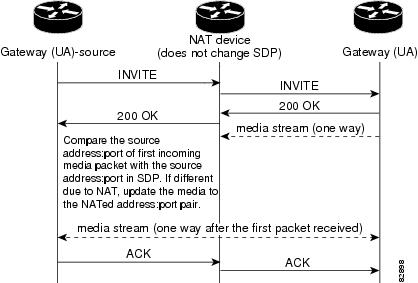
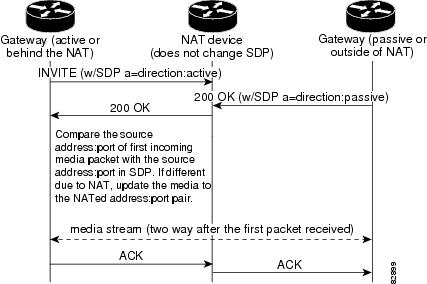
Sample SDP MessageThe following example shows a sample SDP message that describes a session with the direction:<role> attribute set to passive: v=o o=CiscoSystemsSIP-GW-UserAgent 5732 7442 IN IP4 10.15.66.43 s=SIP Call c=IN IP4 10.15.66.43 t=0 0 m=audio 17306 RTP/AVP 0 100 a=rtpmap:0 PCMU/8000 a=rtpmap:100 X-NSE/8000 a=fmtp:100 192-194 a=ptime:20 a=direction:passive Symmetric NAT Call FlowsThe following call flow diagrams describe call setup during symmetric NAT traversal scenarios. The figure below shows a NAT device that is unaware of SIP or SDP signaling. The SIP endpoints are not communicating the connection-oriented media direction role in the SDP message. The originating gateway is configured, using the nat symmetric check-media-src command to detect the media source and update the VoIP RTP session to the network address translated address:port pair. The figure below shows a NAT device that is unaware of SIP or SDP signaling, but the SIP endpoints are communicating the connection-oriented media direction role in the SDP message. The originating gateway is configured as a passive entity in the network using the nat symmetric role command. When the passive entity receives a direction role of active, it updates the VoIP RTP session to the network address translated address:port pair. When renegotiating media mid call, such as when the call is moving from standard to T38 fax relay, the UDP ports used are often renegotiated on third-party endpoints. This new port is not recognized by the symmetric NAT feature. SIP Multilevel Precedence and Priority SupportThe SIP: Multilevel Precedence and Priority Support feature enables Cisco IOS gateways to interoperate with other multilevel-precedence and preemption (MLPP)-capable circuit-switched networks. An MLPP-enabled call has an associated priority level that applications that handle emergencies and congestions use to determine which lower-priority call to preempt in order to dedicate their end-system resources to high-priority communications. This feature addresses the aspect of preemption when interworking with defense-switched networks (DSNs) that are connected through the Cisco IOS gateway.
Description of the SIPThe SIP: Multilevel Precedence and Priority Support feature enables Cisco IOS gateways to interoperate with other MLPP-capable circuit-switched networks. The U.S. Department of Defense (DoD) and Defense Information Service Agency (DISA) mandate that all VoIP network elements support this capability. MLPP is a service that allows properly validated users to preempt lower-priority phone calls either to targeted stations or through fully subscribed shared resources such as time-division multiplexing (TDM) trunks or conference bridges. With this capability, high-ranking personnel are ensured communication to critical organizations and personnel during a national emergency. Connections and resources that belong to a call from an MLPP subscriber are marked with a precedence level and domain identifier and are preempted only by calls of higher precedence from MLPP users in the same domain. The DSN switch sets the maximum precedence level for a subscriber statically. When that subscriber originates a call, it is tagged with that precedence level (if none is provided) or with one that the user provides. Cisco IOS gateways act as transit trunking network elements to map incoming precedence levels to outgoing signaling. This does not provide any schemes to configure the maximum levels for the subscriber lines, or interpret the levels based on the prefixes when a call is offered through a channel-associated signaling/R2 (CAS/R2) type of interface. Precedence and Service Domains for the SIPPrecedence provides for preferred handling of call-service requests. It involves assigning and validating priority levels to calls and prioritized treatment of MLPP service requests. The nature of precedence assignment is based on an internal decision, in that the user chooses to apply or not to apply assigned precedence level to a call. MLPP precedence is unrelated to other call admission control (CAC) or enhanced emergency services (E911) services. User invocation of an MLPP request is provided through dedicated dial access codes and selectors in the dial string. In particular, a precedence call is requested by the user using the string prefix NP, where P is the requested precedence level and N is the preconfigured MLPP access digit. The range of precedence values in DSN/Public SS7 Network Format (DSN/Q.735) service domains is shown in the table below.
The Defense Red Switched Network (DRSN) service domain has six levels of precedence as shown in the table below.
A subscriber A (0100) calling B (0150) that wants to explicitly associate a precedence level (priority) to a particular call, would dial the following digits: 8555-3-0150 ^ ^ ^ | | |___________ Called number | |_____________ Call precedence--priority |__________________ MLPP service prefix If subscriber A is an ordinary customer with an assigned precedence level of 4 (routine), then MLPP automatically treats this call as a routine call. In SIP and ISDN signaling, however, the precedence levels and domain-name space information are carried discretely in the protocol messages and do not require appropriate prefixes to the dialed digits. Precedence-Level Support in SIP SignalingMLPP information in a SIP signal is carried in the Resource-Priority header. The header field marks a SIP request as desiring prioritized resource access depending on the precedence level invoked or assigned to the call originator. The syntax for the Resource-Priority header field is as follows: Resource-Priority="Resource-Priority" HCOLON Resource-value * (COMMA Resource-value) Resource-value=namespace "." r-priority namespace=*(alphanum / "-") r-priority=*(alphanum / "-") Three name spaces are defined by the draft to cater to different service domains:
The Cisco IOS gateway supports all three name spaces. In order to facilitate interworking with those network elements that support any one type of name space, the name space is configurable. Precedence-Level Support in ISDN SignalingMLPP service is provided by the user using the precedence information element (IE) 41 to carry the precedence levels MLPP service domain in the SETUP message. The standard specifies five level values represented by four bits and only one domain indicator value (0000000--dsn). Mapping of DRSN name space values into ISDN poses a problem because the standard does not provide a unique value for flash-override-override. The flash-override-override value is represented as 1000 (8). When you use the most significant bit of the four-bit representation, this information is conveyed to other implementations that interpret or support flash-override-override and also ensure that the call is still treated as the highest priority with those implementations that do not use the most significant bit (MSB). Preemption for the SIPPreemption is the termination of existing calls of lower precedence and extension of a call of higher precedence to or through a target device. Precedence includes notification and acknowledgment of preempted users and reservation of any shared resources immediately after preemption and before preempted call termination. Preemption takes one of two forms:
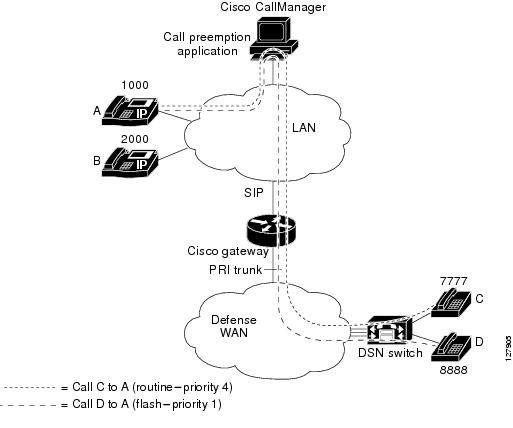
Cisco IOS gateways do not implement any type of preemption service logic; that task wholly rests with the DSN switch. Network Solution and System Flows for the SIPThe figure below shows the system flow for a typical user scenario. The request from a higher priority interrupts a lower-priority usage at a user terminal, such as an IP phone. The Primary Rate Interface (PRI) is connected to a DSN WAN through a Cisco IOS gateway. For the purpose of this illustration, we assume that users A, B, C, and D are properly configured in the DSN switch with the appropriate maximum priority levels, as follows: User C establishes a call with User A. User C wants the call to be set to the maximum priority value and so dials the appropriate code. User D tries to call a security advisor. Because User D's call has the highest priority, the figure below provides an overall illustration on how MLPP works in this scenario and the part this new functionality on the Cisco IOS gateway plays in achieving MLPP.
A typical network solution and call flow is as follows (see the figure above):
Precedence IE: Level - 0000, Service Domain - 0000000 The call is routed through the Cisco IOS gateway.
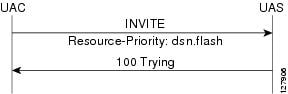
INVITE Resource-Priority: dsn.flash The management system validates the dialed number (DN) and identifies that User A (1000) is already in a call.
There are two options for the management system to provide the treatment to User C (7777). It either provides the preemption tone from its end if it was transcoding and Real-Time Transport Protocol (RTP) streams were controlled by it. Or if the RTP streams were directly established between the endpoints gateway and the phone, it inserts a suitable cause value in the SIP Reason header and lets the gateway or the DSN switch provide the treatment. The management system presents the cause value either in new Reason header name space preemption or in Q.850 format: BYE Reason: Preemption; cause=1;text="UA_Preemption"
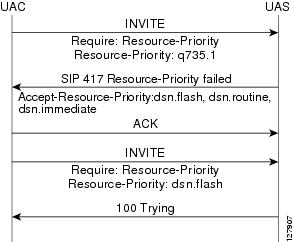
If a higher precedence call comes in during the User D (8888) to User A (1000) call, the management system processes the higher-order preemption. For the IP phones, when a user's profile is assigned to the phone, calls initiated from the phone inherit the precedence of the assigned user. The next two figures show examples of a Resource-Priority (R-P) header call flows with loose mode and strict mode selected. SIP Support for Media ForkingThe SIP Support for Media Forking feature provides the ability to create midcall multiple streams (or branches) of audio associated with a single call and then send those streams of data to different destinations. The feature allows service providers to use technologies such as speech recognition, voice authentication, and text-to-speech conversion to provide sophisticated services to their end-user customers. An example is a web-browsing application that uses voice recognition and text-to-speech (TTS) technology to make reservations, verify shipments, or order products. Feature benefit is as follows: SIP media streams are created and deleted only through re-Invite messages; no CLI is required.
Media StreamsWith the SIP Support for Media Forking feature, you can create up to three Real-Time Transport Protocol (RTP) media streams to and from a single DS0 channel. In addition, separate gateway destinations (IP address or UDP port) are maintained for each of the streams. The streams are bidirectional; media received from the destination gateways are mixed in the DSP before being sent to the DS0 channel, and pulse code modulation (PCM) received from the DS0 is duplicated and sent to the destination gateways. Originating gateways establish multiple media streams on the basis of Session Description Protocol (SDP) information included in midcall re-Invites received from a destination gateway, third-party call controller, or other SIP signaling entity. Only one SIP call leg is involved in media forking at the gateway, so the SIP signaling entity that initiates the re-Invites must be capable of aggregating the media information for multiple destinations (such as IP address, port number, payload types, or codecs) into one SDP description. Multiple m-lines in the SDP are used to indicate media forking, with each m-line representing one media destination.
The ability to create midcall multiple streams (or branches) of audio associated with a single call and send those streams of data to different destinations is similar to a three-way or conference call. A media-forked call has some differences. For example, in a three-way call, each party hears all of the other parties. But in a media-forked call, only the originating caller (the controller) hears the audio (voice and DTMF digits) from all the other participants. The other participants hear audio only from the originating caller and not from each other. Another difference between a three-way call and a media-forked call is that media streams can be configured on the gateway. Three-way calls send the audio to all of the other parties involved in the call. However, media-forking permits each media stream to be independently configured. For example, one media stream to one party may include both voice and DTMF digits, whereas another media stream to another party may include only DTMF digits. The feature supports three types of media streams: voice, DTMF-relay only, and voice plus DTMF-relay. In addition to the following discussion, see the following as appropriate:
Voice Media StreamsVoice-only media streams send all audio from the DS0 channel, and the audio is encoded according to the selected codec. Voice-only media streams have the following characteristics:
DTMF-Relay Media StreamsDTMF relay provides reliable digit relay between VoIP gateways and a standardized means of transporting DTMF tones in RTP packets. DTMF-relay media streams have the following characteristics:
Voice Plus DTMF-Relay Media StreamsVoice plus DTMF-relay media streams send both encoded voice and DTMF-relay packets and have the following characteristics:
Multiple Codec Selection Order and Dynamic Payload CodecsWhen using multiple codecs you must create a voice class in which you define a selection order for codecs, and you can then apply the voice class to VoIP dial peers. The voice class codec command in global configuration mode allows you to define the voice class that contains the codec selection order. Then you use the voice-class codec command in dial-peer configuration mode to apply the class to individual dial peers. If there are any codecs that use dynamic payload types (g726r16, g726r24), Cisco IOS software assigns the payload types to these codecs in the order in which they appear in the configuration, starting with the first available payload type in the dynamic range. The range for dynamic payload types is from 96 to 127, but Cisco IOS software preassigns the following payload types by default.
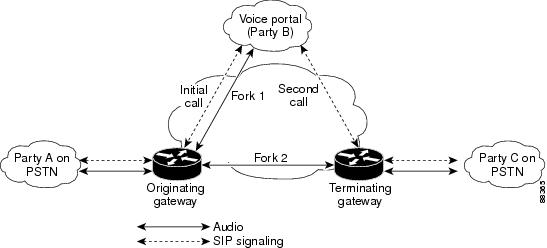
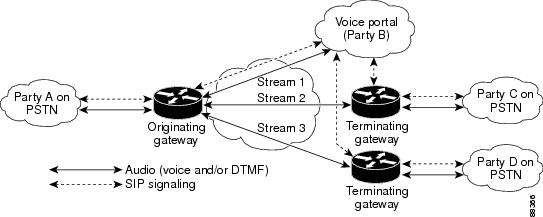
Because the payload types have been reserved by the default assignments shown in the table, Cisco IOS software automatically assigns 98 to the first dynamic codec in the dial-peer configuration, 99 to the second, and 102 to the third. Some of these preassigned payload types can be changed with the modem relay command. This command allows changes to the available payload types that can be used for codecs. For outgoing calls on the originating gateway, all of the codecs that are configured in the codec list used by the dial peer are included in the SDP of the Invite message. On the terminating gateway, Cisco IOS software always uses the dynamic payload types that the originating gateway specified in the SDP of the Invite message. This practice avoids the problem of misaligned payload types for most call types. The exception is when a delayed-media Invite message is received. A delayed-media Invite can be used by a voice portal to signal a terminating gateway before re-Inviting a forking gateway. If a delayed-media Invite is used, the Invite message does not contain SDP information, and the terminating gateway must advertise its own codecs and payload types. It does this in the SDP of its response message (either a 183 or a 200 OK). The terminating gateway assigns payload types to dynamic codecs using the same rules as the originating gateway. However, if there is a difference in either the preassigned dynamic payload types or the order in which the dynamic codecs are listed in the codec list used by the dial peer, the payload types may not be assigned consistently on the originating and terminating gateways. If the terminating gateway selects a different payload type for a dynamic codec, the call may fail. If a G.726 codec is assigned in the first active stream of the call, there are some scenarios in which the voice portal sends a delayed-media re-Invite message to the second or third terminating gateway. Then, it is necessary to ensure that the originating gateway and the second and third terminating gateways have the same preassigned payload types and the same order of dynamic codecs in the codec list for the dial peer being used for the call. Otherwise, the added media stream may be rejected by the originating gateway if the payload types do not match. Media Forking ApplicationsA web-browsing application that uses voice recognition and text-to-speech (TTS) technology to make reservations, verify shipments, or order products is a typical application of media forking. In The figure below, a client (Party A) uses a telephone to browse the web. Party A calls the voice portal (Party B), and the call is routed through the originating gateway. The voice portal operates like a standard voice gateway and terminates calls to a voice response system that has voice recognition and TTS capabilities. This voice response system takes input from Party A by DTMF digits or voice recognition and returns responses (for example, stock quotes retrieved from the web) to Party A. The voice portal, or Party B, is also capable of third-party call control (3pcc) and can set up a call between Party A and a third participant (Party C) without requiring direct signaling between Party A and Party C. One example of a possible call between Party A and Party C is if Party A found a restaurant listing while browsing the web and wanted to speak directly to the restaurant to make reservations. Another feature of the voice portal is that once the call between parties A and C is established, the voice portal can continue to monitor the audio from Party A. By doing so, the voice portal can terminate the connection between Party A and Party C when a preestablished DTMF digit or voice command is received. Party B retains the connection between itself and Party A, in case Party A has any further requests. Continuing with the restaurant example, the continuous connection is important if Party A decides to query yet another restaurant. Party A simply goes back to the connection with Party B, who sets up a call with the new restaurant. Another important aspect of media forking is that although there can be more than one media destination, there is only one signaling destination (in this case, the voice portal). The call leg that was originally set up (from the originating gateway to the voice portal) is maintained for the life of the session. The media destinations are independent of the signaling destination, so media streams (or new destinations) can be added and removed dynamically through re-Invite messages. Media streams are created and deleted only through re-Invite messages rather than through any CLIs. If you configure the timer receive-rtcpcommand for a gateway, a Session Initiation Protocol (SIP) media inactivity timer is started for each active media stream. The timer monitors and disconnects calls if no RTCP packets are received within a configurable time period. If any of the timers expire, the entire call is terminated--not just the stream on which the timer expired. If a stream is put on call hold, the timer for that stream is stopped. When the stream is taken off hold, the timer for that stream is started again. There is a maximum of three VoIP media streams that can be established per call. The figure below shows the maximum number of streams. Media Forking InitiationMedia forking is initiated by specifying multiple media fields (m-lines) in the SDP of a re-Invite message. The rules for adding and deleting multiple m-lines conform to RFC 2543, SIP: Session Initiation Protocol Appendix B . Multiple streams are not created through CLIs. How to Configure SIP Connection-Oriented Media Forking and MLPP Features
Configuring SIP Connection-Oriented Media Enhancements for SIPDETAILED STEPS Configuring SIP Multilevel Precedence and Priority SupportTo configure multilevel precedence and priority support on SIP for a VoIP dial peer, perform the following steps. DETAILED STEPS Configuring SIP Support for Media Forking
Configure Codec ComplexityTo configure codec complexity on a Cisco 2600 series, Cisco 3600 series, Cisco 37xx, or Cisco AS5300, or Cisco 7200 series, perform one of the following tasks, according to your router type. Cisco 2600 Series Cisco 3600 Series Cisco 37xx and Cisco AS5300For routers that have already been configured but need their codec complexity changed to high: If there is a DS0 group or PRI group assigned to any T1 controllers on the card, the DS0 or PRI groups must be removed. To remove the groups, shut down the voice ports associated with the groups; then follow the procedure below. Configuring the correct codec complexity is required for media-forked calls. For the Cisco AS5300, codec complexity is determined by the VCWare code that is loaded on the voice feature card (VFC). To download Cisco VCWare software, see the Cisco software download page. DETAILED STEPS
Cisco 7200 SeriesSUMMARY STEPS
DETAILED STEPS
Map Payload Types to Dynamic Payload Codecs
DETAILED STEPS
Configure Multiple-Codec Selection OrderTo configure multiple-codec selection order, perform the following steps.
DETAILED STEPS
Verifying Connection-Oriented Media and Forking Features for SIPTo verify configuration of connection-oriented media and forking features for SIP, perform the following steps as appropriate (commands are listed in alphabetical order). DETAILED STEPS
Troubleshooting Tips
Following is sample output for some of these commands: Sample Output for the debug ccsip all CommandIn the following example, output is displayed with the role keyword of the nat symmetric command set to active for the originating gateway, and to passive for the terminating gateway.
Router# debug ccsip all
All SIP call tracing enabled
Router#
00:02:12:0x6327E424 :State change from (UNDEFINED, SUBSTATE_NONE) to (STATE_IDLE, SUBSTATE_NONE)
00:02:12:****Adding to UAC table
00:02:12:adding call id 3 to table
00:02:12:Queued event from SIP SPI :SIPSPI_EV_CC_CALL_SETUP (10)
00:02:12:CCSIP-SPI-CONTROL: act_idle_call_setup
00:02:12: act_idle_call_setup:Not using Voice Class Codec
00:02:12:act_idle_call_setup:preferred_codec set[0] type :g711ulaw bytes:160
00:02:12:sipSPICopyPeerDataToCCB:From CLI:Modem NSE payload = 100, Passthrough = 0,Modem relay = 0, Gw-Xid = 1
SPRT latency 200, SPRT Retries = 12, Dict Size = 1024
String Len = 32, Compress dir = 3
00:02:12:****Deleting from UAC table
00:02:12:****Adding to UAC table
00:02:12:Queued event from SIP SPI :SIPSPI_EV_CREATE_CONNECTION (6)
00:02:12:0x6327E424 :State change from (STATE_IDLE, SUBSTATE_NONE) to (STATE_IDLE, SUBSTATE_CONNECTING)
00:02:12:0x6327E424 :State change from (STATE_IDLE, SUBSTATE_CONNECTING) to (STATE_IDLE, SUBSTATE_CONNECTING)
00:02:12:sipSPIUsetBillingProfile:sipCallId for billing records = D6EB9E87-14EE11CC-8008A04C-8E05D30C@10.15.66.43
00:02:12:CCSIP-SPI-CONTROL: act_idle_connection_created
00:02:12:CCSIP-SPI-CONTROL: act_idle_connection_created:Connid(1) created to 172.18.200.237:5060, local_port 56992
00:02:12:CCSIP-SPI-CONTROL: sipSPIOutgoingCallSDP
00:02:12: Preferred method of dtmf relay is:6, with payload :101
00:02:12: convert_codec_bytes_to_ptime:Values :Codec:g711ulaw codecbytes :160, ptime:20
00:02:12:sip_generate_sdp_xcaps_list:Modem Relay disabled. X-cap not needed
00:02:12:CCSIP-SPI-CONTROL: Clock Time Zone is UTC, same as GMT:Using GMT
00:02:12:sipSPIAddLocalContact
00:02:12:Queued event from SIP SPI :SIPSPI_EV_SEND_MESSAGE (7)
00:02:12:sip_stats_method
00:02:12:0x6327E424 :State change from (STATE_IDLE, SUBSTATE_CONNECTING) to (STATE_SENT_INVITE, SUBSTATE_NONE)
00:02:12:Sent:
INVITE sip:2021010124@172.18.200.237:5060;user=phone SIP/2.0
Via:SIP/2.0/UDP 10.15.66.43:5060
From:"888001" <sip:888001@10.15.66.43>;tag=20694-C53
To:<sip:2021010124@172.18.200.237;user=phone>
Date:Mon, 01 Mar 1993 00:02:12 GMT
Call-ID:D6EB9E87-14EE11CC-8008A04C-8E05D30C@10.15.66.43
Supported:timer,100rel
Min-SE: 1800
Cisco-Guid:3563045876-351146444-2147852364-2382746380
User-Agent:Cisco-SIPGateway/IOS-12.x
CSeq:101 INVITE
Max-Forwards:1
Timestamp:730944132
Contact:<sip:888001@10.15.66.43:5060;user=phone>
Expires:60
Allow-Events:telephone-event
Content-Type:application/sdp
Content-Length:291
v=0
o=CiscoSystemsSIP-GW-UserAgent 9502 9606 IN IP4 10.15.66.43
s=SIP Call
c=IN IP4 10.15.66.43
t=0 0
m=audio 16398 RTP/AVP 0 100 101
a=rtpmap:0 PCMU/8000
a=rtpmap:100 X-NSE/8000
a=fmtp:100 192-194
a=rtpmap:101 telephone-event/8000
a=fmtp:101 0-16
a=ptime:20
a=direction:active
00:02:12:CCSIP-SPI-CONTROL: act_sentinvite_wait_100
00:02:12:CCSIP-SPI-CONTROL: Clock Time Zone is UTC, same as GMT:Using GMT
00:02:12:sipSPIAddLocalContact
00:02:12:Queued event from SIP SPI :SIPSPI_EV_SEND_MESSAGE (7)
00:02:12:sip_stats_method
00:02:12:Sent:
INVITE sip:2021010124@172.18.200.237:5060;user=phone SIP/2.0
Via:SIP/2.0/UDP 10.15.66.43:5060
From:"888001" <sip:888001@10.15.66.43>;tag=20694-C53
To:<sip:2021010124@172.18.200.237;user=phone>
Date:Mon, 01 Mar 1993 00:02:12 GMT
Call-ID:D6EB9E87-14EE11CC-8008A04C-8E05D30C@10.15.66.43
Supported:timer,100rel
Min-SE: 1800
Cisco-Guid:3563045876-351146444-2147852364-2382746380
User-Agent:Cisco-SIPGateway/IOS-12.x
CSeq:101 INVITE
Max-Forwards:1
Timestamp:730944132
Contact:<sip:888001@10.15.66.43:5060;user=phone>
Expires:60
Allow-Events:telephone-event
Content-Type:application/sdp
Content-Length:291
v=0
o=CiscoSystemsSIP-GW-UserAgent 9502 9606 IN IP4 10.15.66.43
s=SIP Call
c=IN IP4 10.15.66.43
t=0 0
m=audio 16398 RTP/AVP 0 100 101
a=rtpmap:0 PCMU/8000
a=rtpmap:100 X-NSE/8000
a=fmtp:100 192-194
a=rtpmap:101 telephone-event/8000
a=fmtp:101 0-16
a=ptime:20
a=direction:active
00:02:12:Received:
SIP/2.0 100 Trying
Via:SIP/2.0/UDP 10.15.66.43:5060
From:"888001" <sip:888001@10.15.66.43>;tag=20694-C53
To:<sip:2021010124@172.18.200.237;user=phone>;tag=1069B954-25F
Date:Tue, 04 Jan 2000 23:57:53 GMT
Call-ID:D6EB9E87-14EE11CC-8008A04C-8E05D30C@10.15.66.43
Timestamp:730944132
Server:Cisco-SIPGateway/IOS-12.x
CSeq:101 INVITE
Allow-Events:telephone-event
Content-Length:0
00:02:12:HandleUdpSocketReads :Msg enqueued for SPI with IPaddr:172.18.200.237:5060
00:02:12:CCSIP-SPI-CONTROL: act_sentinvite_new_message
00:02:12:CCSIP-SPI-CONTROL: sipSPICheckResponse
00:02:12:sip_stats_status_code
00:02:12: Roundtrip delay 32 milliseconds for method INVITE
00:02:12:0x6327E424 :State change from (STATE_SENT_INVITE, SUBSTATE_NONE) to (STATE_RECD_PROCEEDING, SUBSTATE_PROCEEDING_PROCEEDING)
00:02:13:Received:
SIP/2.0 183 Session Progress
Via:SIP/2.0/UDP 10.15.66.43:5060
From:"888001" <sip:888001@10.15.66.43>;tag=20694-C53
To:<sip:2021010124@172.18.200.237;user=phone>;tag=1069B954-25F
Date:Tue, 04 Jan 2000 23:57:53 GMT
Call-ID:D6EB9E87-14EE11CC-8008A04C-8E05D30C@10.15.66.43
Timestamp:730944132
Server:Cisco-SIPGateway/IOS-12.x
CSeq:101 INVITE
Require:100rel
RSeq:5975
Allow-Events:telephone-event
Contact:<sip:2021010124@172.18.200.237:5060;user=phone>
Content-Type:application/sdp
Content-Disposition:session;handling=required
Content-Length:240
v=0
o=CiscoSystemsSIP-GW-UserAgent 1692 40 IN IP4 172.18.200.237
s=SIP Call
c=IN IP4 172.18.200.237
t=0 0
m=audio 16898 RTP/AVP 0 100
a=rtpmap:0 PCMU/8000
a=rtpmap:100 X-NSE/8000
a=fmtp:100 192-194
a=ptime:20
a=direction:passive
00:02:13:HandleUdpSocketReads :Msg enqueued for SPI with IPaddr:172.18.200.237:5060
00:02:13:CCSIP-SPI-CONTROL: act_recdproc_new_message
00:02:13:CCSIP-SPI-CONTROL: sipSPICheckResponse
00:02:13:sip_stats_status_code
00:02:13: Roundtrip delay 708 milliseconds for method INVITE
00:02:13:sipSPIGetSdpBody :Parse incoming session description
00:02:13:HandleSIP1xxSessionProgress:Content-Disposition received in 18x response:session;handling=required
00:02:13:sipSPIDoFaxMediaNegotiation()
00:02:13:sipSPIDoMediaNegotiation:Codec (g711ulaw) Negotiation Successful on Static Payload
00:02:13: sipSPIDoPtimeNegotiation:One ptime attribute found - value:20
00:02:13: convert_ptime_to_codec_bytes:Values :Codec:g711ulaw ptime :20, codecbytes:160
00:02:13: convert_codec_bytes_to_ptime:Values :Codec:g711ulaw codecbytes :160, ptime:20
00:02:13: Parsed the direction:role identified as:0
00:02:13:sipSPIDoDTMFRelayNegotiation:Requested DTMF-RELAY option(s) not found in Preferred DTMF-RELAY option list!
00:02:13: sipSPIDoMediaNegotiation:DTMF Relay mode :Inband Voice
00:02:13:sip_sdp_get_modem_relay_cap_params:
00:02:13:sip_sdp_get_modem_relay_cap_params:NSE payload from X-cap = 0
00:02:13:sip_do_nse_negotiation:NSE Payload 100 found in SDP
00:02:13:sip_do_nse_negotiation:Remote NSE payload = local one = 100, Use it
00:02:13:sip_select_modem_relay_params:X-tmr not present in SDP. Disable modem relay
00:02:13:sipSPIDoQoSNegotiation - SDP body with media description
00:02:13:sipSPIUpdCcbWithSdpInfo:SDP Media Information:
Negotiated Codec :g711ulaw , bytes :160
Early Media :0
Delayed Media :0
Bridge Done :0
New Media :0
DSP DNLD Reqd :0
Media Dest addr/Port :172.18.200.237:16898
Orig Media Addr/Port :0.0.0.0:0
00:02:13:0x6327E424 :State change from (STATE_RECD_PROCEEDING, SUBSTATE_PROCEEDING_PROCEEDING) to (STATE_RECD_PROCEEDING, SUBSTATE_PROCEEDING_PROGRESS)
00:02:13:ccsip_process_response_contact_record_route
00:02:13:0x6327E424 :State change from (STATE_RECD_PROCEEDING, SUBSTATE_PROCEEDING_PROGRESS) to (STATE_RECD_PROCEEDING, SUBSTATE_CONNECTING)
00:02:13:Queued event from SIP SPI :SIPSPI_EV_CREATE_CONNECTION (6)
00:02:13:0x6327E424 :State change from (STATE_RECD_PROCEEDING, SUBSTATE_CONNECTING) to (STATE_RECD_PROCEEDING, SUBSTATE_CONNECTING)
00:02:13:sipSPIRtcpUpdates:rtcp_session info
laddr = 10.15.66.43, lport = 16398, raddr = 172.18.200.237, rport=16898
00:02:13:sipSPIRtcpUpdates:NO extraction of source address from remote media
00:02:13: sipSPIRtcpUpdates No rtp session in bridge, create a new one
00:02:13:CCSIP-SPI-CONTROL: ccsip_caps_ind
00:02:13:ccsip_get_rtcp_session_parameters:CURRENT VALUES:
ccCallID=3, current_seq_num=0x1500
00:02:13:ccsip_get_rtcp_session_parameters:NEW VALUES:
ccCallID=3, current_seq_num=0xB93
00:02:13:ccsip_caps_ind:Load DSP with negotiated codec :g711ulaw, Bytes=160
00:02:13:sipSPISetDTMFRelayMode:set DSP for dtmf-relay = CC_CAP_DTMF_RELAY_INBAND_VOICE_AND_OOB
00:02:13:sip_set_modem_caps:Negotiation already Done. Set negotiated Modem caps
00:02:13:sip_set_modem_caps:Modem Relay & Passthru both disabled
00:02:13:sip_set_modem_caps:nse payload = 100, ptru mode = 0, ptru-codec=0, redundancy=0, xid=0, relay=0, sprt-retry=12, latecncy=200, compres-dir=3, dict=1024, strnlen=32
00:02:13:ccsip_caps_ind:Load DSP with codec :g711ulaw, Bytes=160
00:02:13:CCSIP-SPI-CONTROL: ccsip_caps_ack
00:02:13:CCSIP-SPI-CONTROL: act_recdproc_connection_created
00:02:13:CCSIP-SPI-CONTROL: sipSPICheckSocketConnection:Connid(2) created to 172.18.200.237:5060, local_port 50689
00:02:13:0x6327E424 :State change from (STATE_RECD_PROCEEDING, SUBSTATE_CONNECTING) to (STATE_RECD_PROCEEDING, SUBSTATE_NONE)
00:02:13:Queued event from SIP SPI :SIPSPI_EV_SEND_MESSAGE (7)
00:02:13:sip_stats_method
00:02:13:0x6327E424 :State change from (STATE_RECD_PROCEEDING, SUBSTATE_NONE) to (STATE_RECD_PROCEEDING, SUBSTATE_PROCEEDING_PROGRESS)
00:02:13:Received:
SIP/2.0 200 OK
Via:SIP/2.0/UDP 10.15.66.43:5060
From:"888001" <sip:888001@10.15.66.43>;tag=20694-C53
To:<sip:2021010124@172.18.200.237;user=phone>;tag=1069B954-25F
Date:Tue, 04 Jan 2000 23:57:53 GMT
Call-ID:D6EB9E87-14EE11CC-8008A04C-8E05D30C@10.15.66.43
Timestamp:730944132
Server:Cisco-SIPGateway/IOS-12.x
CSeq:101 INVITE
Allow-Events:telephone-event
Contact:<sip:2021010124@172.18.200.237:5060;user=phone>
Content-Type:application/sdp
Content-Length:240
v=0
o=CiscoSystemsSIP-GW-UserAgent 1692 40 IN IP4 172.18.200.237
s=SIP Call
c=IN IP4 172.18.200.237
t=0 0
m=audio 16898 RTP/AVP 0 100
a=rtpmap:0 PCMU/8000
a=rtpmap:100 X-NSE/8000
a=fmtp:100 192-194
a=ptime:20
a=direction:passive
00:02:13:HandleUdpSocketReads :Msg enqueued for SPI with IPaddr:172.18.200.237:5060
00:02:13:Sent:
PRACK sip:2021010124@172.18.200.237:5060;user=phone SIP/2.0
Via:SIP/2.0/UDP 10.15.66.43:5060
From:"888001" <sip:888001@10.15.66.43>;tag=20694-C53
To:<sip:2021010124@172.18.200.237;user=phone>;tag=1069B954-25F
Date:Mon, 01 Mar 1993 00:02:12 GMT
Call-ID:D6EB9E87-14EE11CC-8008A04C-8E05D30C@10.15.66.43
CSeq:102 PRACK
RAck:5975 101 INVITE
Content-Length:0
00:02:13:CCSIP-SPI-CONTROL: act_recdproc_new_message
00:02:13:CCSIP-SPI-CONTROL: sipSPICheckResponse
00:02:13:sip_stats_status_code
00:02:13: Roundtrip delay 736 milliseconds for method PRACK
00:02:13:sipSPIGetSdpBody :Parse incoming session description
00:02:13:CCSIP-SPI-CONTROL: sipSPIUACSessionTimer
00:02:13:CCSIP-SPI-CONTROL: act_recdproc_continue_200_processing
00:02:13:CCSIP-SPI-CONTROL: act_recdproc_continue_200_processing:*** This ccb is the parent
00:02:13:sipSPIDoFaxMediaNegotiation()
00:02:13:sipSPIDoMediaNegotiation:Codec (g711ulaw) Negotiation Successful on Static Payload
00:02:13: sipSPIDoPtimeNegotiation:One ptime attribute found - value:20
00:02:13: convert_ptime_to_codec_bytes:Values :Codec:g711ulaw ptime :20, codecbytes:160
00:02:13: convert_codec_bytes_to_ptime:Values :Codec:g711ulaw codecbytes :160, ptime:20
00:02:13: Parsed the direction:role identified as:0
00:02:13:sipSPIDoDTMFRelayNegotiation:Requested DTMF-RELAY option(s) not found in Preferred DTMF-RELAY option list!
00:02:13: sipSPIDoMediaNegotiation:DTMF Relay mode :Inband Voice
00:02:13:sip_sdp_get_modem_relay_cap_params:
00:02:13:sip_sdp_get_modem_relay_cap_params:NSE payload from X-cap = 0
00:02:13:sip_do_nse_negotiation:NSE Payload 100 found in SDP
00:02:13:sip_do_nse_negotiation:Remote NSE payload = local one = 100, Use it
00:02:13:sip_select_modem_relay_params:X-tmr not present in SDP. Disable modem relay
00:02:13: sipSPICompareSDP:Flags set:NEW_MEDIA :0 DSPDNLD REQD:0
00:02:13:sipSPIUpdCcbWithSdpInfo Bridge was done and there are no fqdn queries in progress, do RTCP updates
00:02:13:sipSPIRtcpUpdates:rtcp_session info
laddr = 10.15.66.43, lport = 16398, raddr = 172.18.200.237, rport=16898
00:02:13:sipSPIRtcpUpdates:NO extraction of source address from remote media
00:02:13: sipSPIRtcpUpdates rtp session already created in bridge - update
00:02:13:sipSPIUpdCcbWithSdpInfo:SDP Media Information:
Negotiated Codec :g711ulaw , bytes :160
Early Media :0
Delayed Media :0
Bridge Done :1048576
New Media :0
DSP DNLD Reqd :0
Media Dest addr/Port :172.18.200.237:16898
Orig Media Addr/Port :0.0.0.0:0
00:02:13:sipSPIProcessMediaChanges
00:02:13:ccsip_process_response_contact_record_route
00:02:13:CCSIP-SPI-CONTROL: sipSPIProcess200OKforinvite
00:02:13:RequestCloseConnection:Closing connid 1 Local Port 50689
00:02:13:Queued event from SIP SPI :SIPSPI_EV_CLOSE_CONNECTION (8)
00:02:13:Queued event from SIP SPI :SIPSPI_EV_SEND_MESSAGE (7)
00:02:13:sip_stats_method
00:02:13:0x6327E424 :State change from (STATE_RECD_PROCEEDING, SUBSTATE_PROCEEDING_PROGRESS) to (STATE_ACTIVE, SUBSTATE_NONE)
00:02:13:The Call Setup Information is :
Call Control Block (CCB) :0x6327E424
State of The Call :STATE_ACTIVE
TCP Sockets Used :NO
Calling Number :888001
Called Number :2021010124
Negotiated Codec :g711ulaw
Negotiated Codec Bytes :160
Negotiated Dtmf-relay :0
Dtmf-relay Payload :0
00:02:13:
Source IP Address (Sig ):10.15.66.43
Source IP Address (Media):10.15.66.43
Source IP Port (Media):16398
Destn IP Address (Media):172.18.200.237
Destn IP Port (Media):16898
Destn SIP Req Addr:Port :172.18.200.237:5060
Destn SIP Resp Addr:Port :0.0.0.0:0
Destination Name :172.18.200.237
00:02:13:
Orig Destn IP Address:Port (Media):0.0.0.0:0
00:02:13:udpsock_close_connect:Socket fd:1 closed for connid 1 with remote port:5060
00:02:13:Sent:
ACK sip:2021010124@172.18.200.237:5060;user=phone SIP/2.0
Via:SIP/2.0/UDP 10.15.66.43:5060
From:"888001" <sip:888001@10.15.66.43>;tag=20694-C53
To:<sip:2021010124@172.18.200.237;user=phone>;tag=1069B954-25F
Date:Mon, 01 Mar 1993 00:02:12 GMT
Call-ID:D6EB9E87-14EE11CC-8008A04C-8E05D30C@10.15.66.43
Max-Forwards:1
Content-Length:0
CSeq:101 ACK
00:02:13:Received:
SIP/2.0 200 OK
Via:SIP/2.0/UDP 10.15.66.43:5060
From:"888001" <sip:888001@10.15.66.43>;tag=20694-C53
To:<sip:2021010124@172.18.200.237;user=phone>;tag=1069B954-25F
Date:Tue, 04 Jan 2000 23:57:54 GMT
Call-ID:D6EB9E87-14EE11CC-8008A04C-8E05D30C@10.15.66.43
Server:Cisco-SIPGateway/IOS-12.x
CSeq:102 PRACK
Content-Length:0
00:02:13:HandleUdpSocketReads :Msg enqueued for SPI with IPaddr:172.18.200.237:5060
00:02:13:CCSIP-SPI-CONTROL: act_active_new_message
00:02:13:CCSIP-SPI-CONTROL: sact_active_new_message_response
00:02:13:CCSIP-SPI-CONTROL: sipSPICheckResponse
00:02:27:Queued event from SIP SPI :SIPSPI_EV_CC_CALL_DISCONNECT (15)
00:02:27:CCSIP-SPI-CONTROL: act_active_disconnect
00:02:27:RequestCloseConnection:Closing connid 2 Local Port 50689
00:02:27:Queued event from SIP SPI :SIPSPI_EV_CLOSE_CONNECTION (8)
00:02:27:Queued event from SIP SPI :SIPSPI_EV_CREATE_CONNECTION (6)
00:02:27:0x6327E424 :State change from (STATE_ACTIVE, SUBSTATE_NONE) to (STATE_ACTIVE, SUBSTATE_CONNECTING)
00:02:27:0x6327E424 :State change from (STATE_ACTIVE, SUBSTATE_CONNECTING) to (STATE_ACTIVE, SUBSTATE_CONNECTING)
00:02:27:udpsock_close_connect:Socket fd:2 closed for connid 2 with remote port:5060
00:02:27:CCSIP-SPI-CONTROL: sipSPICheckSocketConnection:Connid(1) created to 172.18.200.237:5060, local_port 54607
00:02:27:0x6327E424 :State change from (STATE_ACTIVE, SUBSTATE_CONNECTING) to (STATE_ACTIVE, SUBSTATE_NONE)
00:02:27:CCSIP-SPI-CONTROL: act_active_connection_created Call Disconnect - Sending Bye
00:02:27:Queued event from SIP SPI :SIPSPI_EV_SEND_MESSAGE (7)
00:02:27:sip_stats_method
00:02:27:0x6327E424 :State change from (STATE_ACTIVE, SUBSTATE_NONE) to (STATE_DISCONNECTING, SUBSTATE_NONE)
00:02:27:Sent:
BYE sip:2021010124@172.18.200.237:5060;user=phone SIP/2.0
Via:SIP/2.0/UDP 10.15.66.43:5060
From:"888001" <sip:888001@10.15.66.43>;tag=20694-C53
To:<sip:2021010124@172.18.200.237;user=phone>;tag=1069B954-25F
Date:Mon, 01 Mar 1993 00:02:12 GMT
Call-ID:D6EB9E87-14EE11CC-8008A04C-8E05D30C@10.15.66.43
User-Agent:Cisco-SIPGateway/IOS-12.x
Max-Forwards:1
Timestamp:730944147
CSeq:103 BYE
Content-Length:0
00:02:27:Received:
SIP/2.0 200 OK
Via:SIP/2.0/UDP 10.15.66.43:5060
From:"888001" <sip:888001@10.15.66.43>;tag=20694-C53
To:<sip:2021010124@172.18.200.237;user=phone>;tag=1069B954-25F
Date:Tue, 04 Jan 2000 23:58:08 GMT
Call-ID:D6EB9E87-14EE11CC-8008A04C-8E05D30C@10.15.66.43
Server:Cisco-SIPGateway/IOS-12.x
Timestamp:730944147
Content-Length:0
CSeq:103 BYE
00:02:27:HandleUdpSocketReads :Msg enqueued for SPI with IPaddr:172.18.200.237:5060
00:02:27:CCSIP-SPI-CONTROL: act_disconnecting_new_message
00:02:27:CCSIP-SPI-CONTROL: sact_disconnecting_new_message_response
00:02:27:CCSIP-SPI-CONTROL: sipSPICheckResponse
00:02:27:sip_stats_status_code
00:02:27: Roundtrip delay 16 milliseconds for method BYE
00:02:27:CCSIP-SPI-CONTROL: sipSPICallCleanup
00:02:27:sipSPIIcpifUpdate :CallState:4 Playout:0 DiscTime:14742 ConnTime 13360
00:02:27:0x6327E424 :State change from (STATE_DISCONNECTING, SUBSTATE_NONE) to (STATE_DEAD, SUBSTATE_NONE)
00:02:27:The Call Setup Information is :
Call Control Block (CCB) :0x6327E424
State of The Call :STATE_DEAD
TCP Sockets Used :NO
Calling Number :888001
Called Number :2021010124
Negotiated Codec :g711ulaw
Negotiated Codec Bytes :160
Negotiated Dtmf-relay :0
Dtmf-relay Payload :0
00:02:27:
Source IP Address (Sig ):10.15.66.43
Source IP Address (Media):10.15.66.43
Source IP Port (Media):16398
Destn IP Address (Media):172.18.200.237
Destn IP Port (Media):16898
Destn SIP Req Addr:Port :172.18.200.237:5060
Destn SIP Resp Addr:Port :0.0.0.0:0
Destination Name :172.18.200.237
00:02:27:
Orig Destn IP Address:Port (Media):0.0.0.0:0
00:02:27:
Disconnect Cause (CC) :16
Disconnect Cause (SIP) :200
00:02:27:****Deleting from UAC table
00:02:27:Removing call id 3
00:02:27:RequestCloseConnection:Closing connid 1 Local Port 54607
00:02:27:Queued event from SIP SPI :SIPSPI_EV_CLOSE_CONNECTION (8)
00:02:27: freeing ccb 6327E424
00:02:27:udpsock_close_connect:Socket fd:1 closed for connid 1 with remote port:5060
Configuration Examples for SIP Connection-Oriented Media Forking and MLPP Features
Connection-Oriented Media Enhancements for SIP Example
Router# show running-config
Building configuration...
Current configuration :2791 bytes
!
version 12.3
service timestamps debug uptime
service timestamps log uptime
no service password-encryption
!
hostname Router
!
voice-card 2
!
ip subnet-zero
!
no ip domain lookup
ip domain name example.com
ip name-server 172.18.195.113
!
isdn switch-type primary-ni
!
fax interface-type fax-mail
mta receive maximum-recipients 0
ccm-manager mgcp
!
controller T1 2/0
framing esf
linecode b8zs
pri-group timeslots 1-24
!
controller T1 2/1
framing esf
linecode b8zs
pri-group timeslots 1-24
!
interface Ethernet0/0
ip address 172.18.197.22 255.255.255.0
half-duplex
!
interface Serial0/0
no ip address
shutdown
!
interface TokenRing0/0
no ip address
shutdown
ring-speed 16
!
interface FastEthernet1/0
no ip address
shutdown
duplex auto
speed auto
!
interface Serial2/0:23
no ip address
no logging event link-status
isdn switch-type primary-ni
isdn incoming-voice voice
isdn outgoing display-ie
no cdp enable
!
interface Serial2/1:23
no ip address
no logging event link-status
isdn switch-type primary-ni
isdn incoming-voice voice
isdn outgoing display-ie
no cdp enable
!
ip classless
ip route 0.0.0.0 0.0.0.0 Ethernet0/0
no ip http server
ip pim bidir-enable
!
call rsvp-sync
!
voice-port 2/0:23
!
voice-port 2/1:23
!
voice-port 3/0/0
!
voice-port 3/0/1
!
mgcp ip qos dscp cs5 media
mgcp ip qos dscp cs3 signaling
!
mgcp profile default
!
dial-peer cor custom
!
dial-peer voice 646 voip
destination-pattern 5552222
session protocol sipv2
session target ipv4:10.0.0.1
!
dial-peer voice 700 pots
destination-pattern 700#T
port 0:D
!
gateway
!
sip-ua
nat symmetric check-media-src
max-forwards 5
!
line con 0
line aux 0
line vty 0 4
login
!
end
SIP Multilevel Precedence and Priority Support ExampleThe following shows the result when the SIP: Multilevel Precedence and Priority Support feature is configured:
Router# show running-config
Building configuration...
Current configuration:2964 bytes
!
version 12.3
no parser cache
service timestamps debug datetime msec
service timestamps log datetime msec
no service password-encryption
!
hostname router1
!
boot-start-marker
boot-end-marker
!
logging buffered 1000000 debugging
!
!
dial-peer voice 9876 voip
destination-pattern 9876
voice-class sip resource priority namespace drsn
voice-class sip resource priority mode strict
session protocol sipv2
session target ipv4:172.18.194.183
session transport udp
!
dial-peer voice 222 pots
incoming called-number
direct-inward-dial
!
dial-peer voice 333 pots
shutdown
destination-pattern 9876
prefix 9876
!
sip-ua
retry invite 1
retry bye 4
retry cancel 4
retry prack 4
retry notify 4
retry refer 4
retry info 4
sip-server ipv4:172.19.194.186
reason-header override
!
line con 0
exec-timeout 0 0
transport preferred all
transport output all
line aux 0
transport preferred all
transport output all
line vty 0 4
login
transport preferred all
transport input all
transport output all
!
!
end
SIP Support for Media Forking ExamplesThis section provides the following configuration and trace examples:
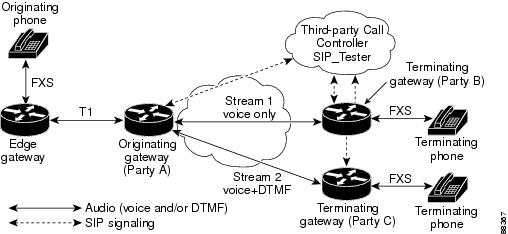
SIP Network Using Media ForkingThis configuration example shows a sample SIP network that uses media forking. The figure below shows a sample network where Party A dials Party B (555-2201). The dial peer for Party B on the originating gateway points to the IP address of SIP_Tester, which is acting as the third-party call controller. The Invite message is sent to SIP_Tester, who then forwards it to Party B. The typical SIP protocol exchange takes place to set up the first stream of the call. The user information portion of the SIP URL for SIP_Tester is 9999, so the dial peers on Party B and Party C are configured with 9999. SIP_Tester initiates the establishment of the second stream by sending an initial Invite message with no SDP to Party C. Party C rings the terminating phone and responds to SIP_Tester with cause code 183 and an SDP that advertises its media capability. When the terminating phone answers, Party C responds to SIP_Tester with a 200 OK. SIP_Tester creates a re-Invite message with two media lines (m-lines) and sends it to Party A, who creates the second stream to Party C. Party A responds with an ACK that contains its local media information in the SDP. SIP_Tester forwards the ACK with SDP to Party C. A forked call is established. Edge GatewayThe edge gateway configuration is used to convert a foreign-exchange-station (FXS) interface to a T1 interface. It is not involved in media forking or VoIP.
Router# show running-config
Building configuration...
Current configuration : 4455 bytes
!
version 12.2
no service single-slot-reload-enable
service timestamps debug datetime msec
service timestamps log uptime
no service password-encryption
!
logging rate-limit console 10 except errors
!
voice-card 1
!
ip subnet-zero
!
ip domain-name example.com
ip name-server 172.26.11.21
!
no ip dhcp-client network-discovery
isdn switch-type primary-dms100
isdn voice-call-failure 0
call rsvp-sync
!
controller T1 1/0
framing esf
linecode b8zs
pri-group timeslots 1-24
!
controller T1 1/1
framing esf
linecode b8zs
pri-group timeslots 1-24
!
interface Serial1/0:23
no ip address
no logging event link-status
isdn switch-type primary-dms100
isdn incoming-voice voice
isdn T310 4000
no cdp enable
!
interface Serial1/1:23
no ip address
no logging event link-status
isdn switch-type primary-dms100
isdn incoming-voice voice
no fair-queue
no cdp enable
!
interface FastEthernet3/0
ip address 172.18.193.136 255.255.0.0
duplex auto
speed auto
!
ip classless
ip route 172.16.0.0 255.0.0.0 FastEthernet3/0
no ip http server
!
snmp-server packetsize 4096
snmp-server manager
!
voice-port 1/0:23
!
voice-port 1/1:23
!
voice-port 2/0/0
!
voice-port 2/0/1
!
voice-port 2/1/0
!
voice-port 2/1/1
!
dial-peer cor custom
!
dial-peer voice 5552 pots
destination-pattern 5552...
port 1/1:23
prefix 5552
!
dial-peer voice 5555 pots
destination-pattern 5555101
port 2/0/1
!
line con 0
exec-timeout 0 0
transport preferred none
line aux 0
line vty 0 4
exec-timeout 0 0
password password1
login
!
end
Party A
Router# show running-config
Building configuration...
Current configuration : 1864 bytes
!
version 12.2
service timestamps debug datetime msec
service timestamps log uptime
no service password-encryption
!
memory-size iomem 10
voice-card 1
codec complexity high
!
ip subnet-zero
!
ip domain-name example.com
ip name-server 172.26.11.21
!
isdn switch-type primary-dms100
isdn voice-call-failure 0
!
voice service voip
sip
!
no voice hpi capture buffer
no voice hpi capture destination
!
fax interface-type fax-mail
mta receive maximum-recipients 0
!
controller T1 1/0
framing esf
linecode b8zs
!
controller T1 1/1
framing esf
linecode b8zs
pri-group timeslots 1-24
!
interface Ethernet0/0
ip address 172.18.193.14 255.255.0.0
half-duplex
fair-queue 64 256 235
ip rsvp bandwidth 7500 7500
!
interface Ethernet0/1
no ip address
shutdown
half-duplex
!
interface Serial1/1:23
no ip address
no logging event link-status
isdn switch-type primary-dms100
isdn incoming-voice voice
no cdp enable
!
ip classless
ip route 0.0.0.0 0.0.0.0 172.18.193.1
no ip http server
!!
call rsvp-sync
!
voice-port 1/1:23
!
mgcp profile default
!
dial-peer cor custom
!
dial-peer voice 2100 voip
destination-pattern 55521..
session target ipv4:172.18.193.88
!
dial-peer voice 2200 voip
destination-pattern 55522..
session protocol sipv2
session target ipv4:172.18.207.18:5062
dtmf-relay rtp-nte
codec g711ulaw
!
dial-peer voice 9999 voip
destination-pattern 9999
session protocol sipv2
session target ipv4:172.18.207.18:5062
!
dial-peer voice 5557 pots
destination-pattern 55571..
direct-inward-dial
port 1/1:23
!
sip-ua
retry invite 3
retry response 3
retry bye 3
retry cancel 3
timers trying 501
!
line con 0
exec-timeout 0 0
transport preferred none
line aux 0
line vty 0 4
password password1
login
line vty 5 15
login
!
no scheduler allocate
!
end
Party B
Router# show running-config
Building configuration...
Current configuration : 1769 bytes
!
version 12.2
service timestamps debug datetime msec
service timestamps log uptime
no service password-encryption
!
memory-size iomem 10
clock timezone gmt 1
ip subnet-zero
!
ip domain-name example.com
ip name-server 172.26.11.21
!
interface FastEthernet0/0
ip address 172.18.193.88 255.255.0.0
no ip mroute-cache
duplex auto
speed auto
fair-queue 64 256 235
no cdp enable
ip rsvp bandwidth 7500 7500
!
ip classless
ip route 0.0.0.0 0.0.0.0 172.18.193.1
no ip http server
!
snmp-server engineID local 00000009020000107BDC8FA0
snmp-server community public RO
snmp-server packetsize 2048
call rsvp-sync
!
voice-port 1/0/0
no supervisory disconnect lcfo
!
voice-port 1/0/1
no supervisory disconnect lcfo
!
dial-peer cor custom
!
dial-peer voice 2100 pots
destination-pattern 5552100
port 1/0/0
!
dial-peer voice 2101 pots
destination-pattern 5552101
port 1/0/1
!
dial-peer voice 2200 pots
destination-pattern 5552200
port 1/0/0
!
dial-peer voice 2201 pots
destination-pattern 5552201
port 1/0/1
!
dial-peer voice 9999 voip
destination-pattern 9999
session protocol sipv2
session target ipv4:172.18.207.18:5062
codec g711ulaw
!
sip-ua
retry invite 3
retry response 3
retry bye 3
retry cancel 3
timers trying 501
!
line con 0
exec-timeout 0 0
transport preferred none
line aux 0
line vty 0 4
password password1
login
line vty 5 15
login
!
end
Party C
Router# show running-config
Building configuration...
Current configuration : 1638 bytes
!
version 12.2
service timestamps debug datetime msec
service timestamps log uptime
no service password-encryption
!
memory-size iomem 10
ip subnet-zero
!
ip domain-name example.com
ip name-server 172.26.11.21
!
interface Ethernet0/0
ip address 172.18.193.80 255.255.0.0
half-duplex
fair-queue 64 256 235
ip rsvp bandwidth 7500 7500
!
interface Ethernet0/1
no ip address
shutdown
half-duplex
!
ip classless
ip route 0.0.0.0 0.0.0.0 172.18.193.1
no ip http server
!
call rsvp-sync
!
voice-port 1/0/0
no supervisory disconnect lcfo
!
voice-port 1/0/1
no supervisory disconnect lcfo
dial-peer cor custom
!
dial-peer voice 3100 pots
destination-pattern 5553100
port 1/0/0
!
dial-peer voice 3101 pots
destination-pattern 5553101
port 1/0/1
!
dial-peer voice 3200 pots
destination-pattern 5553200
port 1/0/0
!
dial-peer voice 3201 pots
destination-pattern 5553201
port 1/0/1
!
dial-peer voice 9999 voip
destination-pattern 9999
session protocol sipv2
session target ipv4:172.18.207.18:5062
dtmf-relay rtp-nte
codec g711ulaw
!
sip-ua
retry invite 3
retry response 3
retry bye 3
retry cancel 3
!
line con 0
exec-timeout 0 0
transport preferred none
line aux 0
line vty 0 4
exec-timeout 0 0
password password1
login
transport input none
escape-character BREAK
line vty 5 15
login
!
end
Party A Initial-Call-Setup TraceThe following is the initial call-setup trace for Party A.
Router# debug ccsip message
*Mar 1 00:32:02.431: Sent:
INVITE sip:5552201@172.18.207.18:5062;user=phone SIP/2.0
Via: SIP/2.0/UDP 172.18.193.14:5060
From: "5555101" <sip:5555101@172.18.193.14>;tag=1D556B-24F1
To: <sip:5552201@172.18.207.18;user=phone>
Date: Mon, 01 Mar 1993 00:32:02 GMT
Call-ID: 1A3F2B6-14F311CC-801AECAF-10CC98B5@172.18.193.14
Supported: timer,100rel
Min-SE: 1800
Cisco-Guid: 27401485-351474124-2149117103-281843893
User-Agent: Cisco-SIPGateway/IOS-12.x
CSeq: 101 INVITE
Max-Forwards: 6
Timestamp: 730945922
Contact: <sip:5555101@172.18.193.14:5060;user=phone>
Expires: 180
Allow-Events: telephone-event
Content-Type: application/sdp
Content-Length: 299
v=0
o=CiscoSystemsSIP-GW-UserAgent 2763 7166 IN IP4 172.18.193.14
s=SIP Call
c=IN IP4 172.18.193.14
t=0 0
m=audio 16412 RTP/AVP 0 100 101
c=IN IP4 172.18.193.14
a=rtpmap:0 PCMU/8000
a=rtpmap:100 X-NSE/8000
a=fmtp:100 192-194
a=rtpmap:101 telephone-event/8000
a=fmtp:101 0-16
a=ptime:20
*Mar 1 00:32:02.499: Received:
SIP/2.0 183 Session Progress
Via: SIP/2.0/UDP 172.18.207.18:5062
From: "5555101" <sip:5555101@172.18.193.14;user=phone>;tag=1D556B-24F1
To: <sip:5552201@172.18.207.18;user=phone>;tag=tester-tag
Date: Mon, 01 Mar 1993 01:01:01 GMT
Call-ID: 1A3F2B6-14F311CC-801AECAF-10CC98B5@172.18.193.14
CSeq: 101 INVITE
Require: 100rel
RSeq: 5413
Contact: <sip:9999@172.18.207.18:5062;user=phone>
Content-Type: application/sdp
Content-Length: 223
v=0
o=SIP_Tester 1239625037 1770029373 IN IP4 172.18.207.18
s=SIP Prot Test Call
t=0 0
m=audio 17236 RTP/AVP 0 100
c=IN IP4 172.18.193.88
a=rtpmap:0 PCMU/8000
a=rtpmap:100 X-NSE/8000
a=fmtp:100 192-194
a=ptime:20
*Mar 1 00:32:02.539: Sent:
PRACK sip:9999@172.18.207.18:5062;user=phone SIP/2.0
Via: SIP/2.0/UDP 172.18.193.14:5060
From: "5555101" <sip:5555101@172.18.193.14>;tag=1D556B-24F1
To: <sip:5552201@172.18.207.18;user=phone>;tag=tester-tag
Date: Mon, 01 Mar 1993 00:32:02 GMT
Call-ID: 1A3F2B6-14F311CC-801AECAF-10CC98B5@172.18.193.14
CSeq: 102 PRACK
RAck: 5413 101 INVITE
Content-Length: 0
*Mar 1 00:32:02.563: Received:
SIP/2.0 200 OK
Via: SIP/2.0/UDP 172.18.207.18:5062
From: "5555101" <sip:5555101@172.18.193.14;user=phone>;tag=1D556B-24F1
To: <sip:5552201@172.18.207.18;user=phone>;tag=tester-tag
Date: Mon, 01 Mar 1993 01:01:01 GMT
Call-ID: 1A3F2B6-14F311CC-801AECAF-10CC98B5@172.18.193.14
CSeq: 102 PRACK
Contact: <sip:9999@172.18.207.18:5062;user=phone>
Content-Length: 0
*Mar 1 00:32:03.609: Received:
SIP/2.0 200 OK
Via: SIP/2.0/UDP 172.18.207.18:5062
From: "5555101" <sip:5555101@172.18.193.14;user=phone>;tag=1D556B-24F1
To: <sip:5552201@172.18.207.18;user=phone>;tag=tester-tag
Date: Mon, 01 Mar 1993 01:01:01 GMT
Call-ID: 1A3F2B6-14F311CC-801AECAF-10CC98B5@172.18.193.14
CSeq: 101 INVITE
Contact: <sip:9999@172.18.207.18:5062;user=phone>
Content-Type: application/sdp
Content-Length: 223
v=0
o=SIP_Tester 1239625037 1770029374 IN IP4 172.18.207.18
s=SIP Prot Test Call
t=0 0
m=audio 17236 RTP/AVP 0 100
c=IN IP4 172.18.193.88
a=rtpmap:0 PCMU/8000
a=rtpmap:100 X-NSE/8000
a=fmtp:100 192-194
a=ptime:20
*Mar 1 00:32:03.633: Sent:
ACK sip:9999@172.18.207.18:5062;user=phone SIP/2.0
Via: SIP/2.0/UDP 172.18.193.14:5060
From: "5555101" <sip:5555101@172.18.193.14>;tag=1D556B-24F1
To: <sip:5552201@172.18.207.18;user=phone>;tag=tester-tag
Date: Mon, 01 Mar 1993 00:32:02 GMT
Call-ID: 1A3F2B6-14F311CC-801AECAF-10CC98B5@172.18.193.14
Max-Forwards: 6
Content-Length: 0
CSeq: 101 ACK
Party B Initial-Call-Setup TraceThe following is the initial call-setup trace for Party B. Also, call status is displayed with the show sip-ua calls command. Router# debug ccsip message *Mar 1 00:43:13.655: Received: INVITE sip:5552201@172.18.193.88;user=phone SIP/2.0 Via: SIP/2.0/UDP 172.18.207.18:5062 From: "SIP_Tester" <sip:9999@172.18.207.18:5062;user=phone>;tag=tester-tag To: "5552201" <sip:5552201@172.18.193.88;user=phone> Date: Mon, 01 Mar 1993 01:01:01 GMT Call-ID: 487666621@172.18.207.18 Supported: 100rel CSeq: 101 INVITE Contact: <sip:9999@172.18.207.18:5062;user=phone> Content-Type: application/sdp Content-Length: 278 v=0 o=SIP_Tester 1818337819 831652457 IN IP4 172.18.207.18 s=SIP Prot Test Call t=0 0 m=audio 16452 RTP/AVP 0 100 101 c=IN IP4 172.18.193.14 a=rtpmap:0 PCMU/8000 a=rtpmap:100 X-NSE/8000 a=fmtp:100 192-194 a=rtpmap:101 telephone-event/8000 a=fmtp:101 0-16 a=ptime:20 *Mar 1 00:43:13.683: Sent: SIP/2.0 100 Trying Via: SIP/2.0/UDP 172.18.207.18:5062 From: "SIP_Tester" <sip:9999@172.18.207.18:5062;user=phone>;tag=tester-tag To: "5552201" <sip:5552201@172.18.193.88;user=phone>;tag=279390-CB Date: Mon, 01 Mar 1993 00:43:13 gmt Call-ID: 487666621@172.18.207.18 Server: Cisco-SIPGateway/IOS-12.x CSeq: 101 INVITE Allow-Events: telephone-event Content-Length: 0 *Mar 1 00:43:13.715: Sent: SIP/2.0 183 Session Progress Via: SIP/2.0/UDP 172.18.207.18:5062 From: "SIP_Tester" <sip:9999@172.18.207.18:5062;user=phone>;tag=tester-tag To: "5552201" <sip:5552201@172.18.193.88;user=phone>;tag=279390-CB Date: Mon, 01 Mar 1993 00:43:13 gmt Call-ID: 487666621@172.18.207.18 Server: Cisco-SIPGateway/IOS-12.x CSeq: 101 INVITE Require: 100rel RSeq: 5450 Allow-Events: telephone-event Contact: <sip:5552201@172.18.193.88:5060;user=phone> Content-Type: application/sdp Content-Disposition: session;handling=required Content-Length: 243 v=0 o=CiscoSystemsSIP-GW-UserAgent 1886 7999 IN IP4 172.18.193.88 s=SIP Call c=IN IP4 172.18.193.88 t=0 0 m=audio 17936 RTP/AVP 0 100 c=IN IP4 172.18.193.88 a=rtpmap:0 PCMU/8000 a=rtpmap:100 X-NSE/8000 a=fmtp:100 192-194 a=ptime:20 *Mar 1 00:43:13.779: Received: PRACK sip:5552201@172.18.193.88;user=phone SIP/2.0 Via: SIP/2.0/UDP 172.18.207.18:5062 From: "SIP_Tester" <sip:9999@172.18.207.18:5062;user=phone>;tag=tester-tag To: "5552201" <sip:5552201@172.18.193.88;user=phone>;tag=279390-CB Date: Mon, 01 Mar 1993 01:01:01 GMT Call-ID: 487666621@172.18.207.18 CSeq: 102 PRACK RAck: 0 101 INVITE Content-Length: 0 *Mar 1 00:43:13.791: Sent: SIP/2.0 200 OK Via: SIP/2.0/UDP 172.18.207.18:5062 From: "SIP_Tester" <sip:9999@172.18.207.18:5062;user=phone>;tag=tester-tag To: "5552201" <sip:5552201@172.18.193.88;user=phone>;tag=279390-CB Date: Mon, 01 Mar 1993 00:43:13 gmt Call-ID: 487666621@172.18.207.18 Server: Cisco-SIPGateway/IOS-12.x CSeq: 102 PRACK Content-Length: 0 *Mar 1 00:43:17.251: Sent: SIP/2.0 200 OK Via: SIP/2.0/UDP 172.18.207.18:5062 From: "SIP_Tester" <sip:9999@172.18.207.18:5062;user=phone>;tag=tester-tag To: "5552201" <sip:5552201@172.18.193.88;user=phone>;tag=279390-CB Date: Mon, 01 Mar 1993 00:43:13 gmt Call-ID: 487666621@172.18.207.18 Server: Cisco-SIPGateway/IOS-12.x CSeq: 101 INVITE Allow-Events: telephone-event Contact: <sip:5552201@172.18.193.88:5060;user=phone> Content-Type: application/sdp Content-Length: 243 v=0 o=CiscoSystemsSIP-GW-UserAgent 1886 7999 IN IP4 172.18.193.88 s=SIP Call c=IN IP4 172.18.193.88 t=0 0 m=audio 17936 RTP/AVP 0 100 c=IN IP4 172.18.193.88 a=rtpmap:0 PCMU/8000 a=rtpmap:100 X-NSE/8000 a=fmtp:100 192-194 a=ptime:20 *Mar 1 00:43:17.343: Received: ACK sip:5552201@172.18.193.88;user=phone SIP/2.0 Via: SIP/2.0/UDP 172.18.207.18:5062 From: "SIP_Tester" <sip:9999@172.18.207.18:5062;user=phone>;tag=tester-tag To: "5552201" <sip:5552201@172.18.193.88;user=phone>;tag=279390-CB Date: Mon, 01 Mar 1993 01:01:01 GMT Call-ID: 487666621@172.18.207.18 CSeq: 101 ACK Content-Length: 0 Router# show sip-ua calls SIP UAC CALL INFO Number of UAC calls: 0 SIP UAS CALL INFO Call 1 SIP Call ID : 487666621@172.18.207.18 State of the call : STATE_ACTIVE (6) Substate of the call : SUBSTATE_NONE (0) Calling Number : 9999 Called Number : 5552201 Bit Flags : 0x1212003A 0x20000 Source IP Address (Sig ): 172.18.193.88 Destn SIP Req Addr:Port : 172.18.207.18:5062 Destn SIP Resp Addr:Port: 172.18.207.18:5062 Destination Name : 172.18.207.18 Number of Media Streams : 1 Number of Active Streams: 1 RTP Fork Object : 0x0 Media Stream 1 State of the stream : STREAM_ACTIVE (5) Stream Call ID : 9 Stream Type : voice-only (0) Negotiated Codec : g711ulaw (160 bytes) Codec Payload Type : 0 Negotiated Dtmf-relay : inband-voice (0) Dtmf-relay Payload : 0 Media Source IP Addr:Port: 172.18.193.88:17936 Media Dest IP Addr:Port : 172.18.193.14:16452 Number of UAS calls: 1 Party A Add-Second-Stream TraceThe following is the second stream trace added by Party A. Also, call status is displayed with the show sip-ua calls command. Router# debug ccsip message *Mar 1 00:33:05.178: Received: INVITE sip:5555101@172.18.193.14;user=phone SIP/2.0 Via: SIP/2.0/UDP 172.18.207.18:5062 From: <sip:5552201@172.18.207.18;user=phone>;tag=tester-tag To: "5555101" <sip:5555101@172.18.193.14;user=phone>;tag=1D556B-24F1 Date: Mon, 01 Mar 1993 01:01:01 GMT Call-ID: 1A3F2B6-14F311CC-801AECAF-10CC98B5@172.18.193.14 Supported: 100rel CSeq: 101 INVITE Contact: <sip:9999@172.18.207.18:5062;user=phone> Content-Type: application/sdp Content-Length: 635 v=0 o=SIP_Tester 1239625037 1770029375 IN IP4 172.18.207.18 s=SIP Prot Test Call t=0 0 m=audio 17236 RTP/AVP 0 100 c=IN IP4 172.18.193.88 a=rtpmap:0 PCMU/8000 a=rtpmap:100 X-NSE/8000 a=fmtp:100 192-194 a=ptime:20 m=audio 17114 RTP/AVP 0 100 101 101 100 c=IN IP4 172.18.193.80 a=rtpmap:0 PCMU/8000 a=rtpmap:100 X-NSE/8000 a=fmtp:100 192-194 a=rtpmap:101 telephone-event/8000 a=fmtp:101 0-16 a=ptime:20 a=rtpmap:0 PCMU/8000 a=rtpmap:100 X-NSE/8000 a=fmtp:100 192-194 a=rtpmap:101 telephone-event/8000 a=fmtp:101 0-16 a=rtpmap:101 telephone-event/8000 a=fmtp:101 0-16 a=rtpmap:100 X-NSE/8000 a=fmtp:100 192-194 *Mar 1 00:33:05.222: Sent: SIP/2.0 200 OK Via: SIP/2.0/UDP 172.18.207.18:5062 From: <sip:5552201@172.18.207.18;user=phone>;tag=tester-tag To: "5555101" <sip:5555101@172.18.193.14>;tag=1D556B-24F1 Date: Mon, 01 Mar 1993 00:33:05 GMT Call-ID: 1A3F2B6-14F311CC-801AECAF-10CC98B5@172.18.193.14 Server: Cisco-SIPGateway/IOS-12.x CSeq: 101 INVITE Allow-Events: telephone-event Contact: <sip:5555101@172.18.193.14:5060;user=phone> Content-Type: application/sdp Content-Length: 431 v=0 o=CiscoSystemsSIP-GW-UserAgent 2763 7167 IN IP4 172.18.193.14 s=SIP Call c=IN IP4 172.18.193.14 t=0 0 m=audio 16412 RTP/AVP 0 100 c=IN IP4 172.18.193.14 a=rtpmap:0 PCMU/8000 a=rtpmap:100 X-NSE/8000 a=fmtp:100 192-194 a=ptime:20 m=audio 18802 RTP/AVP 0 101 100 c=IN IP4 172.18.193.14 a=rtpmap:0 PCMU/8000 a=rtpmap:101 telephone-event/8000 a=fmtp:101 0-16 a=rtpmap:100 X-NSE/8000 a=fmtp:100 192-194 a=ptime:20 *Mar 1 00:33:05.234: Received: ACK sip:5555101@172.18.193.14;user=phone SIP/2.0 Via: SIP/2.0/UDP 172.18.207.18:5062 From: <sip:5552201@172.18.207.18;user=phone>;tag=tester-tag To: "5555101" <sip:5555101@172.18.193.14;user=phone>;tag=1D556B-24F1 Date: Mon, 01 Mar 1993 01:01:01 GMT Call-ID: 1A3F2B6-14F311CC-801AECAF-10CC98B5@172.18.193.14 CSeq: 101 ACK Content-Length: 0 Router# show sip-ua calls SIP UAC CALL INFO Call 1 SIP Call ID : 1A3F2B6-14F311CC-801AECAF-10CC98B5@172.18.193.14 State of the call : STATE_ACTIVE (6) Substate of the call : SUBSTATE_NONE (0) Calling Number : 5555101 Called Number : 5552201 Bit Flags : 0x12120030 0x20000 Source IP Address (Sig ): 172.18.193.14 Destn SIP Req Addr:Port : 172.18.207.18:5062 Destn SIP Resp Addr:Port: 172.18.207.18:5062 Destination Name : 172.18.207.18 Number of Media Streams : 2 Number of Active Streams: 2 RTP Fork Object : 0x83064DC8 Media Stream 1 State of the stream : STREAM_ACTIVE (5) Stream Call ID : 11 Stream Type : voice-only (0) Negotiated Codec : g711ulaw (160 bytes) Codec Payload Type : 0 Negotiated Dtmf-relay : inband-voice (0) Dtmf-relay Payload : 0 Media Source IP Addr:Port: 172.18.193.14:16412 Media Dest IP Addr:Port : 172.18.193.88:17236 Media Stream 2 State of the stream : STREAM_ACTIVE (5) Stream Call ID : 12 Stream Type : voice+dtmf (1) Negotiated Codec : g711ulaw (160 bytes) Codec Payload Type : 0 Negotiated Dtmf-relay : rtp-nte (6) Dtmf-relay Payload : 101 Media Source IP Addr:Port: 172.18.193.14:18802 Media Dest IP Addr:Port : 172.18.193.80:17114 Number of UAC calls: 1 SIP UAS CALL INFO Number of UAS calls: 0 Party C Add-Second-Stream TraceThe following is the second stream trace added by Party C. Also, call status is displayed with the show sip-ua calls command. Router# debug ccsip message *Mar 1 00:44:19.763: Received: INVITE sip:5553201@172.18.193.80;user=phone SIP/2.0 Via: SIP/2.0/UDP 172.18.207.18:5062 From: "SIP_Tester" <sip:9999@172.18.207.18:5062;user=phone>;tag=tester-tag To: "5553201" <sip:5553201@172.18.193.80;user=phone> Date: Mon, 01 Mar 1993 01:01:01 GMT Call-ID: 2108310431@172.18.207.18 Supported: 100rel CSeq: 101 INVITE Contact: <sip:9999@172.18.207.18:5062;user=phone> Content-Length: 0 *Mar 1 00:44:19.792: Sent: SIP/2.0 100 Trying Via: SIP/2.0/UDP 172.18.207.18:5062 From: "SIP_Tester" <sip:9999@172.18.207.18:5062;user=phone>;tag=tester-tag To: "5553201" <sip:5553201@172.18.193.80;user=phone>;tag=2895C8-53B Date: Mon, 01 Mar 1993 00:44:19 GMT Call-ID: 2108310431@172.18.207.18 Server: Cisco-SIPGateway/IOS-12.x CSeq: 101 INVITE Allow-Events: telephone-event Content-Length: 0 *Mar 1 00:44:19.828: Sent: SIP/2.0 183 Session Progress Via: SIP/2.0/UDP 172.18.207.18:5062 From: "SIP_Tester" <sip:9999@172.18.207.18:5062;user=phone>;tag=tester-tag To: "5553201" <sip:5553201@172.18.193.80;user=phone>;tag=2895C8-53B Date: Mon, 01 Mar 1993 00:44:19 GMT Call-ID: 2108310431@172.18.207.18 Server: Cisco-SIPGateway/IOS-12.x CSeq: 101 INVITE Require: 100rel RSeq: 6083 Allow-Events: telephone-event Contact: <sip:5553201@172.18.193.80:5060;user=phone> Content-Type: application/sdp Content-Disposition: session;handling=required Content-Length: 523 v=0 o=CiscoSystemsSIP-GW-UserAgent 8259 5683 IN IP4 172.18.193.80 s=SIP Call c=IN IP4 172.18.193.80 t=0 0 m=audio 18988 RTP/AVP 0 100 101 c=IN IP4 172.18.193.80 a=rtpmap:0 PCMU/8000 a=rtpmap:100 X-NSE/8000 a=fmtp:100 192-194 a=rtpmap:101 telephone-event/8000 a=fmtp:101 0-16 a=ptime:20 *Mar 1 00:44:20.985: Sent: SIP/2.0 200 OK Via: SIP/2.0/UDP 172.18.207.18:5062 From: "SIP_Tester" <sip:9999@172.18.207.18:5062;user=phone>;tag=tester-tag To: "5553201" <sip:5553201@172.18.193.80;user=phone>;tag=2895C8-53B Date: Mon, 01 Mar 1993 00:44:19 GMT Call-ID: 2108310431@172.18.207.18 Server: Cisco-SIPGateway/IOS-12.x CSeq: 101 INVITE Allow-Events: telephone-event Contact: <sip:5553201@172.18.193.80:5060;user=phone> Content-Type: application/sdp Content-Length: 523 v=0 o=CiscoSystemsSIP-GW-UserAgent 8259 5683 IN IP4 172.18.193.80 s=SIP Call c=IN IP4 172.18.193.80 t=0 0 m=audio 18988 RTP/AVP 0 100 101 c=IN IP4 172.18.193.80 a=rtpmap:0 PCMU/8000 a=rtpmap:100 X-NSE/8000 a=fmtp:100 192-194 a=rtpmap:101 telephone-event/8000 a=fmtp:101 0-16 a=ptime:20 *Mar 1 00:44:20.997: Received: ACK sip:5553201@172.18.193.80;user=phone SIP/2.0 Via: SIP/2.0/UDP 172.18.207.18:5062 From: "SIP_Tester" <sip:9999@172.18.207.18:5062;user=phone>;tag=tester-tag To: "5553201" <sip:5553201@172.18.193.80;user=phone>;tag=2895C8-53B Date: Mon, 01 Mar 1993 01:01:01 GMT Call-ID: 2108310431@172.18.207.18 CSeq: 101 ACK Content-Type: application/sdp Content-Length: 277 v=0 o=SIP_Tester 2029259292 42666129 IN IP4 172.18.207.18 s=SIP Prot Test Call t=0 0 m=audio 16728 RTP/AVP 0 101 100 c=IN IP4 172.18.193.14 a=rtpmap:0 PCMU/8000 a=rtpmap:101 telephone-event/8000 a=fmtp:101 0-16 a=rtpmap:100 X-NSE/8000 a=fmtp:100 192-194 a=ptime:20 Router# show sip-ua calls SIP UAC CALL INFO Number of UAC calls: 0 SIP UAS CALL INFO Call 1 SIP Call ID : 186464186@172.18.207.18 State of the call : STATE_ACTIVE (6) Substate of the call : SUBSTATE_NONE (0) Calling Number : 9999 Called Number : 5553201 Bit Flags : 0x1212003A 0x20000 Source IP Address (Sig ): 172.18.193.80 Destn SIP Req Addr:Port : 172.18.207.18:5062 Destn SIP Resp Addr:Port: 172.18.207.18:5062 Destination Name : 172.18.207.18 Number of Media Streams : 1 Number of Active Streams: 1 RTP Fork Object : 0x0 Media Stream 1 State of the stream : STREAM_ACTIVE (5) Stream Call ID : 7 Stream Type : voice+dtmf (1) Negotiated Codec : g711ulaw (160 bytes) Codec Payload Type : 0 Negotiated Dtmf-relay : rtp-nte (6) Dtmf-relay Payload : 101 Media Source IP Addr:Port: 172.18.193.80:19352 Media Dest IP Addr:Port : 172.18.193.14:16770 Number of UAS calls: 1 Additional ReferencesThe following sections provide references related to the SIP Connection-Oriented Media, Forking, and MLPP features. Related DocumentsMIBsTechnical Assistance
Cisco and the Cisco logo are trademarks or registered trademarks of Cisco and/or its affiliates in the U.S. and other countries. To view a list of Cisco trademarks, go to this URL: www.cisco.com/go/trademarks. Third-party trademarks mentioned are the property of their respective owners. The use of the word partner does not imply a partnership relationship between Cisco and any other company. (1110R) Any Internet Protocol (IP) addresses and phone numbers used in this document are not intended to be actual addresses and phone numbers. Any examples, command display output, network topology diagrams, and other figures included in the document are shown for illustrative purposes only. Any use of actual IP addresses or phone numbers in illustrative content is unintentional and coincidental. © 2012 Cisco Systems, Inc. All rights reserved.
|
|||||||||||||||||||||||||||||||||||||||||||||||||||||||||||||||||||||||||||||||||||||||||||||||||||||||||||||||||||||||||||||||||||||||||||||||||||||||||||||||||||||||||||
|
|