This document describes how to enable the Bidirectional Forwarding Detection (BFD) protocol. BFD is a detection protocol that is designed to provide fast forwarding path failure detection times for all media types, encapsulations, topologies, and routing protocols. It includes a description of how to configure multihop BFD sessions.
BFD provides a consistent failure detection method for network administrators, in addition to fast forwarding path failure detection. Because the network administrator can use BFD to detect forwarding path failures at a uniform rate, rather than the variable rates for different routing protocol hello mechanisms, network profiling and planning will be easier, and reconvergence time will be consistent and predictable.
Your software release may not support all the features documented in this module. For the latest caveats and feature information, see
Bug Search Tool and the release notes for your platform and software release. To find information about the features documented in this module, and to see a list of the releases in which each feature is supported, see the feature information table at the end of this module.
Use Cisco Feature Navigator to find information about platform support and Cisco software image support. To access Cisco Feature Navigator, go to
www.cisco.com/go/cfn. An account on Cisco.com is not required.
Prerequisites for Bidirectional Forwarding Detection
Cisco Express Forwarding and IP routing must be enabled on all participating routers.
You must enable Cisco Parallel eXpress Forwarding (PXF) on the Cisco 10720 Internet router in order for BFD to operate properly. PXF is enabled by default and is generally not turned off.
One of the IP routing protocols supported by BFD must be configured on the routers before BFD is deployed. You should implement fast convergence for the routing protocol that you are using. See the IP routing documentation for your version of Cisco IOS software for information on configuring fast convergence. See the Restrictions for Bidirectional Forwarding Detection section for more information on BFD routing protocol support in Cisco IOS software.
Before Virtual Circuit Connection Verification (VCCV) BFD on pseudowires can be run, pseudowires must be configured on the network.
In Cisco IOS Release 15.1(2)S and later releases, support for offloading BFD sessions to ES+ line cards on Cisco 7600 series routers has the following prerequisites:
The router must be running BFD Version 1.
The BFD session type must be IPv4 single hop.
BFD echo mode must be disabled for the session.
See the “Configuring Synchronous Ethernet on the Cisco 7600 Router with ES+ Line Card” section of the
Cisco 7600 Series Ethernet Services Plus (ES+) and Ethernet Services Plus T (ES+T) Line Card Configuration Guide
for more information about prerequisites for hardware offload.
In Cisco IOS Release 15.1(3)S and later releases, support for multihop BFD sessions on Cisco 7600 series routers has the following prerequisites:
The client must support multihop.
A valid multihop template and map must be configured..
Each BFD multihop session must have a unique source-destination address pair.
Restrictions for Bidirectional Forwarding Detection
With CSCts32440, the maximum number of supported VRF-aware IS-IS BFD sessions is 28.
For the Cisco implementation of BFD for Cisco IOS Releases 12.2(18)SXE, 12.0(31)S, 12.4(4)T, 12.0(32)S, 12.2(33)SRA, and 12.2(33)SRB, only asynchronous mode is supported. In asynchronous mode, either BFD peer can initiate a BFD session.
For Cisco IOS Releases 12.2(33)SRC, 12.2(33)SXH, and 12.2(33)SXI, echo mode is the default.
The Cisco IOS software incorrectly allows configuration of BFD on virtual-template and dialer interfaces; however, BFD functionality on virtual-template and dialer interfaces is not supported. Avoid configuring BFD on virtual-template and dialer interfaces.
For Cisco IOS Releases 12.2(18)SXE (and later SX releases), 12.0(31)S, 12.4(4)T, 12.0(32)S, 12.2(33)SRA, 12.2(33)SRB, 12.2(33)SRC, and 12.2(33)SB, the Cisco implementation of BFD is supported only for IPv4 networks.
For Cisco IOS Release 12.2(33)SRB, the Cisco implementation of BFD supports only the following routing protocols: Border Gateway Protocol (BGP), Enhanced Interior Gateway Routing Protocol (EIGRP), Intermediate System-to-Intermediate System (IS-IS), and Open Shortest Path First (OSPF). In Cisco IOS Release 12.2(33)SRC, BFD supports static routing.
For Cisco IOS Release 12.2(33)SRA, the Cisco implementation of BFD supports only the following routing protocols: BGP, IS-IS, and OSPF.
For Cisco IOS Release 12.4(4)T, the Cisco implementation of BFD supports only the following routing protocols: BGP, EIGRP, IS-IS, and OSPF.
For Cisco IOS Release 12.4(11)T, the Cisco implementation of BFD introduced support for the Hot Standby Router Protocol (HSRP). BFD support is not available for all platforms and interfaces.
For Cisco IOS Releases 12.0(31)S and 12.0(32)S, the Cisco implementation of BFD supports only the following routing protocols: BGP, IS-IS, and OSPF.
For Cisco IOS Release 12.2(18)SXE, the Cisco implementation of BFD supports only the following routing protocols: EIGRP, IS-IS, and OSPF.
For Cisco IOS Release 12.2(18)SXH and 12.2(33)SB, the Cisco implementation of BFD supports the following routing protocols: BGP, EIGRP, IS-IS, and OSPF.
BFD works only for directly connected neighbors. BFD neighbors must be no more than one IP hop away. Multihop configurations are not supported.
BFD support is not available for all platforms and interfaces. To confirm BFD support for a specific platform or interface and obtain the most accurate platform and hardware restrictions, see the Cisco IOS software release notes for your software version.
For the following Cisco IOS Releases, BFD on PortChannel is not a supported configuration: 12.2SXF, 12.2SRC, and 12.2SRB.
On the Cisco 10720 Internet router, BFD is supported only on Fast Ethernet, Gigabit Ethernet, and RPR-IEEE interfaces. BFD is not supported on Spatial Reuse Protocol (SRP) and Packet-over-SONET (POS) interfaces.
When you configure the BFD session parameters on a Cisco 10720 interface using the
bfd command (in interface configuration mode), the minimum configurable time period supported for the
milliseconds argument in both the
intervalmilliseconds and
min_rxmilliseconds parameters is 50 milliseconds (ms).
A maximum of 100 BFD sessions is supported on the Cisco 10720 Internet router. When BFD tries to set up a connection between routing protocols and establish a 101th session between a Cisco 10720 Internet router and adjacent routers, the following error message is displayed:
00:01:24: %OSPF-5-ADJCHG: Process 100, Nbr 10.0.0.0 on RPR-IEEE1/1 from LOADING to FULL, Loading Done
00:01:24: %BFD-5-SESSIONLIMIT: Attempt to exceed session limit of 100 neighbors.
The Cisco 10720 Internet router does not support the following BFD features:
Demand mode
Echo packets
BFD over IP Version 6
On the Cisco 12000 series router, asymmetrical routing between peer devices may cause a BFD control packet to be received on a line card other than the line card that initiated the session. In this special case, the BFD session between the routing peers will not be established.
A maximum 100 sessions per line card are supported for the distributed Cisco 12000 series Internet router. The minimum hello interval is 50 ms with up to three Max retries for a BFD control packet to be received from a remote system before a session with a neighbor is declared down.
In Cisco IOS Release 12.2(33)SB, BFD is not stateful switchover (SSO) aware, and it is not supported with NSF/SSO and these features should not be used together. Enabling BFD along with NSF/SSO causes the nonstop forwarding capability to break during failover since BFD adjacencies are not maintained and the routing clients are forced to mark down adjacencies and reconverge.
BFD Control Channel over VCCV--Support for ATM Pseudowire
The BFD Control Channel over VCCV--Support for Asynchronous Transfer Mode Pseudowire feature supports VCCV type 1 only, without IP/User Datagram Protocol (UDP) encapsulation.
Any Transport over Multiprotocol Label Switching (AToM) is the only transport protocol supported by the BFD Control Channel over VCCV--Support for ATM Pseudowire feature.
Layer 2 Transport Protocol version 3 (L2TPv3) is not supported.
Pseudowire redundancy is not supported.
Only ATM attachment circuits (AC) are supported.
Cisco IOS Release 12.2(33)SXI2 and Cisco Catalyst 6500 Series Switches
Cisco Catalyst 6500 series switches support up to 100 BFD sessions with a minimum hello interval of 50 ms and a multiplier of 3. The multiplier specifies the minimum number of consecutive packets that can be missed before a session is declared down.
If SSO is enabled on a dual RP system, the following limitations apply:
The maximum number of BFD sessions supported is 50.
The minimum hello interval is 500 ms with a multiplier of 3 or higher.
If EIGRP is enabled, the maximum number of BFD sessions supported is reduced to 30.
Echo mode is supported on Distributed Forwarding Cards (DFCs) only.
BFD SSO is supported on Cisco Catalyst 6500 series switches using the E-chassis and 67xx line cards only. Centralized Forwarding Cards (CFCs) are not supported.
To enable echo mode the system must be configured with the
noipredirects command.
During the In Service Software Upgrade (ISSU) cycle the line cards are reset, causing a routing flap in the BFD session.
Cisco IOS Release 15.1(2)S and ES+ Line Cards for Cisco 7600 Series Routers
Cisco IOS Release 15.1(2)S, supports offloading BFD sessions to ES+ line cards on Cisco 7600 series routers. See the “Configuring Synchronous Ethernet on the Cisco 7600 Router with ES+ Line Card” section of the
Cisco 7600 Series Ethernet Services Plus (ES+) and Ethernet Services Plus T (ES+T) Line Card Configuration Guide
for more information about restrictions for hardware offload.
Cisco IOS Release 15.1(3)S-Support for BFD Multihop
Only IPv4 and IPv6 BFD multihop sessions are supported.
Multihop sessions will not be offloaded to hardware.
IPv6 link local addresses are not supported for BFD multihop sessions.
Echo mode is not supported in multihop.
Note
For the most accurate platform and hardware restrictions, see the Cisco IOS software release notes for your software version.
Support for Point-to-Point IPv4, IPv6, and GRE Tunnels
Depending on your release, Cisco software supports BFD forwarding on point-to-point IPv4, IPv6, and generic routing encapsulation (GRE) tunnels.
Only numbered interfaces are allowed. When the tunnel type is changed from a supported tunnel type to an unsupported one, BFD sessions are brought down for that tunnel and the BFD configuration is removed from the interface.
BFD detection time depends on the topology and infrastructure. For a single-hop IP tunnel that is deployed across physically adjacent devices, the 150 ms (that is, a hello interval of 50 ms with up to three retries) detection rate applies. However, when the source and destination endpoints of the tunnel are not connected back-to-back, the 150 ms detection rate is not guaranteed.
BFD uses the IP address configured on the tunnel interface. It does not use the tunnel source and destination addresses.
Information About Bidirectional Forwarding Detection
BFD provides a low-overhead, short-duration method of detecting failures in the forwarding path between two adjacent routers, including the interfaces, data links, and forwarding planes.
BFD is a detection protocol that you enable at the interface and routing protocol levels. Cisco supports the BFD asynchronous mode, which depends on the sending of BFD control packets between two systems to activate and maintain BFD neighbor sessions between routers. Therefore, in order for a BFD session to be created, you must configure BFD on both systems (or BFD peers). Once BFD has been enabled on the interfaces and at the router level for the appropriate routing protocols, a BFD session is created, BFD timers are negotiated, and the BFD peers will begin to send BFD control packets to each other at the negotiated interval.
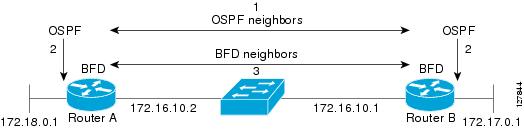
BFD provides fast BFD peer failure detection times independently of all media types, encapsulations, topologies, and routing protocols BGP, EIGRP, IS-IS, and OSPF. By sending rapid failure detection notices to the routing protocols in the local router to initiate the routing table recalculation process, BFD contributes to greatly reduced overall network convergence time. The figure below shows a simple network with two routers running OSPF and BFD. When OSPF discovers a neighbor (1) it sends a request to the local BFD process to initiate a BFD neighbor session with the OSPF neighbor router (2). The BFD neighbor session with the OSPF neighbor router is established (3).
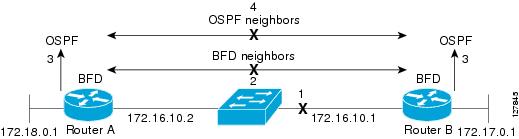
The figure below shows what happens when a failure occurs in the network (1). The BFD neighbor session with the OSPF neighbor router is torn down (2). BFD notifies the local OSPF process that the BFD neighbor is no longer reachable (3). The local OSPF process tears down the OSPF neighbor relationship (4). If an alternative path is available, the routers will immediately start converging on it.
A routing protocol needs to register with BFD for every neighbor it acquires. Once a neighbor is registered, BFD initiates a session with the neighbor if a session does not already exist.
OSPF registers with BFD when:
A neighbor finite state machine (FSM) transitions to full state.
Both OSPF BFD and BFD are enabled.
On broadcast interfaces, OSPF establishes a BFD session only with the designated router (DR) and backup designated router (BDR), but not between any two routers in DROTHER state.
BFD Detection of Failures
Once a BFD session has been established and timer negations are complete, BFD peers send BFD control packets that act in the same manner as an IGP hello protocol to detect liveliness, except at a more accelerated rate. The following information should be noted:
BFD is a forwarding path failure detection protocol. BFD detects a failure, but the routing protocol must take action to bypass a failed peer.
Typically, BFD can be used at any protocol layer. However, the Cisco implementation of BFD for Cisco IOS Releases 12.0(31)S, and 12.4(4)T supports only Layer 3 clients, in particular, the BGP, EIGRP, IS-IS, and OSPF routing protocols. For Cisco IOS Release 12.2(33)SRC, BFD is supported for static routing.
The Cisco implementation of BFD for Cisco IOS Release 12.2(18)SXE also supports only Layer 3 clients and the EIGRP, IS-IS, and OSPF routing protocols. It does not support the BGP routing protocol.
Cisco devices will use one BFD session for multiple client protocols in the Cisco implementation of BFD for Cisco IOS Releases 12.2(18)SXE, 12.0(31)S, and 12.4(4)T. For example, if a network is running OSPF and EIGRP across the same link to the same peer, only one BFD session will be established, and BFD will share session information with both routing protocols.
BFD Version Interoperability
Cisco IOS Release 12.4(9)T supports BFD Version 1 as well as BFD Version 0. All BFD sessions come up as Version 1 by default and will be interoperable with Version 0. The system automatically performs BFD version detection, and BFD sessions between neighbors will run in the highest common BFD version between neighbors. For example, if one BFD neighbor is running BFD Version 0 and the other BFD neighbor is running Version 1, the session will run BFD Version 0. The output from the
showbfdneighbors [details] command will verify which BFD version a BFD neighbor is running.
See the Example Configuring BFD in an EIGRP Network with Echo Mode Enabled by Default for an example of BFD version detection.
BFD Support on Cisco 12000 Routers
The Cisco 12000 series routers support distributed BFD to take advantage of its distributed Route Processor (RP) and line card (LC) architecture. The BFD tasks will be divided and assigned to the BFD process on the RP and LC, as described in the following sections:
The BFD process on the RP will handle the interaction with clients, which create and delete BFD sessions.
Session Management for the BFD Process on the RP
The BFD RP process will primarily own all BFD sessions on the router. It will pass the session creation and deletion requests to the BFD processes on all LCs. BFD LC sessions will have no knowledge of sessions being added or deleted by the clients. Only the BFD RP process will send session addition and deletion commands to the BFD LC process.
Session Database Management
The BFD RP process will maintain a database of all the BFD sessions on the router. This database will contain only the minimum required information.
Process EXEC Commands
The BFD RP process services the BFD show commands.
BFD Process on the LC
Session Management for the BFD Process on the LC
The BFD LC process manages sessions, adds and deletes commands from the BFD RP process, and creates and deletes new sessions based on the commands. In the event of transmit failure, receive failure, or session-down detection, the LC BFD instance will immediately notify the BFD RP process. It will also update transmit and receive counters. The BFD session is maintained completely on the LC. BFD control packets are received and processed, as well as sent, from the LC itself.
Session Database Management
The BFD LC process maintains a database of all the BFD sessions hosted on the LC.
Receive and Transmit
The BFD LC process is responsible for transmitting and receiving BFD packets for the sessions on the LC.
BFD Session Limits
In Cisco IOS Release 12.2(33)SRC, the number of BFD sessions that can be created has been increased to 128.
BFD Support for Nonbroadcast Media Interfaces
In Cisco IOS Release 12.2(33)SRC, the BFD feature is supported on nonbroadcast media interfaces including ATM, POS, serial, and VLAN interfaces. BFD support also extends to ATM, Frame Relay (FR), POS, and serial subinterfaces.
The bfdinterval command must be configured on the interface to initiate BFD monitoring.
BFD Support for VPN Routing and Forwarding Interfaces
The BFD feature is extended in Cisco IOS Release 12.2(33)SRC to be VPN Routing and Forwarding (VRF) aware to provide fast detection of routing protocol failures between provider edge (PE) and customer edge (CE) routers.
BFD Support for Nonstop Forwarding with Stateful Switchover
Typically, when a networking device restarts, all routing peers of that device detect that the device went down and then came back up. This transition results in a routing flap, which could spread across multiple routing domains. Routing flaps caused by routing restarts create routing instabilities, which are detrimental to the overall network performance. Nonstop forwarding (NSF) helps to suppress routing flaps in devices that are enabled with stateful switchover (SSO), thereby reducing network instability.
NSF allows for the forwarding of data packets to continue along known routes while the routing protocol information is being restored after a switchover. With NSF, peer networking devices do not experience routing flaps. Data traffic is forwarded through intelligent line cards or dual forwarding processors while the standby RP assumes control from the failed active RP during a switchover. The ability of line cards and forwarding processors to remain up through a switchover and to be kept current with the Forwarding Information Base (FIB) on the active RP is key to NSF operation.
In devices that support dual RPs, SSO establishes one of the RPs as the active processor; the other RP is designated as the standby processor, and then synchronizes information between them. A switchover from the active to the standby processor occurs when the active RP fails, when it is removed from the networking device, or when it is manually taken down for maintenance.
In Cisco IOS Release 12.2(33)SRC, BFD sessions are placed in an “Admin Down” state during a planned switchover. The BFD configuration is synched from the active to standby processor, and all BFD clients re-register with the BFD process on the standby processor.
In Cisco IOS Release 12.2(33)SB, BFD is not SSO-aware, and it is not supported with NSF/SSO. These features should not be used together. Enabling BFD along with NSF/SSO causes the nonstop forwarding capability to break during failover because BFD adjacencies are not maintained and the routing clients are forced to mark down adjacencies and reconverge.
BFD Support for Stateful Switchover
The BFD protocol provides short-duration detection of failures in the path between adjacent forwarding engines. In network deployments that use dual RP routers or switches (to provide redundancy), the routers have a graceful restart mechanism that protects the forwarding state during a switchover between the active RP and the standby RP.
The dual RPs have variable switchover times that depend on the ability of the hardware to detect a communication failure. When BFD is running on the RP, some platforms are not able to detect a switchover before the BFD protocol times out; these platforms are referred to as slow switchover platforms.
To ensure a successful switchover to the standby RP, the BFD protocol uses checkpoint messages to send session information from the active RP Cisco IOS instance to the standby RP Cisco IOS instance. The session information includes local and remote discriminators, adjacent router timer information, BFD setup information, and session-specific information such as the type of session and the session version. In addition, the BFD protocol sends session creation and deletion checkpoint messages to create or delete a session on the standby RP.
The BFD sessions on the standby RP do not receive or send packets and do not process expired timers. These sessions wait for a switchover to occur and then send packets for any active sessions so that sessions do not time out on adjacent routers.
When the BFD protocol on the standby RP is notified of a switchover it changes its state to active, registers itself with Cisco Express Forwarding so that it can receive packets, and then sends packets for any elements that have expired.
BFD also uses checkpoint messages to ensure that sessions created by clients on the active RP are maintained during a switchover. When a switchover occurs, BFD starts an SSO reclaim timer. Clients must reclaim their sessions within the duration specified by the reclaim timer or else the session is deleted.
Timer values are different based on the number of BFD sessions and the platform.
The table below describes the timer values on Cisco 7600 series routers.
Table 1 BFD Timer Values on a Cisco 7600 Series Router
Maximum Number of BFD Sessions
Chassis Type
BFD Session Type
Minimum Timer Value (ms)
Clients
Comments
128
S-chassis
Async/echo
500 multiplier 3
All
--
512
S-chassis
Async/echo
999 multiplier 3
All
--
128
Non-S-chassis
Async
999 multiplier 5
All
--
128
Non-S-chassis
DFC line card
Echo
999 multiplier 3
All
BFD slow timers configured to 5000
512
Non-S-Chassis
Async/echo
999 multiplier 5
All
--
Note
The BFD SSO feature is supported on Cisco 7600 series routers in Cisco IOS Release 12.2(33)SRE and later releases.
Note
For hardware offload to ES+ line cards on Cisco 7600 series routers in Cisco IOS Release 15.1(2)S, the Tx interval on both BFD peers must be configured in multiples of 50 ms. See the “Configuring Synchronous Ethernet on the Cisco 7600 Router with ES+ Line Card” section of the
Cisco 7600 Series Ethernet Services Plus (ES+) and Ethernet Services Plus T (ES+T) Line Card Configuration Guide
for more information about prerequisites for hardware offload.
The table below describes the timer values on Cisco ASR 1000 Series Aggregation Services Routers.
Table 2 BFD Timer Values on a Cisco ASR 1000 Series Aggregation Services Router
Maximum Number of BFD Sessions
Chassis Type
BFD Session Type
Minimum Timer Value (ms)
Clients
Comments
128
All
Async/echo
50 multiplier 3
All
--
512
All
Async/echo
999 multiplier 3
All
--
Note
The BFD SSO feature is supported on Cisco ASR 1000 Series Aggregation Services Routers in Cisco IOS Release 12.2(33)XNA and later releases.
The table below describes the timer values on Cisco 6500 series routers.
Table 3 BFD Timer Values on a Cisco 6500 Series Router
Maximum Number of BFD Sessions
Chassis Type
BFD Session Type
Minimum Timer Value (ms)
Clients
Comments
50
E-chassis/ 67xx line cards
Async/Echo
500 multiplier 3
All (except EIGRP)
CFC line cards are not supported
30
E-chassis/ 67xx line cards
Async/Echo
500 multiplier 3
EIGRP
CFC line cards are not supported
Note
The BFD SSO feature is supported on Cisco 6500 series routers in Cisco IOS Release 12.2(33)SXI2 and later releases.
The table below describes the timer values on a Cisco 10000 series routers.
Table 4 BFD Timer Values on a Cisco 10000 Series Router
Maximum Number of BFD Sessions
Chassis Type
BFD Session Type
Minimum Timer Value (ms)
Clients
Comments
1100
PRE3/PRE4
Async/echo
999 multiplier 5
All
--
Note
The BFD SSO feature is supported on Cisco 10000 series routers in Cisco IOS Release 12.2(33)XNE and later releases.
BFD Support for Static Routing
Unlike dynamic routing protocols, such as OSPF and BGP, static routing has no method of peer discovery. Therefore, when BFD is configured, the reachability of the gateway is completely dependent on the state of the BFD session to the specified neighbor. Unless the BFD session is up, the gateway for the static route is considered unreachable, and therefore the affected routes will not be installed in the appropriate Routing Information Base (RIB).
For a BFD session to be successfully established, BFD must be configured on the interface on the peer and there must be a BFD client registered on the peer for the address of the BFD neighbor. When an interface is used by dynamic routing protocols, the latter requirement is usually met by configuring the routing protocol instances on each neighbor for BFD. When an interface is used exclusively for static routing, this requirement must be met by configuring static routes on the peers.
If a BFD configuration is removed from the remote peer while the BFD session is in the up state, the updated state of the BFD session is not signaled to IPv4 static. This will cause the static route to remain in the RIB. The only workaround is to remove the IPv4 static BFD neighbor configuration so that the static route no longer tracks BFD session state. Also, if you change the encapsulation type on a serial interface to one that is unsupported by BFD, BFD will be in a down state on that interface. The workaround is to shut down the interface, change to a supported encapsulation type, and then reconfigure BFD.
A single BFD session can be used by an IPv4 static client to track the reachability of next hops through a specific interface. You can assign a BFD group for a set of BFD-tracked static routes. Each group must have one active static BFD configuration, one or more passive BFD configurations, and the corresponding static routes to be BFD-tracked. Nongroup entries are BFD-tracked static routes for which a BFD group is not assigned. A BFD group must accommodate static BFD configurations that can be part of different VRFs. Effectively, the passive static BFD configurations need not be in the same VRF as that of the active configuration.
For each BFD group, there can be only one active static BFD session. You can configure the active BFD session by adding a static BFD configuration and a corresponding static route that uses the BFD configuration. The BFD session in a group is created only when there is an active static BFD configuration and the static route that uses the static BFD configuration. When the active static BFD configuration or the active static route is removed from a BFD group, all the passive static routes are withdrawn from the RIB. Effectively, all the passive static routes are inactive until an active static BFD configuration and a static route to be tracked by the active BFD session are configured in the group.
Similarly, for each BFD group, there can be one or more passive static BFD configurations and their corresponding static routes to be BFD-tracked. Passive static session routes take effect only when the active BFD session state is reachable. Though the active BFD session state of the group is reachable, the passive static route is added to the RIB only if the corresponding interface state is up. When a passive BFD session is removed from a group, it will not affect the active BFD session if one existed, or the BFD group reachability status.
BFD Control Channel over VCCV Support for ATM Pseudowire
Multiprotocol Label Switching (MPLS) pseudowires enable L2 traffic to
be carried over an IP/MPLS core network. The BFD control channel over
VCCV--Support for ATM Pseudowires feature provides operations and management
(OAM) functions for MPLS pseudowires.
Note
This feature provides support for VCCV type 1 only. VCCV Type 1 is
in-band VCCV and can be used only for MPLS pseudowires that use a control word.
The BFD detection protocol can be used to provide OAM functionality to
the MPLS protocol. VCCV provides a control channel associated with the
pseudowire to provide OAM functions over that pseudowire. BFD can use the VCCV
control channel as a pseudowire fault mechanism to detect dataplane failures.
BFD can also use the VCCV control channel to carry the fault status of an
attachment circuit (AC).
MPLS pseudowires can dynamically signal or statically configure virtual
circuit (VC) labels. In dynamically signaled pseudowires, the control channel
(CC) types and connection verification (CV) types are also signaled. In
statically configured pseudowires, the CC and CV types must be configured on
both ends of the pseudowire.
The CC types define whether VCCV packets are in-band or out-of-band for
the pseudowire. The CV types define whether BFD monitoring is required for the
pseudowire. If BFD monitoring is required for the pseudowire, the CV types also
define how the BFD packets are encapsulated and whether BFD provides status
signaling functionality.
Any protocol that requires BFD monitoring must register with BFD as a
client. For example, the Xconnect protocol registers as a BFD client, and BFD
assigns a client ID to Xconnect. Xconnect uses this client ID to create the BFD
sessions that monitor the pseudowire.
BFD can detect forwarding failures (end-to-end) in the pseudowire path.
When BFD detects a failure in the pseudowire forwarding path it notifies the
Xconnect client that created the session. In addition, BFD can signal the
status in any concatenated path, or AC, to the remote device where the BFD
session is terminated.
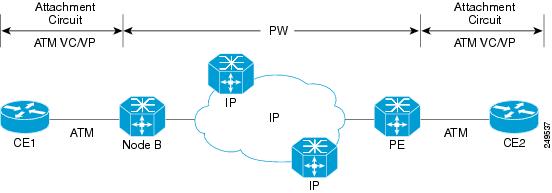
The figure below shows a dynamically signaled MPLS pseudowire carrying
an ATM payload. In this example, BFD monitoring of the pseudowire occurs from
the Node B device to the PE device. BFD also monitors the signal status of the
ACs between the PE and CE2 device, and between the Node B and CE1 device.
BFD on Multiple Hops
Cisco IOS Release 15.1(3)S and later releases support BFD on arbitrary paths, which might span multiple network hops. The BFD Multihop feature provides subsecond forwarding failure detection for a destination more than one hop, and up to 255 hops, away.
A BFD multihop session is set up between a unique source-destination address pair provided by the client. A session can be set up between two endpoints that have IP connectivity.
You must configure the
bfd-template and
bfd map commands to create a multihop template and associate it with one or more maps of destinations and associated BFD timers. You can enable authentication and configure a key chain for BFD multihop sessions.
Benefits of Using BFD for Failure Detection
When you deploy any feature, it is important to consider all the alternatives and be aware of any trade-offs being made.
The closest alternative to BFD in conventional EIGRP, IS-IS, and OSPF deployments is the use of modified failure detection mechanisms for EIGRP, IS-IS, and OSPF routing protocols.
If you set EIGRP hello and hold timers to their absolute minimums, the failure detection rate for EIGRP falls to within a one- to two-second range.
If you use fast hellos for either IS-IS or OSPF, these Interior Gateway Protocol (IGP) protocols reduce their failure detection mechanisms to a minimum of one second.
There are several advantages to implementing BFD over reduced timer mechanisms for routing protocols:
Although reducing the EIGRP, IS-IS, and OSPF timers can result in minimum detection timer of one to two seconds, BFD can provide failure detection in less than one second.
Because BFD is not tied to any particular routing protocol, it can be used as a generic and consistent failure detection mechanism for EIGRP, IS-IS, and OSPF.
Because some parts of BFD can be distributed to the data plane, it can be less CPU-intensive than the reduced EIGRP, IS-IS, and OSPF timers, which exist wholly at the control plane.
How to Configure Bidirectional Forwarding Detection
Configuring BFD Session Parameters on the Interface
The steps in this procedure show how to configure BFD on the interface by setting the baseline BFD session parameters on an interface. Repeat the steps in this procedure for each interface over which you want to run BFD sessions to BFD neighbors.
Exits interface configuration mode and returns to privileged EXEC mode.
Configuring BFD Support for Dynamic Routing Protocols
You can enable BFD support for dynamic routing protocols at the router level to enable BFD support globally for all interfaces or you can configure BFD on a per-interface basis at the interface level.
For Cisco IOS Release 12.2(18)SXE, you may configure BFD support for one or more of the following routing protocols: EIGRP, IS-IS, and OSPF.
For Cisco IOS Releases 12.2(33)SRA, you may configure BFD support for one or more of the following routing protocols: EIGRP, IS-IS, and OSPF.
For Cisco IOS Releases 12.2(33)SRB, you may configure BFD support for one or more of the following routing protocols: BGP, EIGRP, IS-IS, and OSPF.
For Cisco IOS Release 12.2(33)SRC, you may configure BFD support for static routing.
For Cisco IOS Releases 12.0(31)S and 12.4(4)T, you may configure BFD support for one or more of the following routing protocols: BGP, IS-IS, and OSPF.
For Cisco IOS Release 12.0(32)S, for the Cisco 10720 platform, you may configure BFD for one or more of the following routing protocols: BGP, IS-IS, and OSPF.
For Cisco IOS Release 12.4(11)T, BFD support for HSRP was introduced.
This section describes the procedure for configuring BFD support for BGP so that BGP is a registered protocol with BFD and will receive forwarding path detection failure messages from BFD.
Before You Begin
BGP must be running on all participating routers.
The baseline parameters for BFD sessions on the interfaces over which you want to run BFD sessions to BFD neighbors must be configured. See the Configuring BFD Session Parameters on the Interface section for more information.
Note
Output from the
showbfdneighborsdetails command shows the configured intervals. The output does not show intervals that were changed because hardware-offloaded BFD sessions were configured with Tx and Rx intervals that are not multiples of 50 ms.
SUMMARY STEPS
1.enable
2.configureterminal
3.routerbgpas-tag
4.neighborip-addressfall-overbfd
5.end
6.showbfdneighbors[details]
7.showipbgpneighbor
DETAILED STEPS
Command or Action
Purpose
Step 1
enable
Example:
Router> enable
Enables privileged EXEC mode.
Enter your password if prompted.
Step 2
configureterminal
Example:
Router# configure terminal
Enters global configuration mode.
Step 3
routerbgpas-tag
Example:
Router(config)# router bgp tag1
Specifies a BGP process and enters router configuration mode.
Exits router configuration mode and returns the router to privileged EXEC mode.
Step 6
showbfdneighbors[details]
Example:
Router# show bfd neighbors detail
(Optional) Verifies that the BFD neighbor is active and displays the routing protocols that BFD has registered.
Note
In order to display the full output of the
showbfdneighborsdetails command on a Cisco 12000 series router, you must enter the command on the line card. Enter the
attachslot-number command to establish a CLI session with a line card. The registered protocols are not shown in the output of the
showbfdneighborsdetails command when it is entered on a line card.
Note
If hardware-offloaded BFD sessions are configured with Tx and Rx intervals that are not multiples of 50 ms, the hardware intervals are changed. However, output from the
showbfdneighborsdetails command will show the configured intervals, not the changed ones.
Step 7
showipbgpneighbor
Example:
Router# show ip bgp neighbor
(Optional) Displays information about BGP and TCP connections to neighbors.
What to Do Next
See the Monitoring and Troubleshooting BFD section for more information on monitoring and troubleshooting BFD. If you want to configure BFD support for another routing protocol, see the following sections.
Configuring BFD Support for EIGRP
This section describes the procedure for configuring BFD support for EIGRP so that EIGRP is a registered protocol with BFD and will receive forwarding path detection failure messages from BFD. There are two methods for enabling BFD support for EIGRP:
You can enable BFD for all of the interfaces for which EIGRP is routing by using the
bfdall-interfaces command in router configuration mode.
You can enable BFD for a subset of the interfaces for which EIGRP is routing by using the
bfdinterfacetypenumber command in router configuration mode.
Before You Begin
EIGRP must be running on all participating routers.
The baseline parameters for BFD sessions on the interfaces over which you want to run BFD sessions to BFD neighbors must be configured. See the Configuring BFD Session Parameters on the Interface section for more information.
Note
Output from the
showbfdneighborsdetails command shows the configured intervals. The output does not show intervals that were changed because hardware-offloaded BFD sessions were configured with Tx and Rx intervals that are not multiples of 50 ms.
Note
BFD for EIGRP is not supported on the Cisco 12000 series routers for Cisco IOS Releases 12.0(31)S, 12.0(32)S, 12.4(4)T, and 12.2(33)SRA.
Enables BFD globally on all interfaces associated with the EIGRP routing process.
or
Enables BFD on a per-interface basis for one or more interfaces associated with the EIGRP routing process.
Step 5
end
Example:
Router(config-router) end
Exits router configuration mode and returns the router to privileged EXEC mode.
Step 6
showbfdneighbors[details]
Example:
Router# show bfd neighbors details
(Optional) Verifies that the BFD neighbor is active and displays the routing protocols that BFD has registered.
Note
In order to see the full output of the
showbfdneighborsdetails command on a Cisco 12000 series router, you must enter the command on the line card. Enter the
attachslot-number command to establish a CLI session with a line card. The registered protocols are not shown in the output of the
showbfdneighborsdetails command when it is entered on a line card.
Note
If hardware-offloaded BFD sessions are configured with Tx and Rx intervals that are not multiples of 50 ms, the hardware intervals are changed. However, output from the
showbfdneighborsdetails command will show the configured intervals, not the changed ones.
(Optional) Displays the interfaces for which BFD support for EIGRP has been enabled.
What to Do Next
See the Monitoring andTroubleshooting BFD section for more information on monitoring and troubleshooting BFD. If you want to configure BFD support for another routing protocol, see the following sections.
Configuring BFD Support for IS-IS
This section describes the procedures for configuring BFD support for IS-IS so that IS-IS is a registered protocol with BFD and will receive forwarding path detection failure messages from BFD. There are two methods for enabling BFD support for IS-IS:
You can enable BFD for all of the interfaces on which IS-IS is supporting IPv4 routing by using the bfdall-interfaces command in router configuration mode. You can then disable BFD for one or more of those interfaces using the isisbfddisable command in interface configuration mode.
You can enable BFD for a subset of the interfaces for which IS-IS is routing by using the isisbfd command in interface configuration mode.
To configure BFD support for IS-IS, perform the steps in one of the following sections:
IS-IS must be running on all participating routers.
The baseline parameters for BFD sessions on the interfaces that you want to run BFD sessions to BFD neighbors over must be configured. See the Configuring BFD Session Parameters on the Interface section for more information.
Note
Output from the
showbfdneighborsdetails command shows the configured intervals. The output does not show intervals that were changed because hardware-offloaded BFD sessions were configured with Tx and Rx intervals that are not multiples of 50 ms.
Configuring BFD Support for IS-IS for All Interfaces
To configure BFD on all IS-IS interfaces that support IPv4 routing, perform the steps in this section.
SUMMARY STEPS
1.enable
2.configureterminal
3.routerisisarea-tag
4.bfdall-interfaces
5.exit
6.interfacetypenumber
7.iprouterisis [tag]
8.isisbfd[disable]
9.end
10.showbfdneighbors[details]
11.showclnsinterface
DETAILED STEPS
Command or Action
Purpose
Step 1
enable
Example:
Router> enable
Enables privileged EXEC mode.
Enter your password if prompted.
Step 2
configureterminal
Example:
Router# configure terminal
Enters global configuration mode.
Step 3
routerisisarea-tag
Example:
Router(config)# router isis tag1
Specifies an IS-IS process and enters router configuration mode.
Step 4
bfdall-interfaces
Example:
Router(config-router)# bfd all-interfaces
Enables BFD globally on all interfaces associated with the IS-IS routing process.
Step 5
exit
Example:
Router(config-router)# exit
(Optional) Returns the router to global configuration mode.
Step 6
interfacetypenumber
Example:
Router(config)# interface fastethernet 6/0
(Optional) Enters interface configuration mode.
Step 7
iprouterisis [tag]
Example:
Router(config-if)# ip router isis tag1
(Optional) Enables support for IPv4 routing on the interface.
Step 8
isisbfd[disable]
Example:
Router(config-if)# isis bfd
(Optional) Enables or disables BFD on a per-interface basis for one or more interfaces associated with the IS-IS routing process.
Note
You should use the
disable keyword only if you enabled BFD on all of the interfaces that IS-IS is associated with using the
bfdall-interfaces command in router configuration mode.
Step 9
end
Example:
Router(config-if)# end
Exits interface configuration mode and returns the router to privileged EXEC mode.
Step 10
showbfdneighbors[details]
Example:
Router# show bfd neighbors details
(Optional) Displays information that can be used to verify if the BFD neighbor is active and displays the routing protocols that BFD has registered.
Note
In order to display the full output of the
showbfdneighborsdetails command on a Cisco 12000 series router, you must enter the command on the line card. Enter the
attachslot-number command to establish a CLI session with a line card. The registered protocols are not shown in the output of the
showbfdneighborsdetails command when it is entered on a line card.
Note
If hardware-offloaded BFD sessions are configured with Tx and Rx intervals that are not multiples of 50 ms, the hardware intervals are changed. However, output from the
showbfdneighborsdetails command will show the configured intervals, not the changed ones.
Step 11
showclnsinterface
Example:
Router# show clns interface
(Optional) Displays information that can be used to verify if BFD for IS-IS has been enabled for a specific IS-IS interface that is associated.
What to Do Next
See the Monitoring and Troubleshooting BFD section for more information on monitoring and troubleshooting BFD. If you want to configure only for a specific subset of interfaces, perform the tasks in the Configuring BFD Support for IS-IS for One or More Interfaces section.
Configuring BFD Support for IS-IS for One or More Interfaces
To configure BFD for only one or more IS-IS interfaces, perform the steps in this section.
Note
Output from the
showbfdneighborsdetails command shows the configured intervals. The output does not show intervals that were changed because hardware-offloaded BFD sessions were configured with Tx and Rx intervals that are not multiples of 50 ms.
SUMMARY STEPS
1.enable
2.configureterminal
3.interfacetypenumber
4.iprouterisis [tag]
5.isisbfd[disable]
6.end
7.showbfdneighbors[details]
8.showclnsinterface
DETAILED STEPS
Command or Action
Purpose
Step 1
enable
Example:
Router> enable
Enables privileged EXEC mode.
Enter your password if prompted.
Step 2
configureterminal
Example:
Router# configure terminal
Enters global configuration mode.
Step 3
interfacetypenumber
Example:
Router(config)# interface fastethernet 6/0
Enters interface configuration mode.
Step 4
iprouterisis [tag]
Example:
Router(config-if)# ip router isis tag1
Enables support for IPv4 routing on the interface.
Step 5
isisbfd[disable]
Example:
Router(config-if)# isis bfd
Enables or disables BFD on a per-interface basis for one or more interfaces associated with the IS-IS routing process.
Note
You should use the
disable keyword only if you enabled BFD on all of the interfaces that IS-IS is associated with using the
bfdall-interfaces command in router configuration mode.
Step 6
end
Example:
Router(config-if)# end
Exits interface configuration mode and returns the router to privileged EXEC mode.
Step 7
showbfdneighbors[details]
Example:
Router# show bfd neighbors details
(Optional) Displays information that can help verify if the BFD neighbor is active and displays the routing protocols that BFD has registered.
Note
In order to display the full output of the
showbfdneighborsdetails command on a Cisco 12000 series router, you must enter the command on the line card. Enter the
attachslot-number command to establish a CLI session with a line card. The registered protocols are not shown in the output of the
showbfdneighborsdetails command when it is entered on a line card.
Note
If hardware-offloaded BFD sessions are configured with Tx and Rx intervals that are not multiples of 50 ms, the hardware intervals are changed. However, output from the
showbfdneighborsdetails command will show the configured intervals, not the changed ones.
Step 8
showclnsinterface
Example:
Router# show clns interface
(Optional) Displays information that can help verify if BFD for IS-IS has been enabled for a specific IS-IS interface that is associated.
What to Do Next
See the Monitoring and Troubleshooting BFD section for more information on monitoring and maintaining BFD. If you want to configure BFD support for another routing protocol, see one of the following sections.
Configuring BFD Support for OSPF
This section describes the procedures for configuring BFD support for OSPF so that OSPF is a registered protocol with BFD and will receive forwarding path detection failure messages from BFD. You can either configure BFD support for OSPF globally on all interfaces or configure it selectively on one or more interfaces.
There are two methods for enabling BFD support for OSPF:
You can enable BFD for all of the interfaces for which OSPF is routing by using the bfdall-interfaces command in router configuration mode. You can disable BFD support on individual interfaces using the ipospfbfd [disable] command in interface configuration mode.
You can enable BFD for a subset of the interfaces for which OSPF is routing by using the ipospfbfd command in interface configuration mode.
See the following sections for tasks for configuring BFD support for OSPF:
Configuring BFD Support for OSPF for All Interfaces
To configure BFD for all OSPF interfaces, perform the steps in this section.
If you do not want to configure BFD on all OSPF interfaces and would rather configure BFD support specifically for one or more interfaces, see the Configuring BFD Support for OSPF for One or More Interfaces section.
Before You Begin
OSPF must be running on all participating routers.
The baseline parameters for BFD sessions on the interfaces over which you want to run BFD sessions to BFD neighbors must be configured. See the Configuring BFD Session Parameters on the Interface section for more information.
Note
Output from the
showbfdneighborsdetails command shows the configured intervals. The output does not show intervals that were changed because hardware-offloaded BFD sessions were configured with Tx and Rx intervals that are not multiples of 50 ms.
SUMMARY STEPS
1.enable
2.configureterminal
3.routerospfprocess-id
4.bfdall-interfaces
5.exit
6.interfacetypenumber
7.ipospfbfd[disable]
8.end
9.showbfdneighbors[details]
10.showipospf
DETAILED STEPS
Command or Action
Purpose
Step 1
enable
Example:
Router> enable
Enables privileged EXEC mode.
Enter your password if prompted.
Step 2
configureterminal
Example:
Router# configure terminal
Enters global configuration mode.
Step 3
routerospfprocess-id
Example:
Router(config)# router ospf 4
Specifies an OSPF process and enters router configuration mode.
Step 4
bfdall-interfaces
Example:
Router(config-router)# bfd all-interfaces
Enables BFD globally on all interfaces associated with the OSPF routing process.
Step 5
exit
Example:
Router(config-router)# exit
(Optional) Returns the router to global configuration mode. Enter this command only if you want to perform Step 7 to disable BFD for one or more interfaces.
Step 6
interfacetypenumber
Example:
Router(config)# interface fastethernet 6/0
(Optional) Enters interface configuration mode. Enter this command only if you want to perform Step 7 to disable BFD for one or more interfaces.
Step 7
ipospfbfd[disable]
Example:
Router(config-if)# ip ospf bfd disable
(Optional) Disables BFD on a per-interface basis for one or more interfaces associated with the OSPF routing process.
Note
You should use the
disable keyword only if you enabled BFD on all of the interfaces that OSPF is associated with using the
bfdall-interfaces command in router configuration mode.
Step 8
end
Example:
Router(config-if)# end
Exits interface configuration mode and returns the router to privileged EXEC mode.
Step 9
showbfdneighbors[details]
Example:
Router# show bfd neighbors detail
(Optional) Displays information that can help verify if the BFD neighbor is active and displays the routing protocols that BFD has registered.
Note
In order to display the full output of the
showbfdneighborsdetails command on a Cisco 12000 series router, you must enter the command on the line card. Enter the
attachslot-number command to establish a CLI session with a line card. The registered protocols are not shown in the output of the
showbfdneighborsdetailscommandwhen it is entered on a line card.
Note
If hardware-offloaded BFD sessions are configured with Tx and Rx intervals that are not multiples of 50 ms, the hardware intervals are changed. However, output from the
showbfdneighborsdetails command will show the configured intervals, not the changed ones.
Step 10
showipospf
Example:
Router# show ip ospf
(Optional) Displays information that can help verify if BFD for OSPF has been enabled.
What to Do Next
See the Monitoring and Troubleshooting BFD section for more information on monitoring and troubleshooting BFD. If you want to configure BFD support for another routing protocol, see the following sections.
Configuring BFD Support for OSPF for One or More Interfaces
To configure BFD on one or more OSPF interfaces, perform the steps in this section.
Before You Begin
OSPF must be running on all participating routers.
The baseline parameters for BFD sessions on the interfaces over which you want to run BFD sessions to BFD neighbors must be configured. See the Configuring BFD Session Parameters on the Interface section for more information.
Note
Output from the
showbfdneighborsdetails command shows the configured intervals. The output does not show intervals that were changed because hardware-offloaded BFD sessions were configured with Tx and Rx intervals that are not multiples of 50 ms.
SUMMARY STEPS
1.enable
2.configureterminal
3.interfacetypenumber
4.ipospfbfd[disable]
5.end
6.showbfdneighbors[details]
7.showipospf
DETAILED STEPS
Command or Action
Purpose
Step 1
enable
Example:
Router> enable
Enables privileged EXEC mode.
Enter your password if prompted.
Step 2
configureterminal
Example:
Router# configure terminal
Enters global configuration mode.
Step 3
interfacetypenumber
Example:
Router(config)# interface fastethernet 6/0
Enters interface configuration mode.
Step 4
ipospfbfd[disable]
Example:
Router(config-if)# ip ospf bfd
Enables or disables BFD on a per-interface basis for one or more interfaces associated with the OSPF routing process.
Note
You should use the
disable keyword only if you enabled BFD on all of the interfaces that OSPF is associated with using the
bfdall-interfaces command in router configuration mode.
Step 5
end
Example:
Router(config-if)# end
Exits interface configuration mode and returns the router to privileged EXEC mode.
Step 6
showbfdneighbors[details]
Example:
Router# show bfd neighbors details
(Optional) Displays information that can help verify if the BFD neighbor is active and displays the routing protocols that BFD has registered.
Note
In order to display the full output of the
showbfdneighborsdetails command on a Cisco 12000 series router, you must enter the command on the line card. Enter the
attachslot-number command to establish a CLI session with a line card. The registered protocols are not shown in the output of the
showbfdneighborsdetails command when it is entered on a line card.
Note
If hardware-offloaded BFD sessions are configured with Tx and Rx intervals that are not multiples of 50 ms, the hardware intervals are changed. However, output from the
showbfdneighborsdetails command will show the configured intervals, not the changed ones.
Step 7
showipospf
Example:
Router# show ip ospf
(Optional) Displays information that can help verify if BFD support for OSPF has been enabled.
What to Do Next
See the Monitoring and Troubleshooting BFD section for more information on monitoring and troubleshooting BFD. If you want to configure BFD support for another routing protocol, see the following sections.
Configuring BFD Support for HSRP
Perform this task to enable BFD support for Hot Standby Router Protocol (HSRP.) Repeat the steps in this procedure for each interface over which you want to run BFD sessions to HSRP peers.
HSRP supports BFD by default. If HSRP support for BFD has been manually disabled, you can reenable it at the router level to enable BFD support globally for all interfaces or on a per-interface basis at the interface level.
Before You Begin
HSRP must be running on all participating routers.
Cisco Express Forwarding must be enabled.
SUMMARY STEPS
1.enable
2.configureterminal
3.ipcef[distributed]
4.interfacetypenumber
5.ipaddressip-addressmask
6.standby [group-number] ip [ip-address [secondary]]
7.standbybfd
8.exit
9.standbybfdall-interfaces
10.exit
11.showstandbyneighbors
DETAILED STEPS
Command or Action
Purpose
Step 1
enable
Example:
Router> enable
Enables privileged EXEC mode.
Enter your password if prompted.
Step 2
configureterminal
Example:
Router# configure terminal
Enters global configuration mode.
Step 3
ipcef[distributed]
Example:
Router(config)# ip cef
Enables Cisco Express Forwarding or distributed Cisco Express Forwarding.
Step 4
interfacetypenumber
Example:
Router(config)# interface FastEthernet 6/0
Enters interface configuration mode.
Step 5
ipaddressip-addressmask
Example:
Router(config-if)# ip address 10.0.0.11 255.255.255.0
Configures an IP address for the interface.
Step 6
standby [group-number] ip [ip-address [secondary]]
Example:
Router(config-if)# standby 1 ip 10.0.0.11
Activates HSRP.
Step 7
standbybfd
Example:
Router(config-if)# standby bfd
(Optional) Enables HSRP support for BFD on the interface.
Step 8
exit
Example:
Router(config-if)# exit
Exits interface configuration mode.
Step 9
standbybfdall-interfaces
Example:
Router(config)# standby bfd all-interfaces
(Optional) Enables HSRP support for BFD on all interfaces.
Step 10
exit
Example:
Router(config)# exit
Exits global configuration mode.
Step 11
showstandbyneighbors
Example:
Router# show standby neighbors
(Optional) Displays information about HSRP support for BFD.
What to Do Next
See the Monitoring and Troubleshooting BFD section for more information on monitoring and troubleshooting BFD. If you want to configure BFD support for another routing protocol, see the following sections.
Configuring BFD Support for Static Routing
Perform this task to configure BFD support for static routing. Repeat the steps in this procedure on each BFD neighbor. For more information, see the "Example: Configuring BFD Support for Static Routing" section.
(Optional) Displays information about the static BFD configuration from the configured BFD groups and nongroup entries.
Step 12
exit
Example:
Router# exit
Exits privileged EXEC mode and returns to user EXEC mode.
Configuring BFD Echo Mode
BFD echo mode is enabled by default, but you can disable it such that it can run independently in each direction.
BFD echo mode works with asynchronous BFD. Echo packets are sent by the forwarding engine and forwarded back along the same path in order to perform detection--the BFD session at the other end does not participate in the actual forwarding of the echo packets. The echo function and the forwarding engine are responsible for the detection process; therefore, the number of BFD control packets that are sent out between two BFD neighbors is reduced. In addition, because the forwarding engine is testing the forwarding path on the remote (neighbor) system without involving the remote system, there is an opportunity to improve the interpacket delay variance, thereby achieving quicker failure detection times than when using BFD Version 0 with BFD control packets for the BFD session.
Echo mode is described as without asymmetry when it is running on both sides (both BFD neighbors are running echo mode).
Before using BFD echo mode, you must disable the sending of Internet Control Message Protocol (ICMP) redirect messages by entering the
noipredirects command, in order to avoid high CPU utilization.
The baseline parameters for BFD sessions on the interfaces over which you want to run BFD sessions to BFD neighbors must be configured. See the Configuring BFD Session Parameters on the Interface section for more information.
Restrictions
BFD echo mode, which is supported in BFD Version 1, is available only in Cisco IOS Releases 12.4(9), and 12.2(33)SRA.
Note
BFD echo mode does not work in conjunction with Unicast Reverse Path Forwarding (uRPF) configuration. If BFD echo mode and uRPF configurations are enabled, then the sessions will flap.
Configuring the BFD Slow Timer
The steps in this procedure show how to change the value of the BFD slow timer. Repeat the steps in this procedure for each BFD router.
SUMMARY STEPS
1.enable
2.configureterminal
3.bfdslow-timermilliseconds
4.end
DETAILED STEPS
Command or Action
Purpose
Step 1
enable
Example:
Router> enable
Enables privileged EXEC mode.
Enter your password if prompted.
Step 2
configureterminal
Example:
Router# configure terminal
Enters global configuration mode.
Step 3
bfdslow-timermilliseconds
Example:
Router(config)# bfd slow-timer 12000
Configures the BFD slow timer.
Step 4
end
Example:
Router(config)# end
Exits global configuration mode and returns the router to privileged EXEC mode.
Disabling BFD Echo Mode Without Asymmetry
The steps in this procedure show how to disable BFD echo mode without asymmetry—no echo packets will be sent by the router, and the router will not forward BFD echo packets that are received from any neighbor routers.
Repeat the steps in this procedure for each BFD router.
SUMMARY STEPS
1.enable
2.configureterminal
3.nobfdecho
4.end
DETAILED STEPS
Command or Action
Purpose
Step 1
enable
Example:
Router> enable
Enables privileged EXEC mode.
Enter your password if prompted.
Step 2
configureterminal
Example:
Router# configure terminal
Enters global configuration mode.
Step 3
nobfdecho
Example:
Router(config)# no bfd echo
Disables BFD echo mode.
Use the
no form to disable BFD echo mode.
Step 4
end
Example:
Router(config)# end
Exits global configuration mode and returns to privileged EXEC mode.
Creating and Configuring BFD Templates
You can configure a single-hop template to specify a set of BFD interval values. BFD interval values specified as part of the BFD template are not specific to a single interface. You can configure a multihop template to associate these values with one or more maps of destinations and associated BFD timers. You can enable authentication and configure a key chain for BFD multihop sessions.
Perform this task to create a BFD single-hop template and configure BFD interval timers.
Note
Cisco IOS Release 15.0(1)S introduced the concept of BFD templates that allow BFD interval timers to be configured independently of an interface. BFD templates are required to provide support for the BFD Control Channel over VCCV-Support for ATM Pseudowires feature.
Configures the transmit and receive intervals between BFD packets, and specifies the number of consecutive BFD control packets that must be missed before BFD declares that a peer is unavailable.
Step 5
end
Example:
Router(bfd-config)# end
Exits BFD configuration mode and returns the router to privileged EXEC mode.
Configuring a Multihop Template
Perform this task to create a BFD multohop template and configure BFD interval timers, authentication, and key chain.
Note
Cisco IOS Release 15.1(3)S and later releases support BFD on multiple network hops. After you have configured interval timers and authentication in a template, you can configure a map to associate the template with unique source-destination address pairs for multihop BFD sessions.
Note
See “Xconnect as a Client of BFD” for information on configuring xconnect as a client of BFD and detecting failure with the
monitor peer bfd command.
Configures the transmit and receive intervals between BFD packets, and specifies the number of consecutive BFD control packets that must be missed before BFD declares that a peer is unavailable.
Configures authentication for the multihop template and specifies the authentication type.
Step 6
end
Example:
Router(bfd-config)# end
Exits BFD configuration mode and returns the router to privileged EXEC mode.
What to Do Next
The BFD templates that you create can be applied to pseudowire classes to enable BFD control channel over VCCV on ATM pseudowire networks. For more information, see the Configuring BFD Control Channel over VCCV Support for ATM Pseudowire section.
Configuring a BFD Map
Perform this task to configure a BFD map that associates the interval timers and authentication configured in a template with unique source-destination address pairs for multihop BFD sessions.
Before You Begin
You must configure a BFD multihop template before you associate it with a map.
Configures a BFD map and associates it with the template.
Step 4
end
Example:
Router(config)# end
Exits BFD configuration mode and returns the router to privileged EXEC mode.
Configuring BFD Control Channel over VCCV Support for ATM Pseudowire
Perform this task to configure BFD over VCCV Support for ATM Pseudowire networks.
Before You Begin
You must create and configure the BFD template before you assign it to the pseudowire class. For more information, see the Creating and Configuring BFD Templates section.
Before VCCV BFD can be run on pseudowires, pseudowires must be configured on the network.
Binds an attachment circuit to a pseudowire, configures an AToM static pseudowire, and specifies the pseudowire class.
Step 14
end
Example:
Router(cfg-if-atm-l2trans-pvc)# end
Exits ATM virtual circuit configuration mode and returns to global configuration mode.
Monitoring and Troubleshooting BFD
This section describes how to retrieve BFD information for maintenance and troubleshooting. The commands in these tasks can be entered as needed, in any order desired.
For more information about BFD session initiation and failure, refer to the BFD Operation.
This section contains information for monitoring and troubleshooting BFD for the following Cisco platforms:
Monitoring and Troubleshooting BFD for Cisco 7600 Series Routers
To monitor or troubleshoot BFD on Cisco 7600 series routers, perform one or more of the steps in this section.
Note
See the “Configuring Synchronous Ethernet on the Cisco 7600 Router with ES+ Line Card” section of the
Cisco 7600 Series Ethernet Services Plus (ES+) and Ethernet Services Plus T (ES+T) Line Card Configuration Guide
for more information about troubleshooting BFD on Cisco 7600 series routers.
SUMMARY STEPS
1.enable
2.showbfdneighbors[details]
3.debugbfd[packet |
event]
DETAILED STEPS
Command or Action
Purpose
Step 1
enable
Example:
Router> enable
Enables privileged EXEC mode.
Enter your password if prompted.
Step 2
showbfdneighbors[details]
Example:
Router# show bfd neighbors details
(Optional) Displays the BFD adjacency database.
The
details keyword shows all BFD protocol parameters and timers per neighbor.
Note
In order to see the full output of the
showbfdneighborsdetails command on a Cisco 12000 series router, you must enter the command on the line card. Enter the
attachslot-number command to establish a CLI session with a line card. The registered protocols are not shown in the output of the
showbfdneighborsdetails command when it is entered on a line card.
Note
If hardware-offloaded BFD sessions are configured with Tx and Rx intervals that are not multiples of 50 ms, the hardware intervals are changed. However, output from the
showbfdneighborsdetails command will show the configured intervals, not the changed ones.
Step 3
debugbfd[packet |
event]
Example:
Router# debug bfd packet
(Optional) Displays debugging information about BFD packets.
Monitoring and Troubleshooting BFD for Cisco 10720 Internet Routers
To monitor or troubleshoot BFD on Cisco 10720 Internet routers, perform one or more of the steps in this section.
SUMMARY STEPS
1.enable
2.showbfdneighbors[details]
3.debugbfdevent
4.debugbfdpacket
DETAILED STEPS
Command or Action
Purpose
Step 1
enable
Example:
Router> enable
Enables privileged EXEC mode.
Enter your password if prompted.
Step 2
showbfdneighbors[details]
Example:
Router# show bfd neighbors details
(Optional) Displays the BFD adjacency database.
The
details keyword will show all BFD protocol parameters and timers per neighbor.
Note
The registered protocols are not shown in the output of the
showbfdneighborsdetails when it is entered on a line card.
Step 3
debugbfdevent
Example:
Router# debug bfd event
(Optional) Displays debugging information about BFD state transitions.
Step 4
debugbfdpacket
Example:
Router# debug bfd packet
(Optional) Displays debugging information about BFD control packets.
Monitoring and Troubleshooting BFD for Cisco 12000 Series Routers
To monitor or troubleshoot BFD on Cisco 12000 series routers, perform one or more of the steps in this section.
SUMMARY STEPS
1.enable
2.attachslot-number
3.showbfdneighbors[details]
4.showmonitorevent-tracebfd [all]
5.debugbfdevent
6.debugbfdpacket
7.debugbfdipc-error
8.debugbfdipc-event
9.debugbfdoir-error
10.debugbfdoir-event
DETAILED STEPS
Command or Action
Purpose
Step 1
enable
Example:
Router> enable
Enables privileged EXEC mode.
Enter your password if prompted.
Step 2
attachslot-number
Example:
Router# attach 6
Connects you to a specific line card for the purpose of executing monitoring and maintenance commands on the specified line card. Slot numbers range from 0 to 11 for the Cisco 12012 and from 0 to 7 for the Cisco 12008.
If the slot number is omitted, you are prompted for the slot number.
Note
In order to display the full output of the
showbfdneighborsdetails command on a Cisco 12000 series router, you must enter the command on the line card. Enter the
attachslot-number command to establish a CLI session with a line card.
Step 3
showbfdneighbors[details]
Example:
Router# show bfd neighbors details
Displays the BFD adjacency database.
The
details keyword shows all BFD protocol parameters and timers per neighbor.
Note
The registered protocols are not shown in the output of the
showbfdneighborsdetails when it is entered on a line card.
Note
If hardware-offloaded BFD sessions are configured with Tx and Rx intervals that are not multiples of 50 ms, the hardware intervals are changed. However, output from the
showbfdneighborsdetails command will show the configured intervals, not the changed ones.
Step 4
showmonitorevent-tracebfd [all]
Example:
Router# show monitor event-trace bfd all
Displays logged messages for important events in “recent past” on BFD activities that occur on the line cards. This is a rolling buffer based log, so “distant past” events would be lost. Depending on traffic and frequency of events, these events could be seen over a variable time window.
Step 5
debugbfdevent
Example:
Router# debug bfd event
Displays debugging information about BFD state transitions.
Step 6
debugbfdpacket
Example:
Router# debug bfd packet
Displays debugging information about BFD control packets.
Step 7
debugbfdipc-error
Example:
Router# debug bfd ipc-error
Displays debugging information with IPC errors on the RP and LC.
Step 8
debugbfdipc-event
Example:
Router# debug bfd ipc-event
Displays debugging information with IPC events on the RP and LC.
Step 9
debugbfdoir-error
Example:
Router# debug bfd oir-error
Displays debugging information with OIR errors on the RP and LC.
Step 10
debugbfdoir-event
Example:
Router# debug bfd oir-event
Displays debugging information with OIR events on the RP and LC.
Configuration Examples for Bidirectional Forwarding Detection
Example: Configuring BFD in an EIGRP Network with Echo Mode Enabled by Default
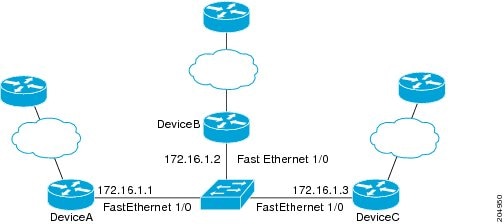
The following example shows how to configure BFD in an EIGRP network with echo mode enabled by default in Cisco IOS Release 12.4(9)T. In the following example, the EIGRP network contains RouterA, RouterB, and RouterC. Fast Ethernet interface 1/0 on RouterA is connected to the same network as Fast Ethernet interface 1/0 on Router B. Fast Ethernet interface 1/0 on RouterB is connected to the same network as Fast Ethernet interface 1/0 on RouterC.
RouterA and RouterB are running BFD Version 1, which supports echo mode, and RouterC is running BFD Version 0, which does not support echo mode. The BFD sessions between RouterC and its BFD neighbors are said to be running echo mode with asymmetry because echo mode will run on the forwarding path for RouteA and RouterB, and their echo packets will return along the same path for BFD sessions and failure detections, while their BFD neighbor RouterC runs BFD Version 0 and uses BFD controls packets for BFD sessions and failure detections.
The figure below shows a large EIGRP network with several routers, three of which are BFD neighbors that are running EIGRP as their routing protocol.
The example, starting in global configuration mode, shows the configuration of BFD.
Configuration for RouterA
interface Fast Ethernet0/0
no shutdown
ip address 10.4.9.14 255.255.255.0
duplex auto
speed auto
!
interface Fast Ethernet1/0
ip address 172.16.1.1 255.255.255.0
bfd interval 50 min_rx 50 multiplier 3
no shutdown
duplex auto
speed auto
!
router eigrp 11
network 172.16.0.0
bfd all-interfaces
auto-summary
!
ip default-gateway 10.4.9.1
ip default-network 0.0.0.0
ip route 0.0.0.0 0.0.0.0 10.4.9.1
ip route 172.16.1.129 255.255.255.255 10.4.9.1
!
no ip http server
!
logging alarm informational
!
control-plane
!
line con 0
exec-timeout 30 0
stopbits 1
line aux 0
stopbits 1
line vty 0 4
login
!
!
end
Configuration for RouterB
!
interface Fast Ethernet0/0
no shutdown
ip address 10.4.9.34 255.255.255.0
duplex auto
speed auto
!
interface Fast Ethernet1/0
ip address 172.16.1.2 255.255.255.0
bfd interval 50 min_rx 50 multiplier 3
no shtdown
duplex auto
speed auto
!
router eigrp 11
network 172.16.0.0
bfd all-interfaces
auto-summary
!
ip default-gateway 10.4.9.1
ip default-network 0.0.0.0
ip route 0.0.0.0 0.0.0.0 10.4.9.1
ip route 172.16.1.129 255.255.255.255 10.4.9.1
!
no ip http server
!
logging alarm informational
!
control-plane
!
line con 0
exec-timeout 30 0
stopbits 1
line aux 0
stopbits 1
line vty 0 4
login
!
!
end
Configuration for RouterC
!
!
interface Fast Ethernet0/0
no shutdown
ip address 10.4.9.34 255.255.255.0
duplex auto
speed auto
!
interface Fast Ethernet1/0
ip address 172.16.1.2 255.255.255.0
bfd interval 50 min_rx 50 multiplier 3
no shutdown
duplex auto
speed auto
!
router eigrp 11
network 172.16.0.0
bfd all-interfaces
auto-summary
!
ip default-gateway 10.4.9.1
ip default-network 0.0.0.0
ip route 0.0.0.0 0.0.0.0 10.4.9.1
ip route 172.16.1.129 255.255.255.255 10.4.9.1
!
no ip http server
!
logging alarm informational
!
control-plane
!
line con 0
exec-timeout 30 0
stopbits 1
line aux 0
stopbits 1
line vty 0 4
login
!
!
end
The output from the
showbfdneighborsdetails command from RouterA verifies that BFD sessions have been created among all three routers and that EIGRP is registered for BFD support. The first group of output shows that RouterC with the IP address 172.16.1.3 runs BFD Version 0 and therefore does not use the echo mode. The second group of output shows that RouterB with the IP address 172.16.1.2 does run BFD Version 1, and the 50 millisecond BFD interval parameter had been adopted. The relevant command output is shown in bold in the output.
RouterA# show bfd neighbors detailsOurAddrNeighAddr
LD/RD RH/RS Holdown(mult) State Int
172.16.1.1 172.16.1.3
5/3 1(RH) 150 (3 ) Up Fa1/0
Session state is UP and not using echo function.
Local Diag: 0, Demand mode: 0, Poll bit: 0
MinTxInt: 50000, MinRxInt: 50000, Multiplier: 3
Received MinRxInt: 50000, Received Multiplier: 3
Holdown (hits): 150(0), Hello (hits): 50(1364284)
Rx Count: 1351813, Rx Interval (ms) min/max/avg: 28/64/49 last: 4 ms ago
Tx Count: 1364289, Tx Interval (ms) min/max/avg: 40/68/49 last: 32 ms ago
Registered protocols: EIGRP
Uptime: 18:42:45
Last packet: Version: 0
- Diagnostic: 0
I Hear You bit: 1 - Demand bit: 0
Poll bit: 0 - Final bit: 0
Multiplier: 3 - Length: 24
My Discr.: 3 - Your Discr.: 5
Min tx interval: 50000 - Min rx interval: 50000
Min Echo interval: 0
OurAddr NeighAddr
LD/RD RH/RS Holdown(mult) State Int
172.16.1.1 172.16.1.2
6/1 Up 0 (3 ) Up Fa1/0
Session state is UP and using echo function with 50 ms interval.
Local Diag: 0, Demand mode: 0, Poll bit: 0
MinTxInt: 1000000, MinRxInt: 1000000, Multiplier: 3
Received MinRxInt: 1000000, Received Multiplier: 3
Holdown (hits): 3000(0), Hello (hits): 1000(317)
Rx Count: 305, Rx Interval (ms) min/max/avg: 1/1016/887 last: 448 ms ago
Tx Count: 319, Tx Interval (ms) min/max/avg: 1/1008/880 last: 532 ms ago
Registered protocols: EIGRP
Uptime: 00:04:30
Last packet: Version: 1
- Diagnostic: 0
State bit: Up - Demand bit: 0
Poll bit: 0 - Final bit: 0
Multiplier: 3 - Length: 24
My Discr.: 1 - Your Discr.: 6
Min tx interval: 1000000 - Min rx interval: 1000000
Min Echo interval: 50000
The output from the
showbfdneighborsdetails command on Router B verifies that BFD sessions have been created and that EIGRP is registered for BFD support. As previously noted, RouterA runs BFD Version 1, therefore echo mode is running, and RouterC runs BFD Version 0, so echo mode does not run. The relevant command output is shown in bold in the output.
RouterB# show bfd neighbors details OurAddr NeighAddr
LD/RD RH/RS Holdown(mult) State Int
172.16.1.2 172.16.1.1
1/6 Up 0 (3 ) Up Fa1/0
Session state is UP and using echo function with 50 ms interval.
Local Diag: 0, Demand mode: 0, Poll bit: 0
MinTxInt: 1000000, MinRxInt: 1000000, Multiplier: 3
Received MinRxInt: 1000000, Received Multiplier: 3
Holdown (hits): 3000(0), Hello (hits): 1000(337)
Rx Count: 341, Rx Interval (ms) min/max/avg: 1/1008/882 last: 364 ms ago
Tx Count: 339, Tx Interval (ms) min/max/avg: 1/1016/886 last: 632 ms ago
Registered protocols: EIGRP
Uptime: 00:05:00
Last packet: Version: 1
- Diagnostic: 0
State bit: Up - Demand bit: 0
Poll bit: 0 - Final bit: 0
Multiplier: 3 - Length: 24
My Discr.: 6 - Your Discr.: 1
Min tx interval: 1000000 - Min rx interval: 1000000
Min Echo interval: 50000
OurAddr NeighAddr
LD/RD RH/RS Holdown(mult) State Int
172.16.1.2 172.16.1.3
3/6 1(RH) 118 (3 ) Up Fa1/0
Session state is UP and not using echo function.
Local Diag: 0, Demand mode: 0, Poll bit: 0
MinTxInt: 50000, MinRxInt: 50000, Multiplier: 3
Received MinRxInt: 50000, Received Multiplier: 3
Holdown (hits): 150(0), Hello (hits): 50(5735)
Rx Count: 5731, Rx Interval (ms) min/max/avg: 32/72/49 last: 32 ms ago
Tx Count: 5740, Tx Interval (ms) min/max/avg: 40/64/50 last: 44 ms ago
Registered protocols: EIGRP
Uptime: 00:04:45
Last packet: Version: 0
- Diagnostic: 0
I Hear You bit: 1 - Demand bit: 0
Poll bit: 0 - Final bit: 0
Multiplier: 3 - Length: 24
My Discr.: 6 - Your Discr.: 3
Min tx interval: 50000 - Min rx interval: 50000
Min Echo interval: 0
The figure below shows that Fast Ethernet interface 1/0 on RouterB has failed. When Fast Ethernet interface 1/0 on RouterB is shut down, the BFD statistics of the corresponding BFD sessions on RouterA and RouterB are reduced.
When Fast Ethernet interface 1/0 on RouterB fails, BFD will no longer detect Router B as a BFD neighbor for RouterA or for RouterC. In this example, Fast Ethernet interface 1/0 has been administratively shut down on RouterB.
The following output from the
showbfdneighbors command on RouterA now shows only one BFD neighbor for RouterA in the EIGRP network. The relevant command output is shown in bold in the output.
RouterA# show bfd neighborsOurAddr NeighAddr
LD/RD RH/RS Holdown(mult) State Int
172.16.1.1 172.16.1.3
5/3 1(RH) 134 (3 ) Up Fa1/0
The following output from the
showbfdneighbors command on RouterC also now shows only one BFD neighbor for RouterC in the EIGRP network. The relevant command output is shown in bold in the output.
RouterC# show bfd neighborsOurAddr NeighAddr
LD/RD RH Holdown(mult) State Int
172.16.1.3 172.16.1.1
3/5 1 114 (3 ) Up Fa1/0
Example: Configuring BFD in an OSPF Network
The following example shows how to configure BFD in an OSPF network in Cisco IOS Release 12.0(31)S. In the following example, the simple OSPF network consists of Router A and Router B. Fast Ethernet interface 0/1 on Router A is connected to the same network as Fast Ethernet interface 6/0 in Router B. The example, starting in global configuration mode, shows the configuration of BFD. For both Routers A and B, BFD is configured globally for all interfaces associated with the OSPF process.
Configuration for Router A
!
interface Fast Ethernet 0/1
ip address 172.16.10.1 255.255.255.0
bfd interval 50 min_rx 50 multiplier 3
!
interface Fast Ethernet 3/0.1
ip address 172.17.0.1 255.255.255.0
!
router ospf 123
log-adjacency-changes detail
network 172.16.0.0 0.0.0.255 area 0
network 172.17.0.0 0.0.0.255 area 0
bfd all-interfaces
Configuration for Router B
!
interface Fast Ethernet 6/0
ip address 172.16.10.2 255.255.255.0
bfd interval 50 min_rx 50 multiplier 3
!
interface Fast Ethernet 6/1
ip address 172.18.0.1 255.255.255.0
!
router ospf 123
log-adjacency-changes detail
network 172.16.0.0 0.0.255.255 area 0
network 172.18.0.0 0.0.255.255 area 0
bfd all-interfaces
The output from the
showbfdneighborsdetails command verifies that a BFD session has been created and that OSPF is registered for BFD support. The relevant command output is shown in bold in the output.
Router A
RouterA# show bfd neighbors details
OurAddr NeighAddr LD/RD RH Holdown(mult) State Int
172.16.10.1 172.16.10.2 1/2 1 532 (3 ) Up Fa0/1
Local Diag: 0, Demand mode: 0, Poll bit: 0
MinTxInt: 200000, MinRxInt: 200000, Multiplier: 5
Received MinRxInt: 1000, Received Multiplier: 3
Holdown (hits): 600(22), Hello (hits): 200(84453)
Rx Count: 49824, Rx Interval (ms) min/max/avg: 208/440/332 last: 68 ms ago
Tx Count: 84488, Tx Interval (ms) min/max/avg: 152/248/196 last: 192 ms ago
Registered protocols: OSPF
Uptime: 02:18:49
Last packet: Version: 0
- Diagnostic: 0
I Hear You bit: 1 - Demand bit: 0
Poll bit: 0 - Final bit: 0
Multiplier: 3 - Length: 24
My Discr.: 2 - Your Discr.: 1
Min tx interval: 50000 - Min rx interval: 1000
Min Echo interval: 0
The output from the
showbfdneighborsdetails command from the line card on Router B verifies that a BFD session has been created:
Note
Router B is a Cisco 12000 series router. The
showbfdneighborsdetails command must be run on the line cards. The
showbfdneighborsdetails command will not display the registered protocols when it is entered on a line card.
Router B
RouterB# attach 6
Entering Console for 8 Port Fast Ethernet in Slot: 6
Type "exit" to end this session
Press RETURN to get started!
Router> show bfd neighbors details
Cleanup timer hits: 0
OurAddr NeighAddr LD/RD RH Holdown(mult) State Int
172.16.10.2 172.16.10.1 8/1 1 1000 (5 ) Up Fa6/0
Local Diag: 0, Demand mode: 0, Poll bit: 0
MinTxInt: 50000, MinRxInt: 1000, Multiplier: 3
Received MinRxInt: 200000, Received Multiplier: 5
Holdown (hits): 1000(0), Hello (hits): 200(5995)
Rx Count: 10126, Rx Interval (ms) min/max/avg: 152/248/196 last: 0 ms ago
Tx Count: 5998, Tx Interval (ms) min/max/avg: 204/440/332 last: 12 ms ago
Last packet: Version: 0 - Diagnostic: 0
I Hear You bit: 1 - Demand bit: 0
Poll bit: 0 - Final bit: 0
Multiplier: 5 - Length: 24
My Discr.: 1 - Your Discr.: 8
Min tx interval: 200000 - Min rx interval: 200000
Min Echo interval: 0
Uptime: 00:33:13
SSO Cleanup Timer called: 0
SSO Cleanup Action Taken: 0
Pseudo pre-emptive process count: 239103 min/max/avg: 8/16/8 last: 0 ms ago
IPC Tx Failure Count: 0
IPC Rx Failure Count: 0
Total Adjs Found: 1
The output of the
showipospf command verifies that BFD has been enabled for OSPF. The relevant command output is shown in bold in the output.
Router A
RouterA# show ip ospf
Routing Process "ospf 123" with ID 172.16.10.1
Supports only single TOS(TOS0) routes
Supports opaque LSA
Supports Link-local Signaling (LLS)
Initial SPF schedule delay 5000 msecs
Minimum hold time between two consecutive SPFs 10000 msecs
Maximum wait time between two consecutive SPFs 10000 msecs
Incremental-SPF disabled
Minimum LSA interval 5 secs
Minimum LSA arrival 1000 msecs
LSA group pacing timer 240 secs
Interface flood pacing timer 33 msecs
Retransmission pacing timer 66 msecs
Number of external LSA 0. Checksum Sum 0x000000
Number of opaque AS LSA 0. Checksum Sum 0x000000
Number of DCbitless external and opaque AS LSA 0
Number of DoNotAge external and opaque AS LSA 0
Number of areas in this router is 1. 1 normal 0 stub 0 nssa
External flood list length 0
BFD is enabled
Area BACKBONE(0)
Number of interfaces in this area is 2 (1 loopback)
Area has no authentication
SPF algorithm last executed 00:00:08.828 ago
SPF algorithm executed 9 times
Area ranges are
Number of LSA 3. Checksum Sum 0x028417
Number of opaque link LSA 0. Checksum Sum 0x000000
Number of DCbitless LSA 0
Number of indication LSA 0
Number of DoNotAge LSA 0
Flood list length 0
Router B
RouterB# show ip ospf
Routing Process "ospf 123" with ID 172.18.0.1
Supports only single TOS(TOS0) routes
Supports opaque LSA
Supports Link-local Signaling (LLS)
Supports area transit capability
Initial SPF schedule delay 5000 msecs
Minimum hold time between two consecutive SPFs 10000 msecs
Maximum wait time between two consecutive SPFs 10000 msecs
Incremental-SPF disabled
Minimum LSA interval 5 secs
Minimum LSA arrival 1000 msecs
LSA group pacing timer 240 secs
Interface flood pacing timer 33 msecs
Retransmission pacing timer 66 msecs
Number of external LSA 0. Checksum Sum 0x0
Number of opaque AS LSA 0. Checksum Sum 0x0
Number of DCbitless external and opaque AS LSA 0
Number of DoNotAge external and opaque AS LSA 0
Number of areas in this router is 1. 1 normal 0 stub 0 nssa
Number of areas transit capable is 0
External flood list length 0
BFD is enabled
Area BACKBONE(0)
Number of interfaces in this area is 2 (1 loopback)
Area has no authentication
SPF algorithm last executed 02:07:30.932 ago
SPF algorithm executed 7 times
Area ranges are
Number of LSA 3. Checksum Sum 0x28417
Number of opaque link LSA 0. Checksum Sum 0x0
Number of DCbitless LSA 0
Number of indication LSA 0
Number of DoNotAge LSA 0
Flood list length 0
The output of the
showipospfinterface command verifies that BFD has been enabled for OSPF on the interfaces connecting Router A and Router B. The relevant command output is shown in bold in the output.
Router A
RouterA# show ip ospf interface Fast Ethernet 0/1
show ip ospf interface Fast Ethernet 0/1
Fast Ethernet0/1 is up, line protocol is up
Internet Address 172.16.10.1/24, Area 0
Process ID 123, Router ID 172.16.10.1, Network Type BROADCAST, Cost: 1
Transmit Delay is 1 sec, State BDR, Priority 1, BFD enabled
Designated Router (ID) 172.18.0.1, Interface address 172.16.10.2
Backup Designated router (ID) 172.16.10.1, Interface address 172.16.10.1
Timer intervals configured, Hello 10, Dead 40, Wait 40, Retransmit 5
oob-resync timeout 40
Hello due in 00:00:03
Supports Link-local Signaling (LLS)
Index 1/1, flood queue length 0
Next 0x0(0)/0x0(0)
Last flood scan length is 1, maximum is 1
Last flood scan time is 0 msec, maximum is 0 msec
Neighbor Count is 1, Adjacent neighbor count is 1
Adjacent with neighbor 172.18.0.1 (Designated Router)
Suppress hello for 0 neighbor(s)
Router B
RouterB# show ip ospf interface Fast Ethernet 6/1
Fast Ethernet6/1 is up, line protocol is up
Internet Address 172.18.0.1/24, Area 0
Process ID 123, Router ID 172.18.0.1, Network Type BROADCAST, Cost: 1
Transmit Delay is 1 sec, State DR, Priority 1, BFD enabled
Designated Router (ID) 172.18.0.1, Interface address 172.18.0.1
No backup designated router on this network
Timer intervals configured, Hello 10, Dead 40, Wait 40, Retransmit 5
oob-resync timeout 40
Hello due in 00:00:01
Supports Link-local Signaling (LLS)
Index 1/1, flood queue length 0
Next 0x0(0)/0x0(0)
Last flood scan length is 0, maximum is 0
Last flood scan time is 0 msec, maximum is 0 msec
Neighbor Count is 0, Adjacent neighbor count is 0
Suppress hello for 0 neighbor(s)
Example: Configuring BFD in a BGP Network
The following example shows how to configure BFD in a BGP network in Cisco IOS Release 12.0(31)S. In the following example, the simple BGP network consists of Router A and Router B. Fast Ethernet interface 0/1 on Router A is connected to the same network as Fast Ethernet interface 6/0 in Router B. The example, starting in global configuration mode, shows the configuration of BFD.
Configuration for Router A
!
interface Fast Ethernet 0/1
ip address 172.16.10.1 255.255.255.0
bfd interval 50 min_rx 50 multiplier 3
!
interface Fast Ethernet 3/0.1
ip address 172.17.0.1 255.255.255.0
!
!
router bgp 40000
bgp log-neighbor-changes
neighbor 172.16.10.2 remote-as 45000
neighbor 172.16.10.2 fall-over bfd
!
address-family ipv4
neighbor 172.16.10.2 activate
no auto-summary
no synchronization
network 172.18.0.0 mask 255.255.255.0
exit-address-family
!
Configuration for Router B
!
interface Fast Ethernet 6/0
ip address 172.16.10.2 255.255.255.0
bfd interval 50 min_rx 50 multiplier 3
!
interface Fast Ethernet 6/1
ip address 172.18.0.1 255.255.255.0
!
router bgp 45000
bgp log-neighbor-changes
neighbor 172.16.10.1 remote-as 40000
neighbor 172.16.10.1 fall-over bfd
!
address-family ipv4
neighbor 172.16.10.1 activate
no auto-summary
no synchronization
network 172.17.0.0 mask 255.255.255.0
exit-address-family
!
The output from the
showbfdneighborsdetails command from Router A verifies that a BFD session has been created and that BGP is registered for BFD support. The relevant command output is shown in bold in the output.
Router A
RouterA# show bfd neighbors details
OurAddr NeighAddr LD/RD RH Holdown(mult) State Int
172.16.10.1 172.16.10.2 1/8 1 332 (3 ) Up Fa0/1
Local Diag: 0, Demand mode: 0, Poll bit: 0
MinTxInt: 200000, MinRxInt: 200000, Multiplier: 5
Received MinRxInt: 1000, Received Multiplier: 3
Holdown (hits): 600(0), Hello (hits): 200(15491)
Rx Count: 9160, Rx Interval (ms) min/max/avg: 200/440/332 last: 268 ms ago
Tx Count: 15494, Tx Interval (ms) min/max/avg: 152/248/197 last: 32 ms ago
Registered protocols: BGP
Uptime: 00:50:45
Last packet: Version: 0 - Diagnostic: 0
I Hear You bit: 1 - Demand bit: 0
Poll bit: 0 - Final bit: 0
Multiplier: 3 - Length: 24
My Discr.: 8 - Your Discr.: 1
Min tx interval: 50000 - Min rx interval: 1000
Min Echo interval: 0
The output from the
showbfdneighborsdetails command from the line card on Router B verifies that a BFD session has been created:
Note
Router B is a Cisco 12000 series router. The
showbfdneighborsdetails command must be run on the line cards. The
showbfdneighborsdetails command will not display the registered protocols when it is entered on a line card.
Router B
RouterB# attach 6
Entering Console for 8 Port Fast Ethernet in Slot: 6
Type "exit" to end this session
Press RETURN to get started!
Router> show bfd neighbors details
Cleanup timer hits: 0
OurAddr NeighAddr LD/RD RH Holdown(mult) State Int
172.16.10.2 172.16.10.1 8/1 1 1000 (5 ) Up Fa6/0
Local Diag: 0, Demand mode: 0, Poll bit: 0
MinTxInt: 50000, MinRxInt: 1000, Multiplier: 3
Received MinRxInt: 200000, Received Multiplier: 5
Holdown (hits): 1000(0), Hello (hits): 200(5995)
Rx Count: 10126, Rx Interval (ms) min/max/avg: 152/248/196 last: 0 ms ago
Tx Count: 5998, Tx Interval (ms) min/max/avg: 204/440/332 last: 12 ms ago
Last packet: Version: 0 - Diagnostic: 0
I Hear You bit: 1 - Demand bit: 0
Poll bit: 0 - Final bit: 0
Multiplier: 5 - Length: 24
My Discr.: 1 - Your Discr.: 8
Min tx interval: 200000 - Min rx interval: 200000
Min Echo interval: 0
Uptime: 00:33:13
SSO Cleanup Timer called: 0
SSO Cleanup Action Taken: 0
Pseudo pre-emptive process count: 239103 min/max/avg: 8/16/8 last: 0 ms ago
IPC Tx Failure Count: 0
IPC Rx Failure Count: 0
Total Adjs Found: 1
The output of the
showipbgpneighbors command verifies that BFD has been enabled for the BGP neighbors:
Router A
RouterA# show ip bgp neighbors
BGP neighbor is 172.16.10.2, remote AS 45000, external link
Using BFD to detect fast fallover
.
.
.
Router B
RouterB# show ip bgp neighbors
BGP neighbor is 172.16.10.1, remote AS 40000, external link
Using BFD to detect fast fallover
.
.
.
Example: Configuring BFD in an IS-IS Network
The following example shows how to configure BFD in an IS-IS network in Cisco IOS Release 12.0(31)S. In the following example, the simple IS-IS network consists of Router A and Router B. Fast Ethernet interface 0/1 on Router A is connected to the same network as Fast Ethernet interface 6/0 for Router B. The example, starting in global configuration mode, shows the configuration of BFD.
Configuration for Router A
!
interface Fast Ethernet 0/1
ip address 172.16.10.1 255.255.255.0
ip router isis
bfd interval 50 min_rx 50 multiplier 3
!
interface Fast Ethernet 3/0.1
ip address 172.17.0.1 255.255.255.0
ip router isis
!
router isis
net 49.0001.1720.1600.1001.00
bfd all-interfaces
!
Configuration for Router B
!
interface Fast Ethernet 6/0
ip address 172.16.10.2 255.255.255.0
ip router isis
bfd interval 50 min_rx 50 multiplier 3
!
interface Fast Ethernet 6/1
ip address 172.18.0.1 255.255.255.0
ip router isis
!
router isis
net 49.0000.0000.0002.00
bfd all-interfaces
!
The output from the
showbfdneighborsdetails command from Router A verifies that a BFD session has been created and that IS-IS is registered for BFD support:
RouterA# show bfd neighbors details
OurAddr NeighAddr LD/RD RH Holdown(mult) State Int
172.16.10.1 172.16.10.2 1/8 1 536 (3 ) Up Fa0/1
Local Diag: 0, Demand mode: 0, Poll bit: 0
MinTxInt: 200000, MinRxInt: 200000, Multiplier: 5
Received MinRxInt: 1000, Received Multiplier: 3
Holdown (hits): 600(0), Hello (hits): 200(23543)
Rx Count: 13877, Rx Interval (ms) min/max/avg: 200/448/335 last: 64 ms ago
Tx Count: 23546, Tx Interval (ms) min/max/avg: 152/248/196 last: 32 ms ago
Registered protocols: ISIS
Uptime: 01:17:09
Last packet: Version: 0 - Diagnostic: 0
I Hear You bit: 1 - Demand bit: 0
Poll bit: 0 - Final bit: 0
Multiplier: 3 - Length: 24
My Discr.: 8 - Your Discr.: 1
Min tx interval: 50000 - Min rx interval: 1000
Min Echo interval: 0
The output from the
showbfdneighborsdetails command from the line card on Router B verifies that a BFD session has been created:
Note
Router B is a Cisco 12000 series router. The
showbfdneighborsdetails command must be run on the line cards. The
showbfdneighborsdetails command will not display the registered protocols when it is entered on a line card.
RouterB# attach 6
Entering Console for 8 Port Fast Ethernet in Slot: 6
Type "exit" to end this session
Press RETURN to get started!
Router> show bfd neighbors details
Cleanup timer hits: 0
OurAddr NeighAddr LD/RD RH Holdown(mult) State Int
172.16.10.2 172.16.10.1 8/1 1 1000 (5 ) Up Fa6/0
Local Diag: 0, Demand mode: 0, Poll bit: 0
MinTxInt: 50000, MinRxInt: 1000, Multiplier: 3
Received MinRxInt: 200000, Received Multiplier: 5
Holdown (hits): 1000(0), Hello (hits): 200(5995)
Rx Count: 10126, Rx Interval (ms) min/max/avg: 152/248/196 last: 0 ms ago
Tx Count: 5998, Tx Interval (ms) min/max/avg: 204/440/332 last: 12 ms ago
Last packet: Version: 0 - Diagnostic: 0
I Hear You bit: 1 - Demand bit: 0
Poll bit: 0 - Final bit: 0
Multiplier: 5 - Length: 24
My Discr.: 1 - Your Discr.: 8
Min tx interval: 200000 - Min rx interval: 200000
Min Echo interval: 0
Uptime: 00:33:13
SSO Cleanup Timer called: 0
SSO Cleanup Action Taken: 0
Pseudo pre-emptive process count: 239103 min/max/avg: 8/16/8 last: 0 ms ago
IPC Tx Failure Count: 0
IPC Rx Failure Count: 0
Total Adjs Found: 1
Example: Configuring BFD in an HSRP Network
In the following example, the HSRP network consists of Router A and Router B. Fast Ethernet interface 2/0 on Router A is connected to the same network as Fast Ethernet interface 2/0 on Router B. The example, starting in global configuration mode, shows the configuration of BFD.
Note
In the following example, the
standbybfd and the
standbybfdall-interfaces commands are not displayed. HSRP support for BFD peering is enabled by default when BFD is configured on the router or interface using the
bfdinterval command. The
standbybfdand
standbybfdall-interfaces commands are needed only if BFD has been manually disabled on a router or interface.
Router A
ip cef
interface Fast Ethernet2/0
no shutdown
ip address 10.0.0.2 255.0.0.0
ip router-cache cef
bfd interval 200 min_rx 200 multiplier 3
standby 1 ip 10.0.0.11
standby 1 preempt
standby 1 priority 110
standby 2 ip 10.0.0.12
standby 2 preempt
standby 2 priority 110
Router B
interface Fast Ethernet2/0
ip address 10.1.0.22 255.255.0.0
no shutdown
bfd interval 200 min_rx 200 multiplier 3
standby 1 ip 10.0.0.11
standby 1 preempt
standby 1 priority 90
standby 2 ip 10.0.0.12
standby 2 preempt
standby 2 priority 80
The output from the
showstandbyneighbors command verifies that a BFD session has been created:
RouterA#show standby neighbors
HSRP neighbors on Fast Ethernet2/0
10.1.0.22
No active groups
Standby groups: 1
BFD enabled !
RouterB# show standby neighbors
HSRP neighbors on Fast Ethernet2/0
10.0.0.2
Active groups: 1
No standby groups
BFD enabled !
Example: Configuring BFD Support for Static Routing
In the following example, the network consists of Router A and Router B. Serial interface 2/0 on Router A is connected to the same network as serial interface 2/0 on Router B. In order for the BFD session to come up, Router B must be configured.
Router A
configure terminal
interface Serial 2/0
ip address 10.201.201.1 255.255.255.0
bfd interval 500 min_rx 500 multiplier 5
ip route static bfd Serial 2/0 10.201.201.2
ip route 10.0.0.0 255.0.0.0 Serial 2/0 10.201.201.2
Router B
configure terminal
interface Serial 2/0
ip address 10.201.201.2 255.255.255.0
bfd interval 500 min_rx 500 multiplier 5
ip route static bfd Serial 2/0 10.201.201.1
ip route 10.1.1.1 255.255.255.255 Serial 2/0 10.201.201.1
Note that the static route on Router B exists solely to enable the BFD session between 10.201.201.1 and 10.201.201.2. If there is no useful static route that needs to be configured, select a prefix that will not affect packet forwarding, for example, the address of a locally configured loopback interface.
In the following example, there is an active static BFD configuration to reach 209.165.200.225 through Ethernet interface 0/0 in the BFD group testgroup. As soon as the static route is configured that is tracked by the configured static BFD, a single hop BFD session is initiated to 209.165.200.225 through Ethernet interface 0/0. The prefix 10.0.0.0/8 is added to the RIB if a BFD session is successfully established.
configure terminal
ip route static bfd Ethernet 0/0 209.165.200.225 group testgroup
ip route 10.0.0.0 255.255.255.224 Ethernet 0/0 209.165.200.225
In the following example, a BFD session to 209.165.200.226 through Ethernet interface 0/0.1001 is marked to use the group testgroup. That is, this configuration is a passive static BFD. Though there are static routes to be tracked by the second static BFD configuration, a BFD session is not triggered for 209.165.200.226 through Ethernet interface 0/0.1001. The existence of the prefixes 10.1.1.1/8 and 10.2.2.2/8 is controlled by the active static BFD session (Ethernet interface 0/0 209.165.200.225).
configure terminal
ip route static bfd Ethernet 0/0 209.165.200.225 group testgroup
ip route 10.0.0.0 255.255.255.224 Ethernet 0/0 209.165.200.225
ip route static bfd Ethernet 0/0.1001 209.165.200.226 group testgroup passive
ip route 10.1.1.1 255.255.255.224 Ethernet 0/0.1001 209.165.200.226
ip route 10.2.2.2 255.255.255.224 Ethernet 0/0.1001 209.165.200.226
Example: Configuring BFD Control Channel over VCCV--Support for ATM Pseudowire
The figure below shows a typical ATM pseudowire configuration. The network consists of a MPLS pseudowire carrying an ATM payload between two terminating provider edge (T-PE) devices: T-PE1 and T-PE2. BFD monitoring of the pseudowire occurs between the T-PE1 device and the switching providing edge (S-PE) device, and between the S-PE device and the T-PE2 device. BFD also monitors the signal status of the ACs between the customer edge (CE) devices and the T-PE devices.
Note
No configuration specific to BFD control channel over VCCV is required for the S-PEs.
CE1
interface ATM 0/0
description connect to mfi6 atm9/0/0
no ip address
no ip directed-broadcast
atm clock INTERNAL
atm sonet stm-1
no atm enable-ilmi-trap
no atm ilmi-keepalive
!
interface ATM 0/0.2 point-to-point
ip address 10.25.1.1 255.255.255.0
no ip directed-broadcast
no atm enable-ilmi-trap
pvc 0/100
encapsulation aal5snap
T-PE1
interface Loopback 0
ip address 10.0.0.6 255.255.255.255
bfd-template single-hop nsn
interval min-tx 500 min-rx 500 multiplier 3
pseudowire-class vccv-bfd1
encapsulation mpls
vccv bfd template nsn raw-bfd
vccv bfd status signaling
interface ATM 9/0/0
description connect mfr4 atm0/0
no ip address
atm asynchronous
atm clock INTERNAL
no atm ilmi-keepalive
no atm enable-ilmi-trap
pvc 0/100 l2transport
xconnect 10.0.0.7 100 pw-class vccv-bfd1
T-PE2
interface Loopback 0
ip address 10.54.0.1 255.255.255.255
bfd-template single-hop nsn
interval min-tx 500 min-rx 500 multiplier 3
!
pseudowire-class vccv-bfd1
encapsulation mpls
vccv bfd template nsn raw-bfd
vccv bfd status signaling
interface ATM 2/0
no ip address
atm asynchronous
no atm ilmi-keepalive
no atm enable-ilmi-trap
pvc 0/100 l2transport
xconnect 10.0.0.7 102 pw-class vccv-bfd1
!
CE2
interface ATM 4/0.2 point-to-point
ip address 10.25.1.2 255.255.255.0
no snmp trap link-status
pvc 0/100
encapsulation aal5snap
Additional References
Related Documents
Related Topic
Document Title
Cisco IOS commands
Cisco IOS Master Commands List, All Releases
Configuring and monitoring BGP
“Cisco BGP Overview” module of the
Cisco IOS IP Routing Protocols Configuration Guide
BFD hardware offload
“Configuring Synchronous Ethernet on the Cisco 7600 Router with ES+ Line Card” section of the
Cisco 7600 Series Ethernet Services Plus (ES+) and Ethernet Services Plus T (ES+T) Line Card Configuration Guide
Configuring and monitoring EIGRP
“Configuring EIGRP” module of the
Cisco IOS IP Routing Protocols Configuration Guide
Configuring and monitoring HSRP
“Configuring HSRP” module of the
Cisco IOS IP Application Services Configuration Guide
Configuring and monitoring IS-IS
“Configuring Integrated IS-IS” module of the
Cisco IOS IP Routing Protocols Configuration Guide
Configuring and monitoring OSPF
“Configuring OSPF” module of the
Cisco IOS IP Routing Protocols Configuration Guide
The Cisco Support and Documentation website provides online resources to download documentation, software, and tools. Use these resources to install and configure the software and to troubleshoot and resolve technical issues with Cisco products and technologies. Access to most tools on the Cisco Support and Documentation website requires a Cisco.com user ID and password.
Feature Information for Bidirectional Forwarding Detection
The following table provides release information about the feature or features described in this module. This table lists only the software release that introduced support for a given feature in a given software release train. Unless noted otherwise, subsequent releases of that software release train also support that feature.
Use Cisco Feature Navigator to find information about platform support and Cisco software image support. To access Cisco Feature Navigator, go to
www.cisco.com/go/cfn. An account on Cisco.com is not required.
Table 5 Feature Information for Bidirectional Forwarding Detection
Feature Name
Releases
Feature Information
BFD Control Channel over VCCV—Support for ATM Pseudowire
15.0(1)S
VCCV provides a control channel that is associated with an ATM pseudowire to perform operations and management functions over the pseudowire. BFD uses the VCCV control channel to detect dataplane failures for pseudowires.
In Cisco IOS Release 15.0(1)S the BFD control channel over VCCV Support for ATM Pseudowire feature is supported for VCCV type-1 (without an IP/UDP header) only.
The following commands were introduced or modified by this feature:
bfd-template,
debugmplsl2transportvcvccv,
interval(BFD),
vccv,
vccvbfdtemplate,
vccvbfdstatussignaling.
BFD Echo Mode
12.2(33)SRB
12.4(9)T
15.0(1)S
BFD echo mode works with asynchronous BFD. Echo packets are sent by the forwarding engine and forwarded back along the same path in order to perform detection--the BFD session at the other end does not participate in the actual forwarding of the echo packets. The echo function and the forwarding engine are responsible for the detection process, therefore the number of BFD control packets that are sent out between two BFD neighbors is reduced. And since the forwarding engine is testing the forwarding path on the remote (neighbor) system without involving the remote system, there is an opportunity to improve the interpacket delay variance, thereby achieving quicker failure detection times than when using BFD Version 0 with BFD control packets for the BFD session.
BFD—EIGRP Support
12.0(31)S
12.2(18)SXE
12.2(33)SRA
12.2(33)SRB
12.4(4)T
15.1(1)SG
BFD support for EIGRP can be configured so that EIGRP is a registered protocol with BFD and will receive forwarding path detection failure messages from BFD.
BFD for EIGRP is not supported on the Cisco 12000 series routers for Cisco IOS Releases 12.0(31)S, 12.0(32)S, 12.4(4)T, and 12.2(33)SRA.
BFD—BFD Hardware Offload Support
15.1(2)S
15.1(1)SG
This feature supports offloading BFD sessions to ES+ line cards on Cisco 7600 series routers. The following command was introduced or modified:
showbfdneighbors.
BFD Multihop
15.1(3)S
This feature supports multihop BFD for IPv4 and IPv6 addresses. The following commands were introduced or modified:
authentication,
bfd map,
bfd-template,
interval,
show bfd neighbors,
show bfd neighbor drops.
BFD—Static Route Support
12.2(33)SRC
15.0(1)M
15.0(1)S
15.0(1)SY
15.1(2)S
15.1(1)SG
Unlike dynamic routing protocols, such as OSPF and BGP, static routing has no method of peer discovery. Therefore, when BFD is configured, the reachability of the gateway is completely dependent on the state of the BFD session to the specified neighbor. Unless the BFD session is up, the gateway for the static route is considered unreachable, and therefore the affected routes will not be installed in the appropriate RIB.
A single BFD session can be used by an IPv4 static client to track the reachability of next hops through a specific interface. A BFD group can be assigned for a set of BFD-tracked static routes.
The following commands were introduced or modified:
iproutestaticbfd and
showipstaticroutebfd.
BFD Support for IP Tunnel (GRE, with IP address)
15.1(1)SY
This feature supports BFD forwarding on point-to-point IPv4, IPv6, and GRE tunnels.
The following commands were introduced or modified:
bfd.
BFD Support over Port Channel
15.1(1)SY
This feature supports configuring BFD timers on port channel interface.
The following commands were introduced or modified:
bfd.
BFD—VRF Support
12.2(33)SRC
15.0(1)M
15.0(1)S
15.1(1)SY
The BFD feature support is extended to be VPN Routing and Forwarding (VRF) aware to provide fast detection of routing protocol failures between provider edge (PE) and customer edge (CE) devices.
BFD—WAN Interface Support
12.2(33)SRC
15.0(1)M
15.0(1)S
The BFD feature is supported on nonbroadcast media interfaces including ATM, POS, serial, and VLAN interfaces. BFD support also extends to ATM, FR, POS, and serial subinterfaces.
The
bfdinterval command must be configured on the interface to initiate BFD monitoring.
Bidirectional Forwarding Detection (standard implementation, Version 1)
12.0(31)S
12.0(32)S
12.2(33)SRB
12.2(33)SRC
12.2(18)SXE
12.2(33)SXH
12.4(9)T
12.4(11)T
12.4(15)T
15.0(1)S
This document describes how to enable the Bidirectional Forwarding Detection (BFD) protocol. BFD is a detection protocol designed to provide fast forwarding path failure detection times for all media types, encapsulations, topologies, and routing protocols. In addition to fast forwarding path failure detection, BFD provides a consistent failure detection method for network administrators. Because the network administrator can use BFD to detect forwarding path failures at a uniform rate, rather than the variable rates for different routing protocol hello mechanisms, network profiling and planning will be easier, and reconvergence time will be consistent and predictable.
In Release 12.0(31)S, support was added for the Cisco 12000 series Internet router.
In Release 12.0(32)S, support was added for the Cisco 10720 Internet router and IP Services Engine (Engine 3) and Engine 5 shared port adapters (SPAs) and SPA interface processors (SIPs) on the Cisco 12000 series Internet router.
HSRP Support for BFD
12.2(33)SRC
12.4(11)T
12.4(15)T
In Release 12.4(11)T, support for HSRP was added.
In Release 12.4(15)T, BFD is supported on the Integrated Services Router (ISR) family of Cisco routers, for example, the Cisco 3800 ISR series routers.
In Release 12.2(33)SRC, the number of BFD sessions that can be created has been increased, BFD support has been extended to ATM, FR, POS, and serial subinterfaces, the BFD feature has been extended to be VRF-aware, BFD sessions are placed in an “Admin Down” state during a planned switchover, and BFD support has been extended to static routing.
IS-IS Support for BFD over IPv4
12.0(31)S
12.2(18)SXE
12.2(33)SRA
12.4(4)T
15.0(1)S
BFD support for OSPF can be configured globally on all interfaces or configured selectively on one or more interfaces. When BFD support is configured with IS-IS as a registered protocol with BFD, IS-IS receives forwarding path detection failure messages from BFD.
OSPF Support for BFD over IPv4
12.0(31)S
12.2(18)SXE
12.2(33)SRA
12.4(4)T
15.0(1)S
15.1(1)SG
BFD support for OSPF can be configured globally on all interfaces or configured selectively on one or more interfaces. When BFD support is configured with OSPF as a registered protocol with BFD, OSPF receives forwarding path detection failure messages from BFD.
SSO—BFD
12.2(33)SRE
12.2(33)SXI2
12.2(33)XNE
15.0(1)S
15.1(1)SG
Network deployments that use dual RP routers and switches have a graceful restart mechanism to protect forwarding states across a switchover. This feature enables BFD to maintain sessions in a up state across switchovers.
SSO—BFD (Admin Down)
12.2(33)SRC
15.0(1)S
To support SSO, BFD sessions are placed in an “Admin Down” state during a planned switchover. The BFD configuration is synched from the active to standby processor, and all BFD clients re-register with the BFD process on the standby processor.