SIP, SSC, and SPA Product Overview
This chapter provides an introduction to SPA interface processors (SIPs), SPA services cards (SSCs), and shared port adapters (SPAs). It includes the following sections:
• Introduction to SIPs and SPAs
•SIP, SSC, and SPA Compatibility
For software details for the specific SIPs, SSCs, and SPAs that are supported on the Catalyst 6500 Series switch, refer to the companion publication, Catalyst 6500 Series Switch SIP, SSC, and SPA Software Configuration Guide.
Introduction to SIPs and SPAs
SIPs, SSCs, and SPAs constitute a new carrier card and port adapter architecture that increases modularity, flexibility, and density across Cisco Systems switches for network connectivity. This section describes the SIPs, SSCs, and SPAs and provides some guidelines for their use.
SPA Interface Processors
The following list describes some of the general characteristics of a SIP:
•A SIP is a carrier card that inserts into a switch slot like a line card. It provides no network connectivity on its own.
•A SIP contains one or more subslots, which are used to contain one or more SPAs. The SPA provides interface ports for network connectivity.
•During normal operation, the SIP should reside in a switch that is fully populated either with functional SPAs in all subslots or with a blank filler plate (SPA-BLANK=) inserted in all empty subslots.
•SIPs support online insertion and removal (OIR) with SPAs inserted in their subslots. SPAs also support OIR and can be inserted or removed independently from the SIP.
SPA Services Cards
The following list describes some of the general characteristics of an SSC:
•An SSC is a carrier card that inserts into a switch slot like a line card. It provides no network connectivity.
•An SSC provides one or more subslots, which are used to contain one or more SPAs. The supported SPAs do not provide interface ports for network connectivity, but provide certain services.
•During normal operation, the SSC should reside in a switch that is fully populated either with functional SPAs in all subslots or with a blank filler plate (SPA-BLANK=) inserted in all empty subslots.
•SSCs support online insertion and removal (OIR) with SPAs inserted in their subslots. SPAs also support OIR and can be inserted or removed independently from the SSC.
Shared Port Adapters
The following list describes some of the general characteristics of a SPA:
•A SPA is a modular type of port adapter that inserts into a subslot of a compatible SIP carrier card to provide network connectivity and increased interface port density. A SIP can hold one or more SPAs, depending on the SIP type.
•Some SPAs provide services rather than network connectivity, and they insert into subslots of compatible SSCs. For example, the IPSec VPN SPA provides services such as IP Security (IPSec) encryption and decryption, generic routing encapsulation (GRE), and Internet Key Exchange (IKE) key generation.
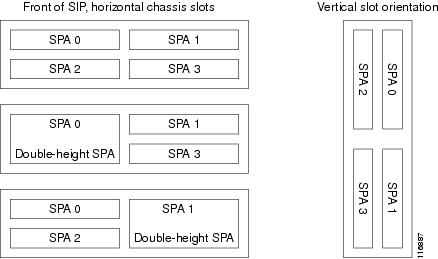
•SPAs are available in the following sizes, as shown in Figure 1-1 and Figure 1-2:
–Single-height SPA—Inserts into one SIP subslot.
–Double-height SPA—Inserts into two single, vertically aligned SIP subslots.
Figure 1-1 Single-Height and Double-Height SPA Sizes
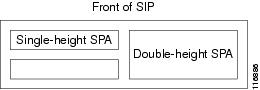
Figure 1-2 Horizontal and Vertical Chassis Slot Orientation for SPAs
•Each SPA provides a certain number of connectors, or ports, that are the interfaces to one or more networks. These interfaces can be individually configured using the Cisco IOS command-line interface (CLI).
•Either a blank filler plate or a functional SPA should reside in every subslot of an SIP during normal operation to maintain cooling integrity. Blank filler plates are available in single-height form only.
•SPAs support online insertion and removal (OIR). They can be inserted or removed independently from the SIP. SIPs also support online insertion and removal (OIR) with SPAs inserted in their subslots.
SIP, SSC, and SPA Compatibility
The following tables show SIP, SSC, and SPA compatibility by SPA technology area on the Catalyst 6500 Series switch.

Note For more information about the introduction of support for different SIPs, SSCs, and SPAs, refer to the "Release History" sections in the overview chapters of the Catalyst 6500 Series Switch SIP, SSC, and SPA Software Configuration Guide.
Modular Optics Compatibility
Some SPAs implement small form-factor pluggable (SFP) optical transceivers to provide network connectivity. An SFP module is a transceiver device that mounts into the front panel to provide network connectivity.
Cisco Systems qualifies the SFP modules that can be used with SPAs.
Note The SPAs will only accept the SFP modules listed as supported in this document. An SFP check is run every time an SFP module is inserted into a SPA, and only SFP modules that pass this check will be usable.
Table 1-7 shows the types of optics modules that have been qualified for use with a SPA.
Power Management
SPAs and SIPs consume chassis power, and, you must make sure the chassis is within the power budget on a Catalyst 6500 Series switch.
|
|
|
|---|---|
Cisco 7600 SIP-200 |
240.01 |
Cisco 7600 SIP-400 |
265.01 |
Cisco 7600 SIP-600 |
341.02 |
Cisco 7600 SSC-400 |
235.03 |
|
|
|
2-Port Channelized T3 SPA |
11.24 |
4-Port Channelized T3 SPA |
13.14 |
8-Port Channelized T1/E1 SPA |
9.4 |
2-Port OC-3c/STM-1 ATM SPA |
24.6 |
4-Port OC-3c/STM-1 ATM SPA |
24.8 |
1-Port OC-12c/STM-4 ATM SPA |
25.1 |
1-Port OC-48c/STM-16 ATM SPA |
38.13 |
1-Port OC-192c/STM-64 POS/RPR SPA |
23.84 |
1-Port OC-192c/STM-64 POS/RPR XFP SPA |
11.05 |
1-Port OC-192c/STM-64 POS/RPR VSR Optics SPA |
11.0 |
2-Port OC-3c/STM-1 POS SPA |
13.07 |
4-Port OC-3c/STM-1 POS SPA |
13.82 |
1-Port OC-12c/STM-4 POS SPA |
12.75 |
1-port OC-48/STM-16 ATM SPA |
38.0 |
2-Port Clear Channel T3/E3 SPA |
7.8 |
4-Port Clear Channel T3/E3 SPA |
8.5 |
IPSec VPN SPA |
40.0 |
1-Port 10-Gigabit Ethernet SPA |
17.45 |
2-Port Gigabit Ethernet SPA |
12.9 |
5-Port Gigabit Ethernet SPA |
13.15 |
10-Port Gigabit Ethernet SPA |
15.05 |
1 Maximum with four SPAs installed 2 Maximum with one SPA installed 3 Maximum with two IPSec VPN SPAs installed 4 Includes LR optics as they are fixed on the board 5 In addition to SFP or XFP optics power |
If the power limit is exceeded, the SIP and SPA is not powered up and an error message is displayed.
Router#%C7KPWR-SP-4-POWERDENIED:insufficient power, module in slot 3 power denied.
On a Catalyst 6500 Series switch, use the show power command on the Route Processor to determine how much power you have available in the chassis and how much is being used or reserved by line cards, supervisor engines, and fan trays.
The following example shows the show power command on a Catalyst 6500 Series switch:
Router# show power
system power redundancy mode = combined
system power redundancy operationally = non-redundant
system power total = 1869.42 Watts (44.51 Amps @ 42V)
system power used = 1302.42 Watts (31.01 Amps @ 42V)
system power available = 567.00 Watts (13.50 Amps @ 42V)
Power-Capacity PS-Fan Output Oper
PS Type Watts A @42V Status Status State
---- ------------------ ------- ------ ------ ------ -----
1 PWR-1900-AC/6 1869.42 44.51 OK OK on
2 none
Pwr-Allocated Oper
Fan Type Watts A @42V State
---- ------------------ ------- ------ -----
1 FAN-MOD-6HS 180.18 4.29 OK
Pwr-Requested Pwr-Allocated Admin Oper
Slot Card-Type Watts A @42V Watts A @42V State State
---- ------------------ ------- ------ ------- ------ ----- -----
3 7600-SIP-400 265.02 6.31 265.02 6.31 on on
4 7600-SIP-200 200.34 4.77 200.34 4.77 on on
5 unknown 328.44 7.82 328.44 7.82 on on
 Feedback