Configurazione di perdite VRF su IOS XE
Sommario
Introduzione
Questo documento descrive e fornisce configurazioni di esempio per i metodi comuni di perdita di route VRF (Virtual Routing and Forwarding).
Prerequisiti
Requisiti
Cisco raccomanda la conoscenza dei seguenti argomenti:
- Border Gateway Protocol (BGP)
- Ridistribuzione del protocollo di routing
- VRF
- Software Cisco IOS® XE
Per ulteriori informazioni su questi argomenti:
- Ridistribuisci protocolli di routing
- Esempio di ridistribuzione reciproca tra EIGRP e BGP
- Informazioni sulla ridistribuzione delle route OSPF in BGP
Componenti usati
Per questo documento, sono stati usati router con Cisco IOS® XE versioni 16.12.X e 17.X
Le informazioni discusse in questo documento fanno riferimento a dispositivi usati in uno specifico ambiente di emulazione. Su tutti i dispositivi menzionati nel documento la configurazione è stata ripristinata ai valori predefiniti. Se la rete è operativa, valutare attentamente eventuali conseguenze derivanti dall'uso dei comandi.
Premesse
Il protocollo VRF consente a un router di gestire tabelle di routing separate per reti virtuali diverse. Quando sono necessarie eccezioni, la perdita di route VRF consente di instradare parte del traffico tra i VRF senza utilizzare route statiche.
Scenario 1 - Perdita della route VRF tra BGP e IGP ( EIGRP )
Nello scenario 1 viene illustrato un esempio di route VRF che perdono tra BGP e EIGRP. Questo metodo può essere utilizzato per altri IGP.
Esempio di rete
Il diagramma reticolare nell'immagine 1 mostra la topologia di livello 3 in cui è necessaria una perdita di percorso.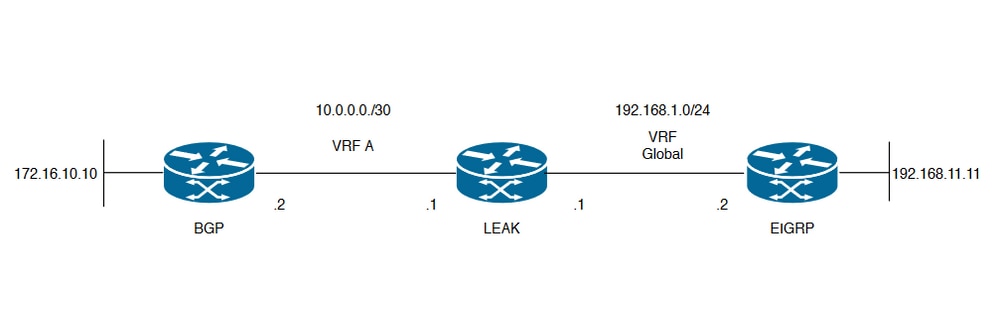
Immagine 1: Topologia di perdita del percorso per lo scenario 1.
Il router LEAK ha un vicinato BGP a un vicino nel VRF A e un vicino EIGRP nel VRF globale. La periferica 192.168.11.11 deve connettersi alla periferica 172.16.10.10 attraverso la rete.
La perdita del router non può effettuare il routing tra i due router perché i percorsi si trovano in VRF diversi. Queste tabelle di routing mostrano i percorsi correnti per VRF e indicano i percorsi che devono essere trafugati tra VRF globale e VRF A.
Tabelle di routing delle perdite:
| Tabella di routing EIGRP (routing globale) |
LEAK#show ip route
Codes: L - local, C - connected, S - static, R - RIP, M - mobile, B - BGP
D - EIGRP, EX - EIGRP external, O - OSPF, IA - OSPF inter area
N1 - OSPF NSSA external type 1, N2 - OSPF NSSA external type 2
E1 - OSPF external type 1, E2 - OSPF external type 2, m - OMP
n - NAT, Ni - NAT inside, No - NAT outside, Nd - NAT DIA
i - IS-IS, su - IS-IS summary, L1 - IS-IS level-1, L2 - IS-IS level-2
ia - IS-IS inter area, * - candidate default, U - per-user static route
H - NHRP, G - NHRP registered, g - NHRP registration summary
o - ODR, P - periodic downloaded static route, l - LISP
a - application route
+ - replicated route, % - next hop override, p - overrides from PfR

Gateway of last resort is not set

192.168.1.0/24 is variably subnetted, 2 subnets, 2 masks
C 192.168.1.0/24 is directly connected, GigabitEthernet2
L 192.168.1.1/32 is directly connected, GigabitEthernet2
192.168.11.0/32 is subnetted, 1 subnets
D 192.168.11.11 [90/130816] via 192.168.1.2, 02:30:29, GigabitEthernet2 >> Route to be exchange to the VRF A routing table.
| Tabella di routing VRF A |
LEAK#show ip route vrf A

Routing Table: A
Codes: L - local, C - connected, S - static, R - RIP, M - mobile, B - BGP
D - EIGRP, EX - EIGRP external, O - OSPF, IA - OSPF inter area
N1 - OSPF NSSA external type 1, N2 - OSPF NSSA external type 2
E1 - OSPF external type 1, E2 - OSPF external type 2, m - OMP
n - NAT, Ni - NAT inside, No - NAT outside, Nd - NAT DIA
i - IS-IS, su - IS-IS summary, L1 - IS-IS level-1, L2 - IS-IS level-2
ia - IS-IS inter area, * - candidate default, U - per-user static route
H - NHRP, G - NHRP registered, g - NHRP registration summary
o - ODR, P - periodic downloaded static route, l - LISP
a - application route
+ - replicated route, % - next hop override, p - overrides from PfR

Gateway of last resort is not set

10.0.0.0/8 is variably subnetted, 2 subnets, 2 masks
C 10.0.0.0/30 is directly connected, GigabitEthernet1
L 10.0.0.1/32 is directly connected, GigabitEthernet1
172.16.0.0/32 is subnetted, 1 subnets
B 172.16.10.10 [200/0] via 10.0.0.2, 01:47:58 >> Route to be exchange to the global routing table.
Configurazione
Completare le procedure per creare la perdita tra le due tabelle di routing:
Step 1.
Create route-maps to filter the routes to be injected in both routing tables.

LEAK(config)#Route-map VRF_TO_EIGRP
LEAK(config-route-map)#match ip address prefix-list VRF_TO_EIGRP
LEAK(config-route-map)#exit
!
Prefix-list created to match the host that is attached to the previous route-map configured.
!
ip prefix-list VRF_TO_EIGRP permit 172.16.10.10/32

or

LEAK(config)#Route-map VRF_TO_EIGRP
LEAK(config-route-map)# match ip address 10
LEAK(config-route-map)#exit
!
ACL created to match the host that is attached to the previous route-map.
!
LEAK#show ip access-lists 10
10 permit 172.16.10.10

LEAK(config)#Route-map EIGRP_TO_VRF
LEAK(config-route-map)#match ip address prefix-list EIGRP_TO_VRF
LEAK(config-route-map)#exit
LEAK(config)#
!
Prefix-list created to match the host that is attached to the previous route-map configured.
!
ip  prefix-list EIGRP_TO_VRF  permit 192.168.11.11/32

or

LEAK(config)#Route-map EIGRP_TO_VRF
LEAK(config-route-map)#match ip address 20
LEAK(config-route-map)#exit
LEAK(config)#
!
ACL created to match the host that is attached to the previous route-map.
!
LEAK#show ip access-list 20
10 permit 192.168.11.11


Step 2.
Define the import/export maps and add the route-map names.

LEAK(config)#vrf definition A
LEAK(config-vrf)#address-family ipv4
LEAK(config-vrf-af)#import ipv4 unicast map EIGRP_TO_VRF >> Import the global routing table routes at the VRF routing table.
LEAK(config-vrf-af)#export ipv4 unicast map VRF_TO_EIGRP >> Export the VRF routes to the Global Routing Table.
LEAK(config-vrf-af)#end

Step 3.
Proceed with the dual redistribution.

Redistribute EIGRP

LEAK(config)#router bgp 1
LEAK(config-router)#redistribute eigrp 1
LEAK(config-router)#end

Redistribution BGP

LEAK(config)#router eigrp 1
LEAK(config-router)#redistribute bgp 1 metric 100 1 255 1 1500
LEAK(config-router)#end
Verifica
Routing table from VRF A

LEAK#show ip route vrf A

Routing Table: A

< Snip for resume >

10.0.0.0/8 is variably subnetted, 2 subnets, 2 masks
C 10.0.0.0/30 is directly connected, GigabitEthernet1
L 10.0.0.1/32 is directly connected, GigabitEthernet1
172.16.0.0/32 is subnetted, 1 subnets
B 172.16.10.10 [200/0] via 10.0.0.2, 00:58:53
192.168.1.0/24 is variably subnetted, 2 subnets, 2 masks
B 192.168.1.0/24 is directly connected, 00:01:00, GigabitEthernet2
L 192.168.1.1/32 is directly connected, GigabitEthernet2
192.168.11.0/32 is subnetted, 1 subnets
B 192.168.11.11 [20/130816] via 192.168.1.2, 00:01:00, GigabitEthernet2 >> Route from global routing table at VRF A routing table.

Global Routing Table (EIGRP)

LEAK#show ip route

< snip for resume >

Gateway of last resort is not set

172.16.0.0/32 is subnetted, 1 subnets
B 172.16.10.10 [200/0] via 10.0.0.2 (A), 00:04:47  >> Route from VRF A at global routing table.
192.168.1.0/24 is variably subnetted, 2 subnets, 2 masks
C 192.168.1.0/24 is directly connected, GigabitEthernet2
L 192.168.1.1/32 is directly connected, GigabitEthernet2
192.168.11.0/32 is subnetted, 1 subnets
D 192.168.11.11 [90/130816] via 192.168.1.2, 01:03:35, GigabitEthernet2
LEAK#
Scenario 2 - Perdita di VRF tra VRF A e VRF B
Nello scenario 2 viene descritta la perdita tra due VRF diversi.
Esempio di rete
In questo documento viene illustrato l'utilizzo di questa configurazione di rete:

Immagine 2: Topologia di perdita del percorso per lo scenario 2.
Il LEAK del router ha una connessione BGP con un router adiacente nel VRF A e una connessione OSPF adiacente nel VRF B. Il dispositivo 192.168.11.11 deve connettersi al dispositivo 172.16.10.10 attraverso la rete.
La perdita del router non può effettuare il routing tra i due router perché i percorsi si trovano in VRF diversi. Queste tabelle di routing mostrano i percorsi correnti per VRF e indicano i percorsi che devono essere persi tra VRF A e VRF B.
Tabella di routing delle perdite:
| Tabella di routing VRF A |
LEAK#show ip route vrf A

Routing Table: A
Codes: L - local, C - connected, S - static, R - RIP, M - mobile, B - BGP
D - EIGRP, EX - EIGRP external, O - OSPF, IA - OSPF inter area
N1 - OSPF NSSA external type 1, N2 - OSPF NSSA external type 2
E1 - OSPF external type 1, E2 - OSPF external type 2, m - OMP
n - NAT, Ni - NAT inside, No - NAT outside, Nd - NAT DIA
i - IS-IS, su - IS-IS summary, L1 - IS-IS level-1, L2 - IS-IS level-2
ia - IS-IS inter area, * - candidate default, U - per-user static route
H - NHRP, G - NHRP registered, g - NHRP registration summary
o - ODR, P - periodic downloaded static route, l - LISP
a - application route
+ - replicated route, % - next hop override, p - overrides from PfR

Gateway of last resort is not set

10.0.0.0/8 is variably subnetted, 2 subnets, 2 masks
C 10.0.0.0/30 is directly connected, Ethernet0/0
L 10.0.0.2/32 is directly connected, Ethernet0/0
172.16.0.0/32 is subnetted, 1 subnets
B 172.16.10.10 [200/0] via 10.0.0.1, 00:03:08 >> Route to be exchange to routing table VRF B.
| Tabella di routing VRF B |
LEAK#show ip route vrf B

Routing Table: B
Codes: L - local, C - connected, S - static, R - RIP, M - mobile, B - BGP
D - EIGRP, EX - EIGRP external, O - OSPF, IA - OSPF inter area
N1 - OSPF NSSA external type 1, N2 - OSPF NSSA external type 2
E1 - OSPF external type 1, E2 - OSPF external type 2, m - OMP
n - NAT, Ni - NAT inside, No - NAT outside, Nd - NAT DIA
i - IS-IS, su - IS-IS summary, L1 - IS-IS level-1, L2 - IS-IS level-2
ia - IS-IS inter area, * - candidate default, U - per-user static route
H - NHRP, G - NHRP registered, g - NHRP registration summary
o - ODR, P - periodic downloaded static route, l - LISP
a - application route
+ - replicated route, % - next hop override, p - overrides from PfR

Gateway of last resort is not set

192.168.1.0/24 is variably subnetted, 2 subnets, 2 masks
C 192.168.1.0/24 is directly connected, Ethernet0/1
L 192.168.1.2/32 is directly connected, Ethernet0/1
192.168.11.0/32 is subnetted, 1 subnets
O 192.168.11.11 [110/11] via 192.168.1.1, 00:58:45, Ethernet0/1 >> Route to be exchange to routing table VRF A.
Configurazione
Completare le seguenti procedure per creare la perdita tra le due tabelle di routing:
Step 1.
Create route-maps to filter the routes to be injected in both routing tables.

LEAK(config)#Route-map VRFA_TO_VRFB
LEAK(config-route-map)#match ip address prefix-list VRFA_TO_VRFB
LEAK(config-route-map)#exit
!
Prefix-list created to match the host and IP segment that is attached to the previous route-map configured.
!
ip prefix-list VRFA_TO_VRFB permit 172.16.10.10/32
ip prefix-list VRFA_TO_VRFB permit 10.0.0.0/30

or

LEAK(config)#Route-map VRFA_TO_VRFB
LEAK(config-route-map)#match ip address 10
LEAK(config-route-map)#exit
!
ACL created to match the host and IP segment that is attached to the previous route-map.
!
LEAK#show ip access-lists 10
10 permit 172.16.10.10
20 permit 10.0.0.0


LEAK(config)#Route-map VRFB_TO_VRFA
LEAK(config-route-map)#match ip address prefix-list VRFB_TO_VRFA
LEAK(config-route-map)#exit
!
Prefix-list created to match the host and IP segment that is attached to the previous route-map configured.
!
ip prefix-list VRFB_TO_VRFA permit 192.168.11.11/32
ip prefix-list VRFB_TO_VRFA permit 192.168.1.0/24

or

LEAK(config)#Route-map VRFB_TO_VRFA
LEAK(config-route-map)#match ip address 20
LEAK(config-route-map)#exit
!
ACL created to match the host and IP segment that is attached to the previous route-map configured.
!
LEAK#show ip access-lists 20
10 permit 192.168.11.11
20 permit 192.168.1.0

Step 2.
At the VRFs configure the import/export map, use the route-map names to leak the routes.

LEAK(config)#vrf definition A
LEAK(config-vrf)#address-family ipv4
LEAK(config-vrf-af)#export map VRFA_TO_VRFB
LEAK(config-vrf-af)#import map VRFB_TO_VRFA


LEAK(config)#vrf definition B
LEAK(config-vrf)#address-family ipv4
LEAK(config-vrf-af)#export map VRFB_TO_VRFA
LEAK(config-vrf-af)#import map VRFA_TO_VRFB

Step 3.
Add the route-target to import and export the route distinguisher from both VRFs.

! --- Current configuration for VRF A

vrf definition A
rd 1:2
!
address-family ipv4
route-target export 1:2
route-target import 1:1
exit-address-family

! --- Current configuration from VRF B

vrf definition B
rd 2:2
!
address-family ipv4
exit-address-family

! --- Import the routes from VRF  B into VRF A

LEAK(config)#vrf definition A
LEAK(config-vrf)#address-family ipv4
LEAK(config-vrf-af)#route-target import 2:2

! --- Import routes from VRF A to VRF B and export routes from VRF B

LEAK(config-vrf-af)#vrf definition B
LEAK(config-vrf)#address-family ipv4
LEAK(config-vrf-af)#route-target import 1:2
LEAK(config-vrf-af)#route-target export 2:2
Verifica
Check the Routing Tables

VRF A Routing Table

LEAK#show ip route vrf A

Routing Table: A

< Snip for resume >

10.0.0.0/8 is variably subnetted, 2 subnets, 2 masks
C 10.0.0.0/30 is directly connected, Ethernet0/0
L 10.0.0.2/32 is directly connected, Ethernet0/0
172.16.0.0/32 is subnetted, 1 subnets
B 172.16.10.10 [200/0] via 10.0.0.1, 00:07:20
192.168.1.0/24 is variably subnetted, 2 subnets, 2 masks
B 192.168.1.0/24 is directly connected, 00:00:10, Ethernet0/1
L 192.168.1.2/32 is directly connected, Ethernet0/1
192.168.11.0/32 is subnetted, 1 subnets
B 192.168.11.11 [20/11] via 192.168.1.1 (B), 00:00:10, Ethernet0/1 >> Route from VRF B routing table at VRF A.

VRF B Routing Table

LEAK#show ip route vrf B
Routing Table: B

< Snip for resume >

10.0.0.0/30 is subnetted, 1 subnets
B 10.0.0.0 [200/0] via 10.0.0.1 (A), 00:00:15
172.16.0.0/32 is subnetted, 1 subnets
B 172.16.10.10 [200/0] via 10.0.0.1 (A), 00:00:15 >> Route from VRF A routing table at VRF B.
192.168.1.0/24 is variably subnetted, 2 subnets, 2 masks
C 192.168.1.0/24 is directly connected, Ethernet0/1
L 192.168.1.2/32 is directly connected, Ethernet0/1
192.168.11.0/32 is subnetted, 1 subnets
O 192.168.11.11 [110/11] via 192.168.1.1, 01:05:12, Ethernet0/1
Scenario 3 - Perdita di VRF tra OSPF (VRF) e EIGRP (globale) con BGP (opzionale)
Nello scenario 3 viene descritta la perdita del percorso tra due IGP (VRF B e VRF globale).
Esempio di rete
Il documento usa la seguente configurazione di rete:
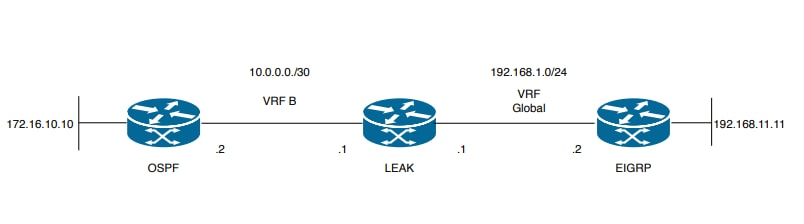
Immagine 3: Topologia di perdita del percorso per lo scenario 3.
Il router LEAK ha un router adiacente OSPF a un router adiacente nel VRF B e un router adiacente EIGRP nel VRF globale. La periferica 172.16.10.10 deve connettersi alla periferica 192.168.11.11 attraverso la rete.
Il router LEAK non può connettersi a questi due host. Queste tabelle di routing mostrano i percorsi correnti per VRF e indicano i percorsi che devono essere trafugati tra VRF B e VRF globale.
Tabella di routing delle perdite:
| Tabella di routing EIGRP (EIGRP) |
LEAK#show ip route
Codes: L - local, C - connected, S - static, R - RIP, M - mobile, B - BGP
D - EIGRP, EX - EIGRP external, O - OSPF, IA - OSPF inter area
N1 - OSPF NSSA external type 1, N2 - OSPF NSSA external type 2
E1 - OSPF external type 1, E2 - OSPF external type 2, m - OMP
n - NAT, Ni - NAT inside, No - NAT outside, Nd - NAT DIA
i - IS-IS, su - IS-IS summary, L1 - IS-IS level-1, L2 - IS-IS level-2
ia - IS-IS inter area, * - candidate default, U - per-user static route
H - NHRP, G - NHRP registered, g - NHRP registration summary
o - ODR, P - periodic downloaded static route, l - LISP
a - application route
+ - replicated route, % - next hop override, p - overrides from PfR

Gateway of last resort is not set

192.168.1.0/24 is variably subnetted, 2 subnets, 2 masks
C 192.168.1.0/24 is directly connected, Ethernet0/1
L 192.168.1.1/32 is directly connected, Ethernet0/1
192.168.11.0/32 is subnetted, 1 subnets
D 192.168.11.11 [90/1024640] via 192.168.1.2, 01:08:38, Ethernet0/1 >> Route to be exchange from global routing table at VRF B routing table.
| VRF B Routing Table (OSPF) |
LEAK#show ip route vrf B

Routing Table: B
Codes: L - local, C - connected, S - static, R - RIP, M - mobile, B - BGP
D - EIGRP, EX - EIGRP external, O - OSPF, IA - OSPF inter area
N1 - OSPF NSSA external type 1, N2 - OSPF NSSA external type 2
E1 - OSPF external type 1, E2 - OSPF external type 2, m - OMP
n - NAT, Ni - NAT inside, No - NAT outside, Nd - NAT DIA
i - IS-IS, su - IS-IS summary, L1 - IS-IS level-1, L2 - IS-IS level-2
ia - IS-IS inter area, * - candidate default, U - per-user static route
H - NHRP, G - NHRP registered, g - NHRP registration summary
o - ODR, P - periodic downloaded static route, l - LISP
a - application route
+ - replicated route, % - next hop override, p - overrides from PfR

Gateway of last resort is not set

10.0.0.0/8 is variably subnetted, 2 subnets, 2 masks
C 10.0.0.0/30 is directly connected, Ethernet0/0
L 10.0.0.2/32 is directly connected, Ethernet0/0
172.16.0.0/32 is subnetted, 1 subnets
O 172.16.10.10 [110/11] via 10.0.0.1, 01:43:45, Ethernet0/0 >> Route to be exchange from routing table VRF B at global routing table.
Configurazione
Completare questa procedura per creare la perdita tra le due tabelle di routing:
Step 1.
Create route-maps for import and export to be injected in both routing tables.

LEAK(config)#Route-map OSPF_TO_EIGRP
LEAK(config-route-map)#match ip address prefix-list OSPF_TO_EIGRP
LEAK(config-route-map)#exit
!
Prefix-list created to match the host that is attached to the previous route-map configured.
!
ip prefix-list OSPF_TO_EIGRP permit 172.16.10.10/32
ip prefix-list OSPF_TO_EIGRP permit 10.0.0.0/30

or

LEAK(config)#Route-map OSPF_TO_EIGRP
LEAK(config-route-map)#match ip address 10
LEAK(config-route-map)#exit
!
ACL created to match the host that is attached to the previous route-map.
!
LEAK#show ip access-lists 10
10 permit 172.16.10.10
20 permit 10.0.0.0

LEAK(config)#Route-map EIGRP_TO_OSPF
LEAK(config-route-map)#match ip address prefix-list EIGRP_TO_OSPF
LEAK(config-route-map)#exit
!
Prefix-list created to match the host that is attached to the previous route-map configured.
!
ip prefix-list EIGRP_TO_OSPF permit 192.168.11.11/32
ip prefix-list EIGRP_TO_OSPF permit 192.168.1.0/24

or

LEAK(config)#Route-map EIGRP_TO_OSPF
LEAK(config-route-map)#match ip address 20
LEAK(config-route-map)#exit
!
ACL created to match the host that is attached to the previous route-map.
!
LEAK#show ip access-lists 20
10 permit 192.168.11.11
20 permit 192.168.1.0/24

Step 2.
Add the import/export maps in order to match the route-map names.

Current configuration
!
vrf definition B
rd 1:2
!
address-family ipv4
exit-address-family
!
!
LEAK(config-vrf)#vrf definition B
LEAK(config-vrf)#address-family ipv4
LEAK(config-vrf-af)#import ipv4 unicast map EIGRP_TO_OSPF
LEAK(config-vrf-af)#export ipv4 unicast map OSPF_TO_EIGRP

Step 3.
To perform the leak is necessary to create a BGP process, in order to redistribute
the IGPs protocols.

router bgp 1
bgp log-neighbor-changes
!
address-family ipv4 vrf B >> Include the address-family to inject VRF B routing table (OSPF)
!
exit-address-family
Step 4.
Create a Dual Redistribution.

IGPs redistribution.

LEAK(config-router)#router bgp 1
LEAK(config-router)#redistribute eigrp 1
!
LEAK(config-router)#address-family ipv4 vrf B
LEAK(config-router-af)#redistribute ospf 1 match internal external 1 external 2
LEAK(config-router-af)#end

BGP Redistribution

LEAK(config)#router ospf 1 vrf B
LEAK(config-router)#redistribute bgp 1
!
LEAK(config-router)#router eigrp TAC
LEAK(config-router)#
LEAK(config-router)# address-family ipv4 unicast autonomous-system 1
LEAK(config-router-af)#
LEAK(config-router-af)# topology base
LEAK(config-router-af-topology)#redistribute bgp 1 metric 100 1 255 1 1500
Verifica
Controllare le tabelle di routing:
| Tabella di routing globale |
LEAK#show ip route

< Snip for resume >

172.16.0.0/32 is subnetted, 1 subnets
B 172.16.10.10 [20/11] via 10.0.0.1, 00:14:48, Ethernet0/0 >> Route from VRF B routing table at global routing table ( EIGRP ).
192.168.1.0/24 is variably subnetted, 2 subnets, 2 masks
C 192.168.1.0/24 is directly connected, Ethernet0/1
L 192.168.1.1/32 is directly connected, Ethernet0/1
192.168.11.0/32 is subnetted, 1 subnets
D 192.168.11.11 [90/1024640] via 192.168.1.2, 02:16:51, Ethernet0/1
| Tabella di routing VRF B |
LEAK#show ip route vrf B
Routing Table: B

< Snip for resume >

10.0.0.0/8 is variably subnetted, 2 subnets, 2 masks
C 10.0.0.0/30 is directly connected, Ethernet0/0
L 10.0.0.2/32 is directly connected, Ethernet0/0
172.16.0.0/32 is subnetted, 1 subnets
O 172.16.10.10 [110/11] via 10.0.0.1, 00:34:25, Ethernet0/0
192.168.1.0/24 is variably subnetted, 2 subnets, 2 masks
B 192.168.1.0/24 is directly connected, 00:08:51, Ethernet0/1
L 192.168.1.1/32 is directly connected, Ethernet0/1
192.168.11.0/32 is subnetted, 1 subnets
B 192.168.11.11 [20/1024640] via 192.168.1.2, 00:08:51, Ethernet0/1 >> Route from global routing table ( EIGRP ) at VRF B routing table.
Scenario 4 - Perdita della route predefinita VRF da OSPF a BGP
Nello scenario 4 viene fornito un esempio di route predefinita VRF che perde da OSPF a BGP.
Esempio di rete
Il diagramma reticolare nell'immagine 4 mostra la topologia di livello 3 in cui è necessaria una perdita di percorso predefinita.

Immagine 4: Topologia di perdita del percorso per lo scenario 4
Il processo OSPF e BGP sono in esecuzione in un VRF diverso sul router LEAK. La route predefinita è presente nel router OSPF. Il router LEAK ha un vicinato BGP in VRF A con Router BGP e un vicinato OSPF in VRF B con Router OSPF.
La perdita del router predefinito da OSPF a BGP su LEAK del router viene dimostrata nella fase di configurazione successiva.
Configurazione
Step 1
Check if a static default route is present in Router OSPF.

OSPF#sh ip route

<output snipped>

Gateway of last resort is 192.168.10.2 to network 0.0.0.0

S* 0.0.0.0/0 [1/0] via 192.168.10.2   >>> default route is present in the routing table.
C 192.168.0.0/24 is directly connected, GigabitEthernet2
L 192.168.0.2/32 is directly connected, GigabitEthernet2
192.168.10.0/24 is variably subnetted, 2 subnets, 2 masks
C 192.168.10.0/24 is directly connected, GigabitEthernet1
L 192.168.10.1/32 is directly connected, GigabitEthernet1


Step 2
From the OSPF router, the default route needs to be advertised in OSPF to Router LEAK.

Use the command "default-information originate" on Router OSPF under OSPF process:( if there is static route in the OSPF router, routing table as verified in Step 1)


OSPF(config)#router ospf 1
OSPF(config-router)#default-information originate


If there is no static route in the Router OSPF routing table then we can generate and advertise a default route to the OSPF neighbour.


OSPF(config)#router ospf 1
OSPF(config-router)#default-information originate always

This forces the router to advertise a default route even if it doesn't have one in its routing table.


Step 3.1
Verify on Router LEAK, if an external OE2 route is installed in the VRF B routing table:

LEAK#sh ip route VRF B

Routing Table: B

<output snipped>

Gateway of last resort is 192.168.0.2 to network 0.0.0.0

O*E2 0.0.0.0/0 [110/1] via 192.168.0.2, 00:05:51, GigabitEthernet2 >>> OE2 route is installed in the VRF B routing table (This needs to be leaked in BGP)
192.168.0.0/24 is variably subnetted, 2 subnets, 2 masks
C 192.168.0.0/24 is directly connected, GigabitEthernet2
L 192.168.0.1/32 is directly connected, GigabitEthernet2

Step 3.2
Configure a prefix-list on Router LEAK

LEAK# conf t
LEAK(config)# ip prefix-list OSPF_TO_BGP seq 5 permit 0.0.0.0/0

Configure a route-map to match the prefix-list.

LEAK(config-route-map)#route-map OSPF_TO_BGP permit 10
LEAK(config-route-map)# match ip address prefix-list OSPF_TO_BGP
LEAK(config-route-map)#exit

Step 3.3
Verify on Router LEAK, that required VRFs , Route Distinguishers (RD) an Route Targets (RT) are configured.

LEAK(config)#vrf definition A
LEAK(config-vrf)#rd 1:1
LEAK(config-vrf)#address-family ipv4
LEAK(config-vrf-af)#route-target import 6500:1
LEAK(config-vrf-af)#exit-address-family
LEAK(config-vrf-af)#end
LEAK#

LEAK(config)#vrf definition B
LEAK(config-vrf)#rd 2:2
LEAK(config-vrf)#address-family ipv4
LEAK(config-vrf-af)#route-target export 6500:1
LEAK(config-vrf-af)#exit-address-family
LEAK(config-vrf-af)#end
LEAK#

Step 3.4
Configure import map in VRF A.

LEAK#conf t
LEAK(config)#vrf definition A
LEAK(config-vrf)#address-family ipv4
LEAK(config-vrf-af)#import map OSPF_TO_BGP
LEAK(config-vrf-af)#end
LEAK#


Step 3.5
Create an address family VRF B in the BGP configuration and advertise “0.0.0.0”

LEAK#sh run | sec bgp
redistribute bgp 6501
router bgp 6501
bgp router-id 10.0.0.1
bgp log-neighbor-changes
!
address-family ipv4 vrf A
neighbor 10.0.0.2 remote-as 6500
neighbor 10.0.0.2 activate
exit-address-family
!
address-family ipv4 vrf B
network 0.0.0.0
exit-address-family

Nota: La creazione di una famiglia di indirizzi VRF in BGP funziona senza attivare alcun router adiacente. La semplice generazione del processo BGP è necessaria per eliminare le route tra il VRF.
Verifica
Verify the default route available in BGP.

LEAK#sh ip route vrf A

Routing Table: A

<output snipped>

Gateway of last resort is 192.168.0.2 to network 0.0.0.0

B* 0.0.0.0/0 [20/1] via 192.168.0.2 (B), 00:15:36, GigabitEthernet2 >>> Default route of VRF B routing table in VRF A routing table.
10.0.0.0/8 is variably subnetted, 2 subnets, 2 masks
C 10.0.0.0/24 is directly connected, GigabitEthernet1
L 10.0.0.1/32 is directly connected, GigabitEthernet1
Ulteriori risorse
Cronologia delle revisioni
| Revisione | Data di pubblicazione | Commenti |
|---|---|---|
5.0 |
08-Jun-2026
|
Controllo ortografico, grammaticale, struttura della frase e immagini Alt Text aggiornate |
4.0 |
16-Oct-2024
|
Formattazione aggiornata. |
3.0 |
12-Jan-2023
|
Rettifica del titolo e correzione del nome dell'autore. Certificato. |
2.0 |
26-Oct-2021
|
Rettifica titolo e nome dell'autore corretto |
1.0 |
16-Dec-2020
|
Versione iniziale |

 Feedback