- New and Changed Information
- Preface
-
- Configuring the MPLS Label Distribution Protocol
- Configuring MPLS LDP Autoconfiguration
- Configuring MPLS LDP Session Protection
- Configuring MPLS LDP IGP Synchronization
- Configuring MPLS LDP Lossless MD5 Session Authentication
- Configuring MPLS LDP Label Filtering
- Configuring MPLS LDP Static Label Binding
- Configuring MPLS LDP Graceful Restart
-
- Configuring Basic MPLS TE
- Configuring Automatic Bandwidth Adjustment for MPLS TE Tunnels
- Configuring MPLS TE RSVP
- Configuring the Path Selection Metric for MPLS TE Tunnels
- Configuring LSP Attributes for MPLS TE
- Configuring MPLS TE Verbatim Paths
- Configuring MPLS TE Forwarding Adjacency
- Configuring MPLS TE Class-Based Tunnel Selection
- Configuring MPLS TE Path Protection
- Configuring MPLS TE Fast Reroute Link and Node Protection
-
- Configuring Any Transport over MPLS
- Configuring Any Transport over MPLS Pseudowire Provisioning
- Configuring Ethernet over MPLS
- Configuring EoMPLS Layer 2 VPN Graceful Restart
- Configuring Virtual Private LAN Service
- Configuring Layer 2 VPN Pseudowire Redundancy
- Configuring Layer 2 VPN VPLS Dual-Homing with a vPC
- Configuration Limits for Cisco NX-OS MPLS
- RFCs
Cisco Nexus 7000 Series NX-OS MPLS Configuration Guide
Bias-Free Language
The documentation set for this product strives to use bias-free language. For the purposes of this documentation set, bias-free is defined as language that does not imply discrimination based on age, disability, gender, racial identity, ethnic identity, sexual orientation, socioeconomic status, and intersectionality. Exceptions may be present in the documentation due to language that is hardcoded in the user interfaces of the product software, language used based on RFP documentation, or language that is used by a referenced third-party product. Learn more about how Cisco is using Inclusive Language.
- Updated:
- October 5, 2015
Chapter: Configuring MPLS TE Forwarding Adjacency
- Finding Feature Information
- Information About MPLS TE Forwarding Adjacency
- Licensing Requirements for MPLS TE Forwarding Adjacency
- Prerequisites for MPLS TE Forwarding Adjacency
- Guidelines and Limitations for MPLS TE Forwarding Adjacency
- Default Settings for MPLS TE Forwarding Adjacency
- Configuring MPLS TE Forwarding Adjacency
- Verifying the MPLS TE Forwarding Adjacency Configuration
- Configuration Example for MPLS TE Forwarding Adjacency
- Additional References for MPLS TE Forwarding Adjacency
- Feature History for MPLS TE Forwarding Adjacency
Configuring MPLS TE Forwarding Adjacency
This chapter describes how to configure Multiprotocol Label Switching (MPLS) traffic engineering (TE) forwarding adjacency on Cisco NX-OS devices.
This chapter includes the following sections:
- Finding Feature Information, page 17-242
- Information About MPLS TE Forwarding Adjacency, page 17-242
- Licensing Requirements for MPLS TE Forwarding Adjacency, page 17-243
- Prerequisites for MPLS TE Forwarding Adjacency, page 17-243
- Guidelines and Limitations for MPLS TE Forwarding Adjacency, page 17-244
- Default Settings for MPLS TE Forwarding Adjacency, page 17-244
- Configuring MPLS TE Forwarding Adjacency, page 17-244
- Verifying the MPLS TE Forwarding Adjacency Configuration, page 17-245
- Configuration Example for MPLS TE Forwarding Adjacency, page 17-246
- Additional References for MPLS TE Forwarding Adjacency, page 17-247
- Feature History for MPLS TE Forwarding Adjacency, page 17-247
Finding Feature Information
Your software release might not support all the features documented in this module. For the latest caveats and feature information, see the Bug Search Tool at https://tools.cisco.com/bugsearch/ and the release notes for your software release. To find information about the features documented in this module, and to see a list of the releases in which each feature is supported, see the “New and Changed Information” chapter or the Feature History table below.
Information About MPLS TE Forwarding Adjacency
MPLS TE forwarding adjacency allows you to handle a TE label-switched path (LSP) tunnel as a link in an Interior Gateway Protocol (IGP) network that is based on the Shortest Path First (SPF) algorithm. Both Intermediate System-to-Intermediate System (IS-IS) and Open Shortest Path First (OSPF) are supported as the IGP.
A forwarding adjacency can be created between switches regardless of their location in the network. The switches can be located multiple hops from each other, as shown in Figure 17-1.
Figure 17-1 Forwarding Adjacency Topology
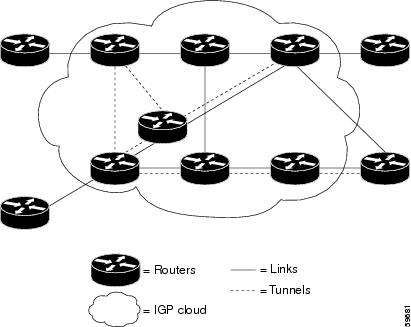
As a result, a TE tunnel is advertised as a link in an IGP network with the tunnel’s cost associated with it.
Switches outside of the TE domain see the TE tunnel and use it to compute the shortest path for routing traffic throughout the network.
TE tunnel interfaces are advertised in the IGP network just like any other links. Switches can then use these advertisements in their IGPs to compute the SPF even if they are not the headend of any TE tunnels.
Licensing Requirements for MPLS TE Forwarding Adjacency
Prerequisites for MPLS TE Forwarding Adjacency
Forwarding adjacency has the following prerequisites:
- You must enable the MPLS TE feature. See the “Configuring MPLS TE”.
Guidelines and Limitations for MPLS TE Forwarding Adjacency
Forwarding adjacency has the following configuration guidelines and limitations:
- Forwarding adjacency increases the size of the IGP database by advertising a TE tunnel as a link.
- When you enable forwarding adjacency on a TE tunnel, the link is advertised in the IGP network as a type, length, value (TLV) 22 object without any TE sub-TLV.
- You must configure MPLS TE forwarding adjacency tunnels bidirectionally.
- You cannot configure MPLS TE over the logical generic routing encapsulation (GRE) tunnel interface.

Note If both forwarding adjacency and autoroute announce are configured on a link, forwarding adjacency takes precedence. The autoroute configuration takes effect automatically if the forwarding adjacency configuration is removed, but not if the forwarding adjacency path fails.
Default Settings for MPLS TE Forwarding Adjacency
Table 17-1 lists the default settings for forwarding adjacency.
|
|
|
|---|---|
Configuring MPLS TE Forwarding Adjacency
You can configure a tunnel interface for an MPLS TE forwarding adjacency.
Note You must configure a forwarding adjacency on two LSP tunnels bidirectionally from A to B and B to A. Otherwise, the forwarding adjacency is advertised but not used in the IGP network.
Prerequisites
You must have the MPLS TE feature enabled (see the “Configuring MPLS TE”).
Ensure that you are in the correct VDC (or use the switchto vdc command).
SUMMARY STEPS
3. forwarding-adjacency [ holdtime value ]
4. isis metric metric-value { level-1 | level-2 }
DETAILED STEPS
Verifying the MPLS TE Forwarding Adjacency Configuration
To display the MPLS TE forwarding adjacency configuration, perform one of the following tasks:
|
|
|
|---|---|
show isis [ process-tag ] database [ level-1 ] [ level-2 ] [ l1 ] [ l2 ] [ detail ] [ lspid ] |
For detailed information about the fields in the output from these commands, see the Cisco NX-OS MPLS Command Reference.
Configuration Example for MPLS TE Forwarding Adjacency
The following example shows how to configure a TE tunnel interface with forwarding adjacency and an IS-IS metric:
Note If both the forwarding adjacency command and the autoroute announce command appear in your configuration, the forwarding adjacency command takes precedence.
In Figure 17-2, if you have no forwarding adjacencies configured for the TE tunnels between B and F, and C and F, all the traffic that A must forward to F goes through B because B is the shortest path from A to F. (The cost from A to F is 15 through B and 20 through C.)
Figure 17-2 Using Forwarding Adjacencies
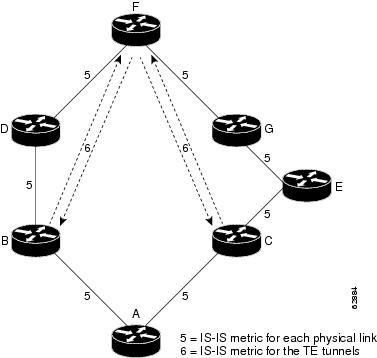
If you have forwarding adjacencies configured on the TE tunnels between B and F and C and F and also on the TE tunnels between F and B, and F and C, then when A computes the SPF algorithm, A sees two equal cost paths of 11 to F. As a result, traffic across the A–B and A–C links is shared.
Additional References for MPLS TE Forwarding Adjacency
For additional information related to the Forwarding Adjacency feature, see the following sections:
Related Documents
|
|
|
|---|---|
MIBs
|
|
|
|---|---|
To locate and download Cisco MIBs for selected platforms, Cisco IOS releases, and feature sets, use Cisco MIB Locator found at the following URL: |
Feature History for MPLS TE Forwarding Adjacency
Table 17-2 lists the release history for this feature.
|
|
|
|
|---|---|---|
 Feedback