- Cisco Unified Border Element Enterprise Protocol-Independent Features and Setup
- SIP-to-SIP Extended Feature Functionality for Session Border Controllers
- Bandwidth-based Call Admission Control
- Interworking Between RSVP Capable and RSVP Incapable Networks
- Cisco Resource Reservation Protocol Agent
- SIP INFO Method for DTMF Tone Generation
- DTMF Events through SIP Signaling
- Negotiation of an Audio Codec from a List of Codecs
- Dynamic Payload Type Interworking for DTMF and Codec Packets for SIP-to-SIP Calls
- iLBC Support for SIP and H.323
- DSP-Based Functionality on the Cisco UBE Enterprise Including Transcoding and Transrating
- Acoustic Shock Protection
- Noise Reduction
- SIP Ability to Send a SIP Registration Message on a Border Element
- SIP Parameter Modification
- Session Refresh with Reinvites
- SIP Stack Portability
- Interworking of Secure RTP calls for SIP and H.323
- Cisco UBE Support for SRTP-RTP Internetworking
- SIP SRTP Fallback to Nonsecure RTP
- VoIP for IPv6
- Support for Software Media Termination Point
- Cisco Unified Communication Trusted Firewall Control
- Cisco Unified Communication Trusted Firewall Control-Version II
- Cisco Unified Communications Trusted Firewall Control - Version III
- Additional References
- Glossary
Cisco Unified Border Element (Enterprise) Protocol-Independent Features and Setup Configuration Guide, Cisco IOS XE Release 3S (Cisco ASR 1000)
Bias-Free Language
The documentation set for this product strives to use bias-free language. For the purposes of this documentation set, bias-free is defined as language that does not imply discrimination based on age, disability, gender, racial identity, ethnic identity, sexual orientation, socioeconomic status, and intersectionality. Exceptions may be present in the documentation due to language that is hardcoded in the user interfaces of the product software, language used based on RFP documentation, or language that is used by a referenced third-party product. Learn more about how Cisco is using Inclusive Language.
- Updated:
- August 6, 2012
Chapter: VoIP for IPv6
- Finding Feature Information
- Prerequisites for VoIP for IPv6
- Information About VoIP for IPv6
- How to Configure VoIP for IPv6
- Configuring a SIP Voice Gateway for IPv6
- Shutting Down or Enabling VoIPv6 Service on Cisco Gateways
- Shutting Down or Enabling VoIPv6 Submodes on Cisco Gateways
- Configuring the Protocol Mode of the SIP Stack
- Configuring the Source IPv6 Address of Signaling and Media Packets
- Configuring the SIP Server
- Configuring the Session Target
- Configuring SIP Register Support
- Configuring Outbound Proxy Server Globally on a SIP Gateway
- Verifying SIP Gateway Status
- Configuring H.323 IPv4-to-SIPv6 Connections in a Cisco Unified Border Element
- Configuring MTP Used with Voice Gateways
- Configuring a SIP Voice Gateway for IPv6
VoIP for IPv6
This document describes VoIP in IPv6 (VoIPv6), a feature that adds IPv6 capability to existing VoIP features. This feature adds dual-stack (IPv4 and IPv6) support on voice gateways and media termination points (MTPs), IPv6 support for Session Initiation Protocol (SIP) trunks, and support for Skinny Client Control Protocol (SCCP)-controlled analog voice gateways. In addition, the Session Border Controller (SBC) functionality of connecting a SIP IPv4 or H.323 IPv4 network to a SIP IPv6 network is implemented on a Cisco Unified Border Element to facilitate migration from VoIPv4 to VoIPv6.
Finding Feature Information
Your software release may not support all the features documented in this module. For the latest caveats and feature information, see Bug Search Tool and the release notes for your platform and software release. To find information about the features documented in this module, and to see a list of the releases in which each feature is supported, see the feature information table at the end of this module.
Use Cisco Feature Navigator to find information about platform support and Cisco software image support. To access Cisco Feature Navigator, go to www.cisco.com/go/cfn. An account on Cisco.com is not required.
Prerequisites for VoIP for IPv6
- Cisco Express Forwarding for IPv6 must be enabled.
- Virtual routing and forwarding (VRF) is not supported in IPv6 calls.
Information About VoIP for IPv6
SIP Voice Gateways in VoIPv6
SIP is a simple, ASCII-based protocol that uses requests and responses to establish communication among the various components in the network and to ultimately establish a conference between two or more endpoints.
For further information about this feature and information about configuring the SIP voice gateway for VoIPv6, see the Configuring a SIP Voice Gateway for IPv6.
MTP Used with Voice Gateways in VoIPv6
Cisco IOS MTP trusted relay point (TRP) supports media interoperation between IPv4 and IPv6 networks.
How to Configure VoIP for IPv6
- Configuring a SIP Voice Gateway for IPv6
- Configuring H.323 IPv4-to-SIPv6 Connections in a Cisco Unified Border Element
- Configuring MTP Used with Voice Gateways
Configuring a SIP Voice Gateway for IPv6
SIP is a simple, ASCII-based protocol that uses requests and responses to establish communication among the various components in the network and to ultimately establish a conference between two or more endpoints.
Users in a SIP network are identified by unique SIP addresses. A SIP address is similar to an e-mail address and is in the format of sip:userID@gateway.com. The user ID can be either a username or an E.164 address. The gateway can be either a domain (with or without a hostname) or a specific Internet IPv4 or IPv6 address.
A SIP trunk can operate in one of three modes: SIP trunk in IPv4-only mode, SIP trunk in IPv6-only mode, and SIP trunk in dual-stack mode, which supports both IPv4 and IPv6.
A SIP trunk uses the Alternative Network Address Transport (ANAT) mechanism to exchange multiple IPv4 and IPv6 media addresses for the endpoints in a session. ANAT is automatically enabled on SIP trunks in dual-stack mode. The ANAT Session Description Protocol (SDP) grouping framework allows user agents (UAs) to include both IPv4 and IPv6 addresses in their SDP session descriptions. The UA is then able to use any of its media addresses to establish a media session with a remote UA.
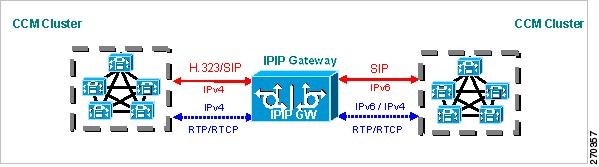
A Cisco Unified Border Element can interoperate between H.323/SIP IPv4 and SIP IPv6 networks in media flow-through mode. In media flow-through mode, both signaling and media flows through the Cisco Unified Border Element, and the Cisco Unified Border Element performs both signaling and media interoperation between H.323/SIP IPv4 and SIP IPv6 networks (see the figure below).
| Figure 1 | H.323/SIP IPv4--SIP IPv6 Interoperating in Media Flow-Through Mode |
- Shutting Down or Enabling VoIPv6 Service on Cisco Gateways
- Shutting Down or Enabling VoIPv6 Submodes on Cisco Gateways
- Configuring the Protocol Mode of the SIP Stack
- Configuring the Source IPv6 Address of Signaling and Media Packets
- Configuring the SIP Server
- Configuring the Session Target
- Configuring SIP Register Support
- Configuring Outbound Proxy Server Globally on a SIP Gateway
- Verifying SIP Gateway Status
Shutting Down or Enabling VoIPv6 Service on Cisco Gateways
DETAILED STEPS
Shutting Down or Enabling VoIPv6 Submodes on Cisco Gateways
DETAILED STEPS
Configuring the Protocol Mode of the SIP Stack
SIP service should be shut down before configuring the protocol mode. After configuring the protocol mode as IPv6, IPv4, or dual-stack, SIP service should be reenabled.
DETAILED STEPS
Example: Configuring the SIP Trunk
This example shows how to configure the SIP trunk to use dual-stack mode, with IPv6 as the preferred mode. The SIP service must be shut down before any changes are made to protocol mode configuration.
Device(config)# sip-ua
Device(config-sip-ua)# protocol mode dual-stack preference ipv6
Disabling ANAT Mode
ANAT is automatically enabled on SIP trunks in dual-stack mode. Perform this task to disable ANAT in order to use a single-stack mode.
DETAILED STEPS
Configuring the Source IPv6 Address of Signaling and Media Packets
Users can configure the source IPv4 or IPv6 address of signaling and media packets to a specific interface's IPv4 or IPv6 address. Thus, the address that goes out on the packet is bound to the IPv4 or IPv6 address of the interface specified with the bind command.
The bind command also can be configured with one IPv6 address to force the gateway to use the configured address when the bind interface has multiple IPv6 addresses. The bind interface should have both IPv4 and IPv6 addresses to send out ANAT.
When you do not specify a bind address or if the interface is down, the IP layer still provides the best local address.
DETAILED STEPS
Example: Configuring the Source IPv6 Address of Signaling and Media Packets
Device(config)# voice service voip
Device(config-voi-serv)# sip
Device(config-serv-sip)# bind control source-interface fastEthernet 0/0
Configuring the SIP Server
DETAILED STEPS
Example: Configuring the SIP Server
Device(config)# sip-ua
Device(config-sip-ua)# sip-server ipv6:[2001:DB8:0:0:8:800:200C:417A]
Configuring the Session Target
Perform this task to configure the session target.
DETAILED STEPS
Example: Configuring the Session Target
Device(config)# dial-peer voice 29 voip
Device(config-dial-peer)# destination-pattern 7777
Device(config-dial-peer)# session target ipv6:[2001:DB8:0:0:8:800:200C:417A]
Configuring SIP Register Support
DETAILED STEPS
Example: Configuring SIP Register Support
Device(config)# sip-ua
Device(config-sip-ua)# registrar ipv6:[2001:DB8:0:0:8:800:200C:417A] expires 3600 secondary
Device(config-sip-ua)# retry register 10
Device((config-sip-ua)#  timers register 500
Configuring Outbound Proxy Server Globally on a SIP Gateway
DETAILED STEPS
Verifying SIP Gateway Status
DETAILED STEPS
Configuring H.323 IPv4-to-SIPv6 Connections in a Cisco Unified Border Element
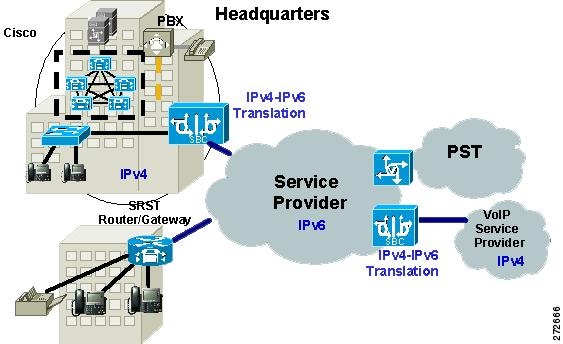
An organization with an IPv4 network can deploy a Cisco Unified Border Element on the boundary to connect with the service provider's IPv6 network (see the figure below).
| Figure 2 | Cisco Unified Border Element Interoperating IPv4 Networks with IPv6 Service Provider |
A Cisco Unified Border Element can interoperate between H.323/SIP IPv4 and SIP IPv6 networks in media flow-through mode. In media flow-through mode, both signaling and media flows through the Cisco Unified Border Element, and the Cisco Unified Border Element performs both signaling and media interoperation between H.323/SIP IPv4 and SIP IPv6 networks (see the figure below).
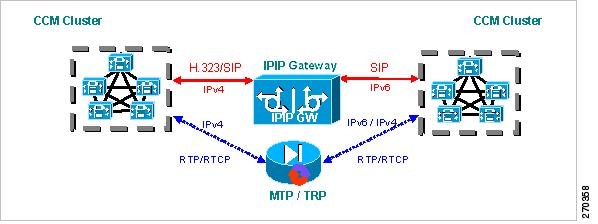
| Figure 3 | IPv4 to IPv6 Media Interoperating Through Cisco IOS MTP |
The Cisco Unified Border Element feature adds IPv6 capability to existing VoIP features. This feature adds dual-stack support on voice gateways and MTP, IPv6 support for SIP trunks, and SCCP-controlled analog voice gateways. In addition, the SBC functionality of connecting SIP IPv4 or H.323 IPv4 network to a SIP IPv6 network is implemented on an Cisco Unified Border Element to facilitate migration from VoIPv4 to VoIPv6.
Cisco Unified Border Element must be configured in IPv6-only or dual-stack mode to support IPv6 calls.
 Note |
A Cisco Unified Border Element interoperates between H.323/SIP IPv4 and SIP IPv6 networks only in media flow-through mode. |
DETAILED STEPS
Example: Configuring H.323 IPv4-to-SIPv6 Connections in a Cisco Unified Border Element
Device(config)# voice service voip
Device(config-voi-serv)# allow-connections h323 to sip
Configuring MTP Used with Voice Gateways
Cisco IOS MTP trusted relay point (TRP) supports media interoperation between IPv4 and IPv6 networks (see the figure below). This functionality is used when an IPv4 phone (registered to Cisco Unified Communications Manager, formerly known as Cisco Unified Call Manager) communicates with an IPv6 phone (registered to another Cisco Unified Communications Manager). In this case, one of the Cisco Unified Communications Managers inserts a Cisco IOS MTP to perform the IPv4-to-IPv6 media translation between the phones.
MTP for IPv4-to-IPv6 media translation operates only in dual-stack mode. Communication between Cisco IOS MTP and Cisco Unified Communications Manager occurs over SCCP for IPv4 only.
| Figure 4 | IPv4 to IPv6 Media Interoperating Through Cisco IOS MTP |
The VoIPv6 feature includes IPv4 and IPv6 dual-stack support on voice gateways and MTP, IPv6 support for SIP trunks, and SCCP-controlled analog phones. In addition, connecting a SIP IPv4 or H.323 IPv4 network to a SIP IPv6 network is implemented on Cisco Unified Border Element.
Configuring MTP for IPv4-to-IPv6 Translation
MTP for IPv4-to-IPv6 media translation operates in dual-stack mode only. A SIP trunk can be configured over IPv4 only, over IPv6 only, or in dual-stack mode. In dual-stack mode, ANAT is used to describe both IPv4 and IPv6 media capabilities.
DETAILED STEPS
Example: Configuring MTP for IPv4-to-IPv6 Translation
Device(config)# sccp ccm group 1
Device(config-sccp-ccm)#associate profile 5 register MTP3825
Device(config-sccp-ccm)# exit
Device(config)# dspfarm profile 5 mtp
Device(config-dspfarm-profile)# codec g711ulaw
Device(config-dspfarm-profile)# maximum sessions software 100
Device(config-dspfarm-profile)# associate application sccp

Device# show sccp
sccp ccm group 1
associate profile 5 register MTP3825
!
dspfarm profile 5 mtp
 codec g711ulaw
 maximum sessions software 100
 associate application SCCP
Feature Information for VoIP for IPv6
The following table provides release information about the feature or features described in this module. This table lists only the software release that introduced support for a given feature in a given software release train. Unless noted otherwise, subsequent releases of that software release train also support that feature.
Use Cisco Feature Navigator to find information about platform support and Cisco software image support. To access Cisco Feature Navigator, go to www.cisco.com/go/cfn. An account on Cisco.com is not required.
| Table 1 | Feature Information for VoIP for IPv6 |
| Feature Name | Releases | Feature Information |
|---|---|---|
| Cisco UBE support for IPv6 |
12.4(22)T |
Cisco UBE support for SIP IPv4-IPv6 dual stack and IPv4 and IPv6 capability provides the following functionality:
|
| DSCP-Based QoS Support |
12.4(22)T |
IPv6 supports this feature. |
| IPv6 Dual Stack |
12.4(22)T |
Adds IPv6 capability to existing VoIP features on the Cisco Unified Border Element. Additionally, the SBC functionality of connecting SIP IPv4 or H.323 IPv4 network to SIP IPv6 network is implemented on a Cisco Unified Border Element to facilitate migration from VoIPv4 to VoIPv6. The following commands were introduced or modified: None |
| IPv6 Dual Stack |
Cisco IOS XE Release 3.3S |
Adds IPv6 capability to existing VoIP features on the Cisco Unified Border Element (Enterprise). Additionally, the SBC functionality of connecting SIP IPv4 or H.323 IPv4 network to SIP IPv6 network is implemented on a Cisco Unified Border Element to facilitate migration from VoIPv4 to VoIPv6. The following commands were introduced or modified: None |
| RTP/RTCP over IPv6 |
12.4(22)T |
RTP stack supports the ability to create IPv6 connections using IPv6 unicast and multicast addresses as well as IPV4 connections. |
| TDM-SIP GW for IPv6 |
12.4(24)T |
IPv6 supports this feature. |
| Voice Gateway/MTP |
12.4(22)T |
Support for If an MTP (Media Translation Point) is used for SIP IPv4/IPv6 media translation. The following commands were introduced or modified: None |
Cisco and the Cisco logo are trademarks or registered trademarks of Cisco and/or its affiliates in the U.S. and other countries. To view a list of Cisco trademarks, go to this URL: www.cisco.com/go/trademarks. Third-party trademarks mentioned are the property of their respective owners. The use of the word partner does not imply a partnership relationship between Cisco and any other company. (1110R)
Any Internet Protocol (IP) addresses and phone numbers used in this document are not intended to be actual addresses and phone numbers. Any examples, command display output, network topology diagrams, and other figures included in the document are shown for illustrative purposes only. Any use of actual IP addresses or phone numbers in illustrative content is unintentional and coincidental.
 Feedback