

|
|
Rocket Software is a 13-year-old independent software development company with headquarters in Newton, Massachusetts, branch offices in northern California and Arkansas, and some 200 employees and contractors throughout the world. The flourishing company's areas of expertise encompass business intelligence, database tools, data center management, security integration, and Windows utilities.
A "virtual" organization that has taken advantage of the ability to outsource overseas for several years, Rocket uses cutting-edge communications and networking technology to create workgroups that span the U.S. and reach as far as India and China. Furthermore, the company collaborates closely with its original equipment manufacturer (OEM) partners through RocketTrack Partner Portals on its Web site. Key Rocket OEM partners include such familiar names as IBM, RSA Security, Microsoft, NEC, and Toshiba. The company also sells software directly to end customers.
Rocket excels at combining onshore innovation and offshore cost benefits to reduce development cycles and overhead, while delivering a level of responsiveness that ensures quality and minimizes partners' business risks. The company was named a runner-up in the Operational Excellence category of the Cisco® Growing with Technology Awards 2003.
The primary business challenge that Rocket faced was linking the company's computing resources, engineering talent, and partners in a close-knit collaborative environment that produces best-of-breed code in a timely, cost-effective manner. As Rocket CIO Troy Heindel puts it, "What keeps partners coming back is our ability to deliver products faster, better, and cheaper than they could do it themselves."
So when Rocket prepared to move to its new headquarters building in Newton, Mass., the company took the opportunity to sharpen its interactive capabilities by renovating the corporate telephony system and upgrading the network infrastructure. The company saw the benefit of investing in a solid infrastructure that would help enable growth and new services in the future. Rocket enlisted Cisco reseller NetTeks Technology Consultants to help meet the technical challenges. "Rocket had a very aggressive timeframe, less than a month to verify configuration and deploy the complete solution in the new location," says Scott Pintsopoulos of NetTeks. "We were brought in because of our flexibility and our experience with the local Cisco sales and engineering teams."
Rocket considers voice communications a crucial part of its business model. But the leased private branch exchange (PBX) systems installed at their headquarters and branch offices were no longer up to the job. The PBXs didn't support their own conferencing, unified messaging, and remote links—or would support them only with costly add-on equipment and carrier services. The analog systems were expensive to operate. And Rocket was unhappy with the maintenance delays and lack of control that resulted from the PBX leasing arrangements.
Rocket determined that the answer to their voice communications dilemma was to converge voice and data on a single network. To do this the company had to meet the challenge of increasing the capacity, intelligence, and resilience of its network infrastructure to handle the converged traffic. Another requirement was scalability: the network had to be able to expand in economical increments to keep pace with the growing firm.
Rocket also wanted to make sure the network was protected and corporate communications were secure, even for remotely located workers—25 percent of the total workforce. With developers and partners needing access to mainframes and other computing resources from around the globe, 24-hour availability was essential. In addition, Rocket wanted to install wireless links in their main office to provide connectivity for visitors and mobility for onsite staff.
Rocket worked with reseller NetTeks to design and implement a new communications system based on Cisco IP Communications solutions, networking, security, and mobility solutions tailored specifically for small to medium-sized businesses like Rocket.
Why Cisco? "We looked at the cost and we looked at the functionality and features," says Heindel. "We were comfortable that Cisco products would get the job done, and that we could grow with them." Rocket technical expert Khalil Javid also cites the company's ability to supply a total voice and data solution as a key consideration. "And the reliability and stability of Cisco were important to us," according to Javid.
To provide company-wide telephony services Rocket implemented the Cisco CallManager solution, a market-leading IP converged system that supports IP telephony, unified communications, and customer contact centers. Cisco Conference Connection software gives Rocket robust, Internet-based conferencing with an easy-to-use Web interface that satisfies Rocket's voice collaboration requirements and reduces conferencing expenses to the vanishing point. Cisco Unity Unified Messaging lets Rocket employees manage their e-mail, voice, and fax messages from one mailbox.
Because customer support is critical to their business, Rocket deployed the Cisco IP Contact Center Express Edition. This contact-center-in-a-box solution offers powerful call distribution features that make it possible for Rocket to provide skills-based routing. The software directs customer calls automatically to the specialists who are best able to assist them.
Rocket implemented Cisco Survivable Remote Site Telephony (SRST) capabilities on Cisco access routers to provide fail-back protection for local Cisco IP phones, helping to ensure uptime. Cisco IP Softphone software lets Rocket employees take their phone extensions with them on their laptops, and makes setting up conference calls quick and intuitive.
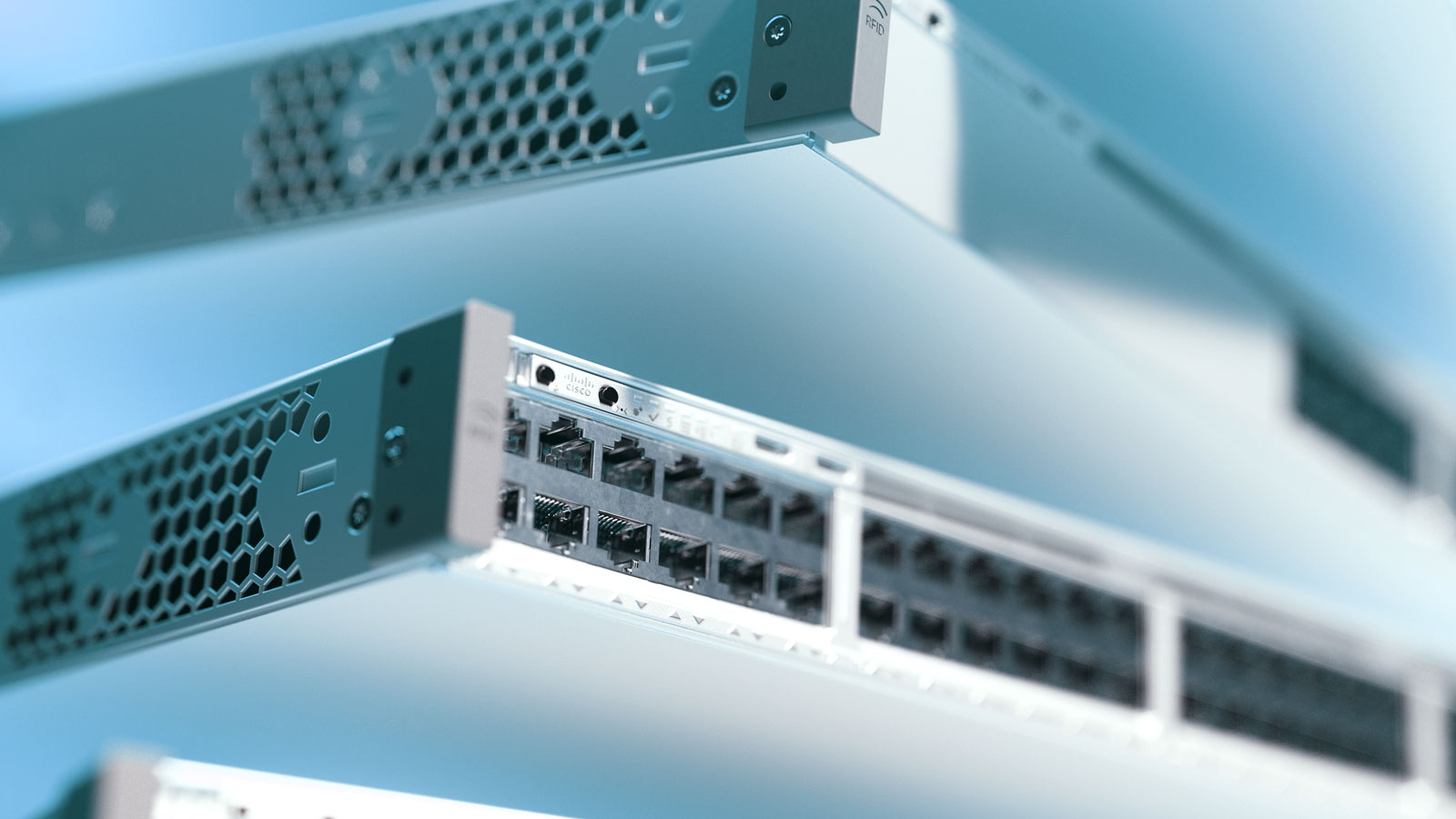
Cisco Catalyst® 4500R 7-slot chassis switches provide Rocket with the capacity-handling control and scalability they were looking for at their larger sites. The switches offer sophisticated quality of service (QoS) for delay-sensitive voice traffic, along with resiliency and configuration flexibility. Additionally, Cisco Catalyst 3550 Series Intelligent Ethernet switches provide stackable, multilayer switching.
Rocket deployed Cisco PIX® security appliances and Cisco VPN 3000 Series concentrators to extend secure connects over the Internet. The PIX units deliver stateful packet inspection, firewalling, protocol and application inspection, virtual private networks (VPNs), and voice security. The VPN 3000 Series concentrators and associated client software bring advanced yet economical encryption and authentication to Rocket's remote users.
Providing 802.11b wireless links at Rocket's headquarters are Cisco Aironet® 1200 Series access points. Modular in design, these Wi-Fi certified access points deliver 11 Mbps connections now and will easily accommodate 54 Mbps 802.11g links in the future.
Heindel sums up the Cisco technology solution this way: "It's appropriate for a business of our size, and provides us with a platform on which we can grow. People are sometimes astounded at what they can do with the technology and how much more effective it makes them in their jobs."
The people at Rocket are confident that their streamlined IP Communications and networking infrastructure has positioned them well for doing business on a global scale and delivering greater value to their OEM partners and direct customers. "Our ability to lower costs and still get better voice and data functionality makes us more competitive," states Heindel. "The network gives us communications capabilities that one might expect to see only in a much larger organization, with a much larger IT budget."
No matter where they happen to be working or what time zone they're in, Rocket employees and contractors stay linked to the company and its culture. Collaboration has been enhanced considerably. Heindel notes that this is in part the result of "simple things like being able to listen to your voicemail from your e-mail program, or calling someone in Russia or China from your home using just four digits." The conferencing capability brings widely dispersed people together in virtual meeting rooms, making the process of software development an interactive rather than a solitary activity. All this while helping to ensure privacy and protection for sensitive information.
In terms of return on investment, the company calculates that the new technology will pay for itself in nine months. And the cost savings that Rocket has realized from sending voice communications over the Internet have been spectacular. The US$10,000-per-month conference call bill, the $10,000 a month the company spent on calling cards, and the $200-per-person long distance expenses were all reduced to zero. Plus, Rocket has been able to completely eliminate the cost burden of third-party PBX maintenance.
The Cisco PIX solution made life easier for managers and users alike with simple-to-use VPN connectivity and firewall support. Even teleworkers get enterprise-level security. Equally convenient is the wireless component of the network. Wi-Fi links have been particularly beneficial at quarterly meetings, when visiting employees can tap into the network anywhere in the headquarters building without having to find an empty cubicle equipped with an Ethernet jack. Furthermore, onsite developers don't have to terminate their mainframe connections when moving to a conference room.
With its new future-facing network infrastructure, Rocket is well prepared for growth and change. The company plans to expand its voice conferencing and eventually add a videoconferencing capability. Management anticipates that they'll continue to grow the infrastructure as the company adds employees, locations, and partners. For example, they expect to integrate a fiber channel switch into the network.
What's more, Rocket plans to upgrade the wireless network from 11 Mbps 802.11b to the newer 54 Mbps 802.11g standard, a move that will be facilitated by Cisco Aironet access points.
Overall, the operational improvements Rocket has made with Cisco products have paved the way for continued business success in today's challenging, globalizing economic climate.
Rocket Software is a highly successful software firm that employs a "virtual company" business model to make software development faster, better, and more economical. This case study details how Rocket uses Cisco IP Communications and networking solutions to create globe-spanning workgroups that improve operational efficiency and inspire close collaboration, allowing Rocket to deliver greater value to their OEM partners and direct customers.
Posted: Thu Feb 19 17:06:13 PST 2004
All contents are Copyright © 1992--2004 Cisco Systems, Inc. All rights reserved.
Important Notices and Privacy Statement.