

|
|
The boom in advanced hosting services, a market that Forrester forecasts will grow to US $10 billion by 2002, is just taking off. Key challenges for Data Return to succeed in this business revolve around delivering highly available services to its customer base. At the top of Data Return's list is the ability to offer guaranteed network performance and 99.95 percent service availability for mission-critical customer applications that include enterprise resource planning (ERP), collaboration and sales force automation tools as well as web hosting, supply chain, and e-commerce applications. Not only is the reliability of its customers' application performance critical to their ongoing success but, as an application infrastructure provider, Data Return's network service must be available 24x7 worldwide.
Data Return delivers scalability and reliability to its global customers in two ways. First it addresses reliability through extensive use of clustering technologies for application-specific solutions based on Microsoft Windows 2000 technology. This reliability extends worldwide by delivering its advanced web hosting services across a global network based on Cisco infrastructure. Data Return currently has five data centers: Texas, California, Washington D.C., New York, and London. It is on a rapid course to deploy 14 additional data centers by the end of June 2000.
"We have built a highly redundant, fault-tolerant network infrastructure using Cisco equipment within each data center and across our global network. Only with a large scale infrastructure based on Cisco routers and switches could we provide individual customers a high level of performance and availability they could not justify acquiring for themselves," says Michael S. Shiff, Senior Vice President of marketing, sales and business development.
Data Return's business model also requires that they move at Internet speed to assist customers in deploying business-critical applications within days. Data Return offers a range of clustering services that allow it to deploy proven Cisco and Microsoft solutions in record time. Its goal is to have a shared host customer "revenue-ready" in two hours, a dedicated host customer in service within two days, and a full business-to-business solution based on a clustered host service up and running in 14 days.
To achieve this fast deployment, Data Return needed not only speed and performance from its network equipment vendor but, even more importantly, it also required maximum flexibility to meet the needs of its diverse global customer base. "We chose Cisco because we need flexibility to capitalize on Internet chaos. Cisco is the only vendor that has the 6000 features we need, and they all work as advertised," according to David Kramer, Technical Services Director of Operations.
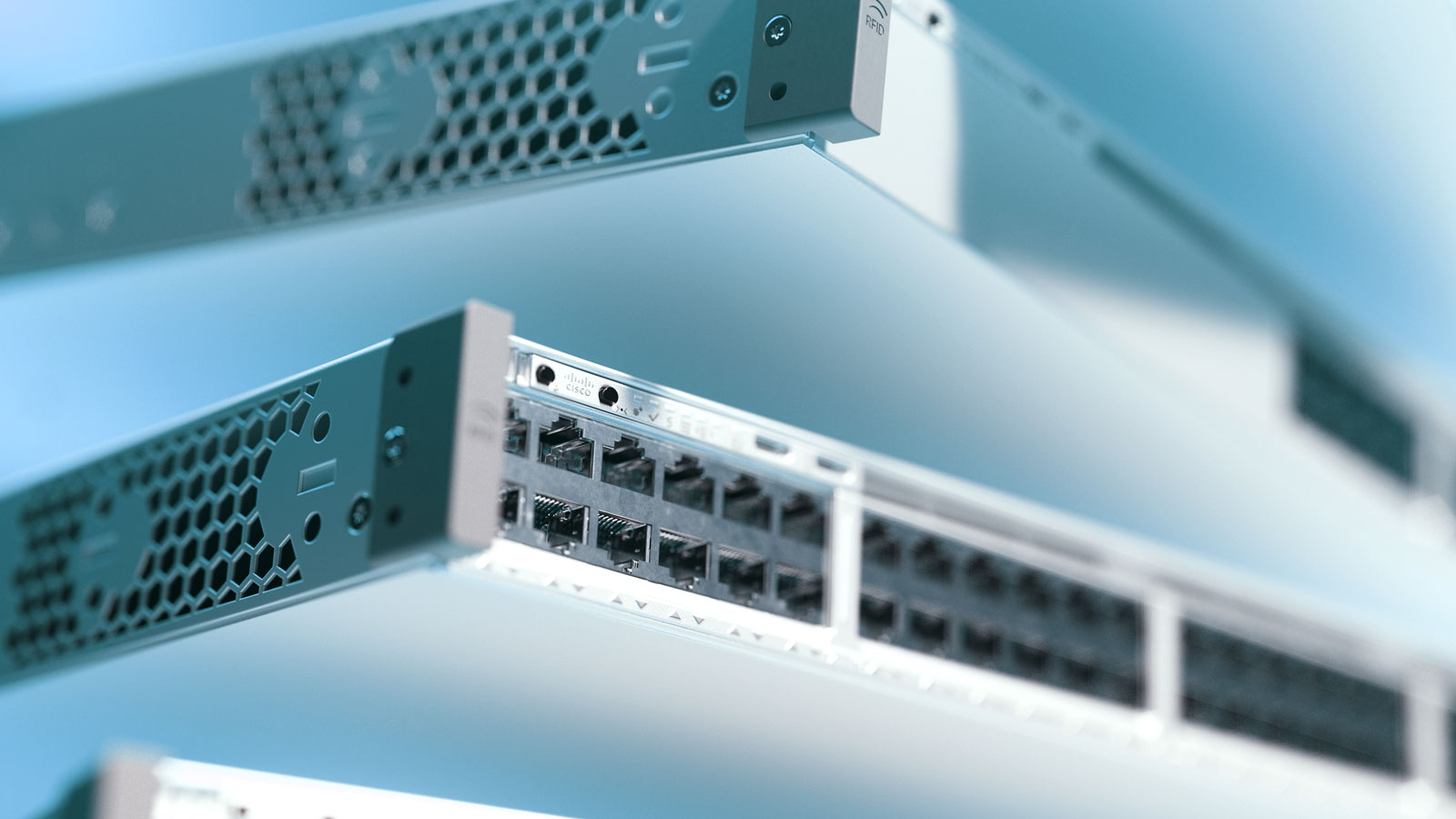
To achieve its goal of end-to-end high availability, all of Data Return's data centers are designed using a redundant, fault-tolerant Cisco router and Catalyst switch architecture to ensure there is no single point of failure. Compaq ProLiant servers are aggregated at the access level using Cisco Catalyst 2924XL switches. (See Figure 1.) Designed for high volumes of Internet traffic, a typical data center contains approximately 384 server cabinets each housing an average of eight servers and two Catalyst 2924XL switches.
Relying on the Catalyst 2924XL Fast EtherChannel® Uplink feature to eliminate bandwidth constraints between the switch and Compaq servers, the Data Return architecture ensures continuous customer access to application services. The three million packets-per-second forwarding rate ensures optimal performance on all 10BaseT/100BaseTX ports. Each Catalyst 2924XL is uplinked to redundant Catalyst 6509 switches to provide the high-speed aggregation needed to support a large install base of servers.
The Cisco Catalyst switch family not only provides Data Return with a high performance, cost-effective solution for aggregating the data center server farms, but it also supports intelligent services Data Return considers critical to maintaining high availability. In particular, the advanced virtual local-area network (VLAN) features supported by the Catalyst 2924XL and Catalyst 6509 switches are pivotal to Data Return's business.
VLANs are used to segment individual customer's servers into separate "logical" networks. They also build in service reliability that is central to Data Return's overall network design. "The ability to support per VLAN spanning tree and to load balance VLAN traffic provides us with the necessary design stability," according to Kramer. "By taking full advantage of VLANs with independent spanning trees, we eliminate the risk of single spanning tree failure from taking down the entire network or multiple subnets."
When combined with the Quick Spanning Tree convergence feature allowing for sub-second distribution link fail-over, the Catalyst switch implementation "ensures we have no single point of failure and that we have fast convergence in the event of a network failure." Kramer said. By implementing dual Catalyst 6509 switches at the distribution layer with FastPath trunk learning, each data center has redundancy down to the network interface card (NIC) level.
At the core, Catalyst 6509 switches with dual Layer 3 switching processors provide continuous high-speed access to the Internet. These are connected to Cisco 7507 routers providing interconnectivity to upstream service providers. The Cisco 7507 redundant Route Switch Processor (RSP) and power supplies give Data Return maximum fault-tolerant support for connectivity via DS3 to their Internet Service Providers (ISPs).
Both the Cisco 7507 routers and Catalyst 6509 switches share responsibility for fast recovery in a network failure. Data Return relies on the Hot-Standby Routing Protocol (HSRP) on the Cisco 7509 routers on inside subnets and Border Gateway Protocol (BGP) multi-hop on outside routing to provide full router redundancy. The core Catalyst 6509 switches also implement HSRP on each subnet with multi-entry subnet VLANs.
The fast fail-over and network convergence technologies implemented at both Layer 2 and 3 interoperate and complement each other to achieve fast recovery. According to Kramer, "We chose Cisco for an end-to-end, standards-based, high-availability solution. The partnering between the Catalyst 2926 and Catalyst 6509 switches, and 7507 routers ensures that any device or link failure does not result in application sessions timing out." Data Return has built fault tolerance throughout the network design to ensure that any network failure remains transparent to its customers and to make good on its service guarantee of uninterrupted access to all applications running on its data center servers.
Data Return has selected Microsoft Windows 2000 Server as its operating system of choice for customers who purchase high-end, clustered hosting solutions. Focused exclusively on providing advanced hosting solutions on the Microsoft platform, Data Return has deployed Microsoft solutions on more than 1000 Compaq ProLiant servers to support its customers all over the world. Efforts are now under way to upgrade all of these customers to Windows 2000.
Data Return is confident that standardizing on Windows 2000 will pay off in improved application performance and enhanced reliability for its customers. After extensive testing and analysis, it found that Windows 2000 delivered increased uptime, scalability, and reliability when compared to Windows NT. It tested Windows 2000 Server performance by running a mixed-operating-system, clustered environment on identical hardware and experienced "a performance and reliability increase of 30-to-40 percent overall and up to 200 percent with multiple processors when compared against Windows NT," says Jason A. Lochhead, Chief Technology Officer, Data Return.
Data Return's high-performance hosting service is optimized for applications that use Windows 2000 Advanced Server, Microsoft Site Server Commerce Edition, Active Server Pages and Microsoft SQL Server 7.0. It offers a range of cluster hosting solutions that provide linear scalability to accommodate high traffic loading. With support for up to eight processors and a larger addressable memory space, Data Return relies heavily on Microsoft SQL servers to offer its customers the most scalable solutions for transactional Internet-intensive applications.
Microsoft Corp. and Cisco Systems have partnered to offer an end-to-end solution for businesses seeking rapid deployment of cost-effective business solutions through application service providers (ASPs) and application infrastructure providers (AIPs) such as Data Return. The Cisco and Microsoft products are enabling Data Return to provide turnkey, high-end, clustered hosting solutions for customer applications that require high availability and scalability worldwide. By standardizing on Cisco and Microsoft technology, Data Return has the flexibility, agility, and performance it needs to deliver leading-edge hosting solutions to its customers in Internet time.

"A Cisco network infrastructure based on Catalyst® switches and high-end routers makes Data Return's business possible. With customers relying on us for mission-critical commercial applications, we could not run our business without the scalability and high availability our Cisco network delivers."
Sunny Vanderbeck,
Chairman and CEO,
Data Return
Posted: Mon Jul 3 02:59:19 PDT 2000
All contents copyright © 1992--2000 Cisco Systems, Inc. Important Notices and Privacy Statement.