Configure the BGP Local-AS Feature

Available Languages
Introduction
This document describes the Border Gateway Protocol (BGP) local-AS feature, which was initially available in Cisco IOS®Software Release 12.0(5)S.
Prerequisites
Requirements
This document recommends knowledge of the BGP routing protocol and its operations. For more information, refer to the Examine Border Gateway Protocol Case Studies.
Components Used
The information in this document was created with this software version, but is not restricted to specific software and hardware versions:
-
Cisco IOS Software Release 12.2(28)
The information in this document was created from the devices in a specific lab environment. All of the devices used in this document started with a cleared (default) configuration. If your network is live, ensure that you understand the potential impact of any command.
Conventions
For more information on document conventions, refer to the Cisco Technical Tips Conventions.
Background Information
The BGP local-AS feature allows a router that runs one BGP Autonomous System (AS) to present a different AS number to a specific eBGP neighbor. This is useful during AS migration scenarios, such as when one ISP acquires another ISP and customers cannot immediately change or prefer to maintain their eBGP configurations. This ensures a smooth transition and minimizes disruptions for the acquired ISP's customers.
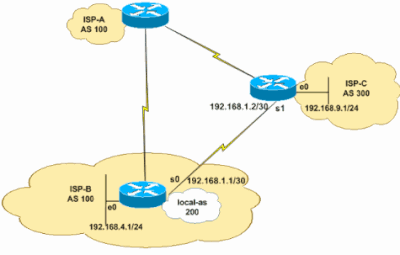
For example, refer to the network diagrams, where in Figure 1, ISP-A has not yet purchased ISP-B and inFigure 2, ISP-A has purchased ISP-B, and ISP-B uses the BGP local-AS feature. If ISP-A purchases ISP-B, but ISP-B customers do not want to modify any configuration, the BGP local-AS feature allows routers in ISP-B to become members of ISP-A (100) AS. At the same time, these routers appear to their customers to retain their ISP-B (200) AS number.
In Figure 2, ISP-B now belongs to AS 100, and ISP-C (customer) to AS 300. When peering with ISP-C, ISP-B uses AS 200 as its AS number with the use of the neighbor <ISP-C> local-as 200 command. In the BGP updates sent from ISP-B to ISP-C, the AS_SEQUENCE in the AS_PATH attribute contains "200 100". The "200" is prepended by ISP-B due to the local-as 200 command configured for ISP-C.
Normally a combined ISP-A/B renumbers the routers in ISP-B to be part of AS 100. What if ISP-C is unable to change its eBGP configurations with ISP-B? Prior to the BGP local-AS feature, the combined ISP-A/B has to maintain two AS numbers. The local-as command allows ISP-A/B to physically be one AS while it appears to be two ASs to ISP-C.
Command Syntax
This list shows the syntax of the commands that the configurations in this document use:
-
neighbor <neighbor IP address> local-as <local-AS-number> -
neighbor <peer-group-name> local-as <local-AS-number>

Note: The configured local AS cannot be the same as the local BGP process AS.
Note: The configured local AS cannot be the same as the remote peer AS.
Note: The local-as command is valid only if the peer is a true eBGP peer. It does not work for two peers in different sub-ASs in a confederation.
Configure
This section presents you with the information to configure the features this document describes.
Network Diagrams
This document uses these network setups.
Figure 1
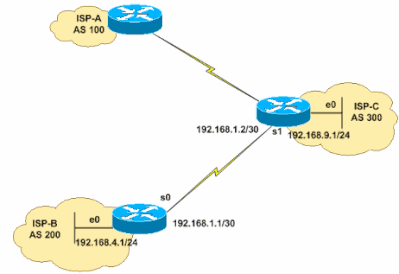
Figure 2
Configurations
The router (within ISP-B) runs BGP AS 100, which represents the post-acquisition AS used by ISP-B. The local-as 200 command causes ISP-C to see this neighbor as AS 200 instead of AS 100. It also causes AS 200 to be prepended to route advertisements sent to ISP-C.
| ISP-B (AS 100, local-as 200) |
|---|
hostname ISP-B ! interface serial 0 ip address 192.168.1.1 255.255.255.252 ! interface ethernet 0 ip address 192.168.4.1 255.255.255.0 ! router bgp 100 !--- Note the AS number 100. This is the AS number of ISP-A, which is now |
| ISP-C (AS 300) |
|---|
hostname ISP-C ! interface serial 1 ip address 192.168.1.2 255.255.255.252 ! interface ethernet 0 ip address 192.168.9.1 255.255.255.0 ! router bgp 300 neighbor 192.168.1.1 remote-as 200 !--- Defines the eBGP connection to ISP-B. !--- Note AS is 200 and not AS 100. network 192.168.9.0 ! ! |
Verify
This section provides information you can use to confirm your configuration properly works.
On ISP-B, show ip bgp summary confirms that the local BGP process runs as AS 100.
ISP-B#show ip bgp summary

  BGP router identifier 192.168.4.1, local AS number 100
  BGP table version is 3, main routing table version 3
  2 network entries and 2 paths using 266 bytes of memory
  2 BGP path attribute entries using 104 bytes of memory
  1 BGP AS-PATH entries using 24 bytes of memory
  0 BGP route-map cache entries using 0 bytes of memory
  0 BGP filter-list cache entries using 0 bytes of memory
  BGP activity 2/6 prefixes, 2/0 paths, scan interval 15  secs

  Neighbor        V    AS MsgRcvd MsgSent   TblVer  InQ OutQ Up/Down  State/PfxRcd
  192.168.1.2     4   300      29      29        3    0    0 00:25:19       1
In the next output on ISP-C, show ip bgp summary confirms that the ISP-B neighbor at 192.168.1.1 is seen as AS 200.
ISP-C#show ip bgp summary
  BGP table version is 3, main routing table version 3
  2 network entries (2/6 paths) using 480 bytes of memory
  2 BGP path attribute entries using 192 bytes of memory
  0 BGP route-map cache entries using 0 bytes of memory
  0 BGP filter-list cache entries using 0 bytes of memory

  Neighbor        V    AS MsgRcvd MsgSent  TblVer InQ OutQ   Up/Down  State/PfxRcd
  192.168.1.1     4   200      34      34       3   0    0  00:30:19   1
Notice in this output that ISP-B prepends "200" to the routes learned from ISP-C. The local-as 200 command causes ISP-B to present AS 200 to ISP-C. ISP-C sees routes from ISP-B with AS_PATH 200 100, while ISP-B displays routes learned from ISP-C with AS_PATH 200 300.
ISP-B#show ip bgp

  BGP table version is 3, local router ID is 192.168.4.1
  Status codes: s suppressed, d damped, h history, * valid, > best, i - internal
  Origin codes: i - IGP, e - EGP, ? - incomplete

  Network          Next Hop            Metric LocPrf  Weight   Path
  *> 192.168.4.0      0.0.0.0               0          32768   i
  *> 192.168.9.0      192.168.1.2           0              0   200 300 i
Notice that the show ip bgp output confirms the AS_PATH behavior introduced by the local-as command. ISP-C receives route 192.168.4.0/24 with AS_PATH "200 100" from ISP-B.
ISP-C#show ip bgp
  BGP table version is 3, local router ID is 192.168.1.2
  Status codes: s suppressed, d damped, h history, * valid, > best, i - internal
  Origin codes: i - IGP, e - EGP, ? - incomplete

  Network          Next Hop          Metric LocPrf  Weight Path
  *> 192.168.4.0      192.168.1.1         0              0 200 100 i
  *> 192.168.9.0      0.0.0.0             0          32768 i
These commands show the configured local-as values in their output:
-
show ip bgp neighbor <neighbor IP address> -
show ip bgp peer-group <peer-group-name>
ISP-B#show ip bgp neighbors 192.168.1.2
BGP neighbor is 192.168.1.2,  remote AS 300,  local AS 200, external link
  BGP version 4, remote router ID 192.168.9.1
  BGP state = Established, up for 00:22:42
  Last read 00:00:42, hold time is 180, keepalive interval is 60 seconds
  Neighbor capabilities:
    Route refresh: advertised and received(old & new)
    Address family IPv4 Unicast: advertised and received
  Message statistics:
    InQ depth is 0
    OutQ depth is 0
                         Sent       Rcvd
    Opens:                  1          1
    Notifications:          0          0
    Updates:                2          1
    Keepalives:            25         25
    Route Refresh:          0          1
    Total:                 28         28
  Default minimum time between advertisement runs is 30 seconds
Troubleshoot
The debug ip bgp updates command displays the received prefixes with its attributes from the neighbor. This output shows that the prefix 192.168.4.0/24 is received with AS PATH 200, 100.

Caution: The debug ip bgp updates command can generate high-volume output on production routers. Use it only during controlled troubleshooting, preferably during a maintenance window or under TAC guidance. Disable debugging with undebug all or no debug ip bgp updates after collecting the required output.
ISP-C#
*May 10 12:45:14.947: BGP(0): 192.168.1.1 computing updates, afi 0, neighbor version 0, table version 5, starting at 0.0.0.0
*May 10 12:45:14.947: BGP(0): 192.168.1.1 send UPDATE (format) 192.168.9.0/24, next 192.168.1.2, metric 0, path
*May 10 12:45:14.947: BGP(0): 192.168.1.1 1 updates enqueued (average=52, maximum=52)
*May 10 12:45:14.947: BGP(0): 192.168.1.1 update run completed, afi 0, ran for 0ms, neighbor version 0, start version 5, throttled to 5
*May 10 12:45:14.947: BGP: 192.168.1.1 initial update completed
*May 10 12:45:15.259: BGP(0): 192.168.1.1 rcvd UPDATE w/ attr: nexthop 192.168.1.1, origin i, metric 0, path 200 100
*May 10 12:45:15.259: BGP(0): 192.168.1.1 rcvd 192.168.4.0/24
*May 10 12:45:15.279: BGP(0): Revise route installing 192.168.4.0/24 -> 192.168.1.1 to main IP table
ISP-C#
Related Information
- Examine Border Gateway Protocol Frequently Asked Questions
- BGP Technical Support
- Cisco Technical Support & Downloads
Revision History
| Revision | Publish Date | Comments |
|---|---|---|
5.0 |
09-Jul-2026
|
Recertification |
2.0 |
08-May-2023
|
Updated formatting. Recertification. |
1.0 |
10-Dec-2001
|
Initial Release |
 Feedback