

Superior threat visibility and control

Powered by Talos Threat Intelligence
Talos analyzes 900 billion security events every day using machine-learning engines and distills them into threat protection services for Cisco Firewall to defend against advanced attacks.

Zero-day protection with SnortML
Talos discloses and protects against more than 200 zero-day vulnerabilities every year. Training on this data, the SnortML detection engine automatically blocks patterns associated with zero-day attacks.

See threats in encrypted traffic
Our unique Encrypted Visibility Engine (EVE) blocks threats in encrypted traffic without decrypting, leveraging global Talos data from 193 countries and regions.

Cisco is a Leader in IDC MarketScape for Enterprise Hybrid Firewall
Read the excerpt to discover how Cisco Hybrid Mesh Firewall helps to secure organizations.
Forrester names Cisco a Leader in the 2024 Enterprise Firewall Solutions Wave
Read the blog to discover how Cisco Firewall can assist in safeguarding your organization.
NetSecOPEN finds Cisco firewalls are 30% faster than competitors
NetSecOPEN testing showed that Cisco Firewall remained 30% faster than competitor firewalls while achieving a 100% block rate.
Integrated into Cisco Hybrid Mesh Firewall
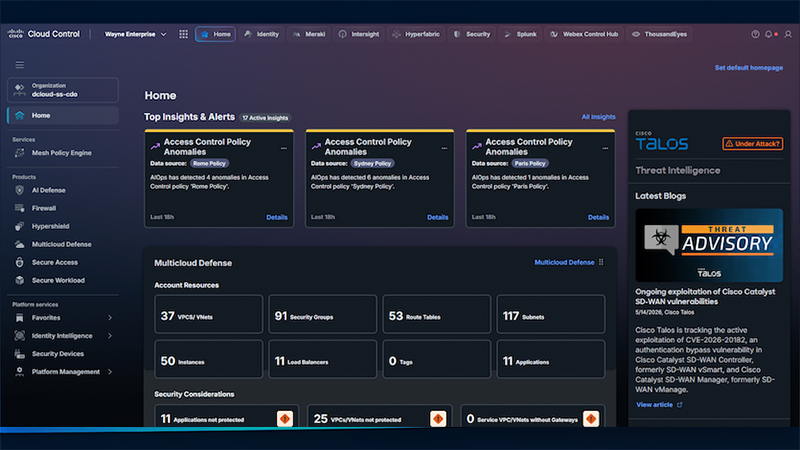
Simplify firewall administration
Gain real-time visibility, streamlined workflows, and enhanced security with centralized control and AI-driven insights across Cisco security solutions with Cisco Security in Cloud Control.

Protect your applications wherever they live
Take advantage of the highly distributed security fabric with unified management that is optimized for zero-trust segmentation and application protection in data center, cloud, campus, and IoT environments.

Firewall for Public Cloud
Maintain cloud agility with unified security controls across leading public cloud providers.
Cisco Firewall for Private Cloud
Reduce complexity and bring consistency to your physical, cloud, and hyperconverged environments.
Firewall for Container
Get powerful stateful L3/L4 firewalling that can be configured to protect your network, your user access through the VPN, and the way your containers access the rest of your network.
Data center
Achieve powerful threat defense and control access, and enable visibility using a built-in crypto accelerator.
6100 Series
This ultra-high-end series protects AI-ready data centers with exceptional firewall performance density, line-rate advanced threat protection, and modular scalability.
4200 Series
Get faster threat detection with deeper visibility and the agility to protect large enterprise data center and campus networks.
Campus and branch
Enable safe connections and protect incoming and outgoing traffic using a firewall with a built-in crypto accelerator.
Campus and branch
3100 Series
Achieve the flexibility to grow in the future with firewalls enhanced for medium-size enterprises.
Branch
1200 Series
Gain advanced security for distributed enterprise branches in a compact, high-performing form factor.
Small business and branch
1000 Series
A world-class firewall solution that is easy to manage, detects more threats, but costs less.
Small business and branch
200 Series
A new family of advanced firewalls extends Cisco's Hybrid Mesh Firewall to branch edges—combining AI-powered inspection and integrated SD-WAN connectivity into a compact form factor.
Cisco Secure Firewall ISA3000
Prevent threats with a ruggedized firewall for manufacturing, industrial, and operational technology environments.
Cisco Cyber Vision industrial security demo
Watch our on-demand demo or schedule a one-on-one demo to learn how to enhance security in your industrial operations.
Embrace the power of a solution that combines SD-WAN capabilities with advanced firewalling, threat protection, encrypted traffic inspection, and zero-trust security across distributed branches.
Cisco Firewall integrations
Real-world success in any environment



The University of the South Pacific
Strengthening security and visibility across the Pacific
With the goal of modernizing their cybersecurity, The University of the South Pacific turned to Cisco to unify management, strengthen compliance, and improve visibility.
“We didn’t just migrate—we modernized."
Barts Health NHS Trust
Creating an environment to optimize hospital performance
Barts Health NHS Trust leverages Cisco networking technology and security to deliver a unified IT environment for five hospitals in Northeast London.
“We successfully transitioned from outdated and inferior equipment to cutting-edge technology that is now fit for purpose.”