Ethernet AUI Port, Pinouts, and Cable Specifications
Available Languages
Contents
Introduction
This document explains the Ethernet AUI port, the cabling specifications, and the port pinouts.
Prerequisites
Requirements
There are no specific requirements for this document.
Components Used
The information in this document is based on the software and hardware versions:
-
AUI adapter cable: CAB-3CE18=
The information in this document was created from the devices in a specific lab environment. All of the devices used in this document started with a cleared (default) configuration. If your network is live, make sure that you understand the potential impact of any command.
Conventions
For more information on document conventions, see the Cisco Technical Tips Conventions.
Background Information
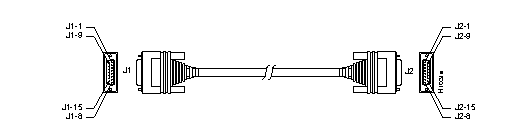
For flexibility, some Cisco routers provide a generic AUI connector for Ethernet ports. These AUI ports are designed to connect to an external transceiver for conversion to a specific media type (such as twisted pair, coax, or fiber). The transceiver may either be directly connected to the AUI port or through an AUI Cable as illustrated below:
Cable Specifications
This section explains the Ethernet port and cable specifications.
Ethernet (AUI) Port Pinout (DB-15)
The table below lists the different pins and their appropriate signals.
| Pin1 | Ethernet Circuit | Signal |
|---|---|---|
| 3 | DO-A | Data Out Circuit A |
| 10 | DO-B | Data Out Circuit B |
| 11 | DO-S | Data Out Circuit Shield |
| 5 | DI-A | Data In Circuit A |
| 12 | DI-B | Data In Circuit B |
| 4 | DI-S | Data In Circuit Shield |
| 2 | CI-A | Control In Circuit A |
| 9 | CI-B | Control In Circuit B |
| 1 | CI-S | Control In Circuit Shield |
| 6 | VC | Voltage Common |
| 13 | VP | Voltage Plus |
| 14 | VS | Voltage Shield (L25 and M25) |
| Shell | PG | Protective Ground |
1Any pin not referenced is not connected.
Ethernet Version 2 and IEEE 802.3 Physical Characteristics
The table below lists the Ethernet Version 2 and IEEE 802.3 physical characteristics of the Ethernet cable.
| Ethernet | IEEE 802.3 | |||
|---|---|---|---|---|
| 10Base5 | 10Base2 | 10BaseT | ||
| Data rate (Mbps) | 10 | 10 | 10 | 10 |
| Signaling method | Baseband | Baseband | Baseband | Baseband |
| Maximum segment length (in meters) | 500 | 500 | 185 | 100 (Unshielded twisted pair - UTP) |
| Media | 50-ohm coax (thick) | 50-ohm coax (thick) | 50-ohm coax (thin) | UTP |
| Topology | Bus | Bus | Bus | Star |
Ethernet Coaxial-type Connection Limits for 10-Mbps Transmission
The following table lists the Ethernet coaxial-type connection limits for 10-Mbps transmission.
| Parameter | 10Base5 | 10Base2 |
|---|---|---|
| Cable diameter | 1 cm (0.4 in) | 0.6 cm (0.25 in) |
| Maximum segment length | 500 m (1640 ft.) | 152 m (500 ft.) |
| Maximum network length (with four repeaters) | 2500 m (8200 ft.) | 762 m (2500 ft.) |
| Maximum connections (taps per segment) | 100 | 30 |
| Minimum connection (tap) spacing | 2.5 m (8.2 ft.) | 0.5 m (1.64 ft.) |
Related Information
Revision History
| Revision | Publish Date | Comments |
|---|---|---|
1.0 |
18-Nov-2003
|
Initial Release |
 Feedback
Contact Cisco
- Open a Support Case

- (Requires a Cisco Service Contract)