Cisco ASR 1000 Series Shared Port Adapter and SPA Interface Processor Support Data Sheet
Available Languages
Product Overview
The Cisco® Interface Flexibility (I-Flex) design combines Shared Port Adapters (SPAs) and SPA Interface Processors (SIPs), taking advantage of an extensible design that facilitates service prioritization for voice, video, and data services. SPAs provide the physical interfaces for router connectivity ranging from copper, Channelized, Packet over SONET/SDH (PoS), ATM, and Ethernet. The Cisco ASR 1000 Series SIP provides the physical termination for the SPAs and accepts up to four half-height and two full-height Cisco SPAs. Enterprise and service provider customers can take advantage of improved slot economics resulting from modular port adapters that are interchangeable across Cisco routing platforms. The I-Flex design maximizes connectivity options and offers powerful service intelligence through programmable interface processors that deliver line-rate performance. I-Flex enhances speed-to-service revenue and provides a rich set of Quality-of-Service (QoS) features for premium service delivery while effectively reducing the overall cost of ownership. Figure 1 shows a sample of the wide range of SPAs supported on the Cisco ASR 1000 Series, and Figure 2 shows the Cisco WebEx® Node for the Cisco ASR 1000 Series. Figure 3 shows the Cisco ASR 1000 Series SIP.

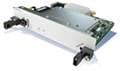
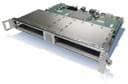
Modular port adapters and programmable interface processors, which are interchangeable across Cisco carrier routing platforms, help enterprise and service provider companies protect network investments and reduce total cost of ownership. The Cisco SPA/SIP portfolio offers a rich set of Quality-of-Service (QoS) features for premium service delivery.
Features and Benefits
The Cisco SPA/SIP portfolio offers many advantages, including:
● Industry's most modular, flexible, intelligent interface processors:
◦ The SPAs/SIPs blend Software as a Service (SaaS) and enterprise networking to enable collaboration with confidence and reduce bandwidth consumption for WebEx® web, Voice over IP (VoIP), and video sessions with the Cisco WebEx Node for the Cisco ASR 1000 Series.
◦ Powerful flexibility provides mix-and-match interface types on the same interface processor for consistent services, independent of access technology.
◦ Pioneering programmable interface processors provide flexibility for the service diversity required in next- generation networks.
◦ The innovative design provides intelligent delivery of services without compromising on performance.
● Increased speed to service revenue:
◦ The programmable Cisco architecture extended to 20 Gigabit Ethernet dramatically improves customer density, increasing potential revenue per platform.
◦ Interface breadth (copper, Channelized, PoS, ATM, and Ethernet) on a modular interface processor allows service providers to more quickly roll out new services, helping ensure that all customers large and small receive consistent, secure, and guaranteed services.
◦ High-density Small Form-Factor Pluggable (SFP) interfaces are featured for high-port-count applications with reach flexibility. Future optical technology improvements can be adopted using existing SPAs.
Product Specifications
For product specifications for all Cisco SPAs, please visit the following website: https://www.cisco.com/c/en/us/products/interfaces-modules/shared-port-adapters-spa-interface-processors/datasheet-listing.html. Table 1 gives ordering information.
Table 1. Ordering Information
| Product Name | Product Number |
| ASR1000 SPA Interface Processor | |
| Cisco ASR1000 Series SPA Interface Processor 10G | |
| Cisco ASR1000 Series SPA Interface Processor 40G | |
| Service SPA | |
| Cisco WebEx Node SPA for ASR 1000 Series (End-of-Sale) | |
| Cisco ASR100 Series Digital Signal Processor SPA | |
| ATM SPA | |
| Cisco 1-Port Clear Channel OC3 ATM Shared Port Adapter (End-of-Sale) | |
| Cisco 3-Port Clear Channel OC3 ATM Shared Port Adapter (End-of-Sale) | |
| Cisco 1-Port OC12 STM Shared Port Adapter (End-of-Sale) | |
| Serial and Channelized SPA | |
| Cisco 8-Port Channelized T1/E1 Shared Port Adapter, Version 2 | |
| Cisco 4-Port Channelized T3 (DS0) Shared Port Adapter, Version 2 | |
| Cisco 2-Port Channelized T3 (DS0) Shared Port Adapter, Version 2 | |
| Cisco 1-port Channelized STM-1/OC-3c to DS0 Shared Port Adapter, Version 2 | |
| Cisco 2-Port Clear Channel T3/E3 Shared Port Adapter, Version 2 | |
| Cisco 4-Port Clear Channel T3/E3 Shared Port Adapter, Version 2 | |
| Cisco 8-Port Clear Channel T3/E3 Shared Port Adapter | |
| Cisco 4-Port Serial Interface Shared Port Adapter | |
| 1-port Channelized OC12 to DS0 SPA (End-of-Sale) | |
| Ethernet SPA | |
| Cisco 4-Port 10BASE-T/100BASE Fast Ethernet Shared Port Adapter, Version 2 | |
| Cisco 8-Port 10BASE-T/100BASE Fast Ethernet Shared Port Adapter, Version 2 | |
| Cisco 2-Port Gigabit Ethernet Shared Port Adapter, Version 2 | |
| Cisco 5-Port Gigabit Ethernet Shared Port Adapter, Version 2 | |
| Cisco 8-Port Gigabit Ethernet Shared Port Adapter, Version 2 | |
| Cisco 10-Port Gigabit Ethernet Shared Port Adapter, Version 2 | |
| Cisco 1-Port 10 Gigabit Ethernet Shared Port Adapter, Version 2 | |
| Cisco 1-port 10GE LAN/WAN-PHY Shared Port Adapter | |
| Cisco Synchronous Ethernet SPA (End-of-Sale) | |
| Packet Over Sonet SPA (POS) | |
| Cisco 2-Port OC3c/STM-1c POS Shared Port Adapter | |
| Cisco 4-Port OC3c/STM-1c POS Shared Port Adapter, Version 2 | |
| Cisco 8-port OC3/STM4 POS Shared Port Adapter | |
| Cisco 1-Port OC12/STM4 POS Shared Port Adapter | |
| Cisco 2-port OC12/STM4 POS Shared Port Adapter | |
| Cisco 4-port OC12/STM4 POS Shared Port Adapter | |
| Cisco 8-port OC12/STM4 POS SPA Shared Port Adapter | |
| Cisco 1-port OC48/STM16 POS/RPR Shared Port Adapter | |
| Cisco 2-port OC48/STM16 POS/RPR Shared Port Adapter | |
| Cisco 4-port OC48/STM16 POS/RPR Shared Port Adapter | |
| Cisco 1-Port OC-192c/STM-64c POS/RPR Shared Port Adapter with XFP Optics | |
| Circuit Emulation Over Packet SPA (CEOP) | |
| Cisco 1 Port Channelized OC3/STM-1 ATM and Circuit Emulation SPA | |
| Cisco 24 Port T1/E1/J1 Circuit Emulation SPA | |
| Cisco 2-Port T3/E3 Circuit Emulation and ATM SPA | |
Cisco Services for the Enterprise WAN Edge
Cisco and our partners help make your enterprise WAN edge deployment a success with a broad portfolio of services based on proven methodologies. We can help you establish a secure, resilient WAN architecture and successfully integrate Cisco Unified Communications, Cisco TelePresence®, security, and mobility technologies with bandwidth to support video, collaboration, branch-office solutions, and growth in alignment with your business goals. Planning and design services align technology with business goals and can increase the accuracy, speed, and efficiency of deployment. Technical services help maintain operational health, strengthen software application functions, solve performance concerns, and lower expenses. Optimization services are designed to continually improve performance and help your team succeed with new technologies. For more information, please visit: https://www.cisco.com/go/services.
Cisco Capital
Flexible Payment Solutions to Help You Achieve Your Objectives
Cisco Capital makes it easier to get the right technology to achieve your objectives, enable business transformation and help you stay competitive. We can help you reduce the total cost of ownership, conserve capital, and accelerate growth. In more than 100 countries, our flexible payment solutions can help you acquire hardware, software, services and complementary third-party equipment in easy, predictable payments. Learn more.
For More Information
For more information about the Cisco SPAs, visit https://www.cisco.com/c/en/us/products/interfaces-modules/shared-port-adapters-spa-interface-processors/datasheet-listing.html or contact your local Cisco account representative.
 Feedback