PDF(132.8 KB) View with Adobe Reader on a variety of devices
Updated:June 6, 2005
Document ID:1518708458120271
Bias-Free Language
The documentation set for this product strives to use bias-free language. For the purposes of this documentation set, bias-free is defined as language that does not imply discrimination based on age, disability, gender, racial identity, ethnic identity, sexual orientation, socioeconomic status, and intersectionality. Exceptions may be present in the documentation due to language that is hardcoded in the user interfaces of the product software, language used based on RFP documentation, or language that is used by a referenced third-party product. Learn more about how Cisco is using Inclusive Language.
DATA SHEET
The Cisco® ONS 15216 50/100-GHz Interleaver/De-interleaver is an advanced 50/100-GHz interleaver and de-interleaver that provides service providers, system integrators, and network equipment manufacturers with one of the critical technologies needed to build next-generation 2.5-, 10-, and 40-Gbps reconfigurable optical add/drop multiplexer (ROADM)-enabled DWDM networks.
Cisco DWDM systems with a maximum of thirty-two 100-GHz spaced channels in the C-band can be expanded to 64-channel capacity using the Cisco ONS 15216 50/100-GHz Interleaver/De-interleaver. The interleaver/de-interleaver can be deployed with the initial DWDM installation to make the DWDM system compatible with future versions and to avoid downtime when the additional capacity is required. The use of 50-GHz channel spacing is a good option for increasing capacity, allowing an additional thirty-two 100-GHz spaced channels to be interleaved with the existing 32 channels. To accomplish this upgrade, a 50/100-GHz interleaver/de-interleaver is required for multiplexing and demultiplexing the additional channels. The Cisco ONS 15216 50/100-GHz Interleaver/De-interleaver incorporates a multiplexing section that interleaves two 100-GHz even and odd wavelength grids to give a composite 50-GHz signal for transmission over Cisco ONS 15454 Multiservice Transport Platform (MSTP) DWDM systems. The demultiplexer section de-interleaves the 50-GHz signal into two 100-GHz wavelength grids prior to further channel demultiplexing by the Cisco ONS 15454 MSTP ROADM.
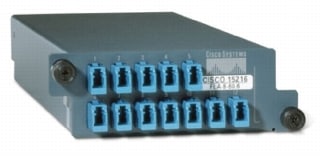
The equipment is housed in a passive Cisco ONS 15216 FlexLayer module and mounted in the Cisco ONS 15216 FlexLayer 4-Slot 1-rack unit (RU) shelf unit. This module extracts a small part of the composite DWDM signal at the interleaver and the component DWDM signals at the de-interleaver for monitoring purposes. The module (Figure 1) is completely (optical and electrical) passive.
Figure 1
Cisco ONS 15216 50/100-GHz Interleaver/De-interleaver Module
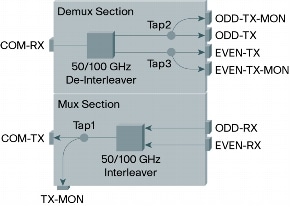
Figure 2 shows the Cisco ONS 15216 50/100-GHz Interleaver/De-interleaver optical flow. The module is a bidirectional unit, in which the multiplexing function and the demultiplexing function are implemented into two different sections so that signal flowing in opposite directions can be managed separately. The demultiplexer section includes a de-interleaver to separate a signal of 50-GHz channel spacing into even and odd channels signals of 100-GHz spacing (EVEN-TX port and ODD-TX port, respectively) followed by a tap coupler on each of the two demultiplexer paths, allowing even (EVEN-MON port) and odd (ODD-MON port) channels signals spectrum monitoring.
The multiplexer section includes an interleaver, to combine even and odd channels signals at 100-GHz spacing (EVEN-RX and ODD-RX ports respectively) into a single signal of 50-GHz channel spacing. A tap coupler follows the interleaving, allowing the aggregate 50-GHz spacing transmitted optical channels spectrum monitoring at the output (TX-MON port).
Figure 2
Optical Schematic for the Cisco ONS 15216 50/100-GHz Interleaver/De-interleaver
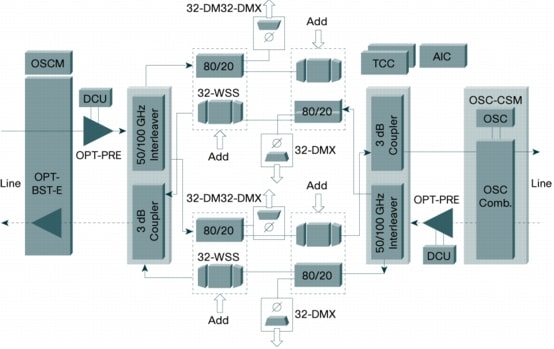
The Cisco ONS 15216 50/100-GHz Interleaver/De-interleaver is deployed with the Cisco ONS 15454 MSTP. Figure 3 shows a Cisco ONS 15216 50/100-GHz Interleaver/De-interleaver deployed in a Cisco ONS 15454 MSTP ROADM node.
Figure 3
Cisco ONS 15216 50/100-GHz Interleaver/De-interleaver Deployed in a 50-GHz ROADM Node
PRODUCT ORDERING INFORMATION
Table 1 lists the ordering information for the Cisco ONS 15216 50/100-GHz Interleaver/De-interleaver.
 Feedback