Cisco Aironet 6-dBi Omnidirectional Antenna (AIR-ANT5160V-R)
Available Languages
Table of Contents
Cisco Aironet 6-dBi Omnidirectional Antenna (AIR-ANT5160V-R)
T-Rail Grid Bracket Installation
Obtaining Documentation and Submitting a Service Request
Cisco Aironet 6-dBi Omnidirectional Antenna (AIR-ANT5160V-R)
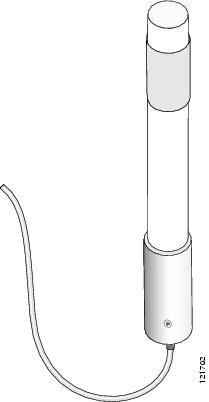
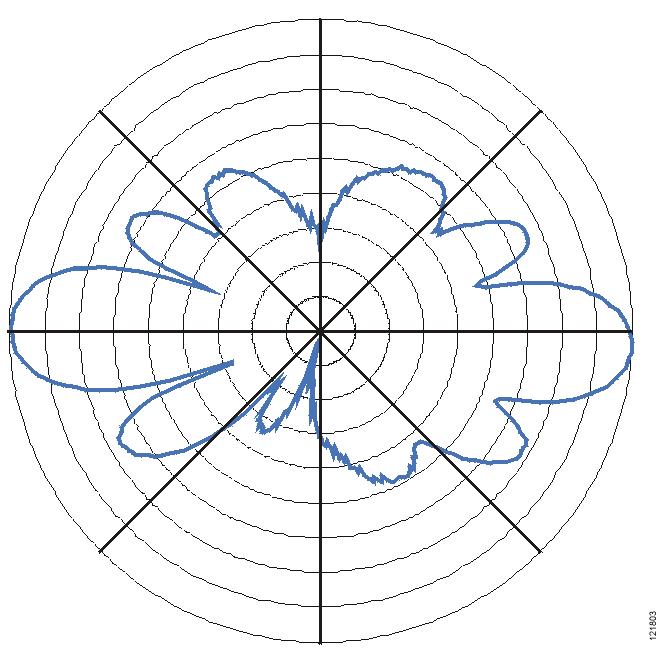
This document outlines the specifications, describes the AIR-ANT5160V-R 6-dBi omnidirectional antenna, and provides instructions for mounting it. The antenna is a ruggedized high-performance colinear antenna that operates in the 5-GHz frequency range and is designed for use in large rooms or vaulted areas where extended coverage is needed. The antenna is designed to be used indoors or outdoors and can be mounted on a mast, I-beam, or suspended ceiling cross member.

System Requirements
This antenna is designed for use with Cisco Aironet access points and bridges but can be used with any 5-GHz Cisco Aironet radio device that utilizes a reverse polarity (RP-TNC) connector.
Safety Precautions

Warning Installation of this antenna near power lines is dangerous. For your safety, follow the installation directions.
Warning This warning symbol means danger. You are in a situation that could cause bodily injury. Before you work on any equipment, be aware of the hazards involved with electrical circuitry and be familiar with standard practices for preventing accidents.
Warning In order to comply with international radio frequency (RF) exposure limits, dish antennas should be located at a minimum of 8.7 inches (22 cm) or more from the bodies of all persons. Other antennas should be located a minimum of 7.9 inches (20 cm) or more from the bodies of all persons.
Warning Do not work on the system or connect or disconnect cables during periods of lightning activity.
Warning This equipment must be grounded. Never defeat the ground conductor or operate the equipment in the absence of a suitably installed ground conductor. Contact the appropriate electrical inspection authority or an electrician if you are uncertain that suitable grounding is available.
Warning Do not locate the antenna near overhead power lines or other electric light or power circuits, or where it can come into contact with such circuits. When installing the antenna, take extreme care not to come into contact with such circuits, as they may cause serious injury or death. For proper installation and grounding of the antenna, please refer to national and local codes (e.g. U.S.:NFPA 70, National Electrical Code, Article 810, in Canada: Canadian Electrical Code, Section 54).
Each year hundreds of people are killed or injured when attempting to install an antenna. In many of these cases, the victim was aware of the danger of electrocution, but did not take adequate steps to avoid the hazard.
For your safety, and to help you achieve a good installation, please read and follow these safety precautions. They may save your life!
1. If you are installing an antenna for the first time, for your own safety as well as others, seek professional assistance. Your Cisco sales representative can explain which mounting method to use for the size and type antenna you are about to install.
2. Select your installation site with safety, as well as performance in mind. Remember: electric power lines and phone lines look alike. For your safety, assume that any overhead line can kill you.
3. Call your electric power company. Tell them your plans and ask them to come look at your proposed installation. This is a small inconvenience considering your life is at stake.
4. Plan your installation carefully and completely before you begin. Successful raising of a mast or tower is largely a matter of coordination. Each person should be assigned to a specific task, and should know what to do and when to do it. One person should be in charge of the operation to issue instructions and watch for signs of trouble.
5. When installing your antenna, remember:
b. Do not work on a wet or windy day.
c. Do dress properly—shoes with rubber soles and heels, rubber gloves, long sleeved shirt or jacket.
6. If the assembly starts to drop, get away from it and let it fall. Remember, the antenna, mast, cable, and metal guy wires are all excellent conductors of electrical current. Even the slightest touch of any of these parts to a power line complete an electrical path through the antenna and the installer: you!
7. If any part of the antenna system should come in contact with a power line, don’t touch it or try to remove it yourself. Call your local power company. They will remove it safely.
8. If an accident should occur with the power lines call for qualified emergency help immediately.
Installation Guidelines
Because the antenna transmits and receives radio signals, they are susceptible to RF obstructions and common sources of interference that can reduce throughput and range of the device to which they are connected. Follow these guidelines to ensure the best possible performance:
 For outside installations, make sure you do not mount the antenna upside down or block the bottom of the antenna at the cable exit. The correct mounting position is with the cable pointing down (towards the ground) so that any moisture will drain through the antenna drain holes. The antenna ships with a yellow mounting instruction label temporarily attached to the antenna radome.
- Mount the antenna to utilize its propagation characteristics. One way to do this is to orient the antenna vertically and mount it as high as possible.
- Keep the antenna away from metal obstructions such as heating and air-conditioning ducts, large ceiling trusses, building superstructures, and major power cabling runs. If necessary, use a rigid conduit to lower the antenna away from these obstructions.
- The density of the materials used in a building’s construction determines the number of walls the signal must pass through and still maintain adequate coverage. Consider the following before choosing the location to install your antenna:
– Paper and vinyl walls have very little affect on signal penetration.
– Solid and pre-cast concrete walls limit signal penetration to one or two walls without degrading coverage.
– Concrete and wood block walls limit signal penetration to three or four walls.
– A signal can penetrate five or six walls constructed of drywall or wood.
– A thick metal wall reflects signals, causing poor penetration.
Site Selection
Before attempting to install your antenna, determine where you can best place the antenna for safety and performance.
Follow these steps to determine a safe distance from wires, power lines, and trees.
Step 1 Measure the height of your antenna.
Step 2 Add this length to the length of your tower or mast and then double this total for the minimum recommended safe distance.
Generally, the higher an antenna is above the ground, the better it performs. Good practice is to install your antenna about 5 to 10 ft (1.5 to 3 m) above the roof line and away from all power lines and obstructions. If possible, find a mounting place directly above your wireless device so that the lead-in cable can be as short as possible.
Installing the Antenna
A mounting hardware kit is provided that allows you to install the antenna on a suspended ceiling, open beam ceiling, or a pole.
The ceiling mount kit consists of the following hardware:
- One T-rail grid bracket
- One bracket plate
- Two internal tooth lock washers
- Two #6-32 x 1/4-in. SS Phillips machine screws
- One I-beam clamp
- One 1/4-in. flat washer
- One 1/4-in. split lock washer
- One 1/4 x 20 x 1/2-in. hex head bolt
The pole (mast) mount kit consists of the following hardware:
- Six 5/16-in. x 18 SS hex nuts
- Four 5/16-in. SS lock washers
- One U-bolt
- One V-bracket
- Two base brackets
- Two 5/16-in. flat washers
You will need the following tools and equipment, which are not provided:
- Phillips head screwdriver
- 7/16-in. open end or box end wrench (or adjustable wrench)
- 1/2-in. open end or box end wrench (or adjustable wrench)
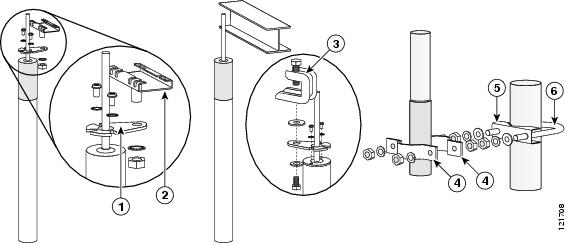
The following sections contain typical procedures for installing the antenna on a suspended ceiling or mast. Your installation may vary. Before you begin, you may want to refer to Figure 1.
Figure 1 shows how the antenna should be mounted to a suspended ceiling or pole (mast).
Figure 1 Antenna Mounting Details
T-Rail Grid Bracket Installation
You can mount the antenna to a T-rail grid with the cable pointing up or down.
Follow these steps to install the antenna on a suspended ceiling using the T-rail grid bracket:
Step 1 Remove the yellow mounting instruction label. If you are mounting the antenna indoors, you can ignore the label instructions.
Step 2 Attach the bracket plate to the antenna base using two #6 Phillips head screws and #6 lock washers as shown in Figure 1.
Step 3 Remove the hex nut and flat washer from the T-rail grid bracket. Discard the flat washer.
Step 4 Install the T-rail grid bracket onto the bracket plate using the hex nut and a 1/4-in. internal tooth lock washer. Do not tighten the hex nut.
Step 5 Clamp the T-rail grid bracket onto the ceiling runner and tighten the hex nut with a 7/16-in. wrench or adjustable wrench.
Step 6 Route the antenna cable to the wireless device.
I-Beam Clamp Installation
Follow these steps to install the antenna on an open beam ceiling using the I-beam clamp:
Step 1 Remove the yellow mounting instruction label. If you are mounting the antenna indoors, you can ignore the label instructions.
Step 2 Attach the bracket plate to the antenna base using two #6 Phillips head screws and #6 lock washers.
Step 3 Install the I-beam clamp to the bracket plate using a 1/4-20 x 1/2-in. hex head bolt, a flat washer and split lock washer as shown in Figure 1.
Step 4 Position the I-beam clamp on the ceiling beam and tighten the clamp bolt.
Step 5 Route the antenna cable to the wireless device.
Pole Installation
Follow these steps to install the antenna on a pole:
Step 1 Attach the U-bolt and V-bracket to the top of the pole using two 5/16 x 18 hex nuts, 5/16-in. flat washers, and 5/16-in. lock washers as shown in Figure 1. Tighten the assembly using a 1/2-in. wrench or adjustable wrench.
Step 2 Start two more 5/16 x 18 hex nuts on the U-bolt and turn them down against the nuts securing the the U-bolt to the pole.
Step 3 Position the base brackets on the antenna base as shown in Figure 1.

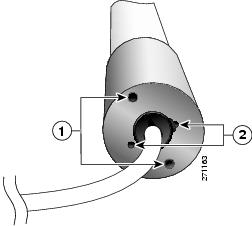
Note For outside installations, make sure you do not mount the antenna upside down or block the bottom of the antenna at the cable exit. The correct mounting position is with the cable pointing down (towards the ground or floor) so that any moisture will drain through the antenna drain holes. Mounting the antenna any other way may cause it to fill with water and fail. See Figure 2.
Step 4 Slide the antenna and base brackets onto the U-bolt threads.
Step 5 Secure the antenna to the U-bolt using two 5/16 x 18 hex nuts and two 5/16-in. lock washers.
Step 6 Tighten the hex head bolts evenly using a 1/2-in. wrench or adjustable wrench.
Step 7 Remove the yellow mounting instruction label.
Step 8 Route the antenna cable to the wireless device.
Suggested Cable
Cisco recommends a high-quality, low-loss cable for use with the antenna.
Note Coaxial cable loses efficiency as the frequency increases, resulting in signal loss. The cable should be kept as short as possible because cable length also determines the amount of signal loss (the longer the run, the greater the loss).
The antenna terminates with a RP-TNC plug after a short, 3-ft (0.91-m) cable. The mating connector to the antenna is an appropriate RP-TNC jack. The connector on the opposite end will vary according to the type of equipment used.
After the cable is attached to the antenna, make sure that the connections are sealed (if outdoors) to prevent moisture and other weathering elements from affecting performance. Cisco recommends using a coax seal (such as CoaxSeal) for outdoor connections. Silicon sealant or electrical tape are not recommended for sealing outdoor connections.
Grounding the Antenna
The antenna should be grounded if you are mounting it outdoors. Follow these steps to ground the antenna in accordance with national electrical code instructions.
Step 1 Use No. 10 AWG copper or No. 8 or larger copper-clad steel or bronze wire as ground wires for both mast and lead-in. Securely clamp the wire to the bottom of the mast.
Step 2 Secure the lead-in wire to a static discharge unit (lightning arrestor) and the mast ground wire to the building with stand-off insulators spaced from 4 ft (1.2 m) to 8 ft (2.4 m) apart.
Step 3 Mount the antenna discharge unit as close as possible to where the lead-in wire enters the building.
Step 4 Drill a hole in the building’s wall as close as possible to the equipment to which you will connect the lead-in cable.
There may be wires in the wall. Make sure your drilling location is clear of any obstructions or other hazards.
Step 5 Pull the cable through the hole and form a drip loop close to where it enters the building.
Step 6 Thoroughly waterproof the lead-in area.
Step 7 Connect the lead-in cable to the equipment.
Obtaining Documentation and Submitting a Service Request
For information on obtaining documentation, using the Cisco Bug Search Tool (BST), submitting a service request, and gathering additional information, see What’s New in Cisco Product Documentation at: http://www.cisco.com/c/en/us/td/docs/general/whatsnew/whatsnew.html.
Subscribe to What’s New in Cisco Product Documentation, which lists all new and revised Cisco technical documentation as an RSS feed and delivers content directly to your desktop using a reader application. The RSS feeds are a free service.
Cisco and the Cisco logo are trademarks or registered trademarks of Cisco and/or its affiliates in the U.S. and other countries. To view a list of Cisco trademarks, go to this URL: www.cisco.com/go/trademarks. Third-party trademarks mentioned are the property of their respective owners. The use of the word partner does not imply a partnership relationship between Cisco and any other company. (1110R)
 Feedback
Contact Cisco
- Open a Support Case

- (Requires a Cisco Service Contract)