Table Of Contents
Catalyst 6000 Family MSFC2 Bootflash Device Upgrade Installation Note
Removing the Supervisor Engine
Installing the Bootflash Device
Replacing the Supervisor Engine
Obtaining Technical Assistance
Catalyst 6000 Family MSFC2 Bootflash Device Upgrade Installation Note
Product Number:
WS-X6K-MSFC2-KIT=This publication describes how to remove and install the bootflash device on the Catalyst 6000 family Multilayer Switch Feature Card 2 (MSFC2).
This installation upgrades the MSFC2 bootflash device from 16 MB to 32 MB.
Note
A boot loader image and an IOS (c6msfc2) image are provided on the bootflash device.
Contents
This publication consists of these sections:
•
Removing the Supervisor Engine
•
Installing the Bootflash Device
•
Replacing the Supervisor Engine
•
Obtaining Technical Assistance
Required Tools
The following tools are required to perform the installation:
•
Antistatic mat or foam pad to support the removed supervisor engine
•
3/16-inch flat-blade screwdriver for the captive installation screws on the supervisor engine
•
A wrist strap or other grounding device to prevent electrostatic discharge (ESD) damage
Refer to the Site Preparation and Safety Guide for ESD details including the locations of the ESD connectors on the Catalyst 6000 family switches.
Safety Overview
Safety warnings appear throughout this publication in procedures that may harm you if performed incorrectly. A warning symbol precedes each warning statement.
Warning
Only trained and qualified personnel should be allowed to install or replace this equipment.
Warning
During this procedure, wear grounding wrist straps to avoid ESD damage to the card. Do not directly touch the backplane with your hand or any metal tool, or you could shock yourself.
Verifying the Bootflash Size
The following sections describe the procedures to determine the size of the MSFC2 bootflash device:
Catalyst Software
Note
For information on accessing the MSFC2 from the switch, refer to Chapter 2, "Command-Line Interfaces," in the Catalyst 6000 Family Configuration Guide.
From the privileged EXEC router prompt, enter the dir bootflash: command to determine the size of the bootflash device installed on the MSFC2.
The following example shows a 16-MB bootflash device:
Router# dir bootflash:Directory of bootflash:/1 -rw- 1599488 Nov 29 1999 11:12:29 c6msfc-boot-mz.120-7.XE.bin15990784 bytes total (14391168 bytes free)Cisco IOS Software
From the privileged EXEC prompt, enter the following commands to determine the size of the bootflash device installed on the MSFC2:
Command PurposeRouter# dir bootflash:
Determine the size of the bootflash device on the active MSFC2.
Router# dir slavebootflash:
Determine the size of the bootflash device on the standby MSFC2.
The following example shows a 16-MB bootflash device:
Router# dir bootflash:Directory of bootflash:/1 -rw- 1599488 Nov 29 1999 11:12:29 c6msfc-boot-mz.120-7.XE.bin15990784 bytes total (14391168 bytes free)Removing the Supervisor Engine
To install the bootflash device upgrade on the MSFC2, you must first remove the supervisor engine from the chassis.
CautionAlways use an ESD wrist strap when handling modules or coming into contact with internal components.
CautionThe supervisor engine is a required system component. If only one supervisor engine is present, removing it while the system is operating causes the system to halt.
Note
When two supervisor engines are installed, hot swapping allows you to remove and replace one of the supervisor engines without turning off the system power.
CautionTo avoid erroneous failure messages, note the current configuration of all interfaces before you remove or replace another switching module, and allow at least 15 seconds for the system to reinitialize after a module has been removed or replaced.
When removing the supervisor engine, use the ejector levers to ensure that the connector pins disconnect from the backplane properly. Any supervisor engine or switching module that is only partially connected to the backplane can disrupt the system. Detailed instructions for removing and installing modules are described in the Catalyst 6000 Family Module Installation Guide.
To remove a supervisor engine, perform these steps:
Step 1
If you do not plan to immediately reinstall the supervisor engine you are removing, disconnect any network interface cables attached to the uplink ports.
Step 2
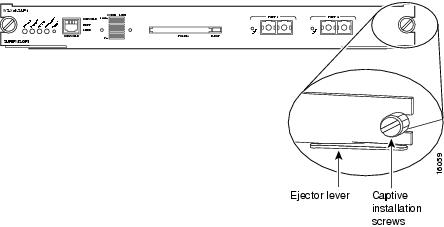
Use a screwdriver to loosen the captive installation screws at the left and right sides of the supervisor engine (see Figure 1).
Figure 1 Ejector Levers and Captive Installation Screws
Step 3
Grasp the left and right ejector levers; simultaneously pull the left lever to the left and the right lever to the right to release the supervisor engine from the backplane connector.
Step 4
As you pull the supervisor engine out of the slot, place one of your hands under the carrier to support it. Avoid touching the supervisor engine itself.
Step 5
Carefully pull the supervisor engine straight out of the slot, keeping one hand under the carrier to guide it. Keep the supervisor engine at a 90-degree orientation to the backplane (horizontal to the floor).
Step 6
Place the removed supervisor engine on an antistatic mat or antistatic foam pad.
When you remove and replace the redundant supervisor engine, the system provides status messages on the console screen. The messages are for information only. For additional information, refer to the Catalyst 6000 Family Software Configuration Guide and Catalyst 6000 Family Command Reference publication.
Installing the Bootflash Device
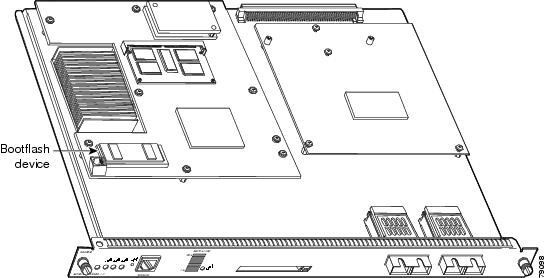
This section describes how to remove the existing bootflash device and replace it with the upgrade bootflash device. The bootflash device location is shown in Figure 2 for the MSFC2 shipped before November 2001 and Figure 3 for the MSFC2 shipped after November 2001.
Figure 2 MSFC2 Shipped Before November 2001—Bootflash Device Location
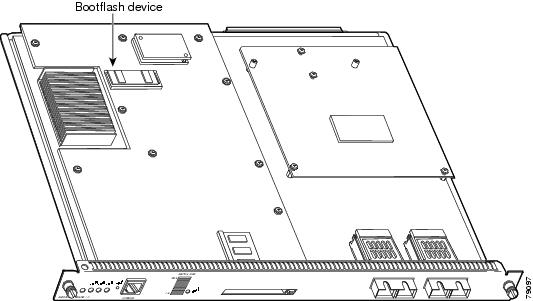
Figure 3 MSFC2 Shipped After November 2001—Bootflash Device Location
To upgrade the bootflash device from 16 MB to 32 MB, follow these steps:
Step 1
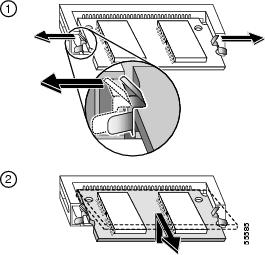
Pull the locking spring clips on both sides of the bootflash device SIMM holder outward and tilt the SIMM up and away from the clips (see Figure 4). Be careful not to break the clips on the SIMM connector.
Figure 4 Removing and Installing the Bootflash Device SIMM
Step 2
Hold the SIMM by its edges and gently lift and remove it, placing it on an antistatic mat or foam. (See Figure 5.)
Figure 5 Handling a SIMM
CautionSIMMs are sensitive components that are susceptible to ESD damage. To prevent ESD damage, handle SIMMs by the edges only; avoid touching the memory modules, pins, or traces (the metal fingers along the connector edge of the SIMM). (See Figure 5.)
Step 3
Remove the upgrade SIMM from the antistatic container.
Step 4
Hold the SIMM by its edges. (See Figure 5.)
Step 5
Tilt the SIMM to approximately the same angle as the socket, and insert the connector edge into the socket. Note the notch (key) on the right connector edge of the SIMM. (See Figure 5.) This key assures correct orientation of the SIMM in the socket.
CautionWhen inserting the SIMM, use firm but not excessive pressure. If you damage a socket, you will have to return the MSFC2 to Cisco for repair.
Step 6
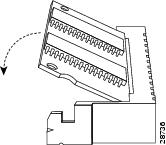
Press the SIMM down until it is secured by the spring clips. (See Figure 6.)
Figure 6 Installing the SIMM in the Socket
Step 7
When the SIMM is installed, check the two alignment holes and ensure that the spring retainer is visible. If it is not visible, the SIMM is not seated properly. If the SIMM appears misaligned, carefully remove it and reseat it in the socket. Push the SIMM firmly back into the socket until the retainer springs snap into place.
Replacing the Supervisor Engine
The ejector levers on the supervisor engine and switching modules align and seat the module connectors in the backplane (see Figure 1). If you fail to use the ejector levers to insert the supervisor engine, you can disrupt the order in which the pins contact the backplane. You must pull out the ejector levers as you slide the supervisor engine in. Detailed instructions for removing and installing the supervisor engine are described in the Catalyst 6000 Family Module Installation Guide.
To replace the supervisor engine, follow Step 1 through Step 6 in the "Removing the Supervisor Engine" section in reverse order. Note that the supervisor engine must go in slot 1 (if a second, redundant supervisor is installed, install it in slot 2).
Related Documentation
For additional information on Catalyst 6000 family switches and command-line interface (CLI) commands, refer to the following publications:
•
Regulatory Compliance and Safety Information for the Catalyst 6000 Family Switches
•
Catalyst 6000 Family Installation Guide
•
Catalyst 6000 Family Module Installation Guide
•
Catalyst 6000 Family Software Configuration Guide
•
Catalyst 6000 Family Command Reference
•
Catalyst 6000 Family IOS Software Configuration Guide
•
Catalyst 6000 Family IOS Command Reference
•
Site Preparation and Safety Guide
Obtaining Documentation
The following sections explain how to obtain documentation from Cisco Systems.
World Wide Web
You can access the most current Cisco documentation on the World Wide Web at the following URL:
Translated documentation is available at the following URL:
http://www.cisco.com/public/countries_languages.shtml
Documentation CD-ROM
Cisco documentation and additional literature are available in a Cisco Documentation CD-ROM package, which is shipped with your product. The Documentation CD-ROM is updated monthly and may be more current than printed documentation. The CD-ROM package is available as a single unit or through an annual subscription.
Ordering Documentation
Cisco documentation is available in the following ways:
•
Registered Cisco Direct Customers can order Cisco product documentation from the Networking Products MarketPlace:
http://www.cisco.com/cgi-bin/order/order_root.pl
•
Registered Cisco.com users can order the Documentation CD-ROM through the online Subscription Store:
http://www.cisco.com/go/subscription
•
Nonregistered Cisco.com users can order documentation through a local account representative by calling Cisco corporate headquarters (California, USA) at 408 526-7208 or, elsewhere in North America, by calling 800 553-NETS (6387).
Documentation Feedback
If you are reading Cisco product documentation on Cisco.com, you can submit technical comments electronically. Click Leave Feedback at the bottom of the Cisco Documentation home page. After you complete the form, print it out and fax it to Cisco at 408 527-0730.
You can e-mail your comments to bug-doc@cisco.com.
To submit your comments by mail, use the response card behind the front cover of your document, or write to the following address:
Cisco Systems
Attn: Document Resource Connection
170 West Tasman Drive
San Jose, CA 95134-9883We appreciate your comments.
Obtaining Technical Assistance
Cisco provides Cisco.com as a starting point for all technical assistance. Customers and partners can obtain documentation, troubleshooting tips, and sample configurations from online tools by using the Cisco Technical Assistance Center (TAC) Web Site. Cisco.com registered users have complete access to the technical support resources on the Cisco TAC Web Site.
Cisco.com
Cisco.com is the foundation of a suite of interactive, networked services that provides immediate, open access to Cisco information, networking solutions, services, programs, and resources at any time, from anywhere in the world.
Cisco.com is a highly integrated Internet application and a powerful, easy-to-use tool that provides a broad range of features and services to help you to
•
Streamline business processes and improve productivity
•
Resolve technical issues with online support
•
Download and test software packages
•
Order Cisco learning materials and merchandise
•
Register for online skill assessment, training, and certification programs
You can self-register on Cisco.com to obtain customized information and service. To access Cisco.com, go to the following URL:
Technical Assistance Center
The Cisco TAC is available to all customers who need technical assistance with a Cisco product, technology, or solution. Two types of support are available through the Cisco TAC: the Cisco TAC Web Site and the Cisco TAC Escalation Center.
Inquiries to Cisco TAC are categorized according to the urgency of the issue:
•
Priority level 4 (P4)—You need information or assistance concerning Cisco product capabilities, product installation, or basic product configuration.
•
Priority level 3 (P3)—Your network performance is degraded. Network functionality is noticeably impaired, but most business operations continue.
•
Priority level 2 (P2)—Your production network is severely degraded, affecting significant aspects of business operations. No workaround is available.
•
Priority level 1 (P1)—Your production network is down, and a critical impact to business operations will occur if service is not restored quickly. No workaround is available.
Which Cisco TAC resource you choose is based on the priority of the problem and the conditions of service contracts, when applicable.
Cisco TAC Web Site
The Cisco TAC Web Site allows you to resolve P3 and P4 issues yourself, saving both cost and time. The site provides around-the-clock access to online tools, knowledge bases, and software. To access the Cisco TAC Web Site, go to the following URL:
All customers, partners, and resellers who have a valid Cisco services contract have complete access to the technical support resources on the Cisco TAC Web Site. The Cisco TAC Web Site requires a Cisco.com login ID and password. If you have a valid service contract but do not have a login ID or password, go to the following URL to register:
http://www.cisco.com/register/
If you cannot resolve your technical issues by using the Cisco TAC Web Site, and you are a Cisco.com registered user, you can open a case online by using the TAC Case Open tool at the following URL:
http://www.cisco.com/tac/caseopen
If you have Internet access, it is recommended that you open P3 and P4 cases through the Cisco TAC Web Site.
Cisco TAC Escalation Center
The Cisco TAC Escalation Center addresses issues that are classified as priority level 1 or priority level 2; these classifications are assigned when severe network degradation significantly impacts business operations. When you contact the TAC Escalation Center with a P1 or P2 problem, a Cisco TAC engineer will automatically open a case.
To obtain a directory of toll-free Cisco TAC telephone numbers for your country, go to the following URL:
http://www.cisco.com/warp/public/687/Directory/DirTAC.shtml
Before calling, please check with your network operations center to determine the level of Cisco support services to which your company is entitled; for example, SMARTnet, SMARTnet Onsite, or Network Supported Accounts (NSA). In addition, please have available your service agreement number and your product serial number.
This document is to be used in conjunction with the documents listed in the "Related Documentation" section.
Copyright © 2002, Cisco Systems, Inc.
All rights reserved.