The Cisco TrustSec security architecture builds secure networks by establishing clouds of trusted network devices. Each device in the cloud is authenticated by its neighbors. Communication on the links between devices in the cloud is secured with a combination of encryption, message integrity checks, and data-path replay protection mechanisms. Cisco TrustSec also uses the device and user identification information acquired during authentication for classifying, or coloring, the packets as they enter the network. This packet classification is maintained by tagging packets on ingress to the Cisco TrustSec network so that they can be properly identified for the purpose of applying security and other policy criteria along the data path. The tag, also called the security group tag (SGT), allows the network to enforce the access control policy by enabling the endpoint device to act upon the SGT to filter traffic.
Note
Ingress refers to entering the first Cisco TrustSec-capable device encountered by a packet on its path to the destination and egress refers to leaving the last Cisco TrustSec-capable device on the path.
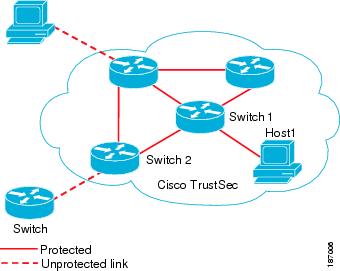
Figure 1.
Cisco TrustSec Network Cloud Example. This figure shows an example of a Cisco TrustSec cloud. In this example, several networking devices and an endpoint device are inside the Cisco TrustSec cloud. One endpoint device and one networking device are outside the cloud because they are not Cisco TrustSec-capable devicesor they have been refused access.
The Cisco TrustSec architecture consists of the following major components:
Authentication
Verifies the identity of each device before allowing them to join the Cisco TrustSec network.
Authorization
Decides the level of access to the Cisco TrustSec network resources for a device based on the authenticated identity of the device.
Access control
Applies access policies on a per-packet basis using the source tags on each packet.
Secure communication
Provides encryption, integrity, and data-path replay protection for the packets that flow over each link in the Cisco TrustSec network.
A Cisco TrustSec network has the following entities:
Supplicants
Devices that attempt to join a Cisco TrustSec network.
Authenticators (AT)
Devices that are already part of a Cisco TrustSec network.
Authorization server
Servers that may provide authentication information, authorization information, or both.
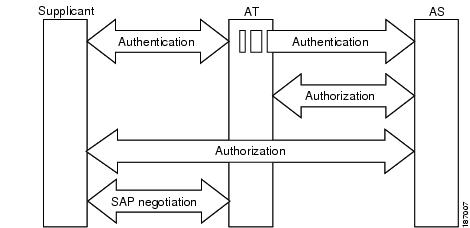
When the link between the supplicant and the AT first comes up, the following sequence of events may occur:
Authentication (802.1X)
The authentication server performs the authentication of the supplicant or the authentication completes trivially if you configure the devices to unconditionally authenticate each other.
Authorization
Each side of the link obtains policies, such as SGT and ACLs, that apply to the link. A supplicant may need to use the AT as a relay if it has no other Layer 3 route to the authentication server.
Security Association Protocol (SAP) negotiation
The EAPOL-Key exchange occurs between the supplicant and the AT to negotiate a cipher suite, exchange security parameter indexes (SPIs), and manage keys. Successful completion of all three tasks results in the establishment of a security association (SA).
Ports stay in the unauthorized state (blocking state) until the SAP negotiation completes.
Figure 2.
SAP Negotiation. This figure shows the SAP netgotiation, including how ports the stay in unauthorized state until the SAP negotiation completes.
SAP negotiation can use any of the following modes of operation:
Galois/Counter Mode (GCM) encryption
GCM authentication (GMAC)
No encapsulation (clear text)
Encapsulation with no encryption or authentication
Based on the IEEE 802.1AE standard, Cisco TrustSec uses ESP-128 GCM and GMAC.
Authentication
Cisco TrustSec authenticates a device before allowing it to join the network. Cisco TrustSec uses 802.1X authentication with Extensible Authentication Protocol Flexible Authentication via Secure Tunnel (EAP-FAST) as the Extensible Authentication Protocol (EAP) method to perform the authentication.
Cisco TrustSec uses EAP-FAST for authentication. EAP-FAST conversations allow for other EAP method exchanges inside the EAP-FAST tunnel using chains, which allows administrators to use traditional user authentication methods, such as Microsoft Challenge Handshake Authentication Protocol Version 2 (MSCHAPv2), while still having security provided by the EAP-FAST tunnel.
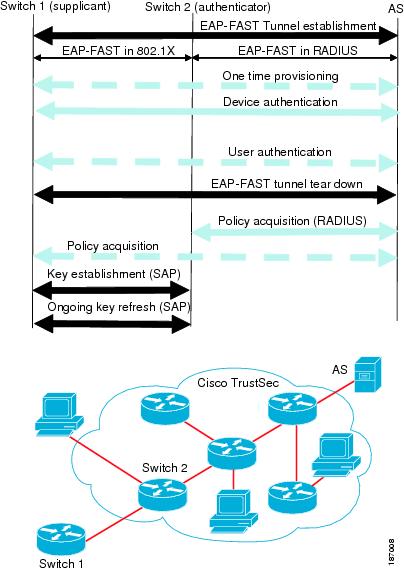
Figure 3.
Cisco TrustSec Authentication. This figure shows the EAP-FAST tunnel and inner methods as used in Cisco TrustSec.
The implementation of EAP-FAST for Cisco TrustSec has the following enhancements:
Authenticate the authenticator
Securely determines the identity of the AT by requiring the AT to use its protected access credential (PAC) to derive the shared secret between itself and the authentication server. This feature also prevents you from configuring RADIUS shared secrets on the authentication server for every possible IP address that can be used by the AT.
Notify each peer of the identity of its neighbor
By the end of the authentication exchange, the authentication server has identified both the supplicant and the AT. The authentication server conveys the identity of the AT, and whether the AT is Cisco TrustSec-capable, to the supplicant by using additional type-length-value parameters (TLVs) in the protected EAP-FAST termination. The authentication server also conveys the identity of the supplicant and whether the supplicant is Cisco TrustSec-capable, to the AT by using RADIUS attributes in the Access-Accept message. Because each peer knows the identity of its neighbor, it can send additional RADIUS Access-Requests to the authentication server to acquire the policy to be applied on the link.
AT posture evaluation
The AT provides its posture information to the authentication server whenever it starts the authentication exchange with the authentication server on behalf of the supplicant.
802.1X Role Selection
In 802.1X, the AT must have IP connectivity with the authentication server because it has to relay the authentication exchange between the supplicant and the AT using RADIUS over UDP/IP. When an endpoint device, such as a PC, connects to a network, it is obvious that it should act as a supplicant. However, in the case of a Cisco TrustSec connection between two network devices, the 802.1X role of each network device might not be immediately apparent to the other network device.
Instead of requiring manual configuration of the AT and supplicant roles for the Cisco NX-OS devices, Cisco TrustSec runs a role-selection algorithm to automatically determine which Cisco NX-OS device acts as the AT and which device acts as the supplicant. The role-selection algorithm assigns the AT role to the device that has IP reachability to a RADIUS server. Both devices start both the AT and supplicant state machines. When a Cisco NX-OS device detects that its peer has access to a RADIUS server, it terminates its own AT state machine and assumes the role of the supplicant. If both Cisco NX-OS devices have access to a RADIUS server, the algorithm compares the MAC addresses used as the source for sending the EAP over LAN (EAPOL) packets. The Cisco NX-OS device that has the MAC address with the higher value becomes the AT and the other Cisco NX-OS device becomes the supplicant.
Cisco TrustSec Authentication Summary
By the end of the Cisco TrustSec authentication process, the authentication server has performed the following actions:
Verified the identities of the supplicant and the AT.
Authenticated the user if the supplicant is an endpoint device.
At the end of the Cisco TrustSec authentication process, both the AT and the supplicant know following:
Device ID of the peer
Cisco TrustSec capability information of the peer
Key used for the SAP
Device Identities
Cisco TrustSec does not use IP addresses or MAC addresses as device identities. Instead, you assign a name (device ID) to each Cisco TrustSec-capable Cisco NX-OS device to identify it uniquely in the Cisco TrustSec network. This device ID used for the following:
Looking up authorization policy
Looking up passwords in the databases during authentication
Device Credentials
Cisco TrustSec supports password-based credentials. The authentication servers may use self-signed certificates instead. Cisco TrustSec authenticates the supplicants through passwords and uses MSCHAPv2 to provide mutual authentication even if the authentication server certificate is not verifiable.
The authentication server uses these credentials to mutually authenticate the supplicant during the EAP-FAST phase 0 (provisioning) exchange where a PAC is provisioned in the supplicant. Cisco TrustSec does not perform the EAP-FAST phase 0 exchange again until the PAC expires and only performs EAP-FAST phase 1 and phase 2 exchanges for future link bringups. The EAP-FAST phase 1 exchange uses the PAC to mutually authenticate the authentication server and the supplicant. Cisco TrustSec uses the device credentials only during the PAC provisioning (or reprovisioning) steps.
The authentication server uses a temporarily configured password to authenticate the supplicant when the supplicant first joins the Cisco TrustSec network. When the supplicant first joins the Cisco TrustSec network, the authentication server authenticates the supplicant using a manufacturing certificate and then generates a strong password and pushes it to the supplicant with the PAC. The authentication server also keeps the new password in its database. The authentication server and the supplicant use this password for mutual authentication in all future EAP-FAST phase 0 exchanges.
User Credentials
Cisco TrustSec does not require a specific type of user credentials for endpoint devices. You can choose any type of authentication method for the user (for example, MSCHAPv2, LEAP, generic token card (GTC), or OTP) and use the corresponding credentials. Cisco TrustSec performs user authentication inside the EAP-FAST tunnel as part of the EAP-FAST phase 2 exchange.
SGACLs and SGTs
In security group access lists (SGACLs), you can control the operations that users can perform based on assigned security groups. The grouping of permissions into a role simplifies the management of the security policy. As you add users to the Cisco NX-OS device, you simply assign one or more security groups and they immediately receive the appropriate permissions. You can modify security groups to introduce new privileges or restrict current permissions.
Cisco TrustSec assigns a unique 16-bit tag, called the security group tag (SGT), to a security group. The number of SGTs in the Cisco NX-OS device is limited to the number of authenticated network entities. The SGT is a single label that indicates the privileges of the source within the entire enterprise. Its scope is global within a Cisco TrustSec network.
The management server derives the SGTs based on the security policy configuration. You do not have to configure them manually.
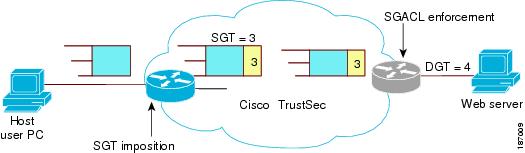
Once authenticated, Cisco TrustSec tags any packet that originates from a device with the SGT that represents the security group to which the device is assigned. The packet carries this SGT throughout the network within the Cisco TrustSec header. Because this tag represents the group of the source, the tag is referred to as the source SGT. At the egress edge of the network, Cisco TrustSec determines the group that is assigned to the packet destination device and applies the access control policy.
Cisco TrustSec defines access control policies between the security groups. By assigning devices within the network to security groups and applying access control between and within the security groups, Cisco TrustSec essentially achieves access control within the network.
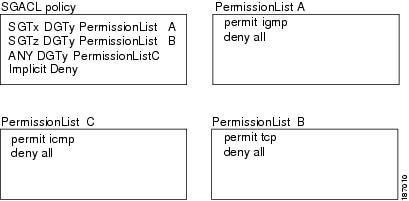
Figure 4.
SGACL Policy Example. This figure shows an example of an SGACL policy.
Figure 5.
SGT and SGACL in Cisco TrustSec Network. This figure shows how the SGT assignment and the SGACL enforcement operate in a Cisco TrustSec network.
The Cisco NX-OS device defines Cisco TrustSec access control policy for a group of devices as opposed to IP addresses in traditional ACLs. With such a decoupling, the network devices are free to move throughout the network and change IP addresses. Entire network topologies can change. As long as the roles and the permissions remain the same, changes to the network do not change the security policy. This feature greatly reduces size of ACLs and simplifies their maintenance.
In traditional IP networks, the number of access control entries (ACEs) configured is determined as follows:
# of ACEs = (# of sources specified) X (# of destinations specified) X (# of permissions specified)
A network device at the ingress of the Cisco TrustSec cloud needs to determine the SGT of the packet entering the Cisco TrustSec cloud so that it can tag the packet with that SGT when it forwards it into the Cisco TrustSec cloud. The egress network device needs to determine the SGT of the packet so that it can apply the SGACLs.
The network device can determine the SGT for a packet in one of the following methods:
Obtain the source SGT during policy acquisition—After the Cisco TrustSec authentication phase,a network device acquires a policy from an authentication server. Authentication server indicates whether the peer device is trusted or not. If a peer device is not trusted then the authentication server can also provide an SGT to apply to all packets coming from the peer device.
Obtain the source SGT field from the Cisco TrustSec header—If a packet comes from a trusted peer device, the Cisco TrustSec header carries the correct SGT field if the network device is not the first network device in the Cisco TrustSec cloud for the packet.
Look up the source SGT based on the source IP address—In some cases, you can manually configure the policy to decide the SGT of a packet based on the source IP address. The SGT Exchange Protocol (SXP) can also populate the IP-address-to-SGT mapping table.
Determining the Destination Security Group
The egress network device in a Cisco TrustSec cloud determines the destination group for applying the SGACL. In some cases, ingress devices or other nonegress devices might have destination group information available. In those cases, SGACLs might be applied in these devices rather than in egress devices.
Cisco TrustSec determines the destination group for the packet in following ways:
Destination SGT of the egress port obtained during the policy acquisition
Destination SGT lookup based on the destination IP address
You do not configure the destination SGT to enforce Cisco TrustSec on egress broadcast, multicast, and unknown unicast traffic on FEX or vEthernet ports. Instead, you set the DST to zero (unknown). The following is an example of the correct configuration:
SXP for SGT Propagation Across Legacy Access Networks
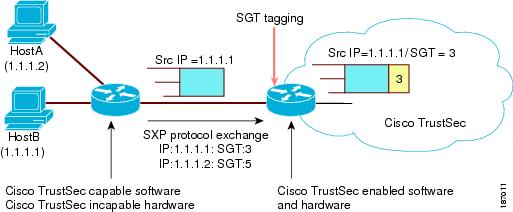
The Cisco NX-OS device hardware in the access layer supports Cisco TrustSec. Without the Cisco TrustSec hardware, the Cisco TrustSec software cannot tag the packets with SGTs. You can use SXP to propagate the SGTs across network devices that do not have hardware support for Cisco TrustSec.
SXP operates between access layer devices and distribution layer devices. The access layer devices use SXP to pass the IP addresses of the Cisco TrustSec-authenticated devices with their SGTs to the distribution switches. Distribution devices with both Cisco TrustSec-enabled software and hardware can use this information to tag packets appropriately and enforce SGACL policies.
Figure 6. Using SXP to Propagate SGT Information. This figure shows how to use SXP to propagate SGT information in a legacy network.
Tagging packets with SGTs requires hardware support. You might have devices in your network that cannot tag packets with SGTs. To allow these devices to send IP address-to-SGT mappings to a device that has Cisco TrustSec-capable hardware, you must manually set up the SXP connections. Manually setting up an SXP connection requires the following:
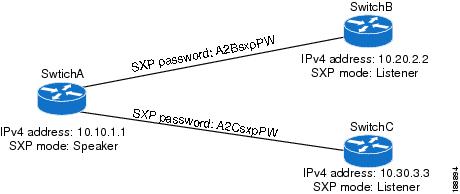
If you require SXP data integrity and authentication, you must configure both the same SXP password on both of the peer devices. You can configure the SXP password either explicitly for each peer connection or globally for the device. The SXP password is not required.
You must configure each peer on the SXP connection as either an SXP speaker or an SXP listener. The speaker device distributes the SXP information to the listener device.
You can specify a source IP address to use for each peer relationship or you can configure a default source IP address for peer connections where you have not configured a specific source IP address.
Authorization and Policy Acquisition
After authentication ends, both the supplicant and AT obtain the security policy from the authentication server. The supplicant and AT enforce the policy against each other. Both the supplicant and AT provide the peer device ID that each receives after authentication. If the peer device ID is not available, Cisco TrustSec can use a manually configured peer device ID.
The authentication server returns the following policy attributes:
Cisco TrustSec trust
Indicates whether the neighbor device is to be trusted for the purpose of putting the SGT in the packets.
Peer SGT
Indicates the security group that the peer belongs to. If the peer is not trusted, all packets received from the peer are tagged with this SGT. If the device does not know if the SGACLs are associated with the peer’s SGT, the device may send a follow-up request to fetch the SGACLs.
Authorization expiry time
Indicates the number of seconds before the policy expires. The Cisco-proprietary attribute-value (AV) pairs indicates the expiration time of an authorization or policy response to a Cisco TrustSec device. A Cisco TrustSec device should refresh its policy and authorization before it times out.
Tip
Each Cisco TrustSec device should support some minimal default access policy in case it is not able to contact the authentication server to get an appropriate policy for the peer.
Environment Data Download
The Cisco TrustSec environment data is a collection of information or policies that assists a device to function as a Cisco TrustSec node. The device acquires the environment data from the authentication server when the device first joins a Cisco TrustSec cloud, although you might also manually configure some of the data on a device. For example, you must configure the seed Cisco TrustSec device with the authentication server information, which can later be augmented by the server list that the device acquires from the authentication server.
The device must refresh the Cisco TrustSec environment data before it expires. The device can also cache the data and reuse it after a reboot if the data has not expired.
The device uses RADIUS to acquire the following environment data from the authentication server:
Server lists
List of servers that the client can use for future RADIUS requests (for both authentication and authorization).
Device SGT
Security group to which the device itself belongs.
Expiry timeout
Interval that controls how often the Cisco TrustSec device should refresh its environment data.
RADIUS Relay Functionality
The Cisco NX-OS device that plays the role of the Cisco TrustSec AT in the 802.1X authentication process has IP connectivity to the authentication server, which allows it to acquire the policy and authorization from the authentication server by exchanging RADIUS messages over UDP/IP. The supplicant device may not have IP connectivity with the authentication server. In such cases, Cisco TrustSec allows the AT to act as a RADIUS relay for the supplicant.
The supplicant sends a special EAP over LAN (EAPOL) message to the Cisco TrustSec AT that contains the RADIUS server IP address and UDP port and the complete RADIUS request. The Cisco TrustSec AT extracts the RADIUS request from the received EAPOL message and sends it over UDP/IP to the authentication server. When the RADIUS response returns from the authentication server, the Cisco TrustSec AT forwards the message back to the supplicant, encapsulated in an EAPOL frame.
Virtualization Support for Cisco TrustSec
Cisco TrustSec configuration and operation are local to the virtual device context (VDC). For more information on VDCs, see the
Cisco Nexus 7000 Series NX-OS Virtual Device Context Configuration Guide.
Licensing Requirements for Cisco TrustSec
The following table shows the licensing requirements for this feature:
Product
License Requirement
Cisco NX-OS
Beginning with Cisco NX-OS Release 6.1, Cisco TrustSec requires no license. Any feature not included in a license package
is bundled with the Cisco NX-OS system images and is provided at no
extra charge to you.
For Cisco NX-OS releases prior to 6.1, Cisco TrustSec requires an Advanced Services license. Cisco TrustSec licensing does not have a grace period. You must obtain and install an Advanced Services license before you can use Cisco TrustSec.
Note
For an explanation of the Cisco NX-OS licensing scheme and how to obtain and apply licenses, see the Cisco NX-OS Licensing Guide.
Prerequisites for Cisco TrustSec
Cisco TrustSec has the following prerequisites:
You must install the Advanced Services license if your device is running a Cisco NX-OS release prior to 6.1.
You must enable the 802.1X feature.
You must enable the 802.1X feature before you enable the Cisco TrustSec feature. Although none of the 802.1X interface level features are available, 802.1X is required for the device to authenticate with RADIUS.
You must enable the Cisco TrustSec feature.
Guidelines and Limitations for Cisco TrustSec
Cisco TrustSec has the following guidelines and limitations:
The following commands are not supported for F1 Series or F2 Series modules:
cts dot1x
propagate-sgt
replay-protection
sap pmk
sap hash-algorithm
Only CTS RBACL is supported for F1 Series and F2 Series modules. The F1 Series and F2 Series modules do not support the cts-dot1x mode or the cts-manual mode.
The F1 Series and F2 Series modules do not support FIPS mode.
Cisco TrustSec uses RADIUS for authentication.
You cannot configure both Cisco TrustSec and 802.1X on an interface; you can configure only one or the other. However, you must enable the 802.1X feature for Cisco TrustSec to use EAP-FAST authentication.
AAA authentication and authorization for Cisco TrustSec is only supported by the Cisco Secure Access Control Server (ACS).
Cisco TrustSec supports IPv4 addressing only.
SXP cannot use the management (mgmt 0) interface.
You cannot enable Cisco TrustSec on interfaces in half-duplex mode.
If SGACL is applied to the packets being routed through SVI, SGACL has to be enabled on all the VLANs and the VRF involved.
When a switch is in N-Port Virtualization (NPV) mode, an Ethernet interface that is bound to a virtual fibre channel in NP mode cannot be assigned a valid SGT. This restriction ensures that SGT and DGT label lookups fail so that the RBACL label configured on the logical interface is used for egress Layer 3 binding checks.
The 40G and 100G M2 Series modules support IEEE 802.1AE MAC security (MACsec). For MACsec links that have a bandwidth that is greater than or equal to 40G, multiple security associations (SCI/AN pairs) are established with each Security Association Protocol (SAP) exchange.
Default Settings For Cisco TrustSec
This table lists the default settings for Cisco TrustSec parameters.
You must enable both the 802.1X feature and the Cisco TrustSec feature on the Cisco NX-OS device before you can configure Cisco TrustSec.
Note
You cannot disable the 802.1X feature after you enable the Cisco TrustSec feature.
Before You Begin
Ensure that you have installed the Advanced Services license, if your device is running a Cisco NX-OS release prior to 6.1.
SUMMARY STEPS
1.configure terminal
2.feature dot1x
3.feature cts
4.exit
5.
(Optional) show cts
6.
(Optional) show feature
7.
(Optional) copy running-config startup-config
DETAILED STEPS
Command or Action
Purpose
Step 1
configure terminal
Example:
switch# configure terminal
switch(config)#
Enters configuration mode.
Step 2
feature dot1x
Example:
switch(config)# feature dot1x
Enables the 802.1X feature.
Step 3
feature cts
Example:
switch(config)# feature cts
Enables the Cisco TrustSec feature.
Step 4
exit
Example:
switch(config)# exit
switch#
Exits configuration mode.
Step 5
show cts
Example:
switch# show cts
(Optional)
Displays the Cisco TrustSec configuration.
Step 6
show feature
Example:
switch# show feature
(Optional)
Displays the enabled status for features.
Step 7
copy running-config startup-config
Example:
switch# copy running-config startup-config
(Optional)
Copies the running configuration to the startup configuration.
Configuring Cisco TrustSec Device Credentials
You must configure unique Cisco TrustSec credentials on each Cisco TrustSec-enabled Cisco NX-OS device in your network. Cisco TrustSec uses the password in the credentials for device authentication.
Note
You must also configure the Cisco TrustSec credentials for the Cisco NX-OS device on the Cisco Secure ACS (see the documentation at the following URL:
Configures a unique device ID and password. The name argument has a maximum length of 32 characters and is case sensitive.
Step 3
exit
Example:
switch(config)# exit
switch#
Exits configuration mode.
Step 4
show cts
Example:
switch# show cts
(Optional)
Displays the Cisco TrustSec configuration.
Step 5
show cts environment
Example:
switch# show cts environment
(Optional)
Displays the Cisco TrustSec environment data.
Step 6
copy running-config startup-config
Example:
switch# copy running-config startup-config
(Optional)
Copies the running configuration to the startup configuration.
Configuring AAA for Cisco TrustSec
You can use Cisco Secure ACS for Cisco TrustSec authentication. You must configure RADIUS server groups and specify the default AAA authentication and authorization methods on one of the Cisco TrustSec-enabled Cisco NX-OS devices in your network cloud. Because Cisco TrustSec supports RADIUS
relay, you need to configure AAA only on a seed Cisco NX-OS device that is directly connected to a Cisco Secure ACS. For all the other Cisco TrustSec-enabled Cisco NX-OS devices, Cisco TrustSec automatically provides a private AAA server group, aaa-private-sg. The seed Cisco NX-OS devices uses the management VRF to communicate with the Cisco Secure ACS.
Note
Only the Cisco Secure ACS supports Cisco TrustSec.
Configuring AAA on the Cisco TrustSec Seed Cisco NX-OS Devices
This section describes how to configure AAA on the seed Cisco NX-OS device in your Cisco TrustSec network cloud.
Note
When you configure the AAA RADIUS server group for the seed Cisco NX-OS device, you must specify a VRF. If you use the management VRF, no further configuration is necessary for the nonseed devices in the network cloud. If you use a different VRF, you must configure the nonseed devices with that VRF.
Before You Begin
Obtain the IPv4 or IPv6 address or hostname for the Cisco ACS.
Configures a RADIUS server host with a key and PAC. The hostname augument is The key augument is alphanumeric, case sensitive, and has a maximum length of 63 characters. The 0 option indicates that the key is in clear text. The 7 option indicates that the key is encrypted. The default is clear text.
Step 3
show radius-server
Example:
switch# show radius-server
(Optional)
Displays the RADIUS server configuration.
Step 4
aaa group server radius group-name
Example:
switch(config)# aaa group server radius Rad1
switch(config-radius)#
Specifies the RADIUS server group and enters RADIUS server group configuration mode.
Step 5
server {ipv4-address | ipv6-address | hostname}
Example:
switch(config-radius)# server 10.10.1.1
Specifies the RADIUS server host address.
Step 6
use-vrfvrf-name
Example:
switch(config-radius)# use-vrf management
Specifies the management VRF for the AAA server group.
Note
If you use the management VRF, no further configuration is necessary for the nonseed devices in the network cloud. If you use a different VRF, you must configure the nonseed devices with that VRF.
Step 7
exit
Example:
switch(config-radius)# exit
switch(config)#
Exits RADIUS server group configuration mode.
Step 8
aaa authentication dot1x default groupgroup-name
Example:
switch(config)# aaa authentication dot1x default group Rad1
Specifies the RADIUS server groups to use for 802.1X authentication.
Step 9
aaa authorization cts default groupgroup-name
Example:
switch(config)# aaa authentication cts default group Rad1
Specifies the RADIUS server groups to use for Cisco TrustSec authorization.
Step 10
exit
Example:
switch(config)# exit
switch#
Exits configuration mode.
Step 11
show radius-server groups [group-name]
Example:
switch# show radius-server group rad1
(Optional)
Displays the RADIUS server group configuration.
Step 12
show aaa authentication
Example:
switch# show aaa authentication
(Optional)
Displays the AAA authentication configuration.
Step 13
show aaa authorization
Example:
switch# show aaa authorization
(Optional)
Displays the AAA authorization configuration.
Step 14
show cts pacs
Example:
switch# show cts pacs
(Optional)
Displays the Cisco TrustSec PAC information.
Step 15
copy running-config startup-config
Example:
switch# copy running-config startup-config
(Optional)
Copies the running configuration to the startup configuration.
Configuring AAA on Cisco TrustSec Nonseed Cisco NX-OS Devices
Cisco TrustSec configures an AAA server group named aaa-private-sg on the nonseed Cisco NX-OS devices in the network cloud. By default, the aaa-private-sg server group uses the management VRF to communicate with the Cisco Secure ACS and no further configuration is required on the nonseed Cisco NX-OS devices. However, if you choose to use a different VRF, you must change the aaa-private-sg on the nonseed Cisco NX-OS device to use the correct VRF.
Before You Begin
Ensure that you enabled Cisco TrustSec.
Ensure that you have configured a seed Cisco NX-OS device in your network.
SUMMARY STEPS
1.configure terminal
2.aaa group server radius aaa-private-sg
3.use-vrfvrf-name
4.exit
5.
(Optional) show radius-server groups aaa-private-sg
6.
(Optional) copy running-config startup-config
DETAILED STEPS
Command or Action
Purpose
Step 1
configure terminal
Example:
switch# configure terminal
switch(config)#
Enters global configuration mode.
Step 2
aaa group server radius aaa-private-sg
Example:
switch(config)# aaa group server radius aaa-private-sg
switch(config-radius)#
Specifies the RADIUS server group aaa-private-sg and enters RADIUS server group configuration mode.
Step 3
use-vrfvrf-name
Example:
switch(config-radius)# use-vrf MyVRF
Specifies the management VRF for the AAA server group.
Step 4
exit
Example:
switch(config-radius)# exit
switch(config)#
Exits configuration mode.
Step 5
show radius-server groups aaa-private-sg
Example:
switch(config)# show radius-server groups aaa-private-sg
(Optional)
Displays the RADIUS server group configuration for the default server group.
Cisco TrustSec Configuration Process for Cisco TrustSec Authentication and Authorization
Follow these steps to configure Cisco TrustSec authentication and authorization:
SUMMARY STEPS
1.Enable the Cisco TrustSec feature.
2.
Enable Cisco TrustSec authentication.
3.
Enable 802.1X authentication for Cisco TrustSec on the interfaces.
DETAILED STEPS
Step 1
Enable the Cisco TrustSec feature.
Step 2
Enable Cisco TrustSec authentication.
Step 3
Enable 802.1X authentication for Cisco TrustSec on the interfaces.
Enabling Cisco TrustSec Authentication
You must enable Cisco TrustSec authentication on the interfaces. By default, the data path replay protection feature is enabled and the SAP operating mode is GCM-encrypt.
Caution
For the Cisco TrustSec authentication configuration to take effect, you must enable and disable the interface, which disrupts traffic on the interface.
Note
Enabling 802.1X mode for Cisco TrustSec automatically enables authorization and SAP on the interface.
Copies the running configuration to the startup configuration.
Configuring Data-Path Replay Protection for Cisco TrustSec on Interfaces
By default, the Cisco NX-OS software enables the data-path reply protection feature. You can disable the data-path replay protection feature on the interfaces for Layer 2 Cisco TrustSec if the connecting device does not support SAP.
Caution
For the data-path replay protection configuration to take effect, you must enable and disable the interface, which disrupts traffic on the interface.
Before You Begin
Ensure that you enabled Cisco TrustSec authentication on the interface.
Copies the running configuration to the startup configuration.
Configuring SGT Propagation for Cisco TrustSec on Interfaces
The SGT propagation feature on the Layer 2 interface is enabled by default. You can disable the SGT propagation feature on an interface if the peer device connected to the interface cannot handle Cisco TrustSec packets tagged with an SGT.
Caution
For the SGT propagation configuration to take effect, you must enable and disable the interface, which disrupts traffic on the interface.
Before You Begin
Ensure that you enabled Cisco TrustSec authentication on the interface.
Copies the running configuration to the startup configuration.
Regenerating SAP Keys on an Interface
You can trigger an SAP exchange to generate a new set of keys and protect the data traffic flowing on an interface.
Before You Begin
Ensure that you enabled Cisco TrustSec.
SUMMARY STEPS
1.cts rekey ethernetslot/port
2.
(Optional) show cts interface all
DETAILED STEPS
Command or Action
Purpose
Step 1
cts rekey ethernetslot/port
Example:
switch# cts rekey ethernet 2/3
Generates the SAP keys for an interface.
Step 2
show cts interface all
Example:
switch# show cts interface all
(Optional)
Displays the Cisco TrustSec configuration on the interfaces.
Configuring Cisco TrustSec Authentication in Manual Mode
You can manually configure Cisco TrustSec on an interface if your Cisco NX-OS device does not have access to a Cisco Secure ACS or authentication is not needed because you have the MAC address authentication bypass feature enabled. You must manually configure the interfaces on both ends of the connection.
Note
You cannot enable Cisco TrustSec on interfaces in half-duplex mode. Use the show interface command to determine if an interface is configured for half-duplex mode.
Caution
For the Cisco TrustSec manual mode configuration to take effect, you must enable and disable the interface, which disrupts traffic on the interface.
switch(config-if-cts-manual)# sap pmk fedbaa modelist gmac
Configures the SAP pairwise master key (PMK) and operation mode. SAP is disabled by default in Cisco TrustSec manual mode.
The key argument is a hexadecimal value with an even number of characters and a maximum length of 32 characters.
Use the use-dot1x keyword when the peer device does not support Cisco TrustSec 802.1X authentication or authorization but does support SAP data path encryption and authentication.
The mode list configures the cipher mode for the data path encryption and authentication as follows:
gcm-encrypt
GCM encryption mode
gmac
GCM authentication mode
no-encap
No encapsulation and no SGT insertion
null
Encapsulation of the SGT without authentication or encryption
Configures dynamic authorization policy download. The peer-name argument is the Cisco TrustSec device ID for the peer device. The peer name is case sensitive.
Note
Ensure that you have configured the Cisco TrustSec credentials and AAA for Cisco TrustSec.
Note
The policy dynamic and policy static commands are mutually exclusive. Only one can be applied at a time. To change from one to the other, you must use the no form of the command to remove the configuration before configuring the other command.
Configures a static authorization policy. The tag argument is in hexadecimal format and the range is from 0x2 to 0xffef. The trusted keyword indicates that traffic coming on the interface with this SGT should not have its tag overridden.
Note
The policy dynamic and policy static commands are mutually exclusive. Only one can be applied at a time. To change from one to the other, you must use the no form of the command to remove the configuration before configuring the other command.
Enables the interface and enables Cisco TrustSec authentication on the interface.
Step 10
exit
Example:
switch(config-if)# exit
switch(config)#
Exits interface configuration mode.
Step 11
show cts interface all
Example:
switch# show cts interface all
(Optional)
Displays the Cisco TrustSec configuration for the interfaces.
Step 12
copy running-config startup-config
Example:
switch# copy running-config startup-config
(Optional)
Copies the running configuration to the startup configuration.
Configuring Pause Frame Encryption or Decryption for Cisco TrustSec on Interfaces
Pause frames are MAC control frames used for Ethernet flow control. The ports on some line cards encrypt and decrypt pause frames while the ports on other line cards do not have this ability. This disparity causes interoperability issues and causes the ports to discard or ignore the pause frames.
You can configure if the pause frames are to be encrypted or clear on individual interfaces. You must configure the interfaces on both ends of the connection but can do so using either dot1x or manual mode. If two ports are connected to form a CTS link and one is clear pause capable and the other is secure (encryption/decryption) pause capable, the pause frames must be sent in the clear across the link in order for them to be correctly sent and received.
Note
F1 Series modules, F2 Series modules, and the N7K-M132XP-12(L) module support only clear pause frames. All other M1 Series modules support both secure (encrypted and decrypted) and clear pause frames.
Note
You cannot enable Cisco TrustSec on interfaces in half-duplex mode. Use the show interface command to determine if an interface is configured for half-duplex mode.
Caution
For the pause frame encryption or decryption configuration to take effect, you must enable and disable the interface, which disrupts traffic on the interface.
Before You Begin
Ensure that you enabled Cisco TrustSec.
Ensure that you have enabled flow control on the interface using the flowcontrol {send | receive} command.
Enters Cisco TrustSec dot1x or manual configuration mode.
Note
You cannot enable Cisco TrustSec on interfaces in half-duplex mode.
Step 4
[no] encrypt pause-frame
Example:
switch(config-if-cts-dot1x)# no encrypt pause-frame
Configures pause frame encryption or decryption for Cisco TrustSec on the interface. When no encrypt pause-frame is configured, the pause frames are sent in the clear. When encrypt pause-frame is configured, pause frames are sent encrypted over the CTS link.
Copies the running configuration to the startup configuration.
Manually Configuring Cisco TrustSec SGTs
You can manually configure unique Cisco TrustSec security group tags (SGTs) for the packets originating from this device.
Note
You must also configure the Cisco TrustSec credentials for the Cisco NX-OS device on the Cisco Secure ACS.
Before You Begin
Ensure that you have enabled Cisco TrustSec.
SUMMARY STEPS
1.configure terminal
2.cts sgt tag
3.exit
4.
(Optional) show cts environment-data
5.
(Optional) copy running-config startup-config
DETAILED STEPS
Command or Action
Purpose
Step 1
configure terminal
Example:
switch# configure terminal
switch(config)#
Enters configuration mode.
Step 2
cts sgt tag
Example:
switch(config)# cts sgt 0x00a2
Configures the SGT for packets sent from the device. The tag argument is a hexadecimal value in the format 0xhhhh. The range is from 0x2 to 0xffef.
Step 3
exit
Example:
switch(config)# exit
switch#
Exits configuration mode.
Step 4
show cts environment-data
Example:
switch# show cts environment-data
(Optional)
Displays the Cisco TrustSec environment data information.
Step 5
copy running-config startup-config
Example:
switch# copy running-config startup-config
(Optional)
Copies the running configuration to the startup configuration.
Manually Configuring IPv4-Address-to-SGACL SGT Mapping for a VLAN
You can manually configure an IPv4 address to SGACL SGT mapping on a VLAN if you do not have Cisco Secure ACS, dynamic ARP inspection, or DHCP snooping available on your Cisco NX-OS device.
Before You Begin
Ensure that you enabled Cisco TrustSec.
Ensure that you enabled SGACL policy enforcement on the VLAN.
SUMMARY STEPS
1.configure terminal
2.vlanvlan-id
3.cts role-based sgt-mapipv4-address tag
4.exit
5.
(Optional) show cts role-based sgt-map
6.
(Optional) copy running-config startup-config
DETAILED STEPS
Command or Action
Purpose
Step 1
configure terminal
Example:
switch# configure terminal
switch(config)#
Enters configuration mode.
Step 2
vlanvlan-id
Example:
switch(config)# vlan 10
switch(config-vlan)#
Specifies a VLAN and enters VLAN configuration mode.
Copies the running configuration to the startup configuration.
Manually Configuring IPv4-Address-to-SGACL SGT Mapping for a VRF
You can manually configure IPv4 address to SGACL SGT mapping on either a VRF if a Cisco Secure ACS is not available to download the SGACL policy configuration. You can use this feature if you do not have Cisco Secure ACS, dynamic ARP inspection, or DHCP snooping available on your Cisco NX-OS device.
Before You Begin
Ensure that you enabled Cisco TrustSec.
Ensure that you enabled SGACL policy enforcement on the VRF.
Copies the running configuration to the startup configuration.
Manually Configuring SGACL Policies
You can manually configure SGACL policies on your Cisco NX-OS device if a Cisco Secure ACS is not available to download the SGACL policy configuration. You can also enable role-based access control list (RBACL) logging, which allows users to monitor specific types of packets exiting the Cisco NX-OS device.
Note
Before the system generates ACLLOG and RBACL syslogs, logged packets are rate limited, and flows are cached. You can view the source group tag (SGT) on the logged packets using the show logging ip access-list cache detail command. For details of this command, see the Cisco Nexus 7000 Series NX-OS System Management Command Reference.
Before You Begin
Ensure that you have enabled Cisco TrustSec.
For Cisco TrustSec logging to function, you must enable Cisco TrustSec counters or statistics.
Ensure that you have enabled SGACL policy enforcement on the VLAN and VRF.
If you plan to enable RBACL logging, ensure that you have enabled RBACL policy enforcement on the VLAN and VRF.
If you plan to enable RBACL logging, ensure that you have set the logging level of ACLLOG syslogs to 6 and the logging level of CTS manager syslogs to 5.
If you plan to enable RBACL logging, ensure that you have set the logging level of CTS manager syslogs to 6 or less.
Specifies an SGACL and enters role-based access list configuration mode. The list-name argument value is alphanumeric, case sensitive, and has a maximum length of 32 characters.
Step 3
{deny | permit} all[log]
Example:
switch(config-rbacl)# deny all log
(Optional)
Denies or permits all traffic. Optionally, you can use the log keyword to specify that packets matching this configuration be logged.
Step 4
{deny | permit} icmp [log]
Example:
switch(config-rbacl)# permit icmp
(Optional)
Denies or permits Internet Control Message Protocol (ICMP) traffic. Optionally, you can use the log keyword to specify that packets matching this configuration be logged.
Step 5
{deny | permit} igmp[log]
Example:
switch(config-rbacl)# deny igmp
(Optional)
Denies or permits Internet Group Management Protocol (IGMP) traffic. Optionally, you can use the log keyword to specify that packets matching this configuration be logged.
Step 6
{deny | permit} ip[log]
Example:
switch(config-rbacl)# permit ip
(Optional)
Denies or permits IP traffic. Optionally, you can use the log keyword to specify that packets matching this configuration be logged.
Denies or permits TCP traffic. The default permits all TCP traffic. The range for the port-number, port-number1, and port-number2 arguments is from 0 to 65535. Optionally, you can use the log keyword to specify that packets matching this configuration be logged.
Denies or permits UDP traffic. The default permits all UDP traffic. The range for the port-number, port-number1, and port-number2 arguments is from 0 to 65535. Optionally, you can use the log keyword to specify that packets matching this configuration be logged.
Step 9
exit
Example:
switch(config-rbacl)# exit
switch(config)#
Exits role-based access-list configuration mode.
Step 10
cts role-based sgt {sgt-value | any | unknown} dgt {dgt-value | any | unknown} access-listlist-name
Copies the running configuration to the startup configuration.
Displaying the Downloaded SGACL Policies
After you configure the Cisco TrustSec device credentials and AAA, you can verify the Cisco TrustSec SGACL policies downloaded from the Cisco Secure ACS. The Cisco NX-OS software download the SGACL policies when it learns of a new SGT through authentication and authorization on an interface, from SXP, or from manual IPv4 address to SGACL SGT mapping.
Before You Begin
Ensure that you enabled Cisco TrustSec.
SUMMARY STEPS
1.show cts role-based access-list
DETAILED STEPS
Command or Action
Purpose
Step 1
show cts role-based access-list
Example:
switch# show cts role-based access-list
Displays Cisco TrustSec SGACLs, both downloaded from the Cisco Secure ACS and manually configured on the Cisco NX-OS device.
Refreshing the Downloaded SGACL Policies
You can refresh the SGACL policies downloaded to the Cisco NX-OS device by the Cisco Secure ACS.
Before You Begin
Ensure that you enabled Cisco TrustSec.
SUMMARY STEPS
1.cts refresh role-based policy
2.
(Optional) show cts role-based policy
DETAILED STEPS
Command or Action
Purpose
Step 1
cts refresh role-based policy
Example:
switch# cts refresh policy
Refreshes the Cisco TrustSec SGACL policies from the Cisco Secure ACS.
Step 2
show cts role-based policy
Example:
switch# show cts role-based policy
(Optional)
Displays the Cisco TrustSec SGACL policies.
Enabling Statistics for RBACL
You can request a count of the number of packets that match role-based access control list (RBACL) policies. These statistics are collected per source group tag (SGT) and destination group tag (DGT).
Note
When you modify an RBACL policy, statistics for the previously assigned access control entry (ACE) are displayed, and the newly
assigned ACE statistics are initialized to 0.
Note
RBACL statistics are lost only when the Cisco NX-OS device reloads or you deliberately clear the statistics.
Before You Begin
Ensure that you have enabled Cisco TrustSec.
If you plan to enable RBACL statistics, ensure that you have enabled RBACL policy enforcement on the VLAN and VRF.
When you enable RBACL statistics, each policy requires one entry in the hardware. If you do not have enough space remaining in the hardware, an error message appears, and you are unable to enable the statistics.
SUMMARY STEPS
1.configure terminal
2.[no] cts role-based counters enable
3.
(Optional) copy running-config startup-config
4.exit
5.
(Optional) show cts role-based counters[sgt {sgt-value | any | unknown}] [dgt {dgt-value | any | unknown}]
6.
(Optional) clear cts role-based counters
DETAILED STEPS
Command or Action
Purpose
Step 1
configure terminal
Example:
switch# configure terminal
switch(config)#
Enters global configuration mode.
Step 2
[no] cts role-based counters enable
Example:
switch(config)# cts role-based counters enable
Enables or disables RBACL statistics. The default is disabled.
Copies the running configuration to the startup configuration.
Step 4
exit
Example:
switch(config)# exit
switch#
Exits global configuration mode.
Step 5
show cts role-based counters[sgt {sgt-value | any | unknown}] [dgt {dgt-value | any | unknown}]
Example:
switch# show cts role-based counters sgt 10 dgt 20
(Optional)
Displays the configuration status of RBACL statistics and lists statistics for all RBACL policies. Optionally displays the total number of packets that match RBACL policies for a specific source group tag (SGT) or destination group tag (DGT). The sgt-value and dgt-value argument values range from 0 to 65519.
Step 6
clear cts role-based counters
Example:
switch# clear cts role-based counters
(Optional)
Clears the RBACL statistics so that all counters are reset to 0.
Clear the policies for Cisco TrustSec connection
information.
Manually Configuring SXP
You can use the SGT Exchange Protocol (SXP) to propagate the SGTs across network devices that do not have hardware support for Cisco TrustSec. This section describes how to configure Cisco TrustSec SXP on Cisco NX-OS devices in your network.
Follow these steps to manually configure Cisco TrustSec SXP:
SUMMARY STEPS
1.Enable the Cisco TrustSec feature.
2.
Enable SGACL policy enforcement on the VRF.
3.Enable Cisco TrustSec SXP.
4.
Configure SXP peer connections.
DETAILED STEPS
Step 1
Enable the Cisco TrustSec feature.
Step 2
Enable SGACL policy enforcement on the VRF.
Step 3
Enable Cisco TrustSec SXP.
Step 4
Configure SXP peer connections.
Note
You cannot use the management (mgmt 0) connection for SXP.
Enabling Cisco TrustSec SXP
You must enable Cisco TrustSec SXP before you can configure peer connections.
Before You Begin
Ensure that you enabled Cisco TrustSec.
SUMMARY STEPS
1.configure terminal
2.cts sxp enable
3.exit
4.
(Optional) show cts sxp
5.
(Optional) copy running-config startup-config
DETAILED STEPS
Command or Action
Purpose
Step 1
configure terminal
Example:
switch# configure terminal
switch(config)#
Enters configuration mode.
Step 2
cts sxp enable
Example:
switch(config)# cts sxp enable
Enables SXP for Cisco TrustSec.
Step 3
exit
Example:
switch(config)# exit
switch#
Exits configuration mode.
Step 4
show cts sxp
Example:
switch# show cts sxp
(Optional)
Displays the SXP configuration.
Step 5
copy running-config startup-config
Example:
switch# copy running-config startup-config
(Optional)
Copies the running configuration to the startup configuration.
Configuring Cisco TrustSec SXP Peer Connections
You must configure the SXP peer connection on both of the devices. One device is the speaker and the other is the listener. When using password protection, make sure to use the same password on both ends.
Note
If the default SXP source IP address is not configured and you do not specify the SXP source address in the connection, the Cisco NX-OS software derives the SXP source IP address from existing local IP addresses. The SXP source address could be different for each TCP connection initiated from the Cisco NX-OS device.
Before You Begin
Ensure that you enabled Cisco TrustSec.
Ensure that you enabled SXP.
Ensure that you enabled RBACL policy enforcement in the VRF.
The source keyword specifies the IPv4 address of the source device. The default source is IPv4 address you configured using the cts sxp default source-ip command.
The password keyword specifies the password that SXP should use for the connection using the following options:
default
Uses the default SXP password you configured using the cts sxp default password command.
none
Does not use a password.
required
Uses the password specified in the command.
The vrf keyword specifies the VRF to the peer. The default is the default VRF.
The mode listenerkeyword specifies the role of the remote peer device.
Note
You cannot use the management (mgmt 0) interface for SXP.
Step 3
exit
Example:
switch(config)# exit
switch#
Exits configuration mode.
Step 4
show cts sxp connections
Example:
switch# show cts sxp connections
(Optional)
Displays the SXP connections and their status.
Step 5
copy running-config startup-config
Example:
switch# copy running-config startup-config
(Optional)
Copies the running configuration to the startup configuration.
Configuring the Default SXP Password
By default, SXP uses no password when setting up connections. You can configure a default SXP password for the Cisco NX-OS device.
Before You Begin
Ensure that you enabled Cisco TrustSec.
Ensure that you enabled SXP.
SUMMARY STEPS
1.configure terminal
2.cts sxp default passwordpassword
3.exit
4.
(Optional) show cts sxp
5.
(Optional) show running-config cts
6.
(Optional) copy running-config startup-config
DETAILED STEPS
Command or Action
Purpose
Step 1
configure terminal
Example:
switch# configure terminal
switch(config)#
Enters configuration mode.
Step 2
cts sxp default passwordpassword
Example:
switch(config)# cts sxp default password A2Q3d4F5
Configures the SXP default password.
Step 3
exit
Example:
switch(config)# exit
switch#
Exits configuration mode.
Step 4
show cts sxp
Example:
switch# show cts sxp
(Optional)
Displays the SXP configuration.
Step 5
show running-config cts
Example:
switch# show running-config cts
(Optional)
Displays the SXP configuration in the running configuration.
Step 6
copy running-config startup-config
Example:
switch# copy running-config startup-config
(Optional)
Copies the running configuration to the startup configuration.
Configuring the Default SXP Source IPv4 Address
The Cisco NX-OS software uses the default source IPv4 address in all new TCP connections where a source IPv4 address is not specified. There is no effect on existing TCP connections when you configure the default SXP source IPv4 address.
Copies the running configuration to the startup configuration.
Changing the SXP Reconcile Period
After a peer terminates an SXP connection, an internal hold-down timer starts. If the peer reconnects before the internal hold-down timer expires, the SXP reconcile period timer starts. While the SXP reconcile period timer is active, the Cisco NX-OS software retains the SGT mapping entries learned from the previous connection and removes invalid entries. The default value is 120 seconds (2 minutes). Setting the SXP reconcile period to 0 seconds disables the timer and causes all entries from the previous connection to be removed.
Before You Begin
Ensure that you enabled Cisco TrustSec.
Ensure that you enabled SXP.
SUMMARY STEPS
1.configure terminal
2.cts sxp reconcile-periodseconds
3.exit
4.
(Optional) show cts sxp
5.
(Optional) copy running-config startup-config
DETAILED STEPS
Command or Action
Purpose
Step 1
configure terminal
Example:
switch# configure terminal
switch(config)#
Enters configuration mode.
Step 2
cts sxp reconcile-periodseconds
Example:
switch(config)# cts sxp reconcile-period 180
Changes the SXP reconcile timer period. The default value is 120 seconds (2 minutes). The range is from 0 to 64000.
Step 3
exit
Example:
switch(config)# exit
switch#
Exits configuration mode.
Step 4
show cts sxp
Example:
switch# show cts sxp
(Optional)
Displays the SXP configuration.
Step 5
copy running-config startup-config
Example:
switch# copy running-config startup-config
(Optional)
Copies the running configuration to the startup configuration.
Changing the SXP Retry Period
The SXP retry period determines how often the Cisco NX-OS software retries an SXP connection. When an SXP connection is not successfully set up, the Cisco NX-OS software makes a new attempt to set up the connection after the SXP retry period timer expires. The default value is 60 seconds (1 minute). Setting the SXP retry period to 0 seconds disables the timer and retries are not attempted.
Before You Begin
Ensure that you enabled Cisco TrustSec.
Ensure that you enabled SXP.
SUMMARY STEPS
1.configure terminal
2.cts sxp retry-periodseconds
3.exit
4.
(Optional) show cts sxp
5.
(Optional) copy running-config startup-config
DETAILED STEPS
Command or Action
Purpose
Step 1
configure terminal
Example:
switch# configure terminal
switch(config)#
Enters configuration mode.
Step 2
cts sxp retry-periodseconds
Example:
switch(config)# cts sxp retry-period 120
Changes the SXP retry timer period. The default value is 60 seconds (1 minute). The range is from 0 to 64000.
Step 3
exit
Example:
switch(config)# exit
switch#
Exits configuration mode.
Step 4
show cts sxp
Example:
switch# show cts sxp
(Optional)
Displays the SXP configuration.
Step 5
copy running-config startup-config
Example:
switch# copy running-config startup-config
(Optional)
Copies the running configuration to the
startup configuration.
Verifying the Cisco TrustSec Configuration
To display Cisco TrustSec configuration information, perform one of the following tasks:
Command
Purpose
show cts
Displays Cisco TrustSec information.
show cts credentials
Displays Cisco TrustSec credentials for EAP-FAST.
show cts environment-data
Displays Cisco TrustSec environmental data.
show cts interface
Displays the Cisco TrustSec configuration for the interfaces.
show cts pacs
Displays Cisco TrustSec authorization information and PACs in the device key store.
show cts role-based access-list
Displays Cisco TrustSec SGACL information.
show cts role-based counters [sgt sgt-value] [dgt dgt-value]
Displays the configuration status of RBACL statistics and lists statistics for all RBACL policies. Optionally displays the total number of packets that match RBACL policies for a specific source group tag (SGT) or destination group tag (DGT).
The ACLLOG syslog does not contain the destination group tag (DGT) information of the matched RBACL policy. You can find this information by looking up the IP-SGT mapping of the destination IP address in the log message and then entering the show cts role-based sgt-map command.
The following example shows how to enable and display RBACL statistics: