The Cisco implementation of 4-byte autonomous system numbers uses asplain (65538, for example) as the default regular expression match and the output display format for AS numbers. However, you can configure 4-byte autonomous system numbers in both the asplain format and the asdot format as described in RFC 5396.
Your software release may not support all the features documented in this module. For the latest caveats and feature information, see
Bug Search Tool and the release notes for your platform and software release. To find information about the features documented in this module, and to see a list of the releases in which each feature is supported, see the feature information table at the end of this module.
Use Cisco Feature Navigator to find information about platform support and Cisco software image support. To access Cisco Feature Navigator, go to
www.cisco.com/go/cfn. An account on Cisco.com is not required.
Information About BGP Support for 4-byte ASN
BGP Autonomous System Number Formats
Prior to January 2009, BGP autonomous system numbers that were allocated to companies were 2-octet numbers in the range from 1 to 65535 as described in RFC 4271,
A Border Gateway Protocol 4 (BGP-4). Due to increased demand for autonomous system numbers, the Internet Assigned Number Authority (IANA) will start in January 2009 to allocate four-octet autonomous system numbers in the range from 65536 to 4294967295. RFC 5396,
Textual Representation of Autonomous System (AS) Numbers, documents three methods of representing autonomous system numbers. Cisco has implemented the following two methods:
Asplain—Decimal value notation where both 2-byte and 4-byte autonomous system numbers are represented by their decimal value. For example, 65526 is a 2-byte autonomous system number and 234567 is a 4-byte autonomous system number.
Asdot—Autonomous system dot notation where 2-byte autonomous system numbers are represented by their decimal value and 4-byte autonomous system numbers are represented by a dot notation. For example, 65526 is a 2-byte autonomous system number and 1.169031 is a 4-byte autonomous system number (this is dot notation for the 234567 decimal number).
For details about the third method of representing autonomous system numbers, see RFC 5396.
Asdot Only Autonomous System Number Formatting
In Cisco IOS XE Release 2.3, the 4-octet (4-byte) autonomous system numbers are entered and displayed only in asdot notation, for example, 1.10 or 45000.64000. When using regular expressions to match 4-byte autonomous system numbers the asdot format includes a period, which is a special character in regular expressions. A backslash must be entered before the period (for example, 1\.14) to ensure the regular expression match does not fail. The table below shows the format in which 2-byte and 4-byte autonomous system numbers are configured, matched in regular expressions, and displayed in
show command output in Cisco IOS images where only asdot formatting is available.
Table 1 Asdot Only 4-Byte Autonomous System Number Format
Format
Configuration Format
Show Command Output and Regular Expression Match Format
asdot
2-byte: 1 to 65535 4-byte: 1.0 to 65535.65535
Asplain as Default Autonomous System Number Formatting
In Cisco IOS XE Release 2.4 and later releases, the Cisco implementation of 4-byte autonomous system numbers uses asplain as the default display format for autonomous system numbers, but you can configure 4-byte autonomous system numbers in both the asplain and asdot format. In addition, the default format for matching 4-byte autonomous system numbers in regular expressions is asplain, so you must ensure that any regular expressions to match 4-byte autonomous system numbers are written in the asplain format. If you want to change the default
show command output to display 4-byte autonomous system numbers in the asdot format, use the
bgpasnotationdot command under router configuration mode. When the asdot format is enabled as the default, any regular expressions to match 4-byte autonomous system numbers must be written using the asdot format, or the regular expression match will fail. The tables below show that although you can configure 4-byte autonomous system numbers in either asplain or asdot format, only one format is used to display
show command output and control 4-byte autonomous system number matching for regular expressions, and the default is asplain format. To display 4-byte autonomous system numbers in
show command output and to control matching for regular expressions in the asdot format, you must configure the
bgpasnotationdot command. After enabling the
bgpasnotationdot command, a hard reset must be initiated for all BGP sessions by entering the
clearipbgp* command.
Note
If you are upgrading to an image that supports 4-byte autonomous system numbers, you can still use 2-byte autonomous system numbers. The
show command output and regular expression match are not changed and remain in asplain (decimal value) format for 2-byte autonomous system numbers regardless of the format configured for 4-byte autonomous system numbers.
Table 2 Default Asplain 4-Byte Autonomous System Number Format
Format
Configuration Format
Show Command Output and Regular Expression Match Format
asplain
2-byte: 1 to 65535 4-byte: 65536 to 4294967295
asdot
2-byte: 1 to 65535 4-byte: 1.0 to 65535.65535
2-byte: 1 to 65535 4-byte: 65536 to 4294967295
Table 3 Asdot 4-Byte Autonomous System Number Format
Format
Configuration Format
Show Command Output and Regular Expression Match Format
asplain
2-byte: 1 to 65535 4-byte: 65536 to 4294967295
2-byte: 1 to 65535 4-byte: 1.0 to 65535.65535
asdot
2-byte: 1 to 65535 4-byte: 1.0 to 65535.65535
Reserved and Private Autonomous System Numbers
In Cisco IOS XE Release 2.3 and later releases, the Cisco implementation of BGP supports RFC 4893. RFC 4893 was developed to allow BGP to support a gradual transition from 2-byte autonomous system numbers to 4-byte autonomous system numbers. A new reserved (private) autonomous system number, 23456, was created by RFC 4893 and this number cannot be configured as an autonomous system number in the Cisco IOS CLI.
RFC 5398,
Autonomous System (AS) Number Reservation for Documentation Use, describes new reserved autonomous system numbers for documentation purposes. Use of the reserved numbers allow configuration examples to be accurately documented and avoids conflict with production networks if these configurations are literally copied. The reserved numbers are documented in the IANA autonomous system number registry. Reserved 2-byte autonomous system numbers are in the contiguous block, 64496 to 64511 and reserved 4-byte autonomous system numbers are from 65536 to 65551 inclusive.
Private 2-byte autonomous system numbers are still valid in the range from 64512 to 65534 with 65535 being reserved for special use. Private autonomous system numbers can be used for internal routing domains but must be translated for traffic that is routed out to the Internet. BGP should not be configured to advertise private autonomous system numbers to external networks. Cisco IOS software does not remove private autonomous system numbers from routing updates by default. We recommend that ISPs filter private autonomous system numbers.
Note
Autonomous system number assignment for public and private networks is governed by the IANA. For information about autonomous-system numbers, including reserved number assignment, or to apply to register an autonomous system number, see the following URL: http://www.iana.org/.
Cisco Implementation of 4-Byte Autonomous System Numbers
In Cisco IOS XE Release 2.4 and later releases, the Cisco implementation of 4-byte autonomous system numbers uses asplain—65538, for example—as the default regular expression match and output display format for autonomous system numbers, but you can configure 4-byte autonomous system numbers in both the asplain format and the asdot format as described in RFC 5396. To change the default regular expression match and output display of 4-byte autonomous system numbers to asdot format, use the
bgpasnotationdot command followed by the
clearipbgp* command to perform a hard reset of all current BGP sessions. For more details about 4-byte autonomous system number formats, see the “BGP Autonomous System Number Formats” section.
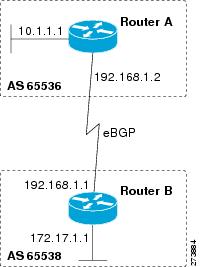
In Cisco IOS XE Release 2.3, the Cisco implementation of 4-byte autonomous system numbers uses asdot—1.2, for example—as the only configuration format, regular expression match, and output display, with no asplain support. For an example of BGP peers in two autonomous systems using 4-byte numbers, see the figure below. To view a configuration example of the configuration between three neighbor peers in separate 4-byte autonomous systems configured using asdot notation, see the “Example: Configuring a BGP Routing Process and Peers Using 4-Byte Autonomous System Numbers” section.
Cisco also supports RFC 4893, which was developed to allow BGP to support a gradual transition from 2-byte autonomous system numbers to 4-byte autonomous system numbers. To ensure a smooth transition, we recommend that all BGP speakers within an autonomous system that is identified using a 4-byte autonomous system number be upgraded to support 4-byte autonomous system numbers.
Note
A new private autonomous system number, 23456, was created by RFC 4893, and this number cannot be configured as an autonomous system number in the Cisco IOS CLI.
Figure 1. BGP Peers in Two Autonomous Systems Using 4-Byte Numbers
How to Configure BGP Support for 4-byte ASN
Configuring a BGP Routing Process and Peers Using 4-Byte Autonomous System Numbers
Perform this task to configure a BGP routing process and BGP peers when the BGP peers are located in an AS that uses 4-byte autonomous system numbers. The address family configured here is the default IPv4 unicast address family, and the configuration is done at Router B in the figure above (in the “Cisco Implementation of 4-Byte Autonomous System Numbers” section). The 4-byte autonomous system numbers in this task are formatted in the default asplain (decimal value) format; for example, Router B is in autonomous system number 65538 in the figure above. Remember to perform this task for any neighbor routers that are to be BGP peers.
Before You Begin
Note
By default, neighbors that are defined using the
neighborremote-as command in router configuration mode exchange only IPv4 unicast address prefixes. To exchange other address prefix types, such as IPv6 prefixes, neighbors must also be activated using the
neighboractivate command in address family configuration mode for the other prefix types.
Specifies the IPv4 address family and enters address family configuration mode.
The
unicast keyword specifies the IPv4 unicast address family. By default, the router is placed in configuration mode for the IPv4 unicast address family if the
unicast keyword is not specified with the
address-familyipv4 command.
The
multicast keyword specifies IPv4 multicast address prefixes.
The
vrf keyword and
vrf-name argument specify the name of the virtual routing and forwarding (VRF) instance to associate with subsequent IPv4 address family configuration mode commands.
(Optional) Specifies a network as local to this autonomous system and adds it to the BGP routing table.
For exterior protocols the
network command controls which networks are advertised. Interior protocols use the
network command to determine where to send updates.
Step 10
end
Example:
Router(config-router-af)# end
Exits address family configuration mode and returns to privileged EXEC mode.
Step 11
showipbgp [network] [network-mask]
Example:
Router# show ip bgp 10.1.1.0
(Optional) Displays the entries in the BGP routing table.
Note
Only the syntax applicable to this task is used in this example. For more details, see the
Cisco IOS IP Routing: BGP Command Reference.
Step 12
showipbgpsummary
Example:
Router# show ip bgp summary
(Optional) Displays the status of all BGP connections.
Examples
The following output from the
showipbgp command at Router B shows the BGP routing table entry for network 10.1.1.0 learned from the BGP neighbor at 192.168.1.2 in Router A in the figure above with its 4-byte autonomous system number of 65536 displayed in the default asplain format.
RouterB# show ip bgp 10.1.1.0
BGP routing table entry for 10.1.1.0/24, version 2
Paths: (1 available, best #1)
Advertised to update-groups:
2
65536
192.168.1.2 from 192.168.1.2 (10.1.1.99)
Origin IGP, metric 0, localpref 100, valid, external, best
The following output from the
showipbgpsummary command shows the 4-byte autonomous system number 65536 for the BGP neighbor 192.168.1.2 of Router A in the figure above after this task has been configured on Router B:
RouterB# show ip bgp summary
BGP router identifier 172.17.1.99, local AS number 65538
BGP table version is 3, main routing table version 3
2 network entries using 234 bytes of memory
2 path entries using 104 bytes of memory
3/2 BGP path/bestpath attribute entries using 444 bytes of memory
1 BGP AS-PATH entries using 24 bytes of memory
0 BGP route-map cache entries using 0 bytes of memory
0 BGP filter-list cache entries using 0 bytes of memory
BGP using 806 total bytes of memory
BGP activity 2/0 prefixes, 2/0 paths, scan interval 60 secs
Neighbor V AS MsgRcvd MsgSent TblVer InQ OutQ Up/Down Stated
192.168.1.2 4 65536 6 6 3 0 0 00:01:33 1
Troubleshooting Tips
Use the ping command to verify basic network connectivity between the BGP routers.
Modifying the Default Output and Regular Expression Match Format for 4-Byte Autonomous System Numbers
Perform this task to modify the default output format for 4-byte autonomous system numbers from asplain format to asdot notation format. The
showipbgpsummary command is used to display the changes in output format for the 4-byte autonomous system numbers.
SUMMARY STEPS
1.enable
2.showipbgpsummary
3.configureterminal
4.routerbgpautonomous-system-number
5.bgpasnotationdot
6.end
7.clearipbgp*
8.showipbgpsummary
9.showipbgpregexpregexp
10.configureterminal
11.routerbgpautonomous-system-number
12.nobgpasnotationdot
13.end
14.clearipbgp*
DETAILED STEPS
Command or Action
Purpose
Step 1
enable
Example:
Router> enable
Enables privileged EXEC mode.
Enter your password if prompted.
Step 2
showipbgpsummary
Example:
Router# show ip bgp summary
Displays the status of all BGP connections.
Step 3
configureterminal
Example:
Router# configure terminal
Enters global configuration mode.
Step 4
routerbgpautonomous-system-number
Example:
Router(config)# router bgp 65538
Enters router configuration mode for the specified routing process.
In this example, the 4-byte autonomous system number, 65538, is defined in asplain notation.
Step 5
bgpasnotationdot
Example:
Router(config-router)# bgp asnotation dot
Changes the default output format of BGP 4-byte autonomous system numbers from asplain (decimal values) to dot notation.
Note
4-byte autonomous system numbers can be configured using either asplain format or asdot format. This command affects only the output displayed for
show commands or the matching of regular expressions.
Step 6
end
Example:
Router(config-router)# end
Exits address family configuration mode and returns to privileged EXEC mode.
Step 7
clearipbgp*
Example:
Router# clear ip bgp *
Clears and resets all current BGP sessions.
In this example, a hard reset is performed to ensure that the 4-byte autonomous system number format change is reflected in all BGP sessions.
Note
Only the syntax applicable to this task is used in this example. For more details, see the
Cisco IOS IP Routing: BGP Command Reference.
Step 8
showipbgpsummary
Example:
Router# show ip bgp summary
Displays the status of all BGP connections.
Step 9
showipbgpregexpregexp
Example:
Router# show ip bgp regexp ^1\.0$
Displays routes that match the autonomous system path regular expression.
In this example, a regular expression to match a 4-byte autonomous system path is configured using asdot format.
Step 10
configureterminal
Example:
Router# configure terminal
Enters global configuration mode.
Step 11
routerbgpautonomous-system-number
Example:
Router(config)# router bgp 65538
Enters router configuration mode for the specified routing process.
In this example, the 4-byte autonomous system number, 65538, is defined in asplain notation.
Step 12
nobgpasnotationdot
Example:
Router(config-router)# no bgp asnotation dot
Resets the default output format of BGP 4-byte autonomous system numbers back to asplain (decimal values).
Note
4-byte autonomous system numbers can be configured using either asplain format or asdot format. This command affects only the output displayed for
show commands or the matching of regular expressions.
Step 13
end
Example:
Router(config-router)# end
Exits router configuration mode and returns to privileged EXEC mode.
Step 14
clearipbgp*
Example:
Router# clear ip bgp *
Clears and resets all current BGP sessions.
In this example, a hard reset is performed to ensure that the 4-byte autonomous system number format change is reflected in all BGP sessions.
Note
Only the syntax applicable to this task is used in this example. For more details, see the
Cisco IOS IP Routing: BGP Command Reference.
Examples
The following output from the
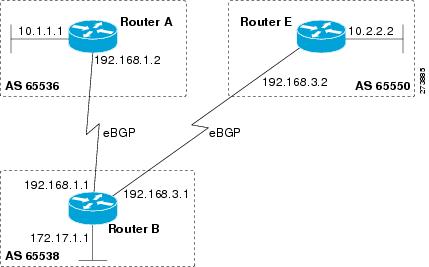
showipbgpsummary command shows the default asplain format of the 4-byte autonomous system numbers. Note the asplain format of the 4-byte autonomous system numbers, 65536 and 65550.
Router# show ip bgp summary
BGP router identifier 172.17.1.99, local AS number 65538
BGP table version is 1, main routing table version 1
Neighbor V AS MsgRcvd MsgSent TblVer InQ OutQ Up/Down Statd
192.168.1.2 4 65536 7 7 1 0 0 00:03:04 0
192.168.3.2 4 65550 4 4 1 0 0 00:00:15 0
After the
bgpasnotationdot command is configured (followed by the
clearipbgp* command to perform a hard reset of all current BGP sessions), the output is converted to asdot notation format as shown in the following output from the
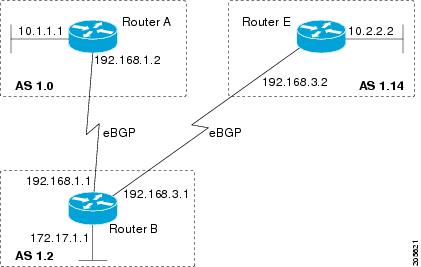
showipbgpsummary command. Note the asdot format of the 4-byte autonomous system numbers, 1.0 and 1.14 (these are the asdot conversions of the 65536 and 65550 autonomous system numbers.
Router# show ip bgp summary
BGP router identifier 172.17.1.99, local AS number 1.2
BGP table version is 1, main routing table version 1
Neighbor V AS MsgRcvd MsgSent TblVer InQ OutQ Up/Down Statd
192.168.1.2 4 1.0 9 9 1 0 0 00:04:13 0
192.168.3.2 4 1.14 6 6 1 0 0 00:01:24 0
After the
bgpasnotationdot command is configured (followed by the
clearipbgp* command to perform a hard reset of all current BGP sessions), the regular expression match format for 4-byte autonomous system paths is changed to asdot notation format. Although a 4-byte autonomous system number can be configured in a regular expression using either asplain format or asdot format, only 4-byte autonomous system numbers configured using the current default format are matched. In the first example below, the
showipbgpregexp command is configured with a 4-byte autonomous system number in asplain format. The match fails because the default format is currently asdot format and there is no output. In the second example using asdot format, the match passes and the information about the 4-byte autonomous system path is shown using the asdot notation.
Note
The asdot notation uses a period, which is a special character in Cisco regular expressions. To remove the special meaning, use a backslash before the period.
Router# show ip bgp regexp ^65536$
Router# show ip bgp regexp ^1\.0$
BGP table version is 2, local router ID is 172.17.1.99
Status codes: s suppressed, d damped, h history, * valid, > best, i - internal,
r RIB-failure, S Stale
Origin codes: i - IGP, e - EGP, ? - incomplete
Network Next Hop Metric LocPrf Weight Path
*> 10.1.1.0/24 192.168.1.2 0 0 1.0 i
Configuration Examples for BGP Support for 4-byte ASN
Examples: Configuring a BGP Routing Process and Peers Using 4-Byte Autonomous System Numbers
Asplain Format
The following example shows the configuration for Router A, Router B, and Router E in the figure below with a BGP process configured between three neighbor peers (at Router A, at Router B, and at Router E) in separate 4-byte autonomous systems configured using asplain notation. IPv4 unicast routes are exchanged with all peers.
Figure 2. BGP Peers Using 4-Byte Autonomous System Numbers in Asplain Format
The following example shows how to create the configuration for Router A, Router B, and Router E in the figure below with a BGP process configured between three neighbor peers (at Router A, at Router B, and at Router E) in separate 4-byte autonomous systems configured using the default asdot format. IPv4 unicast routes are exchanged with all peers.
Figure 3. BGP Peers Using 4-Byte Autonomous System Numbers in Asdot Format
Examples: Configuring a VRF and Setting an Extended Community Using a BGP 4-Byte Autonomous System Number
Asplain Default Format in Cisco IOS Release 12.0(32)SY8, 12.0(33)S3, 12.2(33)SRE, 12.2(33)SXI1, and Later Releases
The following example is available in Cisco IOS Release 12.0(32)SY8, 12.0(33)S3, 12.2(33)SRE, 12.2(33)XNE, 12.2(33)SXI1, and later releases and shows how to create a VRF with a route-target that uses a 4-byte autonomous system number, 65537, and how to set the route target to extended community value 65537:100 for routes that are permitted by the route map.
ip vrf vpn_red
rd 64500:100
route-target both 65537:100
exit
route-map red_map permit 10
set extcommunity rt 65537:100
end
After the configuration is completed, use the
showroute-map command to verify that the extended community is set to the route target that contains the 4-byte autonomous system number of 65537.
RouterB# show route-map red_map
route-map red_map, permit, sequence 10
Match clauses:
Set clauses:
extended community RT:65537:100
Policy routing matches: 0 packets, 0 bytes
Asdot Default Format in Cisco IOS Release 12.0(32)S12, and 12.4(24)T
The following example is available in Cisco IOS Release 12.0(32)S12, and 12.4(24)T and shows how to create a VRF with a route-target that uses a 4-byte autonomous system number, 1.1, and how to set the route target to extended community value 1.1:100 for routes that are permitted by the route map.
Note
In Cisco IOS Release 12.0(32)SY8, 12.0(33)S3, 12.2(33)SXI1, and later releases, this example works if you have configured asdot as the default display format using the
bgpasnotationdot command.
ip vrf vpn_red
rd 64500:100
route-target both 1.1:100
exit
route-map red_map permit 10
set extcommunity rt 1.1:100
end
After the configuration is completed, use the
showroute-map command to verify that the extended community is set to the route target that contains the 4-byte autonomous system number of 1.1.
RouterB# show route-map red_map
route-map red_map, permit, sequence 10
Match clauses:
Set clauses:
extended community RT:1.1:100
Policy routing matches: 0 packets, 0 bytes
Textual Representation of Autonomous System (AS) Numbers
RFC 5398
Autonomous System (AS) Number Reservation for Documentation Use
Technical Assistance
Description
Link
The Cisco Support and Documentation website provides online resources to download documentation, software, and tools. Use these resources to install and configure the software and to troubleshoot and resolve technical issues with Cisco products and technologies. Access to most tools on the Cisco Support and Documentation website requires a Cisco.com user ID and password.
Feature Information for BGP Support for 4-byte ASN
The following table provides release information about the feature or features described in this module. This table lists only the software release that introduced support for a given feature in a given software release train. Unless noted otherwise, subsequent releases of that software release train also support that feature.
Use Cisco Feature Navigator to find information about platform support and Cisco software image support. To access Cisco Feature Navigator, go to
www.cisco.com/go/cfn. An account on Cisco.com is not required.
Table 4 Feature Information for BGP Support for 4-byte ASN
Feature Name
Releases
Feature Information
BGP Support for 4-byte ASN
12.0(32)S12
12.0(32)SY8
12.0(33)S3
12.2(33)SRE
12.2(33)XNE
12.2(33)SXI1
12.4(24)T
15.0(1)S
Cisco IOS XE Release 2.3
Cisco IOS XE Release 2.4
Cisco IOS XE Release 3.1.0SG
15.1(1)SG
Cisco IOS XE Release 3.3SG
Cisco IOS XE Release 3.9S
The BGP Support for 4-Byte ASN feature introduced support for 4-byte autonomous system numbers.
In Cisco IOS XE Release 2.4 and later releases, the Cisco implementation of 4-byte autonomous system numbers uses asplain as the default regular expression match and output display format for autonomous system numbers, but you can configure 4-byte autonomous system numbers in both the asplain format and the asdot format as described in RFC 5396. To change the default regular expression match and output display of 4-byte autonomous system numbers to asdot format, use the
bgpasnotationdot command.
The following commands were introduced or modified by this feature:
bgpasnotationdot,
bgpconfederationidentifier,
bgpconfederationpeers, all
clearipbgpcommands that configure an autonomous system number,
ipas-pathaccess-list,
ipextcommunity-list,
matchsource-protocol,
neighborlocal-as,
neighborremote-as,
redistribute(IP),
routerbgp,
route-target,
setas-path,
setextcommunity,
setorigin, all
showipbgp commands that display an autonomous system number, and
showipextcommunity-list.
In Cisco IOS XE Release 3.9S, support was added for the Cisco ASR
903 Router.