The documentation set for this product strives to use bias-free language. For the purposes of this documentation set, bias-free is defined as language that does not imply discrimination based on age, disability, gender, racial identity, ethnic identity, sexual orientation, socioeconomic status, and intersectionality. Exceptions may be present in the documentation due to language that is hardcoded in the user interfaces of the product software, language used based on RFP documentation, or language that is used by a referenced third-party product. Learn more about how Cisco is using Inclusive Language.
ITU-T Y.1731 Performance
Monitoring in a Service Provider Network
ITU-T Y.1731
performance monitoring provides standard-based Ethernet performance monitoring
that encompasses the measurement of Ethernet frame delay, frame-delay
variation, and throughput as outlined in the ITU-T Y.1731 specification and
interpreted by the Metro Ethernet Forum (MEF). Service providers offer service
level agreements (SLAs) that describe the level of performance customers can
expect for services. This document describes the Ethernet performance
management aspect of SLAs.
Finding Feature Information
Your software release may not support all the features documented in this module. For the latest caveats and feature information,
see Bug Search Tool and the release notes for your platform and software release. To find information about the features documented in this module,
and to see a list of the releases in which each feature is supported, see the feature information table.
Use Cisco Feature Navigator to find information about platform support and Cisco software image support. To access Cisco Feature
Navigator, go to www.cisco.com/go/cfn. An account on Cisco.com is not required.
Prerequisites for ITU-T Y.1731 Performance Monitoring in a Service Provider Network
IEEE-compliant connectivity fault management (CFM) must be configured and enabled for Y.1731 performance monitoring to function.
Note
Y1731 is supported over Port Channel interfaces.
Information About ITU-T Y.1731 Performance Monitoring in a Service Provider Network
Frame Delay and Frame-Delay
Variation
The Frame Delay
parameter can be used for on-demand OAM measurements of frame delay and
frame-delay variation. When a maintenance end point (MEP) is enabled to
generate frames with frame-delay measurement (ETH-DM) information, it
periodically sends frames with ETH-DM information to its peer MEP in the same
maintenance entity. Peer MEPs perform frame-delay and frame-delay variation
measurements through this periodic exchange during the diagnostic interval.
An MEP requires the
following specific configuration information to support ETH-DM:
MEG level—MEG
level at which the MEP exists
Priority
Drop eligibility—marked drop ineligible
Transmission rate
Total interval of
ETH-DM
MEF10 frame-delay variation algorithm
A MEP transmits
frames with ETH-DM information using the TxTimeStampf information element.
TxTimeStampf is the time stamp for when the ETH-DM frame was sent. A receiving
MEP can compare the TxTimeStampf value with the RxTimef value, which is the
time the ETH-DM frame was received, and calculate one-way delay using the
formula
frame delay =
RxTimef – TxTimeStampf.
One-way frame-delay
measurement (1DM) requires that clocks at both the transmitting MEP and the
receiving MEPs are synchronized. Measuring frame-delay variation does not
require clock synchronization and the variation can be measured using 1DM or a
frame-delay measurement message (DMM) and a frame-delay measurement reply (DMR)
frame combination.
If it is not
practical to have clocks synchronized, only two-way frame-delay measurements
can be made. In this case, the MEP transmits a frame containing ETH-DM request
information and the TxTimeStampf element, and the receiving MEP responds with a
frame containing ETH-DM reply information and the TxTimeStampf value copied
from the ETH-DM request information.
Two-way frame delay is calculated as (RxTimeb–TxTimeStampf)–(TxTimeStampb–RxTimeStampf), where RxTimeb is the time that the frame with ETH-DM reply information was received. Two-way frame delay and variation can
be measured using only DMM and DMR frames.
To allow more precise
two-way frame-delay measurement, the MEP replying to a frame with ETH-DM
request information can also include two additional time stamps in the ETH-DM
reply information:
RxTimeStampf—Time
stamp of the time at which the frame with ETH-DM request information was
received.
TxTimeStampb—Time
stamp of the time at which the transmitting frame with ETH-DM reply information
was sent.
The timestamping happens at the hardware level for DMM operations.
Note
The frame-loss, frame-delay, and frame-delay variation measurement processes are aborted when faults related to continuity
and availability occur or when known network topology changes occur.
An MIP is transparent
to the frames with ETH-DM information; therefore, an MIP does not require
information to support the ETH-DM function.
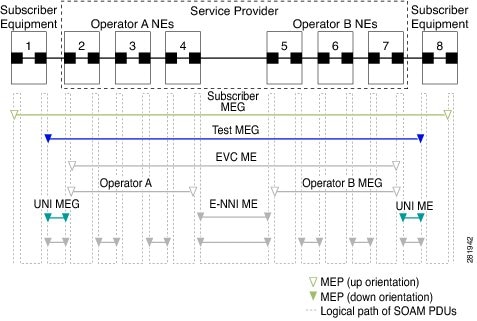
The figure below
shows a functional overview of a typical network in which Y.1731 performance
monitoring is used.
Figure 1. Y.1731
Performance Monitoring
Benefits of ITU-T Y.1731 Performance Monitoring
Combined with IEEE-compliant connectivity fault management (CFM), Y.1731 performance monitoring provides a comprehensive
fault management and performance monitoring solution for service providers. This comprehensive solution in turn lessens service
providers’ operating expenses, improves their service-level agreements (SLAs), and simplifies their operations.
How to Configure ITU-T Y.1731 Performance Monitoring in a Service Provider Network
Configuring Performance
Monitoring Parameters
The following new
commands were introduced that can be used to configure and display performance
monitoring parameters:
debug ethernet cfm pm ,
monitor loss counters , and
show ethernet cfm pm .
For more information
about CFM and Y.1731 performance monitoring commands, see the
Cisco IOS Carrier
Ethernet Command Reference. For more information about debug commands, see
the
Cisco IOS Debug
Command Reference.
Configuration Examples for Configuring ITU-T Y.1731 Performance Monitoring Functions
No new or modified RFCs are supported by this feature, and support for existing RFCs has not been modified by this feature.
--
Technical Assistance
Description
Link
The Cisco Support and Documentation website provides online resources to download documentation, software, and tools. Use
these resources to install and configure the software and to troubleshoot and resolve technical issues with Cisco products
and technologies. Access to most tools on the Cisco Support and Documentation website requires a Cisco.com user ID and password.
Feature Information for ITU-T Y.1731 Performance Monitoring in a Service Provider Network
The following table provides release information about the feature or features described in this module. This table lists
only the software release that introduced support for a given feature in a given software release train. Unless noted otherwise,
subsequent releases of that software release train also support that feature.
Use Cisco Feature Navigator to find information about platform support and Cisco software image support. To access Cisco
Feature Navigator, go to www.cisco.com/go/cfn. An account on Cisco.com is not required.
Table 1. Feature Information for ITU-T Y.1731 Performance Monitoring in a Service Provider Network
Feature Name
Releases
Feature Information
Y.1731 Performance Monitoring
Cisco IOS XE Release 3.5S
The Y.1731 Performance Monitoring feature describes the Ethernet performance monitoring aspect of SLAs such as frame loss,
frame delay, and frame-delay variation.
In Cisco IOS XE Release 3.5S, support was added for the Cisco ASR 903 Router.
In Cisco IOS XE Release 3.6S, support for port channels and cross connect functionality was provided.
The following commands were introduced or modified:
debug ethernet cfm pm ,
ethernet cfm distribution enable ,
monitor loss counters ,
show ethernet cfm pm .

 Feedback