- About Software Images
- About In-Service Software Upgrades on Devices with Dual Supervisor Modules
- Virtualization Support
- Parallel Upgrade
- Prerequisites for Upgrading the Cisco NX-OS Software
- Cisco NX-OS Software Upgrade Guidelines
- Cisco NX-OS Software Downgrade Guidelines
- Upgrading a Device with Dual Supervisor Modules
- Upgrading a Device with a Single Supervisor Module
- Downgrading from a Higher Release
- Performing a Traditional Upgrade or Downgrade (Chassis Reload)
- Example Outputs from Cisco NX-OS Software Upgrades
- Obtaining Documentation and Submitting a Service Request
- Feature History for Software Upgrade and Downgrade
Cisco Nexus 7000 Series NX-OS Software Upgrade and Downgrade Guide
This document describes how to upgrade or downgrade the Cisco NX-OS software.
- About Software Images
- About In-Service Software Upgrades on Devices with Dual Supervisor Modules
- Virtualization Support
- Parallel Upgrade
- Prerequisites for Upgrading the Cisco NX-OS Software
- Cisco NX-OS Software Upgrade Guidelines
- Cisco NX-OS Software Downgrade Guidelines
- Upgrading a Device with Dual Supervisor Modules
- Upgrading a Device with a Single Supervisor Module
- Downgrading from a Higher Release
- Performing a Traditional Upgrade or Downgrade (Chassis Reload)
- Example Outputs from Cisco NX-OS Software Upgrades
- Obtaining Documentation and Submitting a Service Request
- Feature History for Software Upgrade and Downgrade
About Software Images
Each device is shipped with the Cisco NX-OS software. The Cisco NX-OS software consists of two images—the kickstart image and the system image.
The software image install procedure is dependent on the following factors:
- Software images—The kickstart and system image files reside in directories or folders that you can access from the Cisco NX-OS software prompt.
- Image version—Each image file has a version.
- Flash disks on the device—The bootflash: resides on the supervisor module and the CompactFlash disk is inserted into the slot0:, usb1, or usb2: device.
- Supervisor modules—There are single or dual supervisor modules.
 Note |
On devices with dual supervisor modules, both supervisor modules must have connections on the console ports to maintain connectivity when switchovers occur during upgrades and downgrades. See the Cisco Nexus 7000 Series Hardware Installation and Reference Guide. |
About In-Service Software Upgrades on Devices with Dual Supervisor Modules
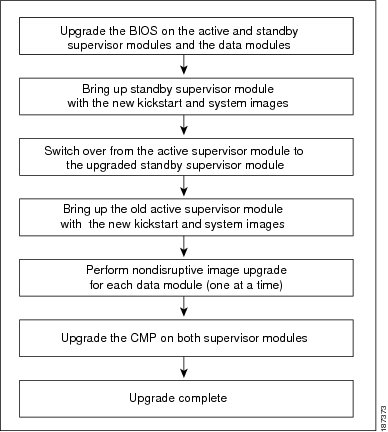
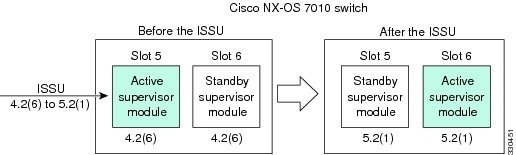
The Cisco NX-OS software supports in-service software upgrades (ISSUs) on devices with dual supervisor modules. An ISSU can update the software images on your device without disrupting data traffic. Only control traffic is disrupted. If an ISSU will cause a disruption of data traffic, the Cisco NX-OS software warns you before proceeding so that you can stop the upgrade and reschedule it to a time that minimizes the impact on your network.
An ISSU updates the following images:
- Kickstart image
- System image
- Supervisor module BIOS
- Data module image
- Data module BIOS
- Connectivity management processor (CMP) image
- CMP BIOS
Virtualization Support
When you upgrade the Cisco NX-OS software, you upgrade the software for all virtual device contexts (VDCs) on the physical device. You cannot upgrade the Cisco NX-OS software for an individual VDC.
Parallel Upgrade
Parallel Upgrade
Starting with Cisco NX-OS Release 5.2(1), multiple linecards can be simultaneously upgraded, and the infrastructure support is available. This decreases the ISSU time when compared with an ISSU upgrade that is done serially (one card at a time).
To start a parallel upgrade, use the following command: install all kickstart image system image parallel
Up to three linecards can be upgraded in parallel with this command. During the upgrade process, the upgrade of the linecards is displayed in the output as follows:
Non-disruptive upgrading.
[#                   ]   0%
Module 5 upgrade completed successfully.
.

Module 3 upgrade completed successfully.
.

Module 6 upgrade completed successfully.
.

Non-disruptive upgrading.
[####################] 100% -- SUCCESS

Non-disruptive upgrading.
[#                   ]   0%
Module 9 upgrade completed successfully.
.

Non-disruptive upgrading.
[####################] 100% -- SUCCESS
Note |
This command will be ignored for a downgrade to a release below Cisco NX-OS Release 5.2.(1). |
Parallel Upgrade with Fabric Extenders
Beginning with Cisco NX-OS Release 6.1(1), a parallel upgrade on the Fabric Extenders is supported if the user types the parallel keyword in the command.
For releases prior to Cisco NX-OS Release 6.1(1), only a serial upgrade of Fabric Extenders is supported. The upgrade process switches to a serial upgrade even for the I/O modules present. Even if the user types the parallel keyword in the command, the upgrade will be a serial upgrade.
Prerequisites for Upgrading the Cisco NX-OS Software
Upgrading the Cisco NX-OS software has the following prerequisite:
Save, commit, or discard any active configuration sessions before upgrading or downgrading the Cisco NX-OS software image on your device. On a device with dual supervisors, the active supervisor module cannot switch over to the standby supervisor module during the Cisco NX-OS software upgrade if you have an active configuration session. On a device with a single supervisor module, the Cisco NX-OS software deletes the active configuration session without warning when you reload the device.
Use the show configuration session summary command to verify that you have no active configuration sessions.
For more information on configuration sessions, see the Cisco Nexus 7000 Series NX-OS System Management Configuration Guide.
Cisco NX-OS Software Upgrade Guidelines
Before attempting to use ISSU to upgrade to any software image version, follow these guidelines:
- Scheduling Schedule the upgrade when your network is stable and steady. Ensure that everyone who has access to the device or the network is not configuring the device or the network during this time. You cannot configure a device during an upgrade.
- Space Verify that sufficient space is available in the location where you are copying the images. This location includes the active and standby supervisor module bootflash: (internal to the device). Internal bootflash: has approximately 200 MB of free space available.
- Hardware Avoid power interruption during any install procedure, which can corrupt the software image.
- Connectivity to remote servers
-
Software images
- Ensure that the specified system and kickstart images are compatible with each other.
- If the kickstart image is not specified, the device uses the current running kickstart image.
- If you specify a different system image, ensure that it is compatible with the running kickstart image.
-
Retrieve the images in one of two ways:
- Locally
- Images are locally available on the switch.
- Remotely
- Images are in a remote location and you specify the destination using the remote server parameters and the filename to be used locally.
- The default Control Plane Policing (CoPP) policy does not change when you upgrade the Cisco NX-OS software.
- When upgrading from Cisco NX-OS Release 5.0 to a later 5.x release, you must disable Bidirectional Forwarding Detection (BFD) before the upgrade and reenable it after the upgrade.
- CoPP MAC policies are supported beginning with Cisco NX-OS Release 5.1, and default policies are installed upon execution of the initial setup script. However, if you use ISSU to upgrade to Cisco NX-OS Release 5.1, the default CoPP policies for the following features must be manually configured: FabricPath, OTV, L2PT, LLDP, DHCP, and DOT1X. For more information on the default CoPP policies, see the Cisco Nexus 7000 Series NX-OS Security Configuration Guide, Release 5.x.
- When you upgrade to Cisco NX-OS Release 5.2, the policy attached to the control plane is treated as a user-configured policy. Check the CoPP profile using the show copp profile command and make any required changes.
- The upgrade to Cisco NX-OS Release 5.2 in an OTV network is disruptive. You must upgrade all edge devices in the site and configure the site identifier on all edge devices in the site before traffic is restored. You can prepare OTV for ISSU to Cisco NX-OS Release 5.2 in a dual-homed site to minimize this disruption. See the Cisco Nexus 7000 Series NX-OS OTV Configuration Guide for information on how to prepare OTV for ISSU to Cisco NX-OS Release 5.2 in a dual-homed site. An edge device with an older Cisco NX-OS release in the same site can cause traffic loops. You should upgrade all edge devices in the site during the same upgrade window. You do not need to upgrade edge devices in other sites as OTV interoperates between sites with different Cisco NX-OS versions.
-
Terminology
This table summarizes the terms used in the install all command output for checking compatibility.
Table 1 install all Command Output TerminologyTerm
Definition
bootable
The module's ability to boot or not boot based on image compatibility.
impact
The type of software upgrade mechanism—disruptive or nondisruptive.
install-type
reset
Resets the module.
sw-reset
Resets the module immediately after a switchover.
rolling
Upgrades each module in sequence.
copy-only
Updates the software for BIOS, loader, or bootrom.
-
Commands to use
- Verify connectivity to the remote server using the ping command.
- Ensure that the required space is available on both the active and standby supervisor modules for the image files to be copied using the dir command.
- Use the one-step install all command to upgrade your software. This command upgrades all modules in any Cisco NX-OS device.
-
Run only one installation on a device at a time.
Note
During vPC setup, the configuration is locked on the peer switch while ISSU is in progress.
- ISSU is not supported when the vPC peers are on a single physical device but are across VDCs.
- Do not enter another command while running the installation.
-
Do the installation on the active supervisor module, not the standby supervisor module.
Note
If the I/O modules are not compatible with the software image you install on the supervisor module, some traffic disruption might occur in those modules, depending on your configuration. The install all command output identifies these commands. You can choose to proceed with the upgrade or end at this point.
- The configuration is locked during the upgrade process.
- You can have only one instance of the install all command running.
Cisco NX-OS Software Downgrade Guidelines
Before attempting to use the in-service software downgrade (ISSD) to downgrade to any software image version, follow these guidelines:
- Any features introduced in a release must be disabled before downgrading to a release that does not support those features. See the release notes for information on the new features introduced in each release.
- When downgrading to Cisco NX-OS Release 5.0 from a later 5.x release, you must disable Bidirectional Forwarding Detection (BFD) before the downgrade and reenable it after the downgrade.
- Downgrading from Cisco NX-OS Release 5.x to earlier releases is not allowed if you configure fewer than five fabric cards in a Cisco NX-OS device using the hardware fabrics max command. For information on configuring the number of fabric cards supported on your device, see the Cisco Nexus 7000 Series Hardware Installation and Reference Guide.
- If you create a dedicated Fibre Channel over Ethernet (FCoE) VDC in Cisco NX-OS Release 5.2 or later releases, you must delete the FCoE VDC before downgrading to an earlier software release.
- If you enable the AES password encryption feature and a master encryption key in Cisco NX-OS Release 5.2 or later releases, you must decrypt all type-6 passwords, disable the AES password encryption feature, and delete the master key.
- If you use ISSD to downgrade from Cisco NX-OS Release 5.2 to an earlier software release, CoPP reports the incompatible configuration and instructs you to copy the CoPP profile. In the earlier software release, all configurations are restored in user-configuration mode.
- If you downgrade from Cisco NX-OS Release 5.2 without using ISSD, the CoPP configuration is lost, and a CoPP policy is no longer attached to the control plane.
- Before you downgrade from Cisco NX-OS Release 5.2 to Cisco NX-OS Release 5.0, remove all system QoS and qos policies configured on F1 Series modules. Use the clear qos policies command to remove the F1 Series module related defaults.
- Before you downgrade from Cisco NX-OS Release 5.2 to an earlier Cisco NX-OS release, clear the QoS MIB and MPLS QoS defaults using the clear qos mpls-snmp command. Otherwise, the downgrade might fail.
- If you downgrade the device from Cisco NX-OS Release 5.2(x) or 5.1(x) to Cisco NX-OS Release 5.0(x) or 4.2(x), AAA configuration commands might fail. The workaround is to write-erase the startup configuration and reboot the device.
-
Supported releases
This table shows the Cisco NX-OS releases that support XL line cards and nondisruptive downgrades.
Table 2 Supported Cisco NX-OS Releases5.2
5.1
5.0
4.2
4.1
4.0
XL line cards
X
X
X
--
--
--
32-port, 10-Gigabit Ethernet XL module
(N7K-M132XP-12L)
X
X
--
--
--
--
Nondisruptive downgrades from Cisco NX-OS Release 5.x
X
X
X
X
--
--
Upgrading a Device with Dual Supervisor Modules
The install all command supports in-service software upgrades (ISSUs) on devices that have dual supervisor modules and performs the following actions:
- Determines whether the upgrade will be disruptive and asks if you want to continue.
- Ensure that you have enough space in the standby bootflash.
- Copies the kickstart and system images to the standby supervisor module.
- Sets the KICKSTART and SYSTEM boot variables.
- Reloads the standby supervisor module with the new Cisco NX-OS software.
- Reloads the active supervisor module with the new Cisco NX-OS software, which causes a switchover to the newly upgraded standby supervisor module.
- Upgrades the line cards.
- The Connectivity Management Processor (CMP) on both supervisors will get upgraded.
- Benefits of Using the install all Command
- ISSU Failure Conditions
- Upgrade Procedure Summary
- Detailed Upgrade Procedure
Benefits of Using the install all Command
The install all command provides the following benefits:
- You can upgrade the entire device using just one command.
- You can receive descriptive information on the intended changes to your system before you continue with the installation.
- You have the option to cancel the command. You can continue or cancel when you see this question (the default is no):
Do you want to continue (y/n) [n] : y
- You can upgrade the entire device using the least disruptive procedure.
- You can see the progress of this command on the console, Telnet, and SSH screens:
- The install all command automatically checks the image integrity, which includes the running kickstart and system images.
- The install all command performs a platform validity check to verify that a wrong image is not used—for example, to check if a Nexus 7000 device image is used inadvertently to upgrade a Nexus 5000 device.
- The Ctrl-c escape sequence gracefully ends the install all command. You are prompted to confirm your decision to abort the ISSU process. If you proceed, the command sequence completes the update step in progress and returns to the device prompt. (Other upgrade steps cannot be ended using Ctrl-c.)
- After entering the install all command, if any step in the sequence fails, the command completes the step in progress and ends. For example, if an I/O module fails to be updated for any reason (for example, due to an unstable network state), the command sequence disruptively updates that module and ends. In such cases, you can verify the problem on the affected switching module and upgrade the other I/O modules.
- The show install all impact image-name command runs pre-upgrade checks against a given image and informs the user if the images are compatible for an upgrade or a downgrade.
ISSU Failure Conditions
The following situations cause the installation to fail to complete:
- If the standby supervisor module bootflash: file system does not have sufficient space to accept the updated image.
- If the specified system and kickstart images are not compatible.
- If the network or device is configured while the upgrade is in progress.
- If a Spanning Tree Protocol (STP) topology change occurs while the upgrade is in progress.
- If the install all command is entered on the standby supervisor module.
- If the install all command does not reference the default bootflash: in a dual supervisor module configuration.
- If a module is removed while the upgrade is in progress.
- If the device has any power disruption while the upgrade is in progress.
- If the entire path for the remote server location is not specified accurately.
- If images are incompatible after an upgrade. For example, an I/O module image may be incompatible with the system image, or a kickstart image may be incompatible with a system image. This is also identified by the show install all impact command in the compatibility check section of the output (under the Bootable column).
- If a linecard is in failure state, the ISSU will abort.
The Cisco NX-OS software prevents most configuration changes while the install all command is in progress. However, the Cisco NX-OS software allows configuration changes from Cisco Fabric Services (CFS) and those changes may affect the ISSU.
Upgrade Procedure Summary
The following summary procedure describes how to upgrade a device that has dual supervisor modules to the latest Cisco NX-OS software.
Detailed Upgrade Procedure
This section describes the detailed procedure to upgrade to the latest Cisco NX-OS software on a device with dual supervisor modules.
| Step 1 | Log in to the device on the console port connection on both of the active and standby supervisor modules. | ||||
| Step 2 |
Log in to Cisco.com to access the links provided in this document. To log in to Cisco.com, go to the URL http://www.cisco.com/ and click Log In at the top of the page. Enter your Cisco username and password.
|
||||
| Step 3 | Access the Software Download Center using this URL: http://www.cisco.com/public/sw-center/index.shtml | ||||
| Step 4 | Navigate to the download site for your device. You see links to the download images for your device. | ||||
| Step 5 | Select and download the kickstart and system software files to a server. | ||||
| Step 6 |
Ensure that the required space is available for the image file(s) to be copied.
switch# dir bootflash:
      49152 Apr 16 14:43:39 2009 lost+found/
   80850712 Apr 04 15:57:44 2009 n7000-s1-dk9.4.2.1.bin
   22593024 Apr 04 15:52:56 2009 n7000-s1-kickstart.4.2.1.bin

Usage for bootflash://sup-local
  103492888 bytes used
  800604904 bytes free
  904097792 bytes total
|
||||
| Step 7 |
If you need more space on the active supervisor module, delete unnecessary files to make space available. switch# delete bootflash:n7000-s1-kickstart.4.2.1.bin switch# delete bootflash:n7000-s1-dk9.4.2.1.bin |
||||
| Step 8 |
Verify that there is space available on the standby supervisor module.
switch# dir bootflash://sup-standby/
      49152     Apr 16 14:43:39 2009  lost+found
   80850712     Apr 04 15:57:44 2009  n7000-s1-dk9.4.2.1.bin
   22593024     Apr 04 15:52:56 2009  n7000-s1-kickstart.4.2.1.bin

Usage for bootflash://sup-standby
  103492888 bytes used
  800604904 bytes free
  904097792 bytes total
|
||||
| Step 9 |
If you need more space on the standby supervisor module, delete any unnecessary files to make space available. switch# delete bootflash://sup-standby/n7000-s1-kickstart.4.2.1.bin switch# delete bootflash://sup-standby/n7000-s1-dk9.4.2.1.bin |
||||
| Step 10 |
Copy the NX-OS kickstart and system images to the active supervisor module using a transfer protocol. You can use ftp:,tftp:, scp:, or sftp:. The examples in this procedure use scp:.
switch# copy scp://user@scpserver.cisco.com//downloads/n7000-s1-kickstart.4.2.1.bin bootflash:n7000-s1-kickstart.4.2.1.bin switch# copy scp://user@scpserver.cisco.com//downloads/n7000-s1-dk9.4.2.1.bin bootflash:n7000-s1-dk9.4.2.1.bin |
||||
| Step 11 | Read the release notes for the related image file. See the Cisco Nexus 7000 Series NX-OS Release Notes, Release 5.x. | ||||
| Step 12 |
Save the running configuration to the startup configuration. switch# copy running-config startup-config vdc-all |
||||
| Step 13 |
Perform the upgrade using the install all command at the command prompt on the active supervisor module. switch# install all kickstart bootflash:n7000-s1-kickstart.4.2.1.bin system bootflash:n7000-s1-dk9.4.2.1.bin
|
||||
| Step 14 |
After the installation operation completes, log in and verify that the device is running the required software version using the show version command.
switch# show version
Cisco Nexus Operating System (NX-OS) Software
TAC support: http://www.cisco.com/tac
Copyright (c) 2002-2009, Cisco Systems, Inc. All rights reserved.
The copyrights to certain works contained in this software are
owned by other third parties and used and distributed under
license. Certain components of this software are licensed under
the GNU General Public License (GPL) version 2.0 or the GNU
Lesser General Public License (LGPL) Version 2.1. A copy of each
such license is available at
http://www.opensource.org/licenses/gpl-2.0.php and
http://www.opensource.org/licenses/lgpl-2.1.php

Software
  BIOS:      version 3.15.0
  loader:    version N/A
  kickstart: version 4.2(1) [gdb]
  system:    version 4.2(1) [gdb]
  BIOS compile time:       03/04/09
  kickstart image file is: bootflash:/n7000-s1-kickstart.4.2.1.bin
  kickstart compile time:  3/6/2009 2:00:00 [04/02/2009 09:49:07]
  system image file is:    bootflash:/n7000-s1-dk9.4.2.1.bin
  system compile time:     3/6/2009 2:00:00 [04/02/2009 10:28:32]


Hardware
  cisco Nexus7000 C7010 (10 Slot) Chassis ("Supervisor module-1X")
  Intel(R) Xeon(R) CPU         with 2063436 kB of memory.
  Processor Board ID JAB10380101
  Device name: switch
  bootflash:    1023120 kB
  slot0:              0 kB (expansion flash)

Kernel uptime is 2 day(s), 17 hour(s), 26 minute(s), 1 second(s)

Last reset at 121426 usecs after  Sun Apr 13 20:38:08 2009

  Reason: Reset Requested by CLI command reload
  System version: 4.2(1)
  Service:
...
|
||||
| Step 15 |
Reload both CMPs. switch# reload cmp module 5 switch# reload cmp module 6 |
||||
| Step 16 |
Type the show install all status command. The entire upgrade process is displayed.
|
||||
| Step 17 | (Optional) Install licenses (if necessary) to ensure that the required features are available on the device. See the Cisco NX-OS Licensing Guide. |
Upgrading a Device with a Single Supervisor Module
This section describes how to upgrade a Cisco NX-OS device with a single supervisor module.
Upgrade Procedure Summary
The following summary procedure describes how to upgrade a device that has a single supervisor module to the latest Cisco NX-OS software.
| Step 1 | Log in to the console port on the supervisor modules. |
| Step 2 | Log in to Cisco.com and download the latest Cisco NX-OS kickstart and system images. |
| Step 3 | Download the Cisco NX-OS kickstart and system images to your device using the copy command. |
| Step 4 | Update the KICKSTART and SYSTEM boot variables and module images using the install all command. |
Detailed Upgrade Procedure
This section describes the detailed procedure to upgrade to the latest Cisco NX-OS software on a device with a single supervisor.
| Step 1 | Log in to the device on the console port connection. | ||
| Step 2 |
Log in to Cisco.com to access the links provided in this document. To log in to Cisco.com, go to the URL http://www.cisco.com/ and click Log In at the top of the page. Enter your Cisco username and password.
|
||
| Step 3 | Access the Software Download Center using this URL: http://www.cisco.com/public/sw-center/index.shtml | ||
| Step 4 | Navigate to the download site for your device. You see links to the download images for your device. | ||
| Step 5 | Select and download the kickstart and system software files to a server. | ||
| Step 6 |
Ensure that the required space is available in the bootflash: directory for the image file(s) to be copied.
switch# dir bootflash:
      49152 Apr 16 14:43:39 2009 lost+found/
   80850712 Apr 04 15:57:44 2009 n7000-s1-dk9.4.2.1.bin
   22593024 Apr 04 15:52:56 2009 n7000-s1-kickstart.4.2.1.bin

Usage for bootflash://sup-local
  103492888 bytes used
  800604904 bytes free
  904097792 bytes total
|
||
| Step 7 |
If you need more space on the supervisor module bootflash, delete unnecessary files to make space available. switch# delete bootflash:n7000-s1-kickstart.4.2.1.bin switch# delete bootflash:n7000-s1-dk9.4.2.1.bin |
||
| Step 8 |
Copy the NX-OS kickstart and system images to the active supervisor module bootflash using a transfer protocol. You can use ftp:, tftp:, scp:, or sftp:. The examples in this procedure use scp:.
switch# copy scp://user@scpserver.cisco.com//downloads/n7000-s1-kickstart.4.2.1.bin bootflash:n7000-s1-kickstart.4.2.1.bin switch# copy scp://user@scpserver.cisco.com//downloads/n7000-s1-dk9.4.2.1.bin bootflash:n7000-s1-dk9.4.2.1.bin |
||
| Step 9 | Read the release notes for the related image file. See the Cisco Nexus 7000 Series NX-OS Release Notes, Release 5.x. | ||
| Step 10 |
Use the install all command to update the boot variables and module images on your device. switch# install all kickstart bootflash:n7000-s1-kickstart.4.2.1.bin system bootflash:n7000-s1-dk9.4.2.1.bin
|
||
| Step 11 |
After the device completes the reload operation, log in and verify that the device is running the required software version.
switch# show version
Cisco Nexus Operating System (NX-OS) Software
TAC support: http://www.cisco.com/tac
Copyright (c) 2002-2009, Cisco Systems, Inc. All rights reserved.
The copyrights to certain works contained in this software are
owned by other third parties and used and distributed under
license. Certain components of this software are licensed under
the GNU General Public License (GPL) version 2.0 or the GNU
Lesser General Public License (LGPL) Version 2.1. A copy of each
such license is available at
http://www.opensource.org/licenses/gpl-2.0.php and
http://www.opensource.org/licenses/lgpl-2.1.php

Software
  BIOS:      version 3.15.0
  loader:    version N/A
  kickstart: version 4.2(1) [gdb]
  system:    version 4.2(1) [gdb]
  BIOS compile time:       03/04/08
  kickstart image file is: bootflash:/n7000-s1-kickstart.4.2.1.bin
  kickstart compile time:  3/6/2009 2:00:00 [04/02/2009 09:49:07]
  system image file is:    bootflash:/n7000-s1-dk9.4.2.1.bin
  system compile time:     3/6/2009 2:00:00 [04/02/2009 10:28:32]


Hardware
  cisco Nexus7000 C7010 (10 Slot) Chassis ("Supervisor module-1X")
  Intel(R) Xeon(R) CPU         with 2063436 kB of memory.
  Processor Board ID JAB10380101
  Device name: switch
  bootflash:    1023120 kB
  slot0:              0 kB (expansion flash)

Kernel uptime is 2 day(s), 17 hour(s), 26 minute(s), 1 second(s)

Last reset at 121426 usecs after  Sun Apr 13 20:38:08 2009

  Reason: Reset Requested by CLI command reload
  System version: 4.2(1)
  Service:
...
|
||
| Step 12 |
Type the show install all status command. The entire upgrade process is displayed.
|
||
| Step 13 |
Reload the CMP modules. switch# reload cmp module 5 switch# reload cmp module 6 |
||
| Step 14 | (Optional) Install licenses to ensure that the required features are available on the device. See the Cisco NX-OS Licensing Guide. |
Downgrading from a Higher Release
Only users with the network-admin role can use ISSD to downgrade the Cisco NX-OS software image and only from the default virtual device context (VDC).
Prior to downgrading your software, use the show incompatibility-all system image-filename command. The resulting output displays incompatibilities and remedies.
| Step 1 | Log in to the device on the console port connection. | ||
| Step 2 |
Verify that the system image files for the downgrade are present on the active supervisor module bootflash: switch# dir bootflash:
49152 Apr 16 14:43:39 2008 lost+found/
80850712 Apr 04 15:57:44 2008 n7000-s1-dk9.4.2.1.bin
22593024 Apr 04 15:52:56 2008 n7000-s1-kickstart.4.2.1.bin
Usage for bootflash://sup-local
103492888 bytes used
800604904 bytes free
904097792 bytes total
|
||
| Step 3 |
If the software image files are not present, log in to Cisco.com to access the links provided in this document. To log in to Cisco.com, go to the URL http://www.cisco.com/ and click Log In at the top of the page. Enter your Cisco username and password. You can obtain the software image files from the Cisco.com software download center at the following URL: http://www.cisco.com/public/sw-center/index.shtml.
switch# copy scp://user@scpserver.cisco.com//downloads/n7000-s1-kickstart.4.2.1.bin bootflash:n7000-s1-kickstart.4.0.1a.bin switch# copy scp://user@scpserver.cisco.com//downloads/n7000-s1-dk9.4.2.1.bin bootflash:n7000-s1-dk9.4.0.1a.bin |
||
| Step 4 |
Determine if you need to disable any features not supported by the older release using the show incompatibility system image-filename command. switch# show incompatibility system bootflash:n7000-s1-dk9.4.2.1.bin The following configurations on active are incompatible with the system image 1) Service : eth_port_channel , Capability : CAP_FEATURE_AUTO_CREATED_PORT_CHANNEL Description : active mode port channels, auto create enabled ports or auto created port-channels are present Capability requirement : STRICT Disable command : 1.Convert Active mode port channels to On mode port channels (no channel mode active). 2.Disable autocreate on interfaces (no channel-group auto). 3.Convert autocreated port channels to be persistent (port-channel 1 persistent). |
||
| Step 5 | Disable any features that are incompatible with the downgrade system image. | ||
| Step 6 |
Save the running configuration to the startup configuration. switch# copy running-config startup-config vdc-all |
||
| Step 7 |
Downgrade the Cisco NX-OS software. switch# install all kickstart n7000-s1-kickstart.4.2.1.bin system n7000-s1-dk9.4.2.1.bin
|
Performing a Traditional Upgrade or Downgrade (Chassis Reload)
Save and back up all configurations before reloading the system to load the new software.
Power down unsupported line cards.
| Step 1 |
Configure the boot variable for the Cisco NX-OS software kickstart image. switch# boot kickstart bootflash:n7000-s1-kickstart.6.0.1.bin |
| Step 2 |
Configure the boot variable for the Cisco NX-OS software system image. switch# boot system bootflash:n7000-s1-dk9.6.0.1.bin |
| Step 3 |
Save the running configuration to the startup configuration. switch# copy running-config startup-config vdc-all |
| Step 4 |
Verify that the "Current Boot Variables" and the "Boot Variables on next reload" match the expected image. switch# show boot Current Boot Variables: sup-1 kickstart variable = bootflash:/n7000-s1-kickstart.6.0.1.bin system variable = bootflash:/n7000-s1-dk9.6.0.1.bin sup-2 kickstart variable = bootflash:/n7000-s1-kickstart.6.0.1.bin system variable = bootflash:/n7000-s1-dk9.6.0.1.bin No module boot variable set Boot Variables on next reload: sup-1 kickstart variable = bootflash:/n7000-s1-kickstart.6.0.1.bin system variable = bootflash:/n7000-s1-dk9.6.0.1.bin sup-2 kickstart variable = bootflash:/n7000-s1-kickstart.6.0.1.bin system variable = bootflash:/n7000-s1-dk9.6.0.1.bin No module boot variable set |
| Step 5 |
Verify that the image location and the image name match the above boot statements. In redundant supervisor chassis, the images auto-synchronize from active to standby once the boot statements are set. switch# show boot auto-copy list switch# dir bootflash://sup-active/ 161980383 Aug 15 17:52:03 2011 n7000-s1-dk9.6.0.1.bin 29471232 Aug 15 18:01:38 2011 n7000-s1-kickstart.6.0.1.bin switch# dir bootflash://sup-standby/ 161980383 Aug 15 18:04:55 2011 n7000-s1-dk9.6.0.1.bin 29471232 Aug 15 18:06:18 2011 n7000-s1-kickstart.6.0.1.bin |
| Step 6 |
After you verify the image location and statements, reload the Cisco NX-OS device. switch# reload |
Example Outputs from Cisco NX-OS Software Upgrades
This section includes example outputs from Cisco NX-OS software upgrades.
- Example Nondisruptive Upgrade of a Device with Dual Supervisors
- Example Disruptive Upgrade of a Device with Dual Supervisors
- Example Disruptive Upgrade of a Device with a Single Supervisor
Example Nondisruptive Upgrade of a Device with Dual Supervisors
The following console session output shows a nondisruptive execution of the install all command on a device with dual supervisor modules:
switch# install all kickstart n7000-s1-kickstart.6.0.1.bin system n7000-s1-dk9.6.0.1.bin

Verifying image bootflash:/n7000-s1-kickstart.6.0.1.bin for boot variable "kickstart".
[####################] 100% -- SUCCESS

Verifying image bootflash:/n7000-s1-dk9.6.0.1.bin for boot variable "system".
[####################] 100% -- SUCCESS

Verifying image type.
[####################] 100% -- SUCCESS

Extracting "lc-m1-n7k" version from image bootflash:/n7000-s1-dk9.6.0.1.bin.
[####################] 100% -- SUCCESS

Extracting "bios" version from image bootflash:/n7000-s1-dk9.6.0.1.bin.
[####################] 100% -- SUCCESS

Extracting "lc-f1-n7k" version from image bootflash:/n7000-s1-dk9.6.0.1.bin.
[####################] 100% -- SUCCESS

Extracting "lc-m1-n7k" version from image bootflash:/n7000-s1-dk9.6.0.1.bin.
[####################] 100% -- SUCCESS

Extracting "lc-m1-n7k" version from image bootflash:/n7000-s1-dk9.6.0.1.bin.
[####################] 100% -- SUCCESS

Extracting "system" version from image bootflash:/n7000-s1-dk9.6.0.1.bin.
[####################] 100% -- SUCCESS

Extracting "kickstart" version from image bootflash:/n7000-s1-kickstart.6.0.1.bin.
[####################] 100% -- SUCCESS

Extracting "lc-m1-n7k" version from image bootflash:/n7000-s1-dk9.6.0.1.bin.
[####################] 100% -- SUCCESS

Extracting "lc-m1-n7k" version from image bootflash:/n7000-s1-dk9.6.0.1.bin.
[####################] 100% -- SUCCESS

Extracting "lc-f1-n7k" version from image bootflash:/n7000-s1-dk9.6.0.1.bin.
[####################] 100% -- SUCCESS

Extracting "lc-m1-n7k" version from image bootflash:/n7000-s1-dk9.6.0.1.bin.
[####################] 100% -- SUCCESS

Extracting "fexth" version from image bootflash:/n7000-s1-dk9.6.0.1.bin.
[####################] 100% -- SUCCESS

Extracting "fexth" version from image bootflash:/n7000-s1-dk9.6.0.1.bin.
[####################] 100% -- SUCCESS

Extracting "fexth" version from image bootflash:/n7000-s1-dk9.6.0.1.bin.
[####################] 100% -- SUCCESS

Extracting "cmp" version from image bootflash:/n7000-s1-dk9.6.0.1.bin.
[####################] 100% -- SUCCESS

Extracting "cmp-bios" version from image bootflash:/n7000-s1-dk9.6.0.1.bin.
[####################] 100% -- SUCCESS

Performing module support checks.
[####################] 100% -- SUCCESS

Notifying services about system upgrade.
[####################] 100% -- SUCCESS


Compatibility check is done:
Module  bootable          Impact  Install-type  Reason
------  --------  --------------  ------------  ------
     1       yes  non-disruptive       rolling
     2       yes  non-disruptive       rolling
     3       yes  non-disruptive       rolling
     8       yes  non-disruptive       rolling
     9       yes  non-disruptive         reset
    10       yes  non-disruptive         reset
    11       yes  non-disruptive       rolling
    14       yes  non-disruptive       rolling
    16       yes  non-disruptive       rolling
    18       yes  non-disruptive       rolling
   101       yes  non-disruptive       rolling
   102       yes  non-disruptive       rolling
   103       yes  non-disruptive       rolling


Images will be upgraded according to following table:
Module       Image                  Running-Version(pri:alt)           New-Version  Upg-Required
------  ----------  ----------------------------------------  --------------------  ------------
     1   lc-m1-n7k                                    5.2(1)                6.0(1)           yes
     1        bios    v1.10.17(04/25/11):  v1.10.17(04/25/11)                                  no
     2   lc-f1-n7k                                    5.2(1)                6.0(1)           yes
     2        bios    v1.10.17(04/25/11):  v1.10.17(04/25/11)                                  no
     3   lc-m1-n7k                                    5.2(1)                6.0(1)           yes
     3        bios    v1.10.17(04/25/11):  v1.10.17(04/25/11)                                  no
     8   lc-m1-n7k                                    5.2(1)                6.0(1)           yes
     8        bios    v1.10.17(04/25/11):  v1.10.17(04/25/11)                                  no
     9      system                                    5.2(1)                6.0(1)           yes
     9   kickstart                                    5.2(1)                6.0(1)           yes
     9        bios     v3.22.0(02/20/10):  v3.22.0(02/20/10)                                  no
     9         cmp                                   6.0(1u)                6.0(1)           yes
     9    cmp-bios                                  02.01.05              02.01.05            no
    10      system                                    5.2(1)                6.0(1)           yes
    10   kickstart                                    5.2(1)                6.0(1)           yes
    10        bios     v3.22.0(02/20/10):  v3.22.0(02/20/10)                                  no
    10         cmp                                   6.0(1u)                6.0(1)           yes
    10    cmp-bios                                  02.01.05              02.01.05            no
    11   lc-m1-n7k                                    5.2(1)                6.0(1)           yes
    11        bios    v1.10.17(04/25/11):  v1.10.17(04/25/11)                                  no
    14   lc-m1-n7k                                    5.2(1)                6.0(1)           yes
    14        bios    v1.10.17(04/25/11):  v1.10.17(04/25/11)                                  no
    16   lc-f1-n7k                                    5.2(1)                6.0(1)           yes
    16        bios    v1.10.17(04/25/11):  v1.10.17(04/25/11)                                  no
    18   lc-m1-n7k                                    5.2(1)                6.0(1)           yes
    18        bios    v1.10.17(04/25/11):  v1.10.17(04/25/11)                                  no


Do you want to continue with the installation (y/n)?  [n] y

Install is in progress, please wait.

Performing runtime checks.
[####################] 100% -- SUCCESS

Syncing image bootflash:/n7000-s1-kickstart.6.0.1.bin to standby.
[####################] 100% -- SUCCESS

Syncing image bootflash:/n7000-s1-dk9.6.0.1.bin to standby.
[####################] 100% -- SUCCESS

Setting boot variables.
[####################] 100% -- SUCCESS

Performing configuration copy.
[####################] 100% -- SUCCESS

Module 1: Refreshing compact flash and upgrading bios/loader/bootrom.
Warning: please do not remove or power off the module at this time.
[####################] 100% -- SUCCESS

Module 2: Refreshing compact flash and upgrading bios/loader/bootrom.
Warning: please do not remove or power off the module at this time.
[####################] 100% -- SUCCESS

Module 3: Refreshing compact flash and upgrading bios/loader/bootrom.
Warning: please do not remove or power off the module at this time.
[####################] 100% -- SUCCESS

Module 8: Refreshing compact flash and upgrading bios/loader/bootrom.
Warning: please do not remove or power off the module at this time.
[####################] 100% -- SUCCESS

Module 9: Refreshing compact flash and upgrading bios/loader/bootrom.
Warning: please do not remove or power off the module at this time.
[####################] 100% -- SUCCESS

Module 10: Refreshing compact flash and upgrading bios/loader/bootrom.
Warning: please do not remove or power off the module at this time.
[####################] 100% -- SUCCESS

Module 11: Refreshing compact flash and upgrading bios/loader/bootrom.
Warning: please do not remove or power off the module at this time.
[####################] 100% -- SUCCESS

Module 14: Refreshing compact flash and upgrading bios/loader/bootrom.
Warning: please do not remove or power off the module at this time.
[####################] 100% -- SUCCESS

Module 16: Refreshing compact flash and upgrading bios/loader/bootrom.
Warning: please do not remove or power off the module at this time.
[####################] 100% -- SUCCESS

Module 18: Refreshing compact flash and upgrading bios/loader/bootrom.
Warning: please do not remove or power off the module at this time.
[####################] 100% -- SUCCESS
2011 Oct 24 09:55:57 switch-B %$ VDC-1 %$ %PLATFORM-2-MOD_REMOVE: Module 10 removed (Serial number JAB1229002Q)
2011 Oct 24 10:01:00 switch-B %$ VDC-1 %$ %IDEHSD-STANDBY-2-MOUNT: slot0: online
2011 Oct 24 10:01:39 switch-B %$ VDC-1 %$ %IDEHSD-STANDBY-2-MOUNT: logflash: online
2011 Oct 24 10:01:41 switch-B %$ VDC-1 %$ %CMPPROXY-STANDBY-2-LOG_CMP_UP: Connectivity Management processor(on module 10) is now UP

Module 10: Waiting for module online.
 -- SUCCESS

Notifying services about the switchover.
[####################] 100% -- SUCCESS
As displayed, once the active supervisor module reloads, the output for the standby supervisor module is displayed.
writing reset reason 7, SAP(93): Swover due to install
2011 Oct ?
NX7 SUP Ver 3.22.0
Serial Port Parameters from CMOS


On Standby sup:
switch-B(standby)#
NX7 SUP Ver 3.22.0
Serial Port Parameters from CMOS
PMCON_1: 0x200
PMCON_2: 0x0
PMCON_3: 0x3a
PM1_STS: 0x101
Performing Memory Detection and Testing
Total mem found : 8192 MB
Performing memory test... Passed.
NumCpus = 2.
Status 61: PCI DEVICES Enumeration Started
Status 62: PCI DEVICES Enumeration Ended
Status 9F: Dispatching Drivers
Status 9E: IOFPGA Found
Status 9A: Booting From Primary ROM
Status 98: Found Cisco IDE
Status 98: Found Cisco IDE
Status 98: Found Cisco IDE
Y??2??0```````````````?0```````````````?
Reset Reason Registers: 0x0 0x8
 Filesystem type is ext2fs, partition type 0x83


              GNU GRUB  version 0.97

Autobooting bootflash:/n7000-s1-kickstart.6.0.1.bin bootflash:/n7000-s1-dk9
.6.0.1.bin...
 Filesystem type is ext2fs, partition type 0x83
Booting kickstart image: bootflash:/n7000-s1-kickstart.6.0.1.bin....
...............................................................................
.................Image verification OK

INIT:
Checking all filesystems..r.r.r..r done.
Loading system software
/bootflash//n7000-s1-dk9.6.0.1.bin read done
Uncompressing system image: bootflash:/n7000-s1-dk9.6.0.1.bin Mon Oct 24 10:00:07 PST 2011
blogger: nothing to do.

..done Mon Oct 24 10:00:12 PST 2011
Load plugins that defined in image conf: /isan/plugin_img/img.conf
Loading plugin 0: core_plugin...
num srgs 1
0: swid-core-supdc3, swid-core-supdc3
num srgs 1
0: swid-supdc3-ks, swid-supdc3-ks
INIT: Entering runlevel: 3


Continuing with installation, please wait
2011 Oct 24 10:01:00 switch-B %$ VDC-1 %$ %IDEHSD-2-MOUNT: slot0: online
2011 Oct 24 10:01:39 switch-B %$ VDC-1 %$ %IDEHSD-2-MOUNT: logflash: online
2011 Oct 24 10:01:41 switch-B %$ VDC-1 %$ %CMPPROXY-2-LOG_CMP_UP: Connectivity Management processor(on module 10) is now UP

Module 10: Waiting for module online.
 -- SUCCESS
2011 Oct 24 10:04:53 switch-B %$ VDC-1 %$ Oct 24 10:04:53 %KERN-2-SYSTEM_MSG: [  480.115904] Switchover started by redundancy driver - kernel
2011 Oct 24 10:04:53 switch-B %$ VDC-1 %$ %SYSMGR-2-HASWITCHOVER_PRE_START: This supervisor is becoming active (pre-start phase).
2011 Oct 24 10:04:53 switch-B %$ VDC-1 %$ %SYSMGR-2-HASWITCHOVER_START: Supervisor 10 is becoming active.
2011 Oct 24 10:04:55 switch-B %$ VDC-1 %$ %SYSMGR-2-SWITCHOVER_OVER: Switchover completed.
2011 Oct 24 10:05:01 switch-B %$ VDC-1 %$ %CALLHOME-2-EVENT: HARDWARE_REMOVAL
2011 Oct 24 10:05:01 switch-B %$ VDC-1 %$ %PLATFORM-2-MOD_REMOVE: Module 6 removed (Serial number )
2011 Oct 24 10:11:03 switch-B %$ VDC-1 %$ %IDEHSD-STANDBY-2-MOUNT: slot0: online
2011 Oct 24 10:11:12 switch-B %$ VDC-1 %$ %CMPPROXY-STANDBY-2-LOG_CMP_UP: Connectivity Management processor(on module 9) is now UP
2011 Oct 24 10:11:15 switch-B %$ VDC-1 %$ %CALLHOME-2-EVENT: PERIODIC_CONFIGURATION
2011 Oct 24 10:12:02 switch-B %$ VDC-1 %$ %IDEHSD-STANDBY-2-MOUNT: logflash: online


Module 1: Non-disruptive upgrading.
[####################] 100% -- SUCCESS

Module 2: Non-disruptive upgrading.
[####################] 100% -- SUCCESS

Module 3: Non-disruptive upgrading.
[####################] 100% -- SUCCESS

Module 8: Non-disruptive upgrading.
[####################] 100% -- SUCCESS

Module 11: Non-disruptive upgrading.
[####################] 100% -- SUCCESS

Module 14: Non-disruptive upgrading.
[####################] 100% -- SUCCESS

Module 16: Non-disruptive upgrading.
[####################] 100% -- SUCCESS

Module 18: Non-disruptive upgrading.
[####################] 100% -- SUCCESS

Module 10: Upgrading CMP image.
Warning: please do not reload or power cycle CMP module at this time.
 [####################] 100% -- SUCCESS

Module 9: Upgrading CMP image.
Warning: please do not reload or power cycle CMP module at this time.
[####################] 100% -- SUCCESS

Recommended action::
"Please reload CMP(s) manually to have it run in the newer version.".

Install has been successful.

User Access Verification
switch-B login: 2011 Oct 24 10:54:44 switch-B %$ VDC-1 %$ %COPP-2-COPP_PROFILE_DIFF: CoPP Default Profile may have changed, please check the diffs using show copp diff profile <profile-type> prior-ver profile <profile-type>

User Access Verification
switch-B login: admin
Password:<password>
Cisco Nexus Operating System (NX-OS) Software
TAC support: http://www.cisco.com/tac
Copyright (c) 2002-2011, Cisco Systems, Inc. All rights reserved.
The copyrights to certain works contained in this software are
owned by other third parties and used and distributed under
license. Certain components of this software are licensed under
the GNU General Public License (GPL) version 2.0 or the GNU
Lesser General Public License (LGPL) Version 2.1. A copy of each
such license is available at
http://www.opensource.org/licenses/gpl-2.0.php and
http://www.opensource.org/licenses/lgpl-2.1.php
Note |
A supervisor module switchover has occurred, and the active supervisor module is now the standby supervisor module. |
Example Disruptive Upgrade of a Device with Dual Supervisors
The following example console session output shows a disruptive execution of the install all command on a device with dual supervisor modules:
switch# install all kickstart n7000-s1-kickstart.6.0.1.bin system n7000-s1-dk9.6.0.1.bin

Verifying image bootflash:/n7000-s1-kickstart.6.0.1.bin for boot variable "kickstart".
[####################] 100% -- SUCCESS

Verifying image bootflash:/n7000-s1-dk9.6.0.1.bin for boot variable "system".
[####################] 100% -- SUCCESS

Verifying image type.
[####################] 100% -- SUCCESS

Extracting "lc1n7k" version from image bootflash:/n7000-s1-dk9.6.0.1.bin.
[####################] 100% -- SUCCESS

Extracting "bios" version from image bootflash:/n7000-s1-dk9.6.0.1.bin.
[####################] 100% -- SUCCESS

Extracting "lc1n7k" version from image bootflash:/n7000-s1-dk9.6.0.1.bin.
[####################] 100% -- SUCCESS

Extracting "lc1n7k" version from image bootflash:/n7000-s1-dk9.6.0.1.bin.
[####################] 100% -- SUCCESS

Extracting "system" version from image bootflash:/n7000-s1-dk9.6.0.1.bin.
[####################] 100% -- SUCCESS

Extracting "kickstart" version from image bootflash:/n7000-s1-kickstart.6.0.1.bin.
[####################] 100% -- SUCCESS

Extracting "lc1n7k" version from image bootflash:/n7000-s1-dk9.6.0.1.bin.
[####################] 100% -- SUCCESS

Extracting "cmp" version from image bootflash:/n7000-s1-dk9.6.0.1.bin.
[####################] 100% -- SUCCESS

Extracting "cmp-bios" version from image bootflash:/n7000-s1-dk9.6.0.1.bin.
[####################] 100% -- SUCCESS

Performing module support checks.
[####################] 100% -- SUCCESS

Notifying services about system upgrade.
[####################] 100% -- SUCCESS


Compatibility check is done:
Module  bootable          Impact  Install-type  Reason
------  --------  --------------  ------------  ------
     1       yes      disruptive         reset  Incompatible image
     3       yes      disruptive         reset  Incompatible image
     4       yes      disruptive         reset  Incompatible image
     5       yes      disruptive         reset  Incompatible image
     6       yes      disruptive         reset  Incompatible image
    10       yes      disruptive         reset  Incompatible image


Images will be upgraded according to following table:
Module       Image                  Running-Version(pri:alt)           New-Version  Upg-Required
------  ----------  ----------------------------------------  --------------------  ------------
     1      lc1n7k                                    5.0(5)                6.0(1)           yes
     1        bios    v1.10.17(04/25/11):  v1.10.17(04/25/11)                                  no
     3      lc1n7k                                    5.0(5)                6.0(1)           yes
     3        bios    v1.10.17(04/25/11):  v1.10.17(04/25/11)                                  no
     4      lc1n7k                                    5.0(5)                6.0(1)           yes
     4        bios    v1.10.17(04/25/11):  v1.10.17(04/25/11)                                  no
     5      system                                    5.0(5)                6.0(1)           yes
     5   kickstart                                    5.0(5)                6.0(1)           yes
     5        bios     v3.22.0(02/20/10):  v3.22.0(02/20/10)                                  no
     5         cmp                                    6.0(1)                6.0(1)            no
     5    cmp-bios                                  02.01.05              02.01.05            no
     6      system                                    5.0(5)                6.0(1)           yes
     6   kickstart                                    5.0(5)                6.0(1)           yes
     6        bios     v3.22.0(02/20/10):  v3.22.0(02/20/10)                                  no
     6         cmp                                    6.0(1)                6.0(1)            no
     6    cmp-bios                                  02.01.05              02.01.05            no
    10      lc1n7k                                    5.0(5)                6.0(1)           yes
    10        bios    v1.10.17(04/25/11):  v1.10.17(04/25/11)                                  no


Switch will be reloaded for disruptive upgrade.
Do you want to continue with the installation (y/n)?  [n] n
Note |
A supervisor module switchover has occurred and the active supervisor module is now the standby supervisor module. |
The following example console session output from the standby supervisor module shows that the standby supervisor module switches over to become the active supervisor module:
switch(standby)#
NX7 SUP Ver 3.17.0
Serial Port Parameters from CMOS
PMCON_1: 0x20
PMCON_2: 0x0
PMCON_3: 0x3a
PM1_STS: 0x101
Performing Memory Detection and Testing
Testing 1 DRAM Patterns
Total mem found : 4096 MB
Memory test complete.
NumCpus = 2.
Status 61: PCI DEVICES Enumeration Started
Status 62: PCI DEVICES Enumeration Ended
Status 9F: Dispatching Drivers
Status 9E: IOFPGA Found
Status 9A: Booting From Primary ROM
Status 98: Found Cisco IDE
Status 98: Found Cisco IDE
Status 90: Loading Boot Loader

Reset Reason Registers: 0x10 0x0
 Filesystem type is ext2fs, partition type 0x83


              GNU GRUB  version 0.97

Autobooting bootflash:/n7000-s1-kickstart.4.0.1a.bin bootflash:/n7000-s1
-dk9.4.0.1a.bin...
 Filesystem type is ext2fs, partition type 0x83
Booting kickstart image: bootflash:/n7000-s1-kickstart.4.0.1a.bin....
........................................................................Image verification OK

Starting kernel...
INIT: version 2.85 booting
Checking all filesystems..r.r.r.. done.
/bootflash//n7000-s1-dk9.4.0.1a.bin read done
duplicate password entry

delete line `adminbackup:x:0:0::/var/home/adminbackup:/bin/bash'? No
duplicate password entry

delete line `adminbackup:x:2003:504::/var/home/adminbackup:/isan/bin/vsh_perm'? No
pwck: no changes

Setting kernel variables: sysctlnet.ipv4.ip_forward = 0
net.ipv4.ip_default_ttl = 64
net.ipv4.ip_no_pmtu_disc = 1
.
Setting the System Clock using the Hardware Clock as reference...System Clock set.
Local time: Fri Apr 18 02:33:42 UTC 2008
Loading system software
Uncompressing system image: bootflash:/n7000-s1-dk9.4.0.1a.bin

Load plugins that defined in image conf: /isan/plugin_img/img.conf
Loading plugin 0: core_plugin...
INIT: Entering runlevel: 3
Exporting directories for NFS kernel daemon...done.
Starting NFS kernel daemon:rpc.nfsd.
rpc.mountddone.

User Access Verification
switch login: admin
Password: <password>
Example Disruptive Upgrade of a Device with a Single Supervisor
The following example console session output shows a disruptive execution of the install all command on a device with a single supervisor module:
switch# install all kickstart n7000-s1-kickstart.6.0.1.bin system n7000-s1-dk9.6.0.1.bin

Verifying image bootflash:/n7000-s1-kickstart.6.0.1.bin for boot variable "kickstart".
[####################] 100% -- SUCCESS

Verifying image bootflash:/n7000-s1-dk9.6.0.1.bin for boot variable "system".
[####################] 100% -- SUCCESS

Verifying image type.
[####################] 100% -- SUCCESS

Extracting "lc1n7k" version from image bootflash:/n7000-s1-dk9.6.0.1.bin.
[####################] 100% -- SUCCESS

Extracting "bios" version from image bootflash:/n7000-s1-dk9.6.0.1.bin.
[####################] 100% -- SUCCESS

Extracting "lc1n7k" version from image bootflash:/n7000-s1-dk9.6.0.1.bin.
[####################] 100% -- SUCCESS

Extracting "lc1n7k" version from image bootflash:/n7000-s1-dk9.6.0.1.bin.
[####################] 100% -- SUCCESS

Extracting "system" version from image bootflash:/n7000-s1-dk9.6.0.1.bin.
[####################] 100% -- SUCCESS

Extracting "kickstart" version from image bootflash:/n7000-s1-kickstart.6.0.1.bin.
[####################] 100% -- SUCCESS

Extracting "lc1n7k" version from image bootflash:/n7000-s1-dk9.6.0.1.bin.
[####################] 100% -- SUCCESS

Extracting "cmp" version from image bootflash:/n7000-s1-dk9.6.0.1.bin.
[####################] 100% -- SUCCESS

Extracting "cmp-bios" version from image bootflash:/n7000-s1-dk9.6.0.1.bin.
[####################] 100% -- SUCCESS

Performing module support checks.
[####################] 100% -- SUCCESS

Notifying services about system upgrade.
[####################] 100% -- SUCCESS


Compatibility check is done:
Module  bootable          Impact  Install-type  Reason
------  --------  --------------  ------------  ------
     1       yes      disruptive         reset  Incompatible image
     3       yes      disruptive         reset  Incompatible image
     4       yes      disruptive         reset  Incompatible image
     5       yes      disruptive         reset  Incompatible image
     6       yes      disruptive         reset  Incompatible image
    10       yes      disruptive         reset  Incompatible image


Images will be upgraded according to following table:
Module       Image                  Running-Version(pri:alt)           New-Version  Upg-Required
------  ----------  ----------------------------------------  --------------------  ------------
     1      lc1n7k                                    5.0(5)                6.0(1)           yes
     1        bios    v1.10.17(04/25/11):  v1.10.17(04/25/11)                                  no
     3      lc1n7k                                    5.0(5)                6.0(1)           yes
     3        bios    v1.10.17(04/25/11):  v1.10.17(04/25/11)                                  no
     4      lc1n7k                                    5.0(5)                6.0(1)           yes
     4        bios    v1.10.17(04/25/11):  v1.10.17(04/25/11)                                  no
     5      system                                    5.0(5)                6.0(1)           yes
     5   kickstart                                    5.0(5)                6.0(1)           yes
     5        bios     v3.22.0(02/20/10):  v3.22.0(02/20/10)                                  no
     5         cmp                                    6.0(1)                6.0(1)            no
     5    cmp-bios                                  02.01.05              02.01.05            no
     6      system                                    5.0(5)                6.0(1)           yes
     6   kickstart                                    5.0(5)                6.0(1)           yes
     6        bios     v3.22.0(02/20/10):  v3.22.0(02/20/10)                                  no
     6         cmp                                    6.0(1)                6.0(1)            no
     6    cmp-bios                                  02.01.05              02.01.05            no
    10      lc1n7k                                    5.0(5)                6.0(1)           yes
    10        bios    v1.10.17(04/25/11):  v1.10.17(04/25/11)                                  no


Switch will be reloaded for disruptive upgrade.
Do you want to continue with the installation (y/n)?  [n] n
Obtaining Documentation and Submitting a Service Request
For information on obtaining documentation, submitting a service request, and gathering additional information, see the monthly What's New in Cisco Product Documentation, which also lists all new and revised Cisco technical documentation, at:
http://www.cisco.com/en/US/docs/general/whatsnew/whatsnew.html
Subscribe to the What's New in Cisco Product Documentation as a Really Simple Syndication (RSS) feed and set content to be delivered directly to your desktop using a reader application. The RSS feeds are a free service and Cisco currently supports RSS version 2.0.
Feature History for Software Upgrade and Downgrade
| Feature Name |
Releases |
Feature Information |
|---|---|---|
Software upgrade |
5.2(1) |
Added the ability to upgrade up to three line cards concurrently. |
 Feedback