Service Assurance

Prerequisites

Before you plan the service assurance subsystem for your Cisco HCS installation, make sure that you:
  • Review and have access to the Cisco Hosted Collaboration Solution Release 12.5 Solution Reference Network Design Guide
  • Complete the actions outlined in previous sections of this guide including:
    • Initial system requirements and planned growth
    • Data center requirements
    • Licensing
    • Customer premise equipment
    • Service fulfilment requirements

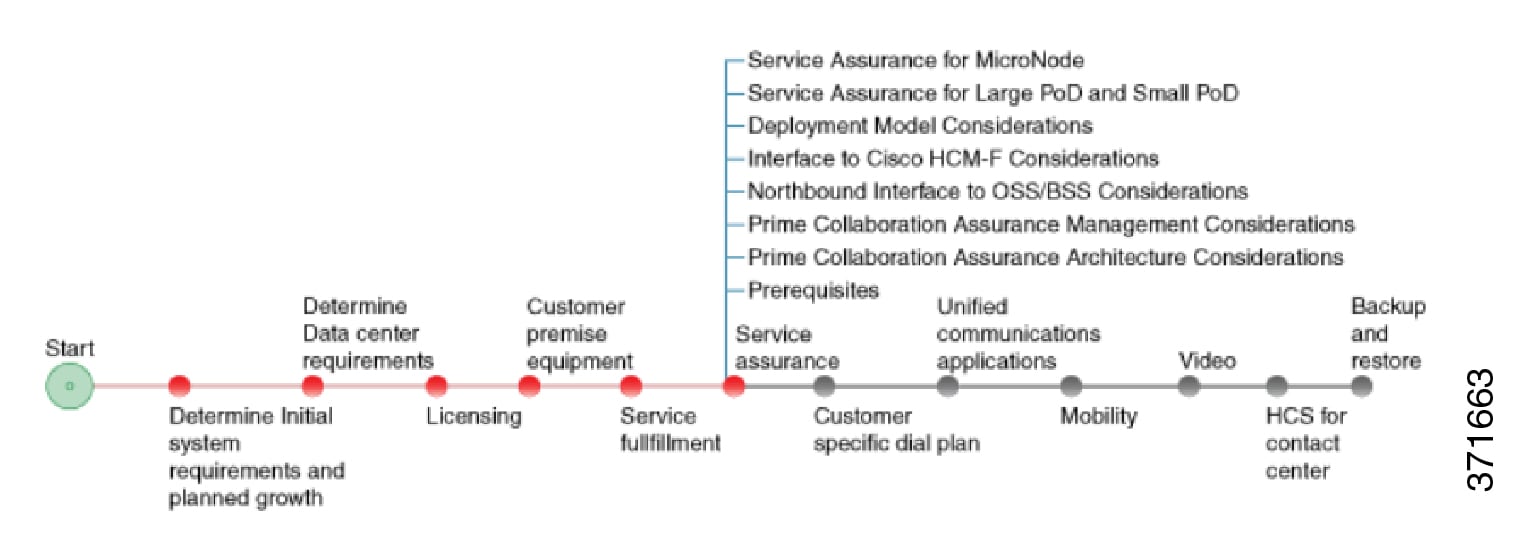
Prime Collaboration Assurance Workflow

Prime Collaboration Assurance Architecture Considerations

As you develop your plan for Prime Collaboration Assurance consider these key aspects :
  • Required interfaces to the Cisco Hosted Collaboration Fulfilment system.
  • Cisco Prime Collaboration Assurance NBI. Information on the Prime Collaboration Assurance northbound interfaces, and how to use them is available at: http://<pc-server-ip>/emsam/nbi/nbiDocumentation.
  • Service assurance management when using Cisco Prime Collaboration Assurance.

Prime Collaboration Assurance Management Considerations

Prime Collaboration Assurance helps you manage Cisco Hosted Collaboration Solution components. Features include:

  • Support for Unified Communications components including Cisco Unified CM, Unity Connection, and Cisco IM and Presence

  • End to end monitoring and real-time diagnostics

  • Multi-customer support in Prime Collaboration voice and video assurance

  • Customer summary dashboard for per customer summaries- devices and endpoints, alarms, video sessions with alarms, and voice calls with poor quality

  • Voice and Video assurance - Telepresence Exchange dashboard shows the health of TelePresence Hosted Infrastructure; CTX cluster, SBC, Conference Hardware, IVR, Regions, and Resource Pools

  • Full Contact Center View - dashboard and topology

Northbound Interface to OSS/BSS Considerations

The Northbound interface to OSS/BSS systems is a key aspect of service assurance as it provides an interface between Prime Collaboration Assurance and MSP systems such as trouble ticketing, and manager of managers (MoM). Its functions include delivering events to MSP systems regardless of the component or device manager from which the event originated. This includes:
  • The ability to integrate with a MoM to proactively notify operators of issues and facilitates rapid resolution of problems.
  • SNMP Traps integrate with existing MoM
  • MoM integration for trouble ticketing
In addition event correlation with alarms computed using:
  • Time-based correlation
  • Threshold-based correlation
  • Root cause correlation

Voice, Video, and Contact Center Correlation with Built-in rules for the most common use cases.

Custom Correlation relation rules feature:
  • The ability to configure correlation engine to generate events based on user defined criteria (for example selecting metrics and setting up violation rules based on an expected range of values).
  • The ability to add event correlation rules on-demand.

Interface to Cisco HCM-F Considerations

When planning, the relationship between service assurance and service fulfilment is a key relationship to consider. Key functions of this relationship are:
  • HCM-F through DMA-SA interacts with the Shared Data Repository (SDR) to a source of information about services, devices, and relationships used by Prime Collaboration Assurance.
  • HCM-F interacts directly with Prime Collaboration Assurance to provide information from SDR about users.
  • To monitor the Prime Collaboration Assurance device discovery process and to highlight any errors that take place during this discovery process.

Note

  • Information about devices added directly through the Prime Collaboration Assurance GUI will not be propagated back through HCM-F to the SDR and as a result HCS will not be aware of these devices.
  • Changes made in the Prime Collaboration Assurance GUI to an existing device may be overwritten by subsequent updates to the device from HCM-F.
  • Basic IP phones (non-Telepresence) are discovered and monitored directly by Prime Collaboration Assurance. TelePresence devices are configured in HCM-F and information about these devices is provided to Prime Collaboration Assurance through DMA-SA.

For information on the interface to between Prime Collaboration Assurance and HCM-F see the Cisco Hosted Collaboration Mediation Fulfillment Planning Guide.

Prime Collaboration Assurance for all Deployments

Prime Collaboration Assurance interacts with the service assurance domain manager (DMA-SA) on the Hosted Collaboration Mediation Fulfillment (HCM-F) system to collect information about customers, clusters, and applications. Cisco Prime Collaboration Assurance is a required component for all HCS deployments.

Planning considerations:

  • Prime Collaboration Assurance runs on any VMware-certified hardware with ESXi 4.1, 5.0, and 5.1 installed. Large and very large deployment models require ESXi 5.0 or later.

  • One virtual machine is required to install Prime Collaboration Assurance.

  • Northbound Interfaces are via Web Services API and SNMP gateway.

  • Use HCM-F for provisioning customers and devices.

  • Cisco recommends that Prime Collaboration Assurance be installed in the management VLAN.

  • Disable hyperthreading in the server (BIOS level) for better performance of Prime Collaboration. This is to avoid CPU-related issues that may occur when hyperthreading is enabled. See your hardware documentation for information about disabling hyperthreading.

  • vCPU speed depends on the UCS server or the virtualized hardware.

  • We do not support oversubscribing server parameters (not using a 1:1 ratio of physical to virtual resources), such as, vCPU and memory.


Note

  • The OVA defines configuration of the virtual machine that includes the CPU, memory, disk, and network resources.

  • We recommend that you install and run Prime Collaboration on Cisco Unified Computing System (UCS), which is VMware-certified.

  • Prime Collaboration Assurance allows you to configure a second NIC (network adapter). See the Cisco Hosted Collaboration Solution, Customer Onboarding Guide for details.


NAT Planning Considerations

In an HCS-LE deployment (single customer only), implementing a NAT between your management applications and Unified Communications applications is not required. Be aware that if a NAT is implemented in this scenario that the synthetic call feature will not be available.

Provisioning Considerations

When you are planning an HCS installation, provisioning is an important consideration. Determine if auto or manual provisioning will be used. Auto-provisioning of customers and services is available using HCM-F as opposed to manual provisioning.

For Cisco Prime Collaboration Assurance to monitor Unified Communications applications and customer equipment devices, these devices must be configured with event destinations (SNMP trap, syslog, or RTMT API) to the Prime Collaborations Assurance server. The Cisco HCS Provisioning Adapter (CHPA) service automatically configures event destinations on the Cisco Unified Communications Manager. You must manually set up other applications and devices to forward events to the Prime Collaboration Assurance server.

Acquire Prime Collaboration Assurance Licenses

As a part of service assurance planning, be sure to acquire the necessary Cisco Prime Collaboration Assurance license files. Prime Collaboration Assurance images are delivered using the Cisco electronic software delivery site and are delivered the same way as the Cisco Unified Communication Manager software. The licenses are also pulled from this site as a PAK to be registered to the PC server MAC.

This includes license for Prime Collaboration Analytics if you are using Prime Collaboration Assurance - Advanced 11.5 in MSP mode. For information on Cisco Prime Collaboration Analytics Licensing, see Cisco Prime Collaboration Analytics guide.

Licensing is ordered based on the endpoint type (Phone or Cisco TelePresence) and the quantity of those endpoints. The type of an endpoint determines which licenses you need, and the quantity of the endpoints determines the tier and number of licenses that you need to purchase to manage your network.
Determine Required Bandwidth

Bandwidth considerations are particularly relevant when considering a split data center with on-premise equipment. For more information on bandwidth considerations, see the Data center requirements chapter.