Cisco Silicon One Q200 and Q200L Processors Data Sheet
Available Languages
Bias-Free Language
The documentation set for this product strives to use bias-free language. For the purposes of this documentation set, bias-free is defined as language that does not imply discrimination based on age, disability, gender, racial identity, ethnic identity, sexual orientation, socioeconomic status, and intersectionality. Exceptions may be present in the documentation due to language that is hardcoded in the user interfaces of the product software, language used based on RFP documentation, or language that is used by a referenced third-party product. Learn more about how Cisco is using Inclusive Language.
The silicon industry has always been plagued with the trichotomy of switching silicon, routing line card silicon, and routing fabric silicon. Using these three basic building blocks, silicon and system vendors created unique architectures tuned for individual markets and industries. Consequentially, forcing customers to consume and manage these disjointed and dissimilar products caused an explosion in complexity, CapEx, and OpEx for the industry.
The Cisco Silicon One™ architecture ushers in a new era of networking, enabling one silicon architecture to address a broad market space, while simultaneously providing best-of-breed devices.
At 12.8 Tbps, the Cisco Silicon One Q200 builds on the ground-breaking technology of the Cisco Silicon One Q100 device, increasing the lead over all other routing silicon in the market. The Q200 is one of the highest bandwidth, highest performance, most flexible, and most power-efficient routing silicon on the market.
At 12.8 Tbps, the Cisco Silicon One Q200L extends the Cisco Silicon One family into the web-scale switching market offering one of industry’s highest performance, most flexible, and most power-efficient 12.8 Tbps switching silicon on the market.
The Cisco Silicon One Q200 processor is a 12.8-Tbps, full-duplex, routing processor with deep buffers, while the Q200L is a 12.8-Tbps, full-duplex, switching processor. These processors can be configured in one of the following modes:
● Q200
◦ 12.8-Tbps, full-duplex, standalone routing processor with deep buffers
◦ 6.4-Tbps, full-duplex line card routing processor with deep buffers
● Q200L
◦ 12.8-Tbps, full-duplex, standalone switching processor
◦ 12.8-Tbps, full-duplex fabric element
◦ 6.4-Tbps, full-duplex line card switching processor
Cisco Silicon One Q200 and Q200L can be used to build a wide range of products covering fixed form factor routers and switches, modular chassis routers and switches, and multipetabit disaggregated routers and switches.
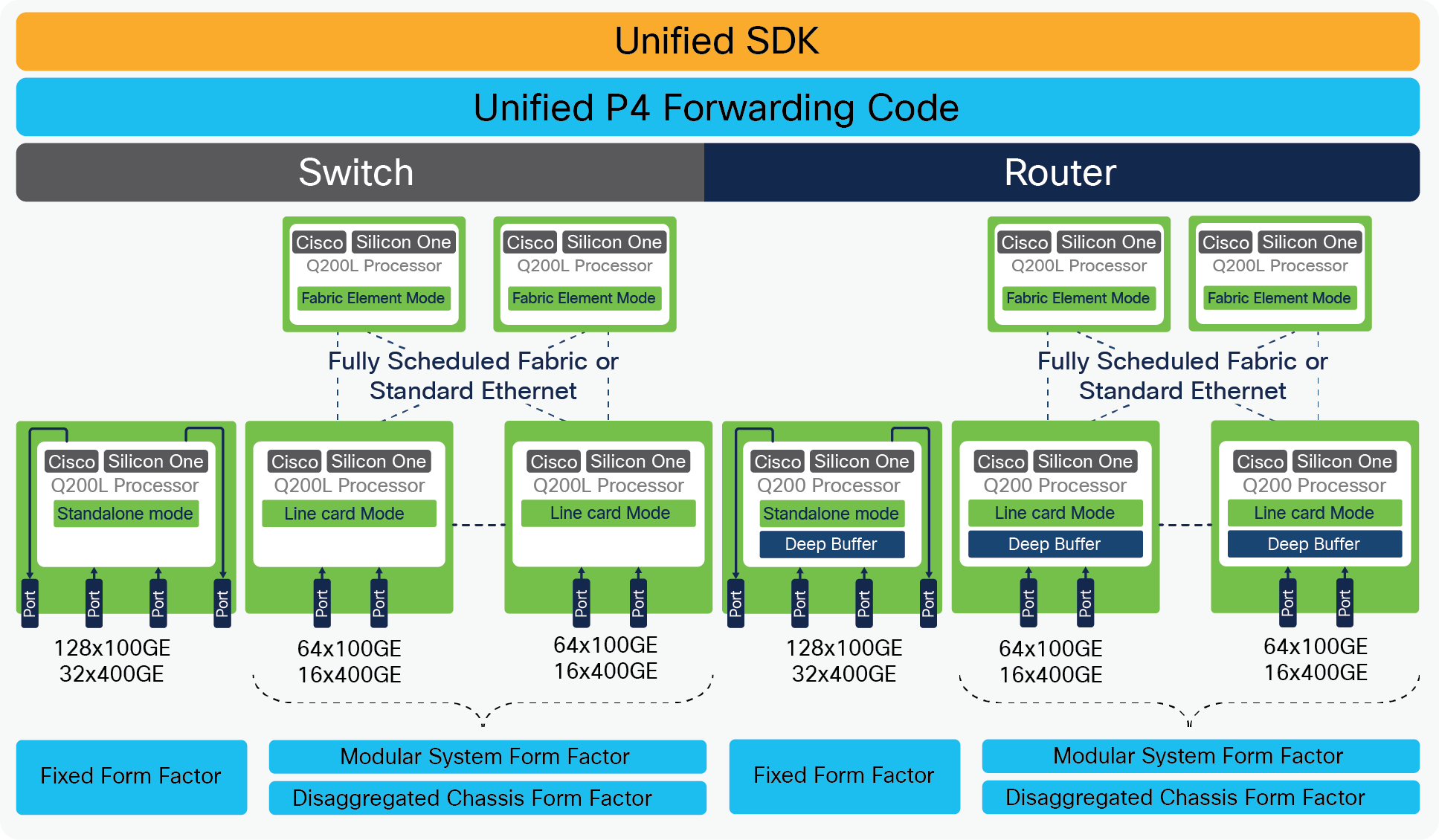
Form factors
Table 1. Architectural Characteristics and Benefits
| Feature |
Benefit |
|
| Unified architecture across multiple markets |
Greatly simplifies customer network infrastructure deployments |
|
| Unified SDK across market segments and applications |
Provides a consistent point of integration for all applications across the entire network infrastructure |
|
| High-bandwidth routing and fabric silicon |
7-nm, 12.8-Tbps routing, switching, and fabric silicon |
|
| High-performance routing and switching silicon |
Achieve line rate at small packet sizes |
|
| Power-efficient routing and switching silicon |
The power efficiency of 7 nm and the Cisco Silicon One architecture |
|
| Large and fully unified packet buffer |
Fully shared on-die buffer with optional, large external packet buffer |
|
| Switching efficiency with routing features and scale |
|
|
| Run-to-completion network processor |
Provides feature flexibility without compromising performance or power efficiency |
|
| P4 programmable |
Leverages an open-source programming language to enable customers to define their own features |
Flexibility, Performance, and Scale for Next-Generation Service Provider and Web-Scale Networks
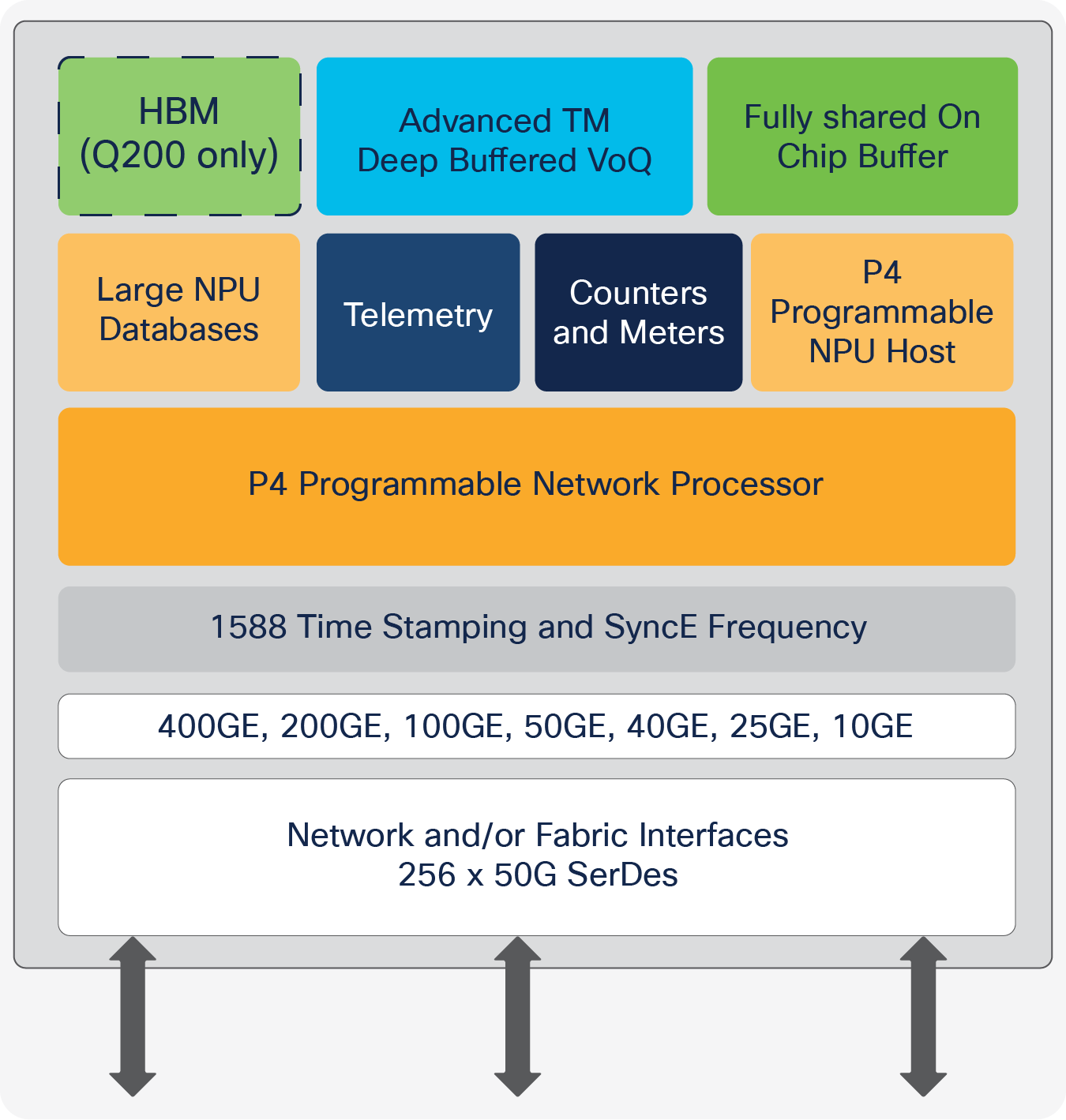
Block Diagram
Features
● 256 56G SerDes; each can be configured independently to operate in 10G/25G/50G using NRZ or PAM4 modulation
● Flexible port configuration supporting 10/25/40/50/100/200/400 Gbps
● Large, fully shared, on-die packet buffer
● Large, in-package packet buffer (Q200 only)
● 1588v2 and SyncE support with nanosecond-level accuracy
● On-chip, high-performance, P4-programmable host NPU for high-bandwidth offline packet processing (for example, OAM processing, MAC learning)
● Multiple embedded processors for CPU offloading
Traffic Management
● Large pool of configurable queues, supporting DiffServ and hierarchical QoS
● Support for system-level, end-to-end QoS and scheduling for both unicast and multicast traffic
● Seamless extension of on-die buffer to external packet buffer
● Support for ingress and egress traffic mirroring
● Support for link-level (IEEE802.3x), PFC priority-level (802.1Qbb) flow control and ECN Marking
● Support of port extenders
Network Processor
● Run-to-completion, P4-programmable network processor
● Line rate at very small packets even with complex packet processing
● Large and shared fungible tables
● Support for complex packet processing features without impacting data rate
● Support for simple packet processing features with optimized power and latency
Load Balancing
● Flow load balancing using ECMP or LAG
● Dynamic flowlet load balancing with ability to detect and handle elephant flows
● Packet-by-packet load balancing, creating an optimal, flow-independent, end-to-end scheduled and lossless fabric
Instrumentation and Telemetry
● Programmable meters used for traffic policing and coloring
● Programmable counters used for flow statistics and OAM loss measurements
● Programmable counters used for port utilization, microburst detection, delay measurements, flow tracking, elephant flow detection, and congestion tracking
● Traffic mirroring: (ER)SPAN on drop
● Support for sFlow and NetFlow
SDK
● APIs provided in both C++ and Python
● Configurability via high-level networking objects
● Distribution-independent Linux packaging
● Robust simulation environment enables rapid feature development
● CPU packet I/O through native Linux network interfaces
P4 Programmability
● Application development is handled by a P4-based IDE programming environment
● At compilation, the P4 application generates low-level register/memory access APIs and higher-level SDK Application APIs
● Provides application support for a wide range of data center, service provider, and enterprise protocols
● Modifications to the provided application can be easily accomplished using the provided P4 development environment
● Ability to develop the SDK and applications running over the SDK over a simulated Cisco Silicon One device
Cisco P4 Application
Due to Silicon One’s extensible P4 programming toolkit, we are always adding features to address new markets and new customer requirements; however, a sample of the features that are currently available with the P4 code is provided below:
|
◦ OSPF ◦ IS-IS ◦ BGP
● MPLS Forwarding
◦ LDP, LDPoTE ◦ RSVP-TE ◦ SR-MPLS ◦ SR-TE ◦ L3VPN, 6PE, 6VPE ◦ BGP LU ◦ VPWS/EoMPLS ◦ VPLS
● Ethernet Switching
◦ 802.1d, 802.1p, 802.1q, 802.1ad
● IP Tunneling
◦ IPinIP ◦ GRE ◦ VXLAN
● Integrated Routing and Bridging (IRB)
● HSRP/VRRP
● Policy-Based Routing
● Security and QoS ACLs
|
● ECMP and LAG (802.3ad)
● Multicast
◦ PIM-SM/SSM ◦ IGMP ◦ MLDP ◦ MVPN
● NAT/PAT
● Protection (Link/Node/Path and TI-LFA)
● QoS Classification and Marking
● Congestion Management
● Telemetry
◦ NetFlow, sFlow ◦ (ER)SPAN ◦ Packet Mirroring with Appended Metadata ◦ Lawful Intercept
● DDoS Mitigation
◦ Control-Plane Policing ◦ BGP Flowspec
● Timing and Frequency Synchronization
◦ SyncE ◦ 1588 |
Information about Cisco’s environmental, social, and governance (ESG) initiatives and performance is provided in Cisco’s CSR and sustainability reporting.
Table 2. Cisco Environmental Sustainability Information
| Sustainability Topic |
Reference |
|
| General |
Information on product-material-content laws and regulations |
|
| Information on electronic waste laws and regulations, including our products, batteries, and packaging |
||
| Information on product takeback and resuse program |
||
| Sustainability inquiries |
Contact: csr_inquiries@cisco.com |
|
| Material |
Product packaging weight and materials |
Contact: environment@cisco.com |
Learn more about the Cisco Silicon One