تكوين تسريبات VRF على IOS XE

المحتويات
المقدمة
يصف هذا المستند ويقدم مثالا لتكوينات الطرق الشائعة لتسريب المسارات للتوجيه الظاهري وإعادة التوجيه (VRF).
المتطلبات الأساسية
المتطلبات
توصي Cisco بأن تكون لديك معرفة بالمواضيع التالية:
- بروتوكول البوابة الحدودية (BGP)
- إعادة توزيع بروتوكول التوجيه
- VRF
- برنامج IOS® XE من Cisco
لمزيد من المعلومات حول هذه الموضوعات:
- إعادة توزيع بروتوكولات التوجيه
- مثال تكوين BGP وإعادة التوزيع المتبادل بين EIGRP
- فهم إعادة توزيع مسارات OSPF إلى BGP
المكونات المستخدمة
تستند المعلومات الواردة في هذا المستند إلى موجهات باستخدام الإصدارات 16.12.x و 17.x من Cisco IOS® XE
تم إنشاء المعلومات الواردة في هذا المستند من الأجهزة الموجودة في بيئة معملية خاصة. بدأت جميع الأجهزة المُستخدمة في هذا المستند بتكوين ممسوح (افتراضي). إذا كانت شبكتك قيد التشغيل، فتأكد من فهمك للتأثير المحتمل لأي أمر.
معلومات أساسية
يسمح VRF للموجه بالحفاظ على جداول توجيه منفصلة للشبكات الظاهرية المختلفة. عندما تكون هناك حاجة إلى إستثناءات، يتيح تسريب مسار التردد اللاسلكي (VRF) توجيه بعض حركة المرور بين شبكات VRF دون إستخدام المسارات الثابتة.
السيناريو 1 - تسريب مسار التردد اللاسلكي (VRF) بين BGP و IGP (EIGRP)
يزود سيناريو 1 مثال من VRF ممر يتسرب بين BGP و EIGRP. يمكن إستخدام هذه الطريقة لبروتوكولات العبارة الداخلية الأخرى.
الرسم التخطيطي للشبكة
يعرض الرسم التخطيطي للشبكة في الصورة 1 مخطط الطبقة 3 حيث تكون هناك حاجة إلى تسريب المسار.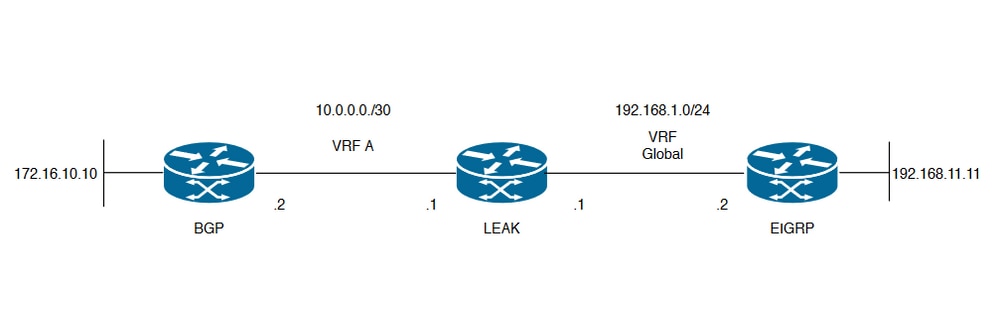
الصورة 1: مخطط تسريب المسار للسيناريو 1.
يشتمل تسريب الموجه على منطقة مجاورة لبروتوكول BGP في VRF A، وجارة لبروتوكول EIGRP في VRF العالمي. يجب أن يتصل الجهاز 192.168.11.11 بالجهاز 172.16.10.10 عبر الشبكة.
يتعذر على تسريب الموجه التوجيه بين الطريقتين نظرا لأن الموجهات في شبكات VRF مختلفة. تظهر جداول التوجيه هذه المسارات الحالية لكل VRF، وتشير إلى المسارات التي يجب تسريبها بين VRF العالمي و VRF A.
تسريب جداول التوجيه:
| جدول توجيه EIGRP (التوجيه العام) |
LEAK#show ip route
Codes: L - local, C - connected, S - static, R - RIP, M - mobile, B - BGP
D - EIGRP, EX - EIGRP external, O - OSPF, IA - OSPF inter area
N1 - OSPF NSSA external type 1, N2 - OSPF NSSA external type 2
E1 - OSPF external type 1, E2 - OSPF external type 2, m - OMP
n - NAT, Ni - NAT inside, No - NAT outside, Nd - NAT DIA
i - IS-IS, su - IS-IS summary, L1 - IS-IS level-1, L2 - IS-IS level-2
ia - IS-IS inter area, * - candidate default, U - per-user static route
H - NHRP, G - NHRP registered, g - NHRP registration summary
o - ODR, P - periodic downloaded static route, l - LISP
a - application route
+ - replicated route, % - next hop override, p - overrides from PfR

Gateway of last resort is not set

192.168.1.0/24 is variably subnetted, 2 subnets, 2 masks
C 192.168.1.0/24 is directly connected, GigabitEthernet2
L 192.168.1.1/32 is directly connected, GigabitEthernet2
192.168.11.0/32 is subnetted, 1 subnets
D 192.168.11.11 [90/130816] via 192.168.1.2, 02:30:29, GigabitEthernet2 >> Route to be exchange to the VRF A routing table.
| جدول توجيه VRF A |
LEAK#show ip route vrf A

Routing Table: A
Codes: L - local, C - connected, S - static, R - RIP, M - mobile, B - BGP
D - EIGRP, EX - EIGRP external, O - OSPF, IA - OSPF inter area
N1 - OSPF NSSA external type 1, N2 - OSPF NSSA external type 2
E1 - OSPF external type 1, E2 - OSPF external type 2, m - OMP
n - NAT, Ni - NAT inside, No - NAT outside, Nd - NAT DIA
i - IS-IS, su - IS-IS summary, L1 - IS-IS level-1, L2 - IS-IS level-2
ia - IS-IS inter area, * - candidate default, U - per-user static route
H - NHRP, G - NHRP registered, g - NHRP registration summary
o - ODR, P - periodic downloaded static route, l - LISP
a - application route
+ - replicated route, % - next hop override, p - overrides from PfR

Gateway of last resort is not set

10.0.0.0/8 is variably subnetted, 2 subnets, 2 masks
C 10.0.0.0/30 is directly connected, GigabitEthernet1
L 10.0.0.1/32 is directly connected, GigabitEthernet1
172.16.0.0/32 is subnetted, 1 subnets
B 172.16.10.10 [200/0] via 10.0.0.2, 01:47:58 >> Route to be exchange to the global routing table.
التكوين
أكمل الإجراءات لإنشاء التسريب بين جدولي التوجيه:
Step 1.
Create route-maps to filter the routes to be injected in both routing tables.

LEAK(config)#Route-map VRF_TO_EIGRP
LEAK(config-route-map)#match ip address prefix-list VRF_TO_EIGRP
LEAK(config-route-map)#exit
!
Prefix-list created to match the host that is attached to the previous route-map configured.
!
ip prefix-list VRF_TO_EIGRP permit 172.16.10.10/32

or

LEAK(config)#Route-map VRF_TO_EIGRP
LEAK(config-route-map)# match ip address 10
LEAK(config-route-map)#exit
!
ACL created to match the host that is attached to the previous route-map.
!
LEAK#show ip access-lists 10
10 permit 172.16.10.10

LEAK(config)#Route-map EIGRP_TO_VRF
LEAK(config-route-map)#match ip address prefix-list EIGRP_TO_VRF
LEAK(config-route-map)#exit
LEAK(config)#
!
Prefix-list created to match the host that is attached to the previous route-map configured.
!
ip  prefix-list EIGRP_TO_VRF  permit 192.168.11.11/32

or

LEAK(config)#Route-map EIGRP_TO_VRF
LEAK(config-route-map)#match ip address 20
LEAK(config-route-map)#exit
LEAK(config)#
!
ACL created to match the host that is attached to the previous route-map.
!
LEAK#show ip access-list 20
10 permit 192.168.11.11


Step 2.
Define the import/export maps and add the route-map names.

LEAK(config)#vrf definition A
LEAK(config-vrf)#address-family ipv4
LEAK(config-vrf-af)#import ipv4 unicast map EIGRP_TO_VRF >> Import the global routing table routes at the VRF routing table.
LEAK(config-vrf-af)#export ipv4 unicast map VRF_TO_EIGRP >> Export the VRF routes to the Global Routing Table.
LEAK(config-vrf-af)#end

Step 3.
Proceed with the dual redistribution.

Redistribute EIGRP

LEAK(config)#router bgp 1
LEAK(config-router)#redistribute eigrp 1
LEAK(config-router)#end

Redistribution BGP

LEAK(config)#router eigrp 1
LEAK(config-router)#redistribute bgp 1 metric 100 1 255 1 1500
LEAK(config-router)#end
التحقق من الصحة
Routing table from VRF A

LEAK#show ip route vrf A

Routing Table: A

< Snip for resume >

10.0.0.0/8 is variably subnetted, 2 subnets, 2 masks
C 10.0.0.0/30 is directly connected, GigabitEthernet1
L 10.0.0.1/32 is directly connected, GigabitEthernet1
172.16.0.0/32 is subnetted, 1 subnets
B 172.16.10.10 [200/0] via 10.0.0.2, 00:58:53
192.168.1.0/24 is variably subnetted, 2 subnets, 2 masks
B 192.168.1.0/24 is directly connected, 00:01:00, GigabitEthernet2
L 192.168.1.1/32 is directly connected, GigabitEthernet2
192.168.11.0/32 is subnetted, 1 subnets
B 192.168.11.11 [20/130816] via 192.168.1.2, 00:01:00, GigabitEthernet2 >> Route from global routing table at VRF A routing table.

Global Routing Table (EIGRP)

LEAK#show ip route

< snip for resume >

Gateway of last resort is not set

172.16.0.0/32 is subnetted, 1 subnets
B 172.16.10.10 [200/0] via 10.0.0.2 (A), 00:04:47  >> Route from VRF A at global routing table.
192.168.1.0/24 is variably subnetted, 2 subnets, 2 masks
C 192.168.1.0/24 is directly connected, GigabitEthernet2
L 192.168.1.1/32 is directly connected, GigabitEthernet2
192.168.11.0/32 is subnetted, 1 subnets
D 192.168.11.11 [90/130816] via 192.168.1.2, 01:03:35, GigabitEthernet2
LEAK#
السيناريو 2 - تسرب تردد الراديو (VRF) بين التردد اللاسلكي (أ) والتردد اللاسلكي (ب)
يصف السيناريو 2 التسرب بين إثنان VRFs مختلف.
الرسم التخطيطي للشبكة
يوثق هذا إستخدام إعداد الشبكة هذا:

الصورة 2: مخطط تسريب المسار للسيناريو 2.
يحتوي تسريب الموجه على علاقة جوار BGP مع أحد جيران VRF A، ويجب أن يتصل الجهاز 192.168.11.11 بالجهاز 172.16.10.10 عبر الشبكة، من أجل OSPF المجاور في VRF B.
يتعذر على تسريب الموجه التوجيه بين الطريقتين نظرا لأن الموجهات في شبكات VRF مختلفة. تظهر جداول التوجيه هذه المسارات الحالية لكل VRF، وتشير إلى المسارات التي يجب تسريبها بين VRF A و VRF B.
جدول توجيه التسريب:
| جدول توجيه VRF A |
LEAK#show ip route vrf A

Routing Table: A
Codes: L - local, C - connected, S - static, R - RIP, M - mobile, B - BGP
D - EIGRP, EX - EIGRP external, O - OSPF, IA - OSPF inter area
N1 - OSPF NSSA external type 1, N2 - OSPF NSSA external type 2
E1 - OSPF external type 1, E2 - OSPF external type 2, m - OMP
n - NAT, Ni - NAT inside, No - NAT outside, Nd - NAT DIA
i - IS-IS, su - IS-IS summary, L1 - IS-IS level-1, L2 - IS-IS level-2
ia - IS-IS inter area, * - candidate default, U - per-user static route
H - NHRP, G - NHRP registered, g - NHRP registration summary
o - ODR, P - periodic downloaded static route, l - LISP
a - application route
+ - replicated route, % - next hop override, p - overrides from PfR

Gateway of last resort is not set

10.0.0.0/8 is variably subnetted, 2 subnets, 2 masks
C 10.0.0.0/30 is directly connected, Ethernet0/0
L 10.0.0.2/32 is directly connected, Ethernet0/0
172.16.0.0/32 is subnetted, 1 subnets
B 172.16.10.10 [200/0] via 10.0.0.1, 00:03:08 >> Route to be exchange to routing table VRF B.
| جدول توجيه VRF B |
LEAK#show ip route vrf B

Routing Table: B
Codes: L - local, C - connected, S - static, R - RIP, M - mobile, B - BGP
D - EIGRP, EX - EIGRP external, O - OSPF, IA - OSPF inter area
N1 - OSPF NSSA external type 1, N2 - OSPF NSSA external type 2
E1 - OSPF external type 1, E2 - OSPF external type 2, m - OMP
n - NAT, Ni - NAT inside, No - NAT outside, Nd - NAT DIA
i - IS-IS, su - IS-IS summary, L1 - IS-IS level-1, L2 - IS-IS level-2
ia - IS-IS inter area, * - candidate default, U - per-user static route
H - NHRP, G - NHRP registered, g - NHRP registration summary
o - ODR, P - periodic downloaded static route, l - LISP
a - application route
+ - replicated route, % - next hop override, p - overrides from PfR

Gateway of last resort is not set

192.168.1.0/24 is variably subnetted, 2 subnets, 2 masks
C 192.168.1.0/24 is directly connected, Ethernet0/1
L 192.168.1.2/32 is directly connected, Ethernet0/1
192.168.11.0/32 is subnetted, 1 subnets
O 192.168.11.11 [110/11] via 192.168.1.1, 00:58:45, Ethernet0/1 >> Route to be exchange to routing table VRF A.
التكوين
أكمل هذه الإجراءات لإنشاء التسريب بين جدولي التوجيه:
Step 1.
Create route-maps to filter the routes to be injected in both routing tables.

LEAK(config)#Route-map VRFA_TO_VRFB
LEAK(config-route-map)#match ip address prefix-list VRFA_TO_VRFB
LEAK(config-route-map)#exit
!
Prefix-list created to match the host and IP segment that is attached to the previous route-map configured.
!
ip prefix-list VRFA_TO_VRFB permit 172.16.10.10/32
ip prefix-list VRFA_TO_VRFB permit 10.0.0.0/30

or

LEAK(config)#Route-map VRFA_TO_VRFB
LEAK(config-route-map)#match ip address 10
LEAK(config-route-map)#exit
!
ACL created to match the host and IP segment that is attached to the previous route-map.
!
LEAK#show ip access-lists 10
10 permit 172.16.10.10
20 permit 10.0.0.0


LEAK(config)#Route-map VRFB_TO_VRFA
LEAK(config-route-map)#match ip address prefix-list VRFB_TO_VRFA
LEAK(config-route-map)#exit
!
Prefix-list created to match the host and IP segment that is attached to the previous route-map configured.
!
ip prefix-list VRFB_TO_VRFA permit 192.168.11.11/32
ip prefix-list VRFB_TO_VRFA permit 192.168.1.0/24

or

LEAK(config)#Route-map VRFB_TO_VRFA
LEAK(config-route-map)#match ip address 20
LEAK(config-route-map)#exit
!
ACL created to match the host and IP segment that is attached to the previous route-map configured.
!
LEAK#show ip access-lists 20
10 permit 192.168.11.11
20 permit 192.168.1.0

Step 2.
At the VRFs configure the import/export map, use the route-map names to leak the routes.

LEAK(config)#vrf definition A
LEAK(config-vrf)#address-family ipv4
LEAK(config-vrf-af)#export map VRFA_TO_VRFB
LEAK(config-vrf-af)#import map VRFB_TO_VRFA


LEAK(config)#vrf definition B
LEAK(config-vrf)#address-family ipv4
LEAK(config-vrf-af)#export map VRFB_TO_VRFA
LEAK(config-vrf-af)#import map VRFA_TO_VRFB

Step 3.
Add the route-target to import and export the route distinguisher from both VRFs.

! --- Current configuration for VRF A

vrf definition A
rd 1:2
!
address-family ipv4
route-target export 1:2
route-target import 1:1
exit-address-family

! --- Current configuration from VRF B

vrf definition B
rd 2:2
!
address-family ipv4
exit-address-family

! --- Import the routes from VRF  B into VRF A

LEAK(config)#vrf definition A
LEAK(config-vrf)#address-family ipv4
LEAK(config-vrf-af)#route-target import 2:2

! --- Import routes from VRF A to VRF B and export routes from VRF B

LEAK(config-vrf-af)#vrf definition B
LEAK(config-vrf)#address-family ipv4
LEAK(config-vrf-af)#route-target import 1:2
LEAK(config-vrf-af)#route-target export 2:2
التحقق من الصحة
Check the Routing Tables

VRF A Routing Table

LEAK#show ip route vrf A

Routing Table: A

< Snip for resume >

10.0.0.0/8 is variably subnetted, 2 subnets, 2 masks
C 10.0.0.0/30 is directly connected, Ethernet0/0
L 10.0.0.2/32 is directly connected, Ethernet0/0
172.16.0.0/32 is subnetted, 1 subnets
B 172.16.10.10 [200/0] via 10.0.0.1, 00:07:20
192.168.1.0/24 is variably subnetted, 2 subnets, 2 masks
B 192.168.1.0/24 is directly connected, 00:00:10, Ethernet0/1
L 192.168.1.2/32 is directly connected, Ethernet0/1
192.168.11.0/32 is subnetted, 1 subnets
B 192.168.11.11 [20/11] via 192.168.1.1 (B), 00:00:10, Ethernet0/1 >> Route from VRF B routing table at VRF A.

VRF B Routing Table

LEAK#show ip route vrf B
Routing Table: B

< Snip for resume >

10.0.0.0/30 is subnetted, 1 subnets
B 10.0.0.0 [200/0] via 10.0.0.1 (A), 00:00:15
172.16.0.0/32 is subnetted, 1 subnets
B 172.16.10.10 [200/0] via 10.0.0.1 (A), 00:00:15 >> Route from VRF A routing table at VRF B.
192.168.1.0/24 is variably subnetted, 2 subnets, 2 masks
C 192.168.1.0/24 is directly connected, Ethernet0/1
L 192.168.1.2/32 is directly connected, Ethernet0/1
192.168.11.0/32 is subnetted, 1 subnets
O 192.168.11.11 [110/11] via 192.168.1.1, 01:05:12, Ethernet0/1
السيناريو 3 - تسرب التردد اللاسلكي بين بروتوكول فتح أقصر مسار أولا (OSPF) وبروتوكول EIGRP (العام) مع بروتوكول بوابة الحدود (BGP) (إختياري)
يصف السيناريو 3 تسريب المسار بين بروتوكولي IGPs (VRF B و VRF العالمية).
الرسم التخطيطي للشبكة
يستخدم هذا المستند إعداد الشبكة التالي:
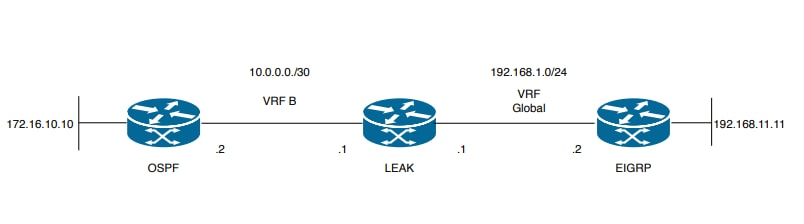
الصورة 3: مخطط تسريب المسار للسيناريو 3.
تشتمل عملية تسريب الموجه على منطقة مجاورة لبروتوكول فتح أقصر مسار أولا (OSPF) إلى أحد جيران بروتوكول VRF (ب) وأحد جيران بروتوكول EIGRP في إطار التردد اللاسلكي العالمي. يجب أن يتصل الجهاز 172.16.10.10 بالجهاز 192.168.11.11 عبر الشبكة.
يتعذر على تسريب الموجه الاتصال بهذين المضيفين. تظهر جداول التوجيه هذه المسارات الحالية لكل VRF، وتشير إلى المسارات التي يجب تسريبها بين VRF B و VRF العالمي.
جدول توجيه التسريب:
| جدول توجيه EIGRP (EIGRP) |
LEAK#show ip route
Codes: L - local, C - connected, S - static, R - RIP, M - mobile, B - BGP
D - EIGRP, EX - EIGRP external, O - OSPF, IA - OSPF inter area
N1 - OSPF NSSA external type 1, N2 - OSPF NSSA external type 2
E1 - OSPF external type 1, E2 - OSPF external type 2, m - OMP
n - NAT, Ni - NAT inside, No - NAT outside, Nd - NAT DIA
i - IS-IS, su - IS-IS summary, L1 - IS-IS level-1, L2 - IS-IS level-2
ia - IS-IS inter area, * - candidate default, U - per-user static route
H - NHRP, G - NHRP registered, g - NHRP registration summary
o - ODR, P - periodic downloaded static route, l - LISP
a - application route
+ - replicated route, % - next hop override, p - overrides from PfR

Gateway of last resort is not set

192.168.1.0/24 is variably subnetted, 2 subnets, 2 masks
C 192.168.1.0/24 is directly connected, Ethernet0/1
L 192.168.1.1/32 is directly connected, Ethernet0/1
192.168.11.0/32 is subnetted, 1 subnets
D 192.168.11.11 [90/1024640] via 192.168.1.2, 01:08:38, Ethernet0/1 >> Route to be exchange from global routing table at VRF B routing table.
| جدول توجيه VRF B (OSPF) |
LEAK#show ip route vrf B

Routing Table: B
Codes: L - local, C - connected, S - static, R - RIP, M - mobile, B - BGP
D - EIGRP, EX - EIGRP external, O - OSPF, IA - OSPF inter area
N1 - OSPF NSSA external type 1, N2 - OSPF NSSA external type 2
E1 - OSPF external type 1, E2 - OSPF external type 2, m - OMP
n - NAT, Ni - NAT inside, No - NAT outside, Nd - NAT DIA
i - IS-IS, su - IS-IS summary, L1 - IS-IS level-1, L2 - IS-IS level-2
ia - IS-IS inter area, * - candidate default, U - per-user static route
H - NHRP, G - NHRP registered, g - NHRP registration summary
o - ODR, P - periodic downloaded static route, l - LISP
a - application route
+ - replicated route, % - next hop override, p - overrides from PfR

Gateway of last resort is not set

10.0.0.0/8 is variably subnetted, 2 subnets, 2 masks
C 10.0.0.0/30 is directly connected, Ethernet0/0
L 10.0.0.2/32 is directly connected, Ethernet0/0
172.16.0.0/32 is subnetted, 1 subnets
O 172.16.10.10 [110/11] via 10.0.0.1, 01:43:45, Ethernet0/0 >> Route to be exchange from routing table VRF B at global routing table.
التكوين
أكمل هذا الإجراء لإنشاء التسريب بين جدولي التوجيه:
Step 1.
Create route-maps for import and export to be injected in both routing tables.

LEAK(config)#Route-map OSPF_TO_EIGRP
LEAK(config-route-map)#match ip address prefix-list OSPF_TO_EIGRP
LEAK(config-route-map)#exit
!
Prefix-list created to match the host that is attached to the previous route-map configured.
!
ip prefix-list OSPF_TO_EIGRP permit 172.16.10.10/32
ip prefix-list OSPF_TO_EIGRP permit 10.0.0.0/30

or

LEAK(config)#Route-map OSPF_TO_EIGRP
LEAK(config-route-map)#match ip address 10
LEAK(config-route-map)#exit
!
ACL created to match the host that is attached to the previous route-map.
!
LEAK#show ip access-lists 10
10 permit 172.16.10.10
20 permit 10.0.0.0

LEAK(config)#Route-map EIGRP_TO_OSPF
LEAK(config-route-map)#match ip address prefix-list EIGRP_TO_OSPF
LEAK(config-route-map)#exit
!
Prefix-list created to match the host that is attached to the previous route-map configured.
!
ip prefix-list EIGRP_TO_OSPF permit 192.168.11.11/32
ip prefix-list EIGRP_TO_OSPF permit 192.168.1.0/24

or

LEAK(config)#Route-map EIGRP_TO_OSPF
LEAK(config-route-map)#match ip address 20
LEAK(config-route-map)#exit
!
ACL created to match the host that is attached to the previous route-map.
!
LEAK#show ip access-lists 20
10 permit 192.168.11.11
20 permit 192.168.1.0/24

Step 2.
Add the import/export maps in order to match the route-map names.

Current configuration
!
vrf definition B
rd 1:2
!
address-family ipv4
exit-address-family
!
!
LEAK(config-vrf)#vrf definition B
LEAK(config-vrf)#address-family ipv4
LEAK(config-vrf-af)#import ipv4 unicast map EIGRP_TO_OSPF
LEAK(config-vrf-af)#export ipv4 unicast map OSPF_TO_EIGRP

Step 3.
To perform the leak is necessary to create a BGP process, in order to redistribute
the IGPs protocols.

router bgp 1
bgp log-neighbor-changes
!
address-family ipv4 vrf B >> Include the address-family to inject VRF B routing table (OSPF)
!
exit-address-family
Step 4.
Create a Dual Redistribution.

IGPs redistribution.

LEAK(config-router)#router bgp 1
LEAK(config-router)#redistribute eigrp 1
!
LEAK(config-router)#address-family ipv4 vrf B
LEAK(config-router-af)#redistribute ospf 1 match internal external 1 external 2
LEAK(config-router-af)#end

BGP Redistribution

LEAK(config)#router ospf 1 vrf B
LEAK(config-router)#redistribute bgp 1
!
LEAK(config-router)#router eigrp TAC
LEAK(config-router)#
LEAK(config-router)# address-family ipv4 unicast autonomous-system 1
LEAK(config-router-af)#
LEAK(config-router-af)# topology base
LEAK(config-router-af-topology)#redistribute bgp 1 metric 100 1 255 1 1500
التحقق من الصحة
تحقق من جداول التوجيه:
| جدول التوجيه العام |
LEAK#show ip route

< Snip for resume >

172.16.0.0/32 is subnetted, 1 subnets
B 172.16.10.10 [20/11] via 10.0.0.1, 00:14:48, Ethernet0/0 >> Route from VRF B routing table at global routing table ( EIGRP ).
192.168.1.0/24 is variably subnetted, 2 subnets, 2 masks
C 192.168.1.0/24 is directly connected, Ethernet0/1
L 192.168.1.1/32 is directly connected, Ethernet0/1
192.168.11.0/32 is subnetted, 1 subnets
D 192.168.11.11 [90/1024640] via 192.168.1.2, 02:16:51, Ethernet0/1
| جدول توجيه VRF B |
LEAK#show ip route vrf B
Routing Table: B

< Snip for resume >

10.0.0.0/8 is variably subnetted, 2 subnets, 2 masks
C 10.0.0.0/30 is directly connected, Ethernet0/0
L 10.0.0.2/32 is directly connected, Ethernet0/0
172.16.0.0/32 is subnetted, 1 subnets
O 172.16.10.10 [110/11] via 10.0.0.1, 00:34:25, Ethernet0/0
192.168.1.0/24 is variably subnetted, 2 subnets, 2 masks
B 192.168.1.0/24 is directly connected, 00:08:51, Ethernet0/1
L 192.168.1.1/32 is directly connected, Ethernet0/1
192.168.11.0/32 is subnetted, 1 subnets
B 192.168.11.11 [20/1024640] via 192.168.1.2, 00:08:51, Ethernet0/1 >> Route from global routing table ( EIGRP ) at VRF B routing table.
السيناريو 4 - تسرب المسار الافتراضي لبروتوكول VRF من OSPF إلى BGP
السيناريو 4 يقدم مثالا على تسرب المسار الافتراضي لبروتوكول VRF من OSPF إلى BGP.
الرسم التخطيطي للشبكة
يعرض الرسم التخطيطي للشبكة في الصورة 4 مخطط الطبقة 3 حيث تكون هناك حاجة إلى تسريب المسار الافتراضي.

الصورة 4: مخطط تسريب المسار للسيناريو 4
يتم تشغيل عملية OSPF و BGP في VRF مختلف على تسريب الموجه. المسار الافتراضي موجود في Router OSPF. يحتوي تسريب الموجه على منطقة مجاورة لبروتوكول BGP في VRF A مع موجه BGP، وواجهة OSPF في VRF B مع موجه OSPF.
يتم عرض تسريب الموجه الافتراضي من OSPF إلى BGP على تسريب الموجه داخل خطوة التكوين التالية.
التكوين
Step 1
Check if a static default route is present in Router OSPF.

OSPF#sh ip route

<output snipped>

Gateway of last resort is 192.168.10.2 to network 0.0.0.0

S* 0.0.0.0/0 [1/0] via 192.168.10.2   >>> default route is present in the routing table.
C 192.168.0.0/24 is directly connected, GigabitEthernet2
L 192.168.0.2/32 is directly connected, GigabitEthernet2
192.168.10.0/24 is variably subnetted, 2 subnets, 2 masks
C 192.168.10.0/24 is directly connected, GigabitEthernet1
L 192.168.10.1/32 is directly connected, GigabitEthernet1


Step 2
From the OSPF router, the default route needs to be advertised in OSPF to Router LEAK.

Use the command "default-information originate" on Router OSPF under OSPF process:( if there is static route in the OSPF router, routing table as verified in Step 1)


OSPF(config)#router ospf 1
OSPF(config-router)#default-information originate


If there is no static route in the Router OSPF routing table then we can generate and advertise a default route to the OSPF neighbour.


OSPF(config)#router ospf 1
OSPF(config-router)#default-information originate always

This forces the router to advertise a default route even if it doesn't have one in its routing table.


Step 3.1
Verify on Router LEAK, if an external OE2 route is installed in the VRF B routing table:

LEAK#sh ip route VRF B

Routing Table: B

<output snipped>

Gateway of last resort is 192.168.0.2 to network 0.0.0.0

O*E2 0.0.0.0/0 [110/1] via 192.168.0.2, 00:05:51, GigabitEthernet2 >>> OE2 route is installed in the VRF B routing table (This needs to be leaked in BGP)
192.168.0.0/24 is variably subnetted, 2 subnets, 2 masks
C 192.168.0.0/24 is directly connected, GigabitEthernet2
L 192.168.0.1/32 is directly connected, GigabitEthernet2

Step 3.2
Configure a prefix-list on Router LEAK

LEAK# conf t
LEAK(config)# ip prefix-list OSPF_TO_BGP seq 5 permit 0.0.0.0/0

Configure a route-map to match the prefix-list.

LEAK(config-route-map)#route-map OSPF_TO_BGP permit 10
LEAK(config-route-map)# match ip address prefix-list OSPF_TO_BGP
LEAK(config-route-map)#exit

Step 3.3
Verify on Router LEAK, that required VRFs , Route Distinguishers (RD) an Route Targets (RT) are configured.

LEAK(config)#vrf definition A
LEAK(config-vrf)#rd 1:1
LEAK(config-vrf)#address-family ipv4
LEAK(config-vrf-af)#route-target import 6500:1
LEAK(config-vrf-af)#exit-address-family
LEAK(config-vrf-af)#end
LEAK#

LEAK(config)#vrf definition B
LEAK(config-vrf)#rd 2:2
LEAK(config-vrf)#address-family ipv4
LEAK(config-vrf-af)#route-target export 6500:1
LEAK(config-vrf-af)#exit-address-family
LEAK(config-vrf-af)#end
LEAK#

Step 3.4
Configure import map in VRF A.

LEAK#conf t
LEAK(config)#vrf definition A
LEAK(config-vrf)#address-family ipv4
LEAK(config-vrf-af)#import map OSPF_TO_BGP
LEAK(config-vrf-af)#end
LEAK#


Step 3.5
Create an address family VRF B in the BGP configuration and advertise “0.0.0.0”

LEAK#sh run | sec bgp
redistribute bgp 6501
router bgp 6501
bgp router-id 10.0.0.1
bgp log-neighbor-changes
!
address-family ipv4 vrf A
neighbor 10.0.0.2 remote-as 6500
neighbor 10.0.0.2 activate
exit-address-family
!
address-family ipv4 vrf B
network 0.0.0.0
exit-address-family

ملاحظة: يعمل إنشاء عنوان VRF لعائلة داخل BGP دون تنشيط أي جار. إن إفراغ عملية بروتوكول BGP فقط ضروري لتسريب المسارات بين التردد اللاسلكي (VRF).
التحقق من الصحة
Verify the default route available in BGP.

LEAK#sh ip route vrf A

Routing Table: A

<output snipped>

Gateway of last resort is 192.168.0.2 to network 0.0.0.0

B* 0.0.0.0/0 [20/1] via 192.168.0.2 (B), 00:15:36, GigabitEthernet2 >>> Default route of VRF B routing table in VRF A routing table.
10.0.0.0/8 is variably subnetted, 2 subnets, 2 masks
C 10.0.0.0/24 is directly connected, GigabitEthernet1
L 10.0.0.1/32 is directly connected, GigabitEthernet1
موارد إضافية
محفوظات المراجعة
| المراجعة | تاريخ النشر | التعليقات |
|---|---|---|
5.0 |
08-Jun-2026
|
تحديث التدقيق الإملائي والنحوي وهيكل الجملة وصور النص البديل المحدثة |
4.0 |
16-Oct-2024
|
تنسيق محدث. |
3.0 |
12-Jan-2023
|
تعديل العنوان وتثبيت اسم مؤلف. تمت إعادة تسميته. |
2.0 |
26-Oct-2021
|
تعديل العنوان وتثبيت اسم مؤلف |
1.0 |
16-Dec-2020
|
الإصدار الأولي |
 التعليقات