Guest
Print-Friendly Version

Product Stewardship

Electronic Waste

"I was in business school with people from Oracle, Intel, and Sun Microsystems," he says. "When I told them that the SVP of Cisco operations had simply asked me, an entry-level manager, what kind of budget I needed, and how many people to address the problem, they were incredulous."

Josh Garrison, Worldwide Returns, Cisco

Read More

For the latest news and updates on Cisco's Product Stewardship efforts click here.

Rapid technological change means electrical and electronic products often have a short life. They may be kept for just a few years or even months before they are replaced or upgraded. Electrical and electronic goods are now one of the fastest growing sources of waste globally.

Much electronic waste (e-waste) ends up in landfill sites or is incinerated. This can have an impact on the environment if materials such as lead, mercury, or cadmium are allowed to contaminate soil and groundwater. Incinerating plastics can also contribute to air pollution.

The 1992 Basel Convention controls the disposal of hazardous materials, including e-waste. The European Union's Directive on Waste Electrical and Electronic Equipment (WEEE) establishes new requirements for the collection, treatment, recycling, and recovery of e-waste. By August 2005, European Union member countries were required to have introduced take-back systems in place for e-waste. Producers will be responsible for the collection and safe reuse and recycling of electronic equipment.

In the United States, California has passed legislation similar to the WEEE directive. Similar legislation has been introduced, or is pending in more than half of all U.S. states, and many other countries, including China, are preparing WEEE legislation.

Surplus Product Utilization and Reclamation

To address these challenges, Cisco has launched the Surplus Product Utilization and Reclamation (SPUR) program, a comprehensive program established to manage all e-waste throughout the company's worldwide operations, with the objective of reducing disposal and increasing reuse and recycling rates.

The SPUR team is working in partnership with the Cisco Energy Efficiency team to provide guidance and help business units build a closed-loop production model that seeks to reduce Cisco's impact on the environment.

SPUR maintains e-waste recycling bins at Cisco's largest facilities where employees can properly discard nonworking and obsolete equipment owned by Cisco. More remote Cisco sites will begin receiving bins in later stages of the program.

Cisco Resource Exchange and Disposal Online

One of SPUR's environmental stewardship initiatives is the Cisco Resource Exchange and Disposal Online (CREDO) which targets the internal reuse of equipment and products owned by Cisco.

The CREDO program functions much like a private online marketplace. Cisco departments advertise any idle equipment that might be of use to another department through a Web-based tool. This helps to ensure that all internal Cisco products are fully utilized rather than discarded, thus addressing the issue of reducing Cisco materials consumption, while tracking the assets movement within the company.

The CREDO tool also allows for quick reporting on cost-avoidance metrics, which will not only help each department reduce budget expense but also slow down the process of e-waste generation.

E-Waste Bins

SPUR maintains e-waste recycling bins at Cisco's largest facilities where employees can properly discard nonworking and obsolete Cisco owned equipment. More remote Cisco sites will begin receiving bins in later stages of the program. Any equipment that is usable is itemized and made available to all Cisco departments through CREDO. Anything that is not reusable is sent to an ISO14001-certified recycling vendor.

Product Take-Back and Recycle Initiatives

Cisco has developed a Customer Take-Back and Recycle Program that enables customers to send back end-of-life or excess Cisco equipment for proper demanufacturing, recycling, or disposal. As customers upgrade their networks, they are often left with surplus equipment. In some cases this could be hundreds or thousands of units. In FY2004 we completed our pilot program and launched a public Take-Back and Recycle Program through our Website. In FY2005, in compliance to the WEEE initiative we launched a worldwide consumer take-back program. Take-up usage is being monitored so the effectiveness of each program can be measured and modifications made as necessary.

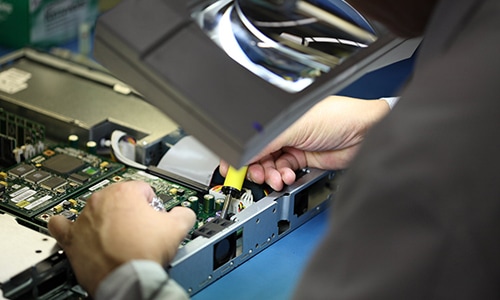
Equipment that is returned to Cisco through this program is recycled or disposed of in an environmentally responsible manner using processes that comply with the WEEE directive, all EPA guidelines, and environmental laws. All Cisco branded products are accepted under the program, and Cisco works with customers to dispose of competitor or other IT products. Priority is placed on reuse and recycling, with disposal as the last resort.

Cisco provides documentation about product disposition when the recycling process is complete. Upon request, Cisco also provides a Certificate of Destruction, which releases the customer from further liability for the equipment returned through the Take-Back and Recycle Program.

  • Desktop services/PC refresh: Used laptops and accessories are returned to a leasing company. If these assets are owned by Cisco, they are cleaned of data, posted on CREDO, and made available for internal reuse throughout Cisco. Ninety-nine percent of all eligible products are subject to reuse.
  • Contract manufacturer excess and obsolete parts and product: All excess and obsolete parts and product are collected from contract manufacturers by a vendor on Cisco's behalf. They are either sold to resellers as original parts, or, for those parts and products that cannot be sold, sent to an ISO14001 recycling vendor.
  • Damaged goods inventory: Through our service contracts, customer-returned products are sent to one of Cisco's Contract Repair Partners (CRPs). The majority of returned products are refurbished by the CRPs and redistributed around Cisco's 700 global service centers. As some customers elect to purchase new equipment, the inventory of refurbished goods at the CRPs gradually grows over time, resulting in an occasional requirement to reduce the stock in inventory. This is addressed by a central Cisco function which makes the newly warranteed, refurbished equipment available to a range of internal functions, including philanthropy and laboratories. We have regularly been able to save and reuse 25-40 percent of this inventory, giving it new life within the company and preventing it from going to an ISO14001 recycling vendor.

Performance

Since 2002 Cisco has sponsored various promotional events to help implement the SPUR initiative among its customer and employee base. Each November 15, (America Recycles Day), and April 22 (Earth Day), the SPUR team organizes an employee e-waste collection day at its San Jose headquarters and at its main campuses in the United States and five locations in Europe and Asia. Employees are asked to bring in any end-of-life electronic equipment from their offices, as well as any personal e-waste items. Each event on average collects more than 55,000 pounds, or 24.9 metric tons, of e-waste. The products are then reused or dismantled, and recycled.

The SPUR program collected a total of 6.7 million pounds of e-waste in FY2004. Of this, 1.4 percent was sent to landfill. In FY2005, the program increased the collection of e-waste to 8.6 million pounds, or 3,900 metric tons, with 1.3 percent sent to landfill.

Plans for FY2006

Our e-waste programs are at different stages of maturity. In FY2006, our primary focus will be to build on the existing base of programs and increase the global consistency, deployment, and regional effectiveness of these programs.