Cisco RF Gateway Downstream 48-1G Universal Edge QAM Line Card
Available Languages
Product Overview
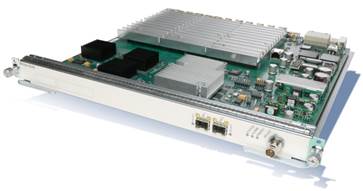
The Cisco® RF Gateway Downstream 48-1G Universal Edge QAM Line Card is a 12-port, 48-channel universal edge quadrature amplitude modulation (UEQAM) modulator designed for operation in the Cisco RF Gateway 10 platform. This line card is very similar in function to the standalone Cisco RF Gateway 1 Universal Edge QAM product, but the Cisco RF Gateway 10 can accommodate up 10x the density of the Cisco RF Gateway 1.
The Cisco RF Gateway Downstream 48-1G UEQAM line card offers concurrent support for standard and high-definition digital broadcast television, switched digital video (SDV), video-on-demand (VoD), and DOCSIS® modular cable modem termination system (M-CMTS™) services. Cable operators can choose to configure the line card as a DOCSIS only, video only, or DOCSIS and video shared universal edge QAM.
In the 10-slot Cisco RF Gateway 10 platform, RF Gateway Downstream 48-1G UEQAM line cards (Figure 1) can be configured with 1:N redundancy (up to 1:9), resulting in a fully protected, high-capacity, and highly dense edge QAM solution. For video services, the line cards can accept multiple formats of video content and provide a wide range of video processing features. Leading-edge RF technology is used to perform QAM modulation and RFupconversion, at significant space and power savings compared to existing upconverter architectures.
Applications
● Broadcast video
● SDV
● VoD
● Standard and high-definition digital video
● DOCSIS 3.0 and M-CMTS
Features and Benefits
Table 1 lists the features and benefits of the RF Gateway Downstream 48-1G UEQAM line card.
Table 1. Features and Benefits
| Feature |
Benefit |
| Video |
|
|
● Concurrent support for Digital Video Broadcast, SDV, and VoD
|
● Supports a very wide variety of video solution architectures
|
|
● Concurrent support for standard and high-definition services
|
● Achieves greater investment protection through the flexibility to evolve as service and capacity requirements change
|
|
● Concurrent support for multiple video encoding formats, including MPEG-2 and MPEG-4/H.264
|
● Can maximize QAM channel utilization
|
|
● Table-based and session-based edge QAM operation
|
● Helps ensure a smooth transition from current video system architectures to future video system architectures
|
| DOCSIS |
|
|
● Designed to meet CableLabs DOCSIS 3.0 and M-CMTS specifications
|
● Industry-recognized common specifications with tested multivendor interoperability
|
|
● Fully tested with the Cisco uBR10012 M-CMTS solution
|
● Full-featured and tested end-to-end M-CMTS solution offering stability, scalability, and availability
|
| Universal Edge QAM |
|
|
● Concurrent support for video and DOCSIS on the same line card
|
● Supports amortization of expenditure for video and DOCSIS edge QAM resources by sharing a common platform and universal edge QAM line card
|
|
● Standards-based universal edge QAM resource management
|
● Designed to support CableLabs defined universal edge QAM specification for multiple vendor interoperability
|
|
● Concurrent support for Annex A, B, and C operations on the same line card
|
● Can support mixed annex environments on the same line card with granularity per port (for example, Annex B for DOCSIS, Annex A for video)
|
|
● 48 QAM channels per line card, up to 10 line cards per RF Gateway 10 chassis (up to 480 QAMs per chassis)
|
● High-capacity edge QAM solution reduces the total number of devices to manage and provides more scalable management than multiple standalone edge QAMs
|
| High Availability |
|
|
● Supports high availability for universal edge QAM applications
|
● Industry’s first carrier-class edge QAM platform provides continuous service availability and reduces the duration of planned service outages
|
| Operations and Management |
|
|
● Software based on QNX microkernel-based real-time, high-performance operating system
|
● As in the Cisco Carrier Routing System 1 (CRS-1) series of products, QNX is the basis of the Cisco RF Gateway Downstream 48-1G EUQAM software architecture, providing a very stable, scalable, and efficient operating system
|
Product Specifications
Table 2 gives product specifications for the Cisco RF Gateway Downstream 48-1G EQAM line card. Table 3 lists system requirements.
Table 2. Product Specifications
| Specification |
Value |
| Hardware Specifications |
|
| Physical |
Occupies a single RF slot in the Cisco RF Gateway 10 chassis |
| RF ports |
12 RF ports with up to four contiguous QAM channels per port for a total of 48 QAMs |
| Dimensions |
1.28 x 15.35 x 15 in. (33 x 390 x 381 mm) (H x W x D) |
| Weight |
9.5 lb (4.32 kg) |
| Power consumption |
180W maximum (3.75W per QAM); 165W typical (3.44W per QAM) |
| Environmental |
● Operating altitude: -60 to 3000m
● Storage temperature: -40 to 158°F (-40 to 70°C)
● Operating temperature, nominal: 32 to 104°F (0 to 40°C)
● Operating relative humidity: 10 to 85%, noncondensing
|
| LEDs |
Status, alarm, traffic, Gigabit Ethernet (GE) port link, and activity |
| Ethernet Uplink Interfaces |
|
| Uplinks |
2 GE |
| Uplink optic types |
Small Form Factor Pluggable (SFP) GE |
| Small Form Factor Pluggables Supported |
|
| Gigabit Ethernet interfaces |
● SFP-GE-T
● SFP-GE-S
● SFP-GE-L
|
| Video Specifications |
|
| Video format |
● MPEG-2 SPTS and MPTS encapsulated in UDP/IP (RFC-768)
● Up to seven 188-byte MPEG-2 packets per UDP datagram
● MPEG-2 and MPEG-4/H.264 content
● Standard and high definition
● CBR and VBR
|
| Video processing |
● PID remapping
● PCR restamping
● PSI extraction, generation, and insertion
● Dejitter (up to 200 ms)
● MPTS passthrough
● Stream replication
● Session statistics
|
| Video redundancy |
● Redundant source failover
● Link redundancy
|
| Video monitoring |
● ASI video monitor port
● BNC-type connector
● Monitor any output MPTS
|
| Multicast |
● IP multicast routing protocols: Protocol Independent Multicast (PIM), including sparse mode and dense mode
● Source Specific Multicast (SSM) and Any-Source Multicast (ASM)
● Internet Group Management Protocol (IGMP)
|
| Dejitter buffering |
200 ms, configurable |
| TS bit rate |
VBR and CBR |
| ASI monitor port |
BNC type connector |
| Signaling mode |
● Table-based or session-based functionality
● Support for up to 1440 streams
|
| Maximum unique video multicast sessions |
2048 load balanced |
| DOCSIS Specifications |
|
| CableLabs specifications supported |
● Downstream RF Interface (DRFI) CM-SP-DRFI
● Downstream External PHY Interface (DEPI)
● DOCSIS Timing Interface (DTI)
● M-CMTS Operations Support System Interface (OSSI)
|
| RF Specifications |
|
| Channel encoding |
Randomization, Reed-Solomon, trellis encoding, and interleaving configurable to ITU-T J.83 Annex A, B, or C |
| QAM constellations |
64 and 256 QAM |
| QAM stacking |
Contiguous, quad-stacked QAM channel block |
| Symbol rate |
3.5 Msym per second to 7 Msym per second |
| Bits per symbol |
6 bits per symbol and 8 bits per symbol |
| Frequency plan |
HRC, IRC, and STD |
| Center frequency range |
57 to 999 MHz |
| Step size |
1 kHz |
| Channel spacing |
6 MHz and 8 MHz |
| MER (unequalized and equalized) |
≥35 dB and ≥43 dB (at RF) |
| Output impedance |
75 ohms |
| Return loss |
● >14 dB: 45-750 MHz
● >13 dB: 750-870 MHz
● >12 dB: 870-1000 MHz
|
| Channel power - 1-channel mode (single QAM stacking) |
+61 dBmV RMS maximum per QAM channel in 0.2 dB steps |
| Channel power - 2-channel mode (dual QAM stacking) |
+57 dBmV RMS maximum per QAM channel in 0.2 dB steps |
| Channel power - 4-channel mode (quad QAM stacking) |
+53 dBmV RMS maximum per QAM channel in 0.2 dB steps |
| Power accuracy |
± 2 dB |
| Channel power delta in 4-QAM block |
<1 dB |
| RF channel muting |
≥73 dB |
| Phase noise |
● 1 KHz-10 KHz: 33 dBc double sideband
● 10 KHz-50 KHz: 51 dBc double sideband
● 50 KHz-3MHz: 51 dBc double sideband
|
| Out-of-band noise and spurious emissions |
● -60 dBc or better
|
| Stability |
± 3 ppm |
Table 3. System Requirements
| Specification |
Value |
| Chassis compatibility |
Cisco RFGW-10 |
| Software |
Cisco IOS® Software version 12.2(50)SQ1 |
Regulatory Compliance
Table 4 provides information about regulatory compliance.
Table 4. Regulatory Compliance
| Specification |
Value |
| Network Equipment Building Standards (NEBS) and European Telecommunications Standards Institute (ETSI) |
UL 60950CAN/CSA-C22.2 No. 60950, EN 60950, IEC 60950, TS 001, AS/NZS 3260 |
| Electromagnetic compatibility (EMC) |
FCC Part 15 (CFR 47) Class A, ICES-003 Class A, EN55022 Class A, AS/NZS CISPR22 Class A, AS/NZS 3548 Class A, VCCI Class A, ETS 300 386, EN 55022, KN22, EN 61000-3-2, EN 61000-3-3 |
| Electromagnetic interference (EMI) |
EN550082-1, EN55024, EN61000-4-2, EN61000-4-3, EN61000-4-5, EN61000-4-6, EN61000-4-8, EN61000-4-11, EN61000-6-1 |
| Safety |
GR-1089-Core Level 3, ETS 300 019 Storage Class 1.1, ETS 300 019 Transportation Class 2.3 (pending), ETS 300 019 Stationary Use Class 3.1, ETS 300 386 |
| Industry EMC, safety, and environmental standards |
Designed to meet NEBS standard GR-63-CORE and GR-1089-CORE |
| Other industry standards |
Cisco corporate compliance standards |
Ordering Information
Table 5 lists ordering information. To place an order, visit the Cisco Ordering Homepage. To download software, visit the Cisco Software Center.
Table 5. Ordering Information for the Cisco RF Gateway Downstream 48-1G UEQAM Line Card
| Product Name and ID |
Product Description |
| Cisco RF Gateway Series Line Cards |
|
| RFGW-DS48-1G |
RFGW Universal Downstream Universal Edge QAM Card, 12 RF ports, 48 QAMs |
| RFGW-DS48-1G= |
RFGW Universal Downstream Universal Edge QAM Card, 12 RF ports, 48 QAMs spare |
| Cisco RF Gateway Series Transceiver Modules |
|
| SFP-GE-T |
1000BASE-T SFP (NEBS 3 ESD) (100 m on Cat5 UTP) |
| SFP-GE-S |
1000BASE-SX short wavelength, with DOM (550m on MMF) |
| SFP-GE-L |
1000BASE-LX/LH short wavelength, with DOM (10 km on SMF) |
| Cisco RF Gateway Series Accessories |
|
| RFGW-LC-COVER |
RFGW line card cover |
| RFGW-LC-COVER= |
RFGW line card cover spare |
Service and Support
Using the Cisco lifecycle services approach, Cisco and its partners provide a broad portfolio of end-to-end services and support that can help increase your network’s business value and return on investment. This approach defines the minimum set of activities needed, by technology and by network complexity, to help you successfully deploy and operate Cisco technologies and optimize their performance throughout the lifecycle of your network.
For More Information
For more information about the Cisco RF Gateway series, visit http://www.cisco.com/en/US/products/ps8360/index.html or contact your local account representative.
 Feedback